Friday mystery object #227 answer

On Friday I asked you to spot the differences between these two cat skulls and I wondered whether anyone could identify them:

mystery227

Both henstridgesj and Allen Hazen made some good observations, the first being about the difference in size, then about morphological features that I’ve marked on this image:

comparing_cats

Now henstridgesj also correctly identified one of the skulls – the one on the right of the image is from a Domestic Cat Felis catus Linnaeus, 1758.

As it turns out, this was a bit of a trick mystery object, since BOTH of the skulls belong to Domestic Cats, so this gives us a useful idea of the kind of variation we might expect within a species.

I think that the main cause of variation between these two animals is probably sex, with the male on the left and the female on the right. There may also be differences based on age (although I don’t think that’s a major factor), breed and perhaps disease (the larger specimen looks like it had an infection that affected the surface of the bone).

After taking various measurements, the most useful difference I’ve found between the two skulls is shown with the yellow line. I think that the ratio of these two measurements may provide a way to tell the difference between a male and female cat (in the male it’s around 1 or less than 1, in the female it’s greater than 1) but I’ll need to make a LOT more measurements to test this.

Two other ideas that could be tested were suggested by henstridgesj and Allen Hazen. Allen said: “My impression is that the presence and development of sagital crests, among felidae, correlates pretty strictly with size” and henstridges said: “It seems that if the species of cats are arranged in increasing size order, then the anterior half of the skull (forward of the frontal-parietal suture) seems to increase in size more than the posterior half”.

I’d better take a look to see if this has been tested before…
Friday mystery object #226 answer

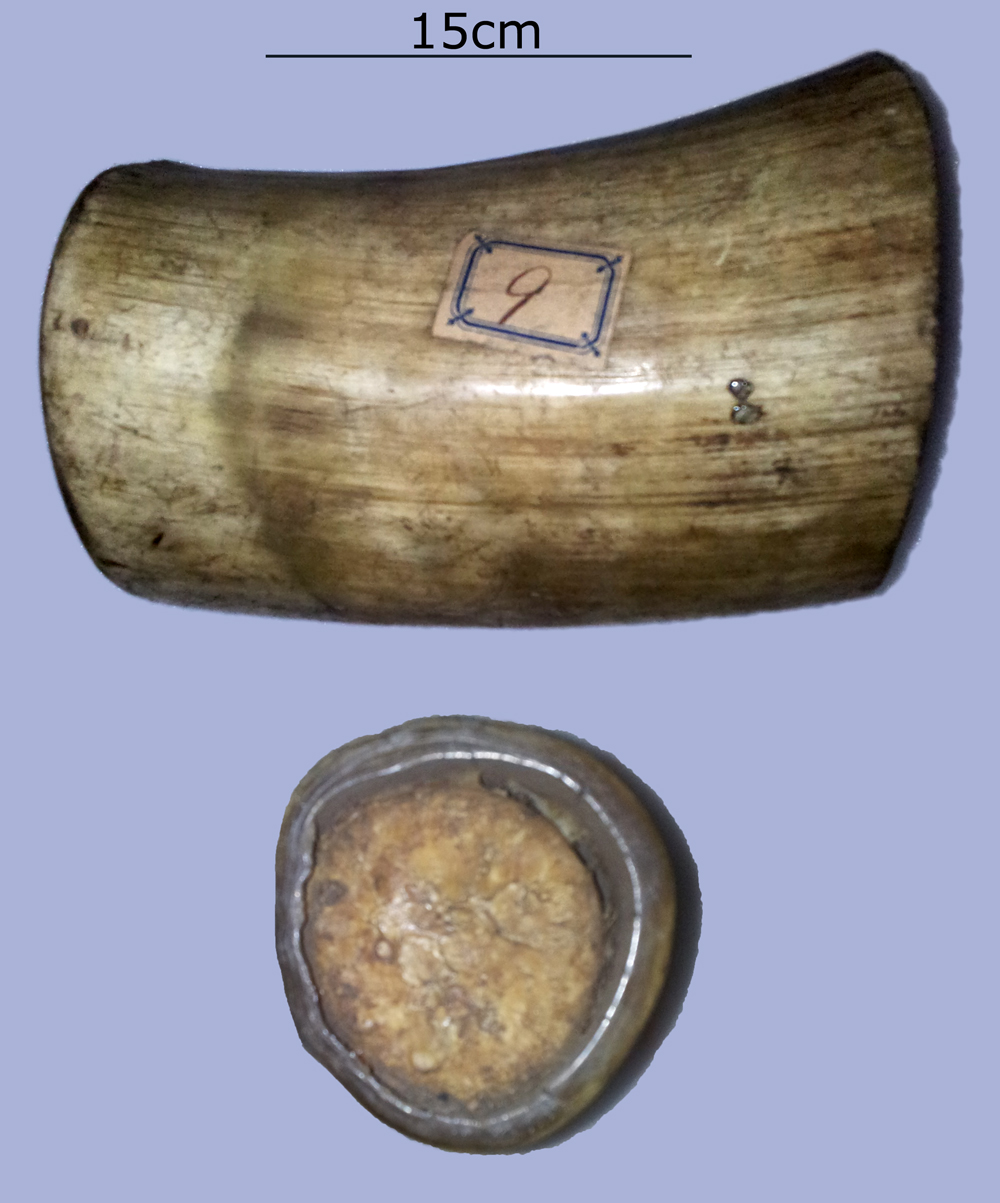
Last week I gave you this rough and ready mystery object to identify:

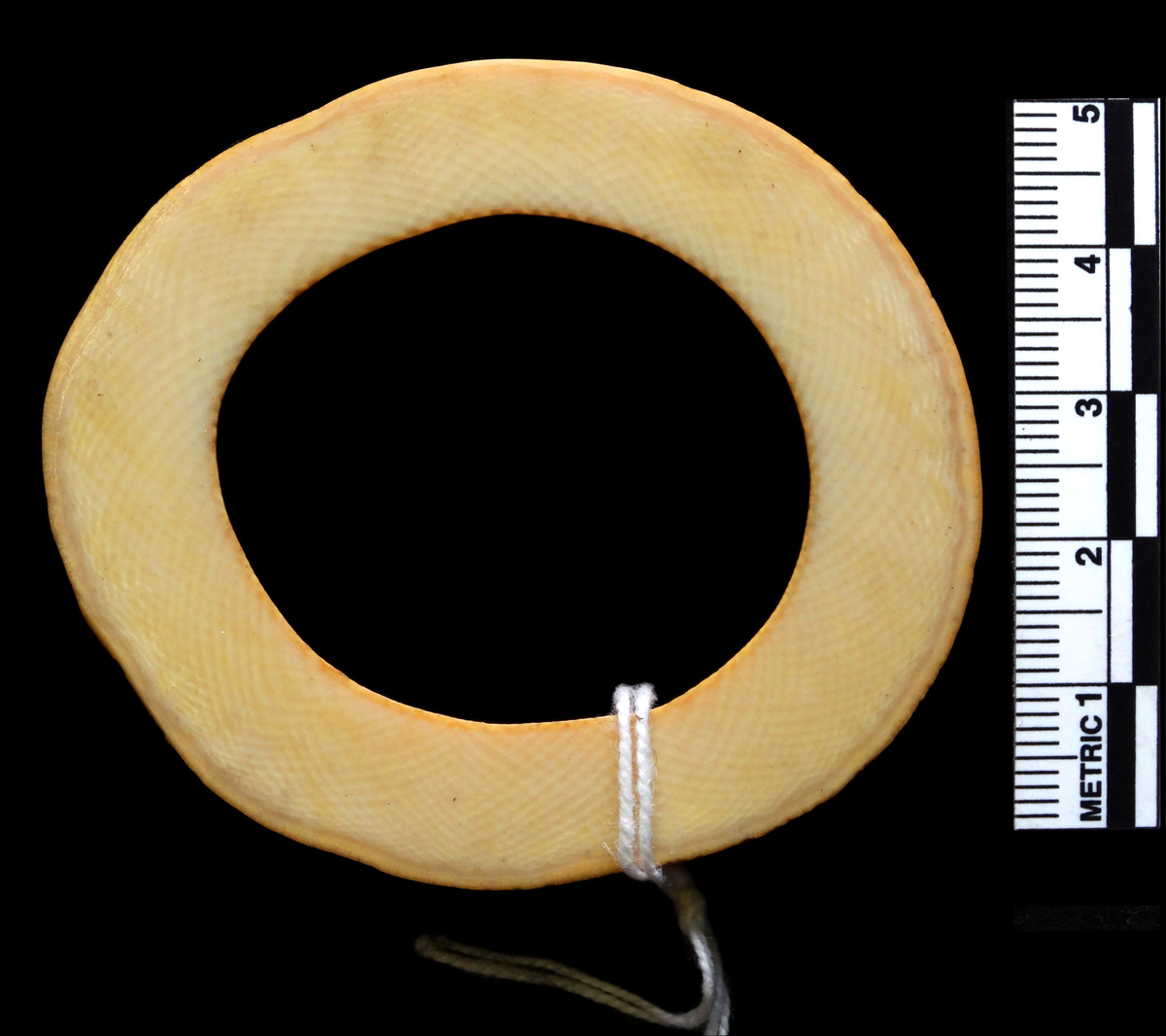
mystery226

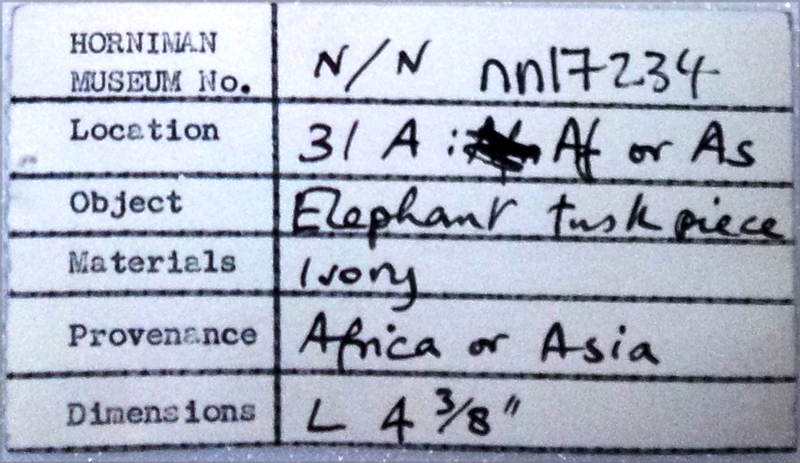
I thought it might be a bit of a challenge as it had originally been misidentified as a piece of elephant tusk by someone in the museum, many years ago, so it was obviously not a straight-forward identification.

mystery226-label


One of the key identifying characteristics of ivory are the Schreger lines, as pointed out by Carlos and rachel. These lines are an optical effect caused by light interacting with the dentinal tubules that provide the structure of the tusk:

Schreger_lines

Tusk section showing Schreger lines

However, these lines aren’t always visible and it will depend on the angle of the cut of the tusk and the angle and intensity of the light.

Another factor to keep in mind is the nature of the material. If you look at a cut section of elephant tusk you note that you get clean edges, because the tusk is quite hard and keeps its structure when cut. It can also show faint growth rings, radiating from the pulp cavity (nearer the tip the cavity is filled in):

elephant_tusk_section

Section of elephant tusk showing clean edges

Instead, the mystery object has a very rounded edge and no clear structure. This suggests to me that it’s horn that has been treated with heat to mould it into shape (keratin that makes horn and hair has thermoplastic properties, which is why hair straighteners work).

So what this mystery object appears to be is a piece of bovine horn – probably cow – that has been melted and shaped at one end to form a cup. The superficial similarity to elephant tusk may or may not have been accidental, after all, elephant ivory is a much sought after material.


Friday mystery object #225 answer

Last Friday I gave you this felid skull to identify:

mystery225

As with the other cats over the last few weeks, it’s been difficult to find really clear diagnostic features.

The size helps narrow down the possibilities and the lack of divided auditory bullae rules out some of the species of Lynx, as does the presence of the small first premolar.

However, beyond that there isn’t much to really differentiate this cat from other species, apart from general features of relative proportion (height vs width vs length) and perhaps the angle of the rear part of the sagittal crest (which will probably vary between individuals).

Nonetheless, henstridgesj managed to correctly identify this as an Ocelot Leopardus pardalis (Linnaeus, 1758), one of the largest of the small cats in South America.

Ocelot, 2003 from US Fish & Wildlife Service, Image Archive

My challenge is going to be find a way to pull together the variety of cat skulls we’ve had for the last few weeks, to help make cat skulls a little easier to identify in the future – if that’s even possible. No pressure…

Friday mystery object #224 answer

Last Friday I gave you this felid skull to have a go at identifying:

mystery224

The size was larger than the previous cat skulls I’ve shown you, which helped reduce the possibilities a bit – after all, there are more smaller cats than bigger ones.

As it turns out, Sam Misan and henstridgesj both managed to work out that this is the skull of a Serval Leptailurus serval (Schreber, 1776).

A Serval cat at Serengeti National Park, Tanzania, by Bob, 2007

A Serval cat at Serengeti National Park, Tanzania, by Bob, 2007

These long-legged cats have a relatively small head, but huge ears – and the large external auditory meatus (ear hole) with a very pronounced ridge above for attachment of the muscles of the pinna (the fleshy part of the ear) helps reflect that.

The long legs and the big ears are key to the Serval’s hunting technique in the long grasses of the African savannah, where they listen for the movement of rodents which they dramatically leap on. Probably easier to appreciate this method by seeing it:

Friday mystery object #223 answer

Last Friday I gave you this fine feline to have a go at identifying:

mystery223

I was a little suspicious of the identification attached to the specimen, but Al Klein suggested the same species – the Jaguarundi Puma yagouaroundi (É. Geoffroy Saint-Hilaire, 1803) [link opens pdf].

My reasons for suspicion were the nature of the post-orbital constriction (the narrowing of the braincase behind the eyes), the nature of the zygomaticotemporal suture between the temporal process of the zygomatic and the zygomatic process of the temporal bone (the bit where two bones meet to make the arch of the cheek) and the shape of the nasal bones where they meet the frontals (the V shaped bones above the nose area).

The observation by henstridgesj that the skull was similar to the previous mystery object (Leopardus tigrinus) was a good one, so I decided to research the genus Leopardus in a bit more detail, to see if there was a better match.

It turns out that the skull I found that matched this one most closely – especially with regard to the relative lack of a post-orbital constriction and the nasal-frontal junction – was the highly arboreal Margay Leopardus wiedii (Schinz, 1821) [link opens pdf].

Margay - Leopardus wiedii, Summit Municipal Parque, Panama. By Brian Gratwicke.

I’m always a bit reticent to re-identify specimens that have original labels from the supplier attached as this one does, but this comes from suppliers (Dr.s Schlüter & Mass) that I know have seriously misidentified or mislabelled specimens in the past (e.g. labelling a African Lappet-faced Vulture as an Andean Condor from Bolivia).

Of course, the real identification may be even more complicated, since the South American cats have a bit of a track record for hybridising to the point of masking distinct species, so any identification I make will be laden with disclaimers and caveats. The joy of real-world animals when contrasted against nice simple biological concepts…

Friday mystery object #218 answer

Last Friday I gave you this skull to identify:

mystery218

There was strong consensus on this being a mustelid – which is good, because that’s what it is. There was also good agreement on it being one of the Martens, which is where things become a bit more difficult.

After looking at a lot of different Marten skulls online without much success in finding a way of telling them apart, this diagram  proved quite helpful.

Images compiled by Mariomassone

Skulls in the sequence: M. zibellina, M. martes, M. foina

If you look at the skull in the middle of the top and centre rows, the auditory bullae (the rounded bones under the skull that house the anatomy used in hearing) have quite distinctive shapes in the three species pictured.

In addition, the the little nub of bone (called the mastoid process) that sticks out behind the ear hole (or external auditory meatus as it’s also known) is very differently developed in the three species. Looking at this character and checking back against other Marten skulls online the clues suggested that the mystery object is the skull of a Pine Marten Martes martes (Linnaeus, 1758).

So well done to everyone who commented – particularly Jake who got the ball rolling with a Martes identification from the start!

Friday mystery object #217 answer

Last Friday I gave you this lovely skull to identify:

mystery217

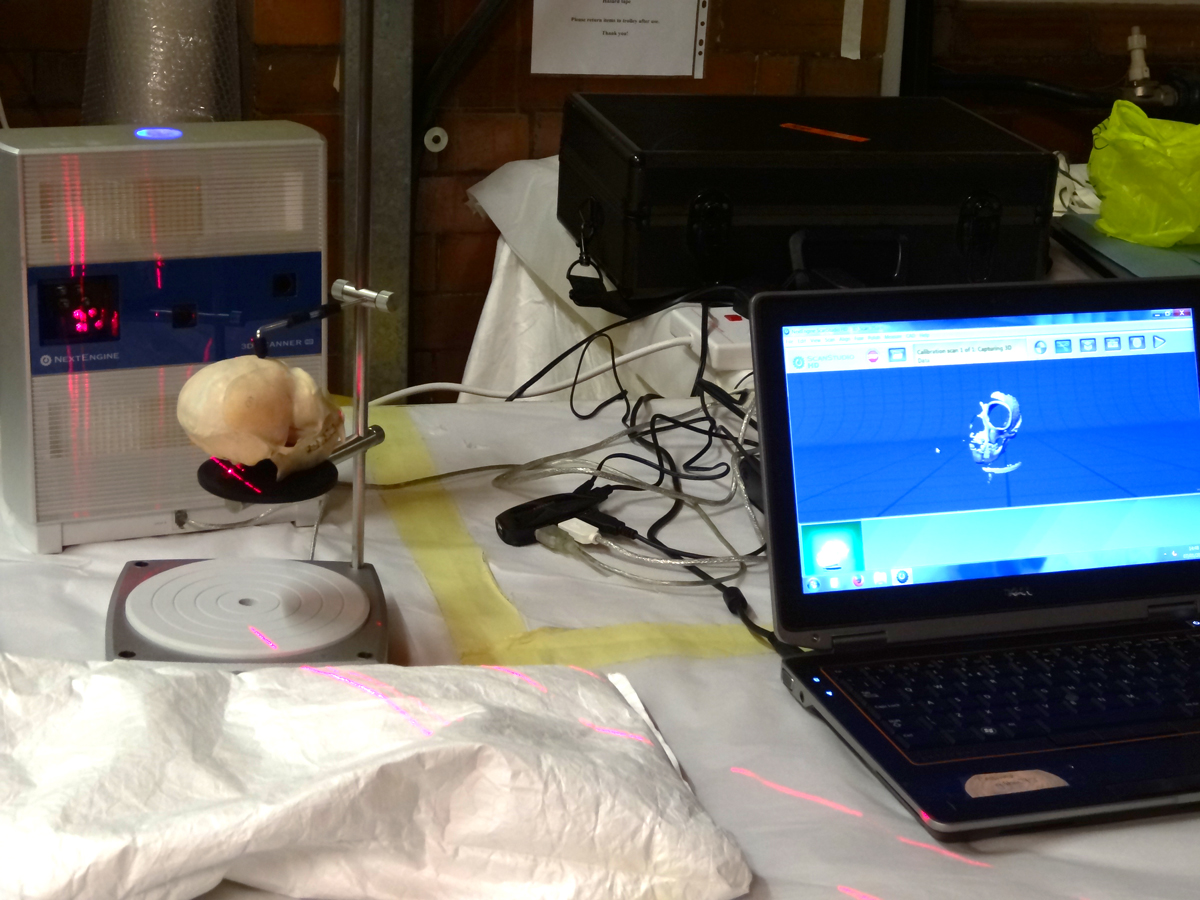
I chose it because it was being used for an interesting project by a student at UCL, involving 3D surface laser scanning of the specimen to identify landmark characters of the skeletal structure of the faces of this family of primates:

mystery217scan

This is a specimen that we actually have a fair amount of information about. It’s a male Grey Gibbon Hylobates muelleri Martin, 1841 collected before 1909, from Melian on the Hanta River in North Borneo. So of all the suggestions, Crispin (@brainketchup) was the closest (with agreement from henstridgesj) when he suggested White-handed Gibbon.

It turns out that this skull also has a taxidermy skin associated with it (which Jake has mentioned before), which shows a common feature of taxidermy specimens where the skull has been prepared separately – it’s mouth is stitched shut:

GreyGibbon

This makes for slightly dodgy taxidermy, but at least it means the skull is available for future research, instead of being stuck in a specimen intended mainly for display.

The skin of this specimen has also seen recent use, but for art rather than science. Artist Paul Robinson has used it as the basis of this somewhat freaky, but striking piece of work:

GIBBON by Paul Robinson

GIBBON by Paul Robinson

It goes to show that specimens in museums can find themselves being used in all sorts of interesting ways. To my mind this is really what museum collections are for – being used by people.

Friday mystery object #216 answer

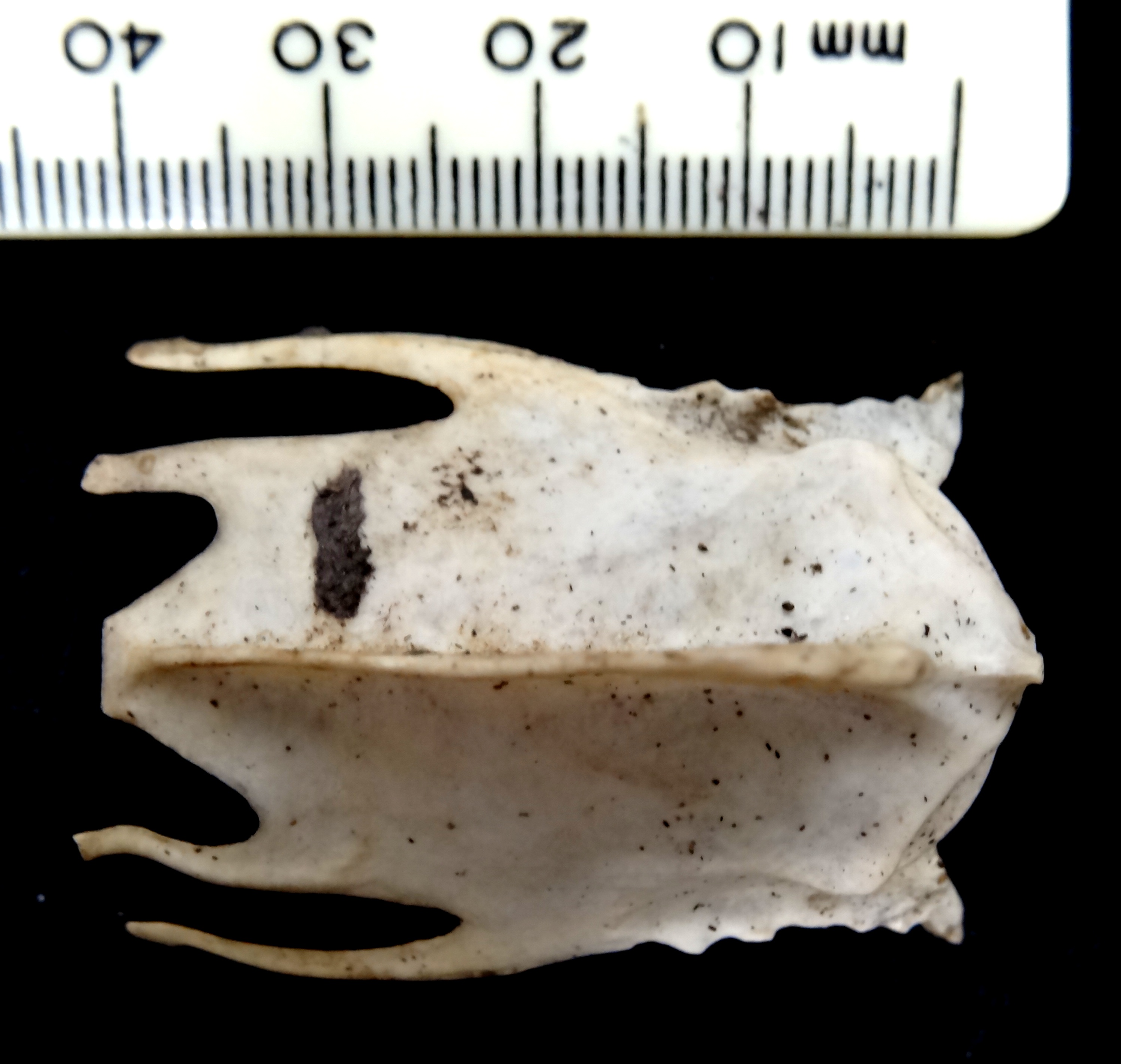
Last Friday I gave you this mystery sternum to identify:

mystery216

I had a rough idea of the family, but I was less certain about the species. As it turns out I’m now less sure of the family than I was before, in light of some useful comments.

At first I thought this was the sternum of a member of the Strigidae or the ‘True Owls’ – something that Jake also thought with his suggestion of Tawny Owl Strix aluco, but henstridgesj and Daniel Jones raised the possibility of it being from a seabird and Daniel Calleri suggested it could also be from a member of the Halcyonidae or the ‘Tree Kingfisher’ family.

With the Christmas and New Year break I haven’t had a chance to get to our stores to check specimens, but there is a very useful website that deals with seabird osteology (helpfully called Seabird Osteology) which has some images of sterna. Several of the Procellariiformes (the order containing the Albatrosses, Petrels, Shearwaters, etc.) have a similarly short sternum with a double notched bottom margin, as do some of the Laridae or the Gull family.

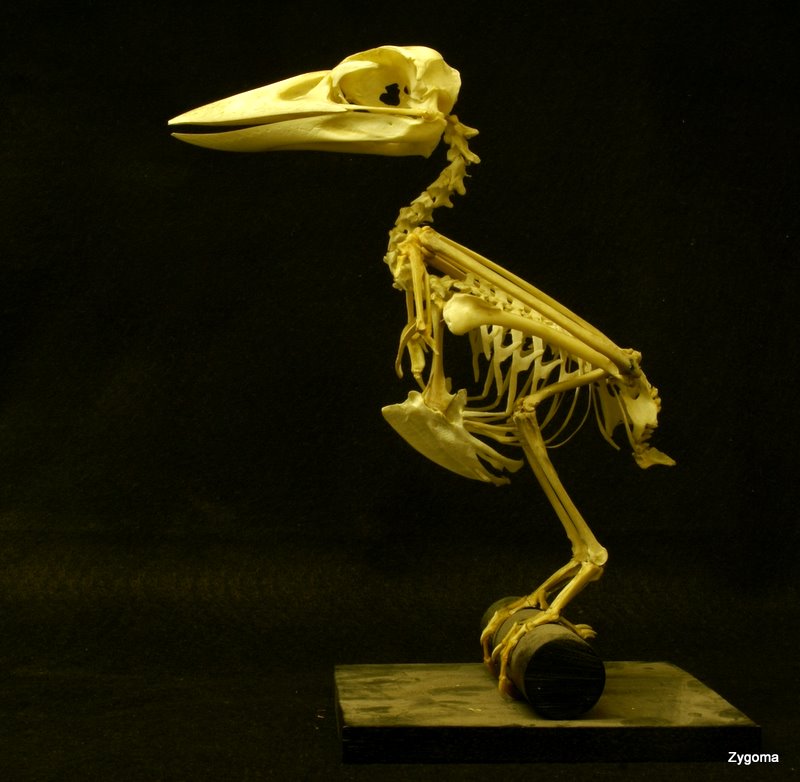
I also checked an image of a Kookaburra from a previous mystery object, which doesn’t show the sternum well, but which does hint at a double notched bottom margin:

Laughing Kookaburra Dacelo novaeguineae skeleton

Laughing Kookaburra (Dacelo novaeguineae) skeleton

This has left me slightly less confident that last week’s mystery object is from an owl, but here are a couple of other owl sterna for comparison:

Barn Owl Tyto alba sternum and coracoid

Barn Owl (Tyto alba) sternum and coracoid

As you can see, the Barn Owl sternum above doesn’t quite have the double notch, although the size is about right. The Eurasian Eagle Owl sternum below (ignore the coracoids and other bits of the pectoral girdle) is a much closer fit, although substantially larger.

Bubo_bubo_sternum_coracoid

Eurasian Eagle Owl (Bubo bubo) sternum, coracoid, furcula and scapula

I’ll see if I can find a Tawny Owl sternum to check against, because the shape does seem pretty good for one of the Strigidae and the size is about the same as a Barn Owl, which is in a different family, but has a size range that overlaps with the Tawny Owl. Of course, it could also be from one of the other medium sized owls, like the Long-eared or Short-eared Owls… more to come!

UPDATE 14:30 on 3rd January 2014

Here’s a Tawny Owl sternum!

Tawny Owl (Strix aluco) sternum

It’s pretty close, but the notches seem a bit deeper, so perhaps one of the Asioninae (Eared Owls) might be a better match for the mystery object?

Friday mystery object #215 answer

Last Friday I gave you this perplexing specimen to identify:

mystery215

It was labelled as a Crab-eating Raccoon, but the facial region is much longer and narrower than other examples I’ve talked about, and it’s much less robust:

Crab-eating Raccoon skull

Now the gracile build could just be because it’s the skull of a juvenile (which is what it looks like), but juveniles have shorter and relatively broader facial regions than adults, so that doesn’t work. Even the less robust jaws of the Common Raccoon are too short and wide for the mystery specimen (which I think may discount Robin Birrrdegg’s suggestion).

Another crab-eating option was suggested by Daniel Jones who thought Crab-eating Fox. Now the overall proportions are a good match for this species, but there’s a problem. If the mystery object had teeth this would be much easier, but there are the holes in the maxilla to give us clues about the shape and size of the molars and as Allen Hazen pointed out:

Three triple-rooted teeth. Are these three molars, or is the last premolar triple-rooted? If it’s three molars… Canids (usually) only have two upper molars…

This is indeed the case and so this skull can’t be from a Crab-eating Fox.

On a different tack, henstridgesj suggested that it might be a civet of some sort, pointing us in the direction of mystery object #143 for comparison:

African Civet skull

But again this really doesn’t look right – in particular the civets have a narrow constriction behind the orbital process, which is lacking in the mystery specimen. This was noticed by henstridgesj and he suggested that the closest option he’d been able to find was a Coati:

Coati skull

Now the specimen of Coati above is a mature male that was mystery object 54 and it doesn’t look much like our most recent mystery object, but on checking the skulls of juvenile and female Coatis I realised that this is probably the best option so far.

I still want to check some more specimens, but I’m really grateful for everyone’s input on this specimen – it’s been a challenge and you have all helped immensely!

I’ll  be back with another mystery object next Friday, but until then I’d like to wish you all a thoroughly enjoyable festive season!

Friday mystery object #214 answer

Apologies for the lateness of the FMO this week, my excuse is a rather apt bout of illness, where some of the alveolar bone of my mandible has been lost due to an infection, leaving me feverish and thoroughly miserable.

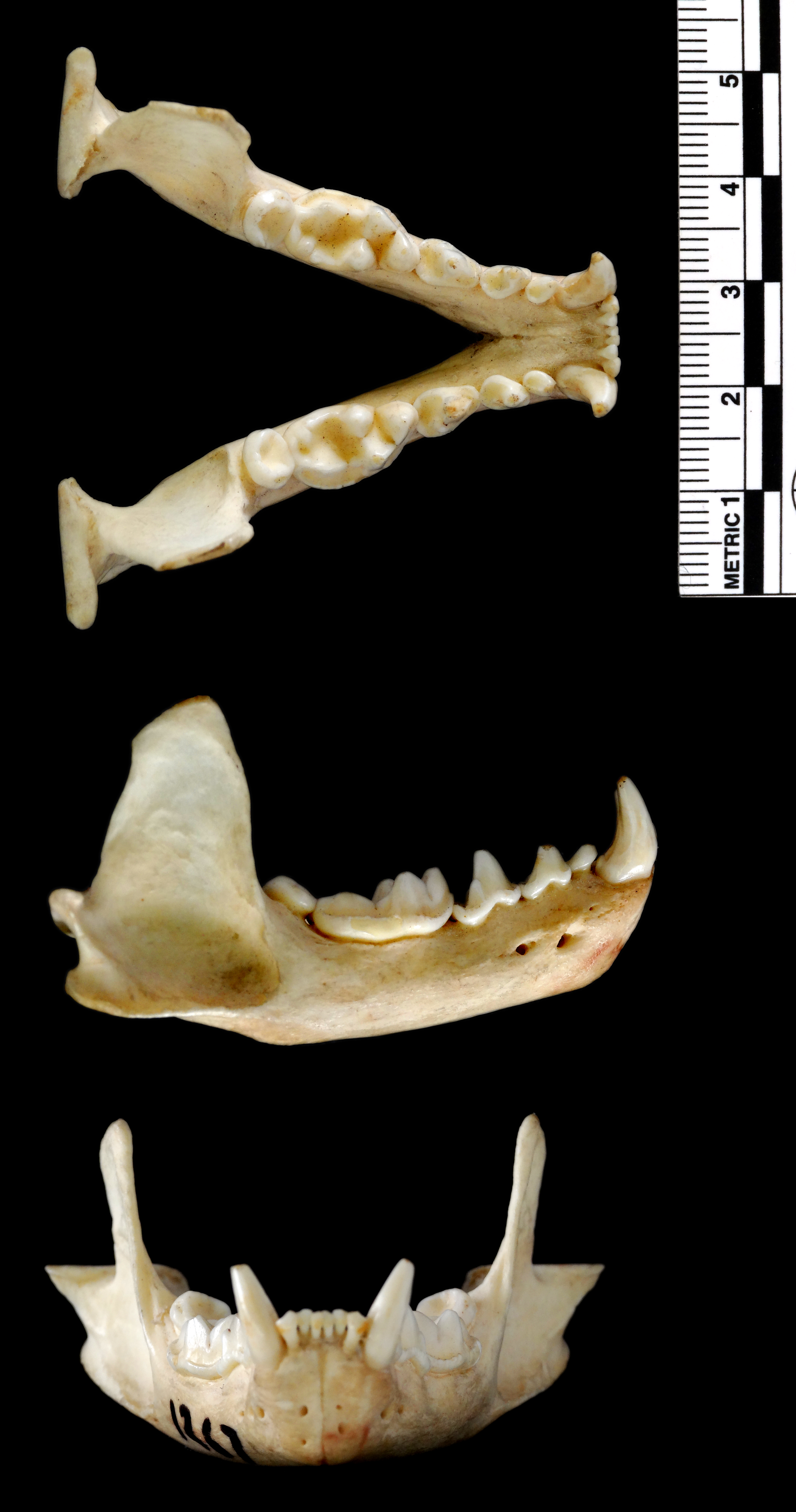
But enough about my me, this is the mandible I’m supposed to be talking about:

mystery214

There was a fascinating discussion about the possible identification in the comments last week, so a big ‘thanks!’ to all of the contributors who provided their informative observations (too many to mention everyone by name!). A mustelid of some sort was quickly agreed upon and the general consensus moved towards an otter of some kind, before starting to drift away again.

Two comments in particular were particularly pertinent. The first was from Daniel Jones:

Alright . . . instantly the foramina on the mandible anterior to the premolars scream Otter! However, the incisors don’t. The incisors just lateral to the canines should be larger and longer than any of the other incisors among the otters (even the Asian Short-clawed Otter).

Now my identification for this specimen was indeed Asian Short-clawed Otter Aonyx cinerea (Illiger, 1815), so this comment made me a bit concerned. However, on checking some images online I realised that the long lateral incisors are present in the premaxilla, but not the mandible – an easy detail to miss.

The second comment was by Allen Hazen:

Anyway… The talonid on the first molar of the one in the picture is BIG.

The reason I found this comment useful was that the long and broad talonid (that’s the flatter grinding section on the molar) is what confirmed the Asian Short-clawed otter identification for me (although the small size was a good first clue).  This became quite clear from an image on the Otter Specialist Group webpage.

The Asian Short-clawed Otter presumably has this large talonid because it has a diet mainly composed of crustaceans rather than fish, and it needs the extra crushing area on the molar to crack open tough exoskeletons.

Who would think you’d get teeth as formidable as these on such an adorable little critter?

Friday mystery object #213 answer

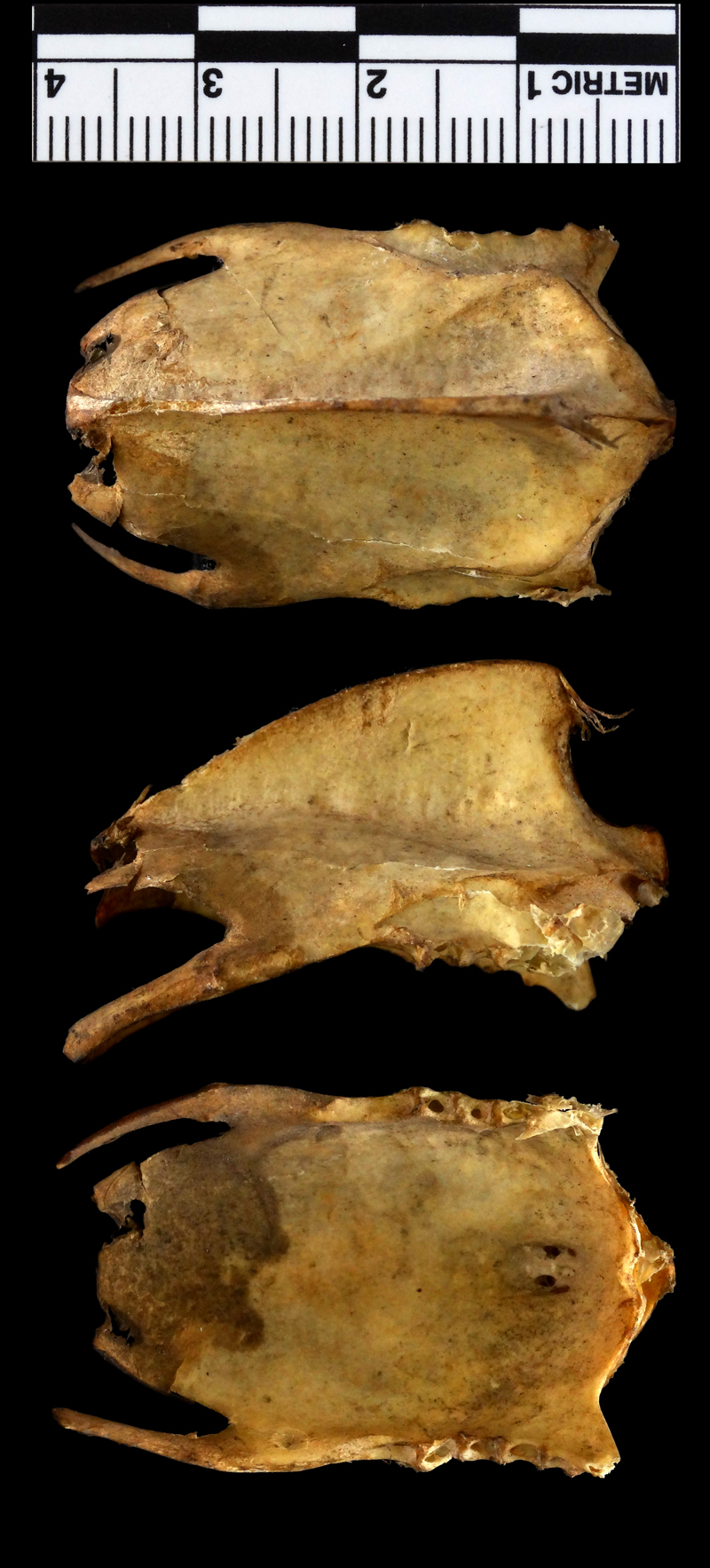
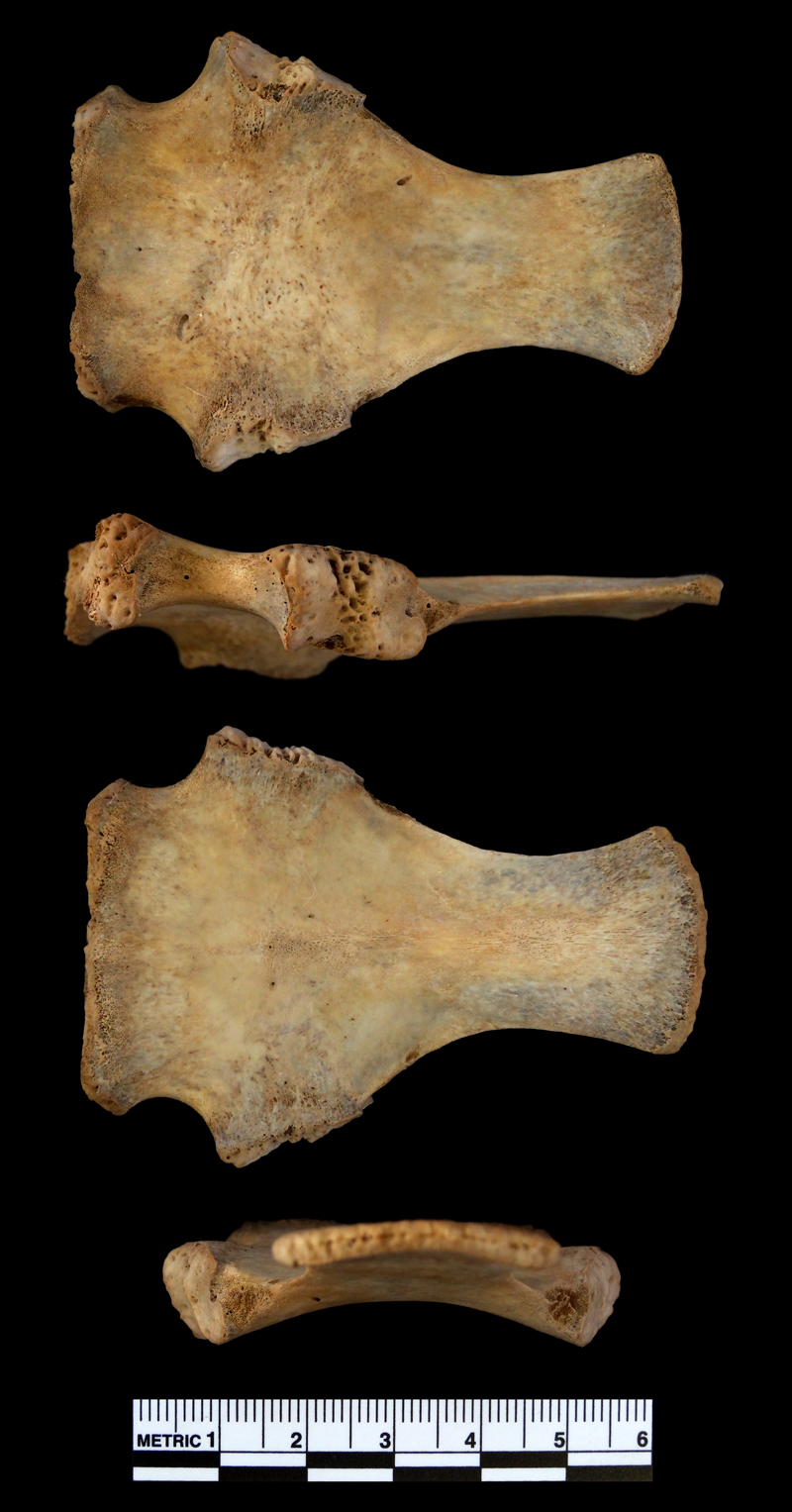
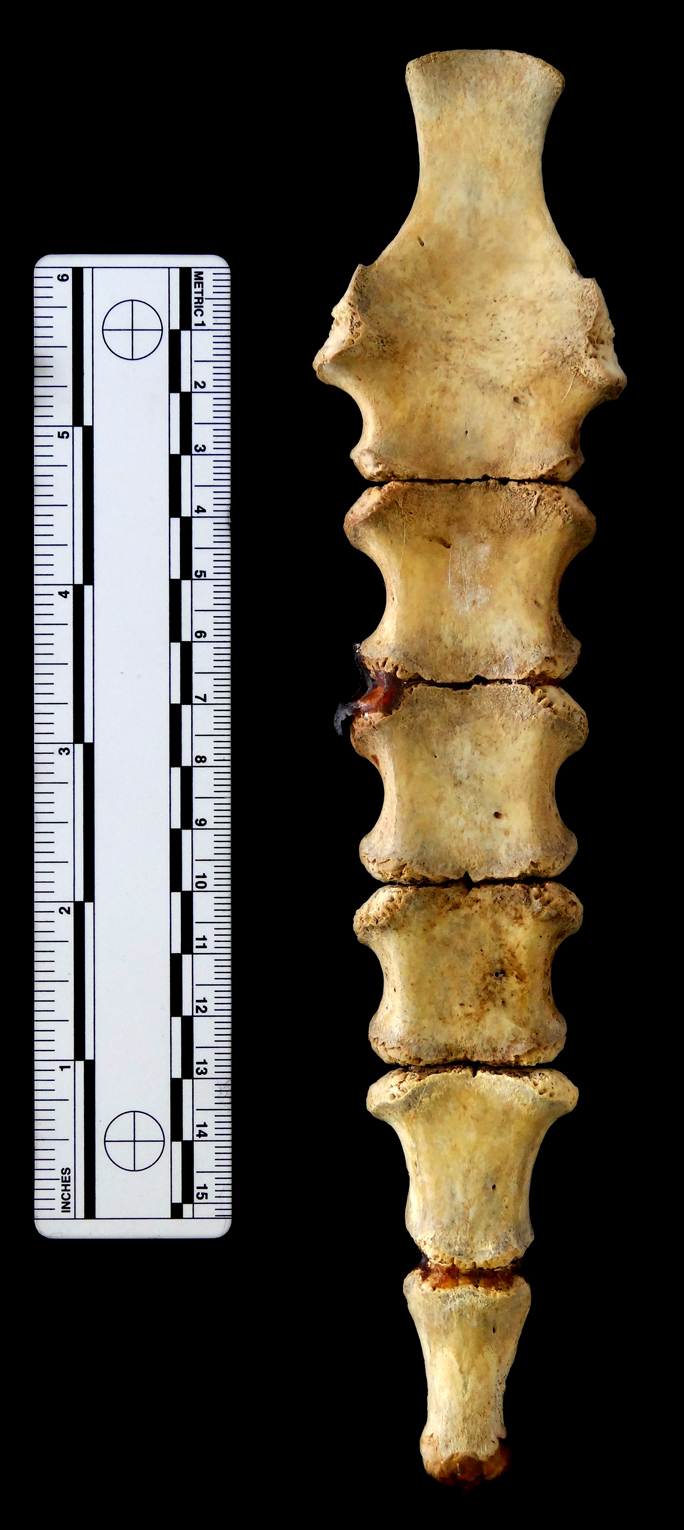
Last week I gave you this interestingly shaped piece of bone to identify:

mystery213

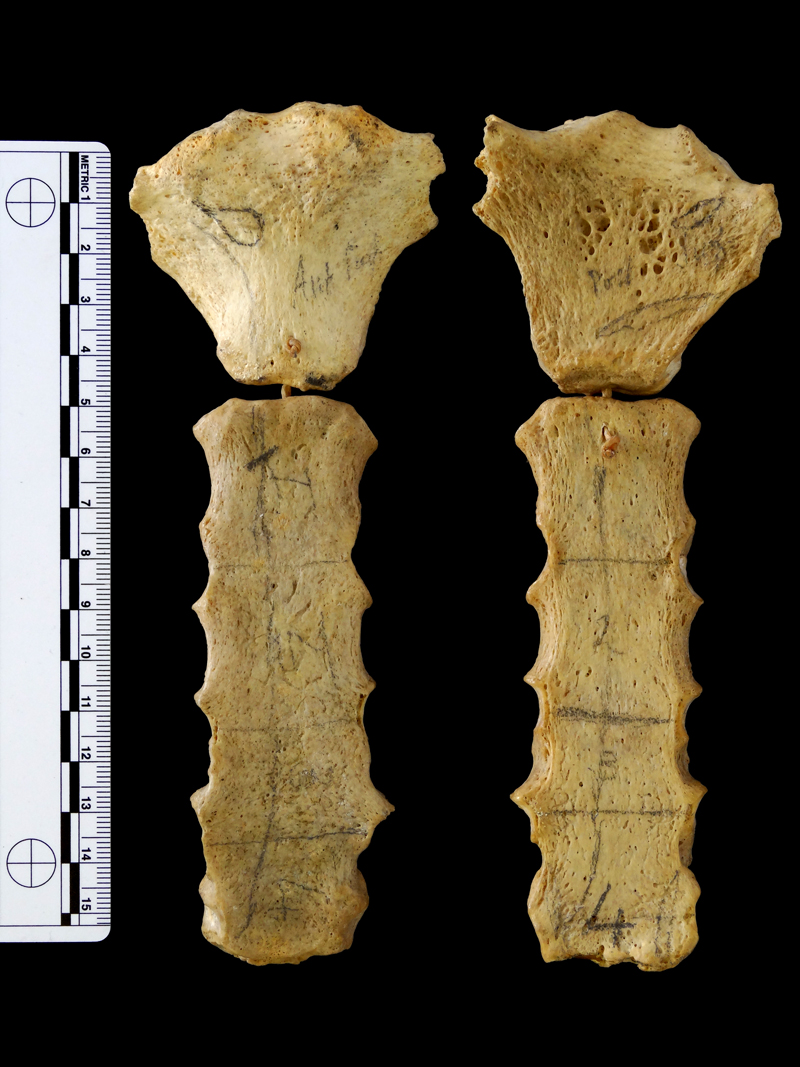
Jake, Elisa, henstridgesj, Hew Morrison, Robin Birrrdegg, Daniel Jones and Daniel Calleri all made a correct identification of this being part of a sternum, a sternebrae or more specifically a manubrium from a fairly large (yet possibly juvenile) ungulate. This was all correct and the final piece of the puzzle is the species, which is actually a smaller Deer than most people were expecting. It’s from an immature male Fallow Deer Dama dama (Linnaeus, 1758) collected from Knowle Park in Kent.

Here’s what it looks like with the rest of the sternebrae (which are the individual elements of bone that make up the sternum, like vertebrae make up the spine) that I could find for the specimen:

Sternum of immature male Fallow Deer Dama dama

Sternum of immature male Fallow Deer Dama dama

So it was indeed the manubrium – the top sternebra which in humans articulates with the top ribs and clavicles, but which here would only articulate with the top ribs, because ungulates don’t have clavicles (as I’ve discussed before). Here’s a human sternum for comparison:

Human sternum

Human sternum

So well done to everyone – I hope you enjoyed the challenge!


Friday mystery object #211 answer

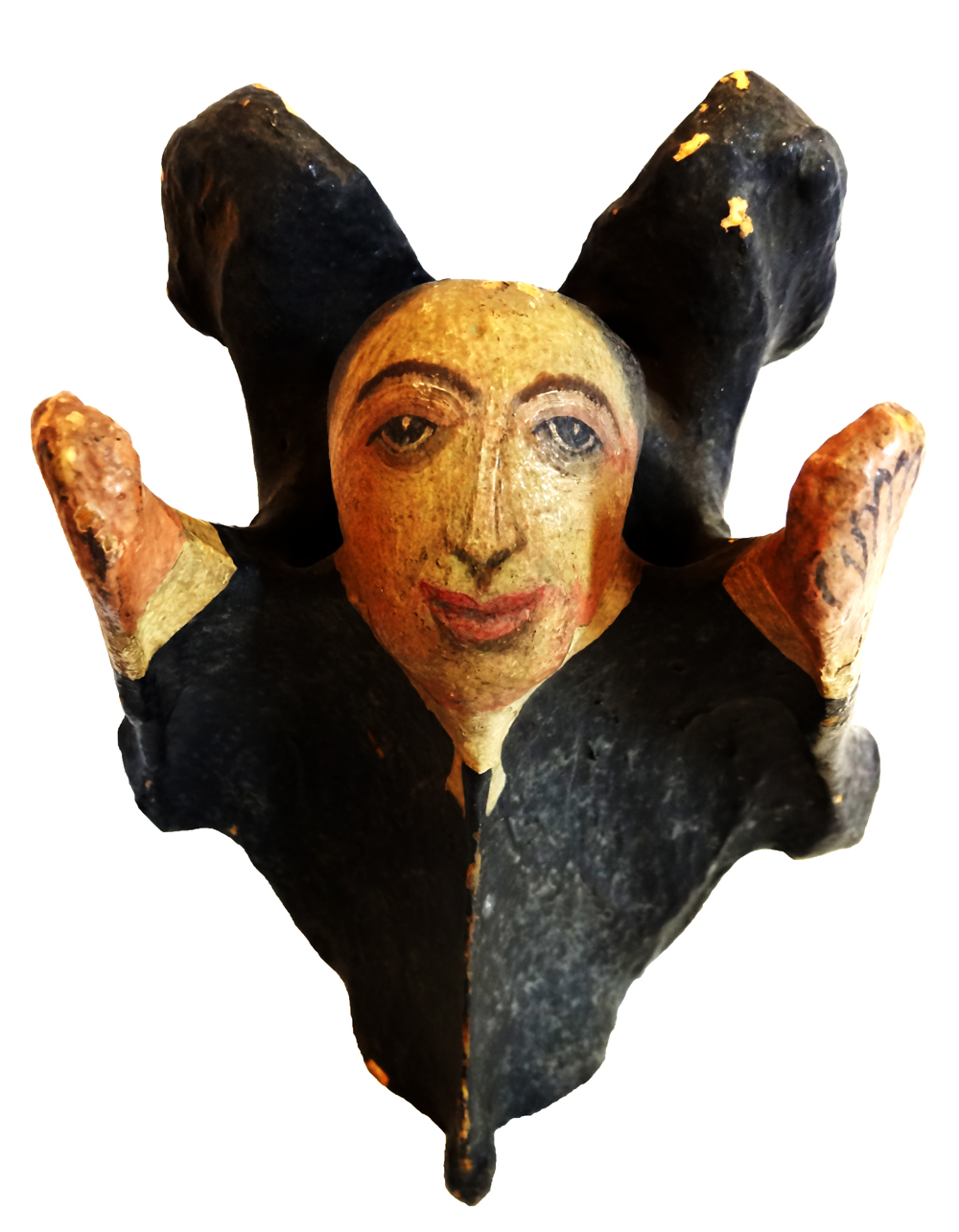
Last week I gave you this very unusual object to identify:

mystery211a

Plenty of you recognised this as a vicar of some sort, painted on the cervical vertebra (or neck bone) of a large mammal. There were some great ideas from neanth, Lewis Thompson, henstridgesj, Ze-Jeff, Jake, ermineofthenorth, Carlos, Daniel Jones, andy J, Natasha and Daniela.

In particular, Daniel Jones made some very interesting observations about which vertebra from which animal, while Tony Morgan managed to identify the preaching subject.

It seems that this object is a cervical vertebrae from a Heavy Horse (by which I mean something like a Shire-horse, not just a greedy nag). Looking at the relative proportions and the angles of the processes I think it’s probably the 4th cervical vertebra.

Meanwhile, the subject of the piece appears to be John Wesley, co-founder of the Methodist movement in the 18th Century. Apparently this sort of British folk depiction of John Wesley (and his brother Charles) was quite common in the late 18th and early-mid 19th Centuries, and there are several examples online (1, 2, 3).

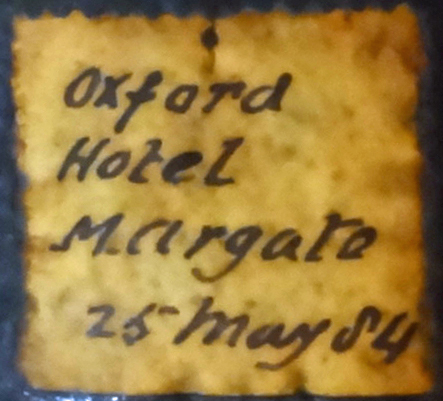
Finally there is a bit of a mystery attached in the form of  a label:

mystery211c

The date is written without the century, which is  a problem in collections that can be well over 100 years old. This could be from 1984 (unlikely), 1884 (the year Horniman started showing his collection, or 1784 (one of years in which John Wesley was active).

The handwriting looks familiar to me, so I’m going to go for 1884 and assume that this is a label that was added when the object was collected by Horniman, rather than it being a label added by the person who painted the vertebra – after all, who adds labels like this to their handiwork?

I hope this provides a good reason for why you should always write the year in full if you work in a museum.

Friday mystery object #210 answer

Last week I gave you this mystery object to have a go at identifying:

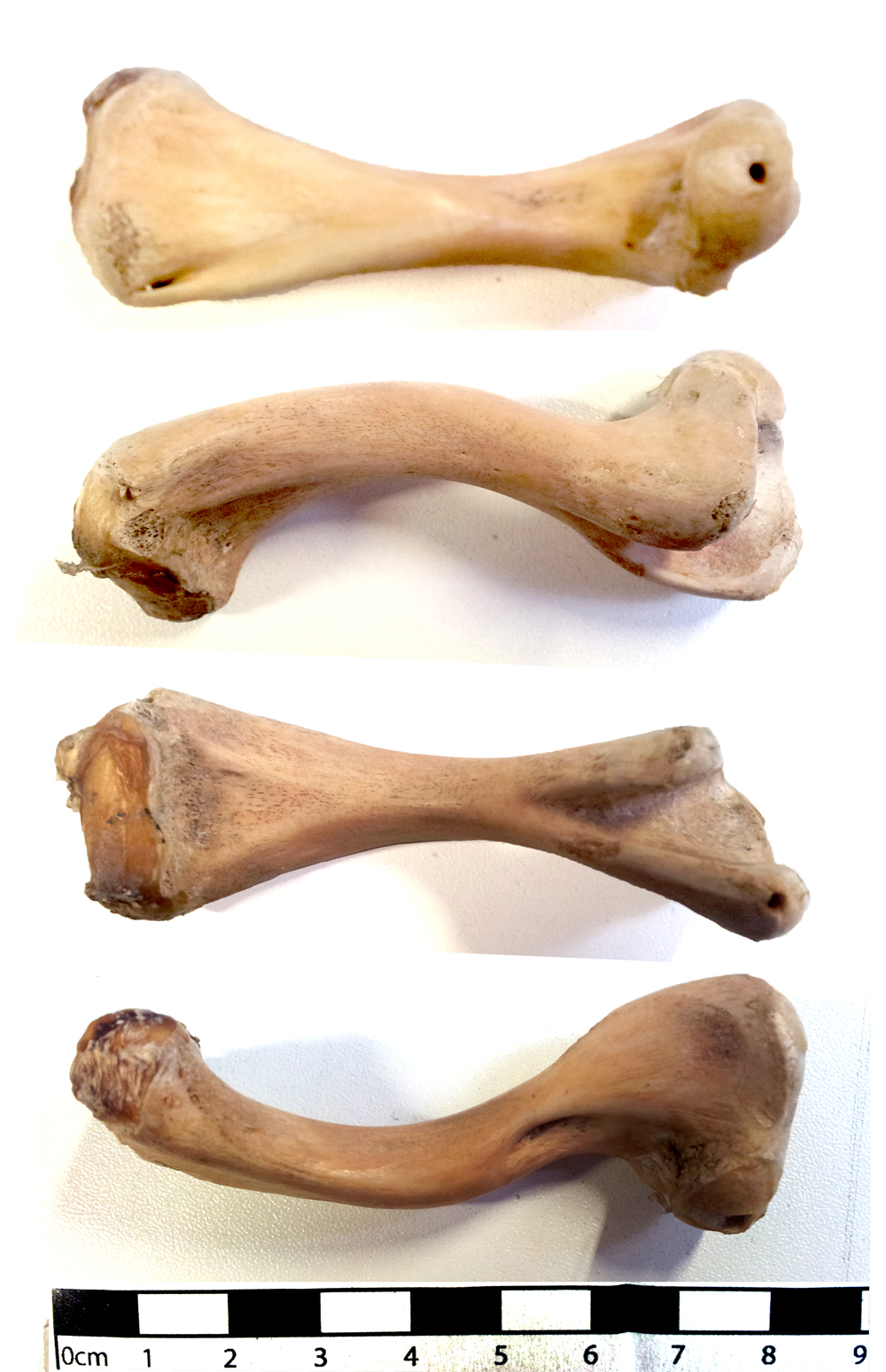
mystery210

Jake was in like a flash, correctly identifying that the bone was a humerus – not an easy thing to spot considering the very strong curve and the deep groove at the head end. Jake also noticed that the humerus was adapted for something unusual, hence the weird shape.

There was a suggestion of pig by henstridgesj, which would have fitted the curve of the bone, but it was too small and the deep groove is at the wrong end.

Newcomer to the mystery object, Rute Branco, suggested that the object was the humerus of a (young) tortoise – a suggestion that I agree with (as does Daniella).

Tortoises have weird legs that need to carry quite a lot of weight, thanks to their bony carapace. They also need to get their legs inside their shell, so they have to be shaped for efficient retraction.

One of the differences between a terrestrial tortoise and an aquatic turtle humerus is the shape of the groove in the head, with terrestrial tortoises having a very steep and deep groove while swimming turtles have a slightly shallower and wider groove to allow a wider range of movement.

I can’t find enough comparative material to work out a species, or even genus of tortoise for this specimen, but I will keep my eyes peeled! Thanks for everyone’s input.

Friday mystery object #209 answer(ish)

It seems like an age ago that I gave you this mystery object:

mystery209

There were fantastic comments from everyone, but I’ve been bad about responding and writing an answer because I’ve been pretty swamped recently. Also, there are several things that confuse me about the specimen and I’ve not had the chance to take a really good look at comparative material.

The function of the object was correctly identified by Daniela, Paleotool and Jeanie – it is a bone whistle, in this case a fairly modern Navajo example. Our Keeper of Musical Instruments was keen to know if this was from an eagle and whether it might be covered by CITES.

At first I thought it might be the femur of one of the large American eagles, but it is far too long. If it was from any bird of prey it would be a Californian Condor based on the size but the tapering shape is wrong. I then considered the humerus – which is a better match for size, but the position of the groove for a tendon path on the underside is wrong. So it doesn’t seem to be from an eagle.

The slight curve and taper rule out a hollowed deer metapodial, which are very straight and uniform in width.

My best guess is that this may made from a section of the humerus of a species of swan – a guess partly informed by the opinion of the anatomical knowledge of Wouter van Gestel and the archaeological knowledge of Paleotool. The shape and few remaining anatomical features are about right, but there are other large birds that haven’t been ruled out.

Perhaps an unsatisfactory answer, but sometimes a good solid “I don’t know, but it’s reasonable to think it might be this” is the best answer you can get. Thanks for everyone’s input!

N.B. Here’s a side view: 20130912_125851

Friday mystery object #208 answer

Last Friday I gave you this mystery object to have a go at identifying:

mystery208

I wasn’t sure if it would be too easy but it turns out that no-one managed to identify it, so I guess not!

Lots of suggestions were made, from a bum (thanks Jake) or coco-de-mer to the join in a lip to the cleft between toes – but the closest suggestion came from newbie Daniela, who suggested an armpit.

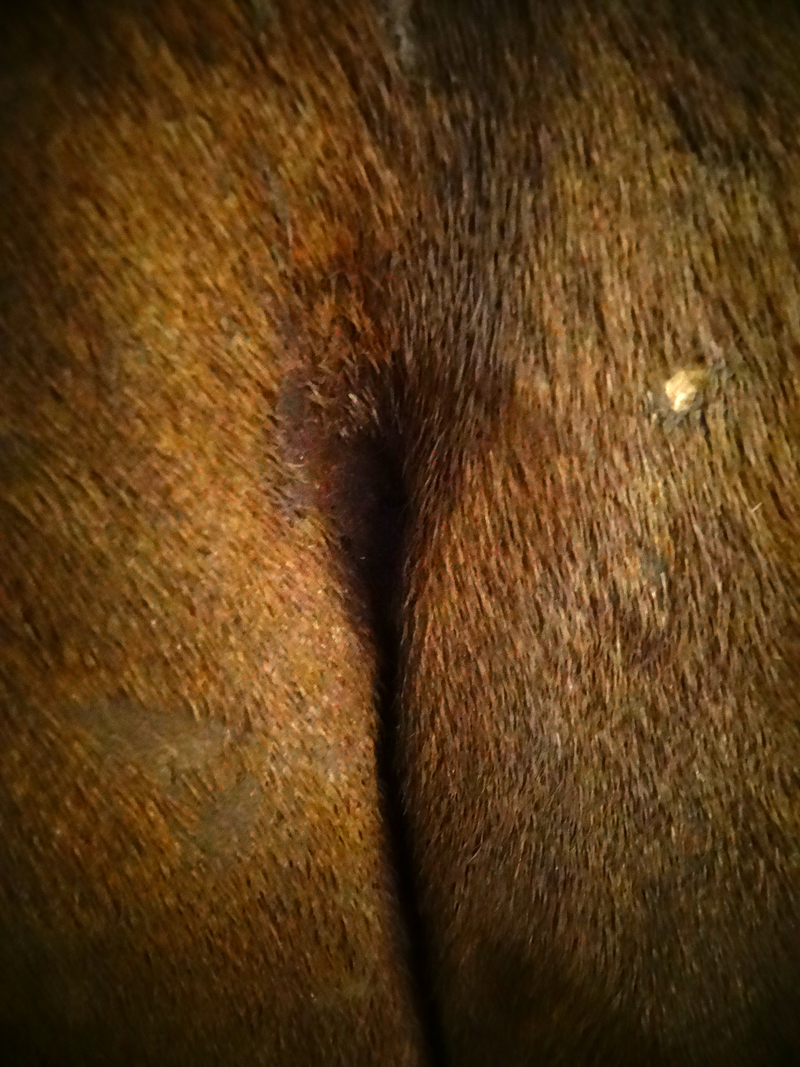
The reason I thought you might find this easy is because it’s the armpit (or perhaps flipperpit is more accurate) of the Horniman’s infamous Walrus Odobenus rosmarus (Linnaeus, 1758). This fine, if portly, specimen will be back from his hols in Margate soon.

walrus

I expect the presence of the hair may have thrown people off the scent, as we don’t tend to think of Walruses as being hairy – but as we can see, they are. A bit.

Friday mystery object #207 answer

A very late and brief answer to the last mystery object I’m afraid – hopefully I’ll get back on track soon, once everything has calmed down a bit!

I gave you this object to identify:

mystery207


It was a bit of a mean one, since these teeth are mostly broken with several missing. but there were some great answers.

Several of you recognised these as teeth from a juvenile Old World primate, so well done to henstridgesj, Jake and Jakob Ramlau. Jakob also alluded to dogs in his answer and I wonder if he managed to spot that the  primate was a Dog-faced Baboon Papio cynocephalus (Linnaeus, 1766) or Yellow Baboon as it’s also known.

mystery207_full

I’ll take some time to talk about deciduous teeth sometime soon, once I’m able to sit down and get back to blogging properly!


Friday mystery object #206 answer

Apologies for having such a belated answer to the belated mystery object from last week.

Things are really busy at the moment – I’m researching mermaids for a paper due to be submitted at the end of this month, curating an exhibition that’s due to open in September, double-checking the scientific accuracy in Jake’s book, doing talks, running PubSci, involved in recruitment for NatSCA, working on elements of the Horniman’s Bioblitz project and trying to write a grant application, on top of my more usual day-to-day work. That means I haven’t been able to spend the time on my blog that I would like. Hopefully everything will start getting back to normal in the next couple of weeks!

On to the answer – I’m afraid it will be brief… I asked what this bone was:

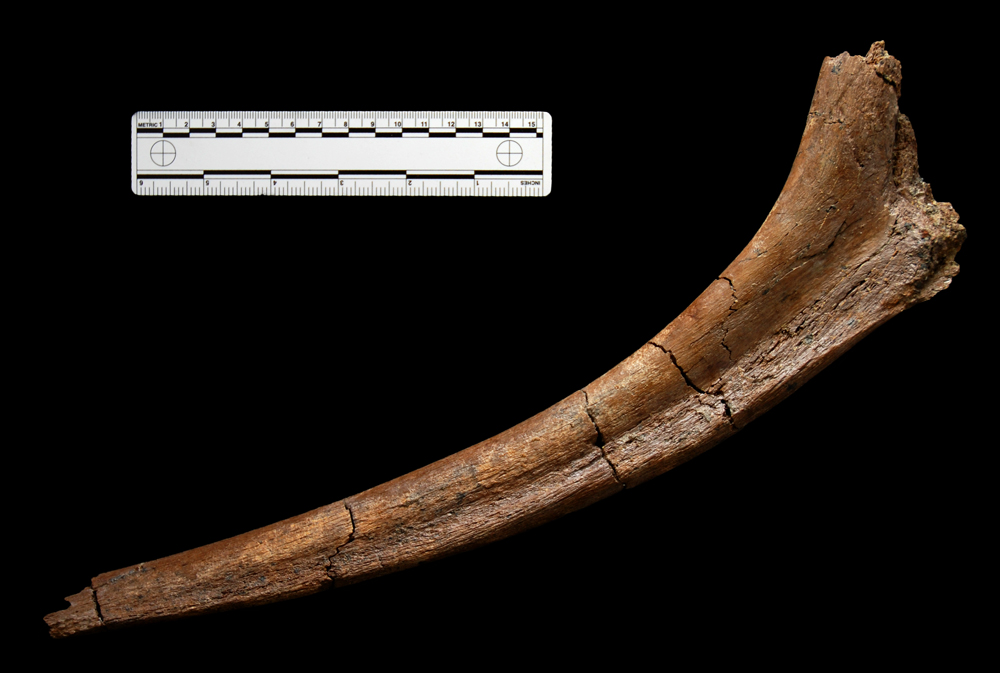
mystery206

Carlos recognised this as a rib and there were a variety of suggestions about what it might be from, ranging from a cetacean to a mammoth. Some good ideas, but Lena came closest with speculation about dinosaurs.

This is in fact the rib of a Triceratops Marsh 1889.

There is a lot that could be said about Triceratops and other horned dinosaurs, but since I’m pushed for time I will just leave you with a link to an article by Darren Naish who knows more about such things than me and this brilliant stop-motion video from the 1925 film of The Lost World, which is simply iconic:

Friday mystery object #205 answer

Last Friday I gave you these tiny bones to identify:

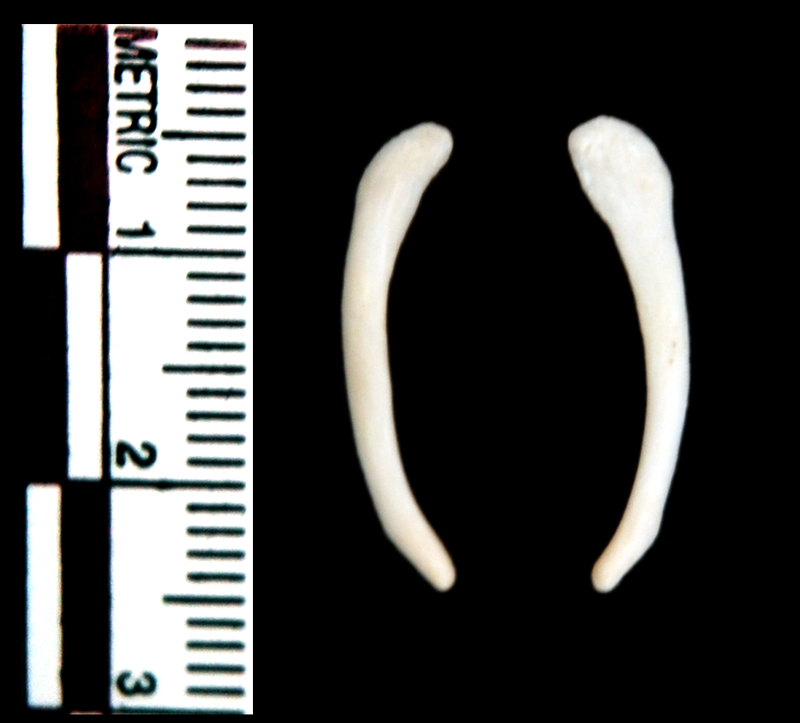
mystery205

Several suggestions were put forward with soph coming close with the suggestion of a broken furcula and Lena and henstridgesj correctly suggesting the clavicles (or collarbones) of a Cat Felis catus Linnaeus, 1758.

Cat clavicles, like the clavicles of a variety of other animals, are much reduced and are no longer connected to the scapulae (shoulder blades). This allows the scapulae to move much more freely during running, which can increase stride length and in the case of Cats it allows the animal to fit through holes big enough to get their heads through (assuming the Cat isn’t a bit too portly).

These sorts of vestigial structures are interesting from an evolutionary perspective, since they serve little or no direct function, but they still develop as a result of inheritance from ancestral forms that did use them.

In the case of Cats that form would have been around quite some time ago (probably 61.5 – 71.2 million years ago) since the closest related group to the Carnivora with a well-developed clavicle (that I can think of) would be the Chiroptera (bats), where it plays an important role in flight.

Since that divergence of the Chiroptera and the lineage giving rise to the Pangolins, Carnivora and Ungulata the clavicle has been pretty much completely lost, so it’s interesting that even a vestigial form occurs in Cats.

It’s funny to think how such small bones can raise questions that lead us through millions of years of evolution in search of answers, but that’s the nature of studying nature!

Friday mystery object #204 answer

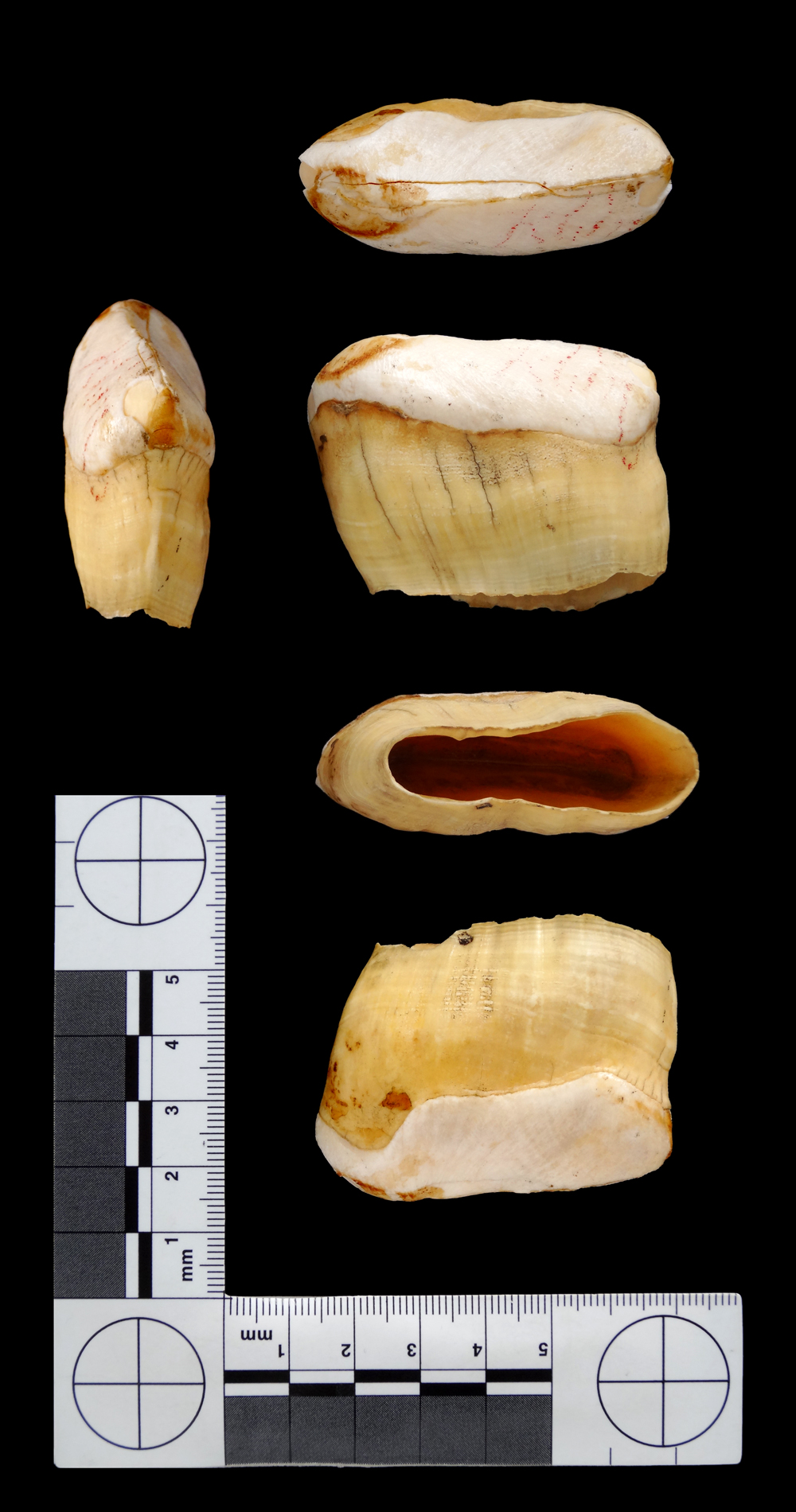
Last Friday I gave you this unusual tooth to identify:

mystery204

It had me a bit stumped, as I couldn’t think of many things big enough for a tooth this size and I could think of even fewer with a tooth this shape.

My first thought was one of the smaller toothed whales, since this would be in the right size range and the open root is similar to what you see in a Sperm Whale:

Tooth of a Sperm Whale in a Hand by Lord Mountbatten

But the low and wide shape was all wrong for most of the whale teeth I can think of, except perhaps for the rather odd tusks found in the mandibles of some species of beaked whale.

In fact, I was thinking that it might be the tusk of a juvenile or female Gray’s Beaked Whale, given the shape of the male’s tusks.

However, Laura McCoy made a very useful observation (initially via ermineofthenorth) about the upper incisors (or premaxillary incisors) of the  Continue reading

Friday mystery object #203 answer

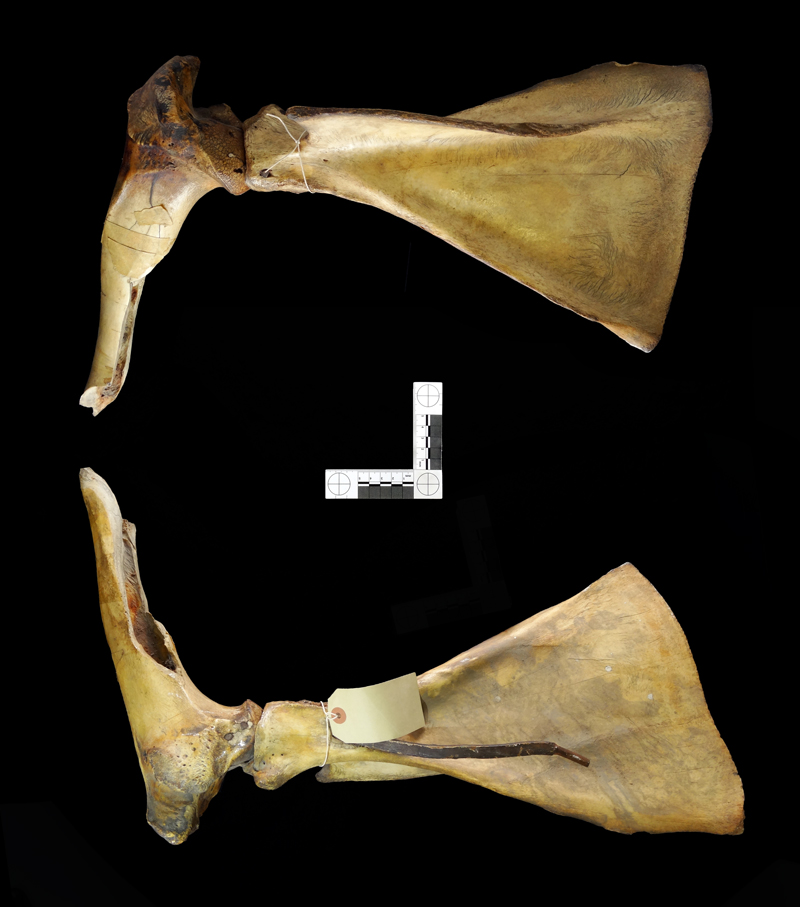
Last Friday I gave you this rather large scapula that I discovered in a crate in the Horniman’s stores to identify:

mystery203

It wasn’t an easy one, since there are relatively few distinctive features on a scapula compared to something like a skull.

Jake has talked about scapulae on his blog before and that provides a good place to see that this specimen is most likely from an ungulate – but an ungulate much bigger than a Red Deer. This led to suggestions for Cow, Horse, Aurochs and one of the larger species of deer. 

Outside the comments section on Zygoma there were also suggestions of Giraffe and Giant Irish Deer and I wondered about Camel.

All in all, there were a lot of suggestions, but none of these looked quite right when I searched for comparative material – although finding good images of scapulae online wasn’t easy. I did, however, find a useful video explaining the differences between Horse, Cow (or Ox) and Camel scapulae:

This was enough for me to rule out each of those animals, although the closest was the Cow – in particular the relative sizes of the two faces (called fossae) on either side of the raised ridge called the spine. However, the shape of the acromion (the hooked bit of the raised spine that points towards the shoulder joint) didn’t seem blunt enough for a Cow.

The size differences in the fossae turn out to be about the same in Sheep and deer as in Cow, which led me back in the direction of Jake’s deer scapulae, which seemed to most closely match the shape, if not the absolute size.

Taking the size into account I realised that this animal must stand almost twice the height of a Red Deer, which narrows it down to just one modern species – the Moose or Eurasian Elk Alces alces (Linnaeus, 1758), which can stand at over 2m at the shoulder compared to the Scottish Red Deer’s (still imposing) 1.22m.

Bull Chukotka Moose by Beloki

I still need to double-check my identification against a confirmed Moose scapula, but from looking at some images of Moose skeletons online it seems that the shape of both the fossae and the acromion fit well.

So a big thanks to everyone for their help in identifying this and special props to newcomer Jeanie who seems to have been spot-on about this being from a cervid. Thanks!