Friday mystery object #315 answer

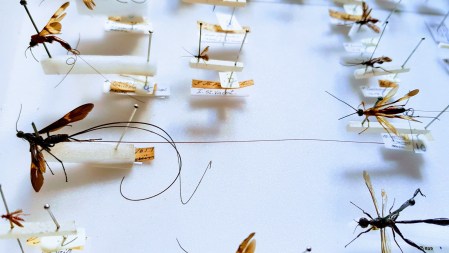
Last week I gave you this big bug to identify:

mystery315

I had a feeling it would be fairly straightforward for some of you, since insects as big as this are reasonably distinctive, and I was therefore not disappointed with the flurry of correct identifications.

The first with a correct identification in the comments was Chris, who hinted at the scientific name with this suggestion:

Trying to identify this Cic-sac? Tho phar, Tho good! (Excuth the lithp!)

On social media people made suggestions relating to the common name for the species, mostly pointing out that it’s very loud. Putting the various hints together gives you the Double-drummer Cicada Thopha saccata (Fabricius, 1803).

Cicadas are weird. They’re in the Order Hemiptera (the true bugs) and the Suborder Homoptera (although that’s disputed and it’s probably safer to say Auchenorrhyncha). Best known for being noisy and having some species with synchronised emergence times that vary between every year and up to every 17 years, or somewhere in-between depending on species and environment. They have widely spaced eyes and a blunt head that is pretty distinctive.

As jennifermacaire pointed out regarding cicadas:

According to Plato, “[This species] used to be human beings who lived before the birth of the Muses. When the Muses were born and song was created for the first time, some of the people of that time were so overwhelmed with the pleasure of singing that they forgot to eat or drink; so they died without even realizing it. It is from them that the race of the [these insects] came into being; and, as a gift from the Muses, they have no need of nourishment once they are born. Instead, they immediately burst into song, without food or drink, until it is time for them to die. After they die, they go to the Muses and tell each one of them which mortals have honored her.”
– Phaedrus

The implications of this is that adult cicadas have a general inability to feed, although this isn’t quite true, since adult cicadas may still feed on sap.

This particular cicada is Australian and is one of the loudest insects on the planet, able to produce a call of over 120 decibels – loud enough to cause permanent hearing damage if right up against a human ear.

The abdomen is fairly hollow in the males of these insects, creating a resonating chamber, but sadly the last segment of this specimen has fallen off, making it hard to be sure of the gender on the basis of the genitals. However, the males have a couple of resonating sacs behind the hind-wing that is missing from this specimen, suggesting that it’s a female.

As far as noisy neighbours go, these insects are an occasional disruption, popping up every 4-6 years and making a noise that is apparently similar to high-pitched bagpipes.

It doesn’t sound great to me, so I’m (not so) secretly glad that I only have to deal with dead examples of these fascinating insects.

More mystery object fun next week!

Friday mystery object #310 answer

Last week I thought it was time for some more bones, so I gave you this specimen from the Dead Zoo to have a go at identifying:

mystery310

There was no scale, the photo is far from ideal and the specimen isn’t in the best condition, but the animal is pretty distinctive, so I thought it wouldn’t prove too much of a challenge – and it turns out that I was right.

Palfreyman1414 was the first to identify it to genus level, correctly recognising that it was one of the two Notoryctes species of Marsupial Mole from Australia.

The weird limbs are a pretty good indicator this being a digger, with large muscle attachments and robust forelimbs, but it has couple of large claws rather than the ridiculous giant hands of the Old World Moles and it has a shorter skull.

Double prep mole from the Horniman Museum

Double prep of an Old World Mole Talpa europaea from the Horniman Museum & Gardens

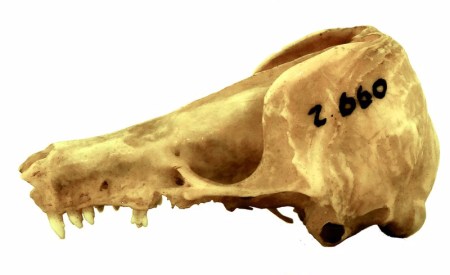
The skull is more similar to that of the golden moles of southern Africa, although their rostrum (nosey bits) tends to be more concave while the marsupial moles have a more convex rostrum (and in some cases, weirdly flaring zygomatic arches).

mystery268

Lateral view of the skull of a Giant Golden Mole Chrysospalax trevelyani from the Grant Museum of Zoology

Now distinguishing between the two species of Marsupial Mole is a bit more tricky, not least because they are quite poorly known animals and there aren’t many specimens available for comparison – this is particularly true of the Northern species, which was first described as recently as 1920.

This is actually quite useful to know, since the mystery specimen came into the collection in 1897 – from Southern Australia – so it’s safe to say it’s the Southern Marsupial Mole Notoryctes typhlops (Stirling, 1889), but that’s not very helpful from a morphological perspective.

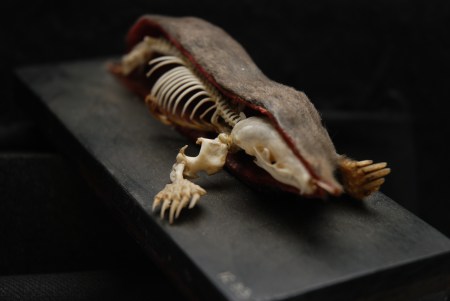
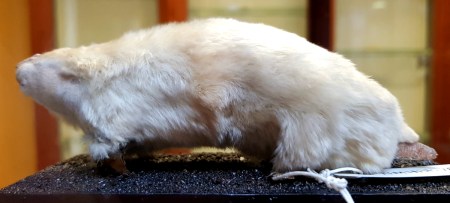
So far I’ve not found any useful skeletal features that help differentiate the two species, but apparently their fur colour is a little different, with the Northern species having pinkish or cinnamon fur and the Southern species having yellowish-white to a deep gold. To see what they look like with their fur, here’s the taxidermy partner to the mystery skeleton:

Southern_marsupial_mole

Taxidermy Southern Marsupial Mole Notoryctes typhlops in the National Museum of Ireland – Natural History

As with most moles these subterranean critters have adapted to spending much of their time underground by losing their eyes, investing in some serious digging equipment and tuning in to smells and low frequency sounds.

I hope you enjoyed this little tour around the main moles of the world! More mysteries next week.

Friday mystery object #309 answer

There are lies, damn lies and statistics* and then there are inaccurate statements made from assumptions that are based on insufficient knowledge and poor research. Last week I fell into this sort of untruth when I offered up this diminutive mystery object that I said was from Ireland:

20170719_094633-01

My excuse for that untruth is the fact that the specimen was in a part of the collection dealing with native species (which I forgot also includes British taxa, because the collection is old enough to have been split into “native” and “foreign” before Ireland stopped being part of the UK) and I’d quickly checked the distribution with reference to a handy online checklist of British and Irish Hymenoptera, but I then missed the bit under the species that said the range was restricted to England. I assumed based on context and as a result I got it wrong – and we all know that we should never ASSUME, because when you ASSUME, you make an ASS of U and ME*.

So thanks to jennifermacaire  and David Notton for pointing out my mistake – it is much appreciated. I should have checked the label for the collection locality, but unfortunately the image was taken as a snap on my phone while bagging the drawer containing this specimen (while I was preparing hundreds of of other such drawers and insect boxes as part of a major collections move) so I didn’t get the chance. This is actually a bit of a problem for digitisation when insects are pinned like this, because the label is invisible from above.

insect room

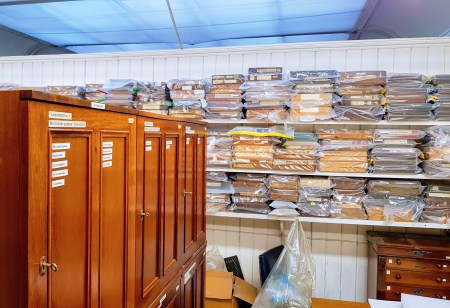
Insect boxes bagged for transport and freezing

If I was more familiar with the insect fauna of Britain and Ireland it would have helped, but as you may be aware, my main area of experience is in bones and the critters that have them, so my knowledge of insects tends to be quite generalised or restricted to particularly important or interesting species that I’ve had reason to research.

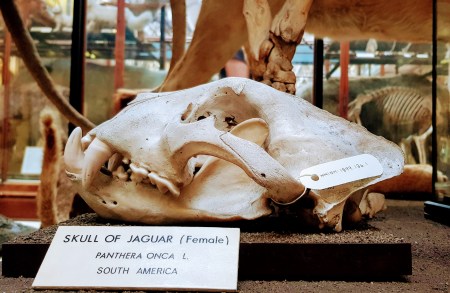
Skull of female Jaguar in the Dublin Dead Zoo

The kind of specimen I really understand

This is one of the challenges in my role as curator of Zoology and Entomology at the National Museum of Ireland, where I work with somewhere in the region of 2 million specimens, covering the whole of the animal Kingdom, from all over the world.

Normally museums with collections of this size would have a few specialist curators to focus on the main taxonomic divisions, but for the time being I’m dealing with the lot, so I have a steep learning curve to get up to speed with the whole collection. Of course, it’s well worth it, as there are some incredible specimens in there – either because of what they are, or who they were collected by and how important they are for science and culture.

Wasps collected by Charles Darwin during the Voyage of the Beagle.

Wasps collected by Charles Darwin during the Voyage of the Beagle.

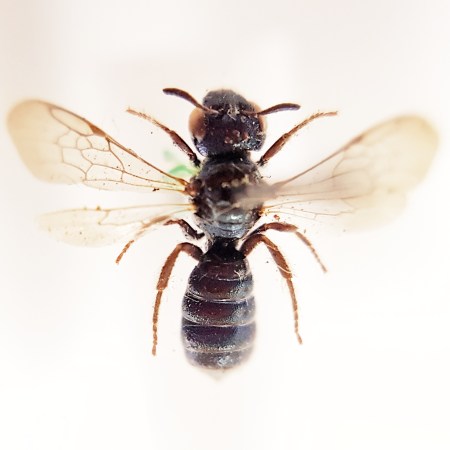
Anyway, excuses aside, I expect you’re keen to find out what that small hymenopteran was. Chris very quickly identified it as one of the small, solitary carpenter bees. This is the only one that is “native” – in that it occurs in Southeast England – and even then it’s pretty rare to find it except in downlands in the South, mainly in East Hampshire.

The name is Ceratina cyanea (Kirby, 1802) and the female excavates a burrow in the stem of a dead plant, making tiny cells with walls of sawdust in which she lays eggs – hence the name “carpenter bees” for the group that shows this behaviour.

Another mystery object to come next week – this time it will hopefully be a bit less misleading!


*Attributed to Benjamin Disraeli, by Mark Twain

*I’m attributing that to the fictional character Dawn Summers from Buffy the Vampire Slayer because that’s where I heard it first, but it was coined by Jerry Belson

Friday mystery object #302 answer

Last week I gave you this egg to try your hand at identifying:

mystery302

Eggs can be tricky, since they are largely similar in shape and, since egg collecting was banned many years ago, there are few modern resources for identification.

However, you can pick up clues by thinking about colour and pattern and working out what advantage it may have. So you might expect a brightly coloured egg to be laid in a well disguised and deep nest, where it’s unlikely to be spotted except by the parent, whereas a yellowy speckled egg is more likely to be camouflaged if laid in a fairly open, sandy environment.

So this egg was probably laid somewhere near the sea, which means it’s probably from a charadriiform bird (those are the shorebirds).

Now there are a lot of shorebirds, but this egg is pretty big and it lacks the strongly conical shape you’d expect from a cliff-nester like a Guillemot (the shape means it rolls in tight circle, making it less likely to be blown or knocked off a cliff). That actually narrows it down to a handful of birds that makes comparison easier. Curlew eggs, for example, are a similar size, but they tend to be more grey and have larger blotches, plus they’re a bit less elongated.

This particular egg has the shape and colour of a gull egg and large size means it’s almost certainly the egg of a Greater Black-backed Gull Larus marinus Linnaeus, 1758.

I would say more, but at the moment I’m at the natural history highlight of the year – the NatSCA conference. Here’s the Twitter feed in case you’re interested in the discussion:

Friday mystery object #291 answer

Last week I gave you this skull from the Grant Museum of Zoology to identify:

mystery291

I thought this would be a fairly easy one and so I wasn’t surprised when Chris was straight in with a correct identification, in a suitably cryptic manner of course.

The huge open sinuses inside the orbit and openings around the auditory bullae (as spotted by palfreyman1414) immediately suggest that this is an animal that dives deep underwater, as the large openings help prevent pressure from building up inside the skull. The shape of the teeth are another giveaway that this is a fish-catching mammal in the Order Carnivora. It is of course a seal.

But what kind of seal? There are 33 species of pinniped, so there are a few options, although the large and distinctive species like Walruses can be ruled out for obvious reasons. In this size range and with multicusped teeth like these we’re looking at one of the true seals (the Phocidae) at the medium to small end of the size range.

When you start looking at the skulls of seals in this range, you need to look  closely. It lacks the flat top of the head and steeply sloping profiles following the nares of a Grey Seal, plus the interorbital distance (the distance between the eyes) is much smaller.

It lacks the inflated nasal region of the cold water Bearded Seal, Ribbon Seal, Ringed Seal and Harp Seal, which need well developed nasal turbinates to help warm the air they breathe in. It also lacks the deflection of the zygomatic below the orbit that is seen in the smaller species like the Caspian and Baikal Seals.

Overall the morphology is most similar to either the Spotted Seal or Harbour Seal, but picking between the two is tricky, especially since the Harbour Seal has around five subspecies that vary somewhat in size and shape of things like the auditory bullae. There is a list of characters that can be used to distinguish between the skulls of the two species by John J. Burns in the Encyclopedia of Marine Mammals. Using that as a guide I think this is a Harbour Seal Phoca vitulina Linnaeus, 1758.

Thanks to everyone who had a go at identifying this – I hope you had fun with it!

Friday mystery object #286 answer

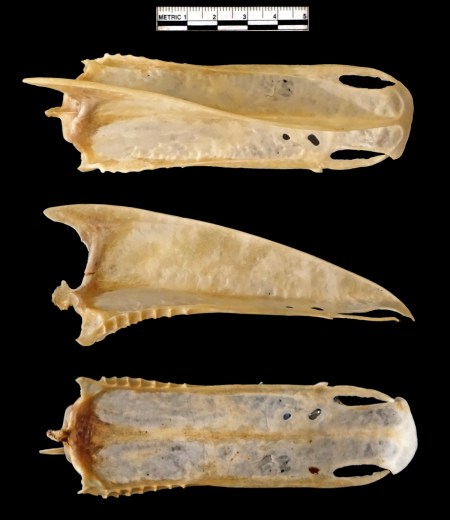
Last week I gave you this mystery object to identify, found on a beach in Ireland:

mystery286

It led to a lot of great cryptic comments relating to marine birds and sternum keels, but Lena was the first to comment and was spot on with the species (or at least as far as I can tell!)

Bird sterna are quite distinctive, with overall shape giving an indicator of mode of life. Long narrow but well-developed keels like this tend to be seen in marine birds that use their wings to fly underwater. The shape of the bottom and sides of the sternum tend to be quite specific to particular genera and species, making sterna pretty good for identification.

Of course that depends on having good comparative material and I was delighted to find John Rochester’s very helpful Flickr page, that has a comparison of British Auks (in this case we’re talking about the geographical British Isles rather than the sociopolitical concept of Britain).

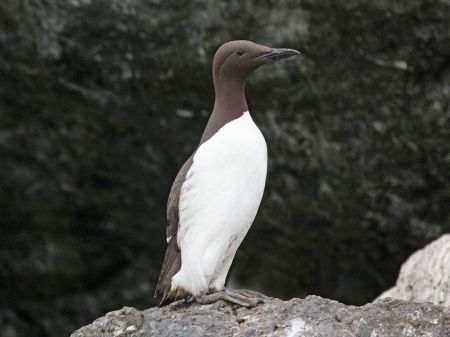
If you take a look at those images you’ll notice that one fits the shape very well indeed – the Guillemot or Common Murre Uria aalge (Pontoppidan, 1763).

1024px-common_murre_rwd2

Guillemot with its meat and feathers on. Image by Dick Daniels, 2011

So that’s the identification I gave to Emer, Ronan, Rory and Paddy who found it on their hols!


Friday mystery object #283 answer

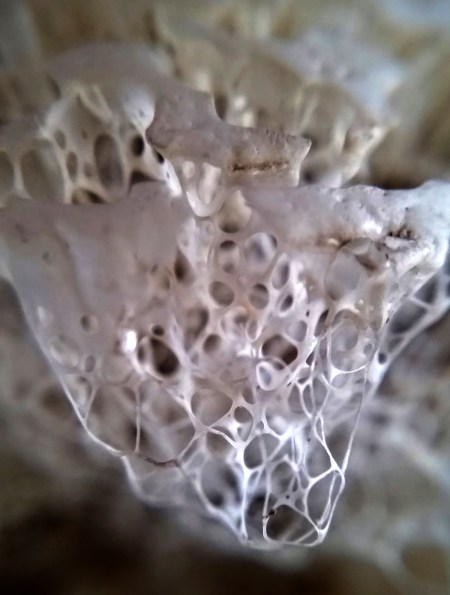
Last week I gave you this zoomed in picture of a specimen to have a go at identifying:

mystery283

It was a bit tricky, so I also gave you this bonus clue to help:

mystery283_bonus

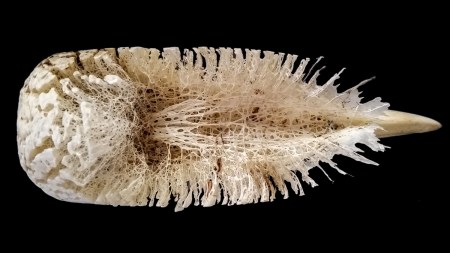
I was impressed to see that, despite the limited information available from the images provided, many of you managed to work out that this shows the lightweight ‘honeycomb’ structure that supports the casque of a hornbill.

That was the first challenge but, as ever, I was keen to see if you could get the identification to species – far more of a challenge considering the lack of a side view of the skull and lack of a scale. To make up for that I’ve decided to provide the necessary image here:

Ceratogymna atrata skull

I won’t say what species this is in this post, as I normally would, just to give some more of you a chance to make the identification yourself. However, what I will say is that the very first response by Wood contained a link to an image of the correct species and later to a blogpost featuring this very specimen. In that post there is a discussion about the appearance of the casque, with speculation about whether it had been damaged during preparation, resulting in its appearance. However, as Richard Lawrence pointed out, this appearance is actually normal for the skulls of several species of hornbill.

I will also say that the discussion between Daniel Calleri & Dan Jones and Richard Lawrence about whether it was a hornbill from a genus starting with A or B was interesting and I initially thought it was an A, but am now convinced that it’s a C.

If you’re desperate to know which species it’s from, here’s a link to the skullsite.com page about it.


Friday mystery object #279 answer

Last week I gave you this mystery object to identify:

mystery279

It’s the kind of thing you find in museum collections quite often, but it will commonly be misidentified – especially in anthropology collections where (in my experience) it will commonly be referred to as a claw or big cat tooth.

However, nobody who commented went down that route, recognising that the hollow base and well defined crown indicates that it’s an open rooted tooth of some sort. In mammals an open root at this size that would suggest a pig tusk or perhaps a whale tooth, but this isn’t mammalian.

In fact, this tooth is from something even less cuddly than a whale, something crocodilian. This was recognised first by Carlos Grau, but others who came to the same conclusion included Jonathan Larwood, Daniel Jones, palfreyman1414, Wouter van Gestel and Charne. More specifically, this tooth is from a Gharial, Gavialis gangeticus (Gmelin, 1789). This Gharial from the Grant Museum of Zoology in fact:

mystery279_Gharial

Grant Museum of Zoology Specimen LDUCZ-Y215

Gharial teeth are a bit less conical than the teeth of most crocodiles and alligators. Presumably the curve helps prevent their main diet of fish from getting free when caught.

Gharials are sexually dimorphic, with the adult males bearing a big rounded bony  knob on the end of their rostrum, this is where the name Gharial comes from, as this feature resembles a local earthenware pot called a “ghara”. Sadly, these distinctive crocodilians are critically endangered, with just a few hundred left alive in the wild. They are affected by habitat loss, egg theft and use in traditional medicines.

More mysteries next week and if you fancy hearing me talking about animals you might be interested in coming to Animal Showoff at the Grant Museum of Zoology next Thursday evening!

Friday mystery object #278 answer

Last week I gave you this mystery object from the Grant Museum of Zoology to get your thoughts on:

mystery278

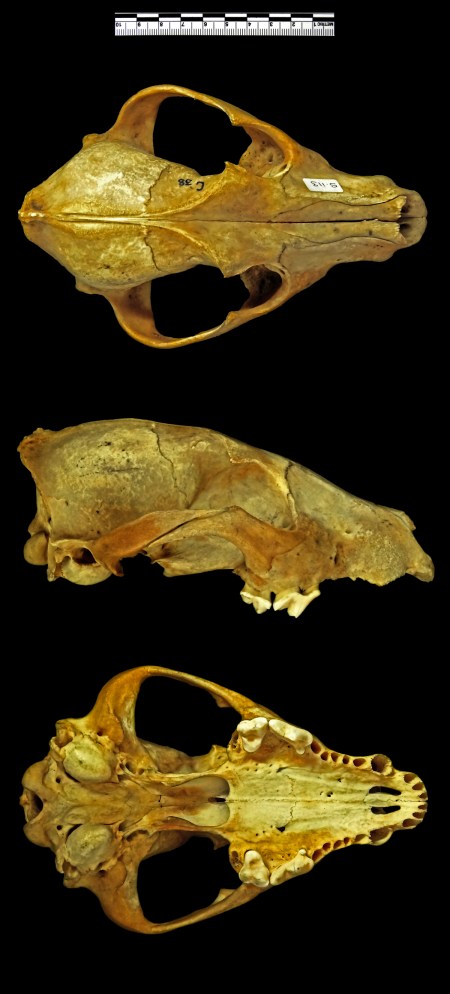
Most people spotted that this was a canid of some sort – but there was a lot of discussion about exactly what sort.

Allen Hazen made an interesting observation about the reduced second molar (missing in the specimen, but the socket shows that it was there and smaller than you’d expect from most dogs), plus the remarkably convex facial profile. Useful observations that have a bearing on the identification.

The short and broad muzzle, combined with the convex skull and distinctive molar morphology led Latinka Hristova to suggest Dhole, an identification agreed with by Lupen, palfreyman1414, Richard Lawrence, joe vans, Henry McGhie – and myself as it turns out.

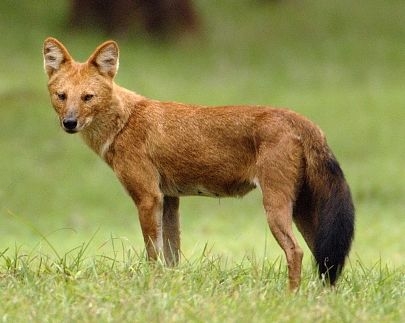
Dhole (Cuon alpinus) by Kalyanvarma

Dhole (Cuon alpinus) by Kalyanvarma

The Dhole Cuon alpinus (Pallas, 1811) is an endangered Asiatic Wild Dog, that hunts in clans and feeds on a variety of medium to large mammals that are usually killed after an extended chase.

I’d not seen the skull of one of these before, but I was aware that they have a convex profile, so it was my immediate suspicion when I saw the mystery object and the species was confirmed by the unusually simple structure of the first molar and very reduced second molar, which are almost cat-like in their adaptation for shearing meat.

All in all, an exciting skull to find – and there are other unidentified canids in the same box that I’m itching to take a look at, so keep your eyes peeled for more mystery mutts.

Friday mystery object #274 answer

Last week I gave you this ungulate skull to try your hand at identifying:

mystery274

It isn’t made any easier by the fact that it’s a female, so it lacks the horns or antlers that make identification easier. As with many ungulates it looks a bit sheepy (as I’ve mention before), but it has some clear indicators that helped you rule out what it’s not.

Jake spotted that the size was about right for a Roe Deer, but the auditory bullae (the bulbs on the underside of the skull that house the ear bones) are too massive and the proportions of the braincase are quite different.

Joe vans also ruled out deer, since it lacks lacrimal pits (large openings in front of the eyes that hold scent glands in cervids). Joe also noticed that the mandible is extremely pinched in just behind the incisors.

The incisors themselves caught the attention of Allen Hazen, who noted the extreme size of the first incisor, which he correctly recognised as being a bit of a giveaway to some people, although only when considered in the context of a variety of other features.

While Daniel Calleri summarised these odd features and added the observation of the decent sized occiptial condyl (the place where the atlas vertebra attaches to the skull) and small paracondylar processes (the bony extensions either side of the occipital condyl and just behind the auditory bullae).

These sorts of observations are exactly what are needed to differentiate between species that are very similar in overall morphology. However, without either an excellent reference collection, or even better, a well researched key, it’s almost impossible.

Fortunately, there is a skull key for a subset of Antelope that occur in Tanzania, created by the Field Museum and the mystery object this week happens to be from a genus present in Tanzania. I’d recommend having a go at using the key, but if you’d rather just find out the answer I’ve provided a link to what it is here. Have fun with the key and enjoy your Easter!

Friday mystery object #269 answer

Last week I gave you this mystery object from the Grant Museum of Zoology to have a go at identifying:

mystery269

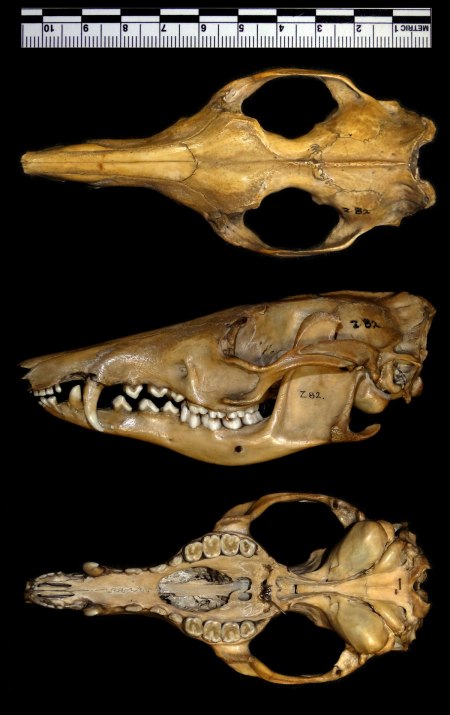
If you’ve been checking the mystery object recently you’ll notice that this specimen has a feature of the palate that I made reference to in the answer to mystery object #267 – the Tasmanian Devil. It’s incompletely ossified, which is a characteristic of marsupials.

The large curved canines and pointed premolars suggest some predatory activity, while the flattened molars suggest some grinding of vegetation, making this one of the marsupial omnivores, in the Order Peramelemorphia.

The large size of the skull and the long curved canines make this specimen rather distinctive – as first spotted by Richard Lawrence, this is indeed a Continue reading

Friday mystery object #268 answer

Happy New Year! I hope everyone had a lovely festive period.

I gave you this distinctive specimen from the Grant Museum of Zoology to try your hand at identifying:

mystery268

Despite being distinctive, it raised some discussion about the identification, because there are few resources available for comparison.

Phil Cox was the first to get the right Family (at least in the comments – @MelanieGbones got it on Twitter) – the Chrysochloridae or Golden Moles. Then the discussion got a bit more involved as species were discussed and the possibility of the convergent Marsupial Moles was considered.

There are 21 species of Golden Mole, all of which occur in southern Africa, which could have made this a very difficult identification to species, if it wasn’t for the large size of the skull and the very characteristic large and vertically-posteriorly flaring zygomatic arch that continues round to near the back of the skull. This narrows it down to one of two species in the genus Chrysospalax.

The extent of this feature in this specimen, plus the shape of the palate, suggest to me that this particular specimen is from the

Continue reading

Friday mystery object #260 answer

Last week I broke the news that in October I’ll be taking on the role of curator at the Grant Museum of Zoology at UCL. Many thanks to everyone for their congratulations and kind comments – it’s wonderful to have so much support!

I’m excited to get started in my new role, but I will be sad to no longer be the go-to person for identifying materials used in the Horniman’s Anthropology collections. This gave me the chance to see some lovely objects, like this little statue:
mystery260
I asked if you had any thoughts on what it might be, and you gave some great answers, mostly involving an ungulate canon bone or metacarpal / metatarsal. However, palaeosam and palfreyman1414 spotted that this isn’t made of bone, while Chris went one better by making a nice reference to ‘Horsing around near the river’ – a reference to the meaning of the name Hippopotamus.

The key to identifying this is to look at the curve of the statue and the view from underneath. That cavity shape (plus the gentle curve) is exactly what you’d expect from the upper canine of Hippopotamus amphibius Linnaeus, 1758 – so well done Chris!

There’s a helpful guide to identification of ivories by the US Fish & Wildlife Service, which is well worth a look to help with this sort of thing. Hopefully that’ll be a helpful resource for my colleagues at the Horniman in my absence… although they know where to find me if they need help in future!

Friday mystery object #259 answer

Last Friday I gave you this section of an object that I found in an unmarked box during a reshuffle of the Horniman’s bone room:

mystery259

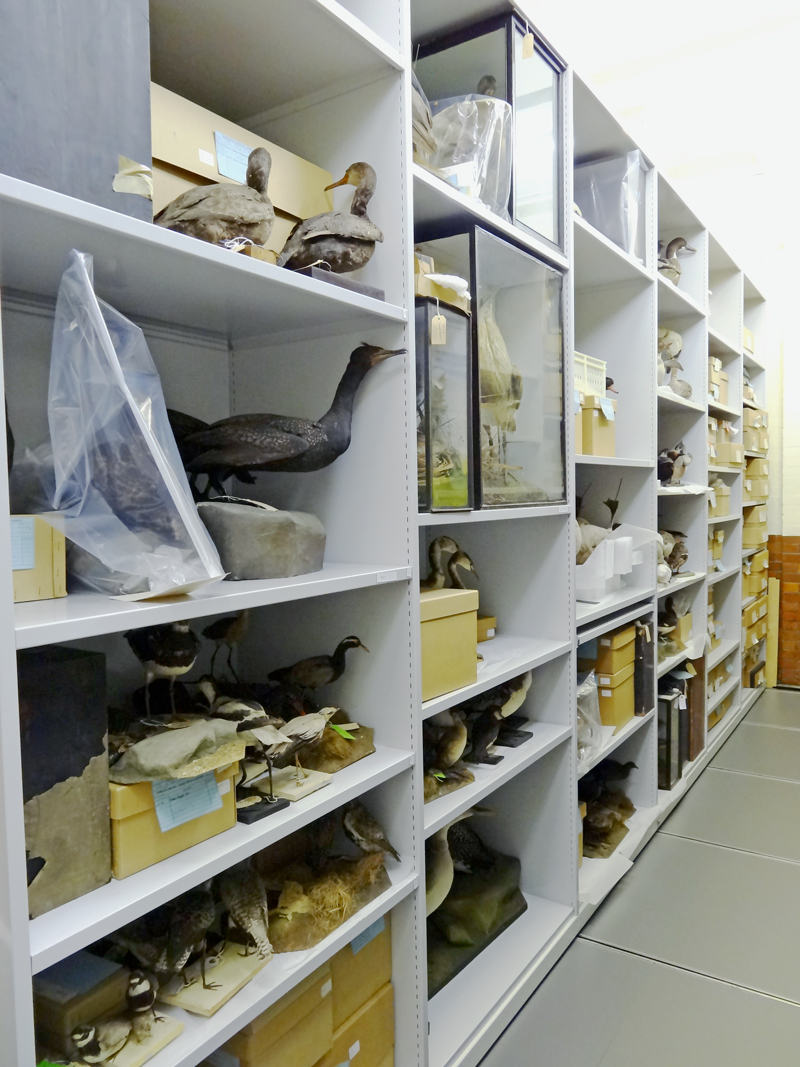
The reshuffle is part of a project to make space for temporarily housing specimens while our taxidermy storage space is upgraded. This is a fairly big undertaking, since it means finding enough nooks and crannies to accommodate a full room’s worth of stuffed critters, to allow the room they came from to be fitted out with long span shelving and roller racking – which should double its capacity.

taxidermy_storage

Bone room invaded by taxidermy birds

This reshuffle has also given me the opportunity to dig through the shrinking number of boxes of unidentified fragmentary material to see if any more can be matched back to specimens or rehoused in smaller boxes, thereby saving space. That’s where the mystery object comes in.

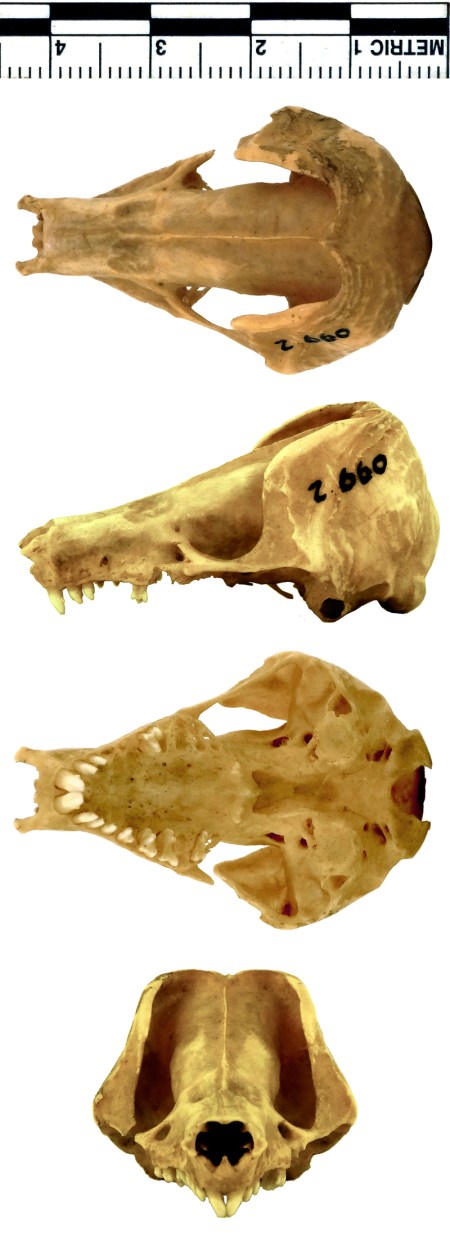
It has quite a distinctive shape, with a robust zygomatic arch (cheekbone), inflated tympanic bulla (bony bulb that houses the earbones) and thin squamosal (a bone of the side of the the skull – all of these parts fused together like this can also be called the temporal bone).

The structure of the glenoid fossa (joint where the mandible articulates) suggests it’s a carnivore of some sort, since herbivores tend to have a more open articulation that allows their mandible to move freely in order to grind tough vegetation more effectively. Carnivores need a more precise bite, to cut or clamp their food, which requires a tighter articulation.

However, the thin bone of the squamosal is less usual in a carnivore of this size, since this region normally deals with large bite forces and needs to be reinforced. This suggests an animal that isn’t relying on a powerful bite. The tympanic bulla is also quite open in structure, which I would associate with an animal that dives underwater and needs to be able to equalise differences in internal pressure effectively. These clues suggest that this piece of bone is from a seal of some sort.

Figuring this out let me compare the mystery object to seal specimens, to see if any were missing the temporal region. As it turns out I did indeed find a fragmentary seal specimen that fit the bill:

seal

This specimen was acquired in 1912 and had been sawn up in order to mount the other half for display on the Natural History Balcony at the Horniman:

Seal_NH.12.37

In the register it was recorded as “Skull of Seal (Phoca annulata)” which is an out-of-date name for the Ringed Seal Pusa hispida (Schreber, 1775), but I have my doubts about this identification after consulting this useful piece of research on identification of archaeological seal remains by Hodgetts, 1999 [opens as pdf]. The tympanic bulla, mandible and dentition (plus the suture on the zygomatic arch) make me think that this may in fact be a Harp Seal Pagophilus groenlandicus (Erxleben, 1777).

So well done to henstridgesj, Ric Morris, Bobby Boessenecker and Lee Post, who all worked out that the mystery object was from a seal. Please feel free to add more thoughts on whether you agree with my identification of Harp Seal!

Friday mystery object #254 answer

Last Friday I gave you this odd bit of bone (or should I say bones) from a box of mixed objects to identify:

mystery254

As Ellen Going immediately recognised, it’s a scapula and clavicle – which in itself tells us that it can’t be from a Carnivore or Ungulate, since they lack a well-developed clavicle.

The open articulation with large acromial and coracoid processes and the symmetrical, blade-like scapula body suggest that this is an animal with a lot of movement in the shoulder, and reciprocal movement at that (hence the symmetry). This suggests a flapping animal, but without the extreme clavicle adaptation (i.e. the wishbone) seen in birds.

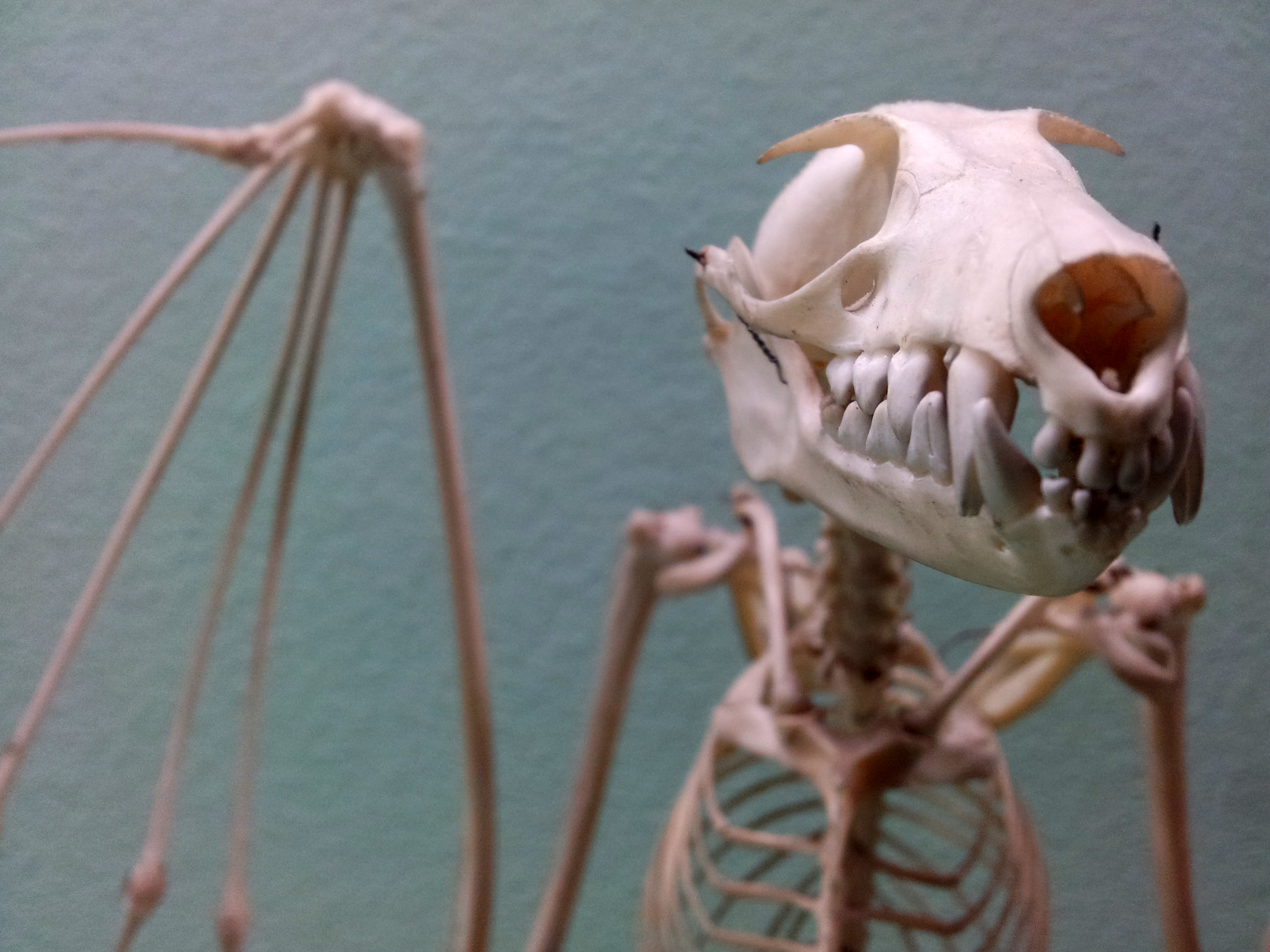
So as Flick Baker, Ric Morris and Joey Williams all realised, this is the shoulder and clavicle of a large fruit bat, in the family Pteropodidae. Good work!

fruitbat-processed

Friday mystery object #253 answer

Last Friday I gave you this lovely specimen from the King’s College Museum of Life Sciences to try your hand at identifying:

mystery253

It wasn’t easy, since there were limited views, so the dentition wasn’t entirely visible and the bones of the palate are not shown. Also, there was no scale bar – something that Ric Morris gently reprimanded me for.

Despite these limitations, many of you correctly managed to work out that this is the skull of a Mongoose of some sort. So congratulations to bugblokenzFlick Bakerhenstridgesj, Michelle and Allen Hazen for recognising that this is a member of the Herpestidae.

Narrowing it down beyond that is more of a challenge and without better images it’s a bit unfair to expect a species level identification – but I’m going to have a go.

Scouring through Mongoose skulls in collections and various images online (especially using the fantastic Animal Diversity Web resource, the ever helpful Skulls Unlimited and the brilliant Mammals of Tanzania Skull Key), I came to realise that the teeth are visible enough to discount many Mongoose species. Also, the shape of the zygomatic region and facial profile was quite distinctive (most Mongooses have cheekbones that are flat under the eye sockets – but not this chap).

Excluding the options that didn’t quite fit, left me with a few that did – the Egyptian Mongoose Herpestes ichneumon, Slender Mongoose Herpestes sanguinea, and White-tailed Mongoose Ichneumia albicauda.

Not a clear-cut identification, but better than nothing, and it might be possible to refine it by looking at the specimen in the flesh… as it were.

Friday mystery object #251 answer

Last week I gave you this object to have a go at identifying:

mystery251

I thought it looked a bit like an Ewok’s weapon, but fairly obviously it’s a bit of some critter’s leg. The question is, which critter?

In comments by David M WatsonDavid Honetaihaku and palfreyman1414  it was quickly recognised as being from a ratite (the group of flightless birds that include Emus, Cassowaries, Kiwis, Rheas and Ostriches – plus some extinct examples like Moas and Elephant Birds), but it was henstridgesj who narrowed it down to a tarsometatarsus (fused ankle and foot bones) of the correct ratite – the Ostrich Struthio camelus Linnaeus, 1758.

The size is a bit smaller than you’d expect for an adult Ostrich and the top of the bone (the bit on the left) is less well fused, so it appears to be from a subadult individual. The reason it can be distinguished from some of the other suggested ratites is all down to the number of trochlea (the rounded and grooved end bits that the toes attach to). Ostriches only have two toes, whereas the other ratites have three or four and this is reflected in those trochlea.

Ostrich foot by Tony Wills, 2007

Ostrich foot showing the two toes. Image by Tony Wills (2007)

So well done to everyone who took part, especially henstridgesj who was spot on!

Friday mystery object #250 answer

For my 250th mystery object I gave you this object from the collections of the Horniman Museum & Gardens to identify:

mystery250

It gave me a bit of a challenge, but eventually I managed to work it out – and it looks like something similar happened in the comments!

We went from ribs, to hind limbs to jaws, which is where it started getting close to the mark. The suggestion of “Part of the zygomatic arch of something large?” by henstridgesj was on the money.

Allen Hazen broke down the observation a bit further, with an astute observation about the components of the zygomatic arch that are present “The jugal and squamosal components of the zygomatic arch (I’d say its the squamosal that has been cut open here)“. Allen also speculated that it may be from a Dugong – which was my preferred identification for a while.

However, Crispin and henstridgesj worked out that it was from an Asian Elephant Elephas maximus Linnaeus, 1758 – the same species that I had also concluded that it belonged to.

By narrowing down the identification to species I was able to search through the museum’s collections management database to find out whether this sliced-off piece of bone might be part of another object. As it turns out, it was!

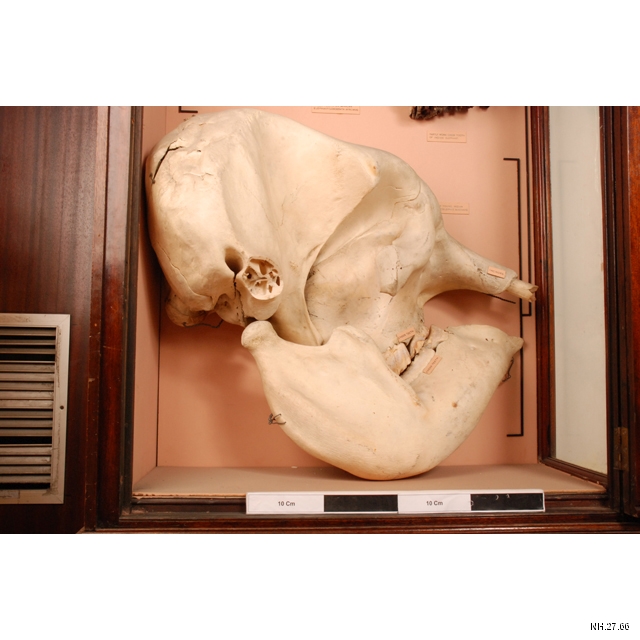
NH.27.66 Elephas maximus on display at the Horniman

NH.27.66 Elephas maximus on display at the Horniman

So by being able to identify this piece of bone it could be reassociated with the specimen that it originally came from and now there is a record for it in our database, so that if the skull ever comes off display it can be reunited with its cheekbone.

It also made an apt object for my 250th mystery object for Zygoma!

Friday mystery object #248 answer

Last Friday I gave you this mysterious leg to identify:

mystery248

It had me stumped for some time and I was hoping that your suggestions might lead me to an identification.

As it turns out, I did indeed get inspiration from your ideas and I think that I may have worked out which species this leg came from.

The first suggestion came from Barbara, who suggested that it might be from a Wombat. This was a great suggestion, since I hadn’t properly considered any marsupials and the robust nature of the leg suggests a heavyset digger. However, the calcaneus (or heel bone) in Wombats is shorter than we see in this specimen and the ungals (the bits at the very end of the toes, where the claws would attach) are longer and more spade-like in the Wombat – an adaptation for digging.

Carlos and Lee Post made some useful observations about the patella (kneecap) and general proportions of the hind limb elements and how they relate to those of other animals – ruling out anything from North America.

Finally, henstridgesj made the interesting suggestion of Capybara, although it appears that the fibula on the mystery object is far too robust to belong to a Capybara. However, I hadn’t thought too much of rodents, so that got me thinking of another possibility:

20140227_143245

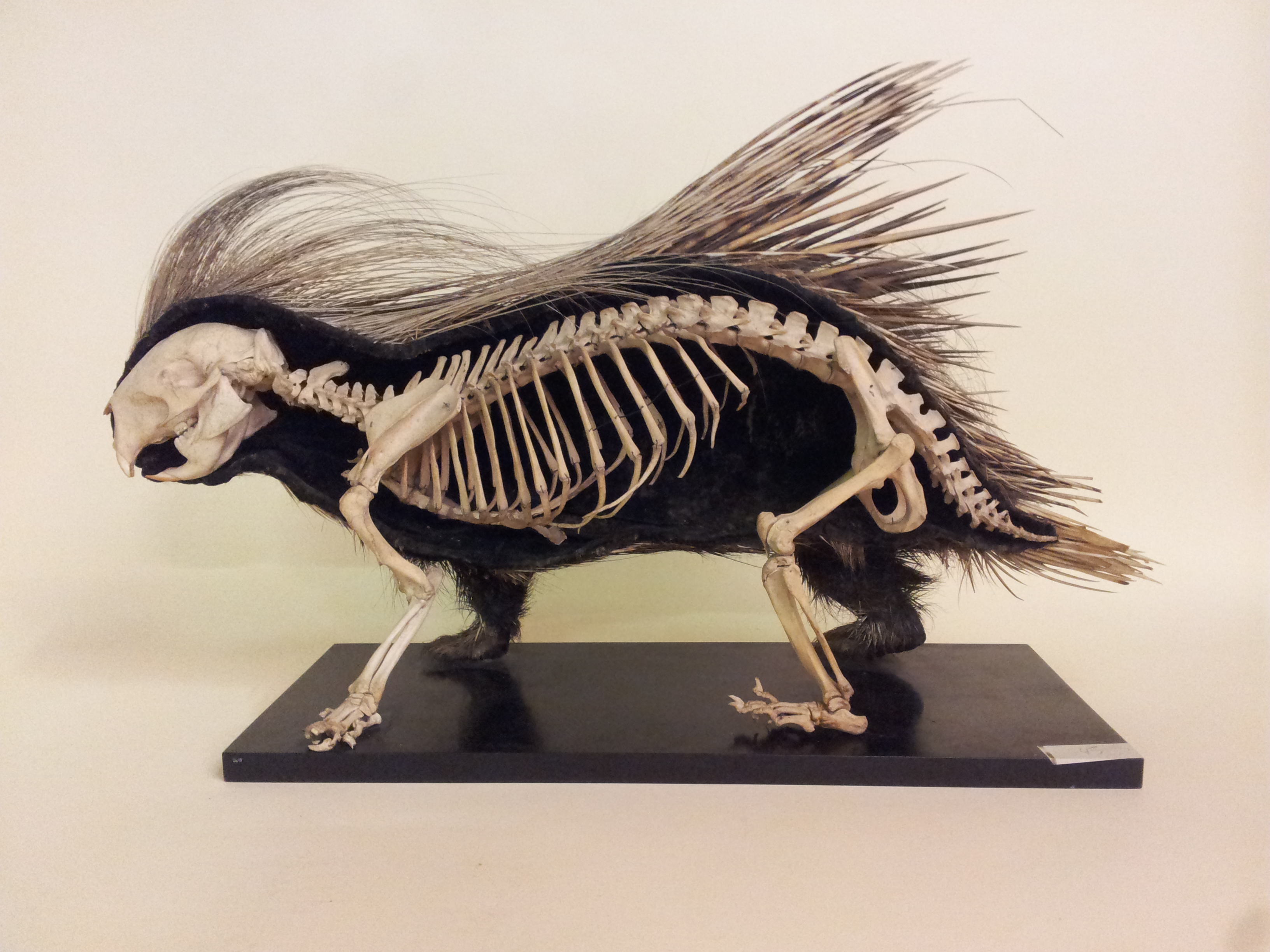
The Crested Porcupin Hystrix cristata Linnaeus, 1758 is the third largest rodent after the Capybara and Beaver, and it appears to have similar general proportions of the hind limbs. I’ll need to check against a specimen, but it seems I have a useful direction for investigation – so many thanks to everyone for your suggestions!

————————–

Update March 27, 2015 9:41am

I have now checked the mystery specimen against a Crested Porcupine and they are indeed a match!

wpid-20150327_092925-1.jpg

Friday mystery object #247 answer

Last Friday I gave you this unidentified object to get your opinions on:

mystery247

This specimen has puzzled me quite a bit. The internal structure is a dense honeycomb, that seems too tightly compacted to belong to a bird – plus it’s so big that the only birds it could possibly belong to would be a Moa, Elephant Bird or maybe Ostrich at a push, and I compared this against two of these three possibilities:

mystery247b

So, it’s mammalian and large. It’s also clearly a metatarsal or metacarpal, based on the shape of the articular surfaces.

It’s not shaped quite right for a one or two toed animal so the it seems that the variety of suggestions along those lines of Hippopotamus, Rhinoceros and Elephant are most likely to be in the right area.

I did compare this to Hippo feet and an Elephant hindfoot and drew a blank, so that leaves an Elephant forefoot or a Rhinoceros foot. My best guess would be the 4th metacarpal of a Rhino, although Elephant is still a contender – I will try to find some comparative material to confirm.

A massive ‘thank you’ to everyone who contributed ideas – it’s great to have some fresh perspectives and new directions to explore when you’re stumped!