This week I thought I’d stick with one of our feathered friends for the Friday Mystery Object:
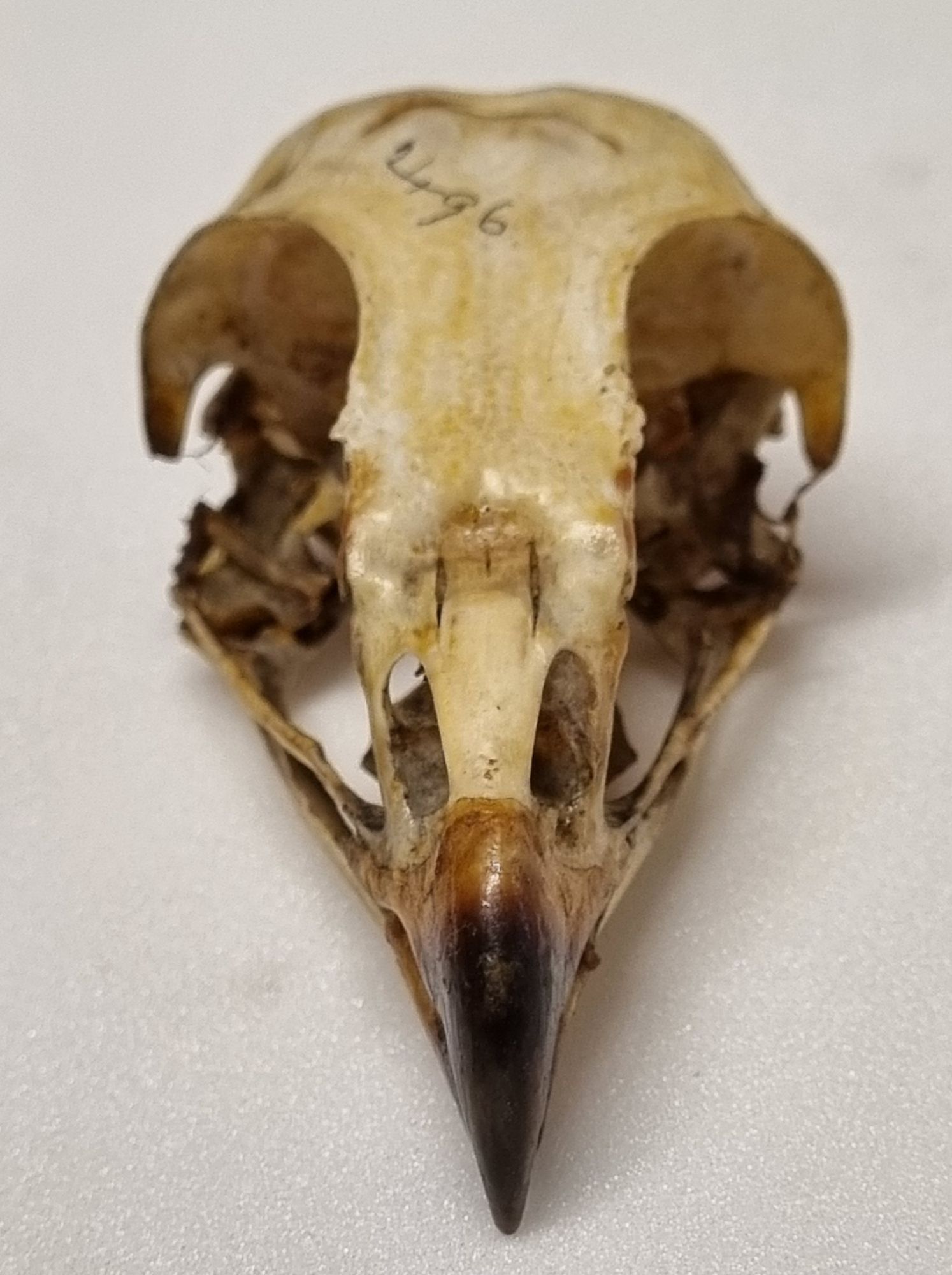
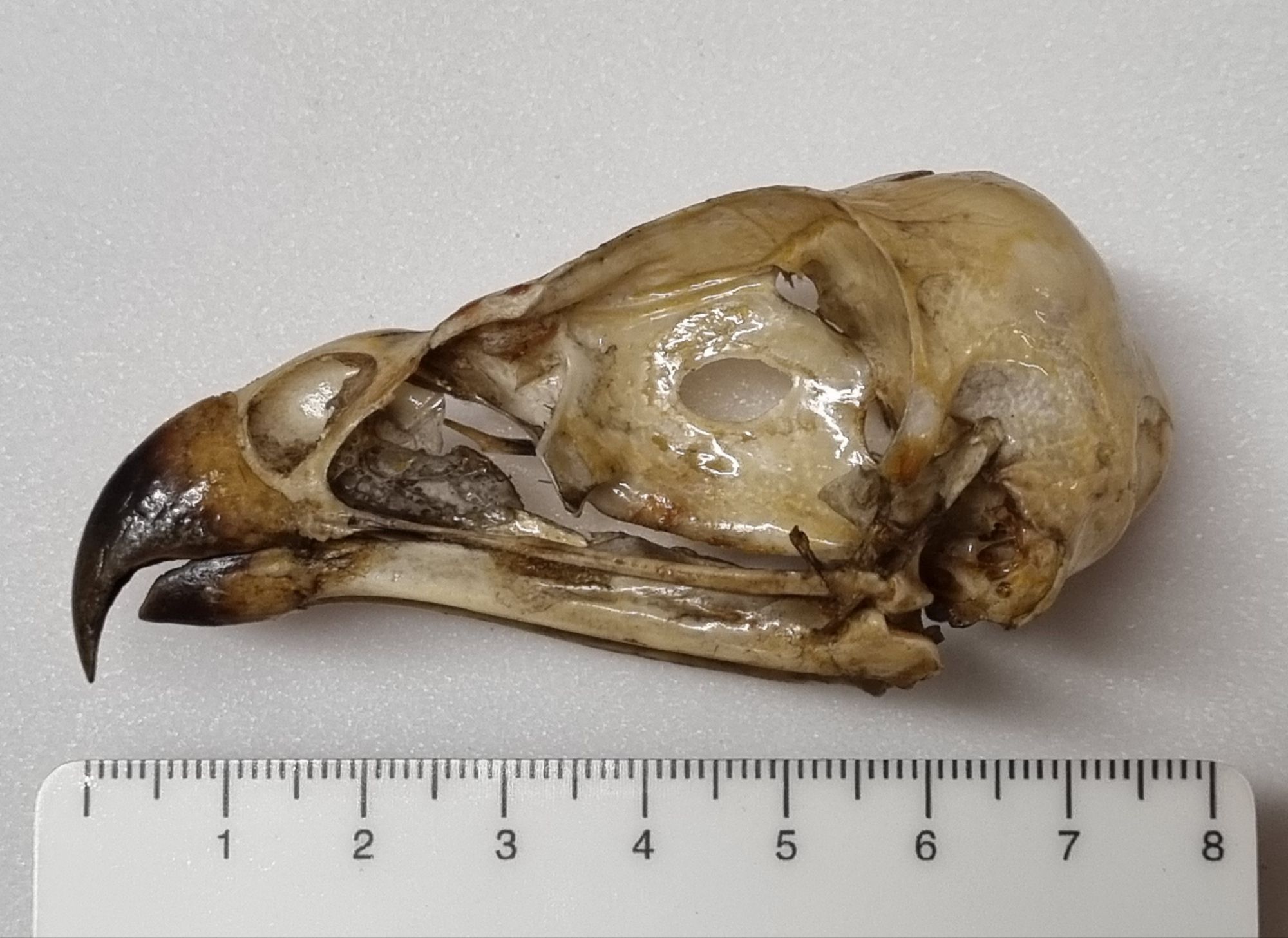
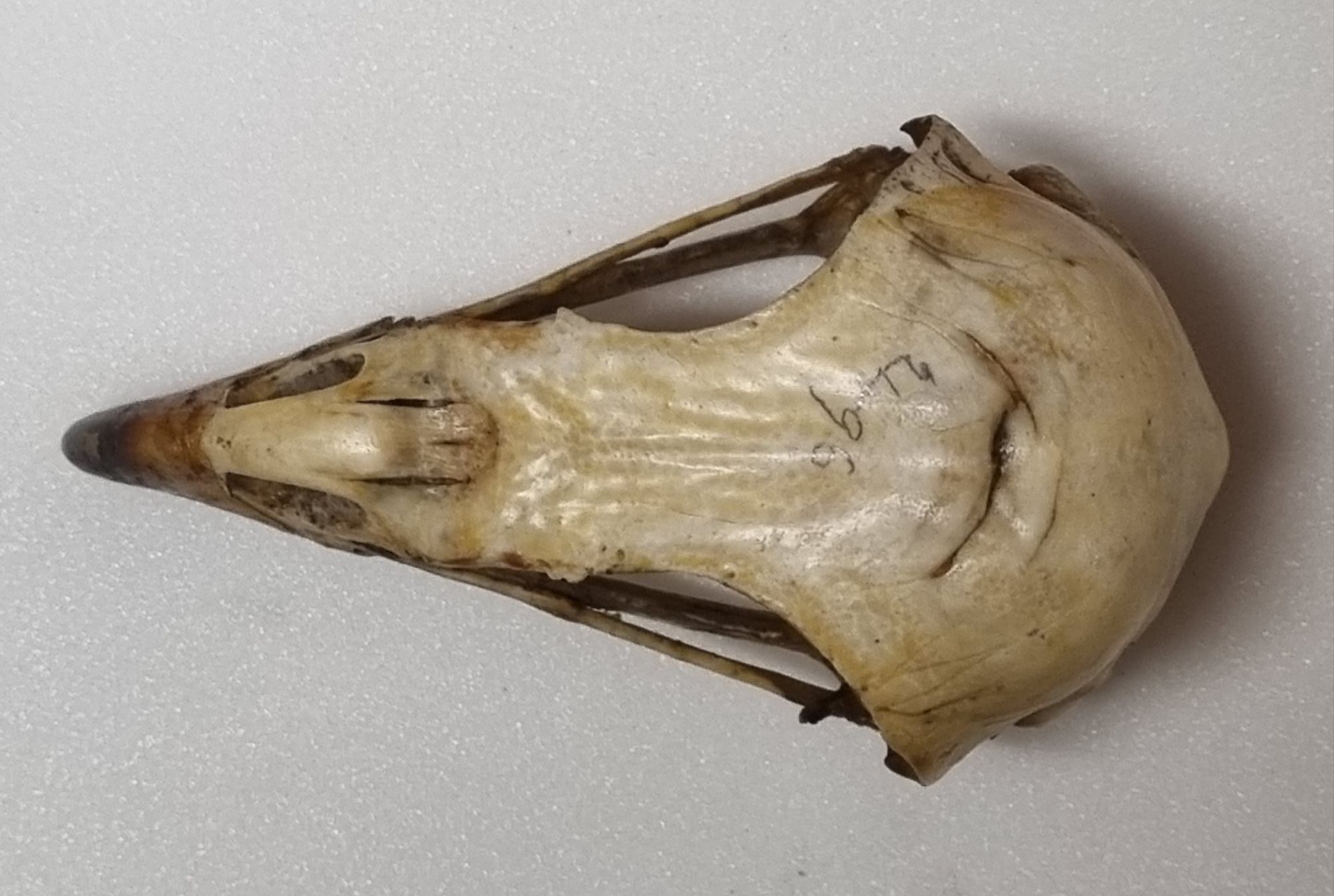
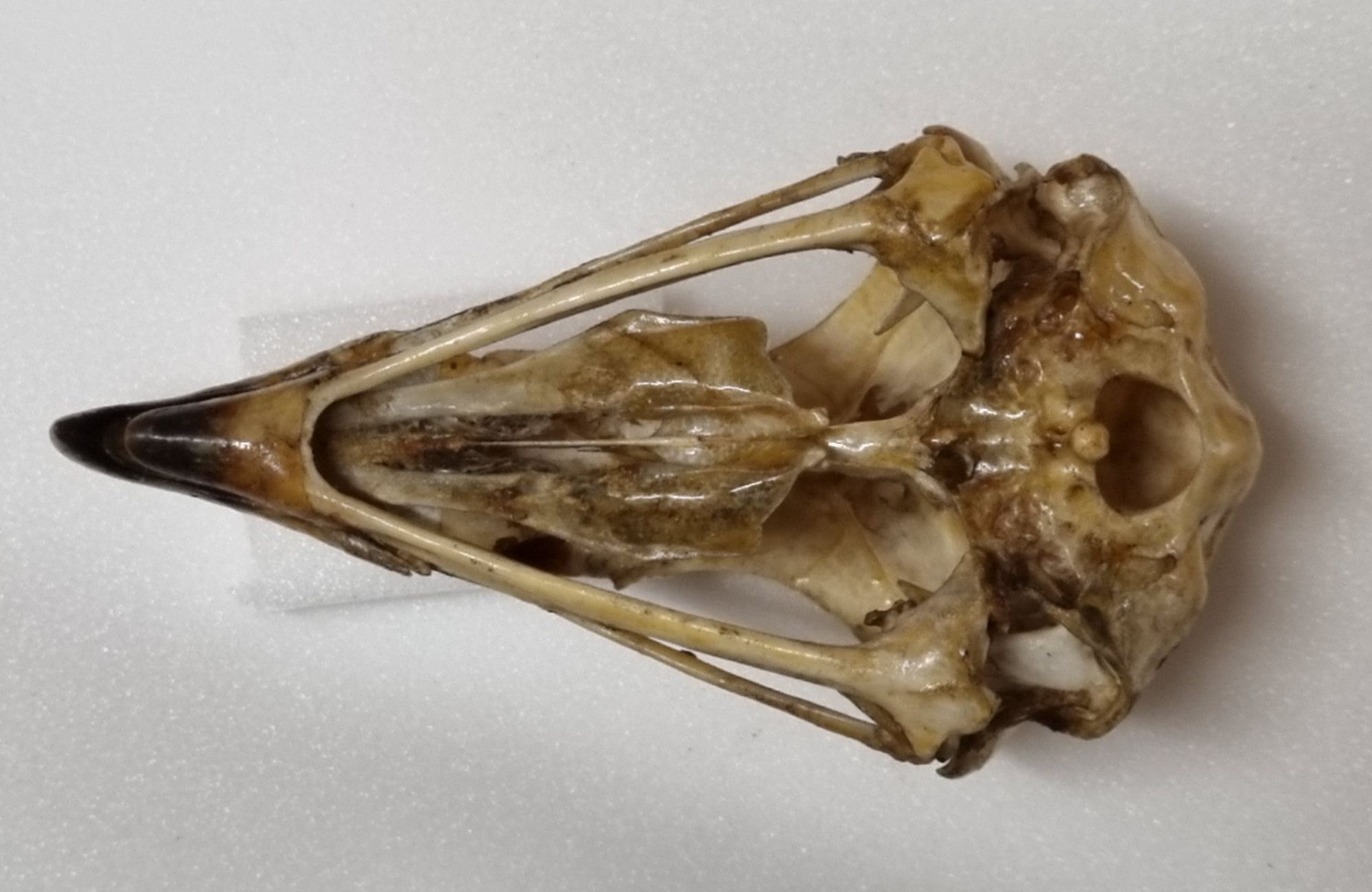
Let me know what you think this specimen might be – I’d love to hear your thoughts in the comments below!

This week I thought I’d stick with one of our feathered friends for the Friday Mystery Object:
Let me know what you think this specimen might be – I’d love to hear your thoughts in the comments below!
Last week I gave you this skinny piece of bone to have a go at identifying:
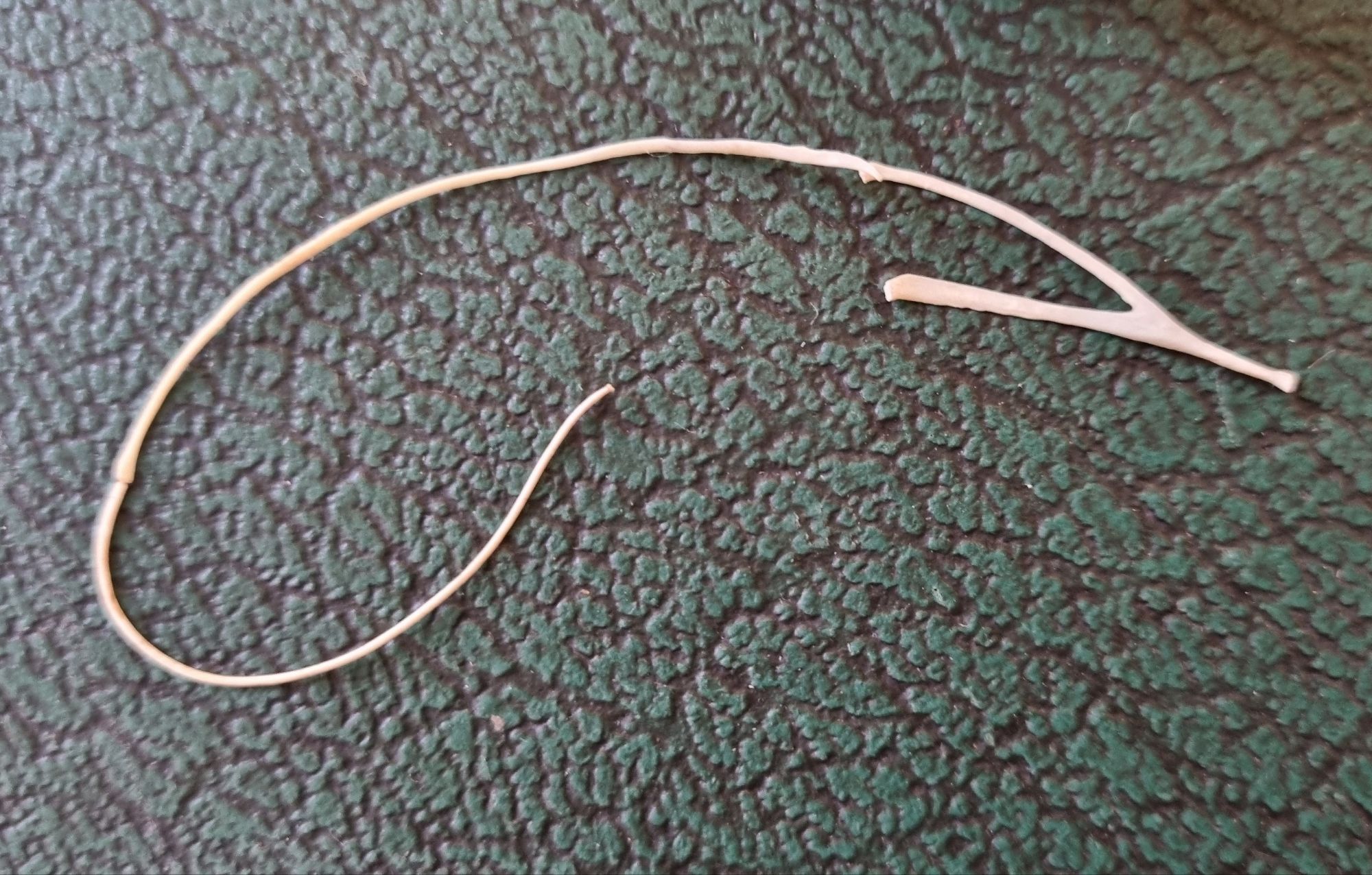
As it turns out, it was both a fairly easy one, and a difficult one at the same time. The easy bit was working out what the bone was and the family that this particular one comes from. The difficult bit was working out the species.
This bone is part of the tongue-bone (or hyoid) of a woodpecker – as everyone seems to have known, based on all the comments. More specifically, this hyoid is from a European Green Woodpecker Picus viridis Linnaeus, 1758.
If you’re not familiar with the hyoid of a woodpecker, it’s a particularly interesting structure that I have written about before (all the way back in 2012). To summarise, the tongue of woodpeckers is extremely long and has barbs, which allows the woodpecker to insert it into the holes it drills in trees to fish out insect larvae.
To help accomodate this length, the hyoid arises from the right nostril of the bird and goes around the skull and into the mouth, supporting the muscle of the tongue almost the whole way around. The tongue can then contract against the bone, which allows it to elongate significantly:

Since I first blogged about this, there has been research published that has dismissed one of the proposed functions of this unusual feature. Research suggests that it is no longer considered likely that the tongue and hyoid act like a shock-absorber to help protect the woodpecker’s brain from impacts when pecking wood. (Physiology: Woodpecker skulls are not shock absorbers: Current Biology).
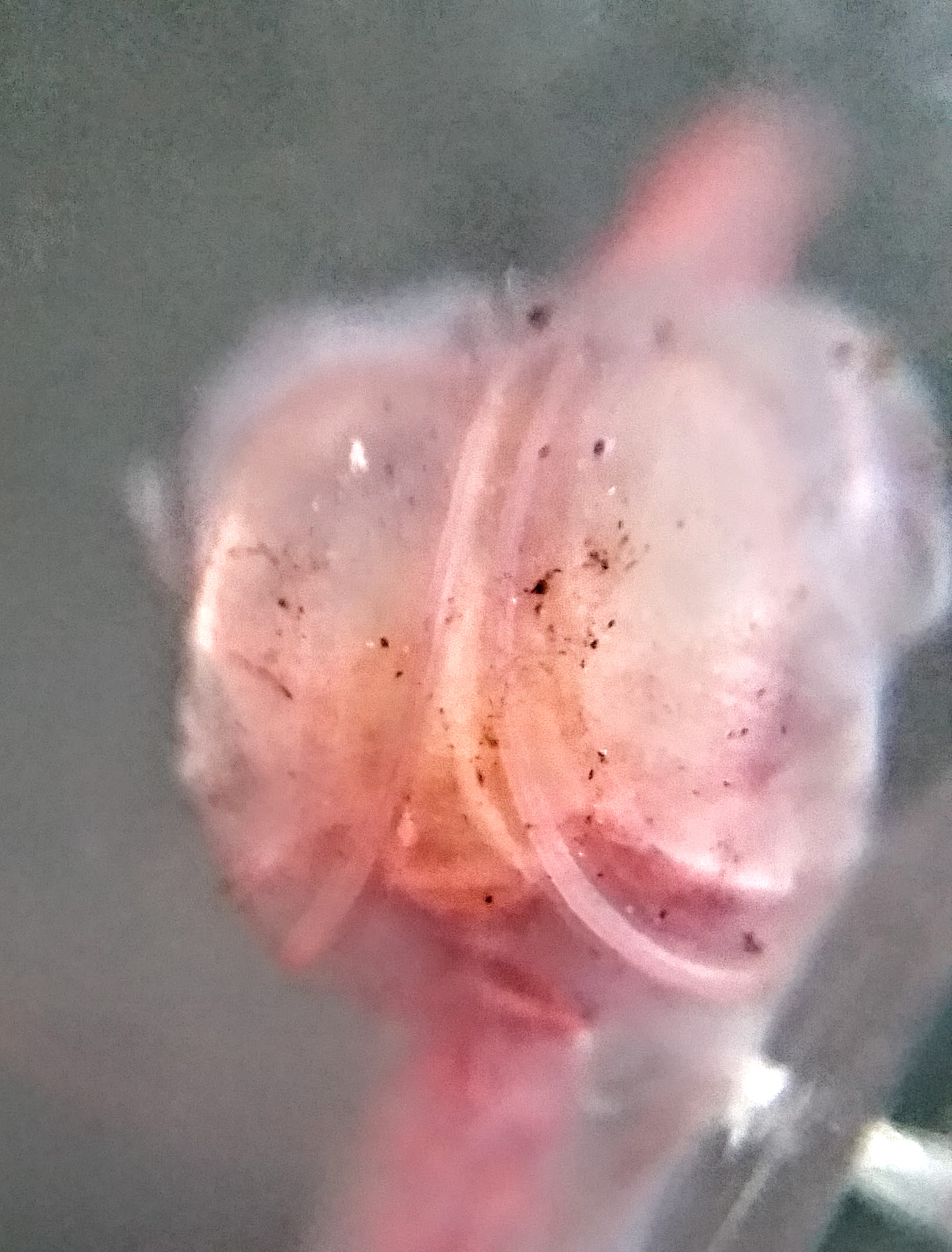
This was previously a widespread idea that had gained a lot of support, but I’m not particularly surprised that it probably isn’t the case to be honest, since it didn’t make a huge amount of sense from a functional perspective. Other species of bird also wrap their hyoid around their skull in the same way, simply to accommodate long tongues, but without any need for cushioning their brain. Hummingbirds are a good example that I’ve featured on the blog before:
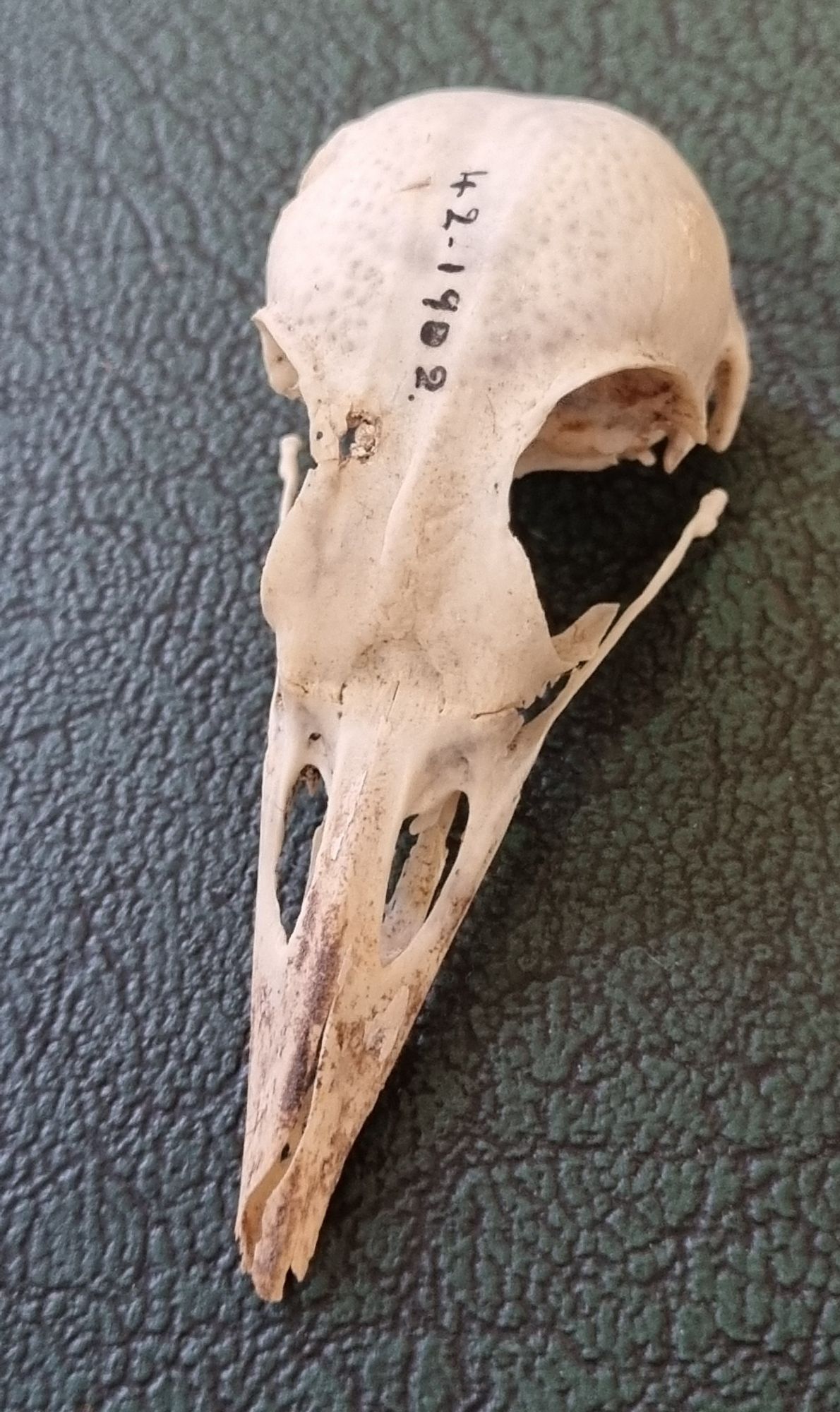
Shock absorbing or not, these long hyoids are fascinating features, that leave a clear mark on the skull of the birds that have them – see the wide, smooth groove over the top of the skull of the specimen that this mystery hyoid came from below (it even makes a handy place to write a museum number!):
Just to note, I thought that someone might have guessed the species based on the scale and shape of the mystery object. I noted that it was 6cm across, and with that curvature it offered a hint at the length of the skull, ruling out smaller species.
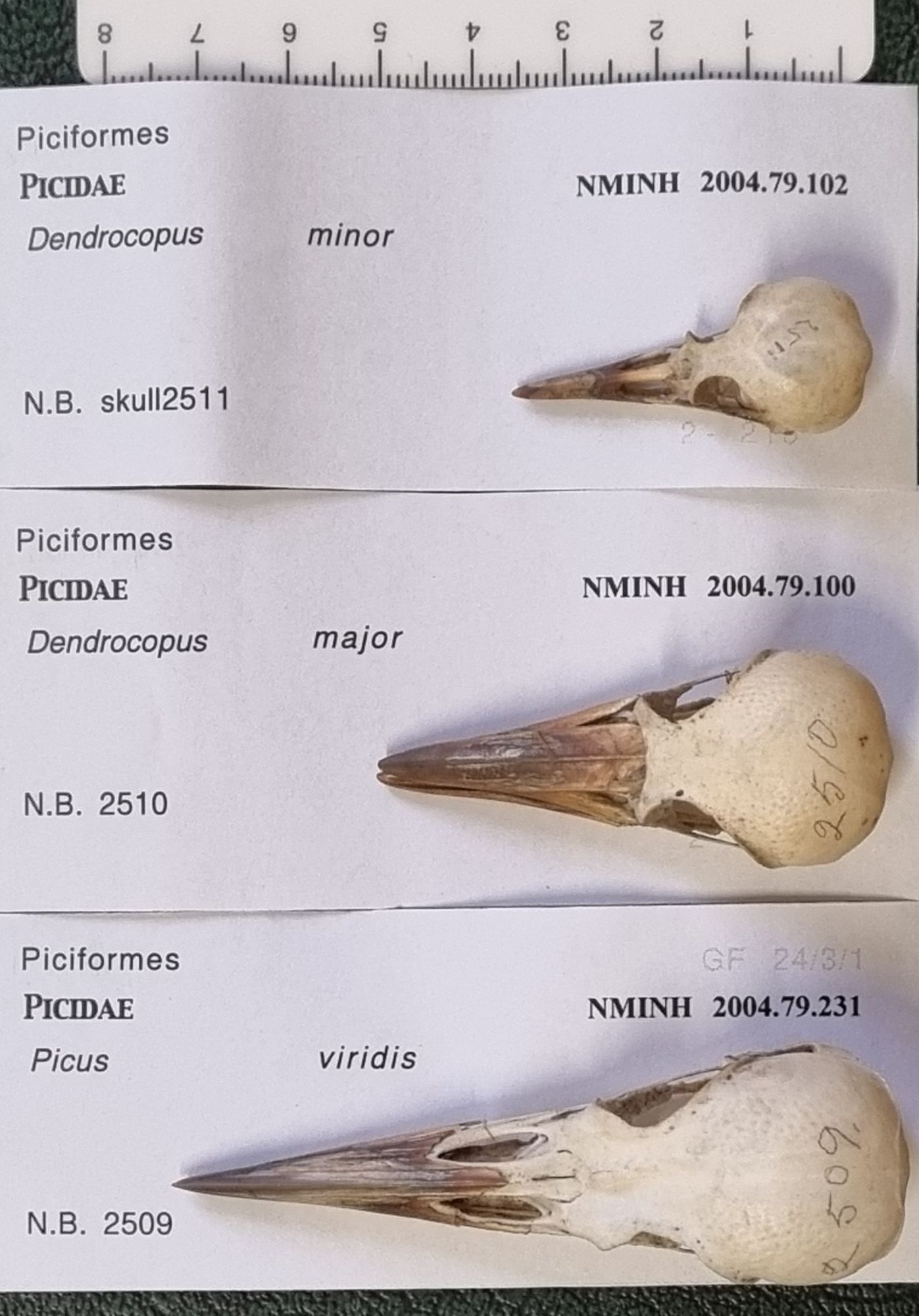
For reference, here are examples of the only woodpecker species that have been recorded in Ireland, with a scale bar to help compare sizes:
I hope you enjoyed that little update on our understanding of the weird and still wonderful woodpecker hyoid.
This week I have a nice mystery object for you from the collections of the Dead Zoo:
It’s around 6cm across if you want a sense of scale.
I was hesitant to go with this, as I thought it might prove a bit tricky, but Melissa (my wonderful wife and a non-biologist) immediately knew what it was, so perhaps it’s not too much of a challenge after all – let’s hear what you think it is and which species it comes from.
Have fun with it!
Last week I gave you this guest mystery object from Zygoma regular Joe Vans:
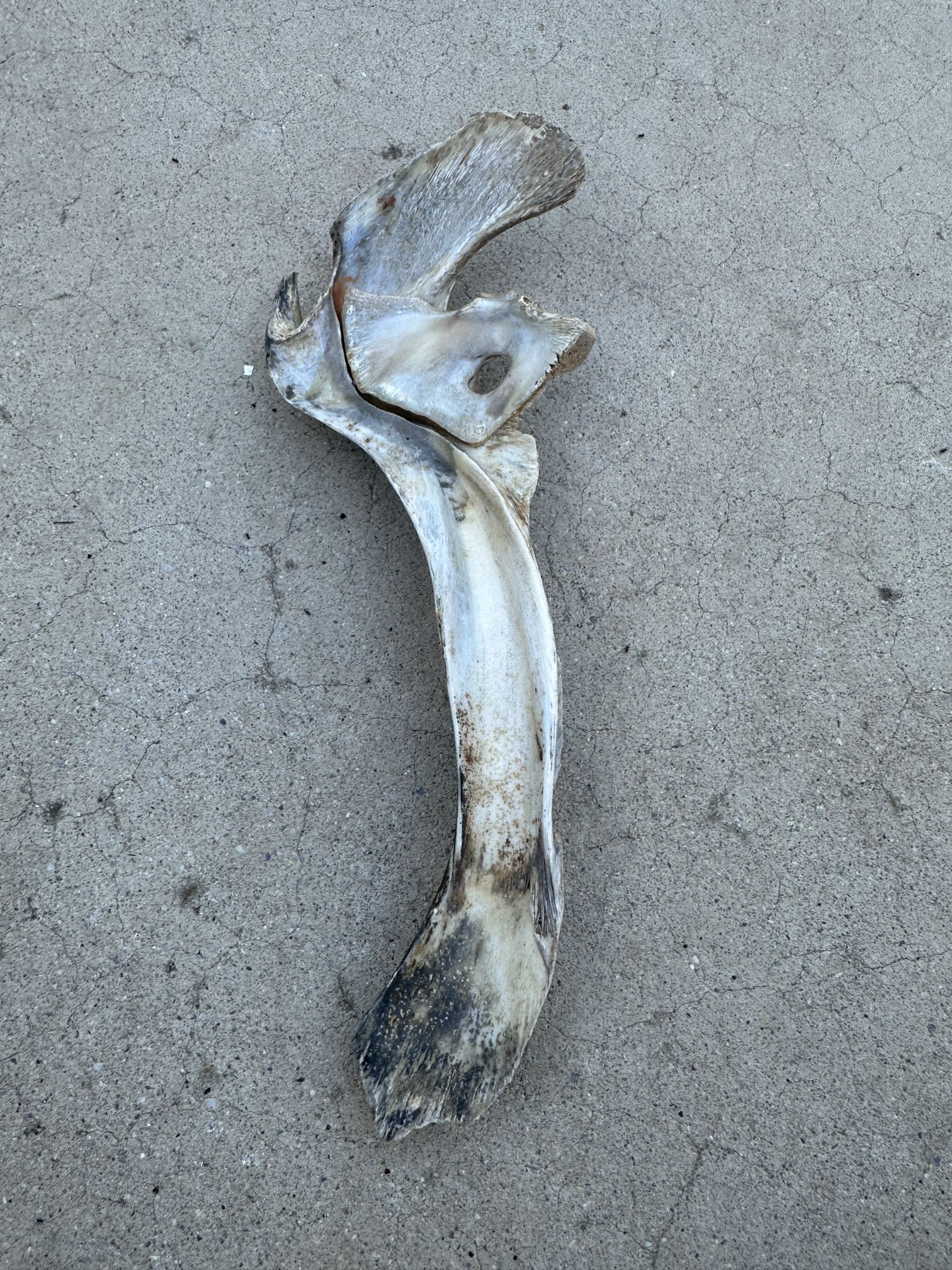
It was a tricky one, as it’s a section of a fish skeleton that is rarely talked about and even more rarely photographed, as it’s nestled among the bones of the pectoral girdle, in close proximity to the rear part of the skull – an area with a lot going on!
Basically this is part of a fish shoulder, as effectively described by Wouter van Gestel, who hinted with the cryptic clue “These are the shoulder bones of a fish the Japanese pay a fortune for, as long as a cook never touches it.” Adam Yates also arrived at the same conclusion, identifying the elements as the “cleithrum and scapula of a scombrid fish.”
This was more or less my response to Joe Vans when he contacted me about this specimen – I thought it could be from a species of Tuna, which is what I think Wouter also thought based on his sashimi reference. Adam Yates went with the same family, but went in the direction of a Spanish Mackerel (close relatives of the Tuna and Bonitos) or Bullet Tuna.
Joe Vans, who has the best perspective on this object since he has it to hand followed up with the this:
“I think it might be a Thunnus, specifically a Pacific Bluefin Tuna (Thunnus orientalis) based on the size of it and being found in Santa Cruz, California”
But Adam Yates thought the morphology didn’t look right for a member of the Thunnus genus.
Finding good comparative reference material to confirm the species is not easy, so I think that’s as good as we’re going to get for an identification at this point – at least until someone comes up with a good match, or even better, a comprehensive reference database for fish postcranial skeletons (given the scale of fish diversity, I’m not holding my breath for that!)
Until then, I suspect we’re dependent on size, local distributions of species, and general familiarity with specimens we may have seen before to get us in the right area. So my thanks to Wouter and Adam for their observations, and to Joe for sharing another genuine mystery object that got us all wracking our brains!
This week I have another guest Mystery Object for you from regular contributor Joe Vans:
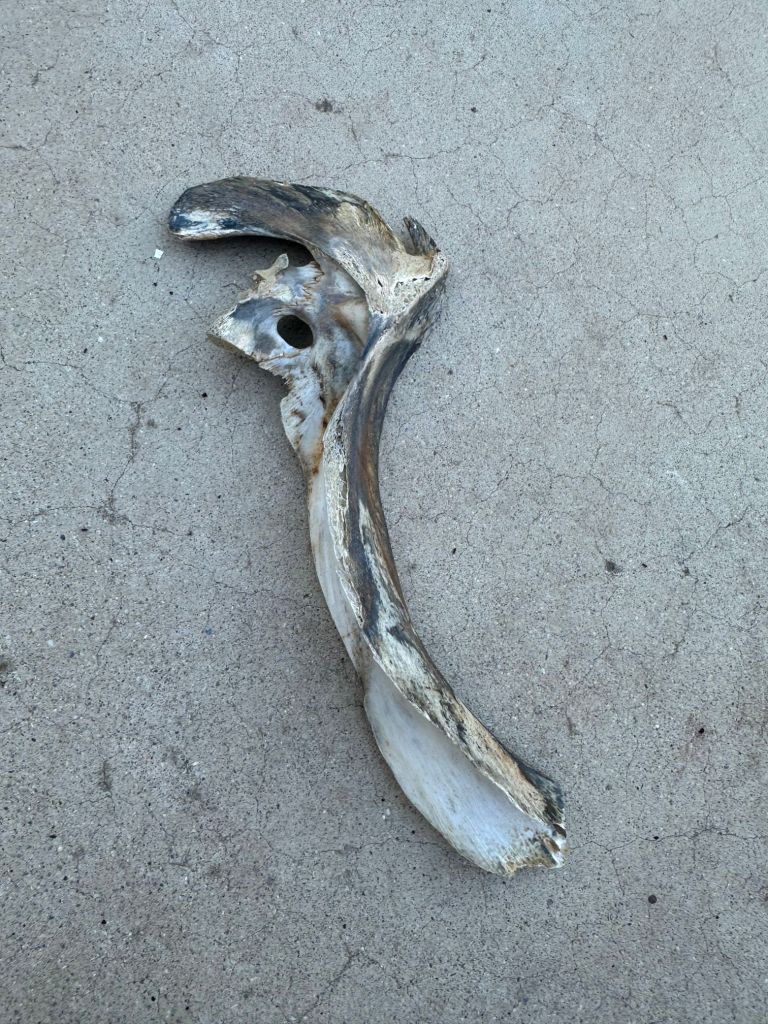
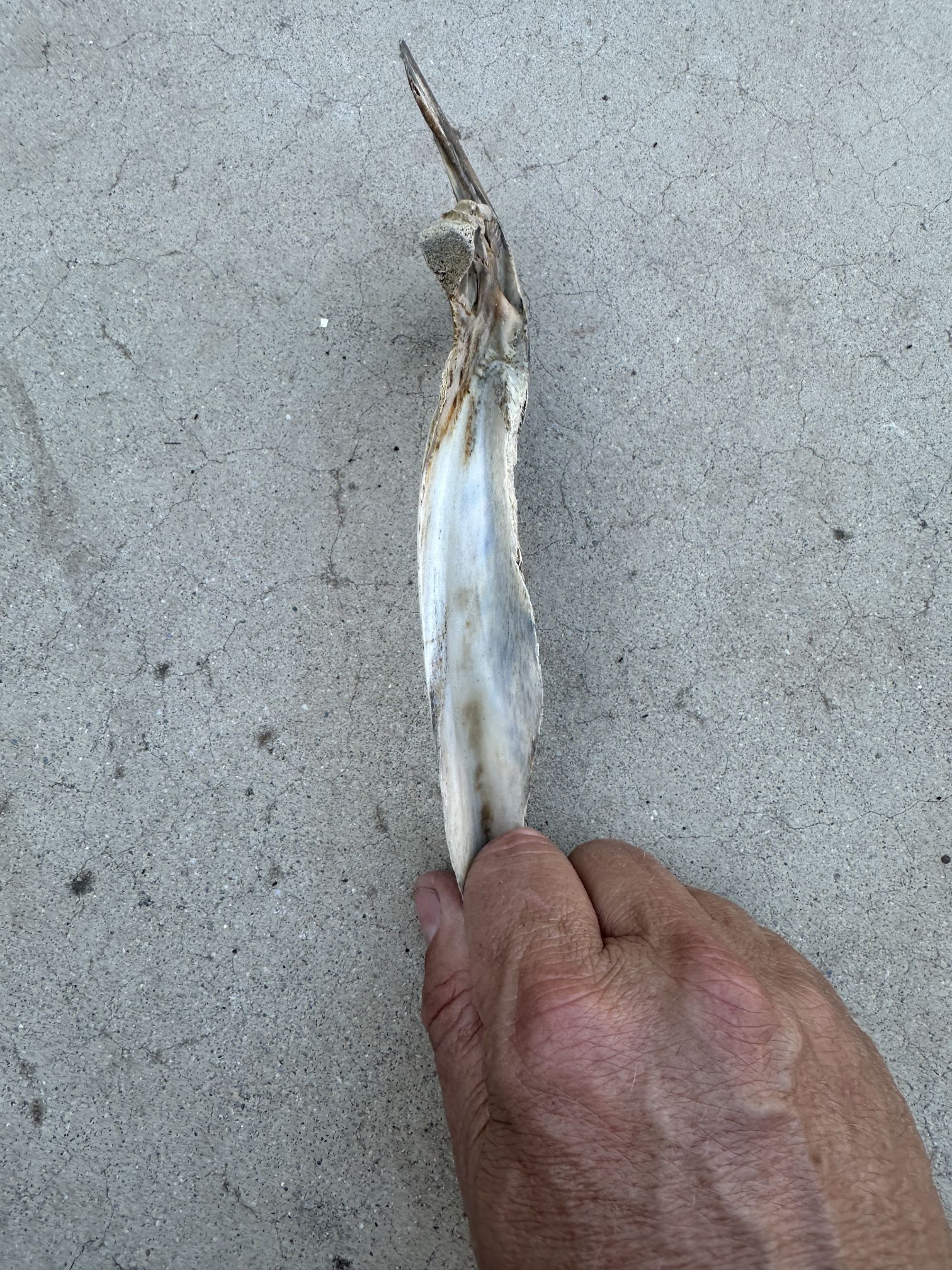
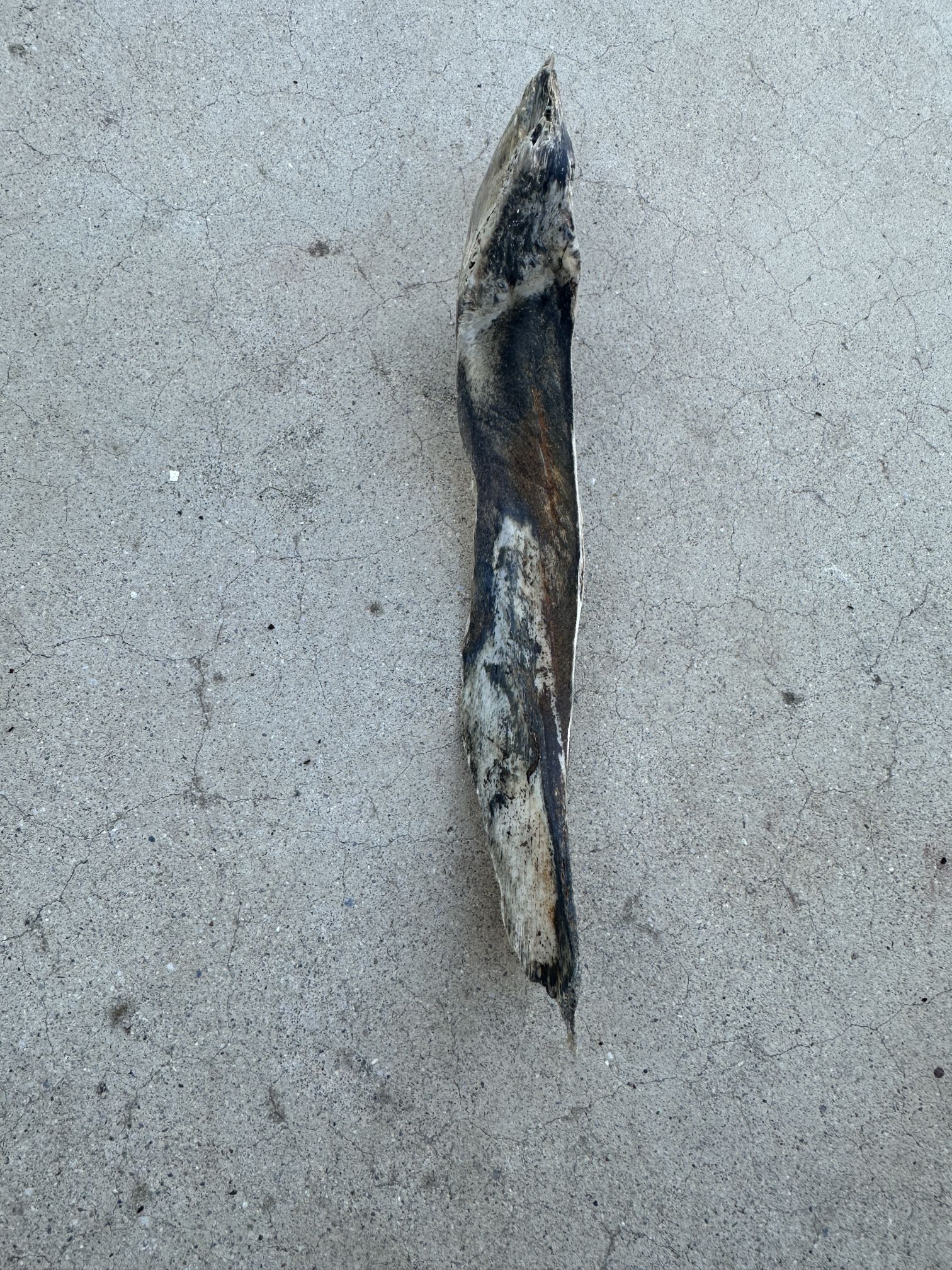
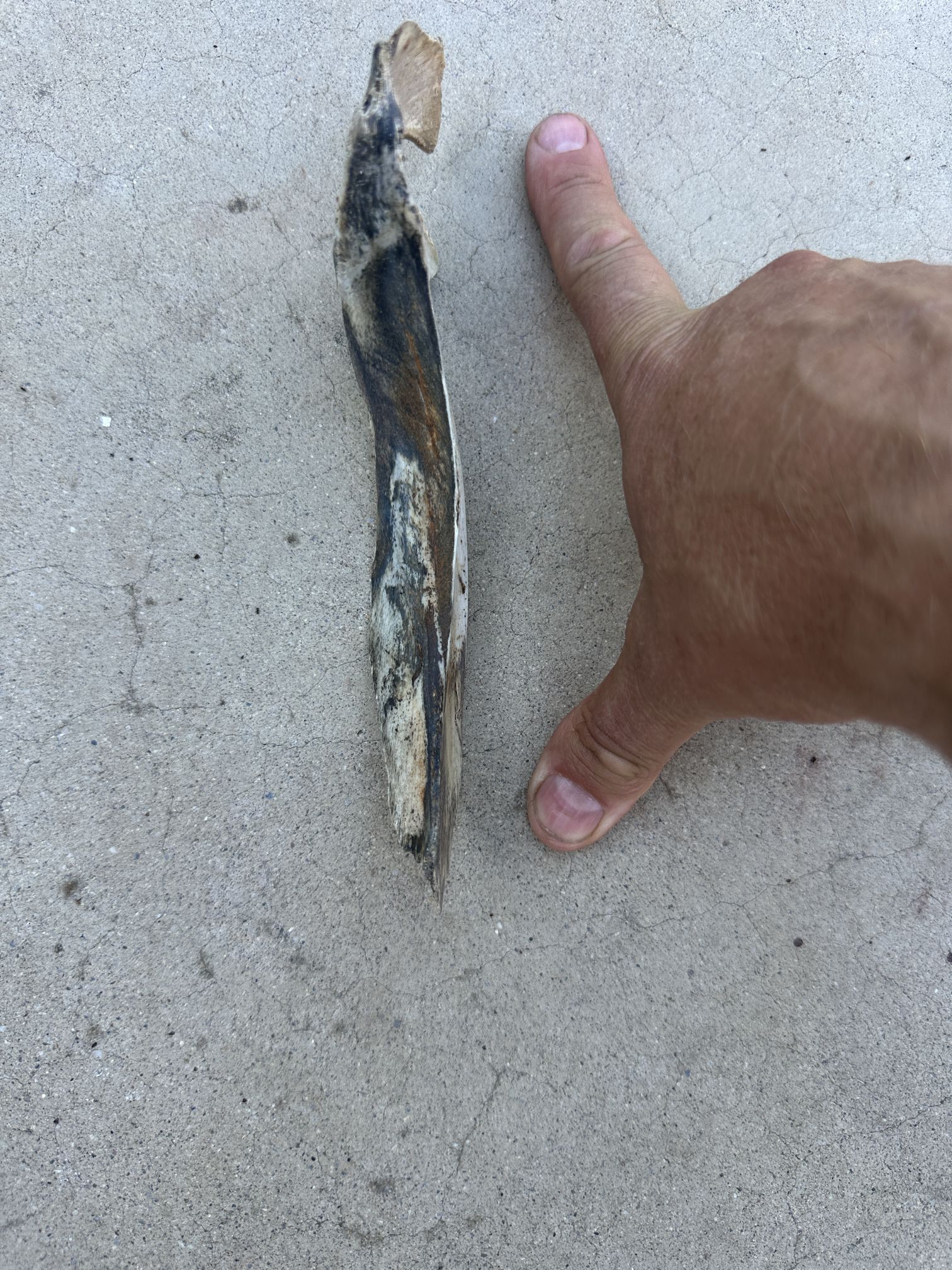
This is a tricky one, and while I think I have a rough idea of the element and Family, I’m still not sure of the species this comes from, so all suggestions are very welcome!
As always, you can drop your ideas, questions and suggestions in the comments below, and Joe may be able to provide some additional information and I may offer some hints as to my thoughts if needed.
Have fun!
Last week I offered up this specimen from the comparative avian osteology collections of the Dead Zoo, to test your bird cranium identification skills:


This wasn’t the easiest mystery object, as this specimen is from a species that has several similar relatives that are quite hard to distinguish based purely on their skull, but they tend to be easy to tell apart whe they have their plumage. As many of you spotted, this is the skull of a species of Ibis.
It has similar proportions and features to several species, including the Australian White Ibis (or “Bin Chicken” as it’s fondly known), the American White Ibis, the Scarlet Ibis, and the actual species that this is – the Glossy Ibis Plegadis falcinellus (Linnaeus, 1766).

It was a bit mean of me to not include the collection locality for this particular specimen, since that would have provided the additional piece of information that would have allowed people to work out which species it was, since it was collected around 1946 near Athlone in Ireland.
The Glossy Ibis is the only species of Ibis that regularly turns up in Ireland:
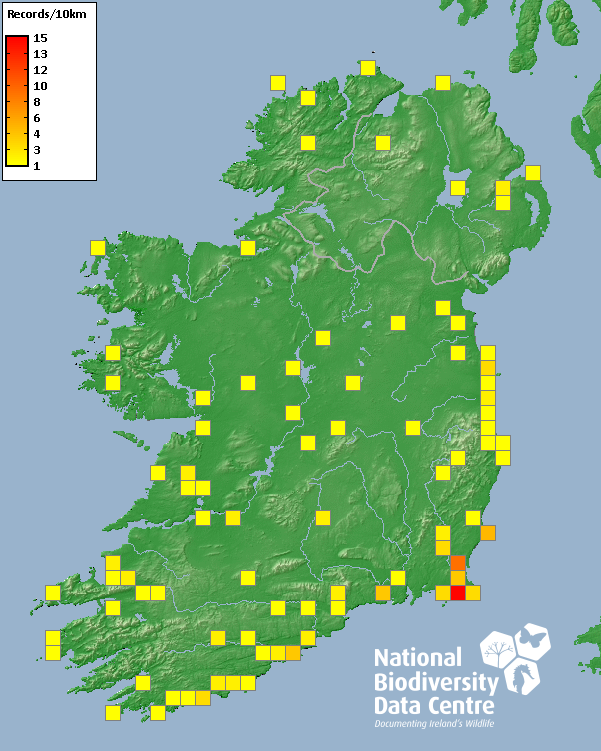
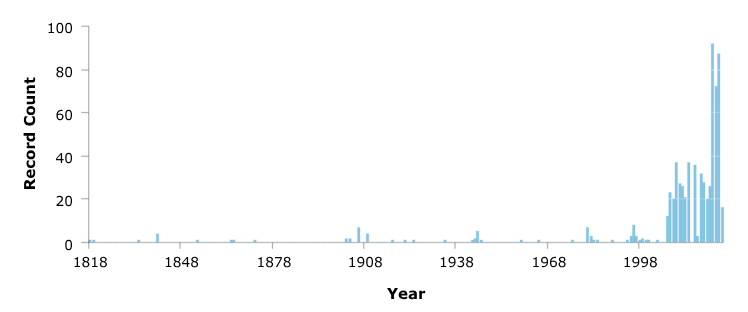
In recent years the Glossy Ibis has been turning up increasingly frequently in Ireland, and it seems that this is linked to changing climate. In particular, the wetlands of Doñana National Park in southern Spain have been drying out following hot summers and misuse of water, forcing these rather fetching birds further north to forage for food in shallow water in wetter areas in the UK and Ireland.
Some are even starting to breed in southern England, so we may yet see the Glossy Ibis forming breeding colonies in Ireland in the next few years, if the situation in Spain continues to reduce their available habitat.
So well done to everyone who worked out which of the curve-billed bird groups this belonged to, and my apologies again for being stingy with the locality details when I set the challenge!
This week I have a skull from the reference collections of the Dead Zoo for you to identify:
If you have an idea what this curvy billed bird might be, let me know in the comments below – and if you don’t, why not have a guess?
Last week I gave you this guest mystery object from regular contributor Joe Vans:
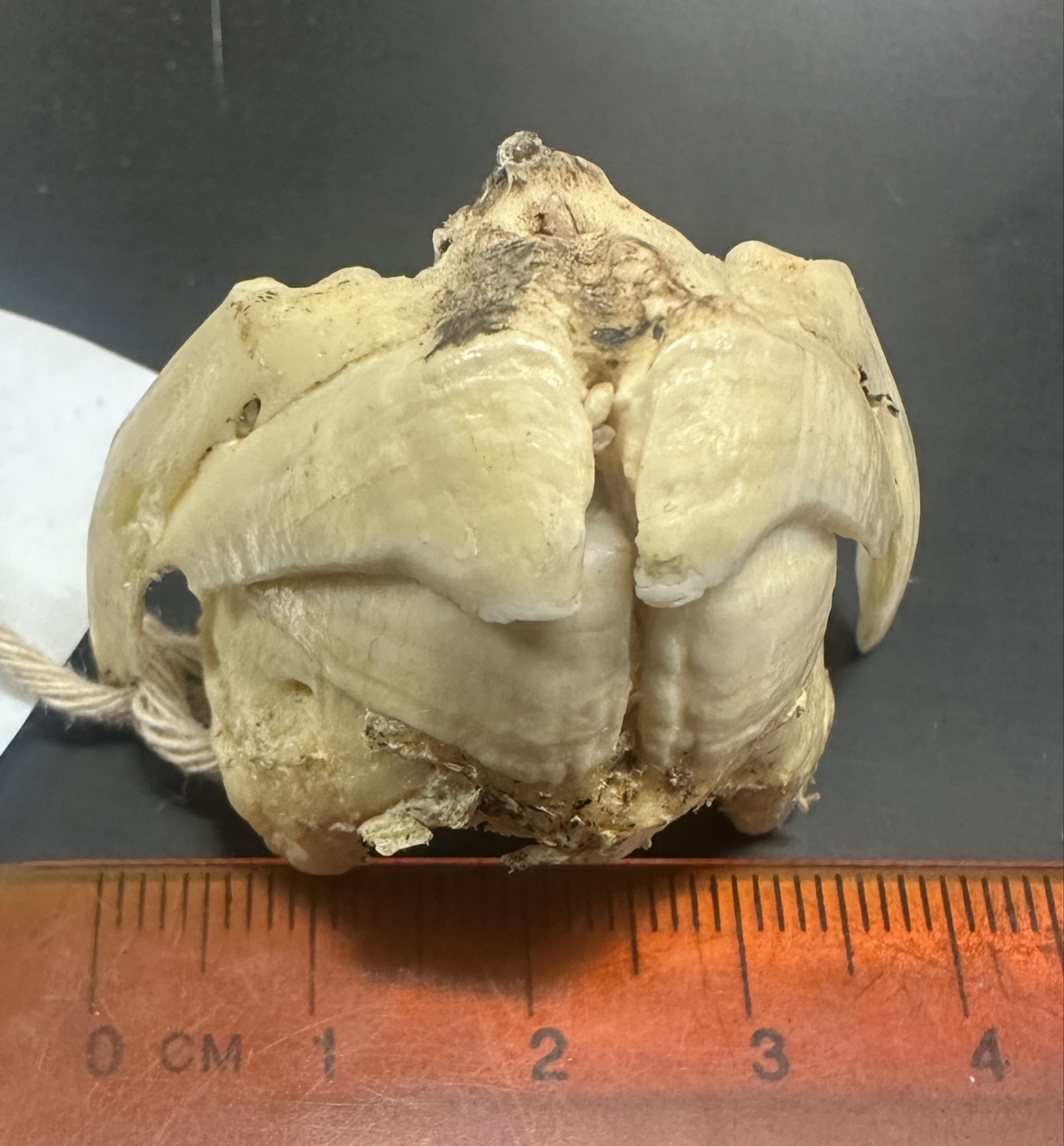
It does pose a real challenge to get to species level, but the Family is a lot more achievable with those distinctive four tooth plates that scream Tetraodontidae.
Joe kindly offered up locality information about where this specimen came from, which does help to narrow things down quite a bit:
mid-peninsula Baja California, gulf side.
With this information the possibilities drop substantially – as Adam Yates said:
I found a list of fish from the Gulf of California. It includes 7 species in the four-tooth family. We can immediately rule out the sharpnose because it has an adult body length of about 9 cm (too small for these jaws).
Narrowing it down further gets tricky, as you need comparative material – if you can find it. For me I spent a while trying to get some decent images for reference and I got lucky with the excellent Osteobase which is an incredible resource for finding fish bone images across many families, but unfortunately there isn’t huge coverage at species level (given the diversity of fish, that would be a mind-boggling undertaking).
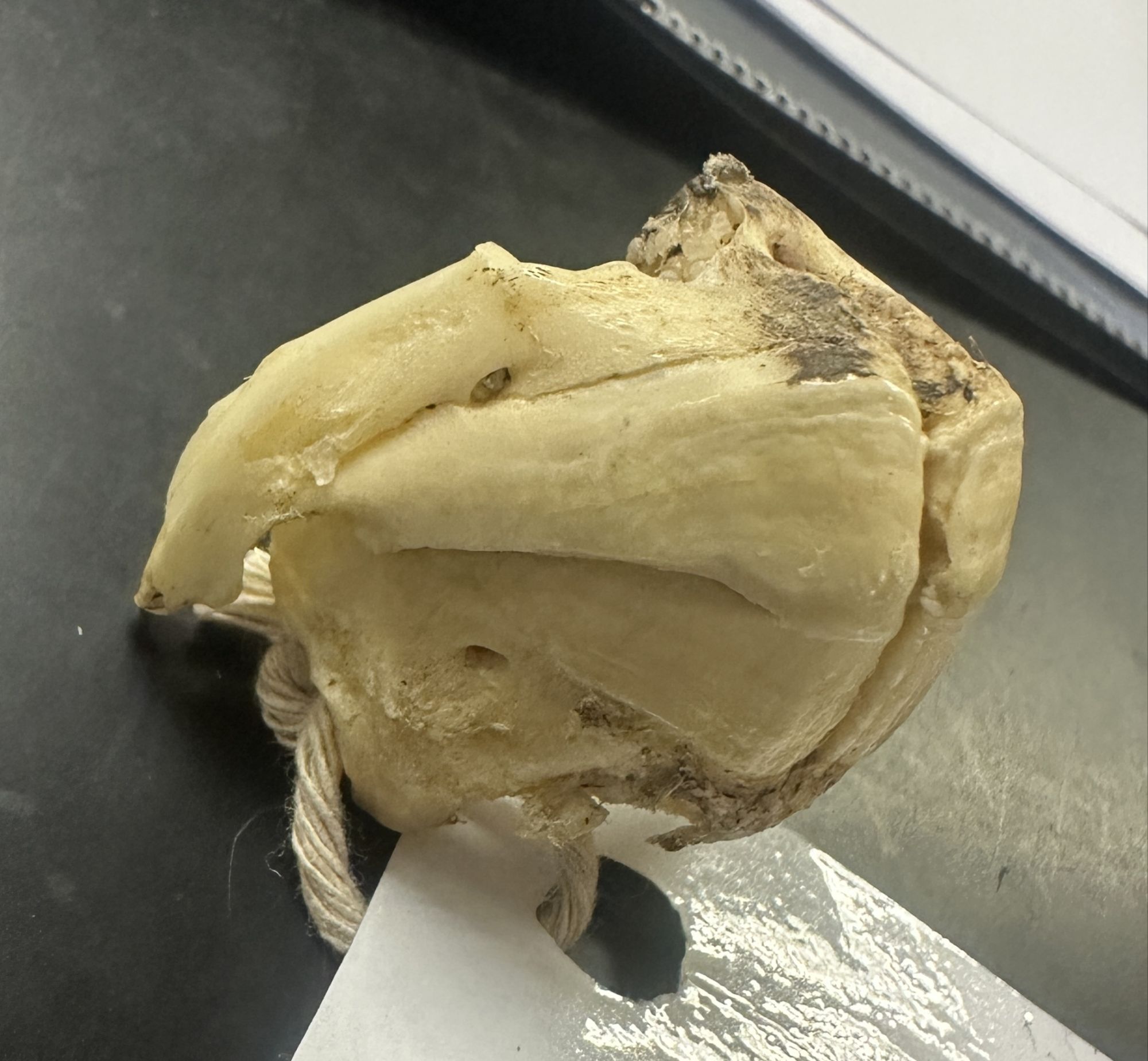
A good amount of scrutiny of the premaxillary, dentary and maxillary left me fairly happy that the one Tetraodontidae represented on Osteobase is in fact the same as this species – so I plumped for the Bullseye Puffer Sphoeroides annulatus (Jenyns, 1842).

Fortunately, Joe Vans saw this fish when there was a bit more to it, and he was able to confirm that this indeed what it is.
I hope you enjoyed delving into the deeps to figure out which pufferfish we were looking at. I don’t think anyone nailed it, but I’m not too surprised given how tricky it is to to find good comparisons. I’d like to pass on my thanks to Joe Vans for sharing his specimen!
This week I have a guest mystery object for you, courtesy of regular mystery-solver Joe Vans:
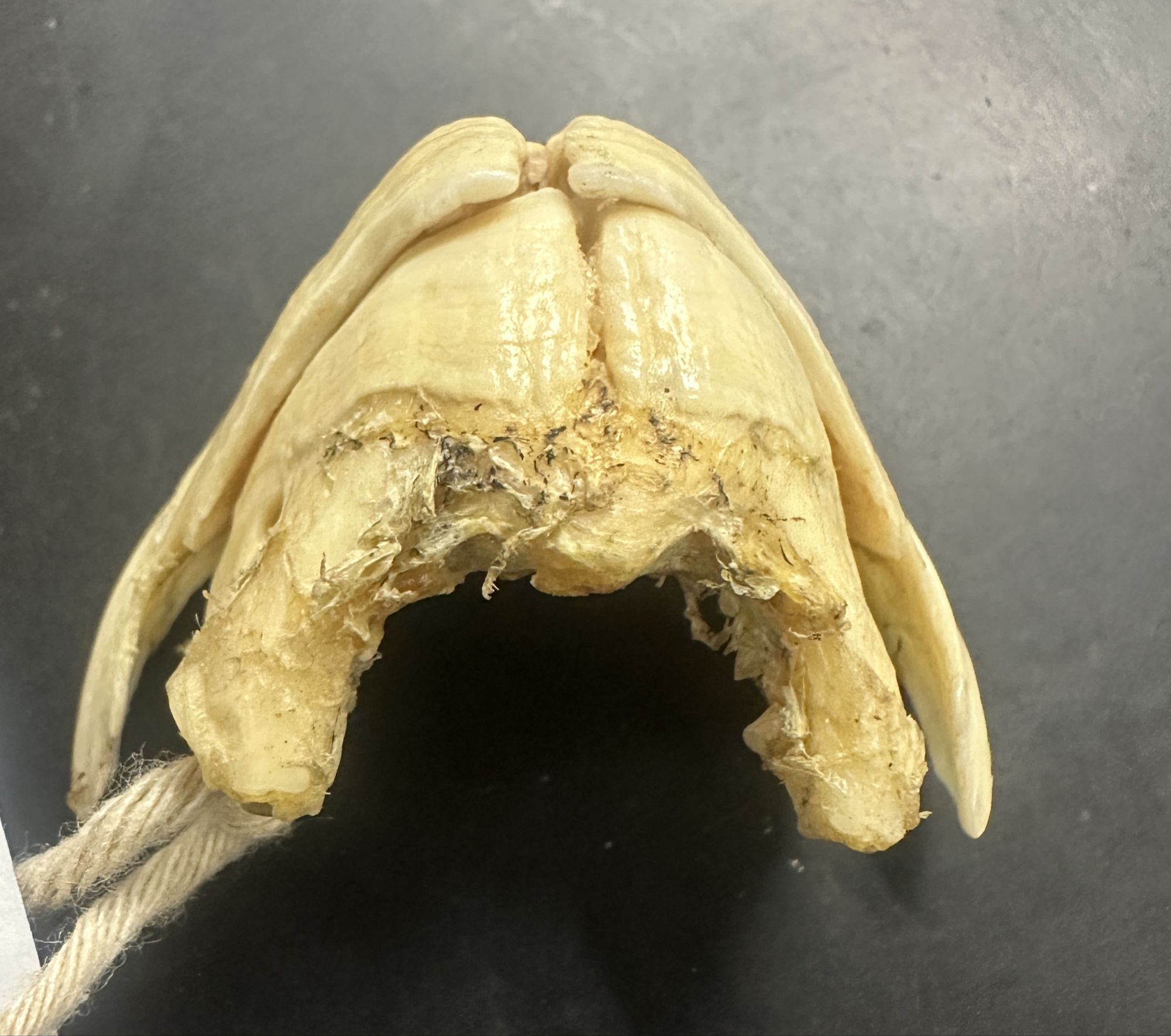
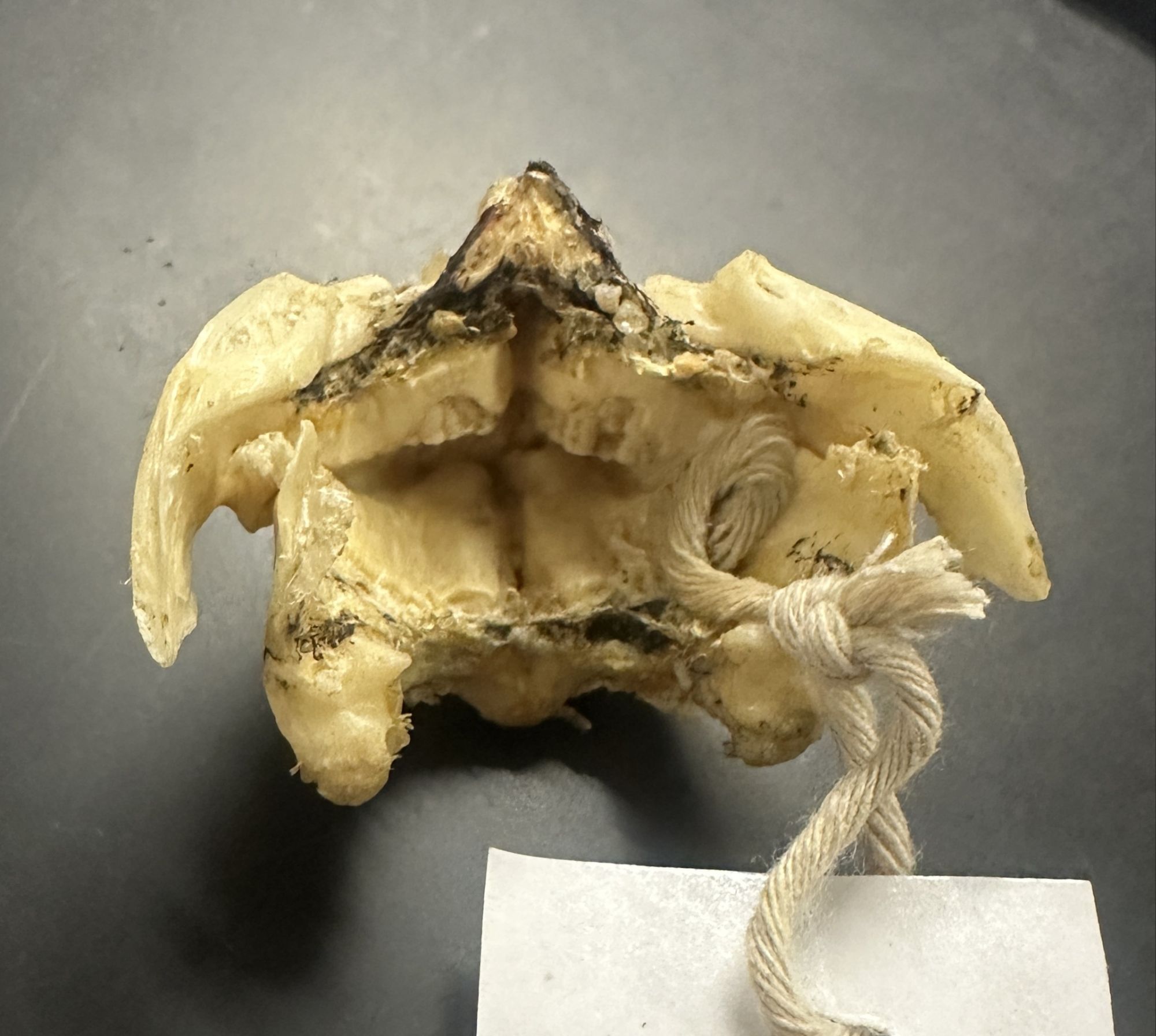
Joe sent it to me as a bit of a challenge, and it was great fun to have a chance to figure it out – it reminded me of why I started this blog in the first place!
Joe was kinder to me than I usually am to you, as he provided a locality to help with identification, so it would be churlish of me to not do the same for you. Joe said:
mid-peninsula Baja California, gulf side.
I hope you have as much fun working this out as I did, and this week you won’t be competing with Joe to get the identification, and who knows, he may even feel like dropping some clues if nobody is getting close (although with the skills of some of you, I suspect that won’t be an issue). Enjoy!
Last week, I gave you an object from the Dead Zoo that presents a genuine mystery:
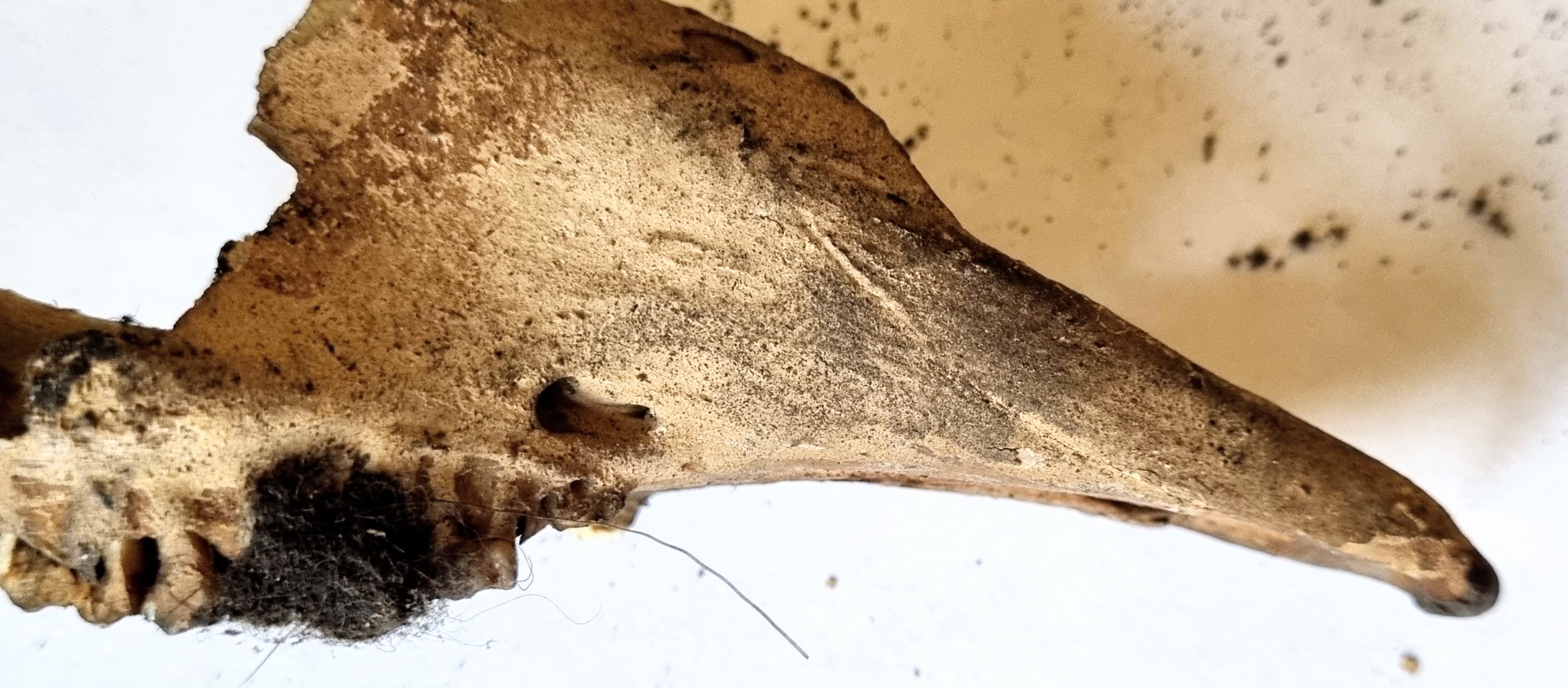
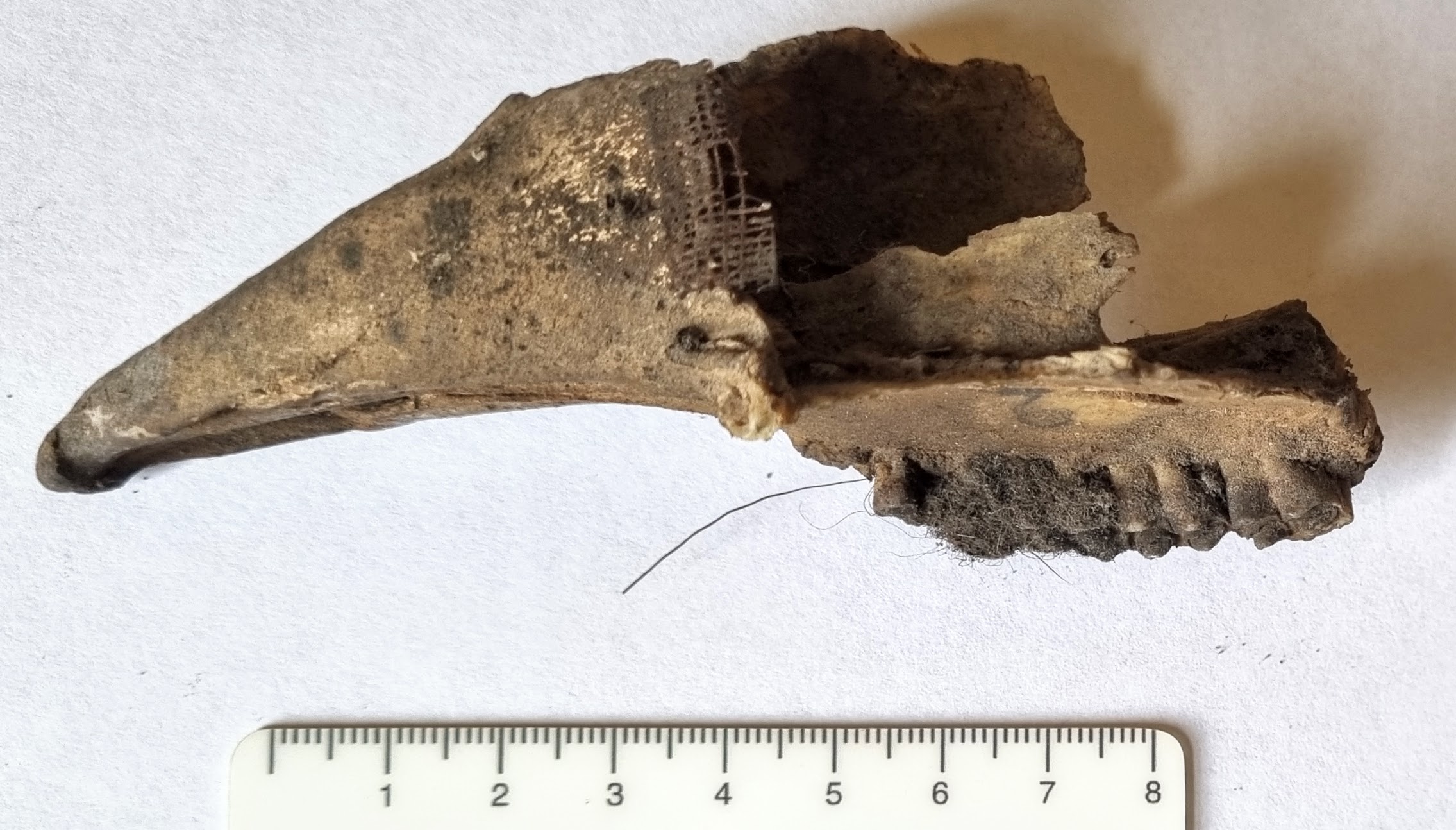
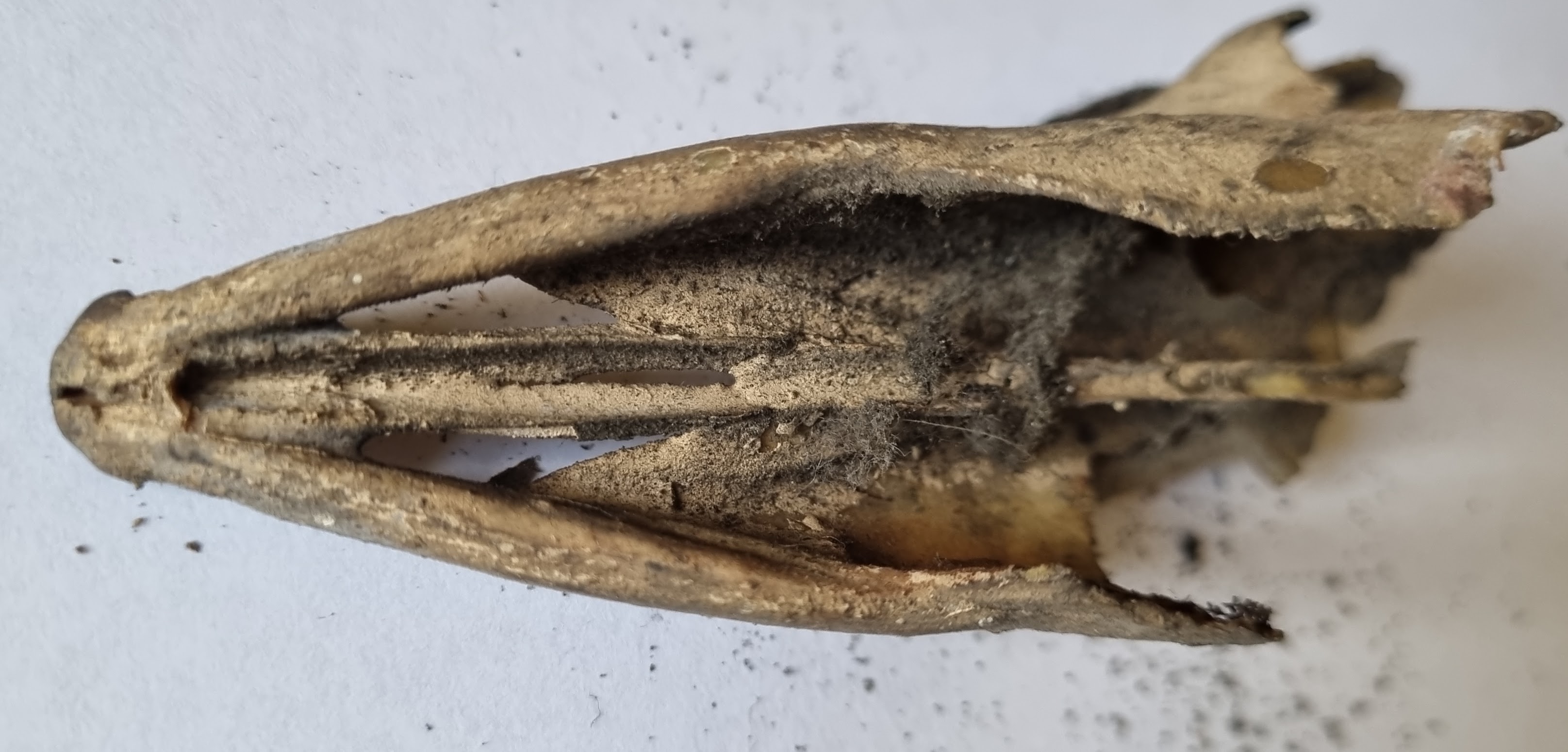
This premaxilla and fragment of maxilla came to light from beneath one of the cases, which was being dismantled to allow furniture conservation work to take place to support the redevelopment of the building.
The narrow tip of the premaxilla and small size immediately put me in mind of a small browsing antelope species that might daintily pick a new growth leaves from thorny scrub.
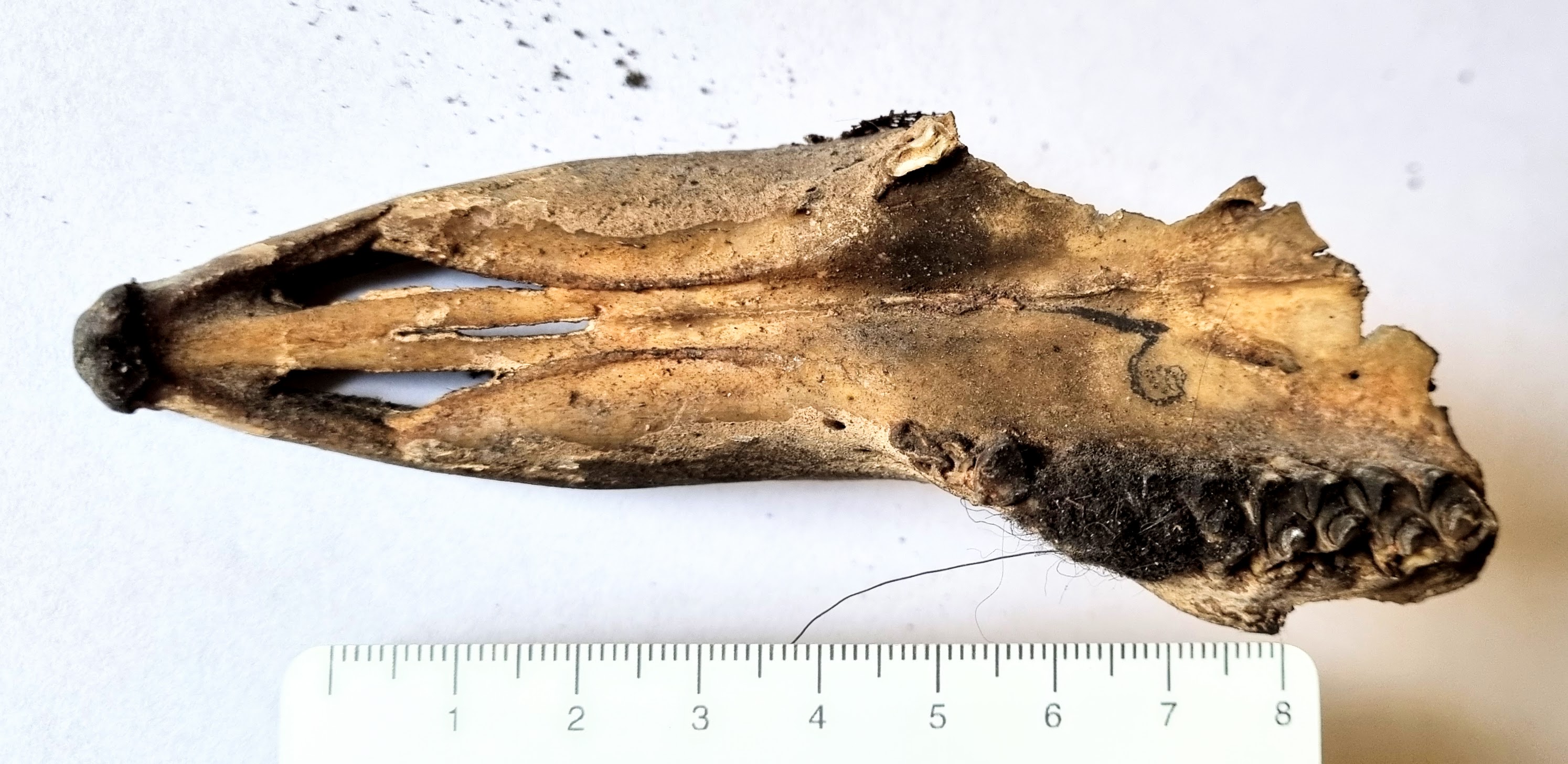
That shape is quite distinctive – allowing multiple species to be discounted, but I’ve been struggling to find anything that quite matches this piece of skull.
Joe Vans made a similar comment, referencing the small size and Duiker-like proportions, but different details of this object.
Frustratingly, many of the resources that used to be available online that offered well identified antelope skulls for reference and keys for identification seem to no longer exist (e.g. the Mammals of Tanzania and Animal Diversity Web), and the various AI search algorithms that seem to be all that is now available seem to have deteriorated in quality to the point that they can no longer find niche websites with sufficiently detailed scientific content, preferring instead to route searches to Etsy, Pinterest and Amazon.
So it looks like I’ll need to track an identification for this specimen down by using more time-intensive old school methods, like checking comparative specimens (something I sadly don’t have much opportunity to do these days as my role has become more managerial and my opportunities to work in the collections are almost non-existent).
Of course, that doesn’t mean there aren’t still great resources out there – John Rochester’s Flickr is a constant source of great quality images for reference, and I was delighted to discover a new one the other day, in the form of the Skull Index, so maybe there is still hope for online osteology, but none of these cover small African antelope species just yet.
Grumbles aside, I’ve managed to rule out Suni, Oribi, and most species of Duiker and Dik-dik. There are some Grysbok that need further consideration and Steenbok isn’t off the table, so at least I may have been able to narrow down the search. Of course, the best way to refine it more is to hear what from other people who may recognise something, so if you have an idea of what this might be from, then please do leave a comment below!
For this week’s mystery object I have a fragment of skull that came to light during recent work on the historic display cases in the Dead Zoo:
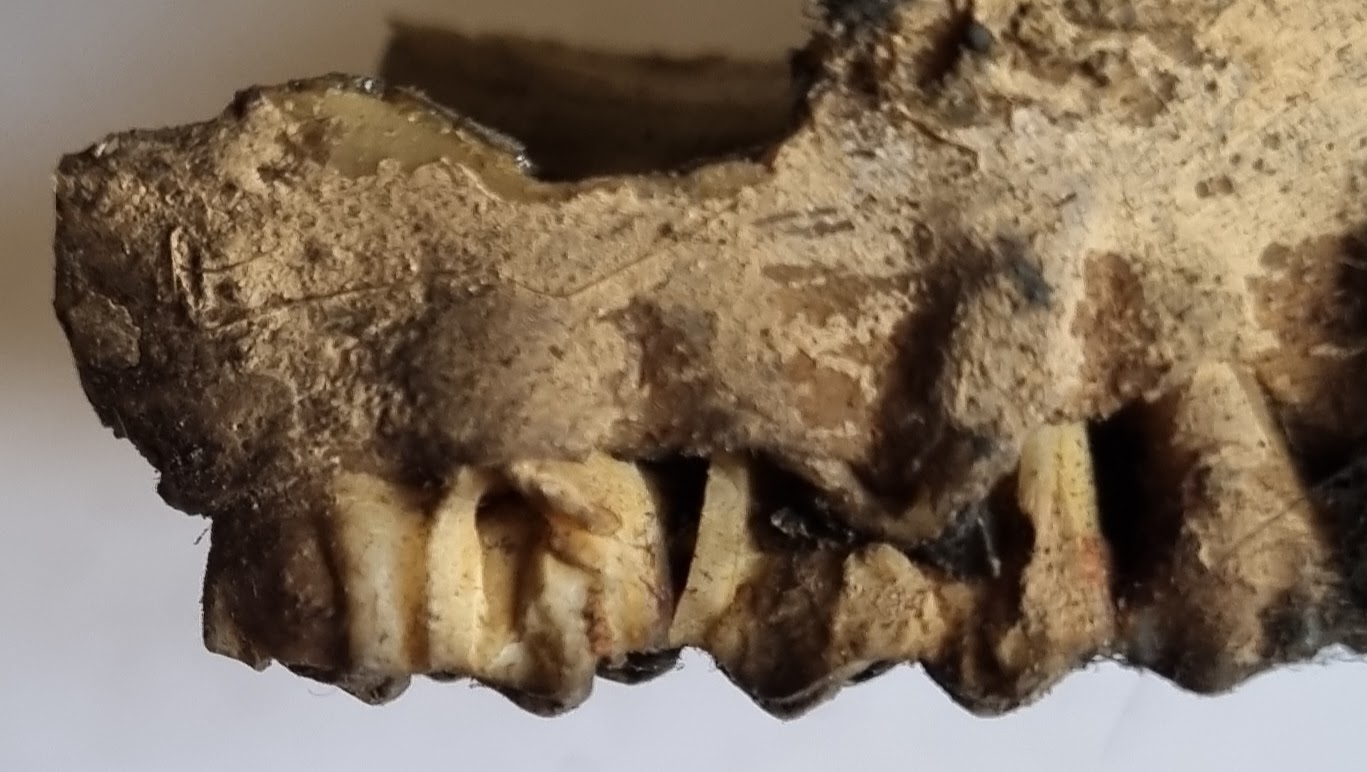
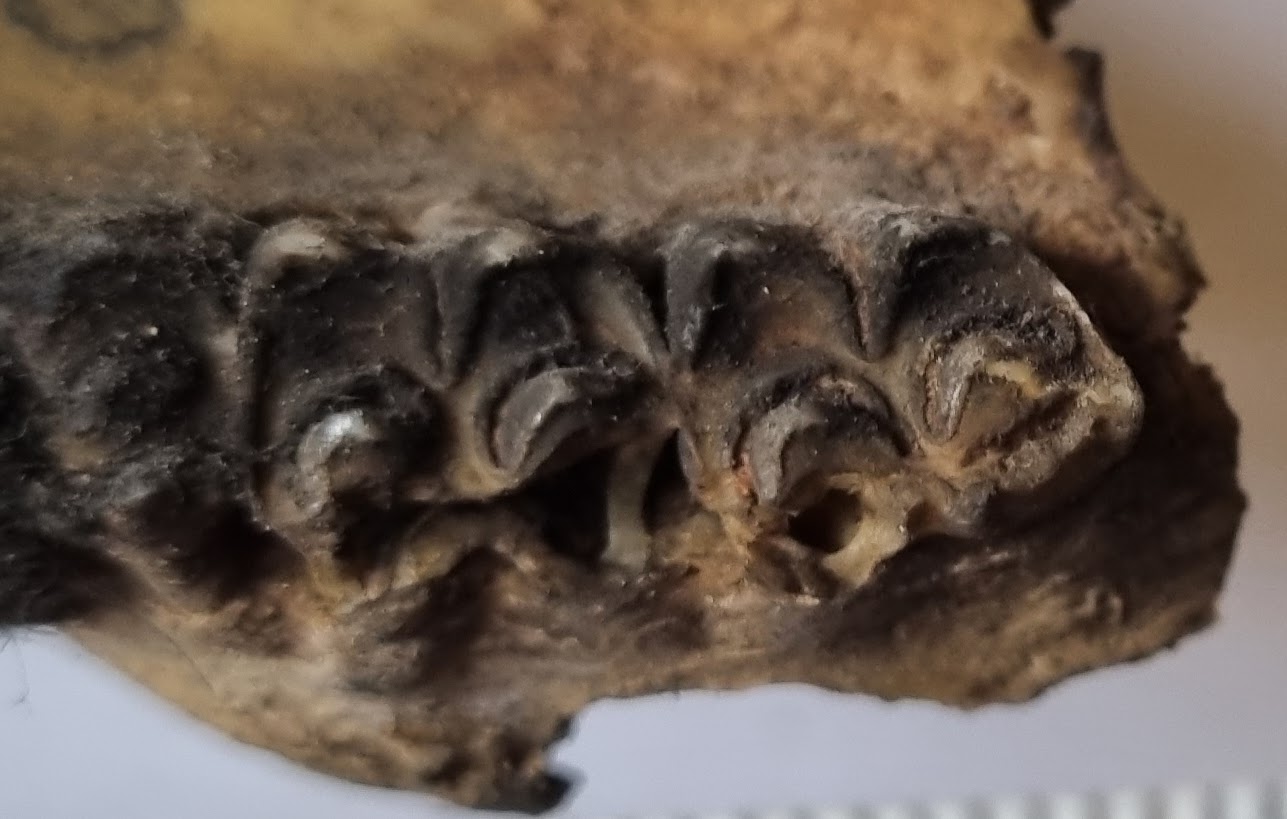
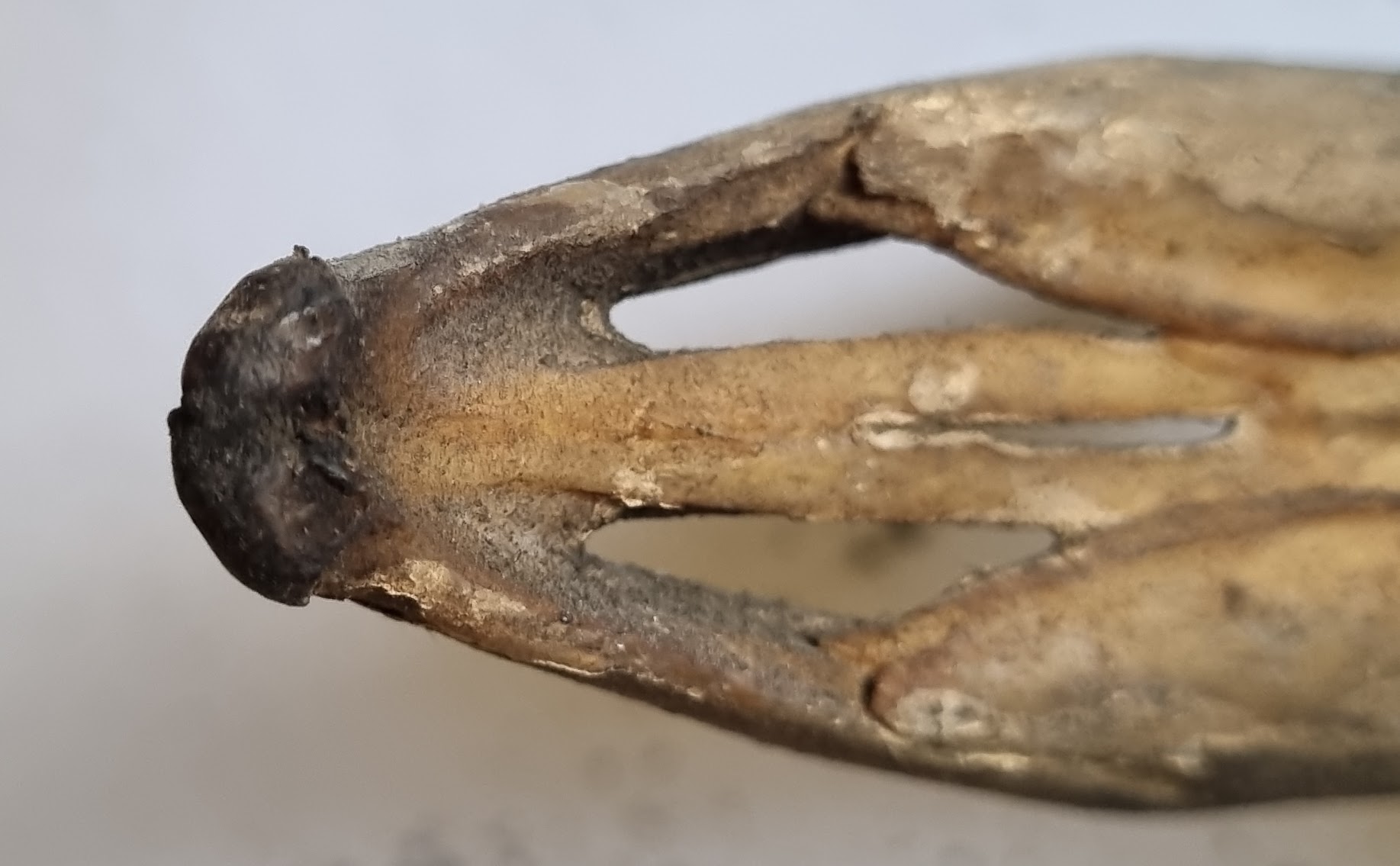
I’d be keen to hear your thoughts on what it might be from. Have fun with this piece of detective work!
Last week I gave you this little critter to have a go at identifying:
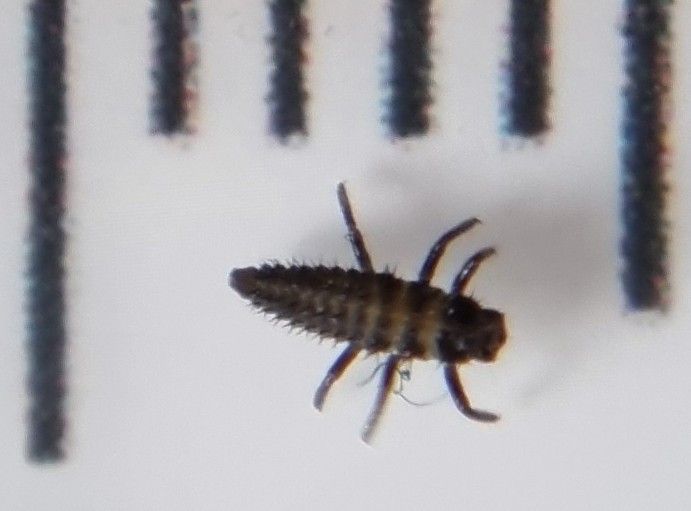
It was a genuien mystery object, as I found it scuttling around on my arm as if searching for prey of some kind.
My inital thought was a ladybird larvae, but it was far smaller and lacking in the colour patches that are present in the larvae of any species I’m familiar with.
However, as I noted in my comment last week, insects have different appearances at different stages of their lifecycle, and I have to admit that I forgot that the early instar larvae of some ladybird species don’t necessarily have the colour patches the the later instars present.
Fortunately, everyone was quick to support the ladybird larve identification, with a reminder about the different larval instars – so thanks for that!
Joe Vans made a specific suggestion of a 10-spot Ladybird Adalia decempunctata (Linnaeus, 1758) larva, which seems plausible. After a lot a searching, I’ve not managed to find anything to confirm or contradict that. The early instar Harlequin Ladybird larvae can lack colour patches, but they seem a bit broader (although maybe the mystery example just needed feeding up a bit?)
I suspect that this is one of those mysteries that can’t be answered without rearing the larvae until it’s grown enough to start disp[aying some more characteristic features, which isn’t possible as I returned it to the great outdoors. So that’s a lesson learned!
Thanks to all of you for your input on this – it’s great to be reminded that sometimes there isn’t always a specific answer available, and keeping an identification broad is just fine. Moreover, keeping it general means you’re less likely to confirm something incorrectly – and I think that’s probably for the best!
This week I have a genuine mystery object for you to have a go at identifying:
I found this little critter hitchhiking on my arm, so I thought I’d see if anyone could help me work out what it is.
Insects aren’t my strongest area of knowledge, as there are just soooo many species, and they even have different appearances at different stages of their lifecycle, so your help would be appreciated!
Any ideas about who my little friend could be?
Last week I gave you this mystery skull to have a go at identifying:
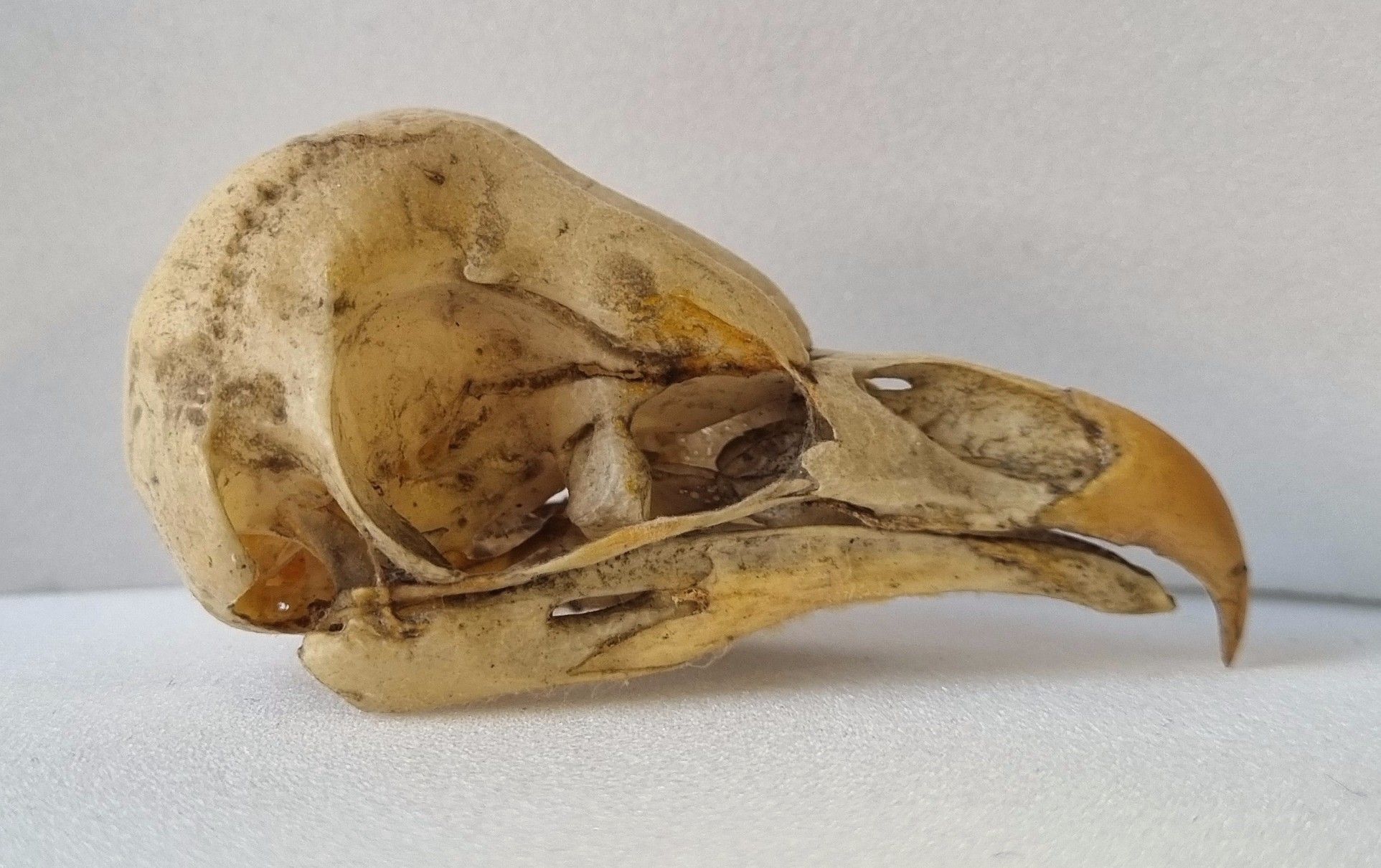
I suspected this one wouldn’t be too much of a challenge, and I wasn’t mistaken.
There were some great cryptic clues, ranging from Chris Jarvis’ references to a charming Jill Tomlinson book, to Adam Yates’ reference to the genus name and some possible members of that genus with names reflecting their habits/habitats:
Well when it grips its prey it certainly has a tight toe, but does it hang out in agricultural storage buildings or among the Poaceae?, I cannot say.
With “tight toe” being Tyto and the options being between Barn Owl and Grass Owls. This is one that hangs out in agricultural buildings – the Barn Owl Tyto alba (Scopoli, 1769).
Barn owls have a distinctive headshape – longer than other owls, with a little bump on their forehead. However, I have to admit that I’m not familiar with the skulls of any of the Tytonidae species, and I’ve found it tricky to find good reference material online. If you know of any resources out there, I’d love to hear about it!
This week I have what I think is a nice and simple mystery skull for you:
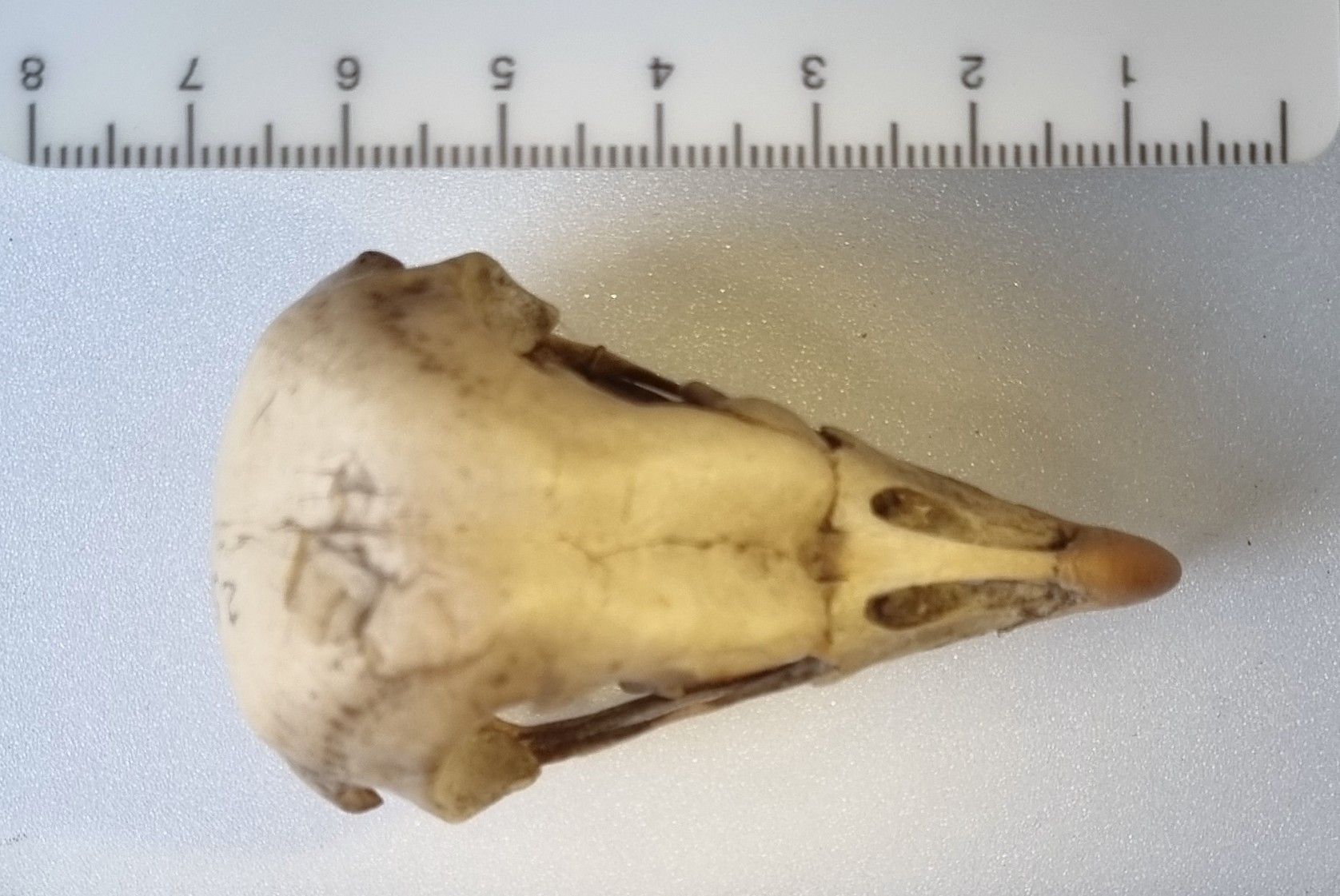
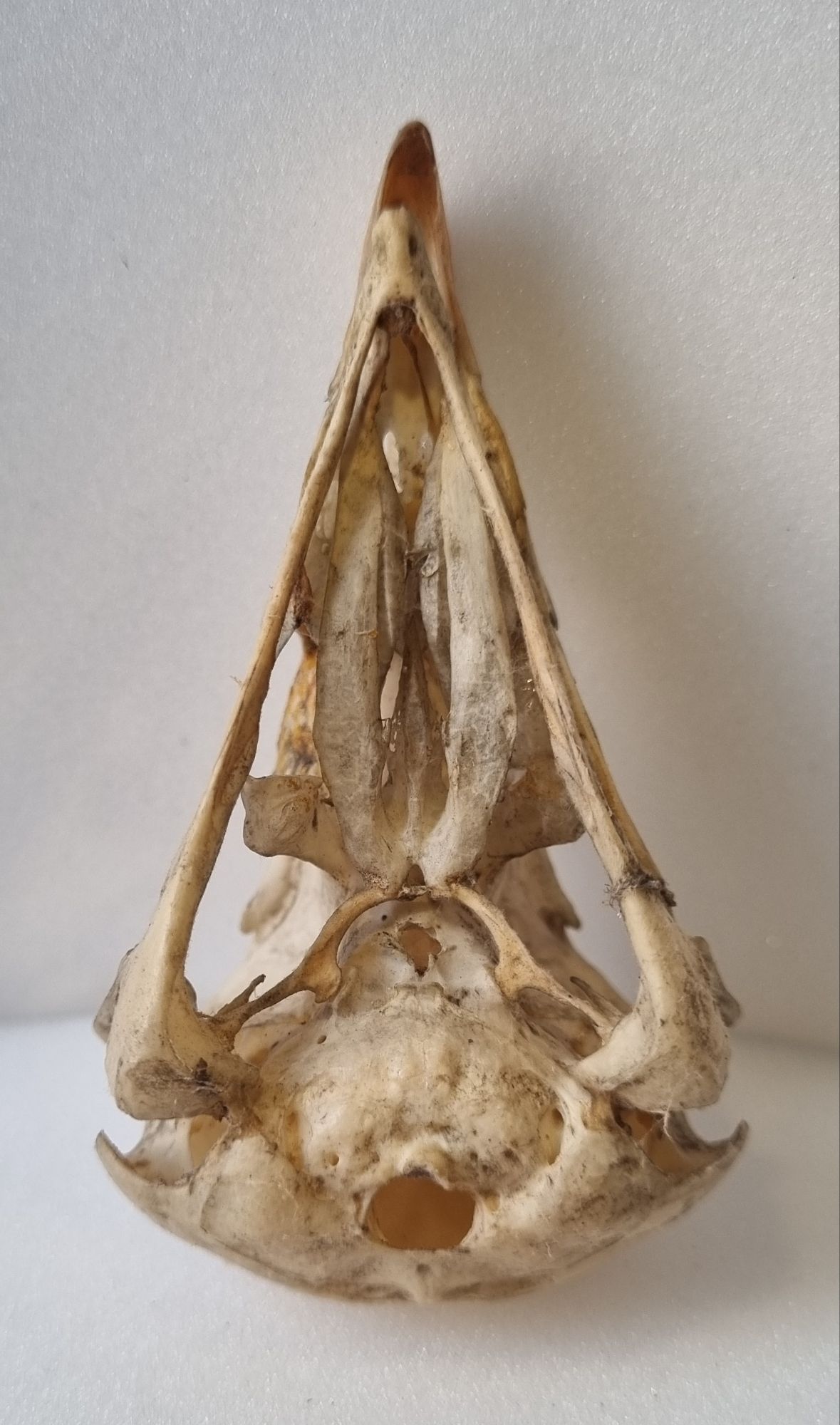
Any suggestions about which species this comes from? Cryptic clues are welcome, just to let people who aren’t sure have a chance to work it out. Have fun!
Last week I gave you this skull to try your hand at identifying:
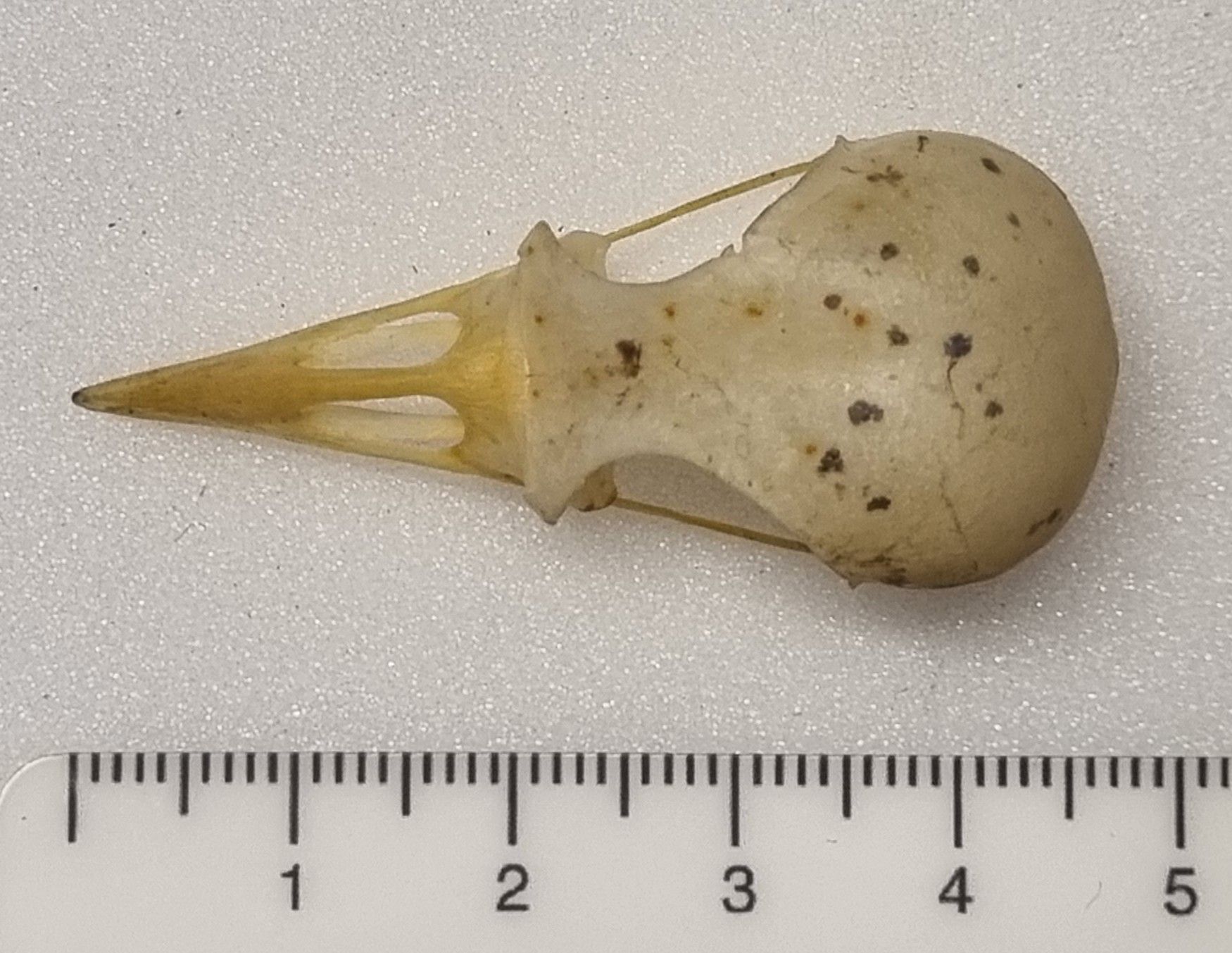
It’s not the easiest of tasks, as there are quite a lot of birds in this general size range and with this general shape of skull, so the overall outline from the top only helps narrow things down a little. It is worth noting that general proportions all suggest some kind of Passeriform.
The exact length of this specimen is 49mm, but as with all species, there is a bit of variation depending on subspecies, age, sex, quality of diet and other environmental factors. I suspect this one is a little on the small side for the species.
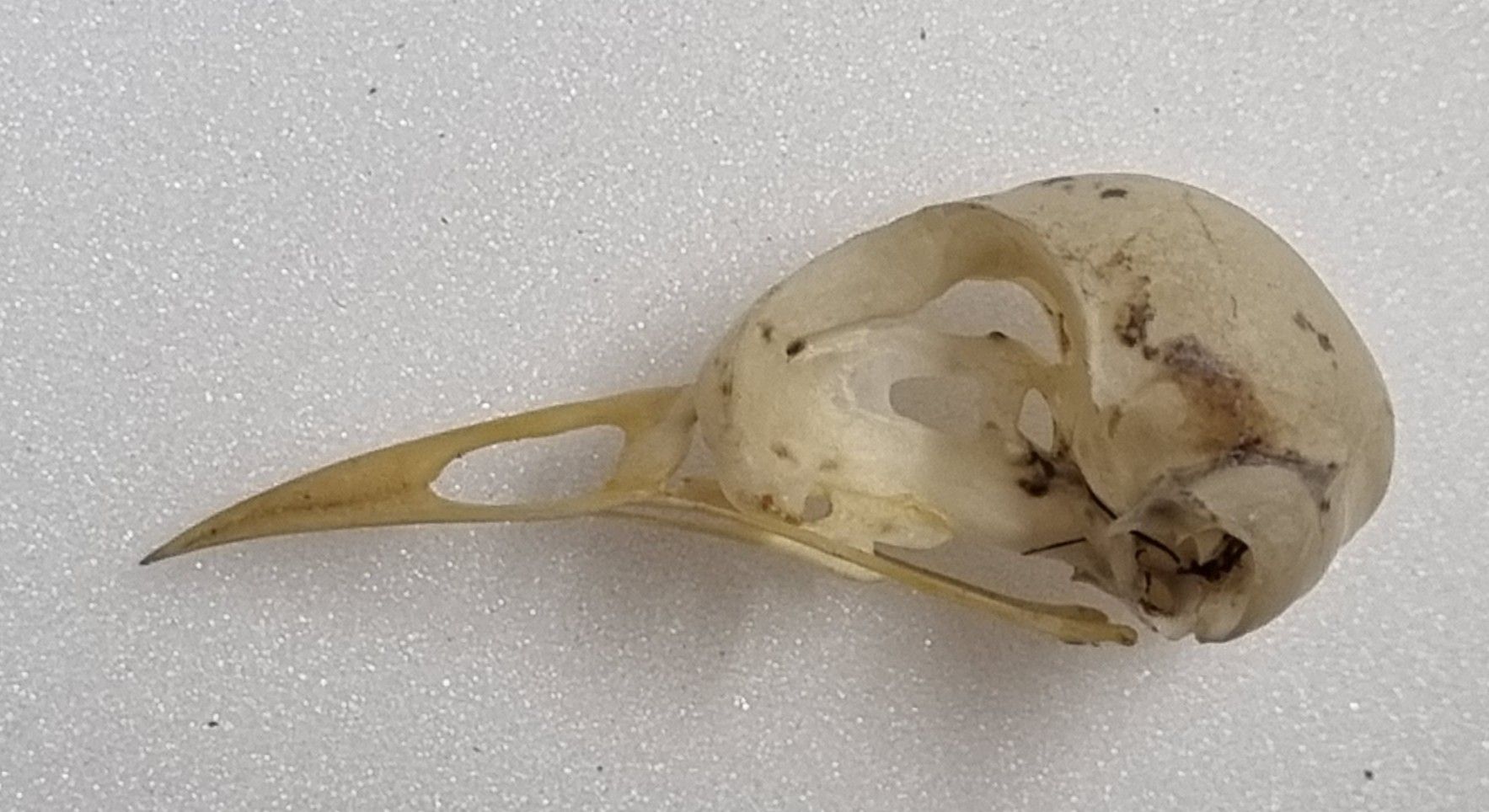
The side view offers another perspective on the bill morphology, which is looks quite generalist, perhaps a little on the gracile side, but not overly skinny. Given the size that puts me (and many who left a comment) in mind of something in the Thrush family.
It’s also worth noting that the bill sheath, while not very apparent, is still present (if it wasn’t you’d see small holes along the side of the bill, which are the blood vessels that supply the tissues that secrete the keratin of the bill sheath). This is a big clue, as the bill sheath is yellow.
For me that immediately put in my mind a very specific type of Thrush – the male Common Blackbird Turdus merula Linnaeus, 1758.
This can be checked with reference to the excellent Skullsite resource, which provides a fantastic range of bird skulls with images from several different angles. Take a look at the underside of this specimen:
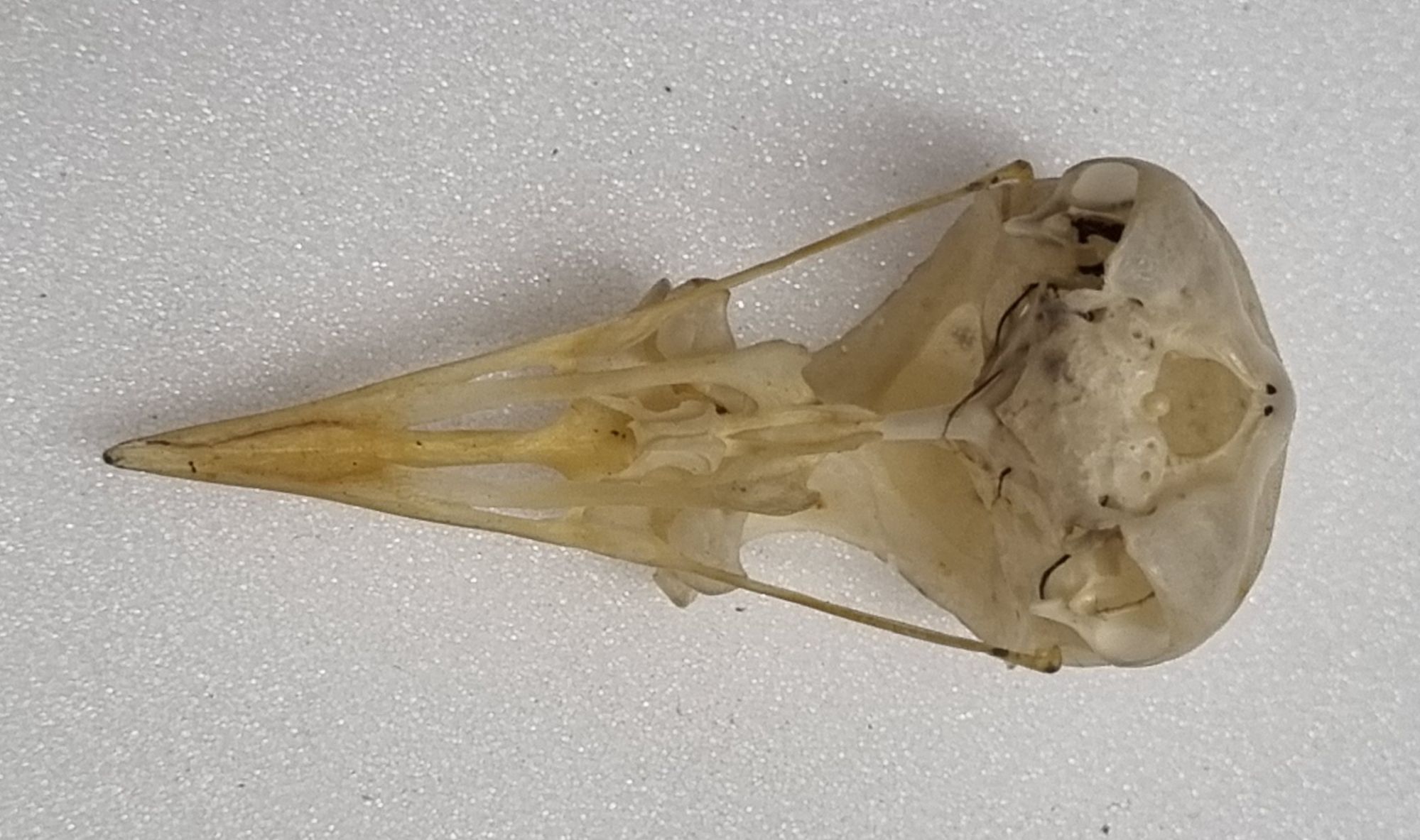
The posterior region of the palatine bones have quite a distinctive shape – flared and with a broad shallow notch at the posteriormost margin. If you compare this to other skulls in the genus Turdus, you’ll notice that the notch is almost absent in the Redwing, it has a much sharper outer angle in the Songthrush, it’s a lot deeper in the American Robin, it’s deeper and sharper in the Fieldfare, and so on. The important thing is that the palatine of the Blackbird on the Skullsite is still consistent with that of the mystery object.
While this feature takes a while to get familiar with, it can be quite helpful when narrowing down similar skulls like these. I hope that pointer proves useful!
Finally, I offer up congratulations to Adam Yates who not only got the correct identification, he also left a great cryptic clue to share that information. Bravo!
This week I have a bony mystery object for you, measuring 49mm long:
If you have any idea what this might be, you can leave your suggestions in the comments below. Have fun with it!
Last week I gave you this leggy mystery object to identify:

As I suspected, it wasn’t a difficult challenge in terms of working out the species, since it is one of the most common examples of its type. To make it a bit more interesting I also asked for you to keep the answer cryptic for extra points.
Chris Jarvis was first to the party referencing “stone” – part of the common name of this species. Adam Yates gained some extra points by cleverly working in a reference to the species name “forficate”, and Joe Vans managed to work a rhyme into his correct response.
This is, of course, a Stone (or Garden, or Brown) Centipede Lithobius forficatus (Linnaeus, 1758). It’s a very widespread species, ocurring across Europe as its natural range, but also now widespread in North America – even occurring on the Hawaiian islands and with records from Colombia.
These centipedes live in leaf litter and hunt small invertebrates with their venomous front legs (which are called forcipules).
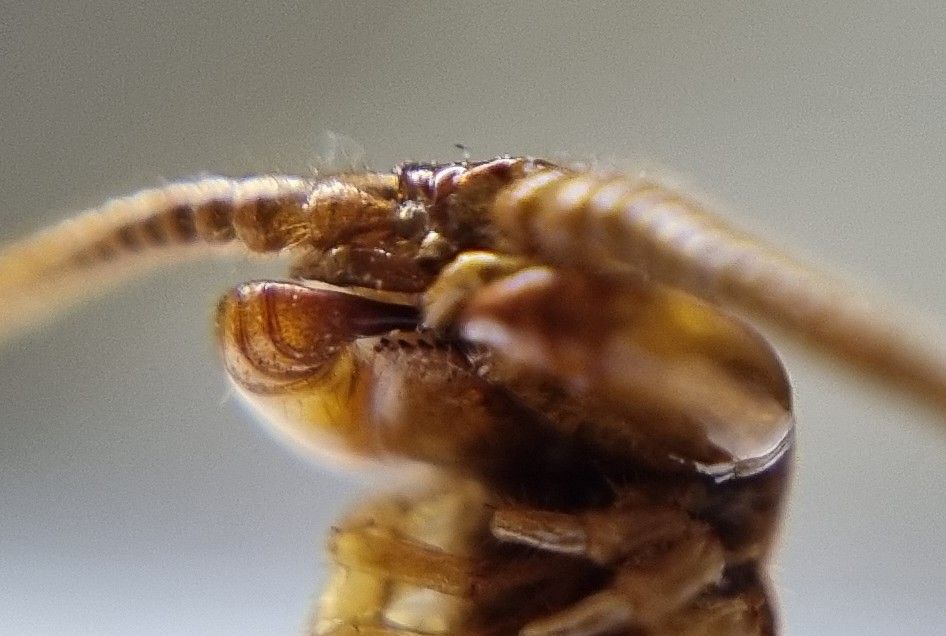
These centipedes can actually be quite difficult to definitively confirm the identification of, as they share a lot of similarities with other Lithobius species, such as the larger Lithobius pilicornis Newport, 1844, so a proper key is really needed (the British Myriapod and Isopod Group have some very useful resources) and specimens are essential for any surveying work that takes place, to allow checking of detailed features under a microscope – such as the forcipular teeth.
This is why specimens are an important validation resource for confirming species identifications, and appropriate lodging of these specimens in collections is important, to allow observations to be checked and confirmed.
Thanks to everyone for playing – let’s see what mystery object I’ll stumble across for next Friday’s challenge. Have a lovely weekend!
This week I have an interesting invertebrate for you to identify:

I suspect this won’t be a difficult species for some of you, so please keep your answers cryptic – with bonus points for creativity. I look forward to hearing your musings!
Last week I presented this mystery object for your identification delectation:
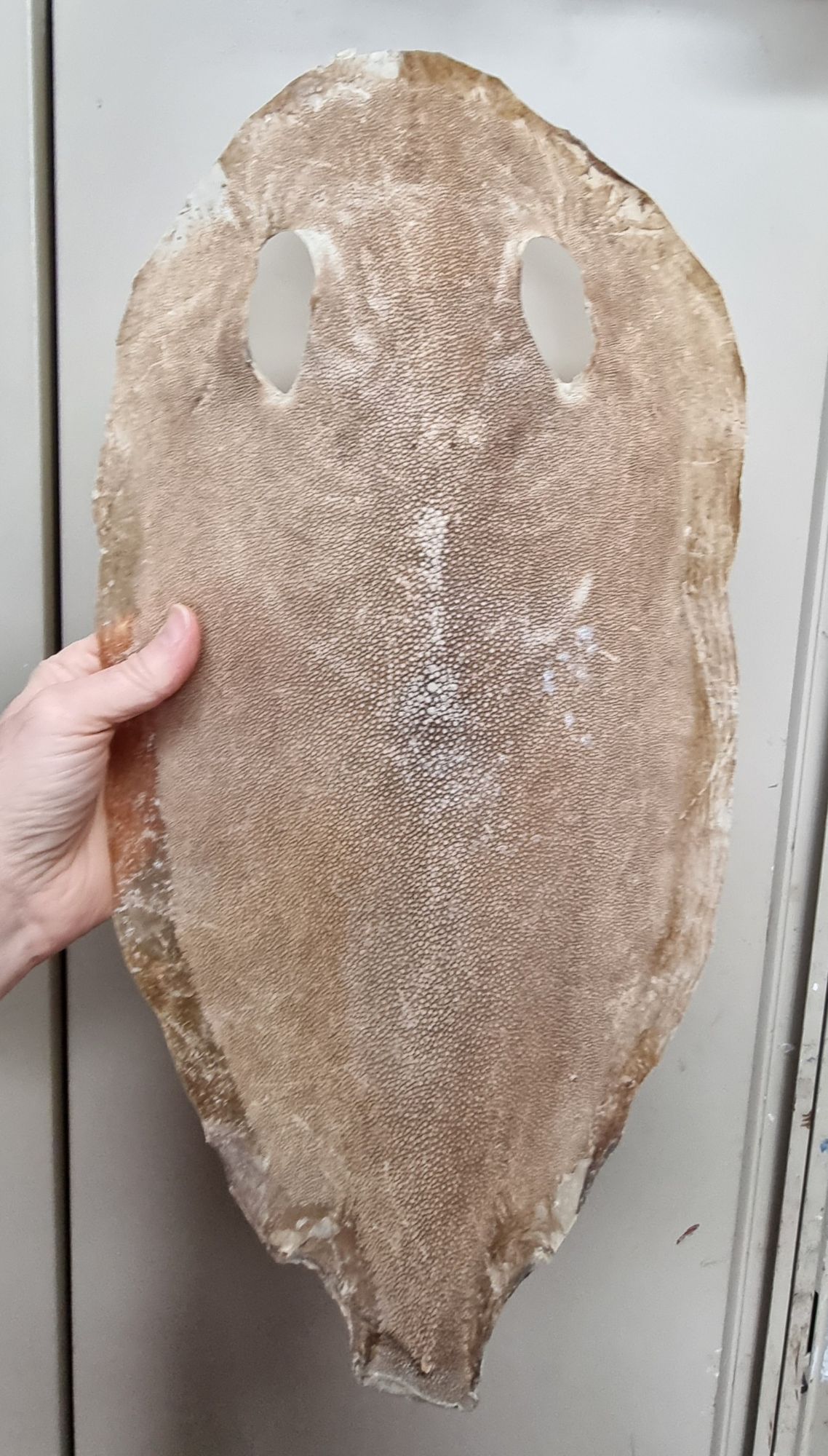
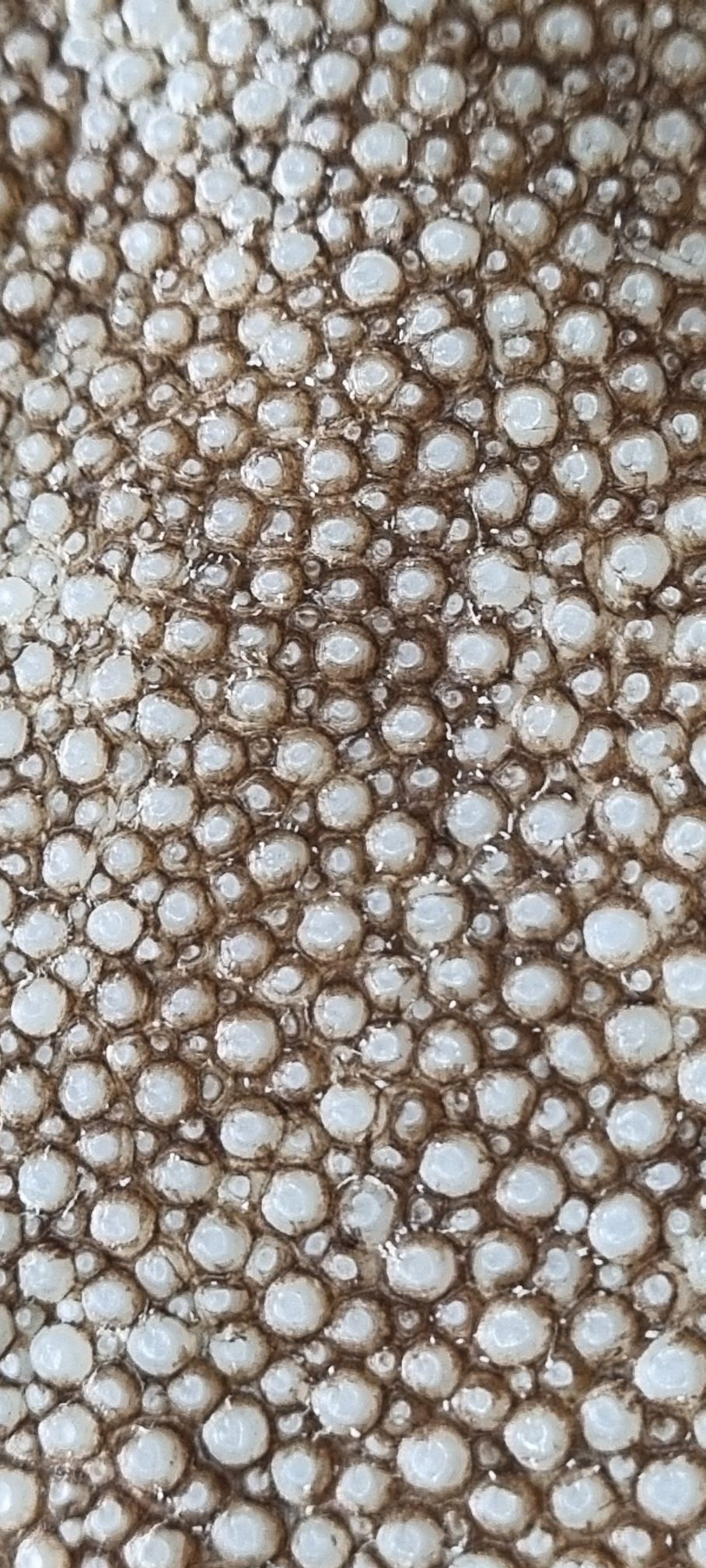
While this is such a heavily processed piece of skin, with most of the diagnostic features removed, an additional close-up image provided a clue:
People in the comments section and on Bluesky recognised that this is the skin of a member of the Batomorphi (AKA the Rays). While there were some differences in opinion on the species, there is one term that came up several times in several ways, but in the words of Chris Jarvis:
Much to my chagrin I think I might know what this is?
This is of course a reference to the material shagreen, which is a type of leather (often dyed green) with rough dentine inclusions that are polished to create “pearls” embedded throughout.
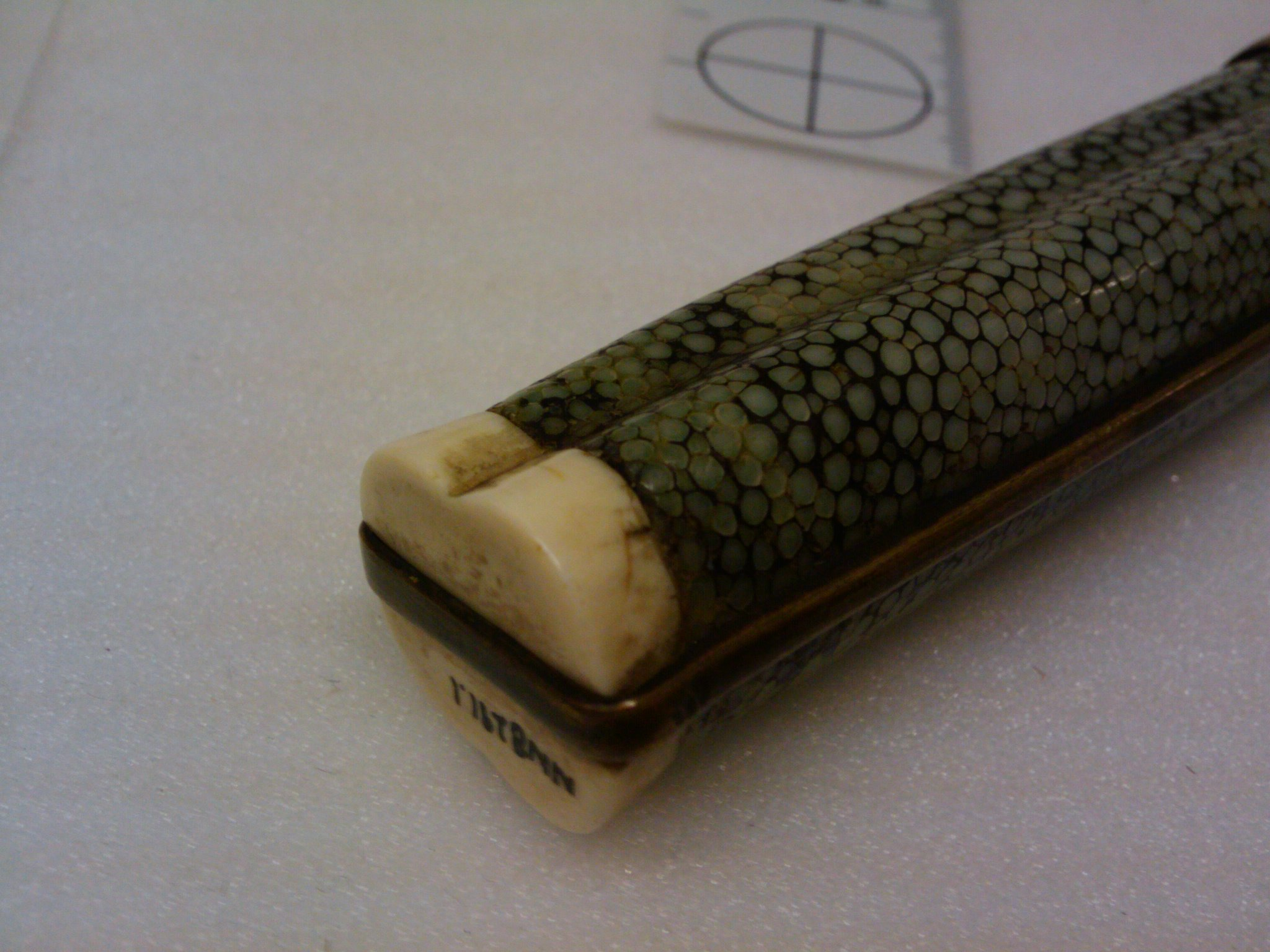
There are several species of Ray – and indeed some sharks – with skin used to make shagreen. One is called the Shagreen Ray, but I suspect that this is not an example of that species, despite it occurring in Ireland (there’s a very helpful guide to the Skates and Rays of Ireland if you’re interested).
I think this mystery object might be a Cowtail Stingray Pastinachus sephen (Forsskål, 1775), since that species has been extensively harvested to supply shagreen in the past, and the object is lacking the distinctive denticle patterns that can be used to help distinguish between the Shagreen Ray and other similar species.
It could of course be another species, and if anyone knows of a definitive set of features visible on this specimen, I would love to know what they are. So I would like to congratuate everyone who mentioned rays and shagreen!

