Friday mystery object #305 answer

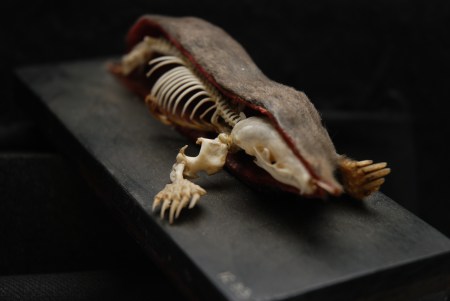
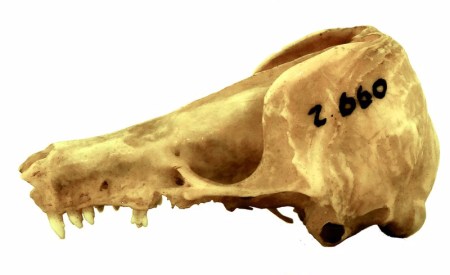
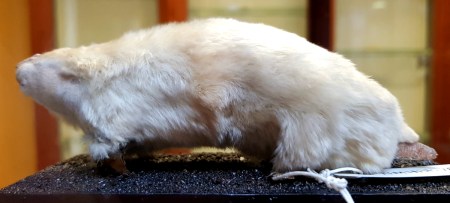
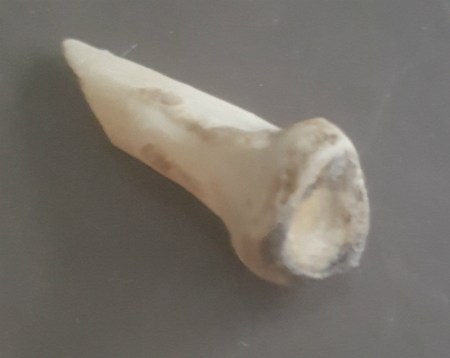
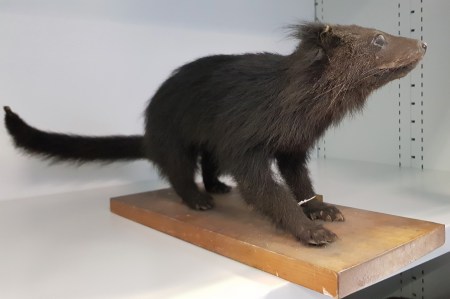
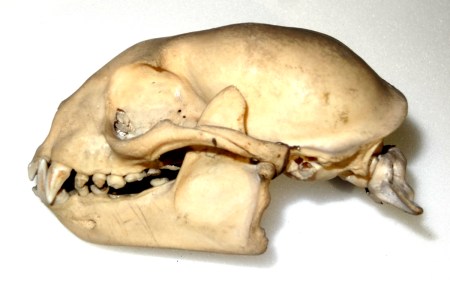
Last week I gave you this specimen to identify, with a clue about the tail being distinctive:

mystery305bmystery305d

There were lots of correct answers – the first coming from palfreyman1414 who nailed it with this great cryptic clue relating to its scientific name:

Trump assortment pack

It is indeed Potus flavus (Schreber, 1774) or as Allen Hazen and jennifermacaire hinted at with kinky clues, a Kinkajou. They’re also known as Sun Bears, Lirón (which is also the Spanish name for the Dormouse) or Micoleón (lion monkeys).

A Kinkajou at the Paradise Animal Rehabilitation Center, Volcancito, Panama. Image by Dick Culbert, 2008

A Kinkajou at the Paradise Animal Rehabilitation Center, Volcancito, Panama. Image by Dick Culbert, 2008

As the name Micoleón suggests, these South American floofsters are what happens when a carnivore tries to be a monkey. They have dexterous digits for climbing and handling the fruit that makes up the bulk of their diet and they are one of only two carnivores with a prehensile tail (the other is the Binturong) – hence that tail clue.

This tail acts like a fifth limb that helps the Kinkajou climb and in particular it allows the animal to hang down in order to reach fruit at the ends of slender branches:

Kinkajou hanging using its prehensile tail. Image by Damian Manda, 2009

Kinkajou hanging using its prehensile tail. Image by Damian Manda, 2009

Unlike monkeys, the Kinkajou is nocturnal, relying on its sense of smell and touch more than its eyesight to work out which fruit is ripe. It uses its very long tongue to scoop out fruit pulp and sometimes to feed on nectar from flowers.

All in all it’s a very curious little carnivore that looks more like a lemur than it does its closest cousin, the Coatimundis.

Friday mystery object #304

This week I was worried that I didn’t have a mystery object planned, but then I stumbled across this on my phone:

mystery304


It’s probably a bit too easy for some of you, so I’d encourage using some cryptic clues and hints to say what it is in the comments box below.

I’ve had a problem with spam comments recently and have switched on a filter to ensure that people’s first posts are approved (regular posters shouldn’t be affected) – fear not, I will be keeping an eye on it and approving first timers!

Have fun!

Friday mystery object #303 answer

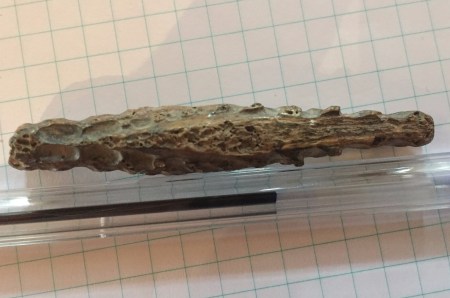
Last week I gave you this mysterious bit of bone from the Thames to have a go at identifying:

mystery303b

A few ideas were put forward, but DrewM was spot on with the suggestion:

I think it’s the synsacrum of a bird, without the ilia fused – the foramina are for spinal nerves.

A synsacrum is a fused section of vertebrae including the sacrum (which is where the pelvis attaches to the spine). General opinion quickly agreed with that suggestion, but the taxonomic group that the synsacrum belongs to remained unguessed.

That is perhaps unsurprising, since it’s hard to find good comparative images of bird synsacra, especially with the hips and lateral (or side) bits knocked off and worn down.

chicken synsacrum

A Chicken synsacrum showing the section preserved in the mystery object

I had a go at looking through some of the comparative bird osteology collections at the Dead Zoo to get a feel for birds with a similar synsacral morphology.

The usual suspect for a bird bone found in the Thames (for me at least) is Chicken, since they’re so closely associated with humans and a lot of the bones washed up on the banks of the Thames are from butchery and food waste. The size was about right, but the vertebral centra (the middle bits) of the Chicken synsacrum become more narrow in the hip-line than in the mystery specimen.

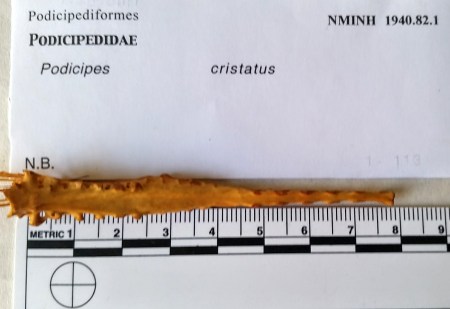
Next I looked at ducks, whose centra taper more in the direction of the tail, then grebes whose whole synsacrum is more narrow overall:

grebe synsacrum

Synsacrum of a Great Crested Grebe

Eventually I made it to the gulls who seem to be a much better fit in terms of shape and the Herring Gull Larus argentatus Pontoppidan, 1763 was a good fit for size:

herring gull synsacrum

Herring Gull synsacrum

Now this doesn’t mean to say that the mystery object is certainly from a Herring Gull. I would want to have the object in my hand and comparative material available from several specimens to check the identification before being sure, but on the basis of the images that Keith Dunmall kindly provided, I think we’re in the right ball park.

More mysteries next week!

Friday mystery object #299

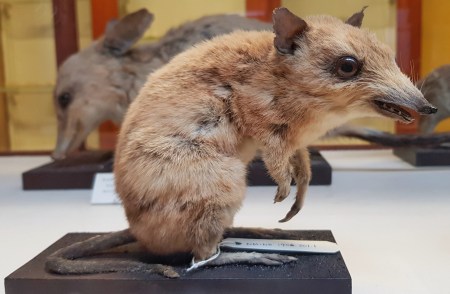
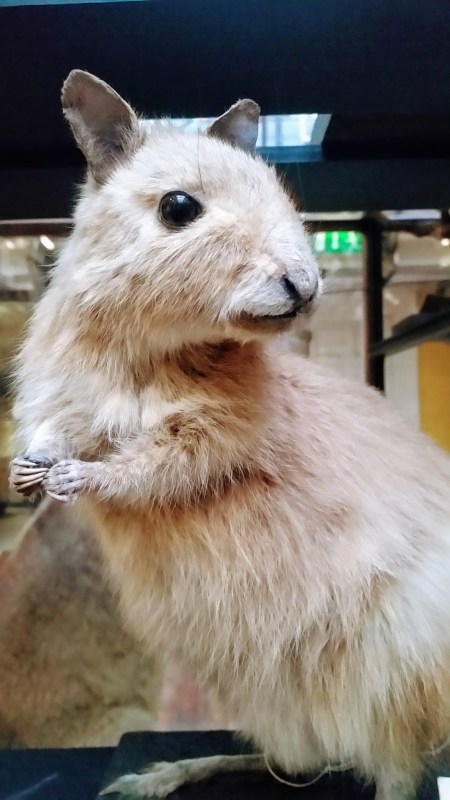
This week I’ve decided to give you a mystery object that has its skin and fur, so in theory it should be really easy to work out what it is. In theory.

mystery299

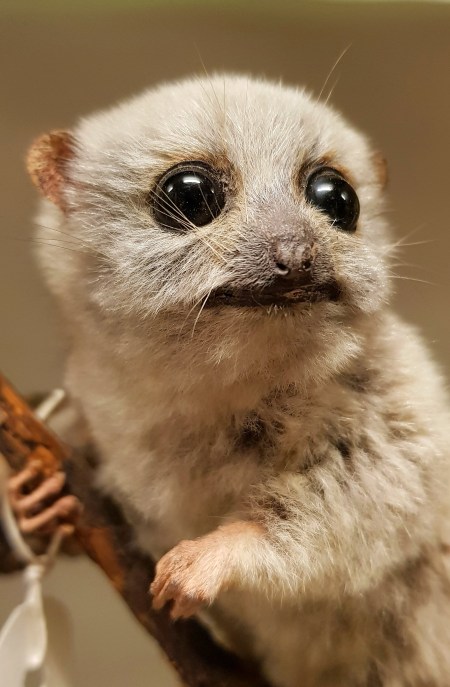
Any idea what species this adorable little critter belongs to?

As usual you can put your thoughts, questions and suggestions in the comments section below. If you find this too easy then maybe you can try to find a cleverly cryptic way to let me know.

Have fun!

Friday mystery object #298

This week it’s back to bones. I’ve had a couple of very helpful work experience students photographing some specimens from the Dead Zoo comparative osteology collection and here’s a distinctive bone for you to identify. The Order should be easy, the Family simple enough, but the Genus and Species may prove more difficult:

mystery298

So if you think you know what this is please put your suggestions in the comments below. Have fun!

Friday mystery object #297 answer

Last week I gave you this shiny green beetle with white spots (and apparently a penchant for making balloon animals) to identify:

mystery297

I thought it might offer a bit more of a challenge, but I forgot about Google. It turns out that a Google Image search using the key distinguishing features provides some useful images to compare, making this easier than I expected.

As palfreyman1414 correctly recognised (followed by many others), this is the Spotted Flower Beetle Stephanorrhina guttata (Olivier, 1789).

Of course, when dealing with historic museum collections things are never quite that simple, so the specimen on display is actually referred to by the genus name Ceratorrhina which isn’t recognised today. Ceratorhina was synonymised with Cyprolais, which is a subgenus (containing the Horniman Beetle) that’s in the genus Eudicella.

Of course, that means that this specimen may have been named incorrectly in the first place, since I’ve seen nothing to suggest that Ceratorrhina has been directly linked to beetles in the genus Stephanorrhina which sometimes carry the synonym Aphelorhina in older collections information.

It would be interesting to work out how the incorrect name was applied to this display specimen, but I have an inkling that there was once a rogue curator who just liked to cause taxonomic trouble…

Friday mystery object #297

Happy Friday everyone! Once again it’s time for the mystery object and once again I’m in a different country and am relying on a photo I have on my phone to supply you with a specimen for identification. That means the photo isn’t ideal, but it does mean I have something a bit different from the usual skull or bone:

mystery297

Any idea what species this colourful insect and its less lovely larva might be?

As always you can put your questions, observations and suggestions in the comments section below. Have fun!

Friday mystery object #296

This week I’ve been in the USA couriering a loan back from the stunning Corning Museum of Glass (I’ll write about that sometime soon). However, that means I’ve had limited access to specimens for this week’s mystery object and I’m restricted to what I’ve got on my phone. Fortunately, I have this non-vertebrate mystery object for you to try your hand at identifying to species:

mystery296

It’s quite a cool specimen and I’ll tell you why next week! Have fun!

Friday mystery object #295

For many of you, last week’s mystery object answer was a little disappointing, since I was unable to pin down what the specimen was. Normally with birds it’s not so difficult, because of useful resources like skullsite.com, but the fact is that some bird groups are still quite poorly represented in collections and finding comparative material is difficult, especially online.

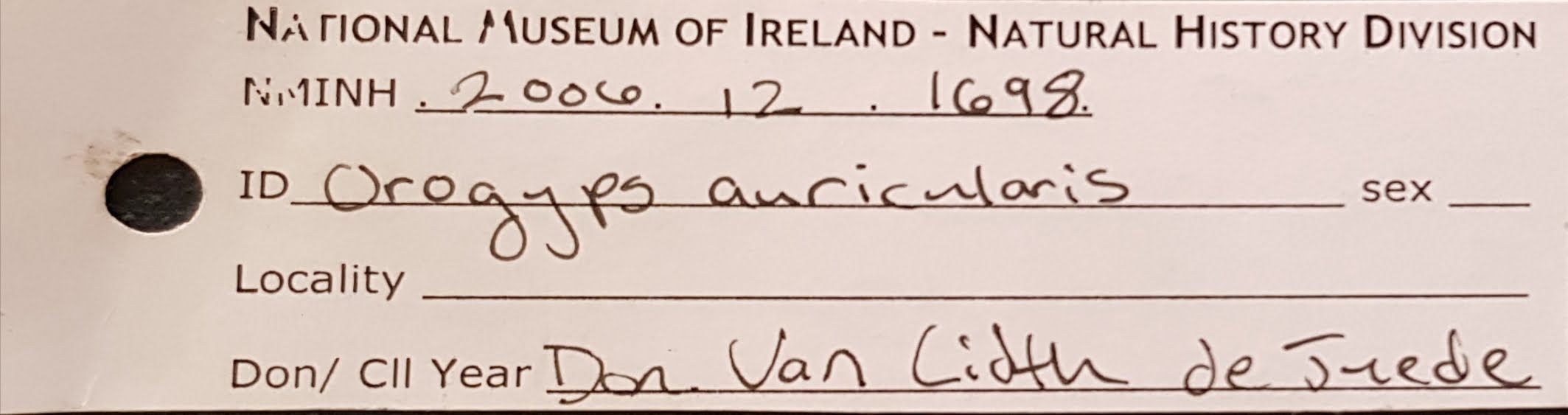
The most frustrating thing about last week’s object is that it did once have a label, but at some point in the past it was lost, so the only information with the specimen now is this:

mystery295_label

However, this label does offer a glimmer of hope, since it identifies the specimen as being from a particular collection and that can often mean there will be more information somewhere.

As it turns out, this specimen is one of several that were purchased in 1867 from an auction of the collections of Dutch anatomist Theodoor Gerard van Lidth de Jeude. This is helpful because auction catalogues can contain information like the species names of the specimens being sold. It is particularly helpful when you have the original catalogue with annotations about the specimens bought by your institution.

Fortunately, at the Dead Zoo we have the auction catalogues. Unfortunately we bought quite a lot of stuff, so working out which of the specimens our mystery object represents is still quite a lot of work.

However, if other specimens from the auction have their names and numbers, it should be easier to narrow down the ones that lost their labels. It also can also help to have an identification of the specimen to track back to the catalogue, which is why I was keen to get your thoughts last time and why this week’s mystery object is from the same collection.

So can you help me work out what species this skull belonged to?

mystery295

No need for cryptic clues, but if you want to show off your taxonomic prowess you could always offer the 1860’s scientific name or the name of what you think it is in Dutch.

I hope you have fun with this one!

Friday mystery object #293 answer

Last Friday I gave you this unidentified specimen from Dublin’s Dead Zoo and asked you to help me work out what it was:

mystery293

The response was incredibly helpful and it was great to see that most of you were drawn by the morphology to make a similar identification to me.

The fact that it’s from the family Anatidae (the ducks, geese and swans) was immediately noticed, and from there the likely genus was quickly narrowed down to Branta, based on the morphology. This is the genus containing the ‘burnt’ geese (that’s what ‘branta’, derived from the Old Norse, means), which includes: the Brant Goose; Barnacle Goose; Canada Goose; Cackling Goose; Red-breasted Goose, and Hawaiian Goose.

However, the nominate examples of all these species (that means the ones derived from the type on which the species name is based) are either the wrong shape or a bit too large to have this skull, which you can see by checking them on the excellent Skullsite by Wouter van Gestel.

The closest species in terms of morphology are the Cackling Goose (B. hutchinsii), Canada Goose (B. canadensis) and Barnacle Goose (B. leucopsis), but it turns out that there are various subspecies of each and one (that was previously recognised as a subspecies of Canada Goose, but which is now considered a subspecies of Cackling Goose) is rather small, as flagged by the subspecies name minima.

This smallest subspecies seems to fit both the morphology and the size very well, so I’m quite confident to identify the mystery specimen as the Small Cackling Goose Branta hutchinsii minima (Ridgway, 1885).

640px-small_cackling_goose_brood

A family of Small Cackling Geese, by Tim Bowman, USFWS, 2003

So thanks to you all for helping me to narrow down where in the Anatidae to start looking! More mysteries from the Dead Zoo next week.

Friday mystery object #292 answer(ish)

Last week I gave you a final mystery object from the Grant Museum of Zoology to help me identify:

dsc06030

Part of the reason for that was because I knew I’d be starting my new job in Dublin where there is a great collection of comparative bird osteology that I thought I’d get a chance to look at in time to write this post.

Alas, I’ve had a whirlwind first week at Dublin’s Dead Zoo and although I’ve managed to take a look at a few sterna, I’ve not had much time to really think about them or consider the identification. I’ve also had limited opportunity to follow up on everyone’s very useful suggestions, although I have tried to use them as a guide to narrow down my perusal of the comparative collections.

However, I did get a chance to take some quick snaps of a range of bird sterna with my phone, so I’m going to provide you with a veritable feast of breast bones to compare the mystery specimen against:

You can click on each image to see a large version – hopefully this will prove useful for future identifications!

None of them quite match the combination of having perforations near the straight and truncated bottom of the mystery specimen, which sports a broad triangular flattening of the lower portion of the carina or keel. This may be a feature of the particular individual, or it might be diagnostic – herein lie the problem with using strongly functional features for identification, as a juvenile or zoo specimen may have differences due to developmental progress of lack of use of a feature. To illustrate, this keel from a Griffon Vulture from the Royal Zoological Society of Ireland shows a significant asymmetry (although it’s hard to see the deformation in the image due to the shadow – I’ll see if I can get a better image):

Griffon Vulture sternum

Griffon Vulture sternum

It’s also worth noting that the Grant specimen has had the top of the sternum cut off, so the overall shape is a little misleading. From comparing the sterna of a variety of bird groups I’m in agreement with the emerging group consensus that this is probably from a pretty large bird of prey.

Thanks for your input on this – I will check some more next week when I have a zooarchaeologist looking at the comparative bird collection and I’ll get the chance to dig out some more material.

Cheers!

Friday mystery object #291 answer

Last week I gave you this skull from the Grant Museum of Zoology to identify:

mystery291

I thought this would be a fairly easy one and so I wasn’t surprised when Chris was straight in with a correct identification, in a suitably cryptic manner of course.

The huge open sinuses inside the orbit and openings around the auditory bullae (as spotted by palfreyman1414) immediately suggest that this is an animal that dives deep underwater, as the large openings help prevent pressure from building up inside the skull. The shape of the teeth are another giveaway that this is a fish-catching mammal in the Order Carnivora. It is of course a seal.

But what kind of seal? There are 33 species of pinniped, so there are a few options, although the large and distinctive species like Walruses can be ruled out for obvious reasons. In this size range and with multicusped teeth like these we’re looking at one of the true seals (the Phocidae) at the medium to small end of the size range.

When you start looking at the skulls of seals in this range, you need to look  closely. It lacks the flat top of the head and steeply sloping profiles following the nares of a Grey Seal, plus the interorbital distance (the distance between the eyes) is much smaller.

It lacks the inflated nasal region of the cold water Bearded Seal, Ribbon Seal, Ringed Seal and Harp Seal, which need well developed nasal turbinates to help warm the air they breathe in. It also lacks the deflection of the zygomatic below the orbit that is seen in the smaller species like the Caspian and Baikal Seals.

Overall the morphology is most similar to either the Spotted Seal or Harbour Seal, but picking between the two is tricky, especially since the Harbour Seal has around five subspecies that vary somewhat in size and shape of things like the auditory bullae. There is a list of characters that can be used to distinguish between the skulls of the two species by John J. Burns in the Encyclopedia of Marine Mammals. Using that as a guide I think this is a Harbour Seal Phoca vitulina Linnaeus, 1758.

Thanks to everyone who had a go at identifying this – I hope you had fun with it!

Friday mystery object #291

Today’s mystery object is a fairly straightforward one from the Grant Museum, although I’m hoping that we’ll get a species identification for the specimen. Any idea what this is?

mystery291

As usual, a nice cryptic clue would be appreciated so that we can have some fun and not give away what it is too soon for those who are developing their identification skills. Enjoy!

Friday mystery object #289

This week I’ve decided to go for another mini mystery object from the Grant Museum Micrarium. Any idea what this is and what it’s from?

mystery289

As always, your thoughts, questions and suggestions can go in the comments box below.

Also, if you have any images of tiny things you can share them on Twitter with the hashtag  to win a signed copy the excellent new book by Ed Yong – it’s well worth a read!

Have fun!

Friday mystery object #288 answer

Last week I gave you this mystery object from the Grant Museum of Zoology to try your hand at identifying:

mystery288

Not the best photos, but they do show some of the key features I used to work out what it is.

There were a lot of comments with a variety of different groups of animal being mentioned, although everyone recognised this as a mammal immediately. The large broad tail was recognised by Allen Hazen as an adaptation to swimming, but its unusual proportions threw some people into thinking this was something quite basal, like a marsupial or member of the Pilosa. The presence of a clavicle supported that to some extent as many of the more recent mammal orders, like the Carnivora, have a reduced or absent clavicle.

The hind feet were also recognised as an adaptation to swimming by palfreyman1414, but he was sceptical that this specimen represented just one species, suggesting it might be a chimera. However, I wouldn’t do that to you (unless it was an April Fool prank) so the real animal remained to be identified.

Hiroto Nakatsubo raised the possibility of it being a rodent, but commented that it was on the big side. This could have pointed at Beaver, as many people suggested, except the specimen lacks the distinctive tail morphology. All of this followed my own though path for working out what it is – a medium large aquatic rodent that isn’t a Beaver.

That narrowed it down to Capybara, Muskrat, Coypu or monster Water Vole. Of these, only one has the size difference between fore and hind limbs, plus the distinctively weird acromion process on the shoulder – the Coypu Myocastor coypus Kerr, 1792. So Isaac Krone was the first to get the correct identification, which he hinted at with reference to the Coypu’s alternative common name Nutria and the genus name which means “mouse-beaver” in Greek. Well done to Isaac!

Coypu showing off its weird discrepancy in limb lengths. Image by José Reynaldo da Fonseca, 2006

Coypu showing off its weird discrepancy in limb lengths. Image by José Reynaldo da Fonseca, 2006


Friday mystery object #288

This week I have a mystery skeleton that emerged from the collections of the Grant Museum of Zoology recently and required identification:

mystery288

Apologies for the slightly rubbish photographs, but I’ve taken pics of the bits I found most useful in making my identification.

Any thoughts on what species this specimen represents? You can put your questions, thoughts and suggestions in the comments section below. Have fun with it!

Friday mystery object #283 answer

Last week I gave you this zoomed in picture of a specimen to have a go at identifying:

mystery283

It was a bit tricky, so I also gave you this bonus clue to help:

mystery283_bonus

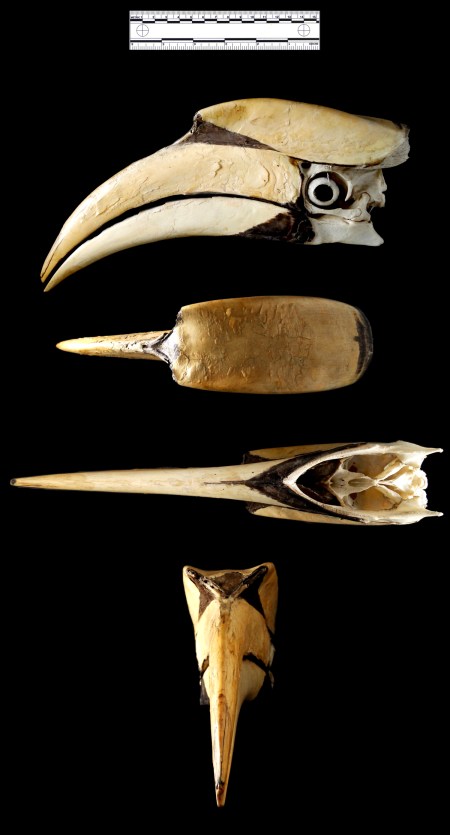
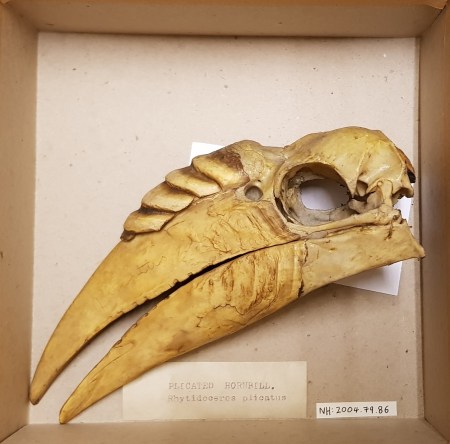
I was impressed to see that, despite the limited information available from the images provided, many of you managed to work out that this shows the lightweight ‘honeycomb’ structure that supports the casque of a hornbill.

That was the first challenge but, as ever, I was keen to see if you could get the identification to species – far more of a challenge considering the lack of a side view of the skull and lack of a scale. To make up for that I’ve decided to provide the necessary image here:

Ceratogymna atrata skull

I won’t say what species this is in this post, as I normally would, just to give some more of you a chance to make the identification yourself. However, what I will say is that the very first response by Wood contained a link to an image of the correct species and later to a blogpost featuring this very specimen. In that post there is a discussion about the appearance of the casque, with speculation about whether it had been damaged during preparation, resulting in its appearance. However, as Richard Lawrence pointed out, this appearance is actually normal for the skulls of several species of hornbill.

I will also say that the discussion between Daniel Calleri & Dan Jones and Richard Lawrence about whether it was a hornbill from a genus starting with A or B was interesting and I initially thought it was an A, but am now convinced that it’s a C.

If you’re desperate to know which species it’s from, here’s a link to the skullsite.com page about it.


Friday mystery object #283

This week I have a mystery object for you that’s a bit different from the usual. Any idea what this zoomed in picture is showing?

mystery283

It’s probably a bit of a tricky one, so if you want an extra image that makes it much easier you can click on this link for a bonus clue.

Please leave your suggestions in the comments below – I’d love to find out your thoughts and let me know if you needed the clue. Have fun!