Friday mystery object #327

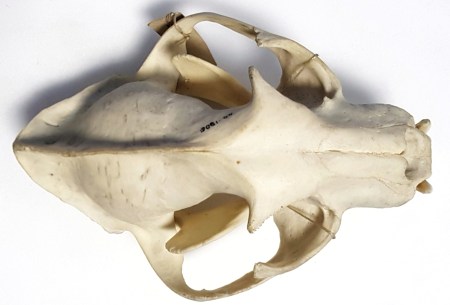
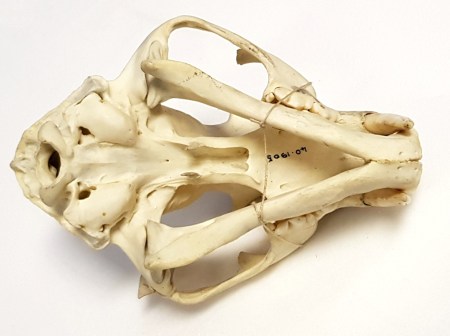
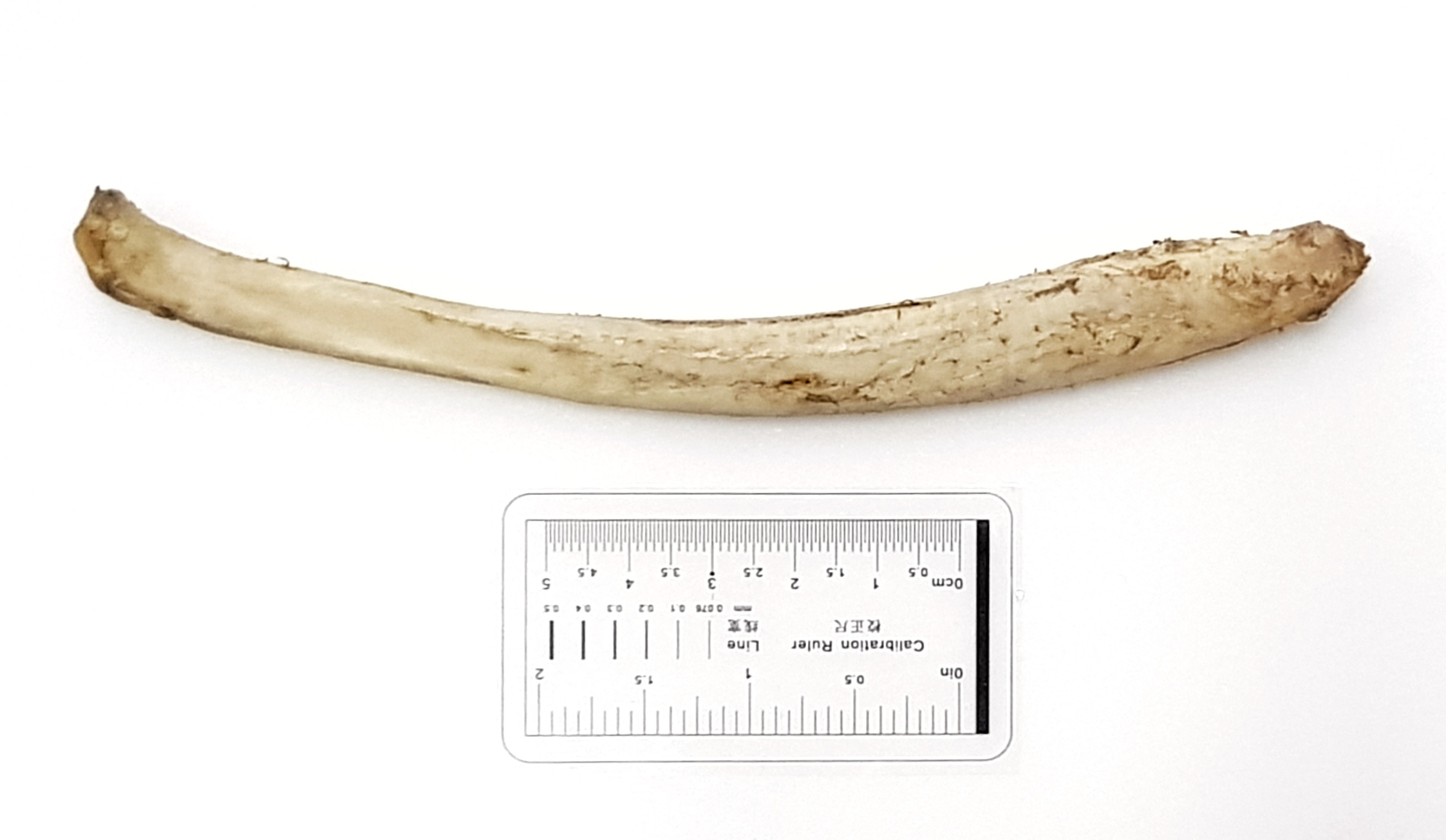
This week I have a mystery object for you that I expect you will find simultaneously easy and difficult:

20171130_153340-01.jpeg

If you’ve been following my blog for a while, I expect you’ll be able to work out what this bone is quite easily – however, you may struggle a bit more to work out which species it came from.

Cryptic answers are encouraged as always – but mainly have some fun with this one!

Friday mystery object #326 answer

Last week I gave you this dissected mandible to have a go at identifying:

20180322_162222-01.jpeg

I thought it might be fun to get a poetic response and I wasn’t disappointed. There were some great efforts and I thoroughly enjoyed unpicking the clues from the verses people crafted in response. Of course, a poetic soul is only so much use in this game – you also need to work out what it is.

Bob Church was the first with a bardic response that was unambiguously on target for the identity of the mystery specimen:

Though the bone’s a disaster
There’s enough left to answer
What this rolly polly animal could be
It might sound a bit funny
But mix a turtle and bunny
And you’ll find the bowled over family

Of course, if you mix a turtle and a bunny you get something that looks like the artistic creation by John Tenniel in 1865 to illustrate Lewis Caroll’s Mock Turtle from Alice’s Adventures in Wonderland:

alice_par_john_tenniel_34

Gryphon and Mock Turtle with Alice, by John Tenniel in 1865

The animal in question is actually remarkably similar in appearance:

9-banded Armadillo by Ereenegee, 2011

9-banded Armadillo by Ereenegee, 2011

It’s the Nine-banded Armadillo, Dasypus novemcinctus Linnaeus, 1758, a decidedly odd animal that lives in South, Central and southern parts of North America.

Most mammals have well differentiated teeth, so the homogeneity of these in shape (or homodont condition) suggested that you were dealing with something a bit unusual, with simple peg-like teeth, open roots and no enamel. That makes the mandible quite distinctive, even with some missing teeth.

The one slightly confusing thing about this half a jaw is that it appears to have tooth holes (or dental alveoli) for 10 teeth (as recognised by salliereynolds, who also got the identification right), but armadillos are only meant to have eight teeth in each side of their upper and lower jaws.

I thought this difference might throw you off the Armadillo scent a bit, but clearly I was wrong. The difference in this jaw will probably be because it comes from a young animal which still has milk teeth (or the alveoli for them) that aren’t all replaced by the adult teeth.

These insectivorous armoured animals are unusual in a variety of ways beyond their dental idiosyncrasies. They have imbricated bony nodules or plates embedded in their skin (or osteoderms) that forms a tough armour:

mysob3a

Dorsal view

mysob3b

Ventral view (width ~5cm)

They also consistently give birth to four offspring every time, originating from a single egg that splits into four. So every Nine-banded Armadillo has three identical siblings. I think this fact alone qualifies them as one of the weirder animals out there.

More mysteries next week!


*Juliette Kings may have got in with the first identification, with reference to the Armadillo’s habit of jumping straight up in the air when alarmed and occasionally screaming, but it sounded a bit more like she was suggesting Goat.

Friday mystery object #326

Yesterday I was doing some work in the gallery of the Dead Zoo and found a specimen that needs a little light repair work to stick teeth back into sockets. I thought it might make an interesting object for you to have a go at identifying:

20180322_162222-01.jpeg

Any idea what this piece of mandible might belong to? It’s probably a bit too easy for some of the mystery object veterans, so please keep your suggestions cryptic and, if you’re in the mood, poetic.

Have fun!

Friday mystery object #325 answer(ish)

Last week I gave you the challenge of identifying this bit of bone found in a rockpool in Kimmeridge by 7 year old Annie:

mystery325a

It’s not the easiest item to identify for a variety of reasons. First of all it’s broken, only showing one end and probably missing quite a lot of the element. Next, the images don’t show all of the angles you might want to see and because the object is small the images aren’t as clear as you might like.

However, there are a few angles visible (see below) and there is a scale, so the main requirements to get an approximate identification are in place. I say approximate, because with something like this I think you really need the object in your hand where you can compare it to other material in detail if you want to make a confident identification.

Excuses aside, let’s take a look and see what it might be…

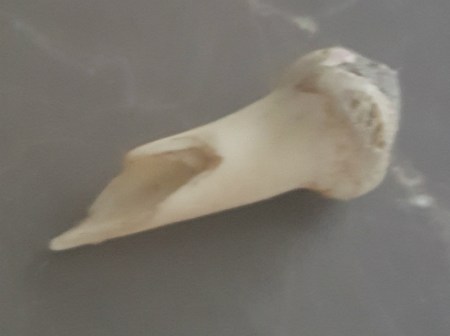
The first thing to note is that the bone is hollow with thin walls. This rules out fish, reptiles, amphibians and mammals (including humans jennifermacaire) – leaving birds.

Weathered mammal bones may have a void in the bone where the marrow would have been, but the cortex (outside layer) will be thicker and near the articular surface it tends to be quite solid.
mystery325c

Hollow bone = bird (usually)

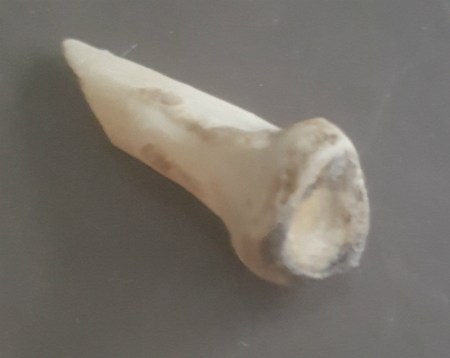
Next, the articular surface of the bone is concave, which palfreyman1414 picked up on:

As far as I recall (mentally running through images in my head) both ends of the proximal limb bones in tetrapods have convex ends?

This is accurate, but while the proximal (near end) of the limb bones are convex, the more distal (far end) limb bones tend to have concave ends, so that helps narrow down what this bony element might be.
mystery325b

Concave articulation

For me the give-away here is the fact that there’s no ridge within the concavity of the articular surface, which means that it will allow movement in several directions – something that the bones of bird feet don’t really need, which is why bird lower legs,  feet and toes have a raised ridge inside the articular surface that corresponds with a groove in the other surface, keeping the articulation of the joint tightly constrained.

20180315_143049-01.jpeg

Articulation of Shag phalanx showing raised ridge

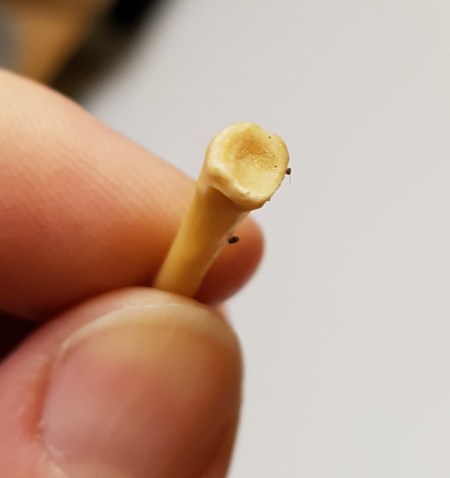
However, bird wing need to make a wider range of motion (at least in some species), so the mystery object is most likely the distal end of a bird radius (the ulna tends to have a hook at the distal end). This is the conclusion that Wouter van Gestel and DrewM also came to (joe vans should’ve stuck to his guns).
20180315_143712-01.jpeg

Distal articulation if duck radius

Identifying the species of bird is a lot more complicated. The size suggests a pretty big bird, which narrows it down and the locality in which it was found makes some species more likely than others. I took a look at the radius of some species that are commonly found on the coast, like Guillemot, Herring Gull, Duck, Cormorant/Shag and Gannet, Skimmer, Pigeon and I also checked out Chicken, since their bones are probably the most commonly occurring on the planet.
20180315_142205-01.jpeg

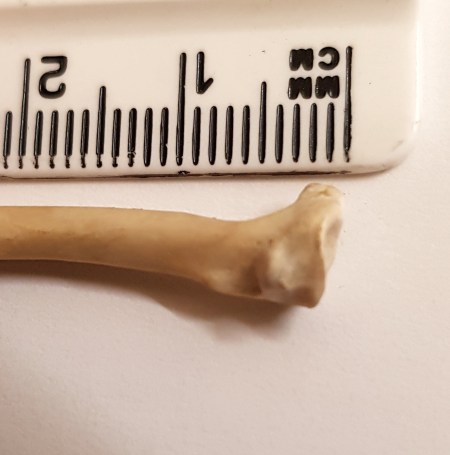
Gannet radius with some distinctive structure around the articulation

Many of the species I checked had quite a distinctive structure around the distal radius articulation, but the gulls, ducks and chickens that I looked at had fairly unremarkable distal radius articulations, making it hard to definitively decide what the mystery object is based on the images.

20180316_072154.jpg

Herring Gull radius

20180315_143308-01.jpeg

Chicken radius


So with that somewhat disappointing conclusion I admit partial defeat, but I can say that it’s not from a Cormorant, Shag, Gannet, Pigeon or Guillemot. Sorry I can’t be more specific Annie!

Unfortunately that’s just how the identification game works sometimes… we’ll try again with something new next week!

Friday mystery object #325

This week I have a genuine mystery object for you passed on from my NatSCA colleague Holly, that was found in a rockpool in Kimmeridge by 7 year old Annie when she was out fossil hunting on the beach:

mystery325amystery325bmystery325c

Any idea what this object could possibly be?

I don’t think there’s any need for cryptic clues this time, as it’s a proper challenge and I’d love to hear what you think it is and what it’s from. Have fun!

Friday mystery object #324

This week I’ve decided to give you a mystery invertebrate from the collections of the Dead Zoo:

mystery324

Now there are a variety of levels of identification for this object: species (obviously), materials, makers and if you really want to show off, you might even be able to provide a year and information about how much it cost at the time.

As always, I’d be delighted to see what you think and to hear about any similar specimens you might know about.

Have fun!

Friday mystery object #321

This week I thought I’d give you a break from the bones and offer up a fuzzball for some Friday fun:mystery321

Any idea what this (slightly dusty looking) critter from the collections might be?

It’s probably a bit too easy for some of you, so cryptic clues and subtly veiled hints would be appreciated in the comments section please. Have fun!

Friday mystery object #320

I hope everyone had a lovely Christmas break!

This week I have another specimen from the Dead Zoo to identify – this one has an identification already, but the taxonomy is rather archaic and I think that once you’ve investigated the modern version of the name, you’ll realise that it’s wrong.

20171228_131937-01-01.jpg20171228_132026-01.jpg

20171228_132058-01.jpg

Skull length = 121mm

20171228_163420.jpg

So, any idea what this name should actually be and, more importantly, what the identification actually is?

As always, you can put your thoughts, questions and suggestions in the comments box below – have fun!

Friday mystery object #318 answer

Last week I gave you this bird skull from the Dead Zoo in Dublin to have a go at identifying:

20171129_162916.jpg

It’s a fairly distinctive looking specimen with that massive bill, immediately narrowing down the possible families to two likely contenders – the Toucans (Ramphastidae) or the Hornbills (Bucerotidae).

On closer examination it lacks the serrated bill margins and remarkably long medial (in this case that means ‘towards the midline of the skull’) process of the quadrate bone (a part of the jaw in birds that I’ve blogged about before) that you see in Toucans. So, it’s a Hornbill – as everyone correctly spotted in the comments – but then we have the question of the species.

There are around 60 Hornbill species, with most of them sporting quite distinctive casques which make them quite identifiable (I’ve blogged about several before):

Ceratogymna atrata skull

Black Hornbill Ceratogymna atrata

mystery240

Great Hornbill Buceros bicornis

Bucorvus abyssinicus (Boddaert, 1783) sectioned skull

Northern Ground-hornbill Bucorvus abyssinicus

However, this specimen seems to be lacking a casque. This could be due to a few reasons. There are some casqueless species, such as the Sri Lanka Grey Hornbill, it could be a young female adult from a small casqued species with sexual dimorphism in casque development, or it could be a young juvenile from a species that has a small casque that grows as the animal matures.

Assuming it’s one of these, it’s easy to check the few casqueless species by looking at the overall bill shape, the position of the nares (nostrils) relative to the orbits (eye sockets) and checking the structure of the jugal and quadratojugal (the thin bones on the side of the skull under the orbit) – this last only if you can find a reliable skull image for comparison.

Using Skullsite and images on the internet it’s time-consuming, but straightforward to rule out a lot of possibilities, since most Hornbills have a fairly robust jugal/quadratojugal and nares located much further away from the orbit than you see in the mystery specimen. In fact the only Hornbills with a similar nares/orbit position and gracile (skinny) jugal/quadratojugal and in the right size range (that I was able to find) were in the genus Rhyticeros L. Reichenbach, 1849.

Unfortunately I’ve not found good skull images of juveniles for all of the species to make a final comparison and you can’t just compare the skull of a juvenile with an adult and expect to see the same configuration and development of features, as there’s still growth to happen (something else I’ve talked about before).

So based on the information it looks like jennifermacaire was the closest with her suggestion of Wreathed Hornbill, although I’m leaning slightly more towards the Papuan Hornbill Rhyticeros plicatus (J.R.Forster, 1781).

20171207_180748.jpg

Hope you enjoyed the challenge!

Friday mystery object #317

For this week’s mystery object I’ve decided to stick with my favourite subject of skulls. This time it’s a bird from the Dead Zoo’s collection, that was in a drawer labelled “Unidentified” – let’s fix that!

mystery317

Any idea what species this skull belonged to? I have my suspicions, but I’d love to hear what you think.

As always, you can leave your clues, questions and suggestions in the comments section below. Have fun!

Friday mystery object #312 answer

Last week I gave you this specimen to identify, which came in as an enquiry after being found in someone’s toilet:

There were a variety of great responses, with some fantastic cryptic clues, including an anagram by Claire Miles (great stuff!). Most opted for this being Stegobium paniceum, which is also known by the aliases Drugstore Beetle, Biscuit Beetle or Bread Beetle.

Stegobium paniceum by Sarefo, 2007

Stegobium paniceum by Sarefo, 2007

However, the mystery critter has a subtly different pronotum (that’s the plate over the thorax that extends over the head).

Another suggestion was woodworm or one of the false powderpost beetles, which covers a range of wood-boring beetles, with Liberty Hightower correctly giving the more taxonomically constrained suggestion, of something from the Tribe Anobiini (which includes Stegobium). However, my colleague Olivier sent me an email with a very definitive identification, informed by a past experience with this particular pest – the Furniture Beetle Anobium punctatum De Geer, 1774.

These beetles have a distinctive pronotum that supposedly looks like a monk’s cowl, with a more distinctive hump and slightly pinched looking back section than the more smoothly curving pronotum of the Stegobium. They fall into the broad category of woodworm because their larvae feed on wood, making tunnels hidden from view and only becoming visible when they emerge from small holes in the wood as adults, leaving a little pile of wood dust as they go.

The presence of these beetles in a toilet isn’t related to the water in the bowl or even wood of the seat – it turns out that there was a window above the toilet and the adult beetles, in an attempt to leave the building after emerging, were attracted to the light from the window and flew into the glass only to bounce off and land in the toilet.

This attraction towards light in the dispersing adult stage of the beetle is a handy behaviour if you want to keep track of these pests. If you’re concerned you may have active woodworm it’s worth checking your windowsills in the summer to see if you have any of these adult beetles lying around. Of course, there are other species that would also be worth checking for, since there are plenty of beetles whose larvae would be considered woodworm. Keep your eyes peeled!

Friday mystery object #311

This week I have a real mystery object for you, which came in as an enquiry from the bottom of a mine in Ireland that was flooded to the roof with freshwater. It’s earned itself the delightful name of the ‘Clonkeen snot’ thanks to its appearance and texture:

mystery311

If you click on the image, it will open a large version so you can have a really good look at the fascinating gunk that was fished from the subterranean dankness.

Any ideas what this might be?

As always you can leave your questions, thoughts and suggestions in the comments section below. Have fun!

Friday mystery object #310 answer

Last week I thought it was time for some more bones, so I gave you this specimen from the Dead Zoo to have a go at identifying:

mystery310

There was no scale, the photo is far from ideal and the specimen isn’t in the best condition, but the animal is pretty distinctive, so I thought it wouldn’t prove too much of a challenge – and it turns out that I was right.

Palfreyman1414 was the first to identify it to genus level, correctly recognising that it was one of the two Notoryctes species of Marsupial Mole from Australia.

The weird limbs are a pretty good indicator this being a digger, with large muscle attachments and robust forelimbs, but it has couple of large claws rather than the ridiculous giant hands of the Old World Moles and it has a shorter skull.

Double prep mole from the Horniman Museum

Double prep of an Old World Mole Talpa europaea from the Horniman Museum & Gardens

The skull is more similar to that of the golden moles of southern Africa, although their rostrum (nosey bits) tends to be more concave while the marsupial moles have a more convex rostrum (and in some cases, weirdly flaring zygomatic arches).

mystery268

Lateral view of the skull of a Giant Golden Mole Chrysospalax trevelyani from the Grant Museum of Zoology

Now distinguishing between the two species of Marsupial Mole is a bit more tricky, not least because they are quite poorly known animals and there aren’t many specimens available for comparison – this is particularly true of the Northern species, which was first described as recently as 1920.

This is actually quite useful to know, since the mystery specimen came into the collection in 1897 – from Southern Australia – so it’s safe to say it’s the Southern Marsupial Mole Notoryctes typhlops (Stirling, 1889), but that’s not very helpful from a morphological perspective.

So far I’ve not found any useful skeletal features that help differentiate the two species, but apparently their fur colour is a little different, with the Northern species having pinkish or cinnamon fur and the Southern species having yellowish-white to a deep gold. To see what they look like with their fur, here’s the taxidermy partner to the mystery skeleton:

Southern_marsupial_mole

Taxidermy Southern Marsupial Mole Notoryctes typhlops in the National Museum of Ireland – Natural History

As with most moles these subterranean critters have adapted to spending much of their time underground by losing their eyes, investing in some serious digging equipment and tuning in to smells and low frequency sounds.

I hope you enjoyed this little tour around the main moles of the world! More mysteries next week.

Friday mystery object #308

As I’ve mentioned before, for the last few months I’ve been feverishly moving objects for a gallery lighting project. 

That’s pretty much done now (and looking great) so now I’m feverishly moving the Dead Zoo’s collection of over a million insects out to a new home in the National Museum of Ireland’s Collections Resource Centre.

So this week I have an insect for you to identity, which should provide a bit of a colourful change from the usual vertebrate bones:

For some of you this may be way too easy, for others, way too hard. It help to know that this was collected in India and it’s around 25-30mm long.

I hope you have fun identifying it!

Friday mystery object #307

The last few months have been particularly busy for me as I’ve been working on a lighting project in the Irish Room of the Dead Zoo in Dublin, so I’ve not had much opportunity to dig out mystery objects and get good images for you to identify.

However, I have moved pretty much every specimen in the gallery and if you want to see how much stuff that entails there’s a 3D interactive map of the space available here (if you want to have a virtual tour of the whole museum check this out). All this moving means I’ve seen a lot of specimens, so here’s one of them for you to have a go at identifying:

mystery307

For a some of you this will be way too easy, so let’s have your best cryptic clues, hints and riddles as to what this is.

Have fun!