This week I have a fragment of a toothy object for you to identify:
Any idea what species this fearsome looking row of teeth might have come from?
You can put your thoughts, questions and suggestions below. Have fun working it out!
Recently I’ve been working through boxes of mixed archaeological bone and bone fragments. So here’s one of the objects I had to identify as part of that process:
Any idea what it might be?
As usual you can put your observations, suggestions and questions in the comments box below. If you find it easy, please try to use a cryptic clue so other people get a chance to get involved. Have fun!
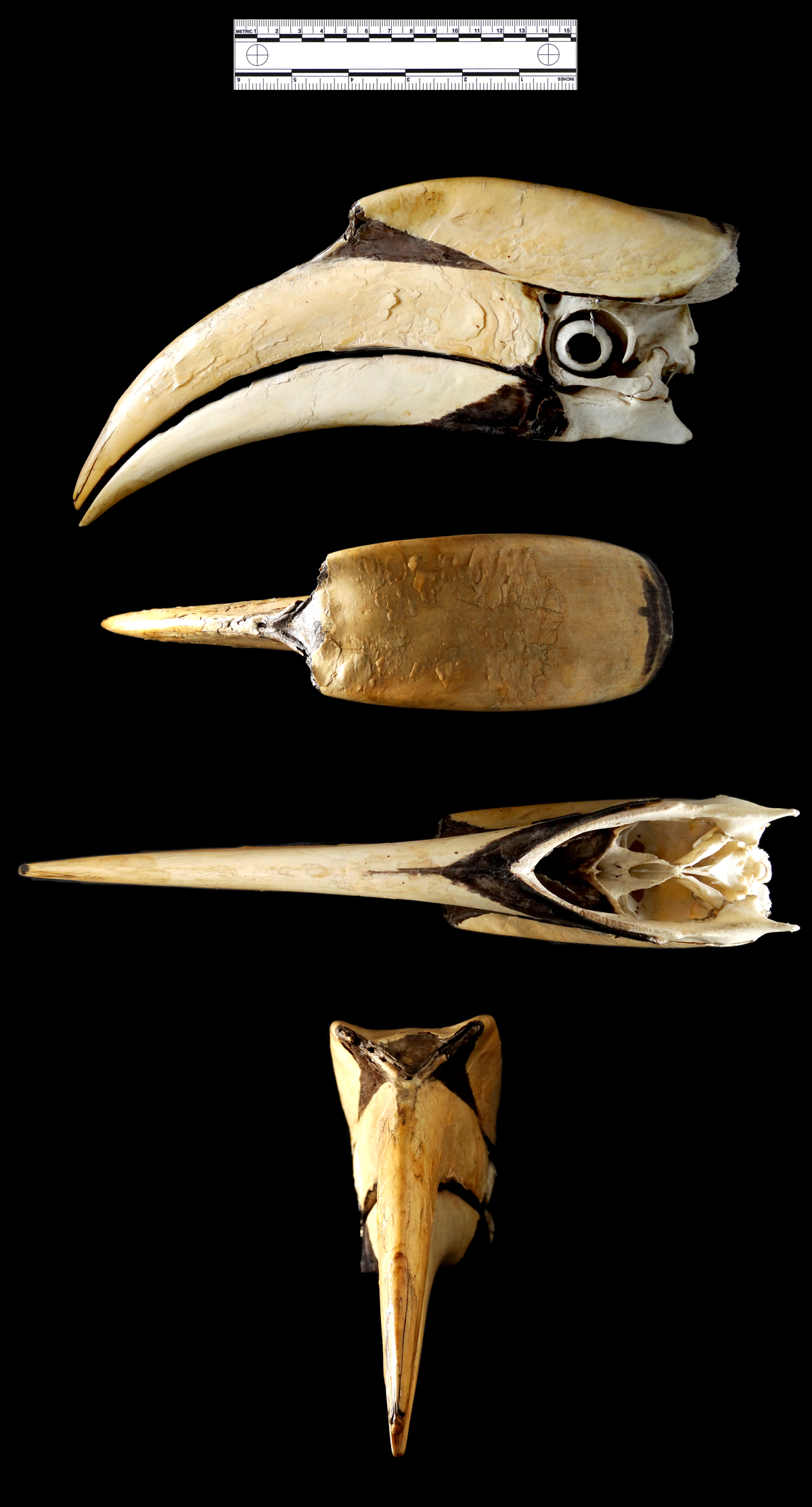
Last Friday I gave you this characteristic skull to identify:
Many of you recognised that this is the skull of a Hornbill, and Martin Edvardsson, ClareP, Jamie Revell, paleomanuel, witcharachne, marcuschua all managed to identify it as a Great Hornbill Buceros bicornis Linnaeus, 1758.
You may be surprised to know that this specimen was originally misidentified as a Black-and-white-casqued Hornbill Bycanistes subcylindricus (Sclater, 1870) by the taxidermists who prepared it – quite a basic error for a natural history professional!
The Great Hornbill is a large Asian bird that feeds on fruit and any small critters that end up at the wrong end of that impressive bill – from insects to owls. Their distinctive black and white plumage is used by a lot of native people in Southeast Asia in costume, leading to pressure on the bird’s population due to hunting.
Great Hornbills have a somewhat odd system for breeding, with the female walling herself up inside a hole in a tree using faeces, and the male delivering food to her and the chicks through a narrow hole. It works for Great Hornbills…
Last Friday I gave you this creepy clown doll made of bone to identify:
There were some great cryptic responses from yogicbear, Claire Miles, Jake, henstridgesj, Daniel Calleri, Robin Birrrdegg and Anne Åslaug Holder identifying that it’s been made from a wishbone, with the unfortunate donor being a Chicken Gallus gallus domesticus (Linnaeus, 1758).
The wishbone is somewhat larger and better formed than the usual one you’ll find in a modern chicken, since modern birds tend to be eaten when they’re much younger than this bird would have been. It came to the Horniman in 1923, donated by English folklorist Edward Lovett.
The second part of last week’s mystery was this sound provided by Cheryl Tipp, curator of the British Library Wildlife Sound Archive:
Again, there were some brilliant cryptic answers to the sound, with an anagram from Claire Miles and two lovely pieces of verse relating to the animal provided by Harry. It is of course the characteristic creaking call of the Corncrake Crex crex (Linnaeus, 1758).
So a big congratulations to everyone who took part – that’ll be the last of the sounds for the time being, next week I’ll have to think about some more specimens to pose a challenge!
Since it’s Halloween I thought it might be appropriate to have something a bit creepy to identify – and what’s more creepy than clowns? Apart from maybe dolls. So here’s a clown doll:
Any idea what this creepy little object is made from?
While you’re pondering on that you may want to also have a think about what this eerie noise from the British Library Wildlife Sound Archive is made by:
…and it’s not the sound of a tiny wild clown chasing sheep in the dead of night.
Probably.
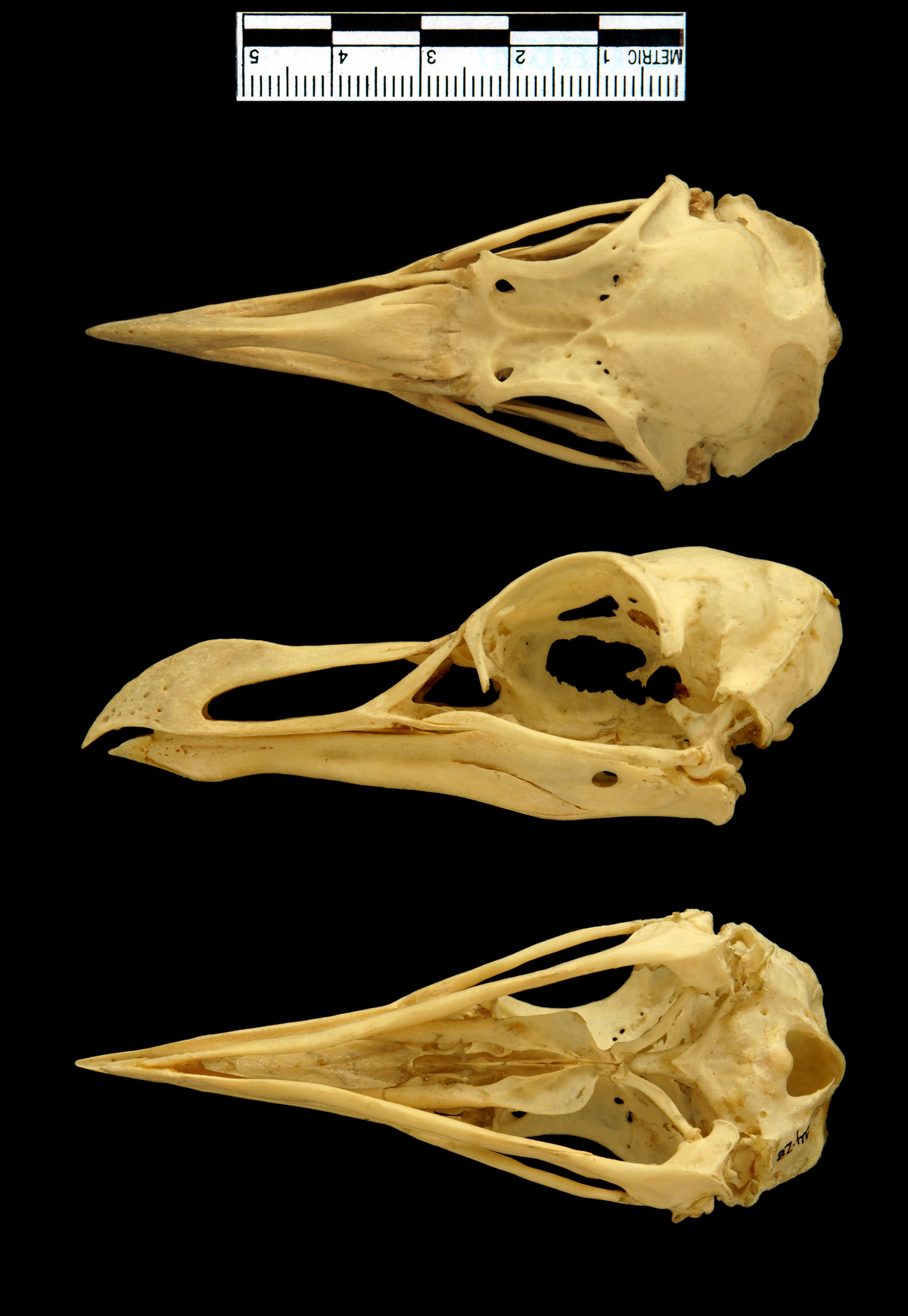
Last Friday I gave you this sound and skull combination to have a go at identifying:
As many of you worked out, the skull and call belong to quite different species that share a love of the seaside.
The call belongs to the somewhat enigmatic Common Eider Somateria mollissima (Linnaeus, 1758) as identified by mark b, Chris, Melanie, Henry McGhie, Anne Åslaug Holder and stuart petch.
A male Somateria mollissima (Common Eider) at the London Wetland Centre, Barnes, UK. By Diliff, 2013
These large marine ducks are at home on the water, where they feed on molluscs and crustaceans. They are probably best known for their super-soft downy breast feathers, that the females use to line their nests and humans use to fill their pillows.
The skull belongs to a Razorbill Alca torda Linnaeus, 1758, as identified by Ric Morris, mark b, Chris, Melanie, Henry McGhie, Anne Åslaug Holder and stuart petch.
These birds are great divers, using their wings to ‘fly’ underwater. They feed on small fish and other slippery critters, caught using that characteristic bill.
Congratulations to everyone who managed to work out what the two species were – there’ll be a final mystery sound from the British Library Wildlife Sound Archive to identify next week, courtesy of curator Cheryl Tipp!
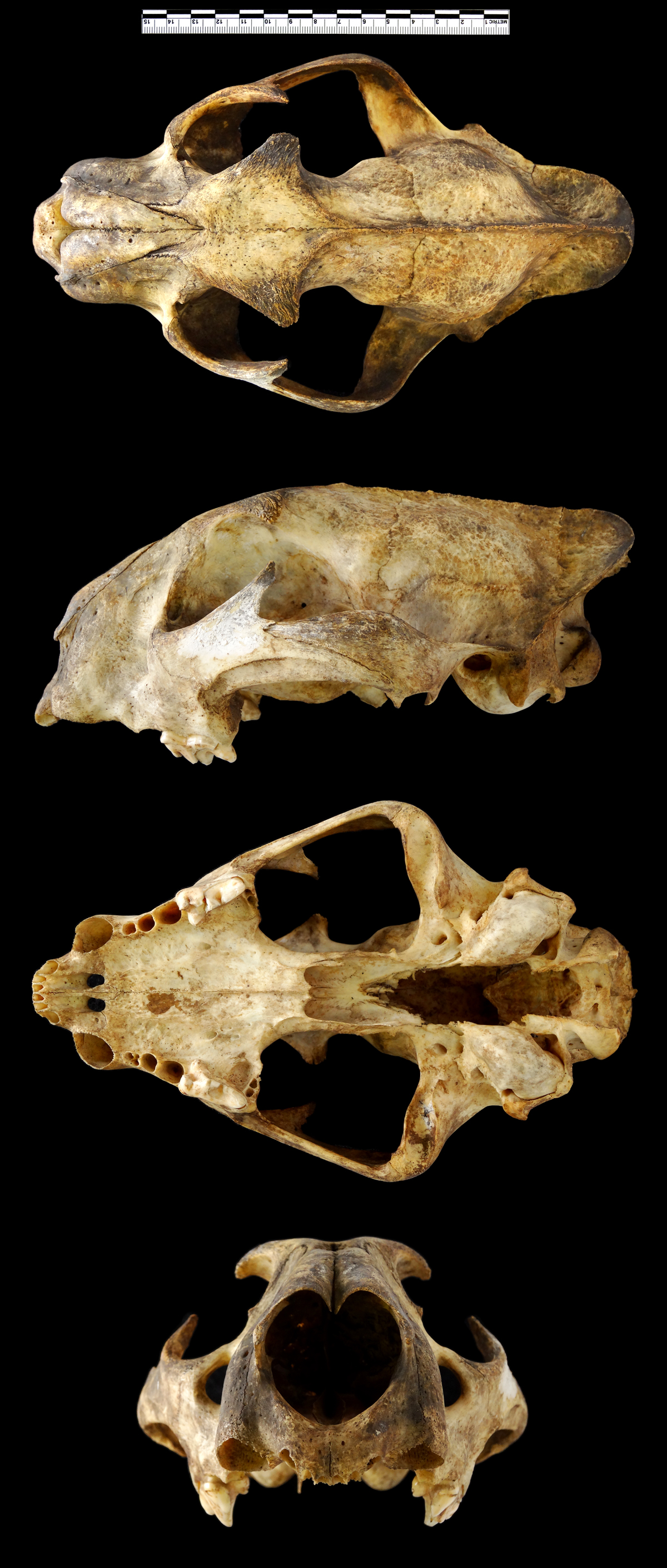
Last Friday I gave you this mystery skull to identify, which I discovered in a box of unidentified bits and bobs:
It was pretty obvious that it was the skull of a big cat of some kind, with most of you suggesting a Jaguar or Cheetah (either of which would make me very happy as we have the skull of neither in the Horniman collection). Unfortunately it appears to belong to neither.
As I’ve mentioned before, cats are quite difficult to differentiate from each other as they haven’t been diverging for all that long and their widespread distributions can mean that populations within a particular species can be quite variable in morphology. Leopards are a good example of this, with a (once continuous) range from Korea to South Africa.
As it turns out, this specimen is most likely from a Leopard Panthera pardus (Linnaeus, 1758), since it’s from an adult animal (as is clear from the well formed sagittal crest) but is on the small side for a Lion or Tiger and too big for a Cougar or Cheetah. It also lacks the broad post orbital region seen in the Cheetah and Snow Leopard, and it lacks the concave profile of both the Snow Leopard and Jaguar. All of these identification pointers can be found in this handy pdf by Margaret “Cookie” Sims.
Just to show you what I mean about the variability within a species, here’s a second skull from the same box, that also matches the Leopard identification.
I expect the big difference in size is largely down to sexual dimorphism, but as you can see the overall proportions are quite different as well. This may be a difference between widely separated populations, or it could just be individual variation – either way it goes to show that cats are hard to identify.
Last Friday I gave you a variety of mandibles to have a go at identifying. They lacked a scale bar and represented a range of different species that have similarities in mandible shape.
There were some great cryptic suggestions of identities, but it must be said that Jake came through with a really clear and pretty much spot-on list of suggestions. So here are the answers in a handy form that might be useful for reference:
The Sheep and Cow have a distinctive upward inflexion at the end of the mandible, with the Cow’s being so strong that the incisors start above the level of the top of the molar tooth row – unlike the Sheep’s.
This inflexion is much less marked in the Red Deer, which has a narrower body of the mandible, presumably relating to the less intensive chewing of a browser compared to grazers (grass is tough stuff). The Deer also has a notch along the bottom of the jaw, which Jake pointed out as a useful feature.
The Pig mandible tapers less overall, but is thicker at the end with the articulation – presumably because the omnivorous Pig is chewing differently, using the temporal muscles more than the masseter muscles and therefore needing a different area of the jaw for muscle attachment. The teeth are also pretty distinctive. Like the Pig, the Donkey mandible lacks the long and hooked coronoid process, but is also very triangular in shape with quite squared teeth – features typical of an equid.
So hopefully that gives you some pointers for telling some common herbivore mandibles apart when you don’t have a scale bar – a more common problem for some of us than you might think…
This Friday I have a challenge for you. Can you work out which five different species these mandibles come from?
They are all different sizes and the lack of scale bars is deliberate – this is about trying to find useful features from the shape rather than the size, It’s not easy!
You can put your answers in the comments section below. Good luck!
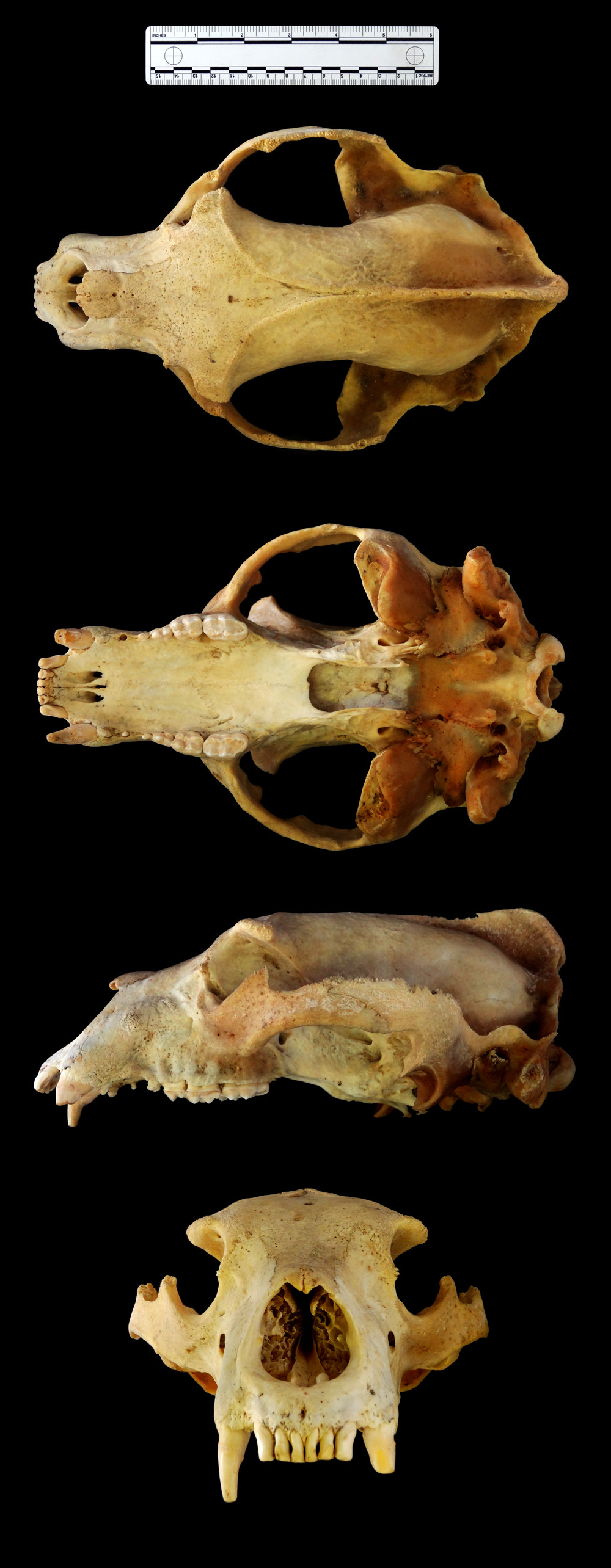
Last Friday I gave you this nice robust skull to identify:
There was a healthy discussion about possible identifications, with the importance of scale mentioned more than once (by Jake, palaeosam, Lena and Robin Birrrdegg). Not only is this a robust skull, it’s also quite large, ruling out the British carnivores – and it clearly is a carnivore judging by the canines and the well-defined sagittal crest.
The lack of cutting and puncturing premolars and molars means that cats, dogs, hyaenas and other very carnivorous large carnivores can be ruled out, narrowing down the likely options in the right size range to the bears, as recognised by palaeosam, Ric Morris, Robin Birrrdegg, Will Viscardi, cromercrox, cackhandedkate, Lena, Daniel Calleri, henstridgesj and Carlos.
The species is a bit more difficult to work out, but the big sagittal crest and fused sutures suggests that this is not an juvenile bear, meaning it’s too small for a bear of the Brown or Polar variety. That still leaves quite a range of other possible bears, but the pronounced forehead and long square muzzle rules out the Giant Panda, Sun Bear, Spectacled Bear and Asiatic Black Bear, while the big robust incisors rule out the Sloth Bear. That leaves the American Black Bear Ursus americanus Pallas, 1780.
So well done to cromercrox, Carlos and Robin Birdeggg who all got the species correct!
Last Friday I gave you this distinctive skull to identify:
I knew it would be a bit of an easy one, given the highly unusual teeth, but it seemed too interesting a specimen to not use.
As cryptically suggested by many of you (Jamie Revell, Nigel Monaghan, henstridgesj, rachel, cromercrox, Robin Birrrdegg, Allen Hazen and Crispin), this is indeed the skull of a Crabeater Seal Lobodon carcinophaga (Hombron & Jacquinot, 1842).
These seals are specialised for catching krill, hence the strange shape and tightly fitting nature of their teeth, which act as a filter to strain the tiny crustaceans from ocean water.
Because these seals live in the waters all around the Antarctic, monitoring their population is particularly difficult, so estimates of their numbers vary considerably, from 2 million to 12 million (which is the more likely figure).
As with most abundant animals they have predators, in particular Leopard Seals. Apparently 78% of adult Crabeaters bear scars of Leopard Seal attacks, which can be seen clearly on the live individual in the image above. Most of the attacks happen before the Crabeaters reach a year old and get a bit too big to be easy prey, but in that first year there is apparently a huge mortality rate, with only 20% of seals making it to their first birthday. Good old Mother Nature is never one for sentiment.
Last Friday I was at the SPHNHC, NatSCA and GCG joint conference in Cardiff, which provided a fantastic opportunity to catch up with natural science curators, conservators and collections managers from all over the world, but which gave me limited time to spend on the mystery object.
As a result you ended up with an object that made an appearance in a ‘feely box’ at a fun pub quiz organised by guys at the Oxford Museum of Natural History.
It’s not the prettiest object but it’s characteristic shape and structure makes it readily identifiable using touch.
Jake spotted that it was a horizontal section through a skull, including the palate and Maxine and Julie Howard recognised the tusk alveoli extending from the maxilla, and correctly suggested Pumbaa, or Warthog Phacochoerus africanus (Gmelin, 1788).
Touch is an often under-appreciated sense in science, but it can be used to identify some specimens and provide a new perspective on the evolution of forms in nature. This is something I came to realise when working at the National Museum of Ireland – Natural History in Dublin, where I was fortunate enough to meet evolutionary biologist Dr Geerat Vermeij, who has been blind since birth, yet is able to identify shells to species and read part of their life history from touch alone.
Geerat Vermeij, Evolutionary Biologist, Reading A Shell’s Story from Shape of Life on Vimeo.
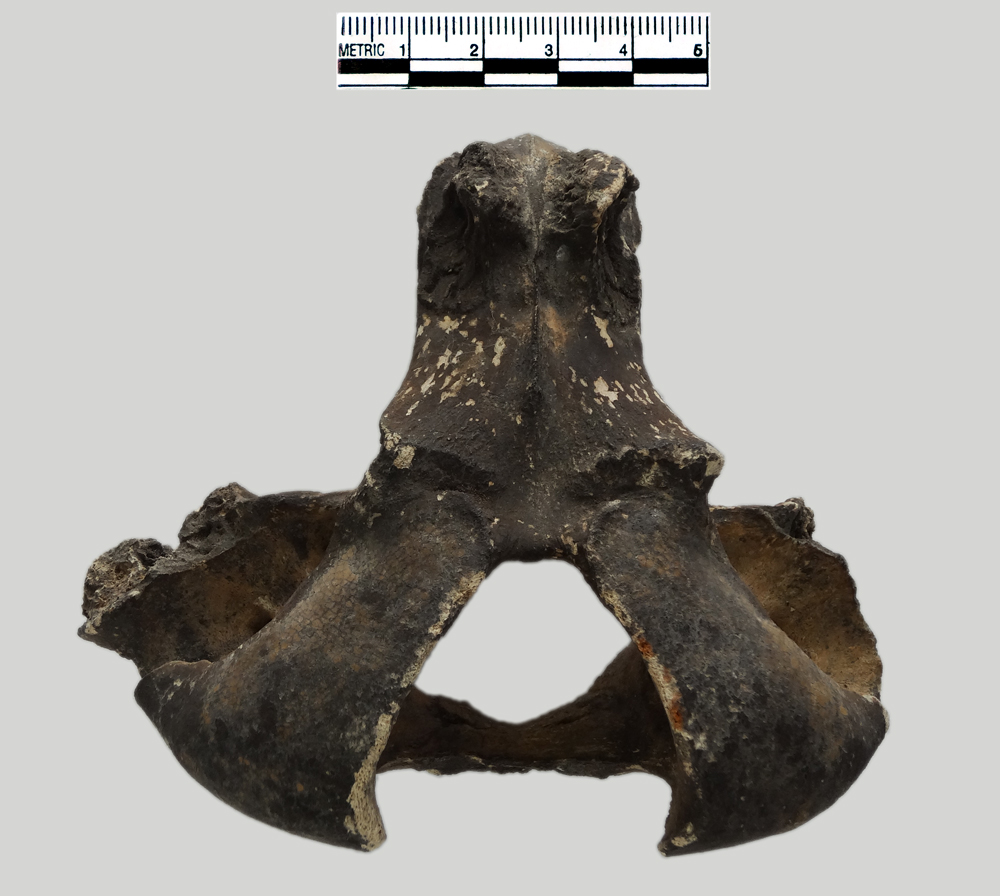
I usually offer up a mystery object on Friday, but here’ a bonus object that landed on my desk this morning.
Apparently it was found in a horsefield in Kent, I have narrowed down the likely species of the animal that ‘donated’ the bone to a couple of options, but thought you might like to have a go as well, before the specimen is handed over to our Anthropologists to inspect the engraved designs.
As usual can can leave your comments below. Have fun!
Last Friday I gave you these bits of mystery forelimb (scapula and humerus) to identify:
I thought it would be an easy one, since it’s from a very common species with a near global distribution – plus the humerus has quite a characteristic crest along the proximal end, from the shoulder articulation to the middle of the bone.
Most people who commented noticed this crest and Jake suggested that it had adaptive features (along with the scapula), maybe for a specialised way of life.
As it turns out, these bones come from an animal that is probably best described as a specialist generalist – a Brown Rat Rattus norvegicus (Berkenhout, 1769).
These versatile and intelligent animals are very good climbers and brilliant swimmers, using their forelimbs to both get around and manipulate food.
This particular rat was a male pet rat purchased from Harrods in October 1960 – I get the impression it didn’t survive for that long, since the humerus head hasn’t fully fused. You can’t buy pets from Harrods any more, so this specimen not only shows us what a rat’s humerus and scapula look like, but it also represents a teeny-tiny piece of British history.
This week’s mystery object is a bit of a break from the cat skulls. Any idea what these two bones are and what species they’re from?
As always, you can put your thoughts and suggestions in the comments section below, but if you think it’s easy please try to be a bit cryptic in your response, to give other people a chance. Enjoy!
This week I thought I should mop up the last of the smaller cats as a spot-the-difference:
What do you think are the diagnostic features that separate these two skulls (bonus points for species identifications)?
I’m really keen to get your thoughts on this, so please put your observations in the comments section below. Thanks!
Last Friday I gave you this felid skull to identify:
As with the other cats over the last few weeks, it’s been difficult to find really clear diagnostic features.
The size helps narrow down the possibilities and the lack of divided auditory bullae rules out some of the species of Lynx, as does the presence of the small first premolar.
However, beyond that there isn’t much to really differentiate this cat from other species, apart from general features of relative proportion (height vs width vs length) and perhaps the angle of the rear part of the sagittal crest (which will probably vary between individuals).
Nonetheless, henstridgesj managed to correctly identify this as an Ocelot Leopardus pardalis (Linnaeus, 1758), one of the largest of the small cats in South America.
My challenge is going to be find a way to pull together the variety of cat skulls we’ve had for the last few weeks, to help make cat skulls a little easier to identify in the future – if that’s even possible. No pressure…
Last Friday I gave you this cat skull to identify:
It is about the same size as a Domestic Cat and is very similar in morphology. But it’s not a Domestic Cat.
The auditory bullae (the bulbs under the skull that hold the hearing apparatus) and the external auditory meatus (ear holes) are a bit bigger, the skull is a bit broader and the interpterygoid notch (the gap at the back of the palate that the airway emerges from) is squarer and has a slight ridge in front of it on the palate (and I’m not sure that ANY of these are particularly significant).
There were plenty of suggestions about what this skull might belong to, but only henstridgesj hit the nail on the head with a correct identification of Southern African Wildcat Felis silvestris cafra Desmarest, 1822. So well done Stephen!