This week’s mystery object may be a bit harder than usual, but I’m sure that someone will get what it is:
As usual, you can put your questions, comments and suggestions below and I’ll respond as best I can – hopefully better than I managed last week, when I was in Ireland without ready access to the internet…
Apologies for the lack of response to questions last Friday, I was travelling and had limited access to the internet.
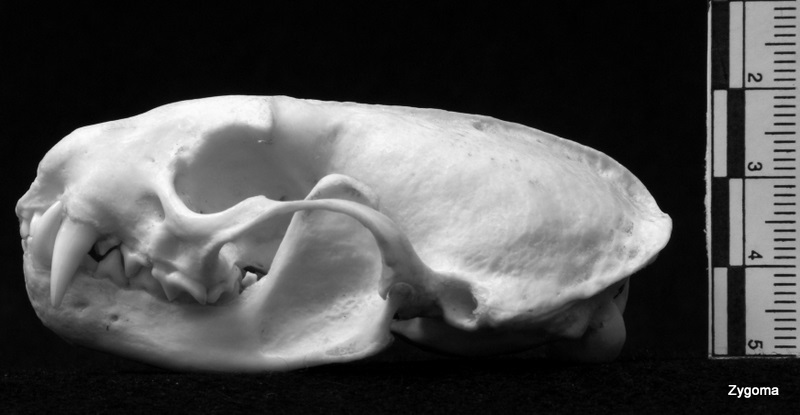
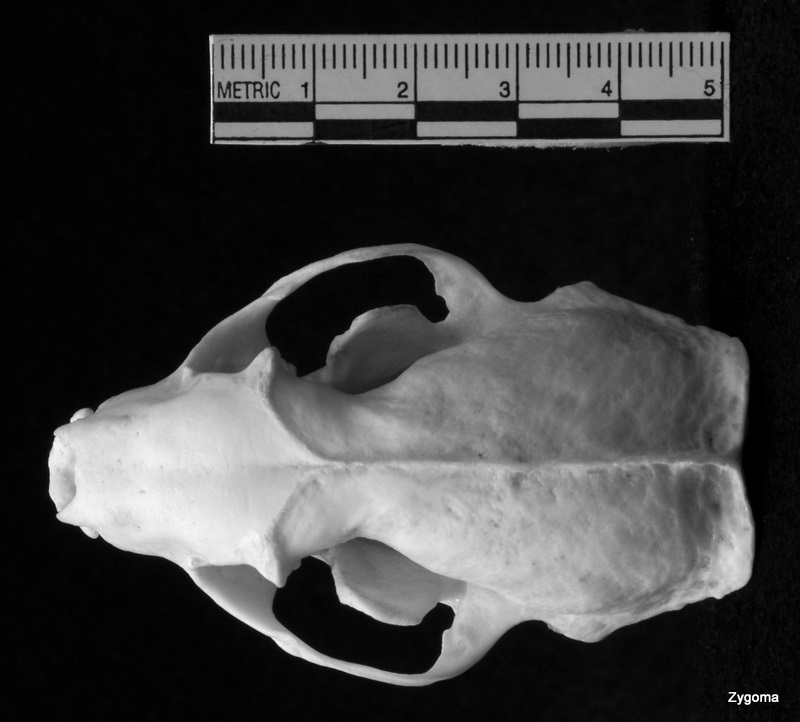
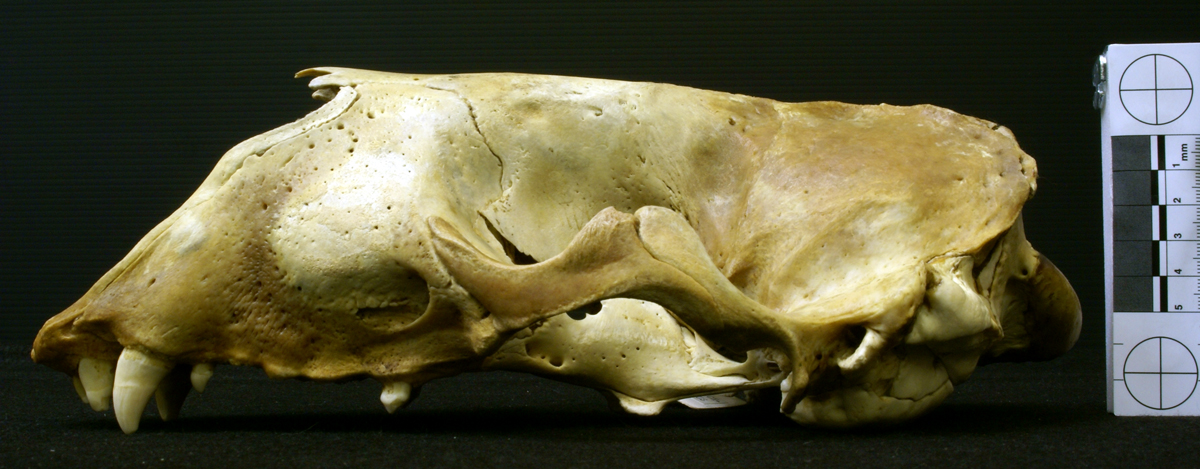
Excuses aside, I was impressed by the overall accuracy of the answers received about what this skull belonged to:
Everyone spotted that it was a carnivore and most of you identified this as being the skull of a mustelid, but no-one seems to have got this identification spot-on (perhaps my stinking clue was a bit too vague). Suggestions ranged a fair bit and uncertainty was rife, as shown in this word cloud of the comments:
Perhaps unsurprisingly given the clue, Skunks were suggested quite a lot as were Civets and Polecats/Ferrets (which are indistinguishable from each other on the basis of the skull, since Ferrets are just domesticated Polecats).
This suggestion of Polecat is pretty much there, although the specimen is not the standard European Polecat Mustela putorius rather it is an African mustelid known as the Continue reading →
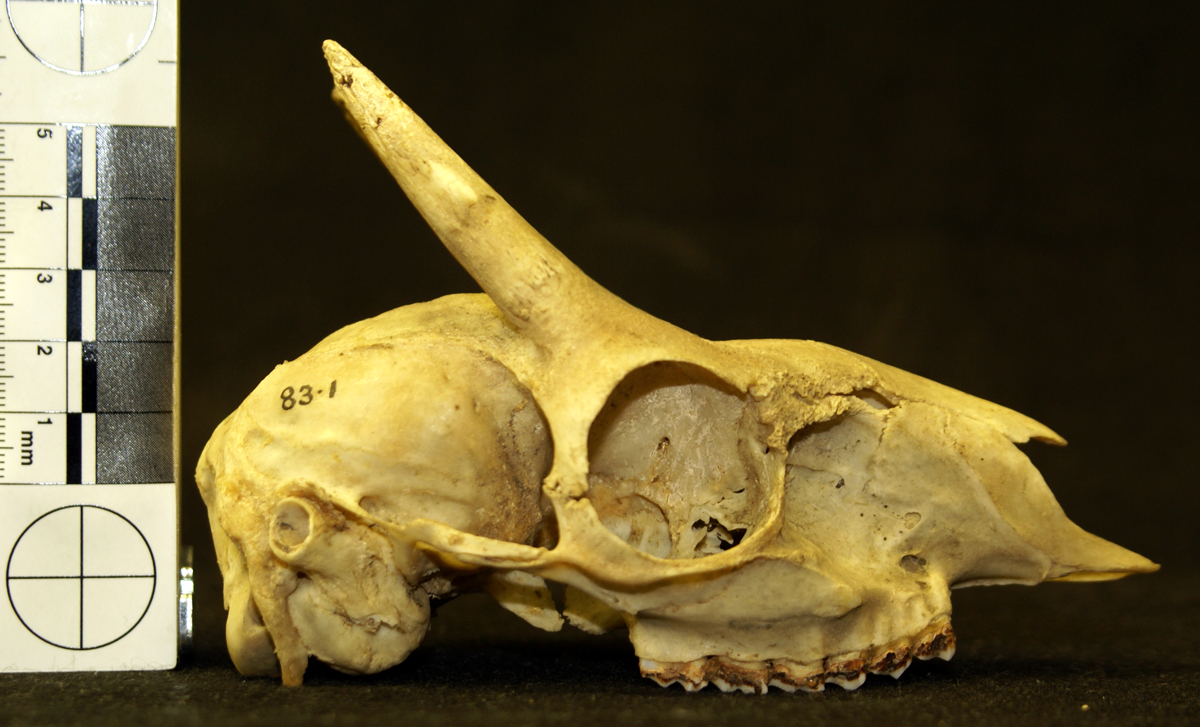
This week I have a tricky mystery object for you to identify. It’s from a group with a number of members that are a similar size and shape, which makes identification a bit tricky. Any idea what this skull belongs to:
I’ll try to answer any questions, but I can’t guarantee I’ll have access to a computer, so apologies if I don’t respond for a while (that’s why I’m a bit late posting this morning).
I was going to give you a clue about what this animal might be, but the only clue I could think of was a complete stinker, so I’m afraid it falls to your abilities to identify this animal. Best of luck!
It’s from one of two boxes labelled NH.83.1, which between them contained twenty unidentified skulls from a variety of different animals, ranging from fish to birds and mammals – several of which have been used as mystery objects in the past.
These boxes have been in the Horniman collections since the 1930′s and there is very little information available about the specimens, so it falls to me to make identifications. The comments I receive when using these specimens as mystery objects is always useful – it makes me double check my identification in light of the suggestions that you make – a form of review that I find very valuable. So thanks to everyone who attempted an identification, your thoughts have proved really useful!
From the outset the suggestions made were along the same lines as I’d been thinking – Prancing Papio FCD suggested a Maxwell’s Duiker, which is of similar size but has a narrower skull, smaller braincase and horns set far back on the skull, rather than originating just above the orbit like this one. This difference in the horn position and the relative size of the braincase rules out all of the Duikers in fact.
Jake suggested Dik-dik using a cryptic clue that I totally misunderstood – but this skull is a fair bit bigger than that of a Dik-dik’s and it has much longer nasal bones (Dik-diks have a bizarrely truncated nasal region).
Stephen J Henstridge suggested Steenbok, which is what I had originally thought it might be, since it’s almost identical, but a few little details of the palate, the horn orientation and the post-orbital process make me think that Stephen’s follow up suggestion of Continue reading →
…the dead in Christ shall rise first: Then we which are alive and remain shall be caught up together with them in the clouds, to meet the Lord in the air: and so shall we ever be with the Lord.
Unfortunately, the centuries of squabbling between various Christian sects has muddied the waters about what being ‘in Christ‘ actually entails, resulting in a poor attendance at today’s big event.
The Big Flop
Barry Higgins of 24 Lamarck Road, Kent. Sole ascendant during the Rapture
Despite finally being predicted correctly by Harold Camping (after a previous miscalculation that placed it back in 1992) and regardless of a flurry of pre-Rapture preparations by Christian fundamentalists around the world, it seems that the only person who actually ascended to meet with the Lord was Barry Higgins of 24 Lamarck Road, Kent.
The Ascent
Barry’s wife Margaret was surprised when her husband suddenly started floating as they walked to their car following an afternoon shopping at their local Lidl.
‘At six o’clock we were carrying the shopping back to the car, when he [Barry] suddenly said he felt a bit light-headed. I thought he might be having one of his turns, but instead he floated out of his brand new Clark’s slip-ons and started rising. It was quite slow at first, but then he started gaining speed until he vanished into the clouds.
He was a lovely man and treated me well until he left me there with all that shopping to get home – and I’ll never get through this lot on my own. I bet his Life Insurance won’t pay out a penny either, since he’ll live forever and it’ll count as an Act of God. His shoes should sell on Ebay though, especially since I got some photos of him floating off with my camera phone as proof.’
The Secret to Rapture
Apparently Barry was a quiet, gentle man who enjoyed a few glasses of beer and liked gardening. He didn’t attend any church and kept his religious views to himself, although when pressed he would apparently say that he was ‘probably a humanist‘ and that he ‘liked some of what Jesus taught’, but thought ‘most of the stuff in the Bible is a bit far-fetched‘ he also reportedly once said that the God of the Old Testament was a ‘bit of a nutcase‘.
Apocalypse Postponed?
It is now in question whether the Battle of Armageddon will go ahead on October 21st as planned, after such a poor turn-out for the Rapture. It seems likely that Jesus may want to wait a bit longer to build up more support, since Barry Higgins is reported as being ‘rubbish in a fight‘ by his younger brother Thomas. We await confirmation of this decision by Jesus’ self-appointed booking agent on Earth, Harold Camping.
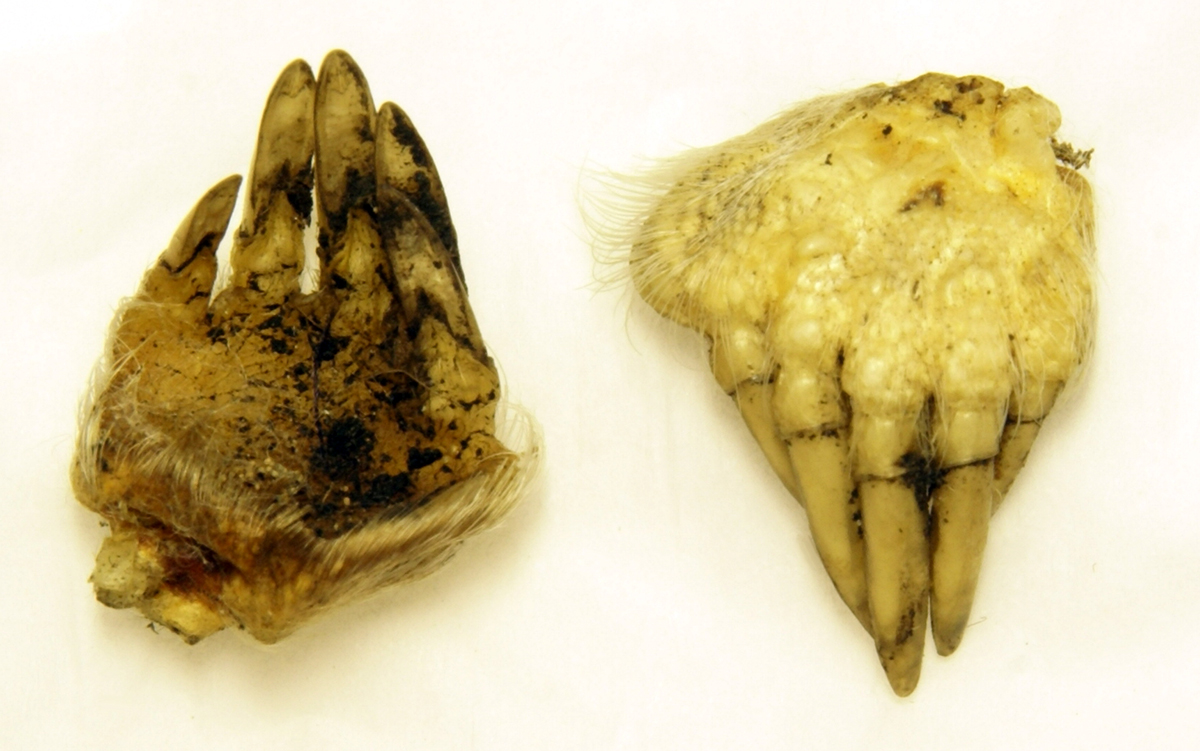
Since Friday was the 13th I gave you a mystery object inspired by the theme of superstition (at the suggestion of the @museumgeekgirls). I asked you to identify what this specimen was, where it was from and what powers were attributed to it:
As it turns out you all did a great job of identifying what these severed feet belonged to and there were some fantastic suggestions about the possible uses of these rather macabre charms.
It had to happen; a mystery object on Friday the 13th – a day reputed to be unlucky. So with the theme of superstition in mind I have an anthropological object for you to identify:
I admit that this doesn’t look much different to the usual mystery objects, but this one is reputed to have certain powers. Can you work out what these powers may be and where in the world this superstition comes from? Of course, the first step will be to identify what the object actually is.
As usual you can put your suggestions, observations and questions below and I’ll do my best to answer.
This week I have a specimen from the Horniman stores for you to take a shot at identifying. It’s missing some teeth and the mandible, which might make it a bit harder than usual, but the shape is very distinctive, so I expect someone will get it pretty quickly:
As usual you can put your questions, comments and suggestions below.
On Friday I gave you this skull to identify from the Balcony in the Natural History Gallery at the Horniman Museum:
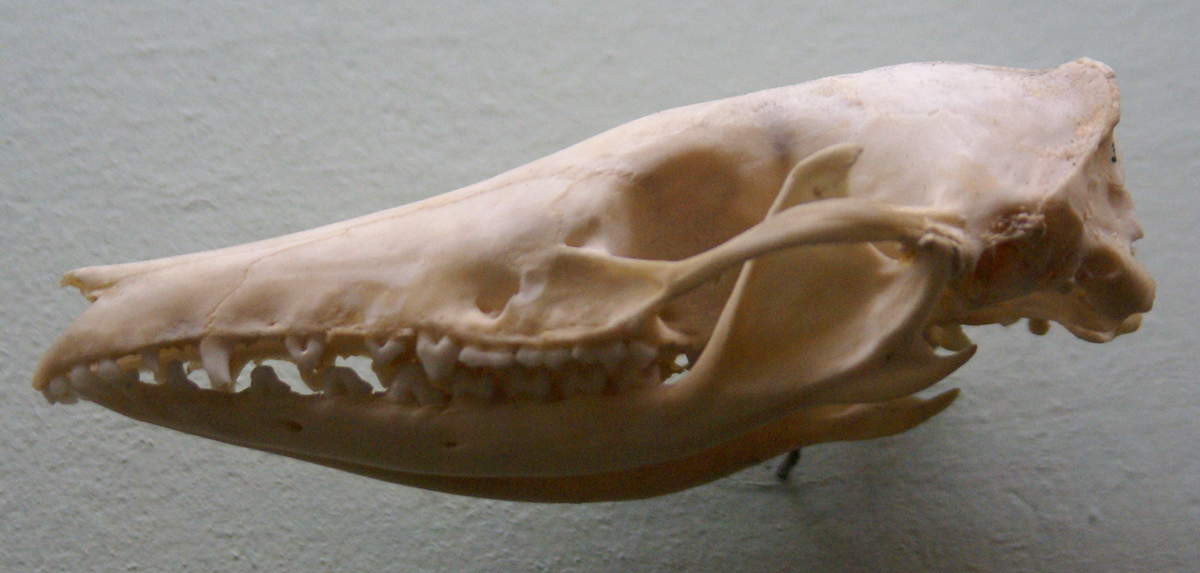
I must say that I was very impressed with the response – diet was quickly identified by Rosa Rubicondior, Will Chapman and Carlos Grau then Stephen J Henstridge spotted that this was the skull of Bandicoot and Jack Ashby, cromercrox and Jamie Revell all dropped hints (or blatantly stated) that this was the skull of a Continue reading →
On Good Friday I gave you this object and asked ‘Any idea what this skull belongs to?‘
Given the levels of pedantism on the Internet, I’m surprised that no-one said ‘the Horniman Museum‘, which would have been a correct answer to the question, since this specimen was bought in 1936 from the German natural history supply company Schlüter and Mass and it therefore belongs to the Museum.
However, you all clearly knew I meant belonged, since you did a great job of working out which species this skull came from.
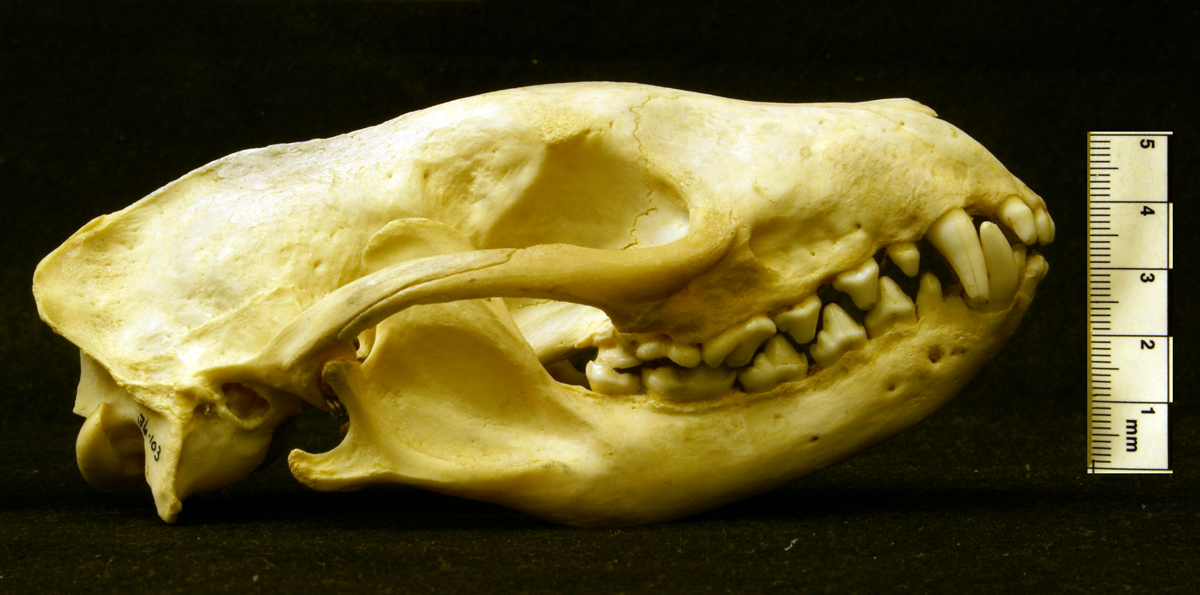
Jake immediately ruled out the large British native carnivores (Fox and Badger) and several questions later had Jamie Revell hot on the trail, only to be pipped to the post by David Craven. Kudos also goes to Carlos Grau and Gina who both came very close.
There are some important questions in life and this probably isn’t one of them, but it seems to have generated a lot of debate, so it’s clearly a topic that needs resolution.
Why wouldn’t apes be monkeys?
If apes are indeed monkeys as I suggest, why do so many intelligent and knowledgeable people insist that apes are not monkeys? I think that perhaps it’s because apes didn’t used to be monkeys.
Let me explain. Taxonomy is the science of naming things and it was established as a discipline by Carl Linnaeus in the mid 1700’s. Evolutionary theory was not part of science at the time, so there was no real understanding of why species formed recognisable groups with shared common features – but those shared features proved useful for classification.
Linnaeus – and the taxonomists that followed in his footsteps – went about classifying things based on the presence or absence of physical and behavioural characteristics.
Defining apes and monkeys
According to the Linnaean system of classification monkeys were medium or small in size and had tails, whereas apes were medium to large in size and didn’t have tails. Simple, apes were not monkeys – except the Barbary ApeMacaca sylvanus (Linnaeus, 1758), which was quite obviously a monkey despite being medium-sized and having no tail… spot the problem?
Of course I’m an ape – look, no tail – Barbary Macaque CORRECTION Crested Black Macaque (Macaca nigra) aka the Sulawesi Black Ape – Thanks Prancing Papio
Phylogenetic systematics
In the 1950’s a taxonomist called Willi Hennig had the bright idea of applying an understanding of evolutionary relationships to taxonomic classifications – he called this phylogenetic systematics. It was an idea that made sense, because rather than basing groups on arbitrary characters that might be open to convergent evolution (like becoming tailless), species could be grouped together (in something called a ‘clade’) according to common ancestry. What a nifty idea!
However, this idea has taken time to get established, since identifying clades means compiling and analysing a huge amount of data. It wasn’t until computers became capable of taking on some of the workload that phylogenetic systematics (or cladistics) became properly established – in real terms this meant that progress was slow until the mid-to-late 1990s.
Computers running cladistic analyses can tell us if apes are monkeys.
Since cladistics has taken off, there has been an effort to marry Linnean classification terms with evolutionary classifications where possible, to limit the confusion caused when discussing groups of organisms. There are rules in the form of PhyloCode, but they don’t really address common names associated with clades.
As a result this revolution in taxonomy has been largely ignored by the public and indeed by scientists not involved in the process. Nonetheless, it directly impacts on how biological terms are used. In this instance the issue impacts on whether apes should be considered monkeys – the fact that they share a clade, suggests that they should.
But is monkey a valid term?
Neither ‘monkey’ nor ‘ape’ are proper scientific terms, but both are commonly used in scientific literature, so they should have formal recognition as valid biological terms. That means that they should be aligned with definable clades, since that’s how taxonomy is done these days. In this case the Simiiformes clade for monkeys and Hominoidea for apes.
This slideshow requires JavaScript.
Common usage of biological terminology may be slow to follow the science, but if it wasn’t related to taxonomy we’d still be calling whales ‘fish’ (which is a fascinating story in its own right). Certainly there would be no justification for denying that apes were monkeys if people were not referring back to traditional taxonomy, because the term would be defined by usage alone and people do call apes monkeys.
In fact, it’s only seems to be in English that a distinction is made between apes and monkeys in common terminology and even then the terms have long been used interchangeably.
If the term monkey is to remain, it should at least be meaningful, which requires the cladistic definition and the inclusion of apes. As explained in more detail in the video below [NB contains swearing]
Should apes be called monkeys?
Let’s face it, it doesn’t really matter if apes are called monkeys.
Monkey is a more generic term than ape, which means it’s not very accurate or meaningful when talking about apes. Therefore it’s not really very appropriate unless the person using the term has a limited ability to identify very characteristic primates.
These are good reasons for not using the term monkey when referring to an ape, but nonetheless an ape is still a monkey. So feel free to criticise the use of monkey when referring to a Chimpanzee (for example), but don’t do it by saying that Chimps aren’t monkeys, because you’d be the one who is wrong – at least from a cladistic perspective.
I don’t know about you, but I’m getting tired of monkeying around the topic.
This week I’ve decided not to opt for an Eastery mystery object and stick with skulls – hopefully nothing too difficult, but enough to be a challenge. Any idea what this skull belongs to?
As usual I will try to respond to any questions comments or suggestions below.
A great crime against pedantry is in progress and it’s time for someone to draw a line
So as a pedant with a professional interest in this issue I am taking my stand, to help ensure that a miscarriage of pedantic justice doesn’t occur.
Nested hierarchies
Apes are monkeys in the same way that monkeys are primates, humans are apes and I am a human – it’s called a nested hierarchy.
This means that all apes are monkeys, but not all monkeys are apes. Just as all humans are apes, but not all apes are human. By the same token, humans are all ape, contrary to the title of the otherwise rather good book 99% Ape: How Evolution Adds Up.
This nested hierarchical system is the mainstay of biological taxonomy – each individual fits in its species (with the possible exception of hybrids), each species in its genus, each genus in its family and so on. It’s how Linnaeus organised things back in the 1750’s and it works remarkably well. [EDIT it’s actually a bit more complex than that]
Why do nested hierarchies work in biology?
Linnaeus’ system works well in biology because species share varying degrees of similarity depending on when they branched off from a common ancestor. The groups with most shared characteristics can be clumped together. That’s a bit tricky to explain in a few words, so here’s a simple diagram:
Primate phylogeny adapted to show clades. Image adapted from handout used by Mr. Krauz (click image for link to source)
The groups that form after a branching event are called ‘clades’ and the members of the group can correctly be referred to by the name of any of the clades that they are part of. This is known as monophyly (which means one leaf).
If a name is given to a group of species that are not all related in this way it will either be a polyphyletic group (many leaves) or a paraphyletic group (excluding leaves). Again, this can be confusing to describe, so here’s another diagram:
Monophyly, paraphyly and polyphyly in the vertebrates – from Wikipedia (click image for source)
Polyphyletic and paraphyletic groups are not particularly scientifically informative, since they include or exclude members of clades with no evolutionary justification. This means that scientists prefer to base names for groups on clear monophyletic clades.
That’s a scientific argument for considering apes to be monkeys.
But ‘Monkey’ isn’t a scientific term
Aha! I must make it clear that I have been using the term monkey as a direct match for the term Simiiformes (which includes the Old and New World monkeys, the lesser apes and the great apes) in the discussion above, but is that valid?
Obviously I argue that it is, since I’ve been using it – the question should be why wouldn’t it be valid? The only logically robust answer (that I can think of) is that it wouldn’t be valid if people don’t commonly use the two terms to refer to the same things. So do people use the term monkey to refer to the apes?
The simple fact is that this whole discussion has been raised because Graham Smith published an article in which he refer to apes as monkeys, which demonstrates that monkey is indeed used as a generic term to refer to apes.
Another example is Terry Pratchett’s Discworld, where the Librarian (who happens to be an Orang-utan) dislikes being referred to as a monkey, which happens regularly – it may be fiction, but it seems reasonable to suggest that it reflects the use of terminology of real people.
In addition, I would suggest that it’s helpful for common terms for biological groups to directly reflect the scientific terminology as much as possible, since this improves the ability of scientists to communicate with a non-specialist audience. So even if monkey didn’t mean the same as Simiiformes (which it seems to) it probably should. Otherwise monkey has no scientifically meaningful analogue, since it would refer to a paraphyletic (and therefore arbitrary) grouping.
Case closed?
I think that my argument is pretty robust and I’ll stand by it until I hear something convincing enough to change my mind.
That said, I will add an important caveat – monkey is a generic term and when referring to Chimpanzees, Gorillas, Gibbons, Orang-utans and Humans the more specific term of ape should be used for clarity. After all, you don’t refer to your pet cat as a pet carnivore, or a budgie as a theropod, because generic terms omit a lot of additional information.
So although apes are monkeys, they are still apes – and that means something.
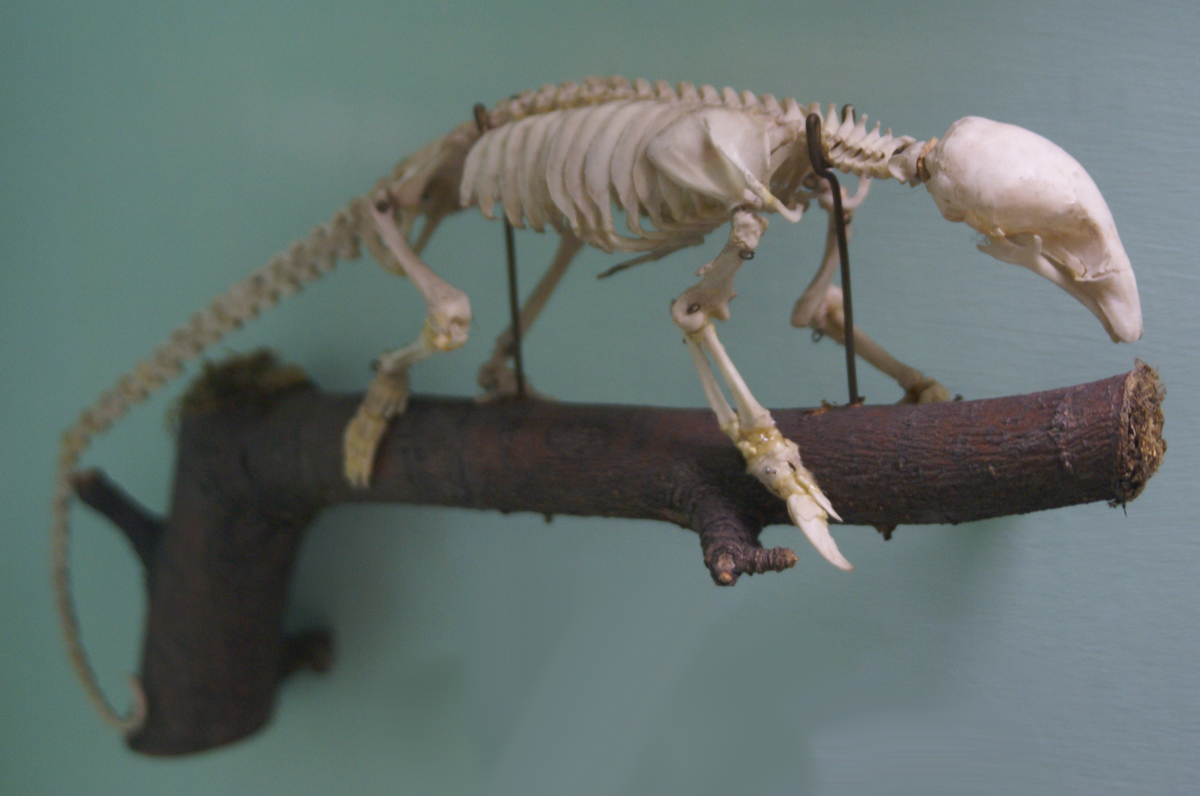
This week I’m going to give you an object that’s on display at the Horniman Museum. Whenever I see this specimen I’m reminded of the diversity of life that is out there in the wider world, that we never consider normally. Any idea what this skeleton belongs to?
As usual, I will do my best to reply to your questions, observations and suggestions in the comments section below.
I must apologise in advance for the somewhat short answer to the mystery object this week. Partly it’s because I don’t know much about musical instruments and partly because I’ve been busy pulling together a guest post for GrrlScientist over at Punctuated Equilibrium on the Guardian science blogging network (not sure when it will go live[EDIT it’s live now]). Excuses aside – on with the answer!
Last Friday I gave you this object to identify:
I was impressed that everyone immediately spotted that it was a musical instrument, but I was even more impressed that so many of you identified which continent it was from (Africa) and the general type of instrument. Historically in the West this has been referred to as a ‘thumb piano’ which is a very Eurocentric interpretation. A more accurate generic name is lamellophone (or lamellaphone).
There are lots of different sorts of lamellopone from different regions in Africa, including the mbira, the sanza, the kalimba and lukembe. This particular example differs from all of these other forms in the way in which the lamellae are secured:
This particular type has tangs on the lamellae that are driven directly into the wooden resonator, rather than having a fretboard like an mbira:
This means that the instrument is not tunable, unlike the mbira.
This unusual characteristic identifies this mystery object is an Continue reading →
This week I thought I’d give you a break from the bones and provide something a bit more cultural for you to identify:
Any idea what it is, where it’s from and what it’s for?
As usual you can put your questions, comments and suggestions below and I’ll get back to you as best I can (possibly with some additional information from my colleague Tom – who knows far more about this object than I do!).









 Zygoma