I’ll keep it simple today and leave you free to ask questions about this week’s mystery object. Quite simply, can you work out what this is:
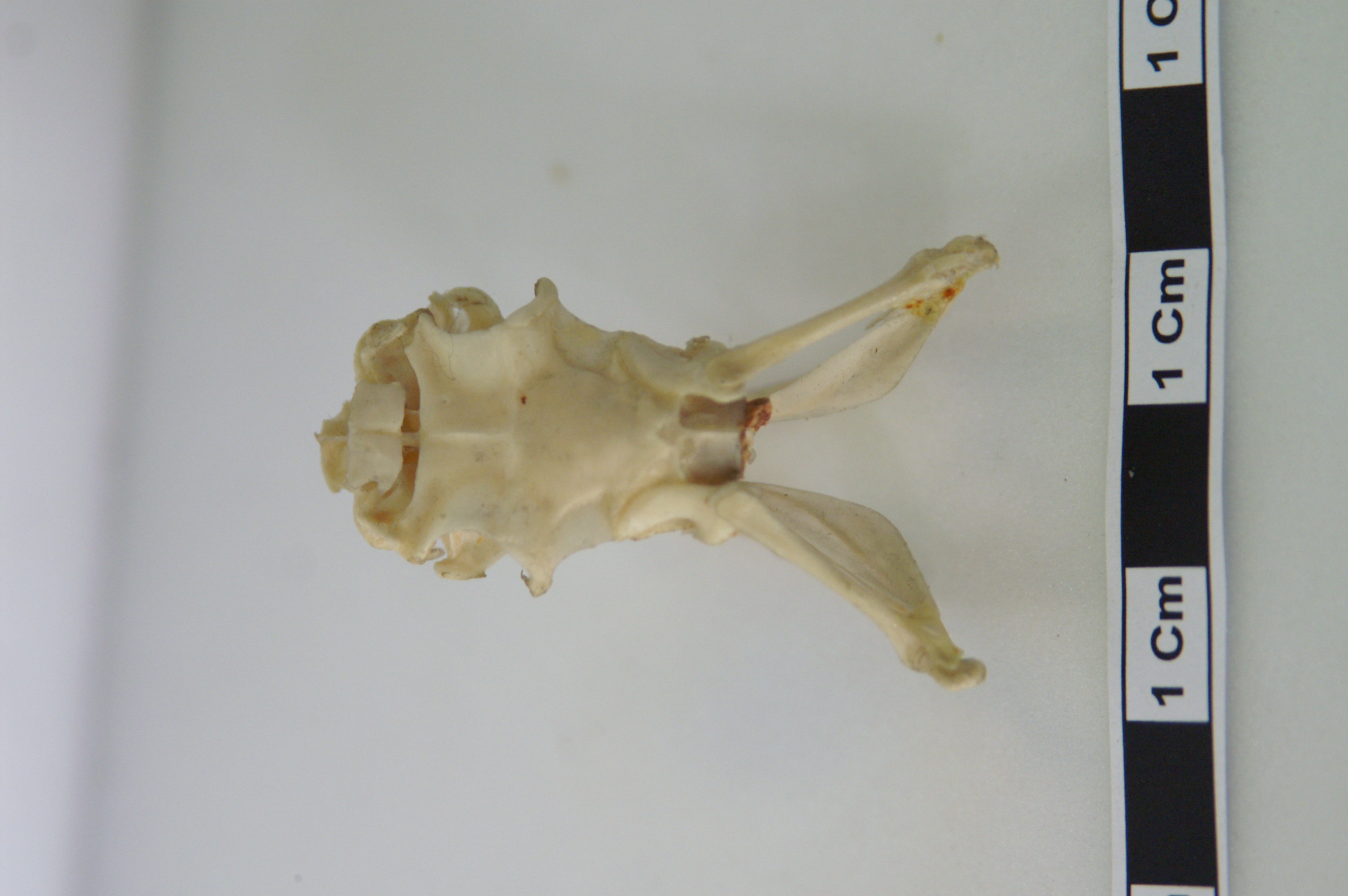
Comments and questions below – I will provide answers as I am able.
Good luck!

I’ll keep it simple today and leave you free to ask questions about this week’s mystery object. Quite simply, can you work out what this is:
Comments and questions below – I will provide answers as I am able.
Good luck!
On Friday I gave you a palaeontological mystery object and asked you to choose what you thought it was from a poll:
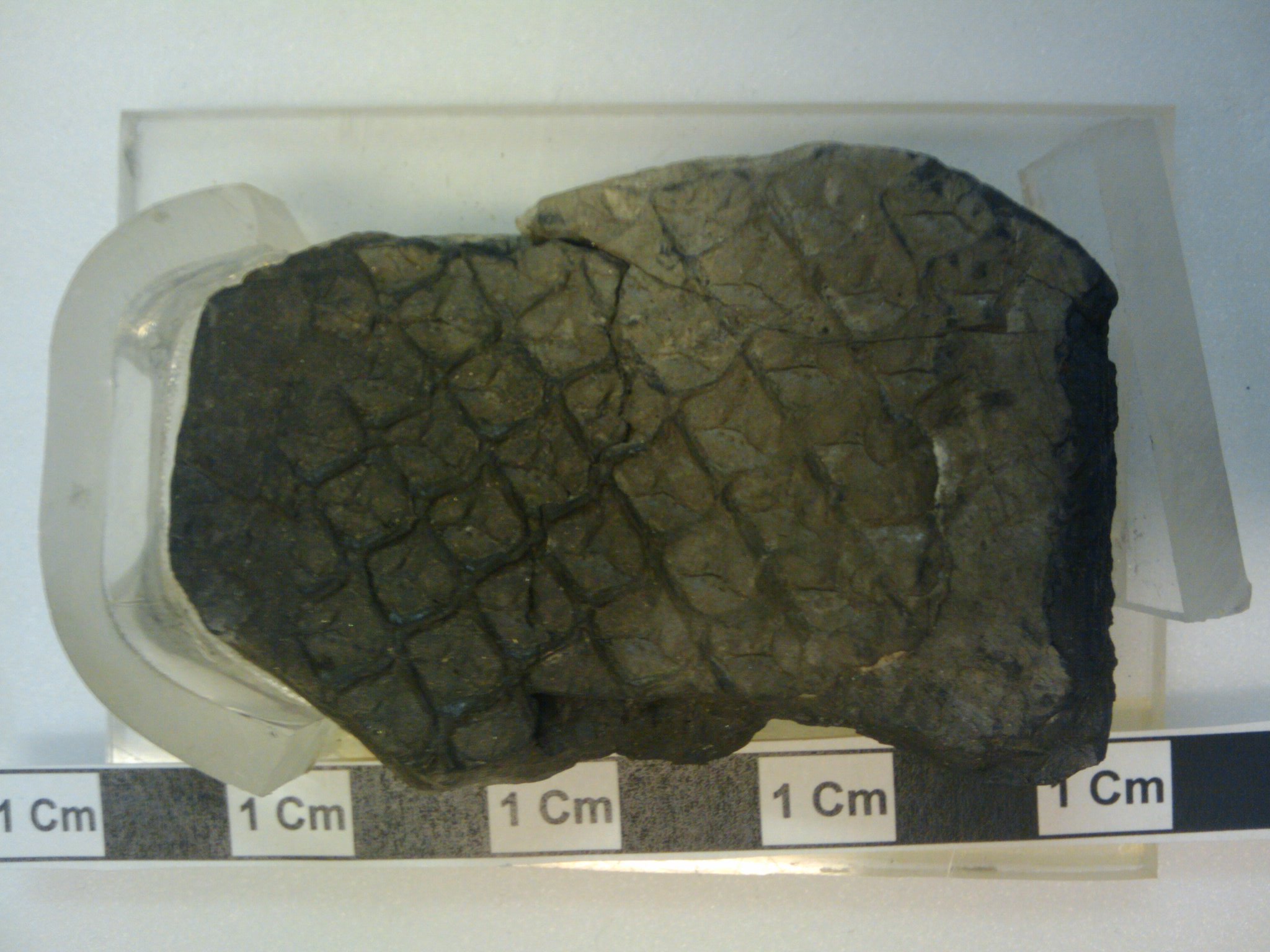
As it turns out, you did pretty well, with 60% of you selecting the correct category (with a couple of you making comments which went into greater detail). The object in indeed a piece of fossil Continue reading
It’s Friday again and I feel it may be time to introduce an object from the area of my original training (that’s palaeontology). Imagine that you’re me, searching through the drawers in a museum and you come across this:
What is it from? It looks scaly, but that’s about all you can tell from looking at it. Based on the scales, what do you think this is most likely to be?
Make your selection in the poll below – if you think you can give a more detailed description that those offered in the poll please add it in the comments section below.
Good luck everyone!
On Friday I gave you a bit of a change from museum specimens and presented you with this:
 Everyone managed to get the identification to at least within the Order level (it’s in the Orthoptera), which is good going when dealing with insects. The hard bit came down to whether it was a cricket or grasshopper. Now, the photo does not show the most important feature for distinguish between these two types of orthopteran: it’s the antennae length that gives it away (grasshoppers have short antennae, crickets have long antennae). Colour is not really important (sorry KateKatV).
That said, the vivid green colour, speckled appearance, lack of wings and characteristics shape of the ovipositor (curved bit at the back which means this is a female) are a give-away for those who are familiar with this particular beastie (and for those who use Google image to help with their identifications). It is in fact a Continue reading
Last week I let Harrison pick an object that proved a bit too difficult (although perhaps I could have been more generous with the clues I gave…). This week I am giving you something that is actually alive and commonly found in gardens in the UK – so it should be a doddle to identify:
Simple questions – what species is it (binomial name gets you kudos) and what sex is it?
Answers in the comments section below – but I’m afraid I won’t be able to respond to comments this week. Good luck!
Crumbs, it appears that last Friday’s object stumped everyone! Harrison certainly chose a difficult one…
 SmallCasserole came closest, asking:
Is it antler or horn?
but my response:
Antler or horn that thick?
was perhaps too ambiguous – because there is a horn out there that is this thick, that of a Continue reading
Today’s mystery object has been selected by a very helpful work experience volunteer who was assisting me in the collections yesterday, so my thanks to Harrison! He is rather more cruel than me, so there’s no multiple choice on this – we just want you to see if you can work out what it is. I will attempt to answer any questions (time permitting) since our broadband seems to have been sorted out at home.
So here it is:
Still no internet, so this is drafted on my phone. Well done to those of you who worked out that Friday’s object was indeed a rattle-snake’s tail.
I will expand on this answer, once I can use a computer to type comfortably!
Right, internet is finally working again, so here’s a (slightly) fuller answer to what this is:

As was mentioned before, this is indeed a rattlesnake’s tail. Rattlesnakes have a bad reputation for being aggressive and dangerous, but it should be remembered that they have a rattle in their tail to warn off predators and large unwary animals that might trample them – so at least they give fair warning.
There are quite a few species of snakes that make use of a rattle on their tail and this one comes (apparently) from Crotalus durissus, a South American pitviper that is quite dangerous due to their powerful neurotoxic venom (unlike the cytotoxic venom of the North American diamondback rattlesnake).
The rattle is formed when the snake sheds its skin – a section of the old skin Continue reading
I am still without internet at home, so apologies for slow responses to comments and the lower quality of my recent posts.
This Friday’s mystery object is pretty straight-forward, a simple case of ‘what is it?’
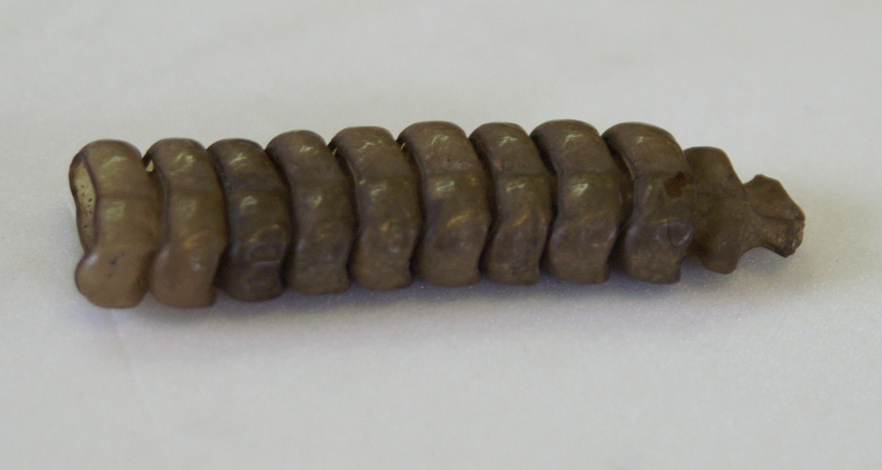
If you think you know what this is just leave a comment below – I will attempt to respond to any questions when (and if) I am able, but I can’t make any guarantees I’m afraid.
Good luck!
Last week I gave you some detective work – I asked to work out what this was:

Unsurprisingly to me, most of you worked it out pretty quickly – it is indeed a Continue reading
My internet is still down at home, but here’s a Friday Mystery Object anyway!
This time I just want you to work out what group of animals this ribcage comes from:
Here’s a close-up that you might find useful:

Now you don’t need to be an expert to work this out – just work out how this ribcage is similar to the ribcage of other animals and certain features should start standing out to make the answer obvious – a real case of deductive power!
To assist, I will point you in the direction of some useful comparative material and I urge you to consider how function and inheritence both shape bones used in movement.
Feel free to ask questions in the comments section below – I will reply whenever possible. I hope you enjoy the detective work!
On Friday I presented two mystery objects after a frantic search through the photos on my phone whilst at the SVP conference in Bristol:

Name the source of this leather seat cover

As it is you performed remarkably well, SmallCasserole spotted that the leather was Continue reading
Currently in my apartment in Bristol frantically searching for a suitable mystery object whilst also trying to plan the talks I want to attend at SVP.
I get the feeling skulls are getting boring for some of you, so perhaps it’s time I introduced an object that isn’t directly related to what I’m doing at work. In the pub yesterday, a natural history curator friend of mine (David Waterhouse from Norwich Castle Museum) queried the type of leather on the seat of his chair (it’s the kind of thing we do). We think we know, but can you work it out?
Name the source of this leather seat cover
Not an easy one, particularly without any clues, but I will attempt to answer any questions go help you on your way – just post them below in the comments section.
Good luck! Continue reading
On Friday I presented you with a skull to identify:

I thought this would be suitably tricky, but achievable. Right enough, there was a wide spread of answers, but the correct answer got the most votes – it is indeed a Continue reading
It’s Friday again, we all know what that means – Mystery Object time!
Last week I gave you a really tricky one, that you managed to work out with some clues. I liked the Q&A format, but unfortunately I am between ISP’s at the moment, so I don’t think I will have the chance to have as much input this week. Instead there is a poll (although comments are always welcome!) and I will return to my favourite objects – skulls.
So, what is this the skull of? Choose an answer from the poll below (don’t forget to hit “vote”): Continue reading
On Friday I set a really taxing mystery object:

Scale in cm
and asked a question that contained a hidden clue:
It’s a tall order I know, but what do you think it is?
After a lot of questioning and some impressive reasoning skills I am pleased to say that some of you managed to get it. It is indeed a section of Continue reading
Well, after last week’s impressiveness on your collective parts, I think I’d better step up to the plate and deliver something truly taxing. This one I guarantee you won’t get without some extra clues.
Here it is:
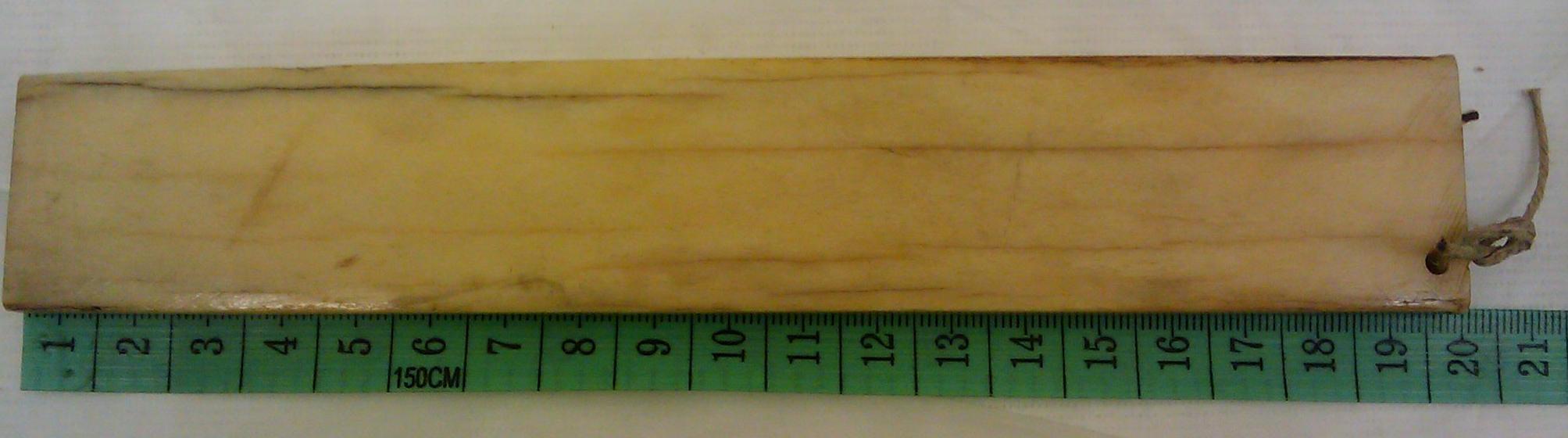
(click on image to enlarge)
It’s a tall order I know, but what do you think it is?
Put your answers in the comments section below and if you need some clues (or ask some sensible questions) I will respond accordingly.
Good luck (I have a feeling you’ll need it!)
Here’s what I said on Friday, just before 7am:
Just posted the Friday Mystery Object. Not a skull, no options and just one clue (for now): http://wp.me/pvJGH-6M You’ll never get it! #FMO
[PaoloViscardi on Twitter, Friday 4th September]
Of course, I was hoping to be proved wrong, but Gimpy managed to prove me wrong in record time (about an hour). So well done to Gimpy, although I now can’t help but hate you just a little bit for ruining my fun… (is this how the woo merchants feel?). Clearly the clue I left was far too much of a give-away (I should have listened to Melissa).
The question was “what is it and what’s it made of?” and it referred to this:
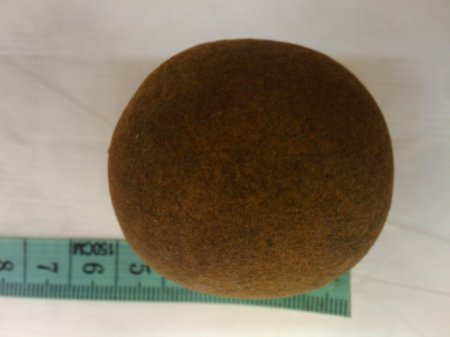
Scale in cm
If you read the comments you probably worked out that it is indeed a Continue reading
Since there have been calls for some variety (skulls not good enough for you eh?) and there have even been accusations of the FMO being “too easy” I have decided to unleash a tricky one for you this week.
Scale in cm
Simple questions, what is it and what’s it made of?
No poll this week, just leave your thoughts in the comments section below. I will give you a clue however – it’s supposed to be magical (even Harry Potter’s used one).
More clues to follow if they’re needed!
On Friday I asked you if you could identify this critter:
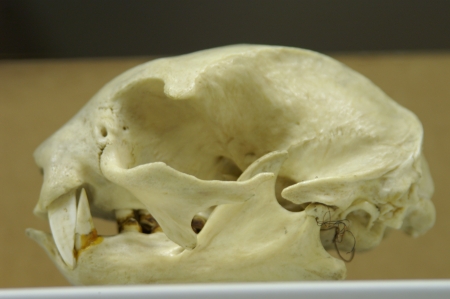
It turns out that many of you could – it is indeed a Continue reading


