Friday mystery object #334

Happy Friday 13th! This week I have another diminutive animal (it’s a little under 4mm long) for you to have a go at identifying:

20180709_094707-02.jpeg

I’m all too familiar with what this is and I’m sure that some of you have been unlucky enough to encounter them before, so cryptic clues as to the identity of this insect would be appreciated, for the sake of those lucky folk who avoided the attentions of this wee beastie.

Friday mystery object #333 answer

Last week I gave you this insect to have a go at identifying:

20180627_142333-01.jpeg

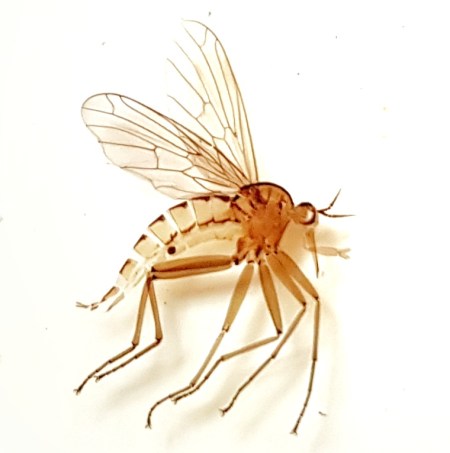
I decided that this didn’t need a cryptic answer, since species in the Order of insects that this belongs to can be quite tricky to identify. The Order is of course the Diptera as this has two wings rather than the four most insects have – that means it’s a true fly (as palfreyman1414 pointed out).

Those pointy but sturdy mouthparts (unlike the pointy and skinny mouthparts of things like mosquitoes) give the family that this fly belongs to one of their common names – this is a type of “dagger fly” in the family Empididae – which you can tell from the antennae structure (three segments with the segment at the end being the longest). That helps narrow it down a little, but after that it’s a case of checking against things like wing veination and pattern – note the black line along the back.

Very well done to Emmanuel and James Bryant who noted these features and hit upon the correct genus. This specimen is Empis stercorea Linnaeus, 1761.

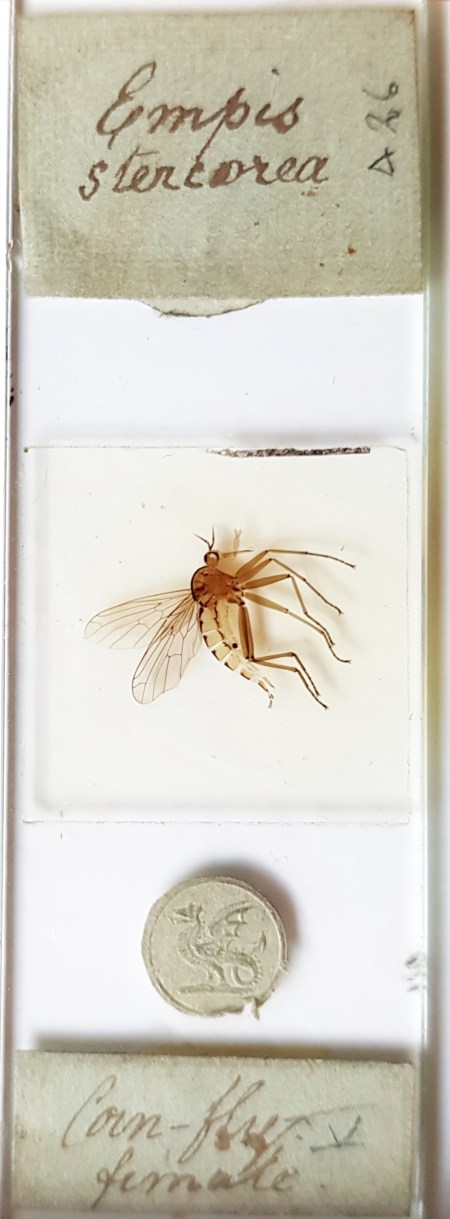
This specimen is actually mounted on a microscope slide, which makes it look a little weird:

20180627_142333-02.jpeg

The label gives us the species, the sex (female) and the common name of “Corn-fly”, which I’ve seen used for a variety of fly species, but not for one of the Empididae. A bit of searching shows that this name is an old one used for Empis sp. in US catalogues for microscope equipment and mounted insects in the 18th Century.

There’s also a circular mark bearing a Wyvern (a two legged winged dragon), which is presumably a makers mark, although I’ve not yet managed to track down who the maker is.

More mysteries next week!

Friday mystery object #332 answer

Last week I gave you this beach-loving little bird to try your hand at identifying:

20180614_165031-01.jpeg

I had a feeling that one or two of you would know exactly what it is, while others would have a pretty good idea of the type of bird, but not the species, since there are quite a few birds on the world’s shorelines that look something like this.

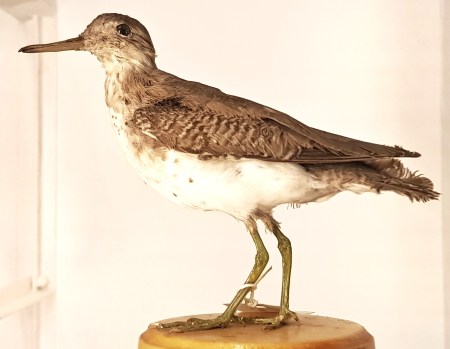
The Waders are a clump of groups of shore birds in the Order Charadriiformes (which also includes non-waders, like Gulls) and the small to medium sized waders, with long straight bills like this one, are mainly in the Family Scolopacidae or Sandpipers (nicely suggested by palfreyman1414 with the cryptic clue “a silicaceous rat enchanter“).

However, there are quite a few species in the sandpiper family – around 80 in total – so there’s still quite a lot to choose from. However, the small size, brown upper parts, white underparts with some spots (only in the breeding season), yellowish legs and bill with a dark tip all point to a widespread wader from North America – the Spotted Sandpiper Actitis macularia (Linnaeus, 1766).

Spotted Sandpiper, at Bluffer's Park (Toronto, Canada), by Factumquintus, c.2005

Spotted Sandpiper, at Bluffer’s Park (Toronto, Canada), by Factumquintus, c.2005

Although this species is from North America, the specimen was actually collected in Ireland – in Finnea, County Westmeath to be more precise. As migratory birds they can sometimes crop up quite a long way from where you’d expect to find them, especially following big storms. Without the spotted breeding plumage it would be very hard to distinguish the specimen from the Common Sandpiper that occurs in Europe, as they are very similar looking birds, apart from the spots.

So well done to Wouter van Gestel, jennifermacaire, and palfreyman1414 who managed to recognised the species, despite the taxidermy being a little jaded.

There will be another mystery next week.


Friday mystery object #332

This week I’ve been looking at birds, so I thought I’d share the joy with you. Do you have any thoughts about what this might be?

I expect that quite a few of you will have a pretty good idea, so please keep your suggestions cryptic, to let people who are less familiar with avian identification have a chance of improving their skills.

Have fun!

Friday mystery object #331 answer

Last week I gave you these skulls from the collections of the Dead Zoo to have a go at identifying:

20180531_095749-0120180531_095713-0120180531_094905-0120180531_095122-01

The reason for picking these was because I had an enquiry challenging the label associated with a specimen that was on display, and on checking there had clearly been some kind of mix-up, because the first mystery object had been identified as a False Killer Whale Pseudorca crassidens Owen, 1846 – which was definitely wrong.

The second mystery specimen is in fact the False Killer Whale (an identification that palfreyman1414 got right, supported by Rémi), whose label had been mixed up. That left the first mystery object still to be solved. Obviously it’s a toothed whale of some sort and the scale suggests it’s not a porpoise (a bit big) and it’s clearly too small to be one of the bigger dolphins (like a Killer Whale or Pilot Whale).

Generally it takes a bit of time looking at dolphin skulls from a few angles before you can start to get your eye in for identification – they just look so weird compared to the skulls of other mammals. They can also photograph quite poorly due to the large size – by which I mean that the height, length and breadth of a specimen can be distorted considerably in an image depending on small changes in the angle it sits at and the distance between the camera and the specimen.

However, the things I always try to look out for are the shape of the rostrum (or snout), the slope of the forehead, the patterns made by sutures between the bones around the nares (nostrils) and sutures between the bones in the ‘cheek’ area.

In this case there’s a very steep forehead, with a small bump midway, an upward deflection of the posterior maxillary margin (it looks like it’s got a bit of a smirk) and the sutures around the nares and the general shape of the nares all adds up to make me think that this is a White-beaked Dolphin Lagenorhynchus albirostris (Gray, 1846).

Imagine how pleased I was when I discovered that there was a label with that name on it, hiding in a different case and missing a specimen!

Friday mystery object #331

This week I have couple of specimens for you to have a go at identifying:

20180531_095749-0120180531_095713-0120180531_094905-0120180531_095122-01

I think these have been mislabelled and need their identifications checked to see if it’s a simple label swap or if it’s a deeper problem with the documentation. I won’t make it easier by providing the labels I’m suspect about – let’s see what you think working just from these images…

Have fun!

Friday mystery object #330 answer

Last week I gave you three guest mystery objects from The Écomusée du pays de Rennes to try your hand at identifying:

mystery330cmystery330bmyserty330a

Now these are genuine mysteries because in the words of Paul Offelman-Flohic, who provided these images: “No one really remembers how we get all of the specimens because some were donated by visitors, some we collected, some were donated by the agronomy school here in Rennes, Bretagne… In the pictures you will find things I found in the darkness of a cupboard that went through a fire (no joke) which might explain their bad condition.”

To give you an idea of what the specimens are used for, here’s what Paul says about the Museum:

“The Écomusée du pays de Rennes is installed in an old farm researchers dated back to the 15th century. 30 years ago, the City of Rennes bought the farm to create a museum interested in explaining the link between the network of farms surrounding the city and the evolution of lifestyle in both the city and the country. Related to that, the Écomusée presents livestock of local breeds and different orchard trees that our ancestors would have found around Rennes.

We welcome a lot of pupils and students and the specimens are really useful to us when we are working with our visitors (young and old).”

bones collection

Some of the specimens used in education at the Écomusée du pays de Rennes

This approach sounds like a fantastic way to integrate an understanding of how the human and natural world are entirely interlinked (unlike the interpretive approach of many museums, which treat natural history and human history as separate concepts) and it’s great that we can help add some identifications to these unlabelled specimens for the Écomusée.

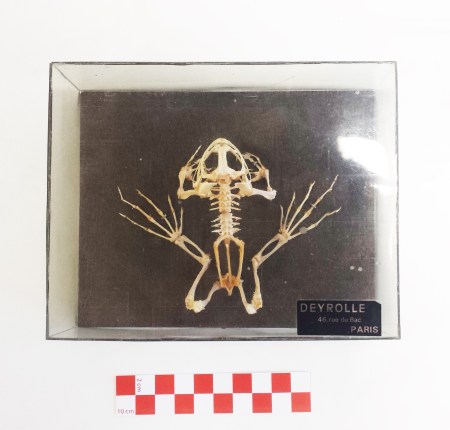
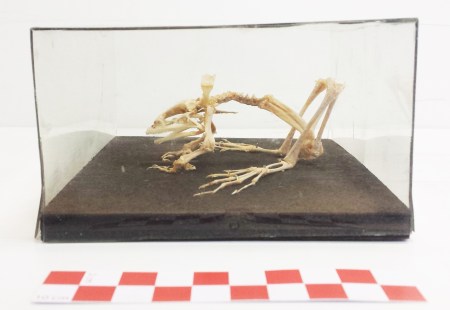
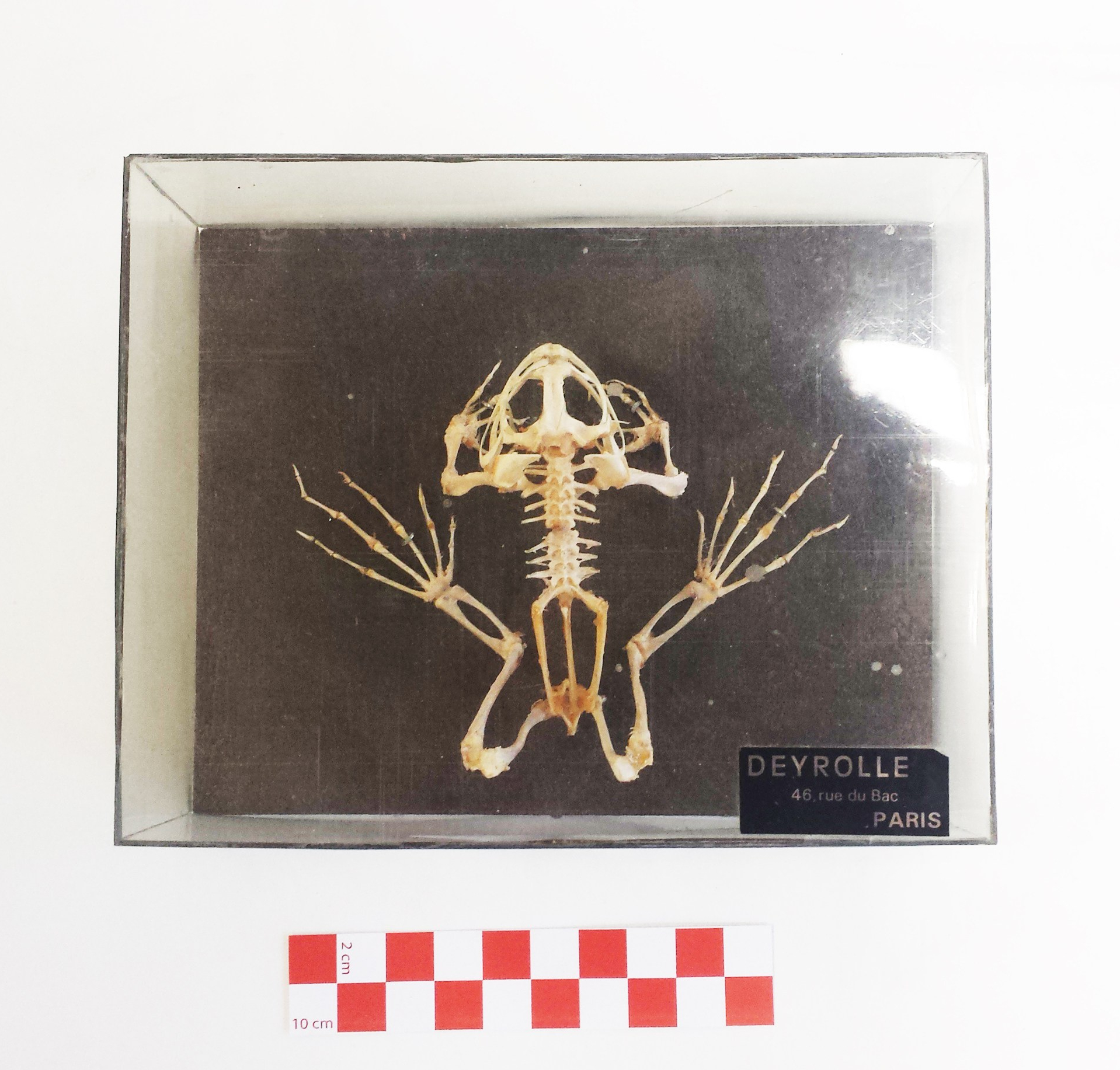
As pointed out by Sergio, these specimens are all examples of Deyrolle didactic products (Deyrolle is a famous natural history emporium in Paris that has been selling educational scientific specimens and charts since 1831). These particular specimens show bony parts of two common species that have interesting and unique characteristics which are often referred to when teaching comparative and functional anatomy.

First up is the complete skeleton in a characteristic pose:

mystery330d

Several people suggested that this was a Toad Bufo bufo, but if you look closely at the skull you can just make out some teeth in the maxilla:

mystery330d-detail

This means it can’t be a Toad as they lack teeth – it seems more likely to be one of the toothed frogs in the family Ranidae, probably Rana temporaria Linnaeus, 1758.

This specimen demonstrates adaptations to jumping in the Anura (frogs and toads), with the long and folded hind limbs that provide a lot of propulsive power – also useful in the water, thanks to the large feet.

Next up is the skull, which looks a bit shrewy, but as Rémi pointed out, it has a zygomatic arch (which is absent from shrews), plus the teeth are wrong for a Hedgehog (which has a relatively shorter face and is generally more robust).

mystery330b-detail

This is the skull of a European Mole Talpa europaea, Linnaeus, 1758. Its long, tapered, cylindrical shape is ideal for an animal that lives in a tube of its own creation and those teeth are like meat grinders for dealing with earthworms.

Finally there was the very distinctive limb:

myserty330a-detail.jpg

The reason it’s so distinctive is largely down to the fact that it is remarkably broad and powerful and it has an extra ‘digit’, which is actually a bone from the wrist that’s been recruited to add more area to the big shovel-like hands. This helps this animal dig its way through soil in its hunt for earthworms. It is of course the forelimb of a European Mole.

I think that apart from a couple of mix ups between toads and fogs, everyone ended up getting the species, often with some nice puns, cryptic clues and even a poem (nice work joe band) so well done to Sergio, Chris, palfreyman1414, Wouter van Gestel, Allen Hazen, Rémi, jennifermaccaire, Wood, and salliereynolds.

More mysteries next week!

Friday mystery object #330

This week I have some guest mystery objects for you, provided by Paul Offelman-Flohic of the Écomusée du pays de Rennes. These are specimens that survived a fire, but lost their information, so let’s help fill in the blanks!

mystery330cmystery330dmystery330bmyserty330a

I recognise these specimens and I expect many of you will have a pretty good idea of what they are, so a bit of cryptic punnery (is that a word?) in the answers would be fun and will help avoid spoiling the challenge for everyone else. Amusez-vous bien!

Friday mystery object #329 answer

Last week I gave you this mystery object to have a go at identifying:

20180503_165758-01.jpeg

I expected most of the regulars to recognise that it’s a bird sternum, since I’ve talked about them quite a lot in the past – to the point of putting together images of a range of sterna from different bird families to help narrow down identifications:

However, this mystery sternum didn’t appear in my gallery, so I thought it would offer a bit of a challenge. Of course, that was before Wouter van Gestel (creator of the fantastic Skullsite resource) recognised it as being from a bird with a fascinating reproductive method based around carefully planned neglect. Yep, this is the sternum of a Common Cuckoo Cuculus canorus Linnaeus, 1758.

Cuckoos are visitors to Britain and Ireland, where they spend their summer holidays destroying the families of host birds (like Dunnocks and Reed Warblers) by removing an egg from the nests of a smaller species and laying their own egg. If the switch isn’t noticed (and most of the time it isn’t) the egg hatches and the Cuckoo chick turfs out the remaining eggs of the host birds, then demands vast quantities of food from the unwitting foster parents.

To help pull off this remarkable feat of irresponsible parenting (or brood parasitism as it’s more properly known), Cuckoos have become remarkable mimics. The male is similar in pattern, colour and flight style to a Eurasian Sparrowhawk – a notable predator of small songbirds.

Common cuckoo by Vogelartinfo, 2010

Common cuckoo in flight. Image by Vogelartinfo, 2010

He hangs around, scaring the host birds off their nest or acting as a distraction, so the female can sneak in and drop off an egg, which itself mimics the colouration of the host bird’s eggs. Different Cuckoos have different species of host bird that they specialise in parasitising, so their eggs are adapted to colour match those host eggs – which is important, since several host species have become wise to the Cuckoo’s tricks and will abandon or destroy any egg they recognise as different.

Reed Warbler nest with what looks like a sneaky impostor egg... Image by NottsExMiner, 2012

Reed Warbler nest with what looks like a sneaky impostor egg… Image by NottsExMiner, 2012

Bizarrely, after all this careful disguise and the danger of discovery, the Cuckoo chick that ends up being fed copious amounts of food by the foster parents rapidly becomes a behemoth that could by no means pass as the same species as its hosts, yet the foster parents carry on feeding it.

Reed Warbler feeding a Common Cuckoo chick in a nest. By Per Harald Olsen.

Reed Warbler feeding a Common Cuckoo chick in a nest. Image by Per Harald Olsen.

It’s remarkable to consider that the complex behaviours of Cuckoos must be entirely genetically determined, since they never meet their parents and never get to learn how to Cuckoo from another member of their own species.

With this as the mystery object, I was delighted last weekend when I heard my first Cuckoo of the year in County Clare – and I was even more excited when I saw one in flight. They may be sneaky destroyers of families, but they are also the heralds of summer in the countryside and it’s hard to not have a soft spot for their evocative call.

Belated Friday mystery object #328 answer

The other Friday I gave you this specimen to have a go at identifying, but alas when the time came to write an answer I was at the Natural Sciences Collections Association (normally just called NatSCA) conference (which has been referred to as “the highlight of the natural history curator’s year”) and as a result I didn’t get much of a chance to write an answer or even read the comments.

20180418_153947-01.jpeg

Now I’m back, buoyed up by the fantastic shared experience of the conference (take a look at the #NatSCA2018 hashtag to get an idea of what was going on) and I’ve finally have a chance to look at the specimen, read the comments and write an answer. I was delighted to find some great cryptic poetry, prose and comments – some requiring perhaps a little more intellectual prowess than I’m capable of commanding, especially after an intense few days of conferencing (sorry salliereynolds!)

This specimen has a somewhat thrush-like appearance, but the hooked tip of the bill doesn’t quite sit right for a member of the Turdidae (the family of true thrushes). This somewhat raptorial feature of the beak is seen more in birds like the Laniidae (shrikes) and some of the Saxicolinae (chats). It’s the chats that I’m interested in with regard to this specimen, although not the “typical” chats. The ones I’m interested in have been moved around taxonomically a fair bit.

A lot of birds with a thrush-like general appearance will have been called a “something-thrush” by Europeans and will have kept that in their common name even after taxonomy has moved on and that species has been moved out of the Turdidae. In the Saxicolinae there are a lot of birds that were once considered thrushes and one genus in particular tends towards being a fairly dark colour with blue elements – Myophonus or the whistling-thrushes.

The distribution of glossy blue feathers on members of Myophonus is variable and reasonably distinctive. Also, because these glossy feather colours are structural, they don’t tend to fade in old museum specimens like the colour from pigments. In this specimen the blue patch is fairly dull and confined to the shoulder (or epaulet) and the rest of the plumage is even more dull – possibly faded, but also possibly because it’s female (we all know that it’s usually the boys that are show-offs).

Keeping in mind the distinctive bill, overall size and pattern of colouration, a trawl through the epic Del Hoyo, et al. Handbook of the Birds of the World -Volume 10 yielded one description that fit rather well – that of the female Javan Whistling-thrush Myophonus glaucinus (Temminck, 1823).

These forest dwelling birds live in, you guessed it, Java. They feed on various invertebrates and frogs, a slightly ramped-up diet from thrushes, necessitating a hooked bill tip to keep the more jumpy morsels from getting away.

More mysteries to come this Friday!


Friday mystery object #328

This Friday I have a feathery object for you to have a go at identifying. I stumbled across this specimen in the Dead Zoo stores and noticed it didn’t have a species identification (and the genus name also looked dubious to me). Any ideas what species this might be?

20180418_153947-01.jpeg

20180418_153852-01.jpeg

As usual, you can put your thoughts, questions and suggestions in the comments box below. Cryptic clues are fun, poems are delightful but I do love a short story, so if you want to include the identification in a bit of short prose please give it a go!

Friday mystery object #327 answer

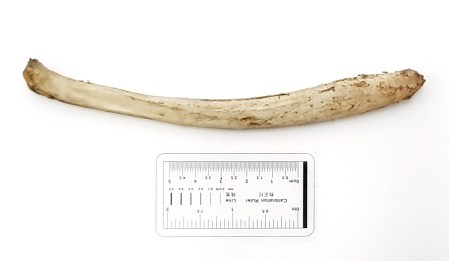
Last week I gave you this mystery bone to identify:

20171130_153340-01.jpeg

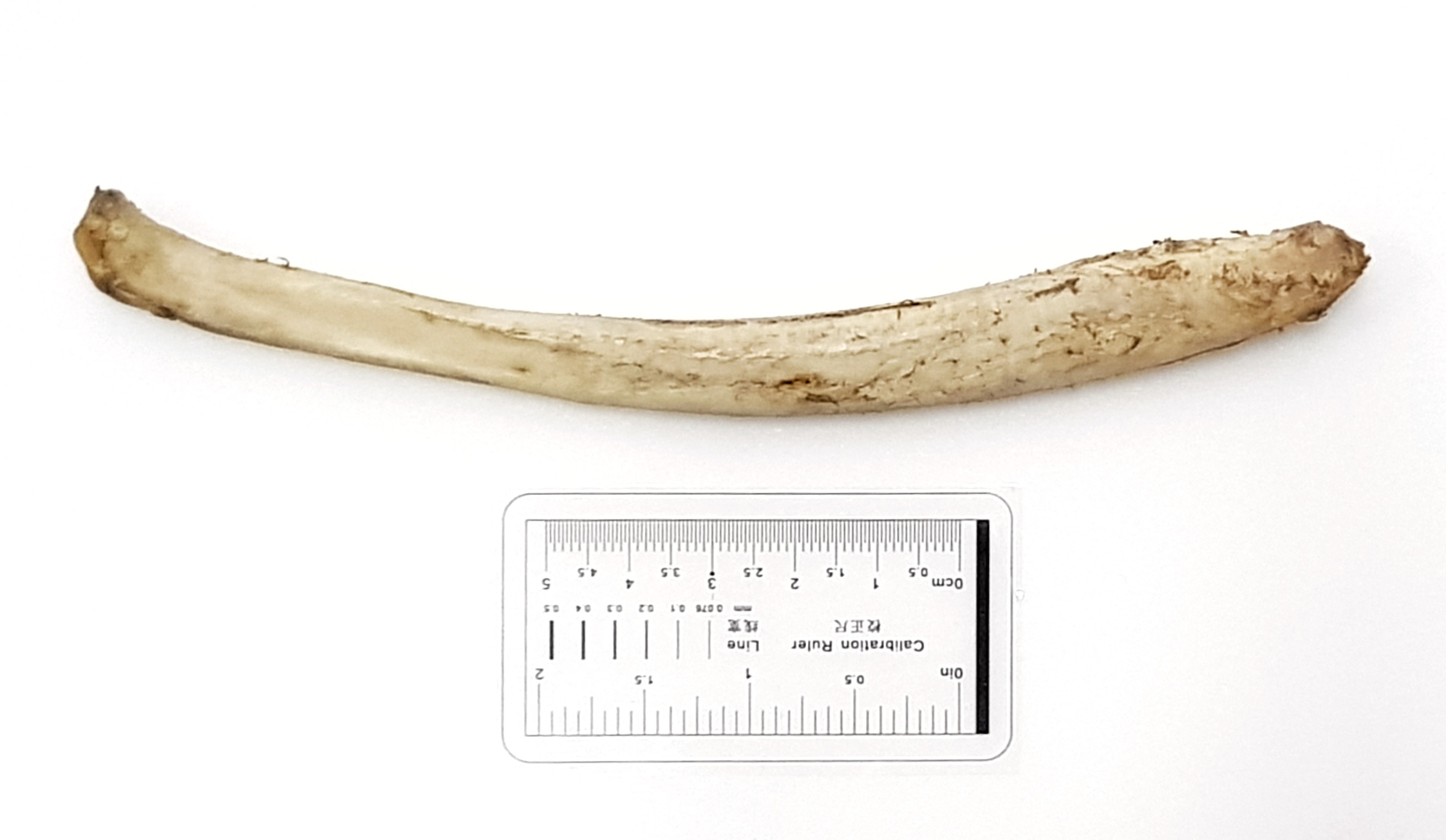
As I suspected, it was simultaneously easy and difficult: easy because it’s clearly an os penis or baculum; difficult because it can be hard to narrow down the species to which a baculum belongs without having specimens for comparison. For some reason people can be funny about penis bones and, despite the fact that male animals tend to be over-represented in museums, the baculum will often have been removed or not included in skeletal mounts.

That said, Steph came closest, getting the right family with the clue:

Bac to the bear-minimum I would guess?

If you remember one of my past posts I showed an image of the baculum mounted on the skeleton of a Giant Panda in Berlin (more about this below):

Panda_penis_bone

You can see that, although it differs slightly with a bit of a dip towards the tip, it’s rather similar in structure to the mystery object.

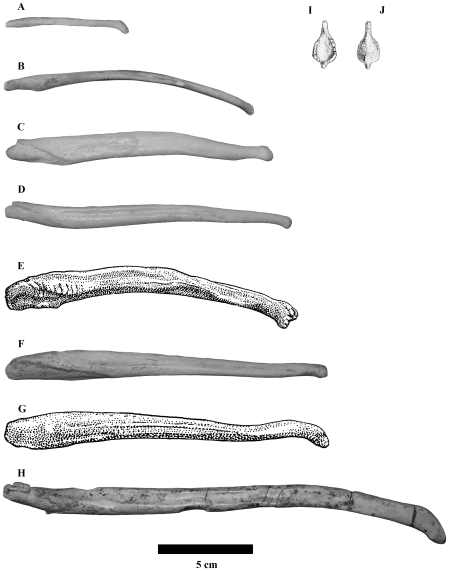
Oddly however, it appears that this baculum on the Berlin Panda specimen has been switched for that of a different bear species. Pandas have a very distinctive reduced baculum with wings (see below), that looks nothing like this, which is more similar to the os penis of a Spectacled Bear (or possibly a Polar Bear at a push).

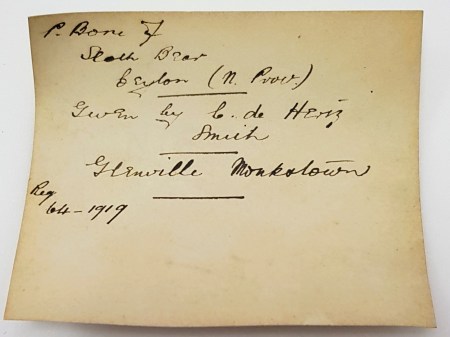
The mystery object is actually the baculum of a Sloth Bear Melursus ursinus (Shaw, 1791).

20171130_153230

N.B. note that the writer of this label couldn’t quite bring themselves to write the full word “penis”

In future, should you ever find yourself with an unidentified bear penis on your hands, I suggest taking a look at this handy figure by Abella et al. 2013¹:

journal.pone.0073711.g001

Baculum in laterial view of: A Helarctos malayanus; B Ursus thibetanus; C Tremarctos ornatus; D Ursus americanus; E Melursus ursinus; F Ursus arctos; G Ursus maritimus; H Indarctos arctoides; I Ventral view of the Baculum of Ailuropoda melanoleuca; J Dorsal view of the baculum of Ailuropoda melanoleuca.

So in answering one mystery object we’ve uncovered a far bigger mystery – how did the Berlin Panda end up with the wrong penis?


¹Abella J, Valenciano A, Pérez-Ramos A, Montoya P, Morales J (2013) On the Socio-Sexual Behaviour of the Extinct Ursid Indarctos arctoides: An Approach Based on Its Baculum Size and Morphology. PLoS ONE 8(9): e73711. https://doi.org/10.1371/journal.pone.0073711

Friday mystery object #327

This week I have a mystery object for you that I expect you will find simultaneously easy and difficult:

20171130_153340-01.jpeg

If you’ve been following my blog for a while, I expect you’ll be able to work out what this bone is quite easily – however, you may struggle a bit more to work out which species it came from.

Cryptic answers are encouraged as always – but mainly have some fun with this one!

Friday mystery object #326 answer

Last week I gave you this dissected mandible to have a go at identifying:

20180322_162222-01.jpeg

I thought it might be fun to get a poetic response and I wasn’t disappointed. There were some great efforts and I thoroughly enjoyed unpicking the clues from the verses people crafted in response. Of course, a poetic soul is only so much use in this game – you also need to work out what it is.

Bob Church was the first with a bardic response that was unambiguously on target for the identity of the mystery specimen:

Though the bone’s a disaster
There’s enough left to answer
What this rolly polly animal could be
It might sound a bit funny
But mix a turtle and bunny
And you’ll find the bowled over family

Of course, if you mix a turtle and a bunny you get something that looks like the artistic creation by John Tenniel in 1865 to illustrate Lewis Caroll’s Mock Turtle from Alice’s Adventures in Wonderland:

alice_par_john_tenniel_34

Gryphon and Mock Turtle with Alice, by John Tenniel in 1865

The animal in question is actually remarkably similar in appearance:

9-banded Armadillo by Ereenegee, 2011

9-banded Armadillo by Ereenegee, 2011

It’s the Nine-banded Armadillo, Dasypus novemcinctus Linnaeus, 1758, a decidedly odd animal that lives in South, Central and southern parts of North America.

Most mammals have well differentiated teeth, so the homogeneity of these in shape (or homodont condition) suggested that you were dealing with something a bit unusual, with simple peg-like teeth, open roots and no enamel. That makes the mandible quite distinctive, even with some missing teeth.

The one slightly confusing thing about this half a jaw is that it appears to have tooth holes (or dental alveoli) for 10 teeth (as recognised by salliereynolds, who also got the identification right), but armadillos are only meant to have eight teeth in each side of their upper and lower jaws.

I thought this difference might throw you off the Armadillo scent a bit, but clearly I was wrong. The difference in this jaw will probably be because it comes from a young animal which still has milk teeth (or the alveoli for them) that aren’t all replaced by the adult teeth.

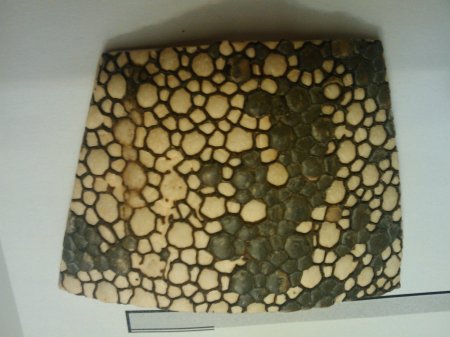
These insectivorous armoured animals are unusual in a variety of ways beyond their dental idiosyncrasies. They have imbricated bony nodules or plates embedded in their skin (or osteoderms) that forms a tough armour:

mysob3a

Dorsal view

mysob3b

Ventral view (width ~5cm)

They also consistently give birth to four offspring every time, originating from a single egg that splits into four. So every Nine-banded Armadillo has three identical siblings. I think this fact alone qualifies them as one of the weirder animals out there.

More mysteries next week!


*Juliette Kings may have got in with the first identification, with reference to the Armadillo’s habit of jumping straight up in the air when alarmed and occasionally screaming, but it sounded a bit more like she was suggesting Goat.

Friday mystery object #326

Yesterday I was doing some work in the gallery of the Dead Zoo and found a specimen that needs a little light repair work to stick teeth back into sockets. I thought it might make an interesting object for you to have a go at identifying:

20180322_162222-01.jpeg

Any idea what this piece of mandible might belong to? It’s probably a bit too easy for some of the mystery object veterans, so please keep your suggestions cryptic and, if you’re in the mood, poetic.

Have fun!

Atacama ‘alien’ (not an alien) revisited

You may (or probably may not) remember back in 2013 I got annoyed by the sensationalist reporting around some diminutive human remains found in the Atacama desert which were hyped by some to be evidence of alien life, and by others as an example of an extreme form of dwarfism. The apparent age of the individual was suggested to be 8 years based on bone density and fusion as assessed by a paediatrician.

Atacama Humanoid © 2013 Sirius Disclosure

Atacama Humanoid © 2013 Sirius Disclosure

In light of this I wrote an analysis of the specimen pointing out that in the features suggested it was a human foetus, probably aborted, exhibiting features altered by taphonomic processes (things that happen between death, burial and discovery) that apparently increased bone density and appearance of fusion, as has been noted in an infant Egyptian mummy, where bone fusion suggested an age between 7 and 10 years, but the height and dentition suggested an age between 14 months and two years (huge thanks to rlabanti for tracking down this archived copy of the paper, as I forgot the reference and the old link died).

You probably wouldn’t believe how many angry comments I received from conspiracy theorists for challenging the idea that the specimen was an alien. Actually, you probably would if you know your memes:

9148130

Aliens aside, the authors of the initial study have been doing more work and have come to the conclusion that the specimen represents a preterm infant with an interesting suite of genetic anomalies that may account for the features seen. I’ve seen the paper and the genetic analysis looks pretty reasonable (at least as far as I am able to assess), but there is still a gaping hole in the taphonomic analysis – in that there is none.

I still consider this to be a problem, because you can’t understand phenotypic (what an individual looks like) abnormalities using genetics in isolation, especially when you know without doubt that there have been post mortem processes taking place. However, as interpretation of the specimen has become less sensational, I find myself less concerned by the omission – although it remains significant. We now know from the new analysis that the Ata foetus was female and had a genetic profile suggesting some input from a variety of geographical locations, but with a predominantly Chilean genome. This information humanises Ata and changes the tone of the discussion.

Rather than my suggestion of deliberate abortion – which was based on an initial mistake regarding damage to the skull which was post mortem rather than a cause of death – it’s more likely that the mutations cited as likely causes of genetic disorders contributed to spontaneous abortion (miscarriage). This is a deeply distressing, yet unfortunately common situation when there are developmental issues with a foetus. On a human level, it means that someone lost their child – and that deserves a bit of respect and sensitivity.

Friday mystery object #325 answer(ish)

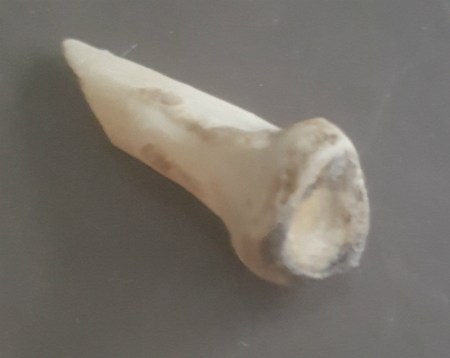
Last week I gave you the challenge of identifying this bit of bone found in a rockpool in Kimmeridge by 7 year old Annie:

mystery325a

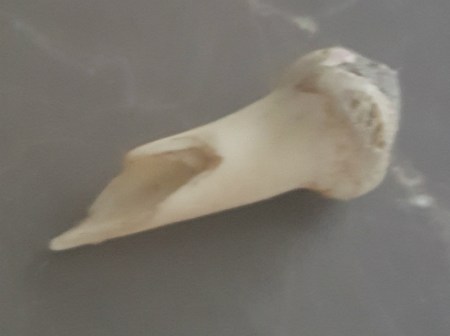
It’s not the easiest item to identify for a variety of reasons. First of all it’s broken, only showing one end and probably missing quite a lot of the element. Next, the images don’t show all of the angles you might want to see and because the object is small the images aren’t as clear as you might like.

However, there are a few angles visible (see below) and there is a scale, so the main requirements to get an approximate identification are in place. I say approximate, because with something like this I think you really need the object in your hand where you can compare it to other material in detail if you want to make a confident identification.

Excuses aside, let’s take a look and see what it might be…

The first thing to note is that the bone is hollow with thin walls. This rules out fish, reptiles, amphibians and mammals (including humans jennifermacaire) – leaving birds.

Weathered mammal bones may have a void in the bone where the marrow would have been, but the cortex (outside layer) will be thicker and near the articular surface it tends to be quite solid.
mystery325c

Hollow bone = bird (usually)

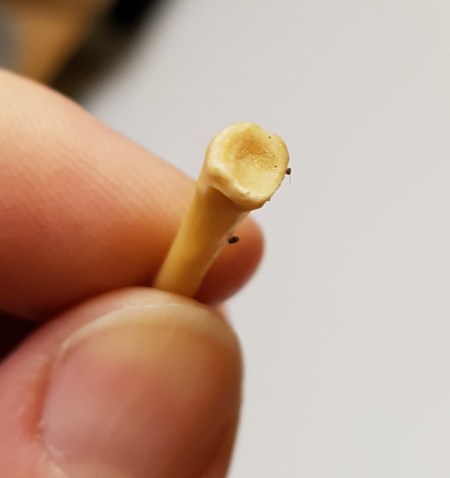
Next, the articular surface of the bone is concave, which palfreyman1414 picked up on:

As far as I recall (mentally running through images in my head) both ends of the proximal limb bones in tetrapods have convex ends?

This is accurate, but while the proximal (near end) of the limb bones are convex, the more distal (far end) limb bones tend to have concave ends, so that helps narrow down what this bony element might be.
mystery325b

Concave articulation

For me the give-away here is the fact that there’s no ridge within the concavity of the articular surface, which means that it will allow movement in several directions – something that the bones of bird feet don’t really need, which is why bird lower legs,  feet and toes have a raised ridge inside the articular surface that corresponds with a groove in the other surface, keeping the articulation of the joint tightly constrained.

20180315_143049-01.jpeg

Articulation of Shag phalanx showing raised ridge

However, bird wing need to make a wider range of motion (at least in some species), so the mystery object is most likely the distal end of a bird radius (the ulna tends to have a hook at the distal end). This is the conclusion that Wouter van Gestel and DrewM also came to (joe vans should’ve stuck to his guns).
20180315_143712-01.jpeg

Distal articulation if duck radius

Identifying the species of bird is a lot more complicated. The size suggests a pretty big bird, which narrows it down and the locality in which it was found makes some species more likely than others. I took a look at the radius of some species that are commonly found on the coast, like Guillemot, Herring Gull, Duck, Cormorant/Shag and Gannet, Skimmer, Pigeon and I also checked out Chicken, since their bones are probably the most commonly occurring on the planet.
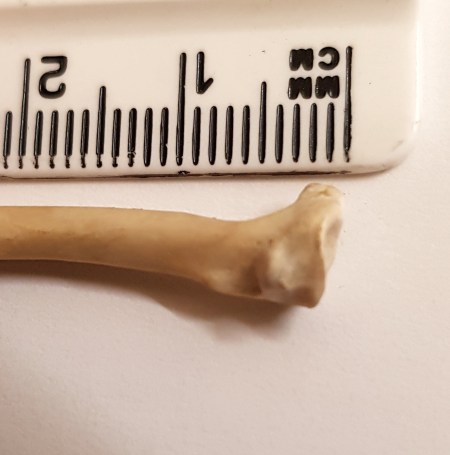
20180315_142205-01.jpeg

Gannet radius with some distinctive structure around the articulation

Many of the species I checked had quite a distinctive structure around the distal radius articulation, but the gulls, ducks and chickens that I looked at had fairly unremarkable distal radius articulations, making it hard to definitively decide what the mystery object is based on the images.

20180316_072154.jpg

Herring Gull radius

20180315_143308-01.jpeg

Chicken radius


So with that somewhat disappointing conclusion I admit partial defeat, but I can say that it’s not from a Cormorant, Shag, Gannet, Pigeon or Guillemot. Sorry I can’t be more specific Annie!

Unfortunately that’s just how the identification game works sometimes… we’ll try again with something new next week!