Friday mystery object #219 answer

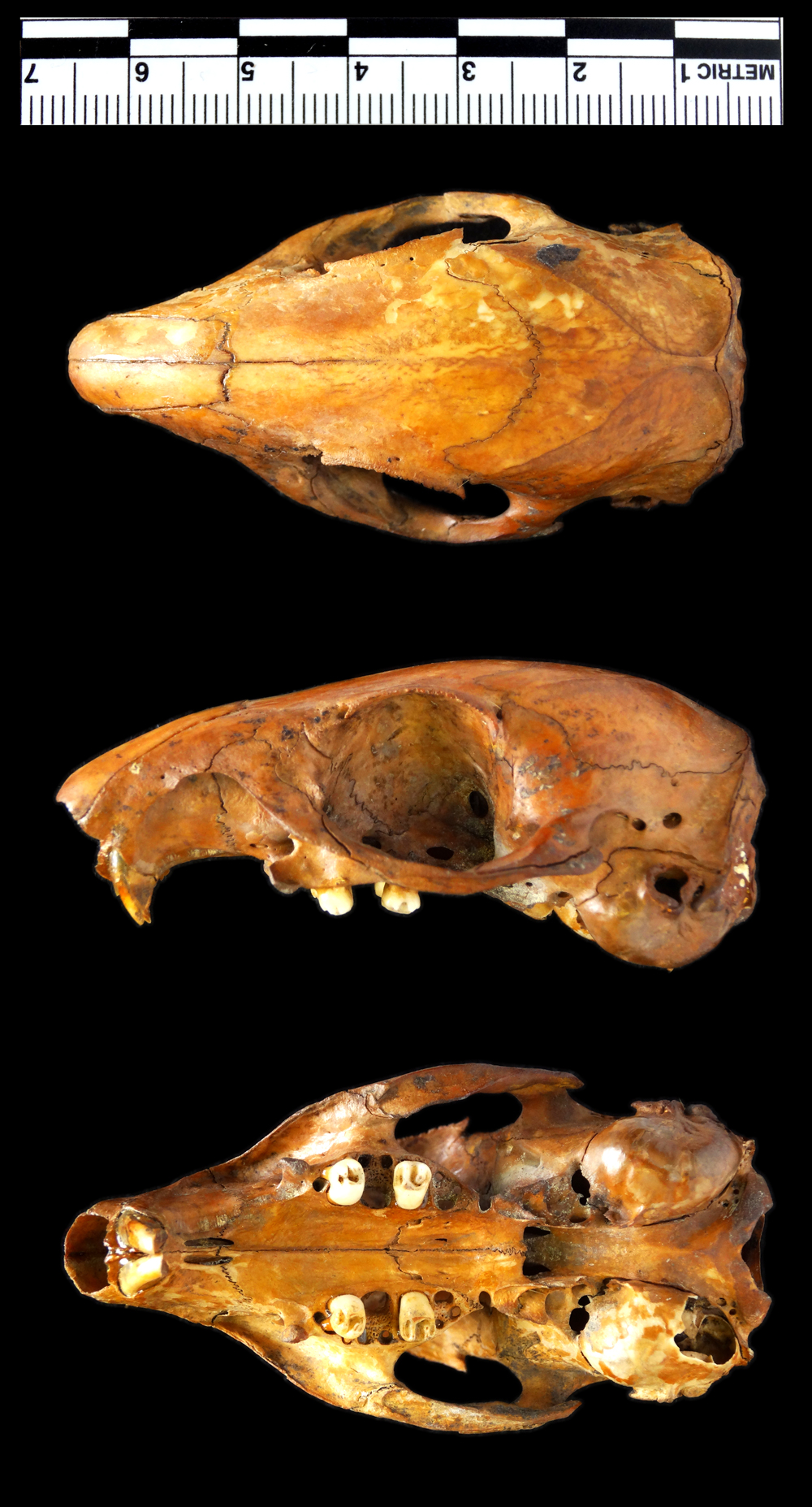
On Friday 7th Feb I gave you this mystery skull to identify:
mystery219

The post got lots of activity from both regulars and biology students from the University of Chicago Laboratory School, which means there were lots of helpful comments!

The specimen was quite clearly from a rodent, due to the paired incisors, but there are a LOT of different rodents out there.

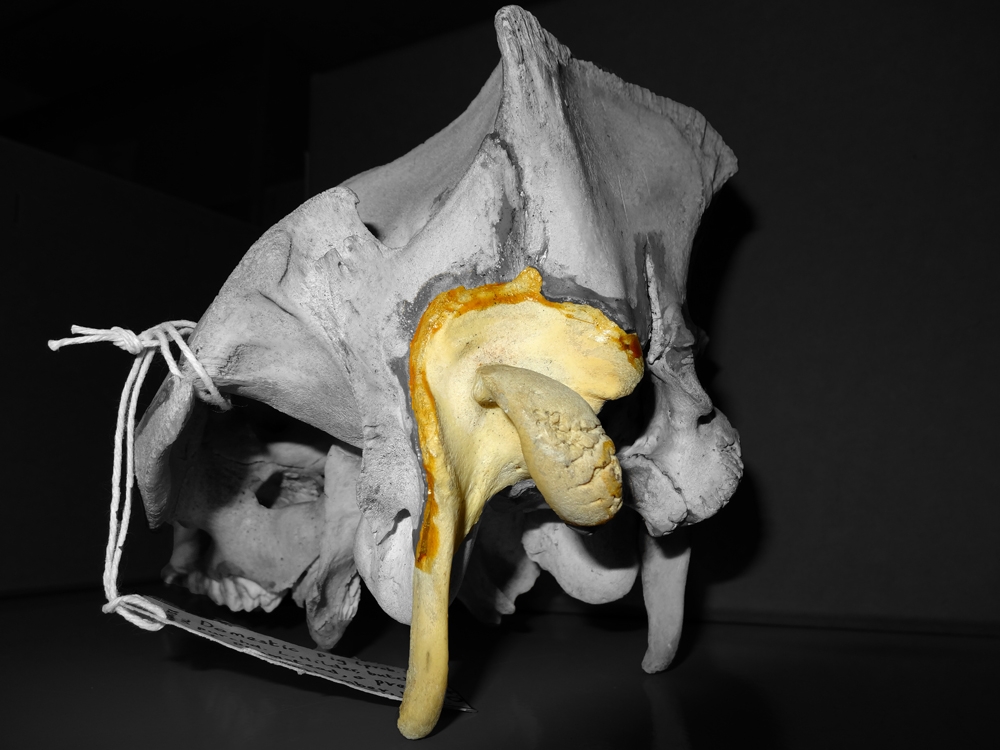
The type of rodent was narrowed down by bugblokenz who suggested the skull was from a squirrel of some sort and Jake pointed out how we know that is the case – the specimen has a spiky postorbital process:

rodentpostorbitalprocess

The presence of a spiky postorbital process (see top skull) suggests that it was from a type of squirrel. Most other rodents either lack this process (see bottom skull), or the process is more stout and blunt.

Narrowing it down to a squirrel is helpful, but there are still around 285 different species to choose from and many squirrels have very similar skulls. This is where the real challenge lay, especially since it clearly wasn’t the British Red Squirrel Sciurus vulgaris or the more widespread Eastern Grey Sciurus carolinensis, as I showed you on Friday 14th. Other suggestions included the Southern Flying Squirrel Glaucomys volans (which is a bit on the small side) and Eastern Fox Squirrel Sciurus niger (which has a really interesting method you can use to identify it).

The relatively narrow zygomatic breadth, combined with a relatively wide breadth between the orbits suggests a ground squirrel of some sort, which many people recognised, leading to suggestions of Poliocitellus frankliniiSpermophilus sp., Otospermophilus sp. and Tamias sp. – for which this useful reference provides some great comparative specimens (huge thanks to Crispin for sharing this).

However, none of the North American ground squirrels quite matched up, with the closest suggestions of Otospermophilus variegatus or Poliocitellus franklinii still being different in a variety of ways, particularly in relation to the width of the skull, relative zygomatic breadth and shape of the postorbital process.

After much consideration it came to me that we may be looking on the wrong continent and it turns out that African ground squirrels are more similar to this specimen. Fortunately, there is a very useful resource providing images of specimens of African rodent species available through the Belgian Biodiversity Platform. This fantastic site has enabled me to make a reasonably confident identification of Striped Ground Squirrel Xerus erythropus (Geoffroy Saint-Hilaire, 1803).

Striped Ground Squirrel (Xerus erythropus) by BOISSEL Philippe

Striped Ground Squirrel (Xerus erythropus) by BOISSEL Philippe

I’d still like to get my mystery skull to a comprehensive physical collection, just to make some fine detail checks (there are some issues with the shape of the posterior margin of the palate I’m not 100% happy about), but overall I’m happy with this – but please let me know if you think I’ve missed something!

Big thanks to everyone who has contributed their ideas on this specimen – let’s see what I can find for you to identify this coming Friday…

[Further information available in this species description PDF]

Friday mystery object #219 answer coming soon…

Apologies for not having the answer to last week’s mystery object posted yet – it’s been a busy week and I simply haven’t had a chance to prepare a decent answer.

However, I have an image of last week’s object alongside a Grey Squirrel (the lighter coloured specimen), to give you an idea of how they differ, so I hope that will prove of interest until I can get a proper post prepared:

Grey_Squirrel_vs_Mystery_219

Friday mystery object #218 answer

Last Friday I gave you this skull to identify:

mystery218

There was strong consensus on this being a mustelid – which is good, because that’s what it is. There was also good agreement on it being one of the Martens, which is where things become a bit more difficult.

After looking at a lot of different Marten skulls online without much success in finding a way of telling them apart, this diagram  proved quite helpful.

Images compiled by Mariomassone

Skulls in the sequence: M. zibellina, M. martes, M. foina

If you look at the skull in the middle of the top and centre rows, the auditory bullae (the rounded bones under the skull that house the anatomy used in hearing) have quite distinctive shapes in the three species pictured.

In addition, the the little nub of bone (called the mastoid process) that sticks out behind the ear hole (or external auditory meatus as it’s also known) is very differently developed in the three species. Looking at this character and checking back against other Marten skulls online the clues suggested that the mystery object is the skull of a Pine Marten Martes martes (Linnaeus, 1758).

So well done to everyone who commented – particularly Jake who got the ball rolling with a Martes identification from the start!

Friday mystery object #217 answer

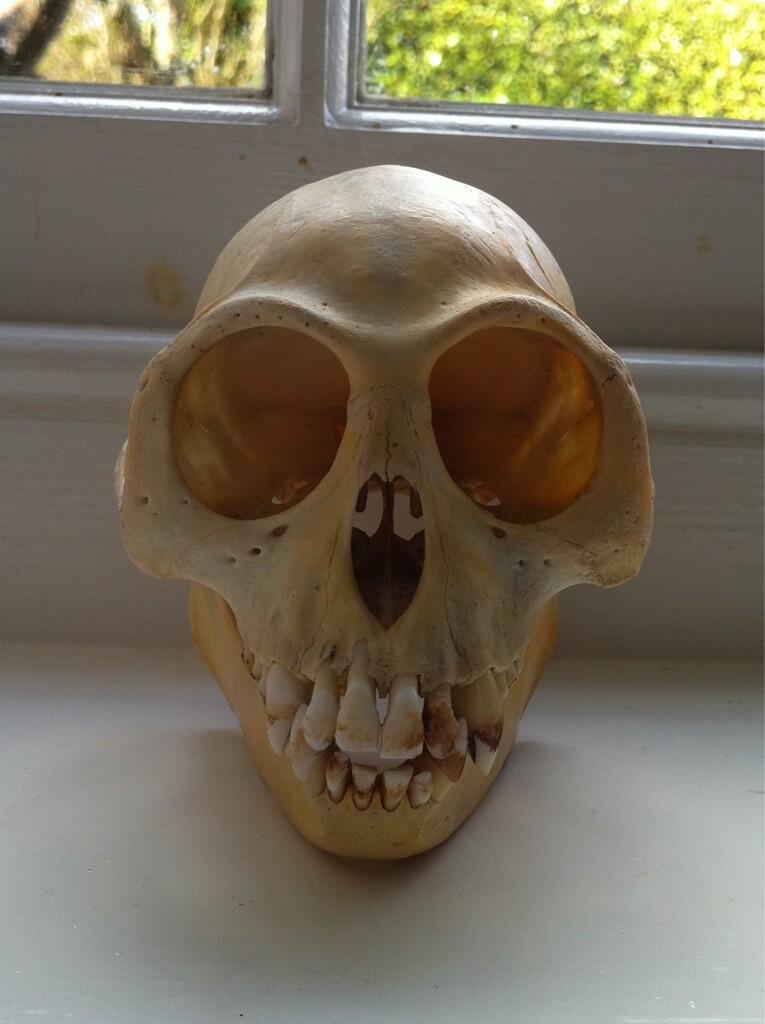
Last Friday I gave you this lovely skull to identify:

mystery217

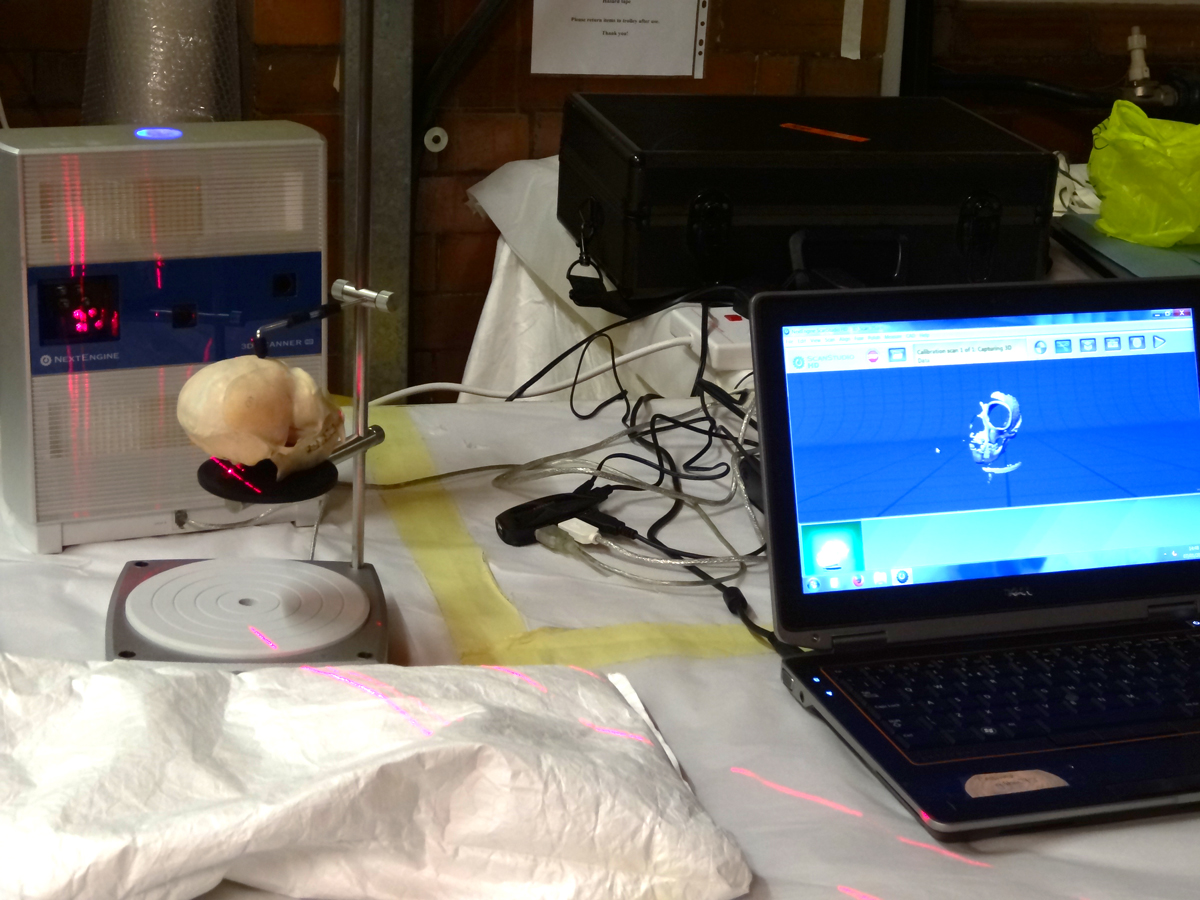
I chose it because it was being used for an interesting project by a student at UCL, involving 3D surface laser scanning of the specimen to identify landmark characters of the skeletal structure of the faces of this family of primates:

mystery217scan

This is a specimen that we actually have a fair amount of information about. It’s a male Grey Gibbon Hylobates muelleri Martin, 1841 collected before 1909, from Melian on the Hanta River in North Borneo. So of all the suggestions, Crispin (@brainketchup) was the closest (with agreement from henstridgesj) when he suggested White-handed Gibbon.

It turns out that this skull also has a taxidermy skin associated with it (which Jake has mentioned before), which shows a common feature of taxidermy specimens where the skull has been prepared separately – it’s mouth is stitched shut:

GreyGibbon

This makes for slightly dodgy taxidermy, but at least it means the skull is available for future research, instead of being stuck in a specimen intended mainly for display.

The skin of this specimen has also seen recent use, but for art rather than science. Artist Paul Robinson has used it as the basis of this somewhat freaky, but striking piece of work:

GIBBON by Paul Robinson

GIBBON by Paul Robinson

It goes to show that specimens in museums can find themselves being used in all sorts of interesting ways. To my mind this is really what museum collections are for – being used by people.

Friday mystery object #215 answer

Last Friday I gave you this perplexing specimen to identify:

mystery215

It was labelled as a Crab-eating Raccoon, but the facial region is much longer and narrower than other examples I’ve talked about, and it’s much less robust:

Crab-eating Raccoon skull

Now the gracile build could just be because it’s the skull of a juvenile (which is what it looks like), but juveniles have shorter and relatively broader facial regions than adults, so that doesn’t work. Even the less robust jaws of the Common Raccoon are too short and wide for the mystery specimen (which I think may discount Robin Birrrdegg’s suggestion).

Another crab-eating option was suggested by Daniel Jones who thought Crab-eating Fox. Now the overall proportions are a good match for this species, but there’s a problem. If the mystery object had teeth this would be much easier, but there are the holes in the maxilla to give us clues about the shape and size of the molars and as Allen Hazen pointed out:

Three triple-rooted teeth. Are these three molars, or is the last premolar triple-rooted? If it’s three molars… Canids (usually) only have two upper molars…

This is indeed the case and so this skull can’t be from a Crab-eating Fox.

On a different tack, henstridgesj suggested that it might be a civet of some sort, pointing us in the direction of mystery object #143 for comparison:

African Civet skull

But again this really doesn’t look right – in particular the civets have a narrow constriction behind the orbital process, which is lacking in the mystery specimen. This was noticed by henstridgesj and he suggested that the closest option he’d been able to find was a Coati:

Coati skull

Now the specimen of Coati above is a mature male that was mystery object 54 and it doesn’t look much like our most recent mystery object, but on checking the skulls of juvenile and female Coatis I realised that this is probably the best option so far.

I still want to check some more specimens, but I’m really grateful for everyone’s input on this specimen – it’s been a challenge and you have all helped immensely!

I’ll  be back with another mystery object next Friday, but until then I’d like to wish you all a thoroughly enjoyable festive season!

Friday mystery object #215

This week I have a skull for you that I think has been misidentifed, but because its teeth are mostly missing it’s a little hard to be sure.

mystery215

I’d appreciate your thoughts on what it might be and as usual you can put those thoughts in the comments section below. Let’s see if we can work out what this is!

Friday mystery object #214 answer

Apologies for the lateness of the FMO this week, my excuse is a rather apt bout of illness, where some of the alveolar bone of my mandible has been lost due to an infection, leaving me feverish and thoroughly miserable.

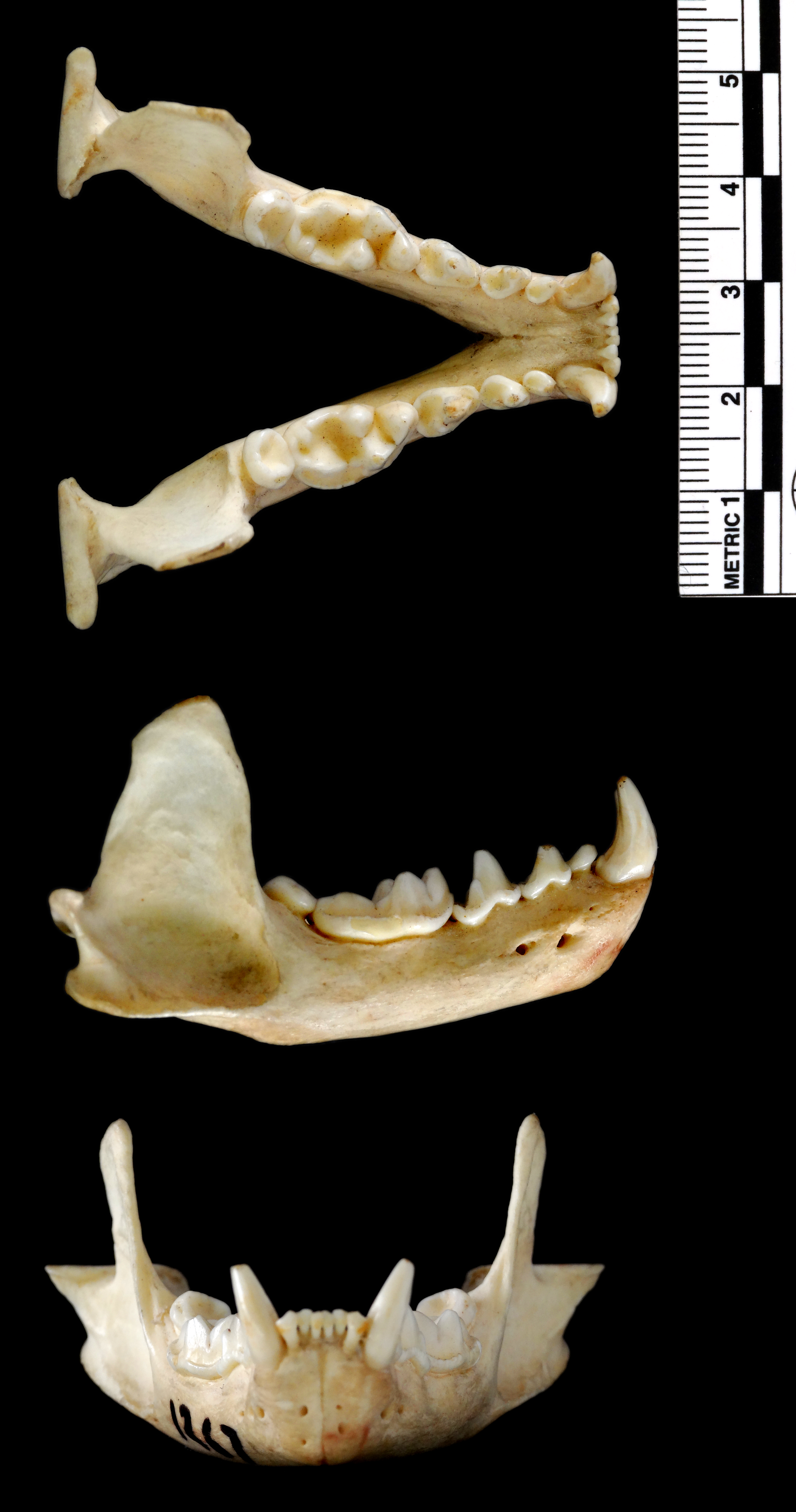
But enough about my me, this is the mandible I’m supposed to be talking about:

mystery214

There was a fascinating discussion about the possible identification in the comments last week, so a big ‘thanks!’ to all of the contributors who provided their informative observations (too many to mention everyone by name!). A mustelid of some sort was quickly agreed upon and the general consensus moved towards an otter of some kind, before starting to drift away again.

Two comments in particular were particularly pertinent. The first was from Daniel Jones:

Alright . . . instantly the foramina on the mandible anterior to the premolars scream Otter! However, the incisors don’t. The incisors just lateral to the canines should be larger and longer than any of the other incisors among the otters (even the Asian Short-clawed Otter).

Now my identification for this specimen was indeed Asian Short-clawed Otter Aonyx cinerea (Illiger, 1815), so this comment made me a bit concerned. However, on checking some images online I realised that the long lateral incisors are present in the premaxilla, but not the mandible – an easy detail to miss.

The second comment was by Allen Hazen:

Anyway… The talonid on the first molar of the one in the picture is BIG.

The reason I found this comment useful was that the long and broad talonid (that’s the flatter grinding section on the molar) is what confirmed the Asian Short-clawed otter identification for me (although the small size was a good first clue).  This became quite clear from an image on the Otter Specialist Group webpage.

The Asian Short-clawed Otter presumably has this large talonid because it has a diet mainly composed of crustaceans rather than fish, and it needs the extra crushing area on the molar to crack open tough exoskeletons.

Who would think you’d get teeth as formidable as these on such an adorable little critter?

Geekwars?

After a weekend of discussion about the hashtag #bonegeeks for a crowd-sourced, social media based resource for images of bones, I have come to the conclusion that you can’t please all of the people all of the time.

The nub of the discussion centres on the word ‘geek’, which is a term that some people dislike and don’t identify with. This is fair enough – how one identifies with and adopts labels for themselves is a personal thing, a point that Alice Roberts made earlier in the year.

Language evolves and so terms take on new meanings to reflect common usage. To my mind this means that the term ‘geek’ has taken on a new and (to my mind) positive meaning as “someone who is interested in a subject (usually intellectual or complex) for its own sake“, so I am happy with that description for myself – but I can understand that others feel differently.

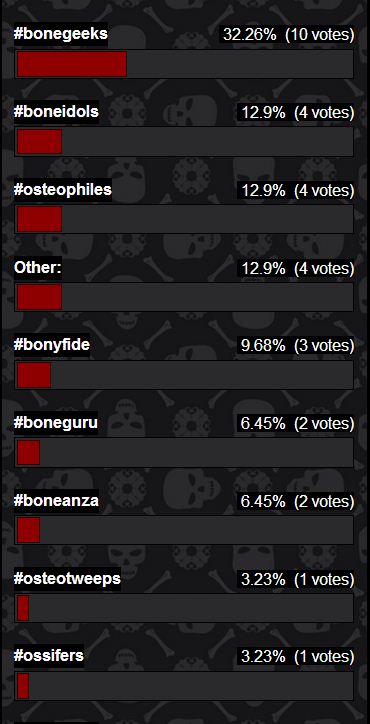
In order to try to come up with a better hastag for a bony resource I made a poll that included a range of suggestions, the most popular of which can be seen below:

poll

Now obviously #bonegeeks comes out on top – presumably due to input from other people who self-identify as geeks, but there are enough people voting for alternatives to raise a warning flag that several people may feel actively excluded by use of term ‘geek’. In light of this I am unwilling to stick with #bonegeeks, but the general lack of consensus on alternative names leads me to reject the other options.

Where to go from here? The obvious answer is to go back to what we are trying to achieve and to think of a hashtag that is descriptive of the outcome rather than the contributors, so I suggest we use #bonepics so that both #bonegeeks and every other brand of osteology enthusiast who doesn’t consider themselves a geek can get on with making something rather awesome…

#bonegeeks

There are some great resources online for finding images of comparative material for skulls, but the postcranial skeleton tends to be quite badly represented online even for common species. I’d love to change that, but it’s a big challenge for one person.

Paramastoid process of Pig (Sus scrofa)

Paramastoid process of Pig (Sus scrofa)

That’s why I’d like to set up #bonegeeks on Twitter (and maybe on other social media as well). The way I see it, people who have access to skeletal material could easily take snaps of bits of postcrania from known species (preferably with something for scale) using their phone and share the image to Twitter, Tumblr or Facebook with the name of the species and the bone (and perhaps where the specimen is held).

With the #bonegeeks tag it should be easy to collate images and hopefully start building up a comparative collection of images to make identifications easier.

It could start with a bone of the week to get the seldom depicted bones better represented and I’m sure #bonegeeks would be willing to respond to requests if there were particular bones that someone wanted to see.

I wonder if this could work… shall we give it a go and find out? Please add your thoughts on this idea in the comments section below or on Twitter using the #bonegeeks hashtag.

Oh and here’s how the idea got started: [View the story “#bonegeeks” on Storify]

Friday mystery object #202 answer

Last Friday I gave you this big chunk of bone to identify:

mystery202

I was hoping that it might be a little bit of a challenge because it doesn’t seem to have any really diagnostic characters, but your shape-matching skills were good and several of you managed to get a close identification.

Heather was straight in with the suggestion of it being the back part of the frontal bone (the bit that makes up the front and top of the skull) of an Aurochs – the very large, extinct ancestor of modern Cows. Wouter van Gestel also suggested one of the large bovids – the Asian Water Buffalo, and Ben Gruwier agreed with both Heather and Wouter in saying that it was from a large bovid.

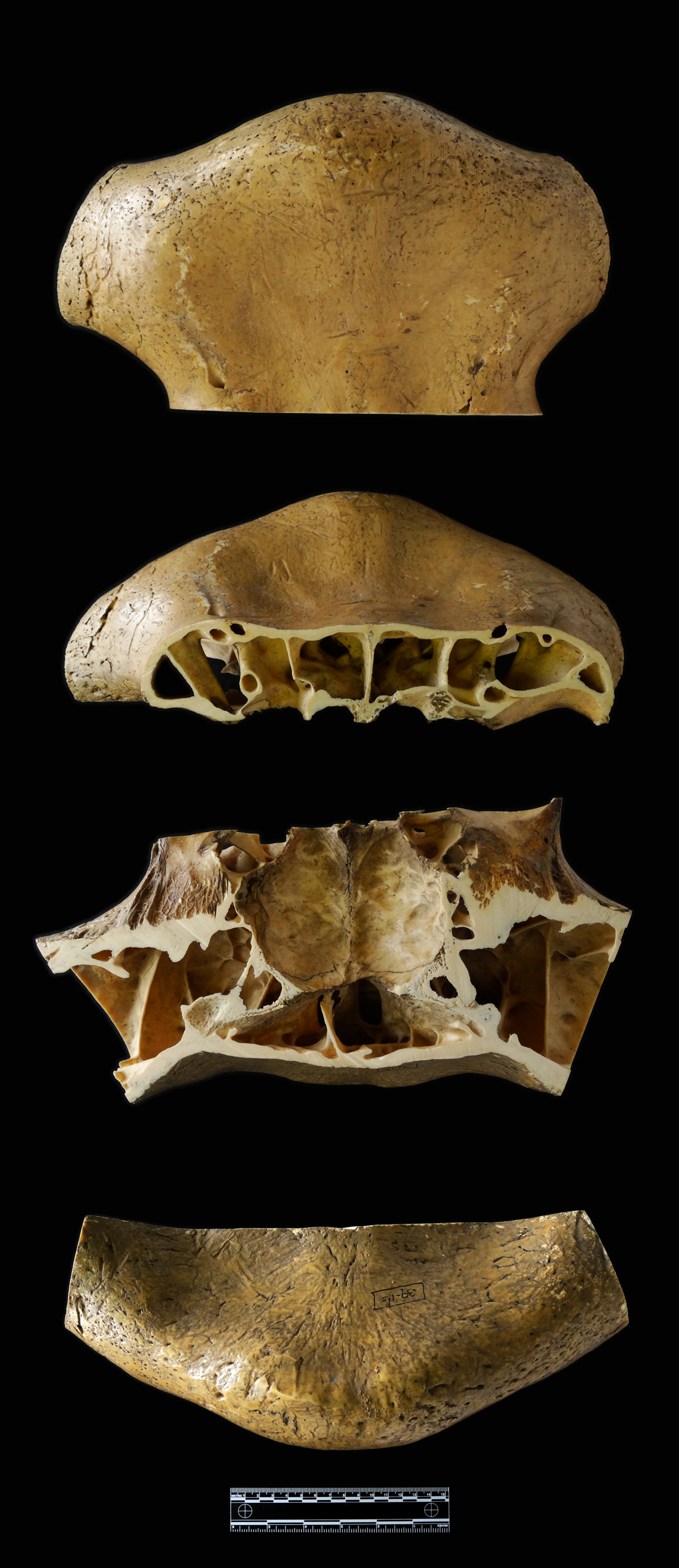
This was as far as I had managed to get with the identification myself, however the specimen had a number (39.16), which I was able to check against the natural history registers. The first part of the number told me to check in the register for the year 1939 and it was the 16th entry for that year, so it was easy to find (unlike with some numbering systems with museum specimens).

It turns out that this specimen is in fact the frontal bone of a Gaur or Indian Bison Bos gaurus Smith,1827, and it turns out that the Gaur has a distinctive ridge between the horns, which is what this specimen is showing, so I should have been able to work it out from the morphology (I will be able to in future).

Gaur bull at Nagarhole National Park, India. By Dineshkannambadi

Bull Gaur can weigh up to 1.5 tonnes and stand 2.2m (7’2″) to the shoulder – they’re enormous. Their only natural predators are the Tigers and large Crocodiles they share their Southeast Asian forest habitat with, but even then Gaur have been known to kill Tigers by trampling and goring them.

Perhaps unsurprisingly these animals are far more risk from humans and have been hunted for meat and trophies until they have become threatened. They are protected by CITES (the Convention on International Trade in Endangered Species), but illegal trade continues and their forest habitats are constantly being lost due to human encroachment.

It’s disheartening that so many of my mystery objects end with a comment about human activities driving a species towards extinction, but unfortunately it’s a massive problem in the world we live in. I wonder if there will be any wild Gaur left in 2039, just 100 years after this specimen was collected?

Friday mystery object #197 answer

On Friday I gave you this skull to identify:

mystery197

As I suspected, it wasn’t too much of a challenge. Jake got in quick with the suggestion of a Sri Lankan Python, with Gina Allnatt, Kevin and Rhina Duque-Thues all agreeing with a generic Python sp. identification. Nicola Newton also suggested Python, but she was of the opinion that it was probably a Royal Python or Carpet Python on the basis of the size.

I agree with Nicola and think that this is most likely the skull of a Royal (or Ball) Python Python regius (Shaw, 1802), based on the size of the specimen and the shape of the supratemporal and frontal bones compared to other Pythons I was able to find images for (if you don’t know which bones I mean you can see what I mean on a handy annotated picture of a Python skull from the Digimorph website).

Pet ball python - normal phase, probably an import (rescue). By Mokele

The skull is one of several similar specimens from the old King’s College teaching collection, so it’s a pretty good bet that the skulls came from either research animals or pets. The Royal Python is a fairly small African Python that is commonly sold as a pet because it has a mild temperament – so that helps offer a bit of support for the identification, although what’s really needed is a detailed identification key for Python skulls or access to good comparative material.

The lack of good resources for identifying the skulls of snakes is a bit frustrating. After working with bird and mammal skulls, where there are some amazing resources like Skullsite and the Mammalian Crania Photographic Archive I’m still searching for something similar for reptiles. Perhaps the Deep Scaly Project will deliver the goods one day… here’s hoping!

Friday mystery object #197

This week I have a skull for you to identify – to make a change from the more tricky specimens I’ve had recently. Any idea what this belonged to?

mystery197

As usual you can leave your comments, questions and suggestions below and I’ll do my best to respond. Enjoy!

Friday mystery object #194 answer

On Friday I gave you this rather unusual looking skull to identify:

mystery194

In fact, it’s so unusual that it doesn’t even look entirely like a skull, so it’s not surprising that the specimen proved a bit of a challenge.

Some elements (like the lower jaw) look a bit like they’re from a turtle, but other elements of the skull shape look more like they belong to an amphibian – from something like Necturus perhaps. Despite these similarities to some of the ‘basal’ tetrapods, the skull is actually from a fish.

The reason why it looks quite similar to a tetrapod skull and less like the average fish is because it belongs to a member of the Lobe-finned fish (Sarcopterygii) which are more closely related to the tetrapods than the more common and diverse Ray-finned fish (Actinopterygii). Despite the difficult identification, microecos managed to spot that this was a Lungfish and henstridgesj managed to identify the species as being the  Continue reading

Friday mystery object #192 answer

On Friday I gave you this unidentified specimen from the Horniman’s collections to take a look at. I had already had a go at working out what it is, but it never hurts to get a second opinion.

mystery192

It’s actually a bit of a generic looking overall shape, perhaps reminiscent of a owl or a maybe a pheasant of some sort. However, the nares (nostrils) are very small and round and set in a bill that is sharp, shortish and very solidly constructed, which is something you only really see in a few passerines, some parrots and the falcons. The skull is too big for a passerine and the bill is totally the wrong overall shape for a parrot, which leaves us with a falcon – a fairly small one at that.

From there the shape of the palate and the proportions of the cranium led me to a species identification that I’m pleased to say agreed with that proposed by Tony Irwin and Wouter van Gestel (who eloquently explained the indicative characters that I mentioned above). We all think that this is the cranium of a  Continue reading

Friday mystery object #192

This week I have a skull with no data that I came across in the collections a little while back. I think I managed to get a decent identification on it, but I’d be interested to see if you all agree:

mystery192

What do you think it is? As usual you can put your suggestions below. Thanks for helping out!

Friday mystery object #191 answer

On Friday we had this skull submitted by Dr Ben Swift for identification:

mystery191amystery191c

Now this is quite obviously a primate, as it has a bony ring around the orbit, a bony back wall to the orbit and just eight incisors as opposed to the twelve that forms the basal condition for mammals. The teeth also tell us that this is an Old World Monkey (Cercopithecidae), since these primates only have eight premolars instead of the twelve you find in the New World Monkeys (Platyrrhini). The small canines suggest that this is the skull of a female.

From there it starts getting a bit more difficult. The fairly small size of the specimen ruled out a few genera, but the main features that helped narrow down the possibilities were the very flat face, the heavy bony rings around the orbits, the flaring of the zygomatic arches (cheekbones) and the short and rounded braincase. Effectively the only way to consider these features is to look at a lot of comparative specimens (the excellent Mammalian Crania Photographic Archive proved very useful for this).

After a lot of consideration I found myself in agreement with the suggestion of something from the genus  Continue reading