Friday mystery object #101 answer

As promised, here’s a quick answer to last Friday’s mystery object:

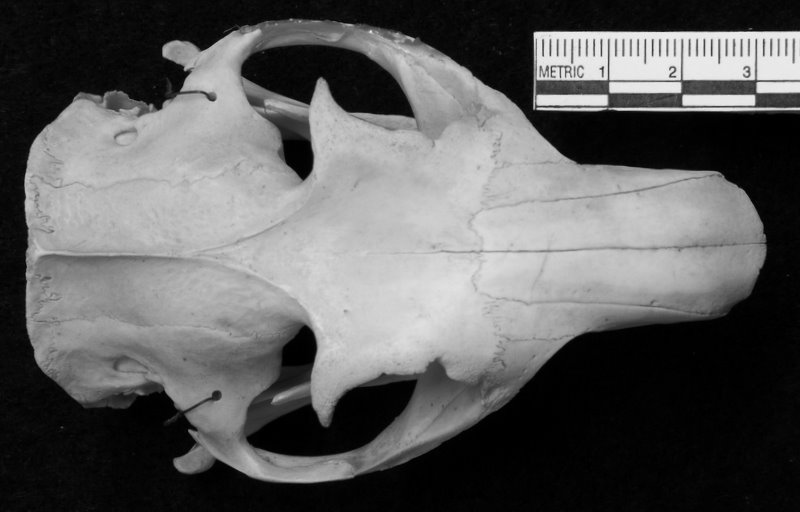
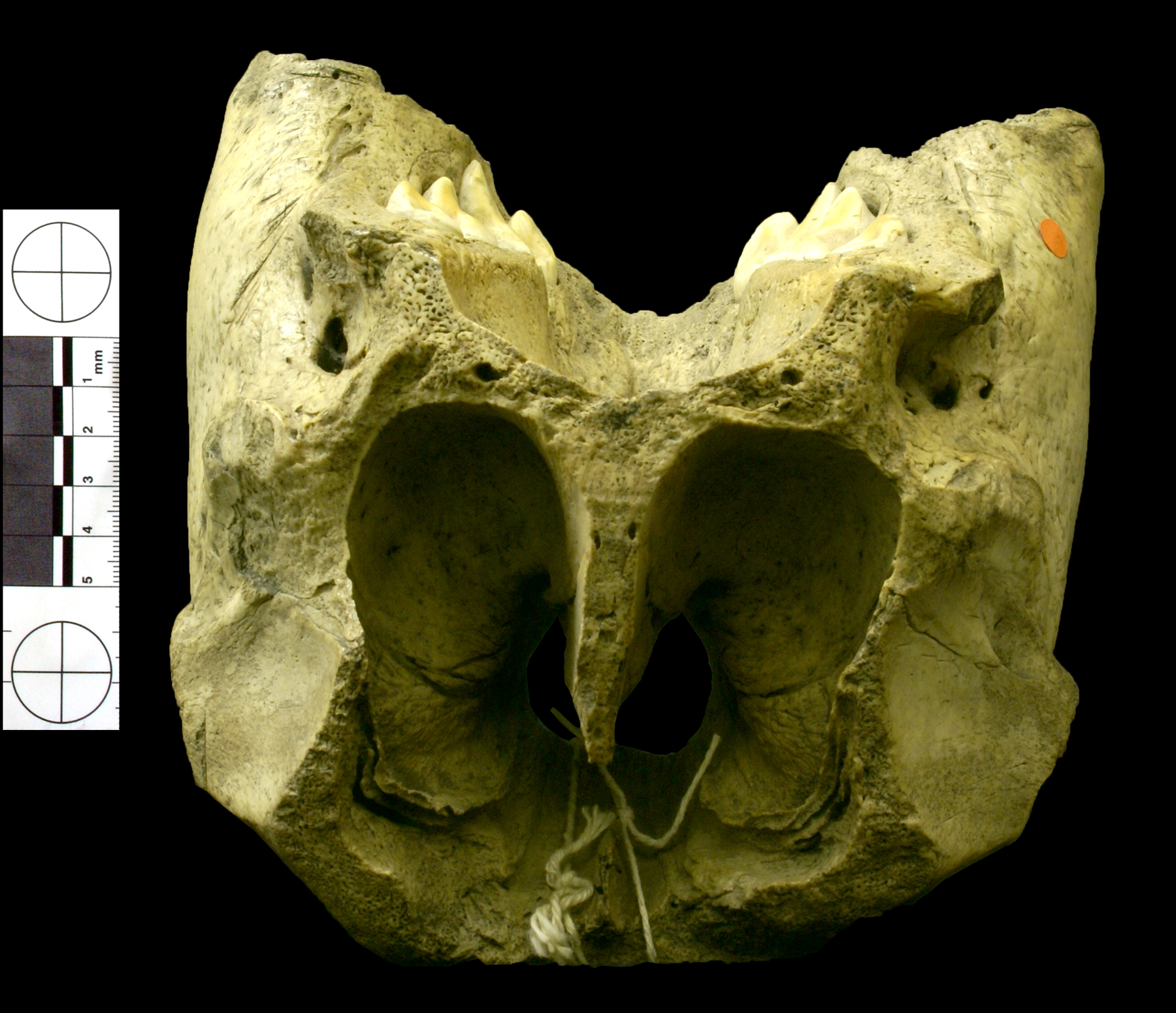
The big nuchal crest (ridge running along the back of the skull that meets the sagittal crest) points to this being a carnivore.

The large auditory bullae (the bulbous bits on the underside of the skull which relate to hearing) and very rounded notch in the occipital condyles (the bit of the skull that attaches to the atlas vertebra of the neck) suggest a cat, since dogs have a more V shaped notch and smaller bullae.

This is the back of the skull of a Leopard Panthera pardus (Linnaeus, 1758), in fact it is part of the same specimen as mandible F from last week.

Friday mystery object #101

Although last week I hinted that I may stop the mystery object, I’ve decide to try out a different system. Rather than give an extended answer on Monday (a time-consuming business) I will simply provide a very brief answer. Hopefully this will free up some time to do other things.

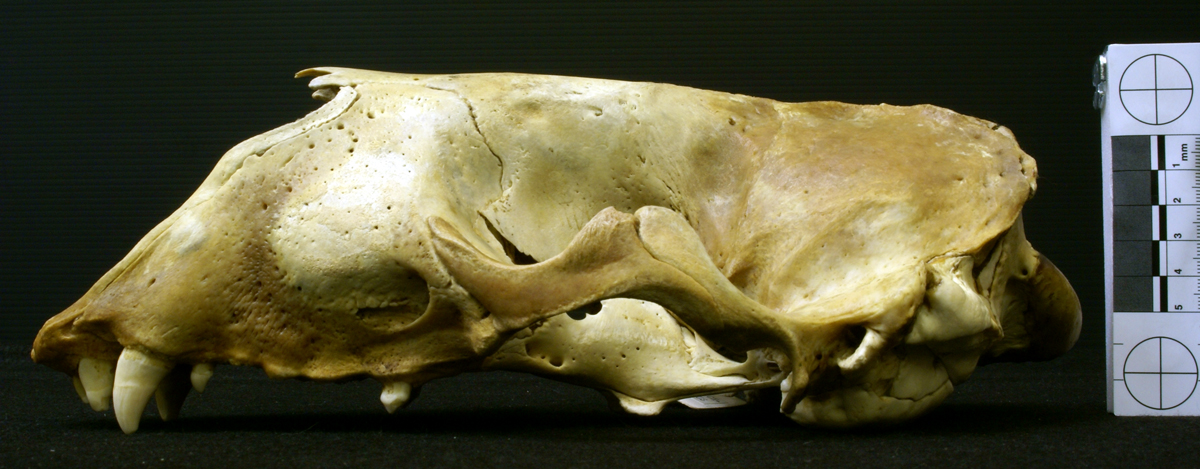
This week I present you with another partial piece of skull that I recently reunited with the rest of the specimen it came from. There’s no scale bar to keep it challenging!

Any idea what this is?

As usual, you can put your suggestions, comments and questions below and I will do my best to answer. Good luck!

Friday mystery object #100 answer

Friday was the 100th mystery object and I am considering making it the last one, since I’m finding it hard to come up with new objects every week. Moreover, I find that I don’t have time to keep up with all the other things I want/need to do.

However, I may keep FMO running for a bit longer with a slightly different format for the answer (since they’re what take the most time to write). So here’s the quick answer to Friday’s object, or should I say objects.

From top to bottom: A, B, C, D, E, F

From the top, the specimens belong to:

So congratulations to everyone who had a stab at identifying these mandibles – since all of you got some of them right.

If you have any thoughts on the continuation of the Friday mystery object, please feel free to let me know in the comments section below. Perhaps I should do a monthly mystery object or have them in a more ad hoc way as I find interesting objects? Your input would be of great help.

Many thanks!

Friday mystery object #100

It’s the one hundredth mystery object and I’ve decided to give you a challenge that I had to deal with at work this week.

I found a box of mandibles with no data, I identified them and checked them against their respective specimen types in the Horniman collections (that I’ve worked hard to organise for such a purpose).

The whole process took me half a morning and 5 of the 6 specimens were successfully reunited with the skulls they were separated from over 70 years ago – a satisfying outcome for a curator (our fun is cheap).

Now it’s your turn to identify the mystery mandibles (click image for bigger version):

From top to bottom: A, B, C, D, E, F

Put your suggestions and questions in the (newly organised) comments section below and I’ll do my best to respond.

Best of luck!

Friday mystery object #99 answer

On Friday I gave you this rather cool skull to identify:

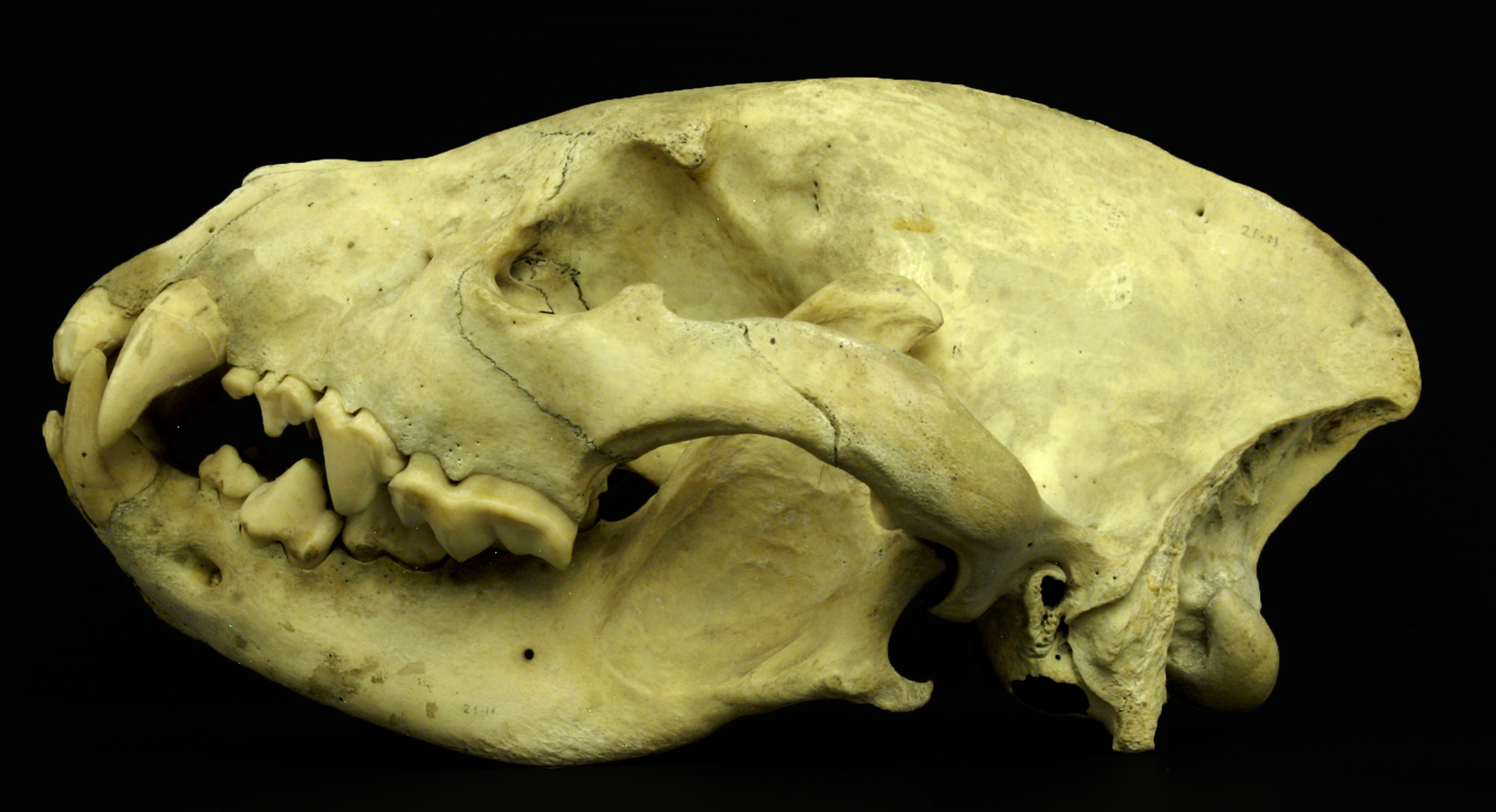
There was no doubt that this was a carnivore of some sort, given the sharp canines and the massive carnassial teeth. Most of you spotted that it was the skull of a juvenile or subadult, given the partially emerged teeth and the unfused sutures. Most of you also spotted that it was a canid of some sort, given the overall shape and the tooth arrangement.

The correct identification was arrived at in short order by David Craven and many of you concurred with his neatly veiled answer of

Could I paint you a picture of this animal?

This answer is a reference to the name of an African carnivore, the  Continue reading

Friday mystery object #98 answer

On Friday I gave you this skull to identify:

Everyone spotted that it was from a monkey, perhaps unsurprisingly since monkeys have a very characteristic appearance, with a globular braincase and forward-facing eyes. The orbit is enclosed by a solid bony ring and there is a post-orbital wall made up of the sphenoid and ethmoid bones, that produces a cup-shaped eye socket.

But there are a lot of different monkey species – around 286 if you include the Apes (as you should). We can see that this specimen belongs to the Catarrhini clade (the Old World Monkeys and Apes) since it only has 2 premolars instead of the 3 premolars you’d expect in a New World Monkey (N.B. some extinct Catarrhines known from fossils have 3 premolars, so this useful distinction doesn’t actually help define the clade).

The size of the skull and the the shape of the nose region and the mandible isn’t quite right for an Ape, or a typical Cheek-pouch Monkey (like Macaques or Baboons), leaving us with the Colobinae (which includes Colobus Monkeys, Doucs, Langurs, Leaf Monkeys, Proboscis Monkeys, Snub-nosed Monkeys and Surelis).

Once we get this far it becomes rather more tricky to identify what species we’re dealing with (and it doesn’t help that the names are applied somewhat inconsistently), so I must offer congratulations to Jake, jonpaulkaiser, curatorialtrainee, henstridgesj, carlos grau and Steven D. Garber, PhD – all of whom suggested perfectly possible candidates amongst the Langurs and Snub-nosed Monkeys.

This skull is actually from a  Continue reading

Friday mystery object #98

This week’s mystery object may be a bit harder than usual, but I’m sure that someone will get what it is:

As usual, you can put your questions, comments and suggestions below and I’ll respond as best I can – hopefully better than I managed last week, when I was in Ireland without ready access to the internet…

Good luck!

Friday mystery object #97 answer

Apologies for the lack of response to questions last Friday, I was travelling and had limited access to the internet.

Excuses aside, I was impressed by the overall accuracy of the answers received about what this skull belonged to:

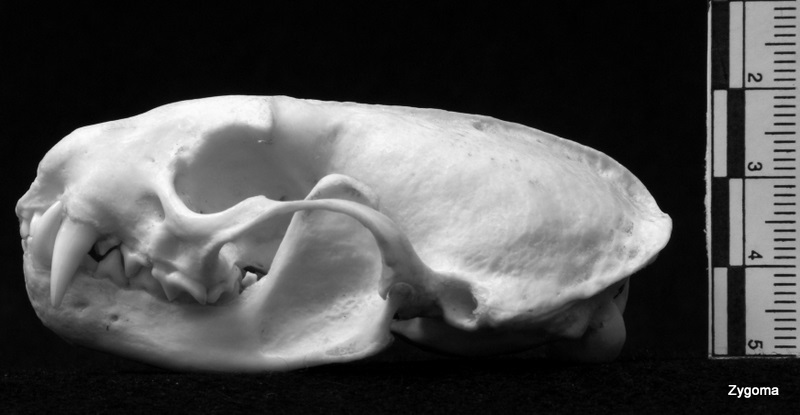
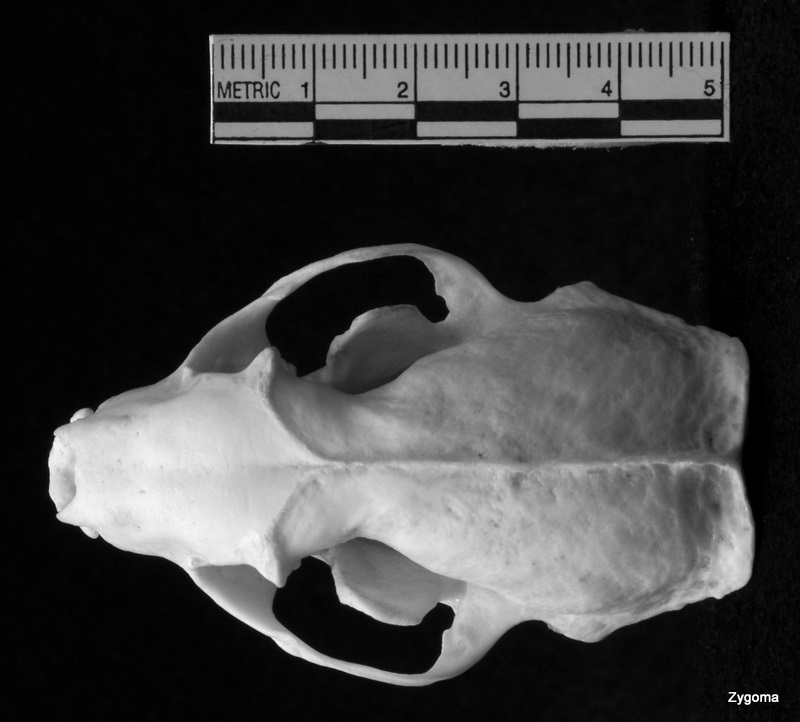
Everyone spotted that it was a carnivore and most of you identified this as being the skull of a mustelid, but no-one seems to have got this identification spot-on (perhaps my stinking clue was a bit too vague). Suggestions ranged a fair bit and uncertainty was rife, as shown in this word cloud of the comments:

Perhaps unsurprisingly given the clue, Skunks were suggested quite a lot as were Civets and Polecats/Ferrets (which are indistinguishable from each other on the basis of the skull, since Ferrets are just domesticated Polecats).

This suggestion of Polecat is pretty much there, although the specimen is not the standard European Polecat Mustela putorius rather it is an African mustelid known as the  Continue reading

Friday mystery object #96 answer

On Friday I gave you this specimen to identify:

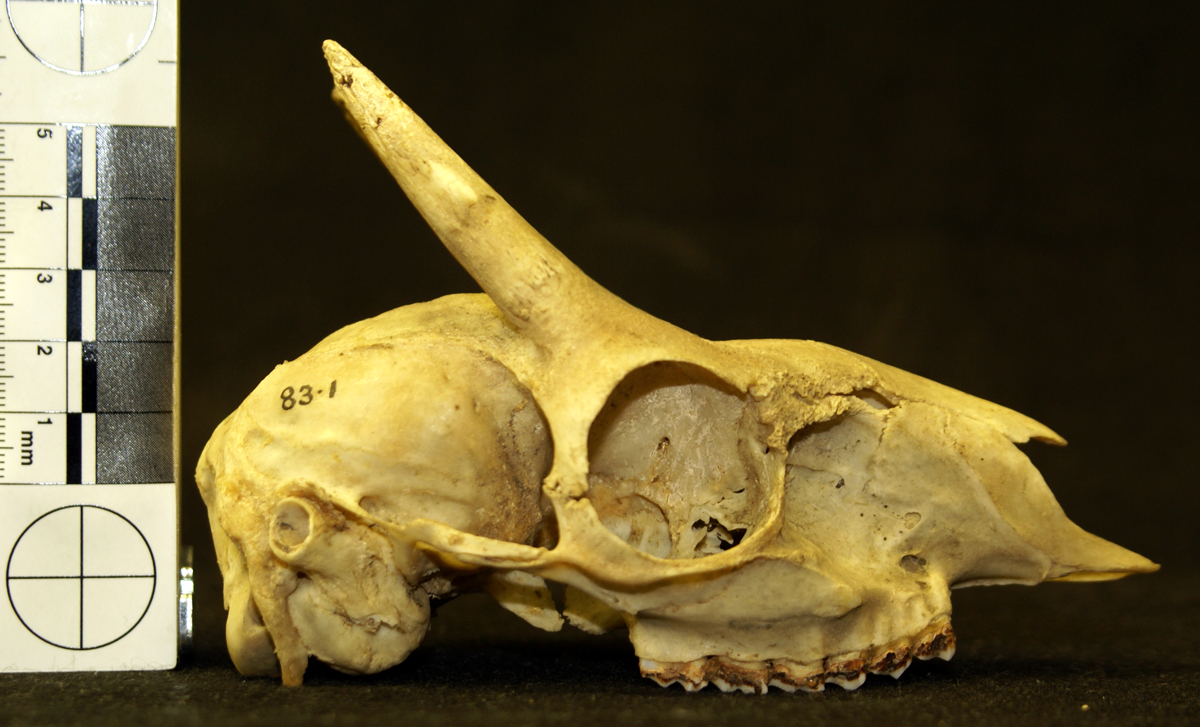
It’s from one of  two boxes labelled NH.83.1, which between them contained twenty unidentified skulls from a variety of different animals, ranging from fish to birds and mammals – several of which have been used as mystery objects in the past.

These boxes have been in the Horniman collections since the 1930′s and there is very little information available about the specimens, so it falls to me to make identifications. The comments I receive when using these specimens as mystery objects is always useful – it makes me double check my identification in light of the suggestions that you make – a form of review that I find very valuable. So thanks to everyone who attempted an identification, your thoughts have proved really useful!

From the outset the suggestions made were along the same lines as I’d been thinking – Prancing Papio FCD suggested a Maxwell’s Duiker, which is of similar size but has a narrower skull, smaller braincase and horns set far back on the skull, rather than originating just above the orbit like this one. This difference in the horn position and the relative size of the braincase rules out all of the Duikers in fact.

Jake suggested Dik-dik using a cryptic clue that I totally misunderstood – but this skull is a fair bit bigger than that of a Dik-dik’s and it has much longer nasal bones (Dik-diks have a bizarrely truncated nasal region).

Stephen J Henstridge suggested Steenbok, which is what I had originally thought it might be, since it’s almost identical, but a few little details of the palate, the horn orientation and the post-orbital process make me think that Stephen’s follow up suggestion of  Continue reading

Friday mystery object #94

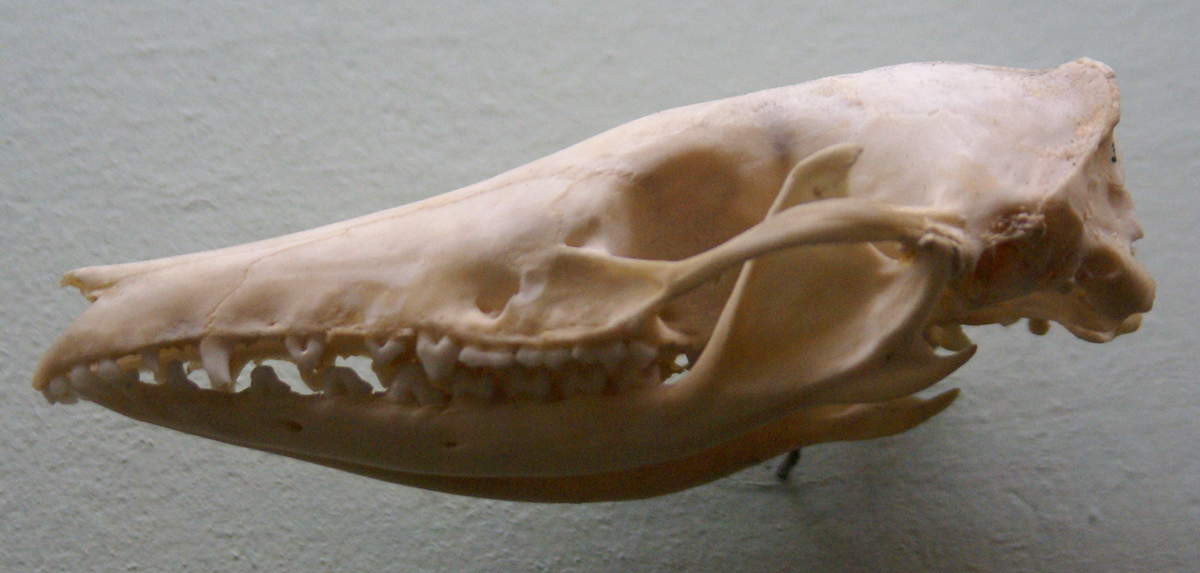
This week I have a specimen from the Horniman stores for you to take a shot at identifying. It’s missing some teeth and the mandible, which might make it a bit harder than usual, but the shape is very distinctive, so I expect someone will get it pretty quickly:

As usual you can put your questions, comments and suggestions below.

Good luck!

Friday mystery object #91

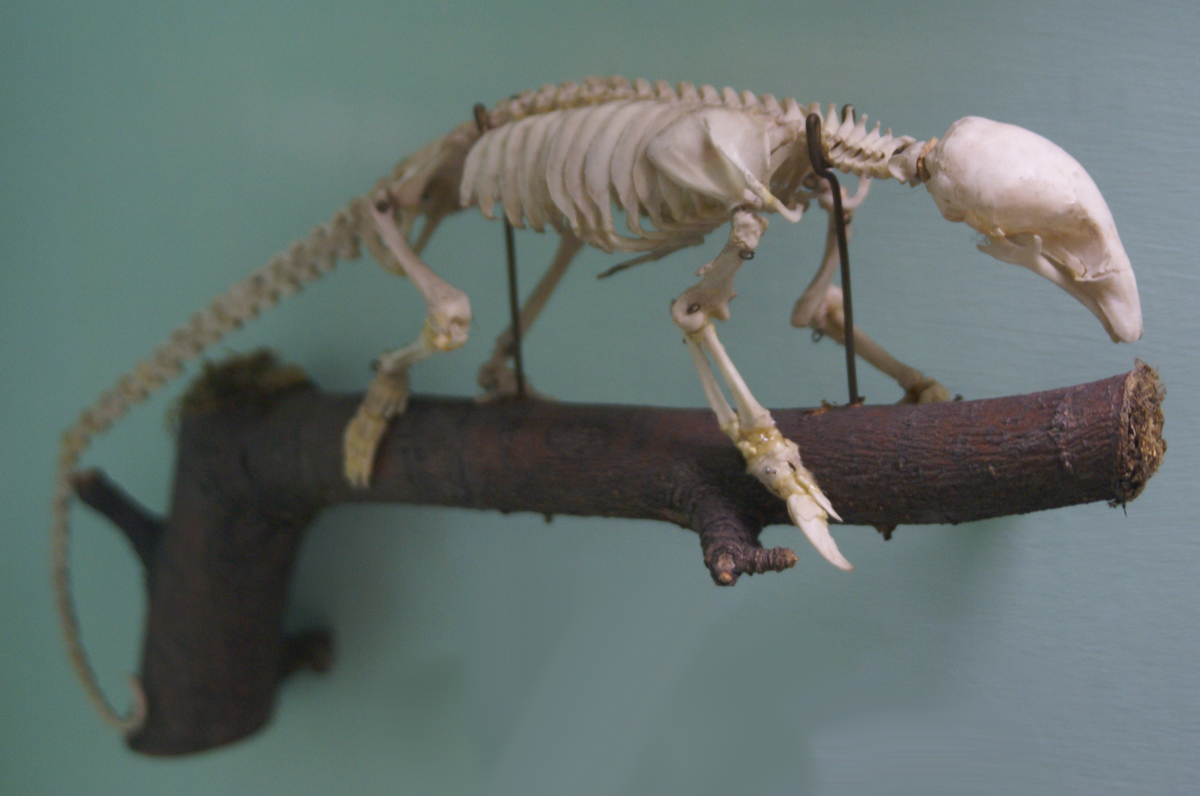
This week I’m going to give you an object that’s on display at the Horniman Museum. Whenever I see this specimen I’m reminded of the diversity of life that is out there in the wider world, that we never consider normally. Any idea what this skeleton belongs to?

As usual, I will do my best to reply to your questions, observations and suggestions in the comments section below.

Good luck!

Friday mystery object #85 answer

On Friday I was at the Natural Science Collections Association conference in Newcastle, which was a very enjoyable couple of days spent with other natural scientists discussing issues relating to natural history collections. The downside was that I wasn’t really able to respond to comments particularly well.

However, it turns out that you didn’t really need my input, since there were some great clues by other commentators, that helped with the identification of this object:

Jake spotted that it was the nasal cavities and teeth (the premaxilla and part of the maxilla) of a marine mammal and Jonpaulkaiser identified that it belonged to a  Continue reading

Friday mystery object #74 answer

On Friday I gave you another bird skull to identify:

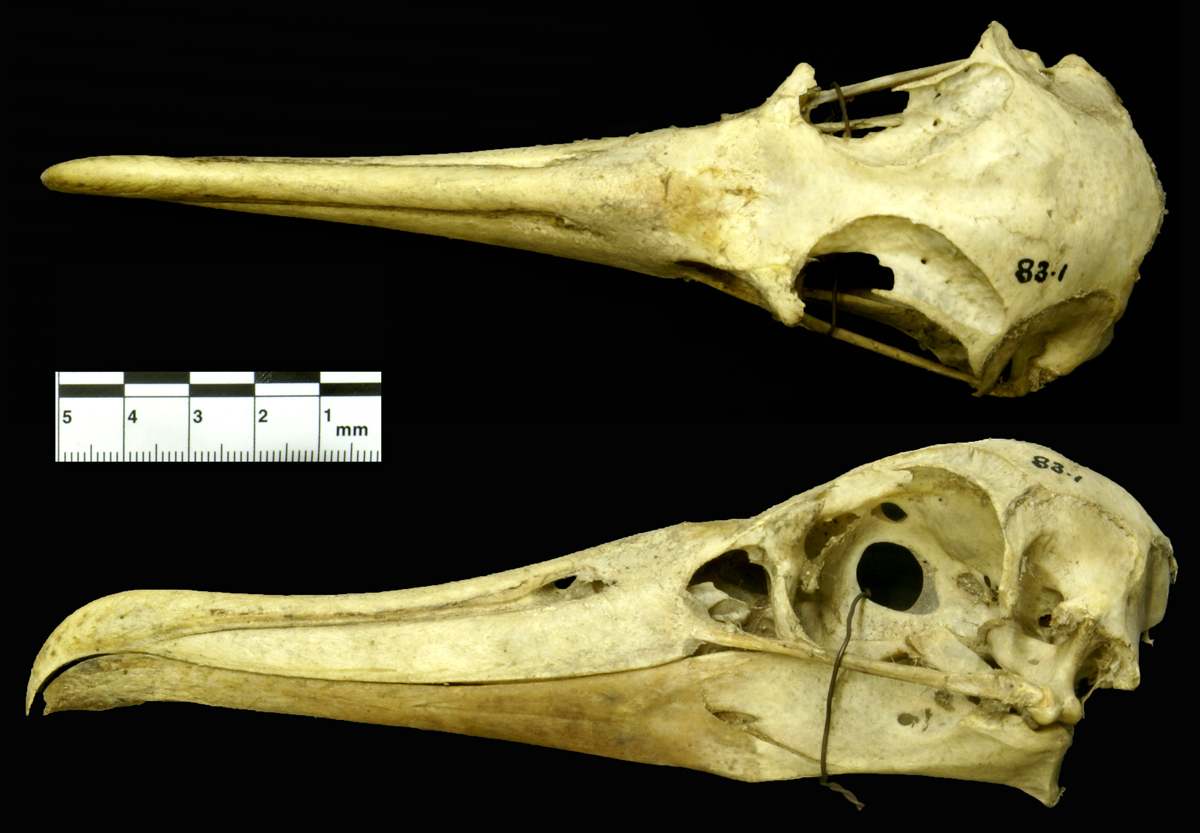
As expected, the regulars immediately waded in with correct identifications to the group, based on the scars from the salt glands on top of the head, bill shape (including the groove running from the nostril) and the size of the specimen no doubt. So congratulations go to Dave Hone, Jake, jonpaulkaiser, KateV, cromercrox, David Craven, Matt King and Curianth (everyone who commented in fact) – you were all correct in suggesting that this is the skull of an  Continue reading

Friday mystery object #74

I don’t give you birds very often (GrrlScientist has that area well covered) and I’m mostly working with mammals at the moment, but following up on last week’s Gentoo Penguin I thought I might give you another bird from the Horniman’s collections. This is one that I’ve had to identify from the infamous box 83.1 and it was picked by my trusty minion Cat and our work experience student Tilly (thanks guys!). Here it is:

As usual, you can put your questions, observations and suggestions below and I’ll do my best to answer. Good luck!

Friday mystery object #70 answer

On Friday I gave you this skull to identify:

I deliberately didn’t provide a scale bar, partly because I wanted to demonstrate how important it can be to have a sense of scale when identifying a specimen and partly to make the specimen a bit more challenging to identify.

Nonetheless, most of you got a correct identification, with some very good subtle hints being used to communicate that fact. So well done to Jack Ashby, David Craven, CopilasDenis, Dave Godfrey and Manabu Sakomoto, who all hinted or explicitly stated that this was the skull of a  Continue reading

Friday mystery object #69 answer

On Friday I gave you an odd-looking skull to identify:

The fact it’s so odd-looking made it a pretty easy one to identify for most of you, with Cromercrox being the first to get the general identification, citing the very distinctive teeth as the characteristic that gave it away and Dave Godfrey getting the identification to species level.

Continue reading

Friday mystery object #67 answer

On Friday I gave you this object to identify:

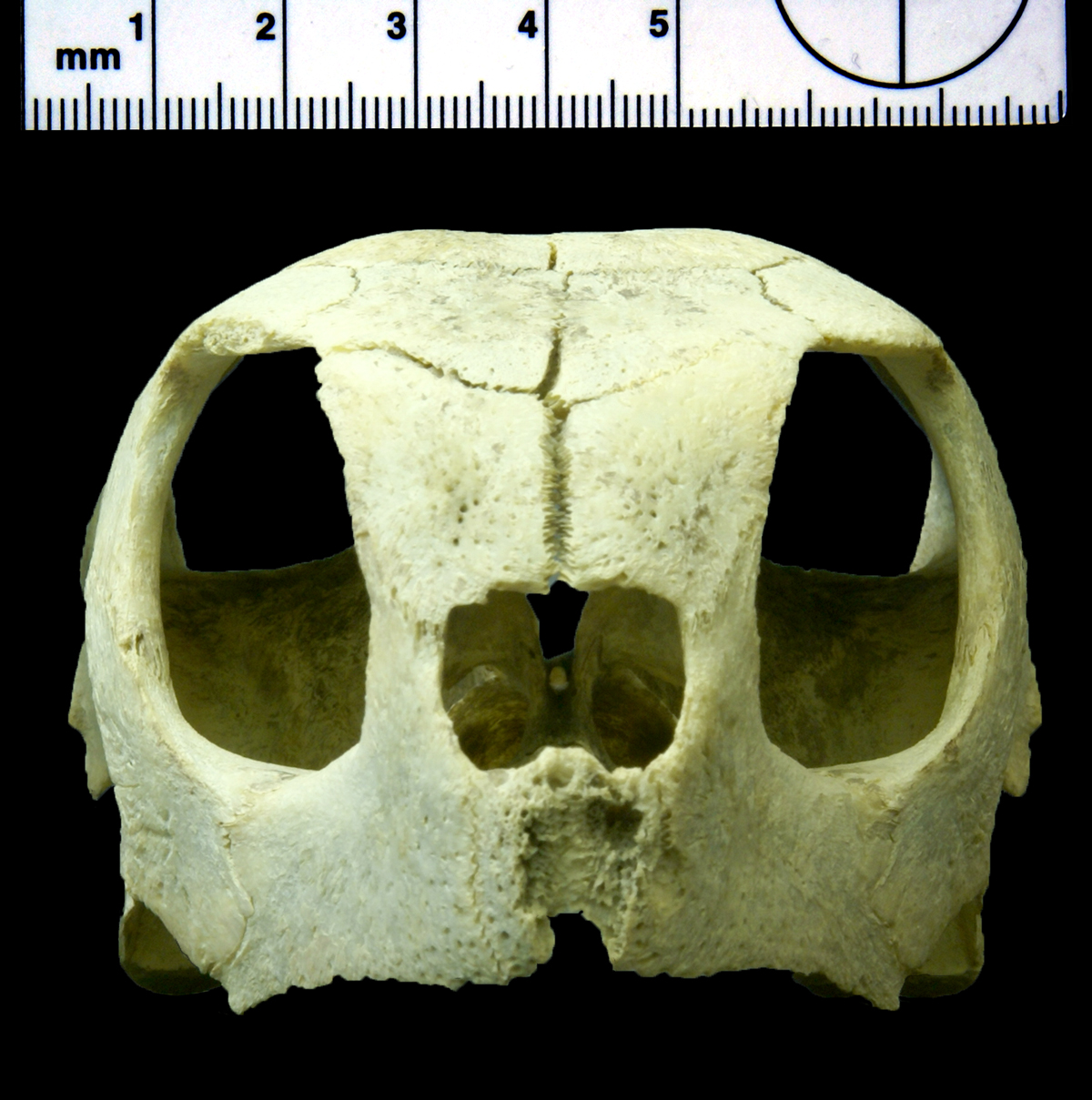
As I suspected, you all worked out that it is the skull of a turtle, so well done all and particularly Jake, who got there first.

Turtle skulls are quite characteristic, in that they have a bill with no teeth and they have no openings apart from the obvious ones like the eye sockets and nose. Most other tetrapods have several openings in their skulls, something that is diagnostic for, and sometime provides the name for, major groups like the main ‘reptile’ group the Diapsida. This name that means two arches, which is a reference to two additional openings present in the skulls of this lineage (which includes the lizards, snakes, crocodiles and dinosaurs – including the birds). Turtles and tortoises are members of the Anapsida, which means without arches.

The characteristics of this skull are those of an Anapsid and the streamlined shape and quite large size (despite it being a youngish adult, as indicated by the unfused sutures) suggests that it is a sea-turtle. There are only 7 species of sea-turtle and the comments provide an example of features that can be used to distinguish this as a  Continue reading