Friday mystery object #249 answer

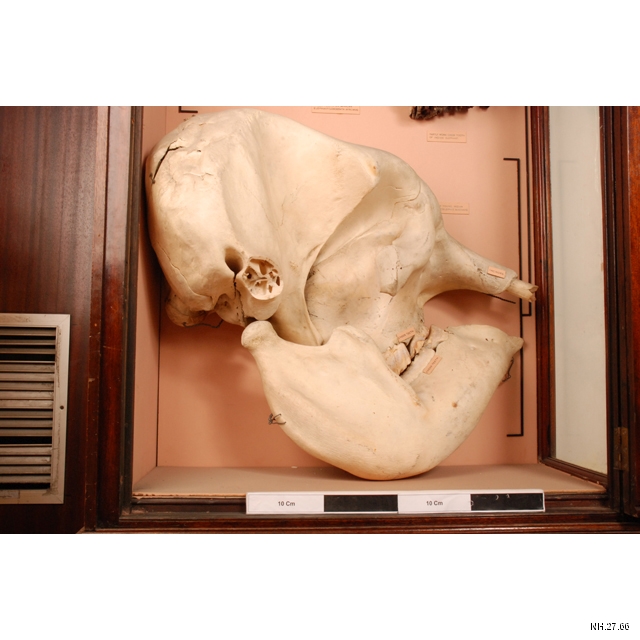
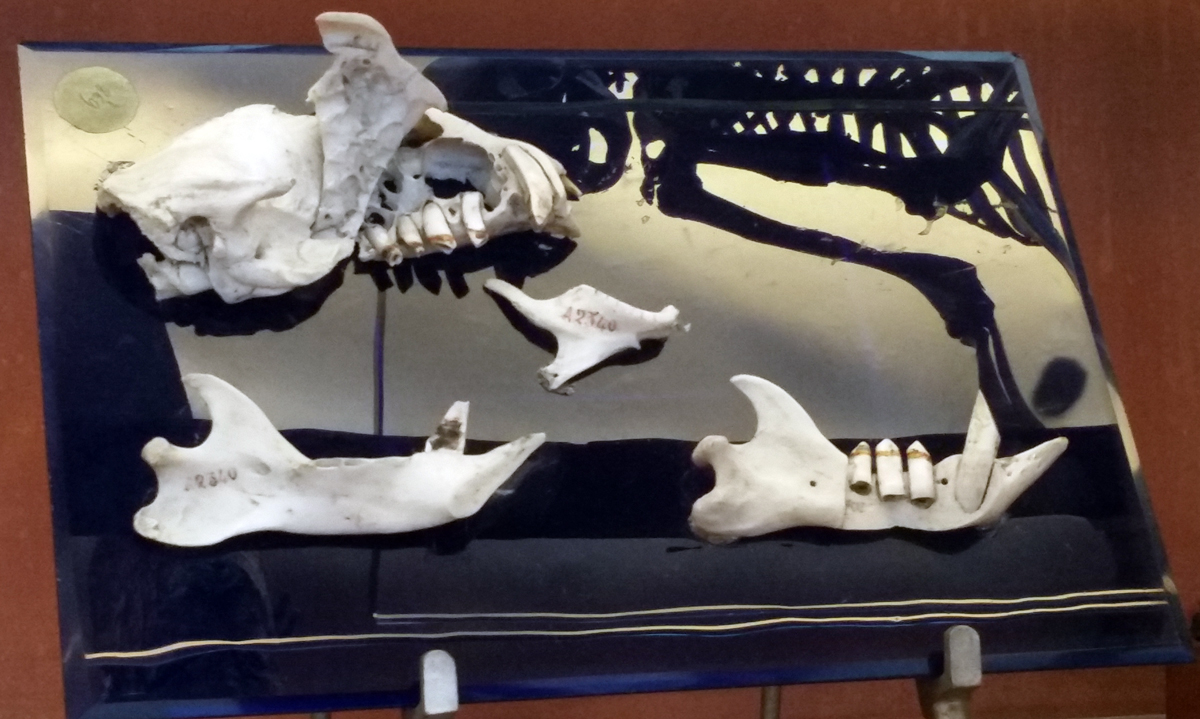
Last Friday I gave you this exploded skull from the incredible Galerie d’anatomie comparée et de Paléontologie in Paris:

mystery249

As I suspected, it was a bit of an easy one for many of you, but that provided the chance for some cryptic clue fun.

So my thanks to Agata Stachowiak, Chris, Allen Hazen, henstridgesjClaire Miles and witcharachne who all hinted at an identification of Sloth, more specifically a Two-toed Sloth, I think of the species Choloepus hoffmanni Peters, 1858 as opposed to C. didactylus Linnaeus, 1758, which appears to have a smaller angular process on the mandible and a less broad zygomatic region.

A two-toed sloth (Choloepus hoffmanni) at La Selva Biological Station, Sarapiqui, Costa Rica. By Geoff Gallice

A two-toed sloth (Choloepus hoffmanni) at La Selva Biological Station, Sarapiqui, Costa Rica. By Geoff Gallice

The teeth of Sloths are fascinating, due to their fairly simple rooting and their impressively sharp premolars that look like canines.

These Sloths have an interesting feature of their hair, which has a groove to help support algae, which help keep the Sloth camouflaged. This is pretty handy given the Sloth’s notorious lack of speed with which to escape predators. This may help explain the need for those sharp premolars as well!

Friday mystery object #248 answer

Last Friday I gave you this mysterious leg to identify:

mystery248

It had me stumped for some time and I was hoping that your suggestions might lead me to an identification.

As it turns out, I did indeed get inspiration from your ideas and I think that I may have worked out which species this leg came from.

The first suggestion came from Barbara, who suggested that it might be from a Wombat. This was a great suggestion, since I hadn’t properly considered any marsupials and the robust nature of the leg suggests a heavyset digger. However, the calcaneus (or heel bone) in Wombats is shorter than we see in this specimen and the ungals (the bits at the very end of the toes, where the claws would attach) are longer and more spade-like in the Wombat – an adaptation for digging.

Carlos and Lee Post made some useful observations about the patella (kneecap) and general proportions of the hind limb elements and how they relate to those of other animals – ruling out anything from North America.

Finally, henstridgesj made the interesting suggestion of Capybara, although it appears that the fibula on the mystery object is far too robust to belong to a Capybara. However, I hadn’t thought too much of rodents, so that got me thinking of another possibility:

20140227_143245

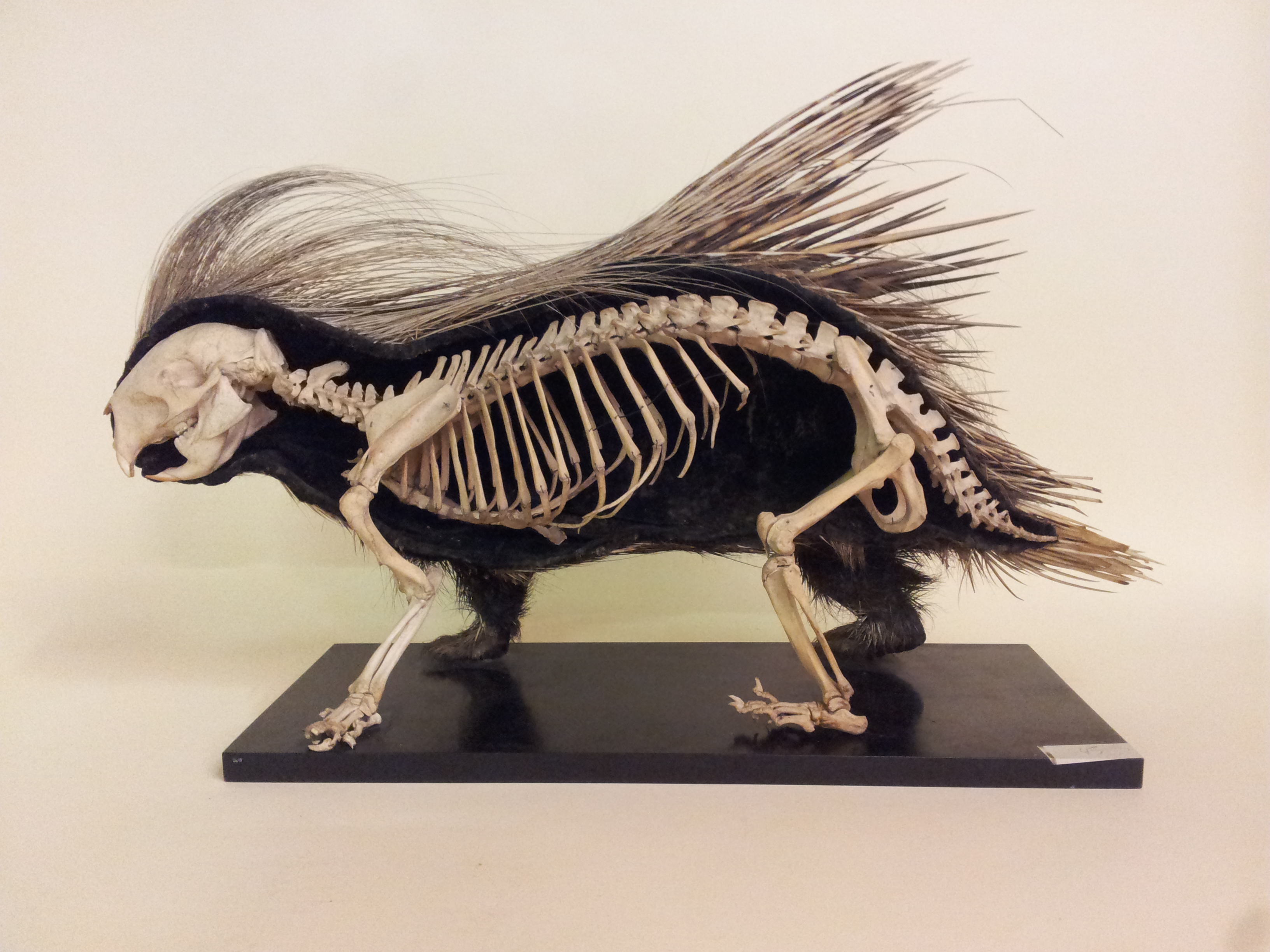
The Crested Porcupin Hystrix cristata Linnaeus, 1758 is the third largest rodent after the Capybara and Beaver, and it appears to have similar general proportions of the hind limbs. I’ll need to check against a specimen, but it seems I have a useful direction for investigation – so many thanks to everyone for your suggestions!

————————–

Update March 27, 2015 9:41am

I have now checked the mystery specimen against a Crested Porcupine and they are indeed a match!

wpid-20150327_092925-1.jpg

Friday mystery object #248

This week I have another perplexing mystery object for you, that I’ve found harder to identify than expected:

click to embiggen

I’ve compared it to several specimens in a similar size range and it hasn’t matched any of them well enough to make a confident attempt at identification. Whatever  it is, I don’t have a skeleton of anything comparable in the stores at the Horniman, and it’s a chunky critter with much more robust hind limbs than a Eurasian Badger Meles meles.

Any suggestions on what this might be from would be greatly appreciated!

Friday mystery object #247 answer

Last Friday I gave you this unidentified object to get your opinions on:

mystery247

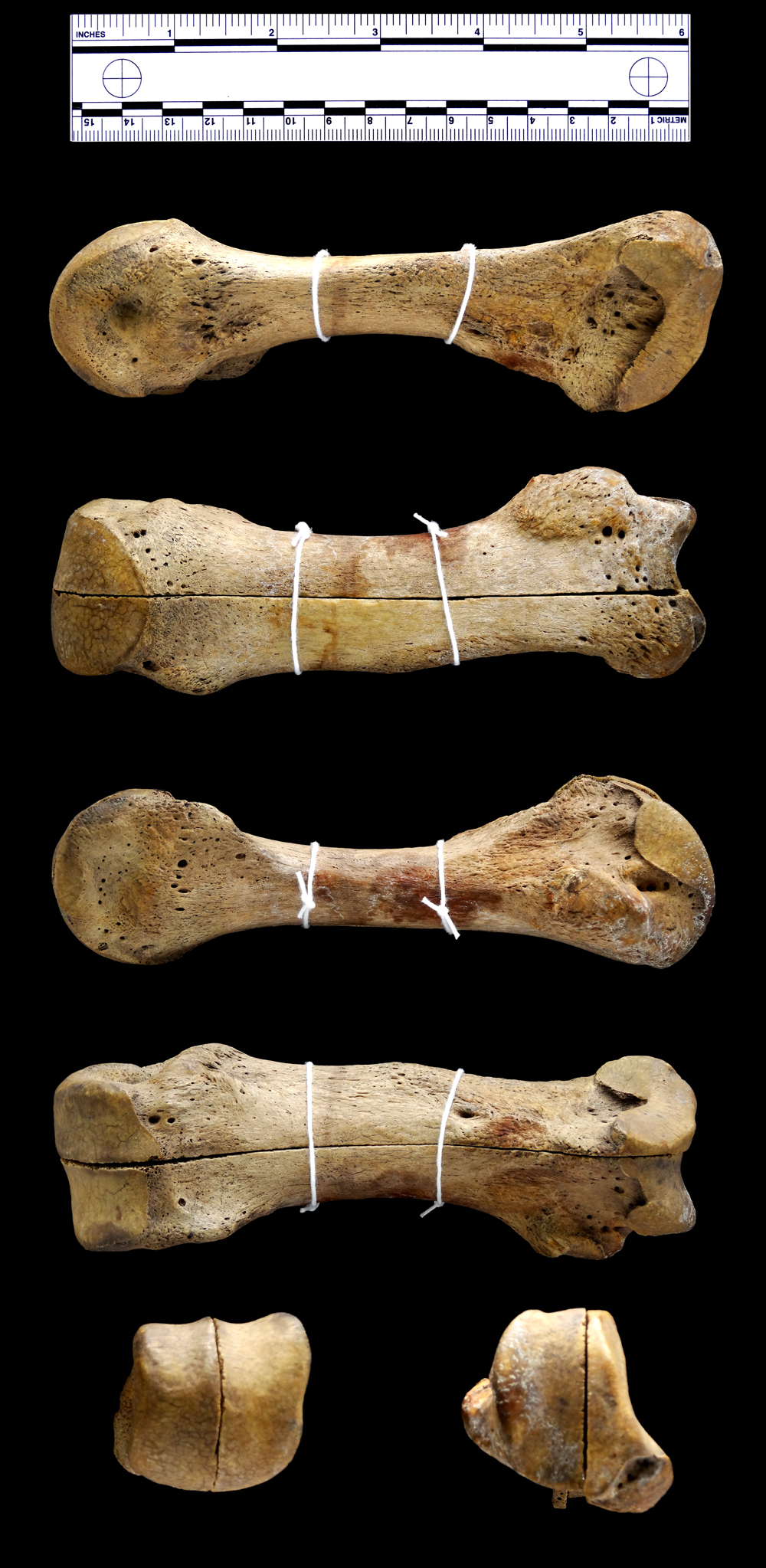
This specimen has puzzled me quite a bit. The internal structure is a dense honeycomb, that seems too tightly compacted to belong to a bird – plus it’s so big that the only birds it could possibly belong to would be a Moa, Elephant Bird or maybe Ostrich at a push, and I compared this against two of these three possibilities:

mystery247b

So, it’s mammalian and large. It’s also clearly a metatarsal or metacarpal, based on the shape of the articular surfaces.

It’s not shaped quite right for a one or two toed animal so the it seems that the variety of suggestions along those lines of Hippopotamus, Rhinoceros and Elephant are most likely to be in the right area.

I did compare this to Hippo feet and an Elephant hindfoot and drew a blank, so that leaves an Elephant forefoot or a Rhinoceros foot. My best guess would be the 4th metacarpal of a Rhino, although Elephant is still a contender – I will try to find some comparative material to confirm.

A massive ‘thank you’ to everyone who contributed ideas – it’s great to have some fresh perspectives and new directions to explore when you’re stumped!

Friday mystery object #247

This week I have a complete mystery for you to identify. I’ve checked this specimen against all sorts of species and have drawn a blank. So, I’m opening it up to you, to see if you have some inspiration to help me solve what this is:

mystery247

As usual, you can put your thoughts, questions and suggestions in the comments box below. I look forward to hearing your ideas!

Friday mystery object #246 answer

Last week I gave you this mystery skull from the stunning Galerie d’anatomie comparée et de Paléontologie in Paris:

mystery246

I was struck by the cat-like dentition and general shape, but as many of you worked out, that’s no cat.

It is in fact a specimen of a Fossa Cryptoprocta ferox Bennett, 1833, as correctly identified by Charne, Manabu Sakamoto, Nigel Monaghan, SMerjeevski – good skills!

Fossa by Ran Kirlian

Fossa by Ran Kirlian

This carnivore is endemic to Madagascar and is the foremost natural predator of lemurs. They are well adapted to climbing in order to catch their tree-dwelling main course, with rotating ankles a bit like a Margay.

Madagascar is an amazing place for biology. It separated from Africa around 20 million years ago and has had its own unique wildlife evolving there ever since. This means that the familiar cats that fill niches in (relatively) nearby Africa are missing, since they didn’t really exist when Madagascar started drifting off. The Fossa fills that catty niche.

There may be more mystery objects to come from the  Galerie d’anatomie comparée et de Paléontologie, since the whole place blew me away!

Wow

Friday mystery object #246

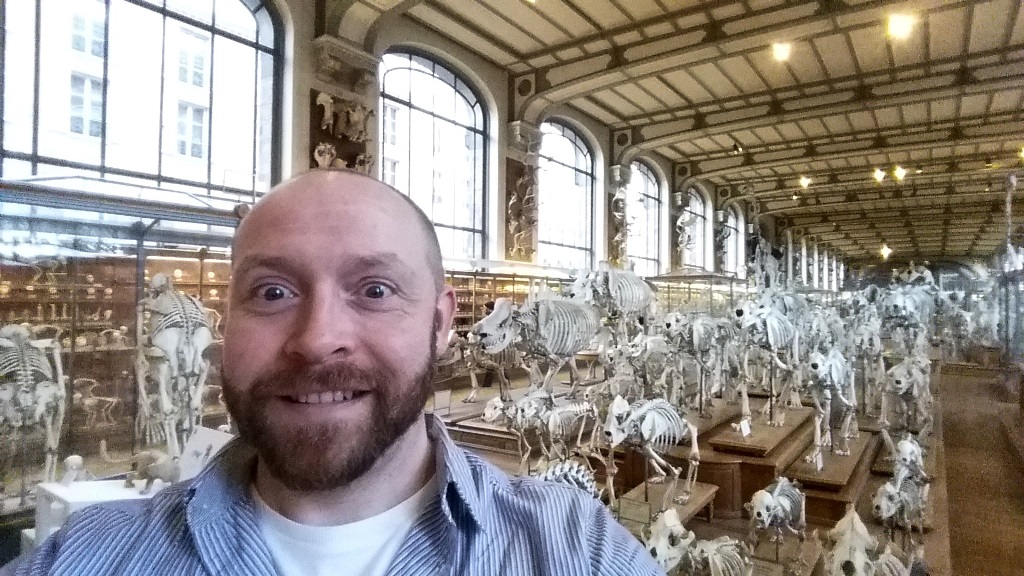
Last weekend I had a fantastic visit to Paris and my wonderful wife gave me the best Valentines Day gift in the world, by taking me to the spectacular Galerie d’anatomie comparée et de Paléontologie.

Paris_Comparative_Anatomy_G

As you might have guessed, I was in bone heaven and had to be dragged out by security at closing time – but not before taking hundreds of photos of the incredible collections.

So this week’s mystery object comes courtesy of Georges Pouchet, the comparative anatomist who established the Gallery:

mystery246

Any idea what this might be?

As usual you can put your suggestions, thoughts and questions in the comments box below. I hope you enjoy the challenge!

Friday mystery object #245 answer

Last Friday I gave you this guest mystery object from Dr Nick Crumpton at the NHM:
mystery245
Here’s what Nick had to say about it:
So when I first picked it up I thought – embarrassingly now – that perhaps it was something a bit pinniped-like but then the teeth didn’t match that idea at all so I reverted to thinking it was a bit more doggy.
Irritatingly, it was a juvenile so that scuppered size-based guesses, and ruled out taking too much information from the posterior, mandibular teeth. Also, the skull was darn cute, with a shorter snout than an adult would possess.
I had a couple of ideas from looking at the width of the zygomatic arches, but that lack of a parasagittal crest got me all twisted around. And time was tight for what we needed it for!
My esteemed colleague Mr Garrod was the first to push me in the direction of a wolverine, but I’ll leave it to Paolo to show how he managed to ID the little critter and save the day – although it looks like a bunch of people on here already managed that! Love the bone-banter. 😀
We’ve discussed in the past how the skulls of juvenile animals can be misleading and for this species a number of the features you would immediately recognise in the adult are absent in this juvenile. Therefore I’m not that surprised the suggestions in included Arctic Fox, Sea Otter, Common Seal and Spectacled Bear, in addition to the possibility of Wolverine.
Wolverine cranium

Wolverine cranium for comparison

Despite the juvenile dentition, the blade-like molar and 3rd premolar, and robust second molar were indicative of a carnivore with a specialisation for eating bone and the breadth across the zygomatic arches indicated something with a powerful bite force.
Wolverine dentition is remarkably robust, since they often scavenge bone and in the winter they need to feed on meat that has frozen solid. They have a wide skull (see above), but the relatively large upper molar is at right angles to the 4th premolar, which has a cleft that the 3rd premolar nestles into.
This is rather different to the much straighter dentition of the mystery animal, which is distinctly more cat-like, albeit with too many teeth. That narrows it down to one of the Hyenas. From there it becomes a bit more difficult and the fact it’s a juvenile throws a bit of a spanner in the works, but if pushed I’d probably opt for Spotted Hyaena Crocuta crocuta (Erxleben, 1777).
So well done to Chris, Lena, palfreyman1414, Allen Hazen and henstridgesj who all came to the same conclusion.
Finally, a big ‘thank you!’ to Nick for posing a decent challenge!

Friday mystery object #245

This week I have a guest mystery object for you from Dr Nick Crumpton at the NHM.

Hello Zygoma fans. Nick Crumpton here from across the way at the Natural History Museum in South Ken.

Well, this fellow completely stumped me for a few hours this week on finding it in our teaching collection:

mystery245

Until, that is, I called on the always helpful advice of Mr Viscardi (OK, and a certain Mr Garrod too…)

I’d love to see whether anyone can work out what it is, and how they figured it out!

You can leave your suggestions and thoughts in the comments section below – enjoy!

Friday mystery object #244 answer

Last week i gave you this colourful specimen to identify:

mystery244

As I suspected, some of the keen birders out there were straight on the case and GrrlScientist (unsurprisingly to me) immediately knew the species and an awful lot about its taxonomy, offering helpful hints and clues to other commentators.

After some discussion it became clear that this is a Finch and one of the Neotropical varieties at that. The bright yellow belly, emerald green head, throat, chest and wing, brilliant blue nape, back and eye ring all suggest that this is a male Blue-naped Chlorophonia Chlorophonia cyanea longipennis (Du Bus, 1855) from Peru.

There are other subspecies of Blue-naped Chlorophonia, but they have some slight differences in appearance, such as a yellow forehead, yellow tinged crown or green feathers in the mantle.

Here’s one of the little chaps in action:

So a big well done to everyone who managed to work it out!

Friday mystery object #244

This week I thought I’d give you a beautiful bird skin from the Horniman collections to have a go at identifying:

mystery244

Any idea what this colourful critter might be?

You can leave your suggestions in the comments box below – but please try to be cryptic if you find it easy, so other people get a chance to work it out themselves. Enjoy!

Friday mystery object #243 answer

Last week I gave you this nightmarish looking mystery object to identify:

mystery243

There were lots of great suggestions about what it might be, with most of you in the right area of the animal kingdom with a legless critter in mind. In particular a fairly primitive type, with aglyphous or ‘groove-less’ teeth (as opposed to snakes characterised by having opsithoglyphous or ‘backward grooved’, proteroglyphous or ‘forward grooved’ and solenglyphous or ‘pipe grooved’ teeth).

There were several suggestions of Boa constrictor – specifically the right maxilla (upper jaw), but they have a straighter top to the maxilla and a differently shaped process that connects with the frontal and ectopterygoid bones (check out Udo Savalli’s snake skull anatomy page to see what those terms mean).

Anaconda was also suggested, but the anterior (front) part of  the maxilla is not squared off enough.

Nicola Newton, rachel and Alex Kleine all suggested Python, which is what I think it is. I’m not certain of the species, but it’s definitely a big one – I’m leaning towards the Reticulated Python Python reticulatus (Schneider, 1801).

Just to give you a better idea of which bone it is, here it is compared to the skull of another large Python skull from the Horniman’s collection:

mystery243b

and to give a better sense of scale, here it is with my (fairly large) hand for comparison:

mystery243a

My very rough estimate of the length of the animal, based on other skeletal material I’ve seen, is around 5m – that’s one snake I wouldn’t want to get on the wrong side of!

Friday mystery object #242 answer

A very Happy New Year to everyone!

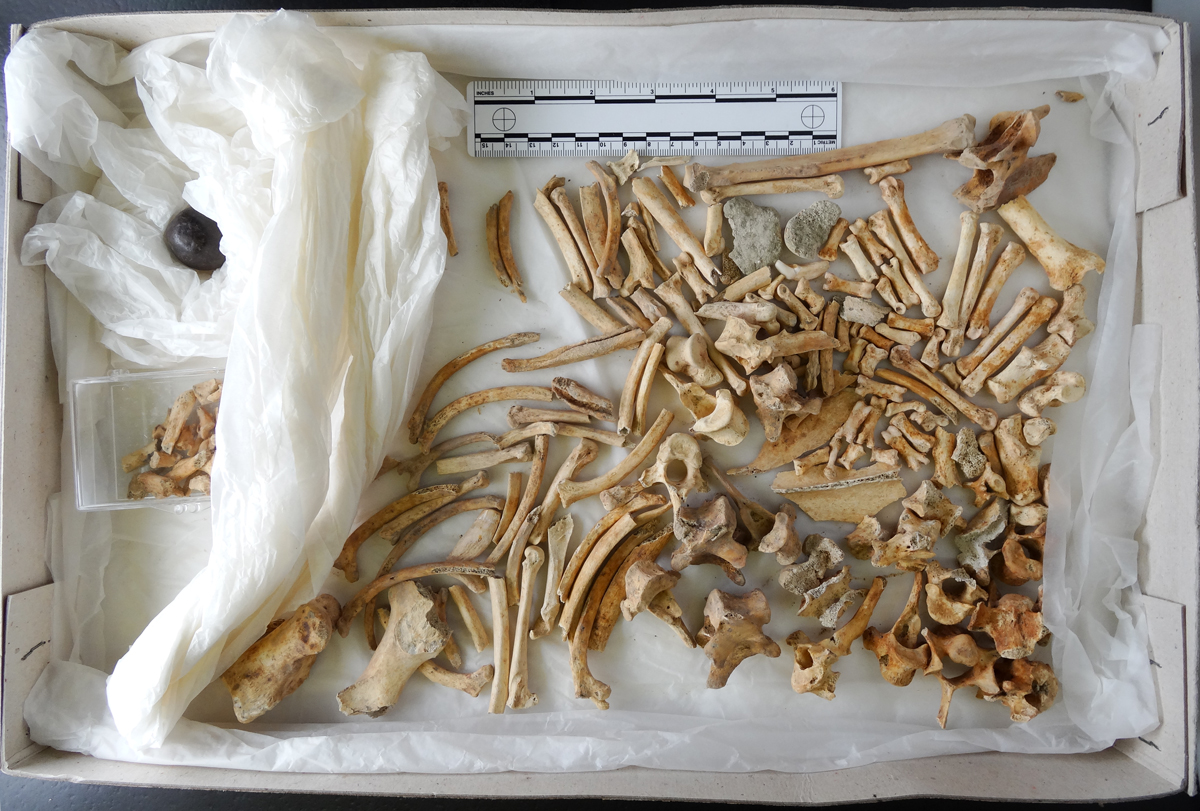
Last week (and indeed last year) I gave you this box of bones and one non-bony object, dug up on the Isle of Sheppey to identify:

mystery242a

Everyone correctly spotted that the bones were canid (and by everyone I mean Ric Morris, witcharachne, Jake, Paleotool, Allen Hazen and Sam Misan), either Dog or possibly Fox, as suggested by Sam Misan.

The length of the bones would fit both Dog and Fox, but they’re a bit too robust for Fox – here’s a comparison of a radius from the box and a Fox:

mystery242d

So we have a Dog in the box, but the non-bony object has posed more of a challenge:

mystery242b

mystery242bb

The initial thought was that it might be a musket ball, but it’s rather on the big side for that – more like a small cannon ball or piece of grapeshot.

The material its made of may provide a clue as to what it is. It’s not magnetic and there’s no red coloured oxidisation on the surface, so it’s not iron. It doesn’t have any casting marks, it’s too hard to be lead and although it’s dense, it doesn’t seem to be metal.

To my mind it seems likely to be a naturally formed mineral concretion. It could be a phosphatic nodule, pyrite or marcasite (they contain iron, but they’re not magnetic) or maybe a quartz mineral, like flint (which is what I’m leaning towards).

This may be naturally occurring in the area, but if the materials were collected together it seems likely that the ball had been used by someone for something. The possibility I’m inclined to go for is as ammunition for a sling.

All a bit speculative I’m afraid, but that’s how the game sometimes works out. Thanks to everyone for your input!

Friday mystery object #242

Seasons greetings! Since it’s Boxing Day, I thought it would be appropriate to give you a box of bones from an archaeological dig to have a go at identifying:

mystery242a

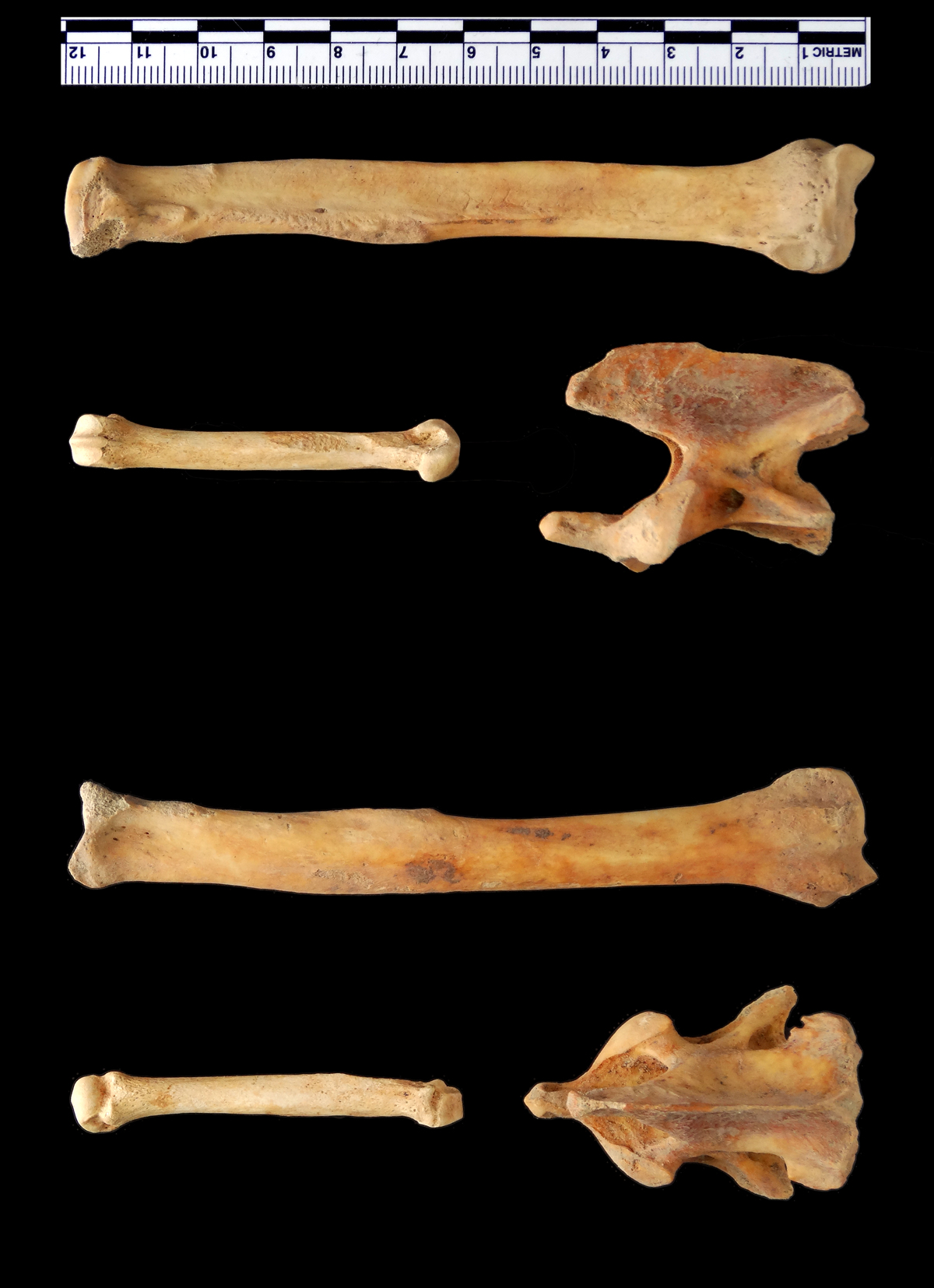
Here are a couple of detailed images of some of the bones to help you:

mystery242c

And here is a detail of the non-bony object that’s associated:

mystery242b

You can put your questions, observations and suggestions in the comments box below and maybe we can work out what’s been dug up!

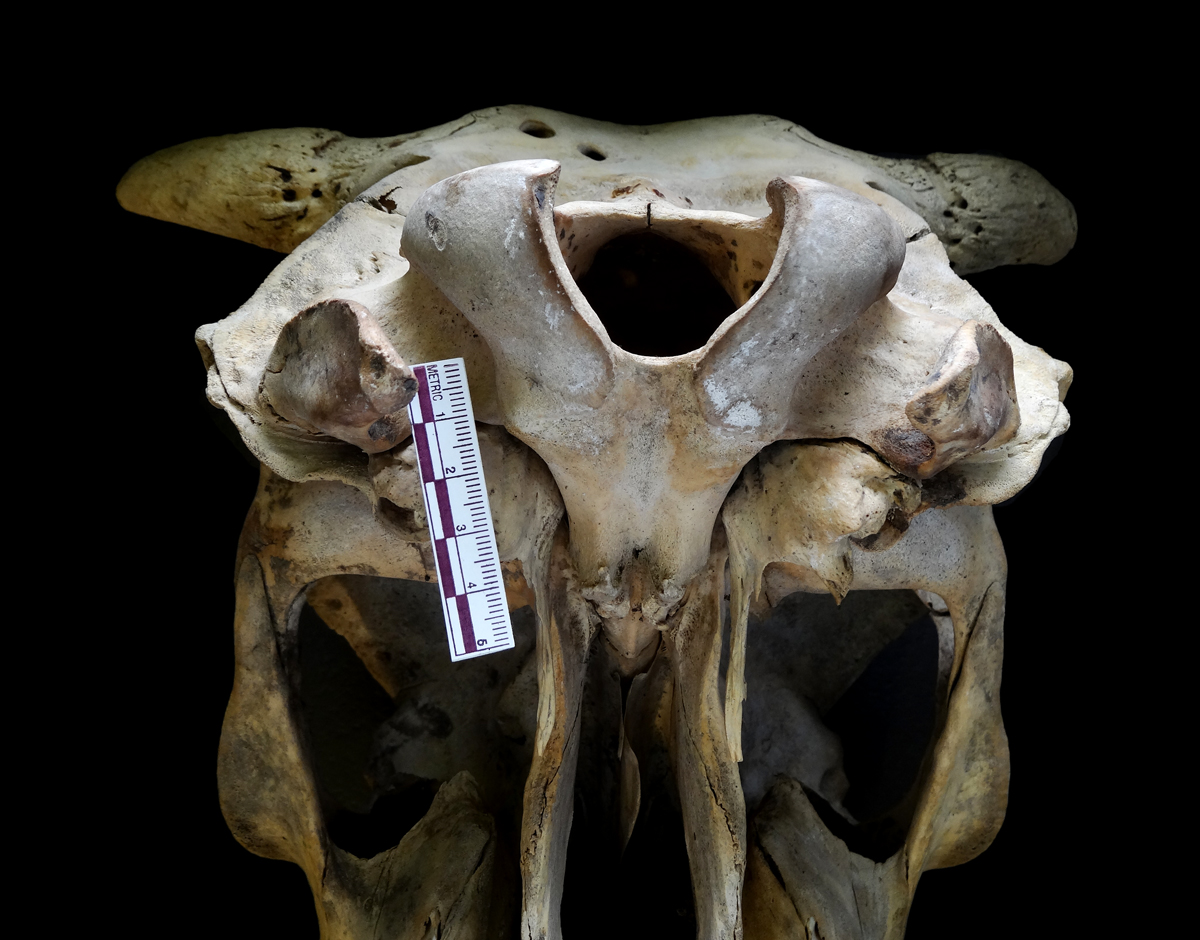
Friday mystery object #241 answer

Last Friday I gave you this object, that I’ve been working on, to identify:

mystery241

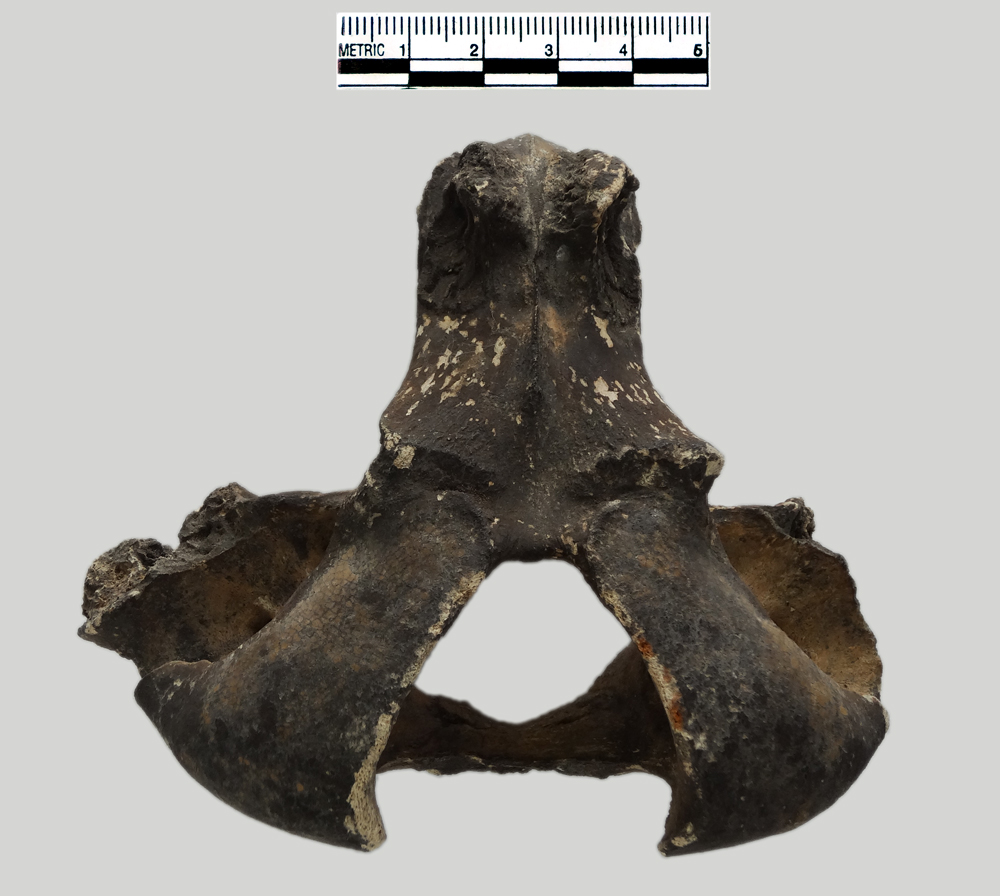
Ric Morris was straight in with the nicely disguised correct answer of occipital bone viewed from the basal aspect, correctly suggesting something bovine as the source.

mystery241b

This is the kind of object that you often come across from archaeological sites, where material may have been dug up from a butchery site, kitchen midden or similar assemblage.

Fragmentary bits can be quite hard to identify compared to complete skulls, but when you get a fairly complete chunk like this it makes things a bit more straightforward. In particular the hole of the foramen magnum and bordering occipital condyles provide a clear indication of where in the body it comes from. The shape and size of the condyles also helps narrow down the species.

Expect some more burnt and broken bits of bone in future mystery objects!

Friday mystery object #241

Recently I’ve been working through boxes of mixed archaeological bone and bone fragments. So here’s one of the objects I had to identify as part of that process:

mystery241

Any idea what it might be?

As usual you can put your observations, suggestions and questions in the comments box below. If you find it easy, please try to use a cryptic clue so other people get a chance to get involved. Have fun!

Friday mystery object #240 answer

Last Friday I gave you this characteristic skull to identify:

mystery240

Many of you recognised that this is the skull of a Hornbill, and Martin Edvardsson, ClareP, Jamie Revell, paleomanuel, witcharachne, marcuschua all managed to identify it as a Great Hornbill Buceros bicornis Linnaeus, 1758.

You may be surprised to know that this specimen was originally misidentified as a Black-and-white-casqued Hornbill Bycanistes subcylindricus (Sclater, 1870) by the taxidermists who prepared it – quite a basic error for a natural history professional!

The Great Hornbill is a large Asian bird that feeds on fruit and any small critters that end up at the wrong end of that impressive bill – from insects to owls. Their distinctive black and white plumage is used by a lot of native people in Southeast Asia in costume, leading to pressure on the bird’s population due to hunting.

Great Hornbills have a somewhat odd system for breeding, with the female walling herself up inside a hole in a tree using faeces, and the male delivering food to her and the chicks through a narrow hole. It works for Great Hornbills…

Friday mystery object #240

After the last mystery object, which was really difficult, I have an easier one for you to identify:

mystery240

Apologies for the rather odd-looking set of images – the specimen proved quite hard to get level for photography.

As usual for easy objects, please try to be a bit discrete with your answer so everyone gets a chance to test their identification skills. I look forward to some interesting answers!