We’re heading towards the end of the cats this week – any idea what this slightly battered looking feline might be?

Suggestions gratefully received in the comments section below!

We’re heading towards the end of the cats this week – any idea what this slightly battered looking feline might be?
Suggestions gratefully received in the comments section below!
I don’t know about you, but my job can be quite sedentary. Lots of time spent in front of the computer or looking at skulls, very little time getting any exercise – obviously not counting my stint as Extreme Curator…
Every so often I try to get off my backside and do something approaching exercise, but because I am fundamentally lazy, I can find it hard to get motivated.
Last year I forced myself to do the Push-ups Challenge (100 push-ups a day for 6 weeks) and by the end of the challenge I was feeling far stronger, more toned and significantly more self-satisfied, because I’d stuck to my goals.
One of the things that helped me was to share my progress each day on Twitter as way of keeping track of the challenge. What I hadn’t expected was the support and encouragement that came from people online, which really made me feel like I wanted to complete the challenge.
I’ve decided to do a version of the challenge again this year, during May and I hope to encourage other people to take part. The hashtag on Twitter is #100aDayInMay and if you feel like doing some exercise with some training buddies to offer support and encouragement, why not join in?
The rules are simple:
Finally, here’s a video explaining good form in both full and half push-ups (although the guy’s bum seems to be raised a little bit too high for perfect form):
I hope you feel like joining in!
Last Friday I gave you this felid skull to have a go at identifying:

The size was larger than the previous cat skulls I’ve shown you, which helped reduce the possibilities a bit – after all, there are more smaller cats than bigger ones.
As it turns out, Sam Misan and henstridgesj both managed to work out that this is the skull of a Serval Leptailurus serval (Schreber, 1776).

A Serval cat at Serengeti National Park, Tanzania, by Bob, 2007
These long-legged cats have a relatively small head, but huge ears – and the large external auditory meatus (ear hole) with a very pronounced ridge above for attachment of the muscles of the pinna (the fleshy part of the ear) helps reflect that.
The long legs and the big ears are key to the Serval’s hunting technique in the long grasses of the African savannah, where they listen for the movement of rodents which they dramatically leap on. Probably easier to appreciate this method by seeing it:
For the last few weeks I’ve been using cat skulls as mystery objects, because they are really hard to tell apart and I was hoping that some useful distinguishing features might get spotted when you try to identify them.
I certainly feel like I’ve learned something, but I’m pleased to say that there aren’t too many more skulls to go, because it’s really difficult. This next one should hopefully be a bit easier than some of the recent cats:
Any idea what fine felid this skull comes from?
As usual I would really appreciate your thoughts in the comments section below – let’s see if we can crack this!
I’ve already posted a teaser about my mermaid research, but now I’m pleased to say that the academic paper is available in the Journal of Museum Ethnography, no. 27 (2014), pp.98-116.

©Horniman Museum and Gardens & © Heini Schneebeli
We had hoped (and we asked) to make the paper open-access, as one of my co-authors is based at the Wellcome Library and the Wellcome takes open-access seriously and provide funds for making research freely available.
But alas our request seems to have been missed or ignored. I’m not hugely surprised as the Journal is published by the Museum Ethnographers Group, which is a Subject Specialist Network (SSN) run by volunteers and the systems are simply not in place for organisations like that to adopt new publishing models quickly and easily.
I should know, as I am involved in a couple of SSNs and I know how much time and effort goes into producing a Journal and I know how core the Journal is to the running of an SSN – it’s seen as a benefit of membership and therefore giving away the content freely is seen by some as devaluing membership.
At the SSN I am most involved in (the Natural Sciences Collections Association – NatSCA) we make all of our Journal articles freely available, but only a year after publication, so there is still a benefit to joining (among other benefits of course!).
I may not be able to legally share the final version of the paper with everyone, as I don’t hold the copyright, but I hold the copyright of the earlier drafts, so here is an earlier draft of the paper if you want to get the gist of the mermaid research.
I won’t go into detail here about the contents of the paper, since I’ve been busy writing for other blogs where I look at different aspects of mermaids:
how to make a mermaid is explained on Henry Nichol’s excellent Guardian science blog Animal Magic;
why Henry Wellcome may have collected mermaids is explore on the Wellcome Collection’s blog;
and there is a nice blog by Vicky Pearce on the Horniman blog.
Hopefully this mass of mermaid information will inspire discussion, where I really hope to find out about more mermaid specimens and stories.
If you have any information, thoughts or questions please either use the #mermania hashtag on twitter or leave a comment below. Enjoy!
Last Friday I gave you this fine feline to have a go at identifying:

I was a little suspicious of the identification attached to the specimen, but Al Klein suggested the same species – the Jaguarundi Puma yagouaroundi (É. Geoffroy Saint-Hilaire, 1803) [link opens pdf].
My reasons for suspicion were the nature of the post-orbital constriction (the narrowing of the braincase behind the eyes), the nature of the zygomaticotemporal suture between the temporal process of the zygomatic and the zygomatic process of the temporal bone (the bit where two bones meet to make the arch of the cheek) and the shape of the nasal bones where they meet the frontals (the V shaped bones above the nose area).
The observation by henstridgesj that the skull was similar to the previous mystery object (Leopardus tigrinus) was a good one, so I decided to research the genus Leopardus in a bit more detail, to see if there was a better match.
It turns out that the skull I found that matched this one most closely – especially with regard to the relative lack of a post-orbital constriction and the nasal-frontal junction – was the highly arboreal Margay Leopardus wiedii (Schinz, 1821) [link opens pdf].
.jpg)
I’m always a bit reticent to re-identify specimens that have original labels from the supplier attached as this one does, but this comes from suppliers (Dr.s Schlüter & Mass) that I know have seriously misidentified or mislabelled specimens in the past (e.g. labelling a African Lappet-faced Vulture as an Andean Condor from Bolivia).
Of course, the real identification may be even more complicated, since the South American cats have a bit of a track record for hybridising to the point of masking distinct species, so any identification I make will be laden with disclaimers and caveats. The joy of real-world animals when contrasted against nice simple biological concepts…
I hope you’re not all fed up with cats yet, because here’s another:
I have concerns about the identification attached to this one, so let’s see if your thoughts agree with what I have written on the label.
As always, you can put your thoughts below and they will be very welcome!
As you may already know, I’ve been doing a lot of work on a mermaid specimen in the collections of the Horniman Museum & Gardens over the last few years.
The upshot of all that activity is that I have a paper written in a journal that will be hitting the bookshelves any day now. As you may have heard me say before, the specimen is not made of a monkey attached to a fish – I know that after undertaking painstaking examination of the specimen using CT scanning equipment and DNA sampling and good old fashioned anatomical investigation.


Instead it appears to be a real creature of uncertain taxonomic affiliation. The teeth suggest a link to the Wrasse family, the tail to the Carp and the torso to no known living group, so I have designated this specimen as the type for its species and have named it Pseudosiren paradoxoides. Full details can be found in the paper which is due out next week in the Journal of Museum Ethnography – I’m so excited!
Today is #MuseumSelfie day as part of #MuseumWeek, so here are few selfies of me trying to recreate the look of specimens from the Horniman’s natural history gallery.


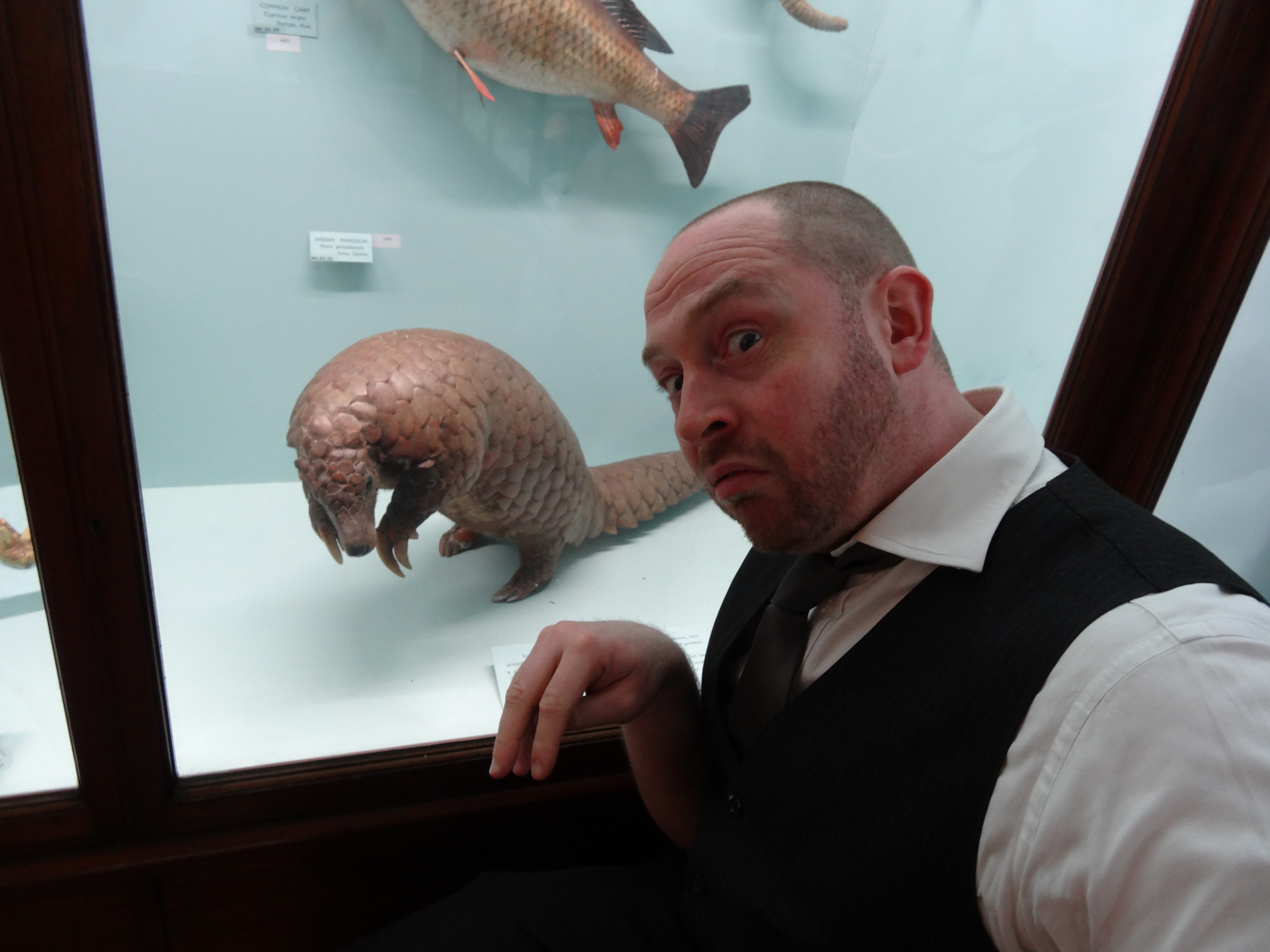
Utterly ridiculous, but fun nonetheless. If you have some similar selfies why not link to them below in the comments section? After all, I don’t want to be the only one looking silly!
Last Friday I gave you this fabulous feline skull to have a go at identifying:

No one got quite the right species, but several people (Crispin, manwhohunts, Maxine and Alex Klein) managed to narrow it down to the correct genus.
The flat frontals give the forehead a slope rather than the usual curve we’ve seen in previous cats of this size, making the cranium appear very domed in contrast. The post orbital processes are quite short and gracile (slender). The jaw is quite short while maxilla bone above the canines appears pinched in and the nasals are steep and protruding somewhat. These are features that appear in the genus Leopardus – the South and Central American small spotted cats.
How to distinguish between different species of Leopadus is more of a problem. Daniel Jones picked up on the incredibly robust bone margin of the foramen magnum (the hole the spinal chord goes into), which may be distinctive, but so far I’ve not seen the underside of other small Leopardus species skulls, so I can’t be sure.
All I know is that this is the skull of an Oncilla Leopardus tigrinus (Schreber, 1775), a small and mainly ground-hunting South American forest cat. I’ve said it before and I’ll say it again, cats are so difficult to identify!
Here’s an handy guide to the skulls of the carnivores found in Oz, just in case you find yourself in the area and stumble across a large carnivore skull. Natch.
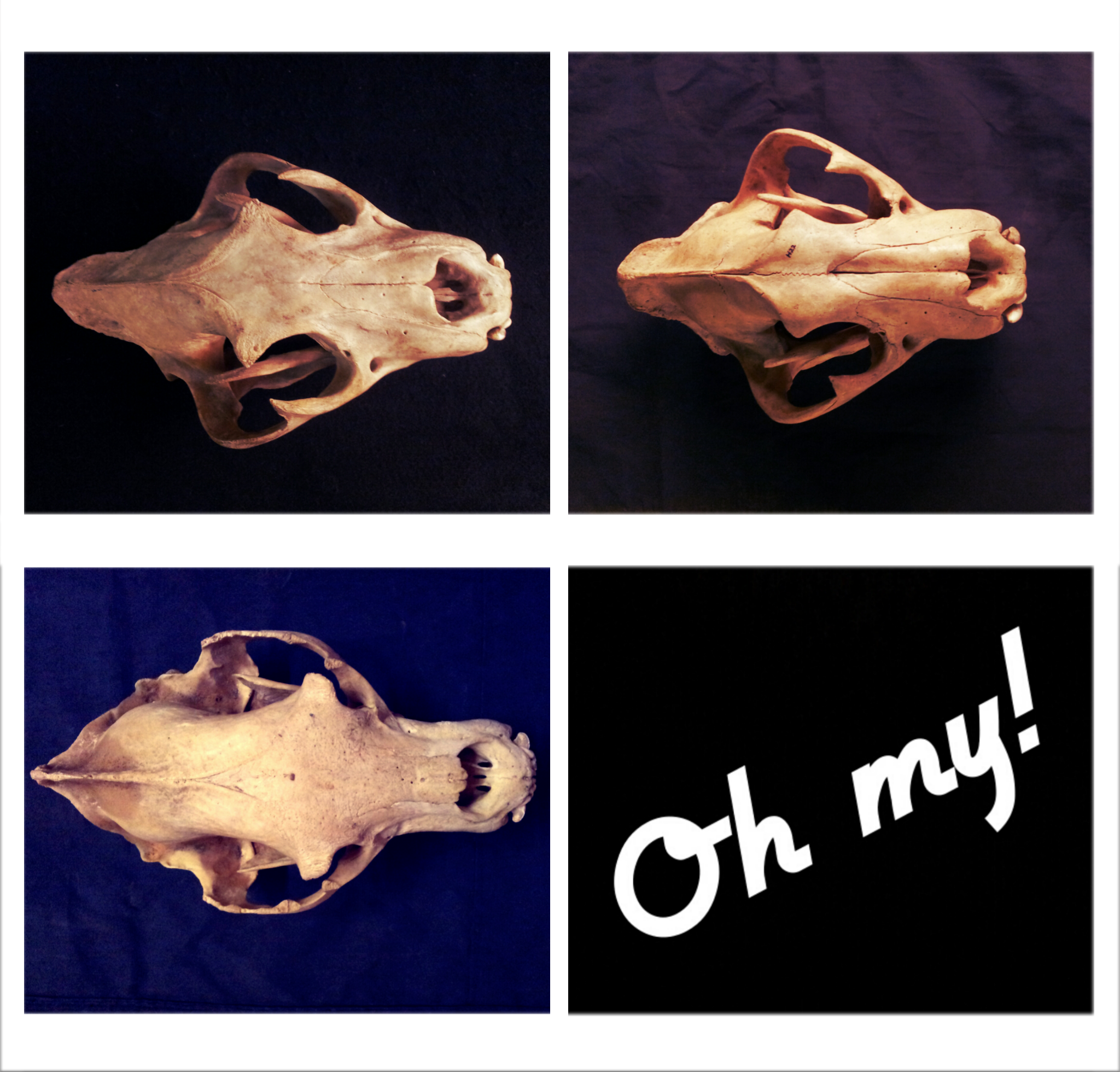
They are arranged in the order left to right, top to bottom and they follow the sequence of the wild animals of Oz song. If you don’t know the song, it’s here:
Enjoy that little earworm!
 Twitter has provided some great opportunities for sharing blogs, photos and other interesting content relating to museums. If you’re interested in museums, from either a personal or professional perspective, you should definitely try using twitter.
This week is #MuseumWeek, which provides me with an excellent and relevant excuse for being tardy in responding to Jack Shoulder’s 11 questions to me, which he shared last week on #MuseumBlogs day.
1. Who are you and what do you like about blogging?
I’m Paolo Viscardi, curator, bonegeek and staunch advocate of museums and science. Blogging for me is something that I don’t really enjoy doing, but I really enjoy the outcomes, when I feel like I’ve shared information, ideas and some of the good bits of my amazing job.

2. What is the most popular post on your blog?
Last year I published a post called Atacama ‘alien’ mystery is no mystery, which wasn’t directly about museums, although they do get a mention. It’s had around 45000 views so far, with almost 14000 of those on the day it was posted. There have been 136 comments, not counting the offensive or trolling ones I deleted. It was a controversial post in that it challenged some very odd ideas, that some conspiracy theorists seemed to take quite seriously, without applying much critical thought.
3. And which post on your blog did you have the most fun writing?
Back in 2011 there was a lot of hype about a prediction of the Rapture (the ascent to Heaven in advance of the end of the world) by evangelical Christian Harold Camping. I had a lot of fun writing the post Jesus disappointed by Rapture flop, which took the position that the Rapture had actually happened and only one person ascended, who wasn’t even a Christian. Since most of my posts are observational or factual it made a nice change of pace and gave me a chance to play with ideas.
4. If you could go behind the scenes of any museum, which one would it be and why?
Most of my museum experiences involve going behind the scenes. I rarely go to see exhibitions and I’m usually visiting other museums in order to meet other curators, or to do some research. I’ve not yet been to the West Coast of America, but if I ever make it over there I’d love to get behind the scenes at the Page Museum at Rancho La Brea to take a look at some of the amazing fossil mammal material they have in their collections.

Smilodon at the Page Museum at the La Brea Tar Pits. Image by Dallas Krentzel
5. If you could interview anyone, anyone at all, for your blog, who would you talk to and what would be the first question you ask them?
I’m interested in observing the physical world and trying to understand it, so I’ve never considered doing interviews. I suppose I could interview other scientists, but I’m not really a natural people-person and I would struggle to know what to ask!
6. What is your earliest museum memory?
This is a question I’ve (sort of) answered for Meet a Museum Blogger on Museum Minute a while back, so I’ll repeat that here:
“Seeing the door into the Palaeontology department at the Natural History Museum in London (the one next to the Megatherium specimen) is one of the clearest memories from my childhood – it was at that point I realized there must be people working behind the scenes in museums and that I could be one of them.”

Megatherium at London NHM. Image by Ballista
7. What was the last museum you visited what did you see?
Apart from the Horniman, which I visit every week day for work, the last museum I visited was the Città della Scienza (Naples Science Centre) at the start of March. That was a scouting trip for a potential temporary Dinosaur exhibition for the Horniman. I was impressed by the museum’s tenacity in the face of outright criminal assault, following an arson attack a year ago to the day of my visit, that razed the main museum site to the ground.
8. Share a museum selfie?
I hate taking selfies, but since they’ve become so popular I was persuaded to take one with the Horniman Walrus – just awful…

Since then I’ve taken a lot of selfies, and thankfully I’ve managed to look a bit less smug in those…
9. If time and money were not an issue, which museum in the world would you most like to visit?
As someone with a soft spot for Smilodon it would have to be the Page Museum!
10. Which museum do you think more people should know about?
The Horniman is a pretty small museum that does some pretty big things, but I know that outside the museum sector we’re not as well known as we could be. That said, I love the Grant Museum of Zoology at UCL and the Natural History Museum in Dublin – two of my favourite places that shockingly few people seem to know about!
I do think that all museums deserve to be known about though, which is why I’ve been working hard with colleagues at the Natural Sciences Collections Association (NatSCA) and a variety of partner organisations (like the NHM and Linnean Society) to get a better idea of what museums are out there that hold natural science collections. At the moment the project is in its early days, but we’ve developed a crowdsourced map of UK natural history collections that you can see – and add to – on the NatSCA collections pages.
11. What’s the oddest search term that has led people to your blog?
“Rat poo”. It’s a surprisingly common search term too, with almost 400 people finding the site through some variation on that theme. I suppose that’s what happens if you show people pictures of rat poo though…

On that somewhat unsavoury note I will pass on the baton to some more museum bloggers:
Here are my questions for Jake, Claire and Russell:
1. Who are you and what do you blog about?
2. Why do you blog about museums?
3. And which post on your blog was the hardest to write?
4. Which is your favourite museum?
5. Do you think you’ll still be interested in museums in 20 years time?
6. What is your earliest museum memory?
7. What was the last museum you visited and what did you see?
8. Share a museum selfie?
9. If you could build a museum, what kind would it be?
10. What is the most popular post on your blog?
11. What’s the oddest search term that has led people to your blog?
And here’s what you have to do:
Answer the eleven questions – you can adapt them a little to fit your blog.
Include the BEST BLOG image in your post, and link back to the person who nominated you (that would be me, or this blog post).
Devise eleven new questions – or feel free to keep any of these ones here if you like them – and pass them on to how ever many bloggers you would like to.
Here’s the mystery Friday feline for this week:
As with the others I think it may prove hard to find good diagnostic characters, but hopefully something will come to light! Good luck!
Every so often I’ll meet someone who asks me what I do; this draws the response “I’m a natural history curator”*. Sometimes I will then be faced with the dreaded follow-up question “what does that mean?”
I hate it when this happens, because the curatorial role involves lots of different things and it can be hard to summarise them in any kind of concise and intelligible way. Different museums expect different things from curators, which will usually depend on the rest of the staffing structure. So when I answer I can only really answer for myself and what I think MY curatorial role entails.
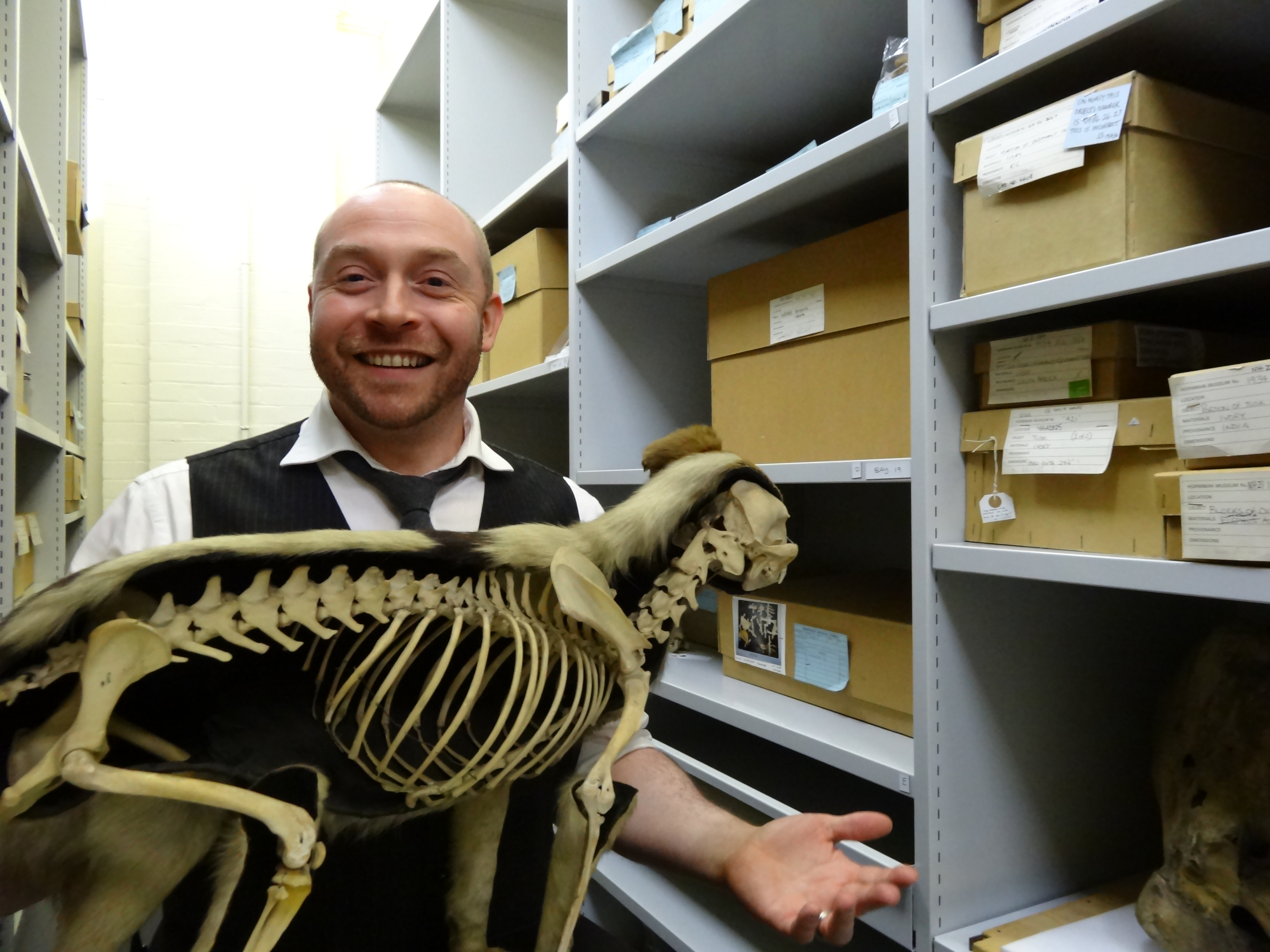
The most obvious responsibility is “curating collections”, which is not actually an explanation in any meaningful way. To curate more or less means to “take care of”, but these days the museum sector has become professionalised and there are other specialists who take on much of the duty of care; conservators, collections managers, documentalists and so on.
What I bring to the care side of things overlaps with these roles, but my spin is to bring subject specialist knowledge to the mix.
This allows me to help other departments by providing them with useful information. For example, non-specialist staff will largely have to go by what’s written on an object label, whereas I am expected to check that information and challenge old taxonomy and misidentifications. I may also provide additional or new information about objects by researching their history or identifying parts of their composition.
A nice illustration of this can be seen in these two objects – one from the Horniman Museum & Gardens‘ Anthropology collection (top) and one from the Natural History collection (bottom):

The Natural History specimen had originally been mislabelled by the original supplier as the skull of an Andean Condor from Bolivia, which I had spotted and corrected to Lappet-faced Vulture (a species from Africa) after a bit of research. The Anthropology specimen was originally identified as being an ‘eagle skull’ charm from Nigeria and it was simple to provide a more detailed species identification after having done the work on the Natural History specimen.
This sort of fact-checking and enrichment of data is essential for museums if we are to provide an accurate, reliable and authoritative resource for our audiences.
The same need for fact-checking also applies to quality television programmes, so it is perhaps unsurprising that museum curators will often be involved in documentaries, either as a presenter (like George McGavin or Richard Fortey), an expert that gets wheeled in to provide context (I think all curators have done this!), or as a shadowy figure behind the scenes baby-sitting an object or advising on content (I was scientific advisor for Ben Garrod’s excellent Secrets of Bones for example and I have fond memories of fiercely guarding an Indian Elephant leg at the filming of the Royal Institution’s Christmas Lecture “Why Elephant’s Can’t Dance“).
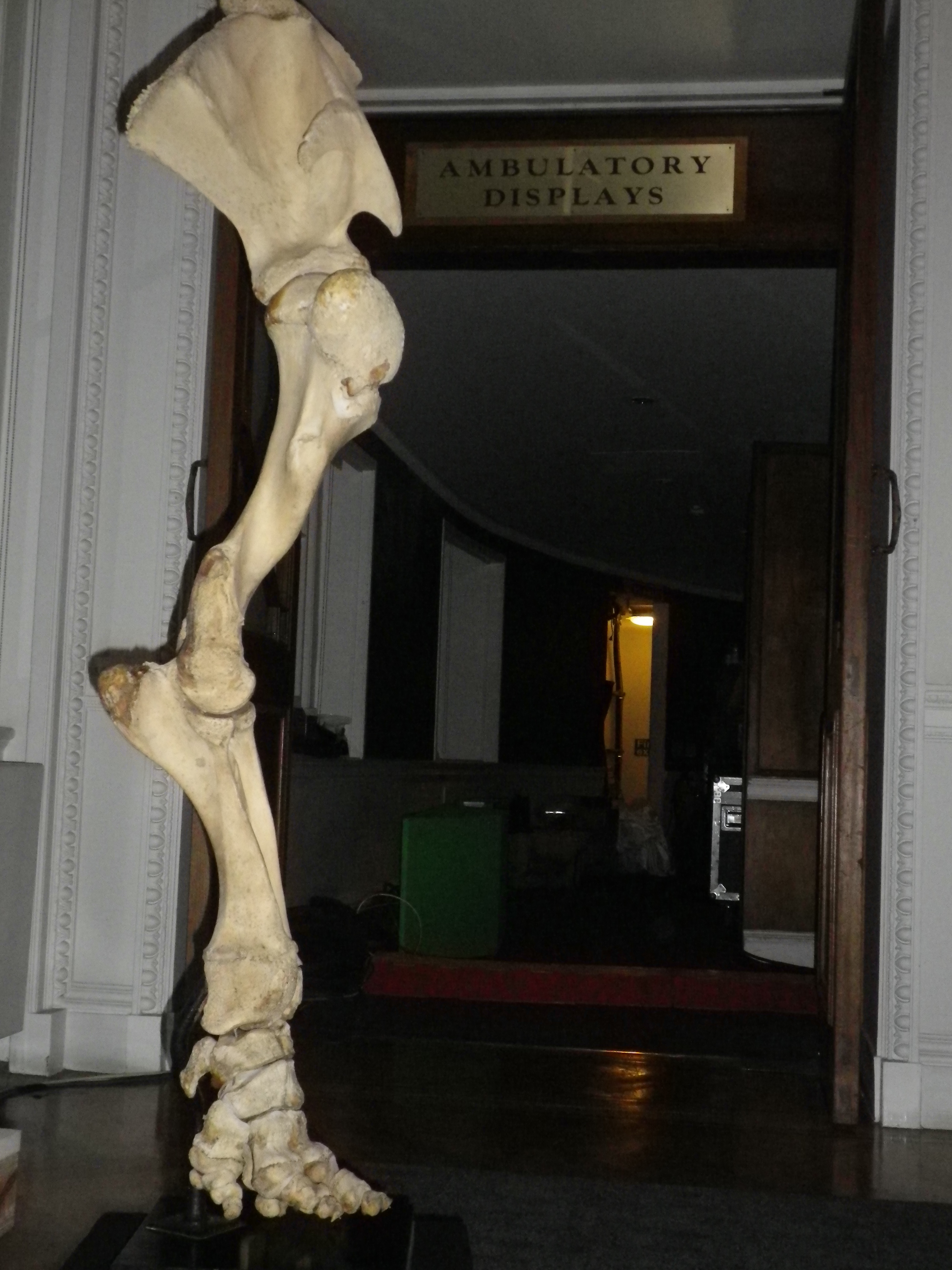
An Elephant leg that I had to babysit for 14 hours (with no comfort break) for the filming of a Royal Institution Christmas Lecture
I’m all for getting collections used like this, since I think that the real value of collections lies in their use. This may be scientific, educational or artistic use – it doesn’t matter which, as long as the use doesn’t significantly compromise the objects and contributes to a wider understanding or appreciation of the world. In some cases you can manage both – a project I’ve been involved in with fine art photographer Sean Dooley is a good example of this.
Another large part of what I do is science communication. Museums were one of the earliest methods by which the general population could access decent quality information about the wider world and, despite the rise of the telly, museums still serve as an important interface between the academic world and the public.
This means that I get to research topics (in varying amounts of detail) that are relevant to our collections and audiences and produce exhibitions, give talks and write articles communicating that research. Sometimes this will be somewhat on the dry side (like a methodological paper about measuring skulls), while other times it will be a bit more fun, like my stint as #ExtremeCurator:
For me science communication and museum advocacy goes beyond the museum walls and 9-5 working hours, so I also organise free monthly science-related events in a London pub, I’m a trustee of the Natural Sciences Collections Association, I do evening talks all around the UK, I tweet and of course I am a #MuseumBlogger here at Zygoma.
This last activity has been both hard work and incredibly enjoyable. The hard work comes from the discipline required to organise and write a weekly blogpost, while the enjoyment has come from the fantastic community that has developed around the Friday Mystery Object posts (which have now been running for about five years). I’ve found that my knowledge has increased a huge amount and I’ve been able to encourage and help support other people in their interest.
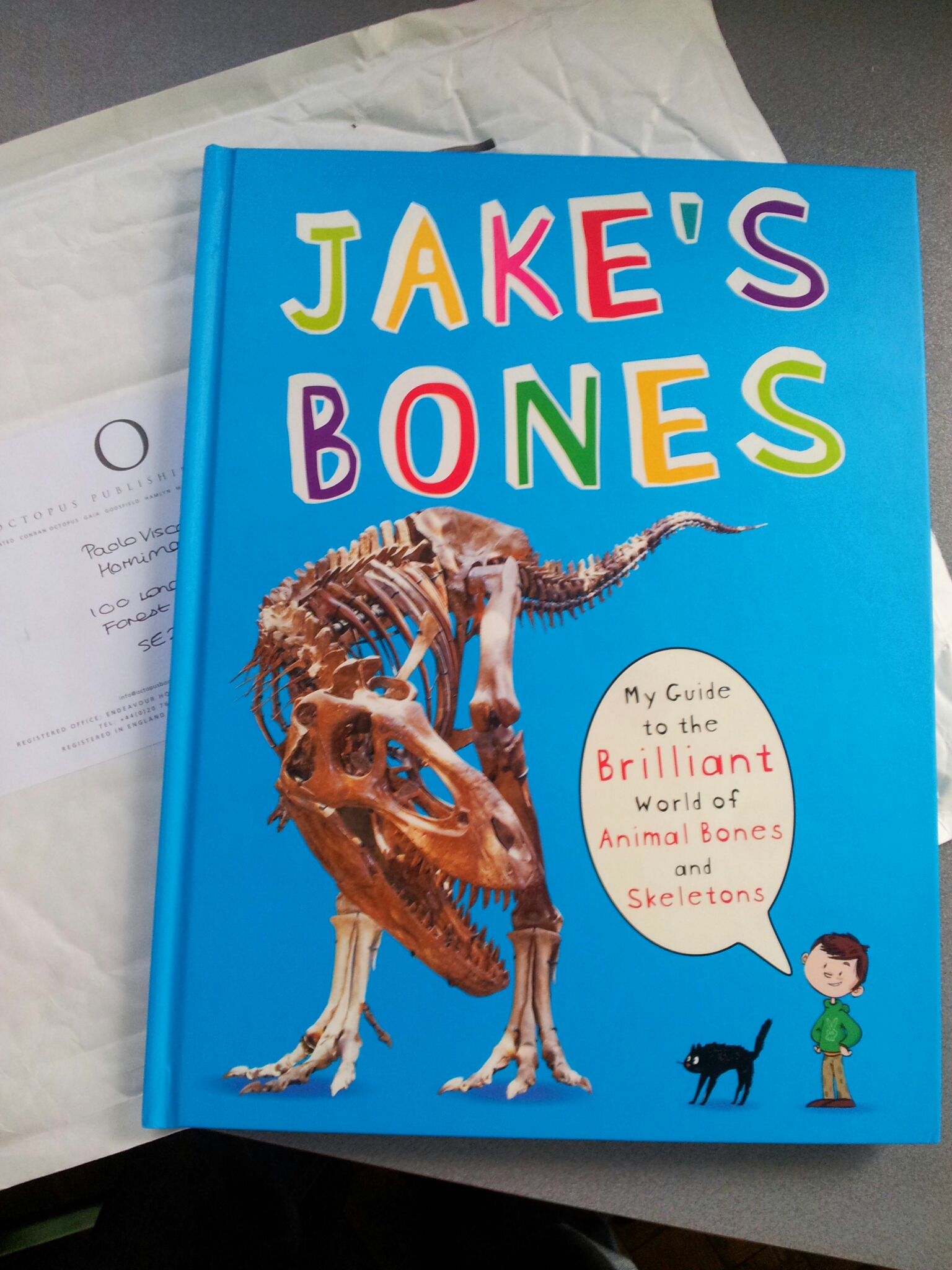
My favourite example of this is Jake, who has been reading my blog since he was seven! Now he’s twelve and has already published an incredible book on bones that I was lucky enough to be able to help with. It’s the unexpected things like this that make blogging so worthwhile and which make my job the best job in the world!
*my job title is actually “Deputy Keeper of Natural History”, but that’s a term even less familiar than “curator”.
Last Friday I gave you this cat skull to identify:

It is about the same size as a Domestic Cat and is very similar in morphology. But it’s not a Domestic Cat.
The auditory bullae (the bulbs under the skull that hold the hearing apparatus) and the external auditory meatus (ear holes) are a bit bigger, the skull is a bit broader and the interpterygoid notch (the gap at the back of the palate that the airway emerges from) is squarer and has a slight ridge in front of it on the palate (and I’m not sure that ANY of these are particularly significant).
There were plenty of suggestions about what this skull might belong to, but only henstridgesj hit the nail on the head with a correct identification of Southern African Wildcat Felis silvestris cafra Desmarest, 1822. So well done Stephen!

Southern African Wildcat (Felis silvestris cafra) by Johann du Preez 2008
Here’s the Friday feline for this week:
Any idea what species this skull is from?
As usual you can put your questions, comments and suggestions below and I’ll do my best to respond. Good luck!
Last week I gave you this lovely skull to identify:

As I suspected, everyone immediately recognised it as a type of cat. The characteristic two large blade-like premolars with a gap (diastema) behind the long canines and the straight incisor row were a dead give-away.
Then came the difficult bit. There are around 40 living cat species recognised in the world and because they didn’t diverge from a common ancestor until just 10 million years ago (or thereabouts), they all tend to look quite similar.
There were lots of suggestions, ranging from Lynx to Jungle Cat, but only Jake managed to recognise this short and highly domed skull (with impressively long canines) as belonging to a Marbled Cat Pardofelis marmorata (Martin, 1836).
The Marbled Cat is an tree-dwelling species from South and Southeast Asia that isn’t really very well known. They have a ridiculously long and chunky tail to help with their arboreal lifestyle and beautiful patterns on their coat, which gives them their name.

Since cats are so hard to tell apart do you think I should post a few more over the next few weeks? Between us we may be able to spot some useful distinguishing features…
This week I have a rather nice skull for you to identify:
I know what this skull comes from, but I wonder if you can work out the species just from the cranium. I should warn you though, it’s not quite as easy as it looks…
Enjoy the challenge!
On Friday 7th Feb I gave you this mystery skull to identify:
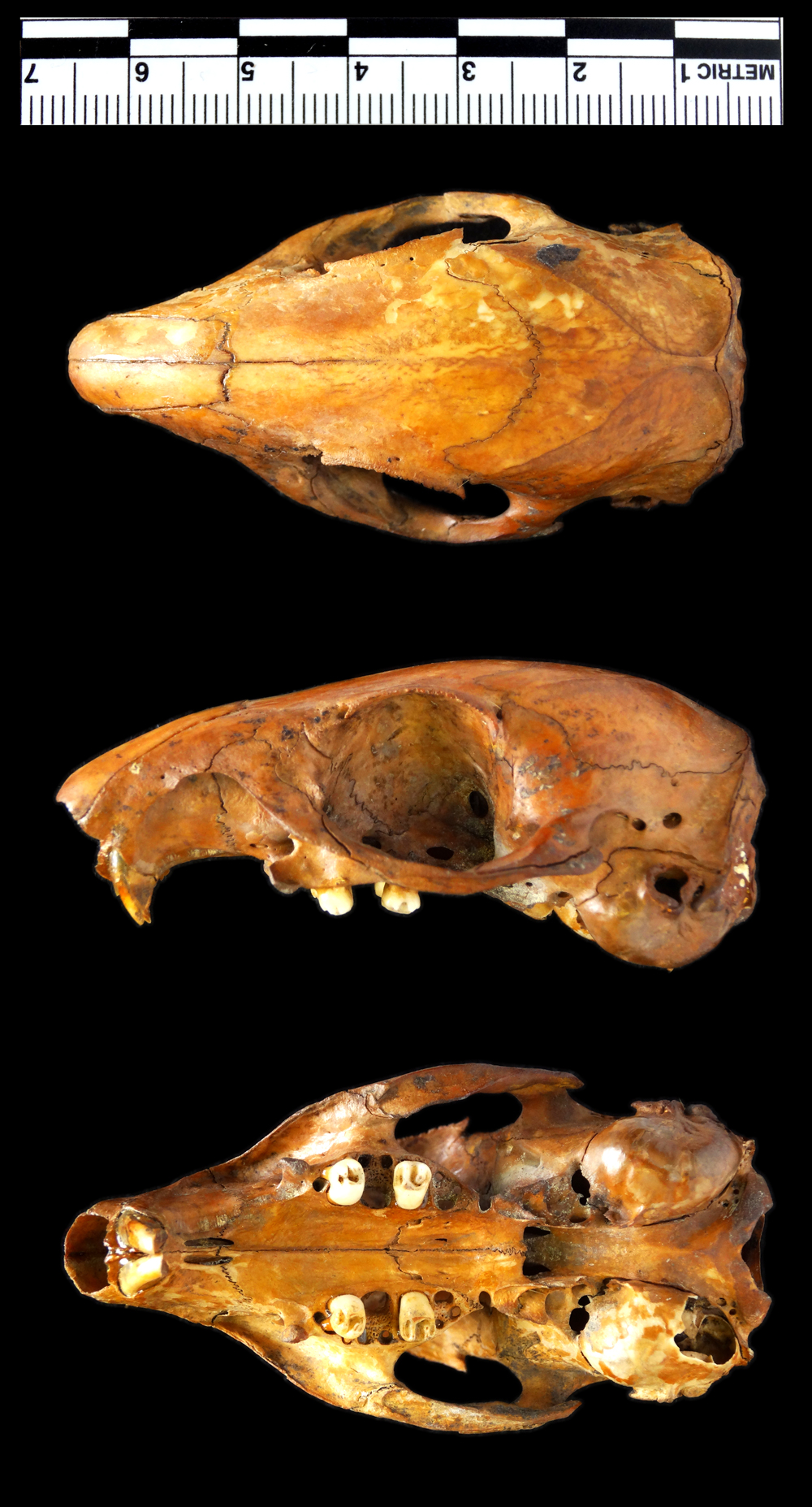
The post got lots of activity from both regulars and biology students from the University of Chicago Laboratory School, which means there were lots of helpful comments!
The specimen was quite clearly from a rodent, due to the paired incisors, but there are a LOT of different rodents out there.
The type of rodent was narrowed down by bugblokenz who suggested the skull was from a squirrel of some sort and Jake pointed out how we know that is the case – the specimen has a spiky postorbital process:

The presence of a spiky postorbital process (see top skull) suggests that it was from a type of squirrel. Most other rodents either lack this process (see bottom skull), or the process is more stout and blunt.
Narrowing it down to a squirrel is helpful, but there are still around 285 different species to choose from and many squirrels have very similar skulls. This is where the real challenge lay, especially since it clearly wasn’t the British Red Squirrel Sciurus vulgaris or the more widespread Eastern Grey Sciurus carolinensis, as I showed you on Friday 14th. Other suggestions included the Southern Flying Squirrel Glaucomys volans (which is a bit on the small side) and Eastern Fox Squirrel Sciurus niger (which has a really interesting method you can use to identify it).
The relatively narrow zygomatic breadth, combined with a relatively wide breadth between the orbits suggests a ground squirrel of some sort, which many people recognised, leading to suggestions of Poliocitellus franklinii, Spermophilus sp., Otospermophilus sp. and Tamias sp. – for which this useful reference provides some great comparative specimens (huge thanks to Crispin for sharing this).
However, none of the North American ground squirrels quite matched up, with the closest suggestions of Otospermophilus variegatus or Poliocitellus franklinii still being different in a variety of ways, particularly in relation to the width of the skull, relative zygomatic breadth and shape of the postorbital process.
After much consideration it came to me that we may be looking on the wrong continent and it turns out that African ground squirrels are more similar to this specimen. Fortunately, there is a very useful resource providing images of specimens of African rodent species available through the Belgian Biodiversity Platform. This fantastic site has enabled me to make a reasonably confident identification of Striped Ground Squirrel Xerus erythropus (Geoffroy Saint-Hilaire, 1803).

Striped Ground Squirrel (Xerus erythropus) by BOISSEL Philippe
I’d still like to get my mystery skull to a comprehensive physical collection, just to make some fine detail checks (there are some issues with the shape of the posterior margin of the palate I’m not 100% happy about), but overall I’m happy with this – but please let me know if you think I’ve missed something!
Big thanks to everyone who has contributed their ideas on this specimen – let’s see what I can find for you to identify this coming Friday…
[Further information available in this species description PDF]
Apologies for not having the answer to last week’s mystery object posted yet – it’s been a busy week and I simply haven’t had a chance to prepare a decent answer.
However, I have an image of last week’s object alongside a Grey Squirrel (the lighter coloured specimen), to give you an idea of how they differ, so I hope that will prove of interest until I can get a proper post prepared:


