The Aquatic Ape Hypothesis

You may have noticed some coverage in the press recently about the Aquatic Ape Hypothesis (AAH), sparked by a conference on the topic due to be held in May.

If you’re not familiar with the AAH it basically suggests that human ancestors passed through a semiaquatic stage which provided the selective pressure that has led to the differences seen between humans and other primates. Some people call it the Aquatic Ape Theory, but it lacks the necessary scientific support to be considered a theory so it remains a hypothesis [see comments for discussion of the terminology].

The idea was first suggested by pathologist Max Westenhöfer in 1942 and the first line of evidence in support of the hypothesis was proposed by marine biologist Alister Hardy in 1960. Hardy noted that subcutaneous fat is unusual in terrestrial mammals and is normally associated with marine mammals – raising the very good question ‘why do humans have subcutaneous fat?’ (the answer being because we eat too much and exercise too little – just like some lab monkeys).

The baton was then picked up by writer Elaine Morgan who has championed the AAH since 1972. Here’s Elaine in action on a TED video from 2009:

Elaine Morgan is a great communicator and she’s done a remarkable job of delivering the AAH to a wide audience, but I have concerns that the packaging is more impressive than the contents, from a scientific perspective.

In the video Elaine does a cracking job of setting up the AAH in opposition to the more established Savanna Hypothesis (SavH), which suggests that humans diverged from other primates as a result of exploiting more arid environments. She then suggests that the SavH has been discounted on the basis of palaeoenvironmental data, leaving a paradigm gap that should (she suggests) be filled by the AAH.

But of course, a paradigm gap should only be filled by a robust theory and when it comes to plotting evolutionary trajectories there is not solid theoretical foundation on how to do it, beyond relying on the physical evidence provided by the fossil record.

In this case that would require fossils of human ancestors to be found in primarily aquatic deposits, something which we do not see, which is surprising, since aquatic environments are usually far better for fossil preservation than terrestrial environments. In fact, taphonomy suggests that early hominid fossils would be more common if the individuals were living and dying in water with any frequency.

Map of the fossil sites and spread of the generi Australopithecus and Paranthropus, from 4.3 M BP until 1 M BP. From PARKER (G.). Compact History of the World. London, HarperCollins Publishers, 2008, pp 12 - 13

Without having physical data in the form of fossils linking hominids to water, it becomes difficult to make a connection without falling back on evolutionary ‘just-so stories‘, that try to explain an observation by relying on a plausible narrative.

The trouble with this is that the public and media love a good narrative, but it simply isn’t scientific unless it can be falsified. I think this is the part of the process that Elaine Morgan doesn’t quite grasp – she is convinced by her own narrative and believes in the hypothesis, but for a scientist it is more appropriate to subscribe to none of the available hypotheses if they cannot provide factual evidence in support. This is where I currently stand.

I am certainly not convinced by statements like:

“Docosahexaenoic acid (DHA) is an omega-3 fatty acid that is found in large amounts in seafood,… It boosts brain growth in mammals. That is why a dolphin has a much bigger brain than a zebra, though they have roughly the same body sizes. The dolphin has a diet rich in DHA. The crucial point is that without a high DHA diet from seafood we could not have developed our big brains. We got smart from eating fish and living in water.” [Quote attributed to Dr Michael Crawford]

This statement starts by comparing two utterly different species, with a very different evolutionary history and current mode of life, then offers a single dietary explanation for the difference in brain size. This is patently nonsense.

If a seafood diet is the main driver of large brain size then the relatively very large brains of Chimpanzees and other Apes become a remarkable oddity and the relatively small brains of Blue Whales become bizarre variants. Moreover, what about people that don’t have access to seafood? Are they unable to grow large brains? No. Clearly there is more going on.

Brain size is not directly linked to a single dietary chemical, it is linked to managing interactions in and with a complex environment – keeping track of seasonal and spatial variation in fruiting or schooling of fish, coordinating group efforts and understanding prey behaviour to hunt more effectively, or problem solving to access food sources that are hard to acquire. Where a big brain provides a selective advantage, it will evolve.

I don’t want this post to turn into a refutation of the AAH, since there’s a lot to say and much has been done elsewhere. What I do want this post to do is highlight that a scientific theory needs to be testable, it needs to consider contradictory information and it needs to be aware of confirmation bias.

The AAH relies strongly on observed similarities in condition between humans and aquatic mammals, but it dismisses other similarities out of hand. For instance, Naked Mole-rats are simply dismissed by Morgan as an example of a non-aquatic mammal that has lost body hair, but they provide evidence that hair loss can occur for reasons beyond aquatic adaptations – which is worthy of note.

It is also worth considering the supporting examples in the context of phylogeny and physiology, which doesn’t seem to happen often. For instance, the Cetacea, walruses and Sirenia are examples of naked aquatic mammals cited in the AAH, but both the Sirenia and walruses retain a short coat of hairs, quite different in structure to the fine body hair of humans. Whales and Sirenia have also been adapting to an aquatic habitat for 50 million years and the ‘nakedness’ of modern examples may be more related to the evolution of large body size and the benefits to thermoregulation provided by mass – which is supported by the fact that the largest species in the Pinnipedia (like the Elephant Seal and Walrus) are much less reliant on fur than the smaller species of seal.

Unless our ancestors were massive, it seems unlikely that they would have been losing their hair in order to survive better in the water.

Of course, that’s not to say that our ancestors avoided water – far from it. Marginal environments are rich sources of food and most terrestrial animals that live near water will exploit it in some way or another. I’m sure our ancestors would have done the same, I’m just unsure about how immersive and influential that exploitation was on our evolutionary trajectory.

Japanese Macaques, Nagano, Japan. By Yblieb

So far I am unconvinced by the AAH and the more bad science and overstated arguments I see in support of it, the less convinced I become. Let’s see if any good supporting science with hard facts emerge from the conference in May.

Friday mystery object #197

This week I have a skull for you to identify – to make a change from the more tricky specimens I’ve had recently. Any idea what this belonged to?

mystery197

As usual you can leave your comments, questions and suggestions below and I’ll do my best to respond. Enjoy!

Friday mystery object #196 answer (well, not really)

On Friday I asked you to help me identify this mystery object:

mystery196

Many thanks to everyone who made suggestions about what this sacrum and caudal vertebrae (the bones that make up the tail) could be from. There were some useful ideas that I intend to follow up on, but alas I must apologise to you all because I’ve still not managed to make a confident identification (as yet).

I always struggle with the identification of vertebrae without having good comparative material. Skulls are straightforward to identify as they tend to contain lots of diagnostic features, but with vertebrae there are fewer distinctive feature that allow a straightforward species level identification.

In this case I’m still not sure whether this tail is from a marsupial, a monkey or a mustelid, although I’m pretty certain it’s from a mammal.

I think I may have to mop up some of the loose ends of mystery objects that I’ve not been able to confidently identify at some point, by making a trip to another museum with a bigger collection of postcranial material than I have available at the Horniman.

Of course, sometimes you just have to accept that there isn’t enough information associated with a specimen to make a confident identification at all. Sometimes you also need to ask whether it’s worth the extra time and resources trying to get a good identification for a specimen with no other good data about where, when and by whom it was collected.

This kind of information can turn an interesting display or teaching specimen into an even more useful research specimen, that can be used to address questions about species distribution, population genetics and evolution – amongst other things.

With a specimen that lacks these kinds of data – and which isn’t particularly visually exciting for display – it becomes more difficult to justify going to special efforts to identify it. Nonetheless, I know this specimen will bug me until I work out what it is!

Friday mystery object #195 answer

On Friday I gave you this mystery object from the collections at the Horniman Museum to identify:

mystery195

The bone is interesting because it was badly broken when the animal was alive. As Jake pointed out, the bone has healed without the attentions of a vet, so it hasn’t healed straight and there’s a lot of excess bone growth. This makes it harder to work out what the bone originally looked like.

Minioncat recognised that this is the humerus of a juvenile animal and although there were several species suggested on the basis of size, none seemed to quite fit.

Lena made a really helpful observation about the presence of a supracondylar foramen – which is the hole that can be clearly seen on the side of the bone in the top image, near the articulation on the right hand-side of the picture.

This foramen is something seen in some of the carnivores, like cats and mustelids, but the bone itself doesn’t really match any of the cat or mustelid bones that I compared it to.

When I first found this bone I though that it belonged to a tree-climbing (or arboreal) carnivore, because the head of the humerus would allow for a considerable range of movement (plus broken bones are common in arboreal animals). The only thing I could really think of that was likely was a small species of bear, since cat humeri are quite different from this.

However, on Twitter Raymond Vagell made the inspired suggestion that it could be the humerus of a Fossa Cryptoprocta ferox Bennett, 1833 – something that I never even considered.

Fossa (Cryptoprocta ferox) image by Ran Kirlian

I don’t have any Fossa postcrania for comparison and I can’t even find a good image of a Fossa humerus online, so it’s hard to check. There is a Fossa skeleton image on the Museum Victoria website, which shows that the humerus is pretty similar, but alas it’s a clear enough image to be more sure.

Once I started thinking about less commonly occurring carnivores I broadened my search and came across a paper with a comparative drawing of the humerus of a Binturong Arctictis binturong (Raffles, 1822), which is another tree-climbing mammal, with a similar humerus shape.

Binturong (Arctictis binturong) at Overloon, NL by Tassilo Rau

The long and short of it is that I still don’t know what specimen this mystery object came from, but I now have a fresh perspective for renewing my search, thanks to the people who get involved with the Friday mystery object. I will let you know if I get any further in my search for an identification, but I owe you all a big thanks for contributing!

Friday mystery object #195

Today I have a real challenge for you. This bone has a pathology that has significantly changed its appearance and it had no information associated when I found it. So far the best identification I have is very tenuous, so I thought it would be worth seeing if you had any ideas about what it came from:

mystery195

Feel free to put your thoughts, observations and suggestions below. No need for cryptic clues today I think – this specimen is cryptic enough!

Friday mystery object #193 answer

On Friday I gave you this specimen to identify:

mystery193

Unsurprisingly you all recognised it as a tortoise carapace. The species was a bit more difficult though as tortoises can display quite a lot of variation in their colour and shell structure within a species.

There were various good suggestions, but in the comments only Barbara Powell made reference to what Colin McCarthy and myself thought this was from, although Maggie J Watson also identified it in a tweet.

When we saw the specimen we thought that it was probably a  Continue reading

Friday mystery object #193

This week I’ve decided to give you an object to identify that came up in our collections review recently with the splendid Colin McCarthy. We have a lot of these in our collection, most of which were unidentified. Any idea which species this is from?

mystery193

You can leave your suggestions below and I’ll respond during the day. Enjoy the challenge and have a thoroughly enjoyable Easter break!

Friday mystery object #192 answer

On Friday I gave you this unidentified specimen from the Horniman’s collections to take a look at. I had already had a go at working out what it is, but it never hurts to get a second opinion.

mystery192

It’s actually a bit of a generic looking overall shape, perhaps reminiscent of a owl or a maybe a pheasant of some sort. However, the nares (nostrils) are very small and round and set in a bill that is sharp, shortish and very solidly constructed, which is something you only really see in a few passerines, some parrots and the falcons. The skull is too big for a passerine and the bill is totally the wrong overall shape for a parrot, which leaves us with a falcon – a fairly small one at that.

From there the shape of the palate and the proportions of the cranium led me to a species identification that I’m pleased to say agreed with that proposed by Tony Irwin and Wouter van Gestel (who eloquently explained the indicative characters that I mentioned above). We all think that this is the cranium of a  Continue reading

Friday mystery object #192

This week I have a skull with no data that I came across in the collections a little while back. I think I managed to get a decent identification on it, but I’d be interested to see if you all agree:

mystery192

What do you think it is? As usual you can put your suggestions below. Thanks for helping out!

Friday mystery object #191 answer

On Friday we had this skull submitted by Dr Ben Swift for identification:

mystery191amystery191c

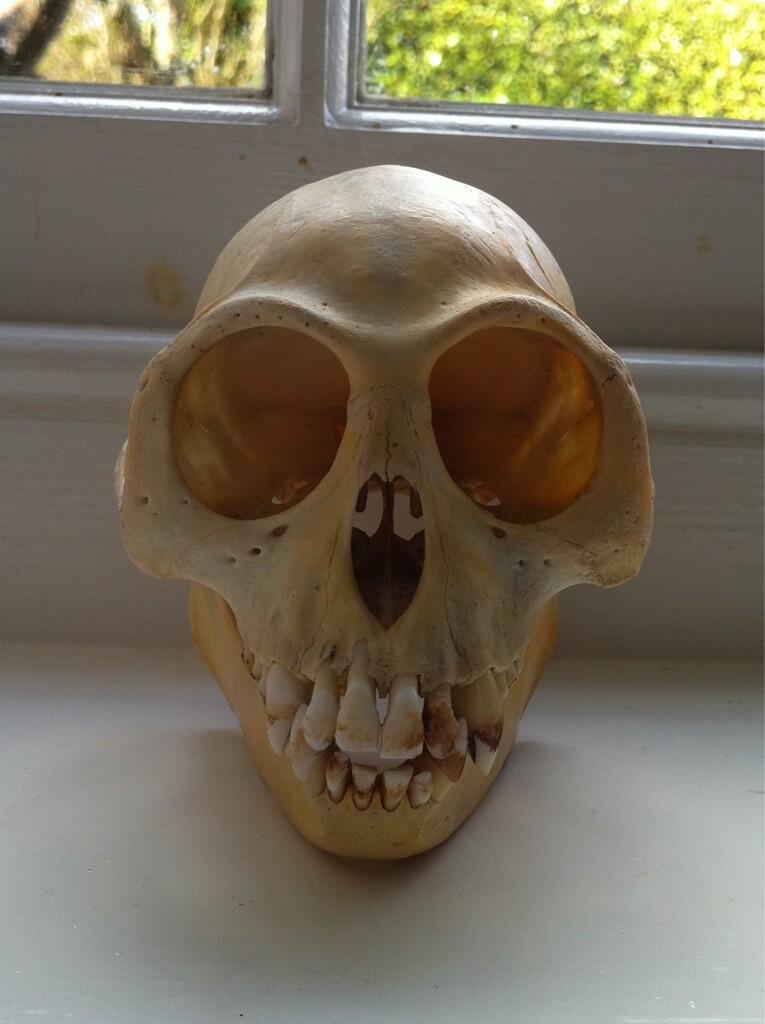
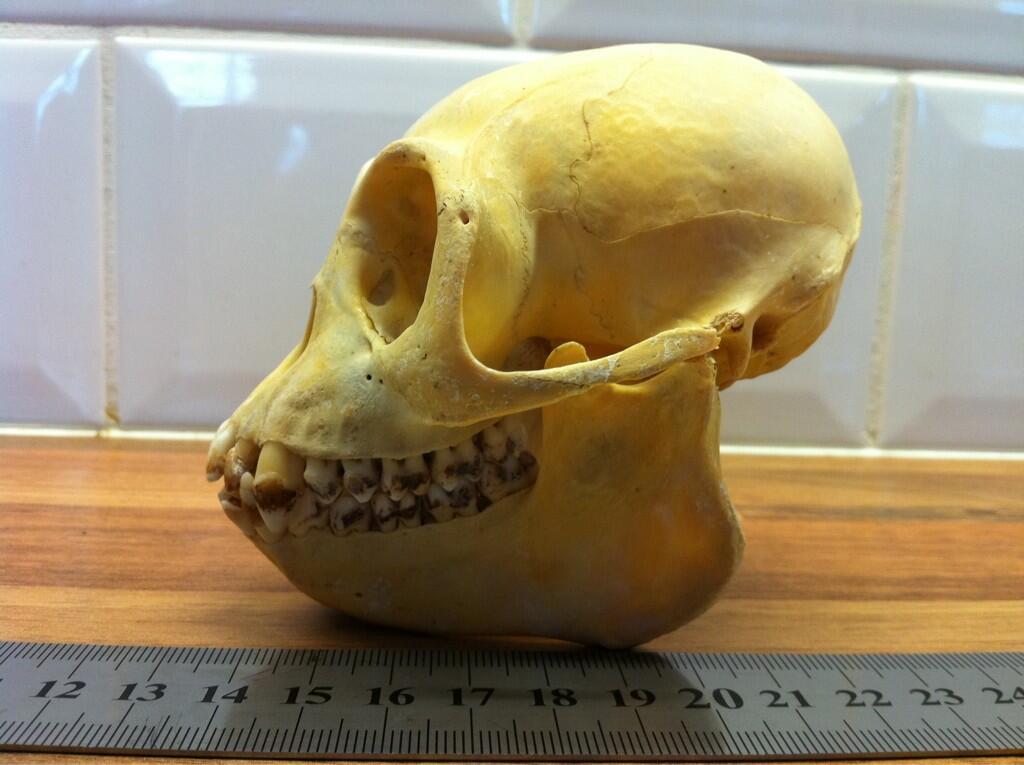
Now this is quite obviously a primate, as it has a bony ring around the orbit, a bony back wall to the orbit and just eight incisors as opposed to the twelve that forms the basal condition for mammals. The teeth also tell us that this is an Old World Monkey (Cercopithecidae), since these primates only have eight premolars instead of the twelve you find in the New World Monkeys (Platyrrhini). The small canines suggest that this is the skull of a female.

From there it starts getting a bit more difficult. The fairly small size of the specimen ruled out a few genera, but the main features that helped narrow down the possibilities were the very flat face, the heavy bony rings around the orbits, the flaring of the zygomatic arches (cheekbones) and the short and rounded braincase. Effectively the only way to consider these features is to look at a lot of comparative specimens (the excellent Mammalian Crania Photographic Archive proved very useful for this).

After a lot of consideration I found myself in agreement with the suggestion of something from the genus  Continue reading

Friday mystery object #191

This week I have a skull for you to have a go at identifying that has been submitted by Dr Ben Swift. Any idea what species this belongs to?

mystery191a mystery191b mystery191c

I’ll be trying to get an identification on this specimen myself and I’m not the best at primates, so your suggestions and comments would be appreciated – let’s see if we can crowdsource an identification!

Friday mystery object #190 answer

On Friday I gave you this skull to identify:

mystery190

The animal it comes from is quite distinctive, with loads of character, so it’s no big surprise that so many of you managed to identify it.

So well done to Jake, Dave Godfrey, henstridgesjMieke Roth, Wouter van Gestel, Steven D. Garber and Crispin – this is indeed a  Continue reading

Friday mystery object #190

This week I have a skull with character for you to identify. It will probably prove to be little challenge to some of you, but if you know what it is please try to use cryptic clues so you don’t spoil the game for others:

mystery190

Put your thoughts below and I’ll be sure to make comments during the day. Enjoy!

Friday mystery object #189 answer

On Friday I gave you this skull to have a go at identifying:

mystery189

I didn’t do a very good job of responding to comments I’m afraid, as I was rather busy at day two of this year’s Natural Sciences Collections Association conference at the Yorkshire Museum. Nonetheless, you managed to work out what this specimen came from without any input from me.

Jake spotted that it was the skull of a big reptile, more importantly, a big reptile with heterodont dentition (meaning it’s teeth aren’t all the same shape). That narrowed down the possibilities considerably. From there henstridgesj, Wouter van Gestel and Barbara Powell came to the conclusion that this is the skull of a  Continue reading

Friday mystery object #189

This week I have another interesting skull that came up during one of our recent reviews:

mystery189

Any idea what animal this belonged to? You can put your suggestions below and I’ll do my best to reply, although I will be at the NatSCA conference today, so it will depend on the quality of internet access on my phone.

Friday mystery object #188 answer

On Friday I gave you this previously misidentified specimen to have a go at identifying:

mystery188

It turns out that you did a great job!

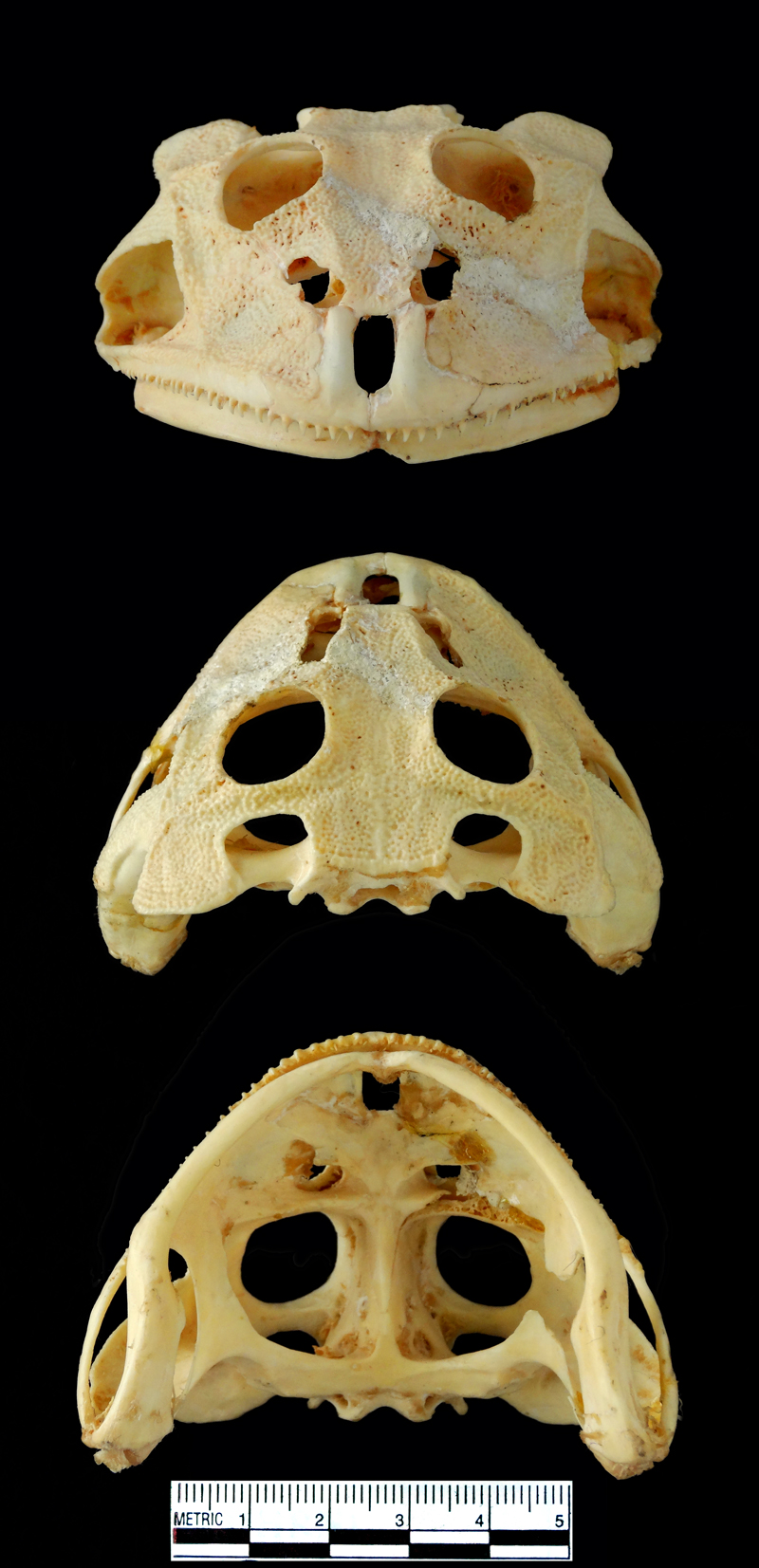
Jake and Mieke Roth immediately spotted that the skull belonged to a large turtle of some kind, henstridgesj narrowed it down to a fresh-water turtle and he and Steven D. Garber recognised that despite the large size, it wasn’t from one of the snapping turtles (which is what the original identification mistakenly had it as) and that it was more likely to be from one of the side-necked turtles. However, microecos went one better and managed to get a species identification for the specimen that agreed with the identification that our visiting reptile expert Dr Colin McCarthy who suggested  Continue reading

Friday mystery object #188

This week I have an object that came up in one of the Bioblitz collections reviews at the Horniman recently. It’s a great specimen, but it was misidentified by the preparators when it was purchased back in 1937 and that identification had never been corrected. Any idea what it should have been labelled as?

mystery188

You can put your suggestions, questions and observations below and I’ll do my best to reply. On Monday I’ll post the identification that our incredibly helpful specialist reviewer suggested, so you can see how you did. Good luck!

Friday mystery object #187 answer

On Friday I gave you this somewhat odd object to identify:

mystery187

My first thought when seeing it was Bowser from the Mario games:

Bowser. New Super Mario Bros. 2: © 2012 Nintendo

This probably isn’t the worst place to start the identification, since the animal with this feature was clearly big, scaly and toothy. This was obviously in the minds of Barbara Powell and Wouter van Gestel, who reached the correct conclusion that this is the structure from the tip of the snout of an adult male  Continue reading