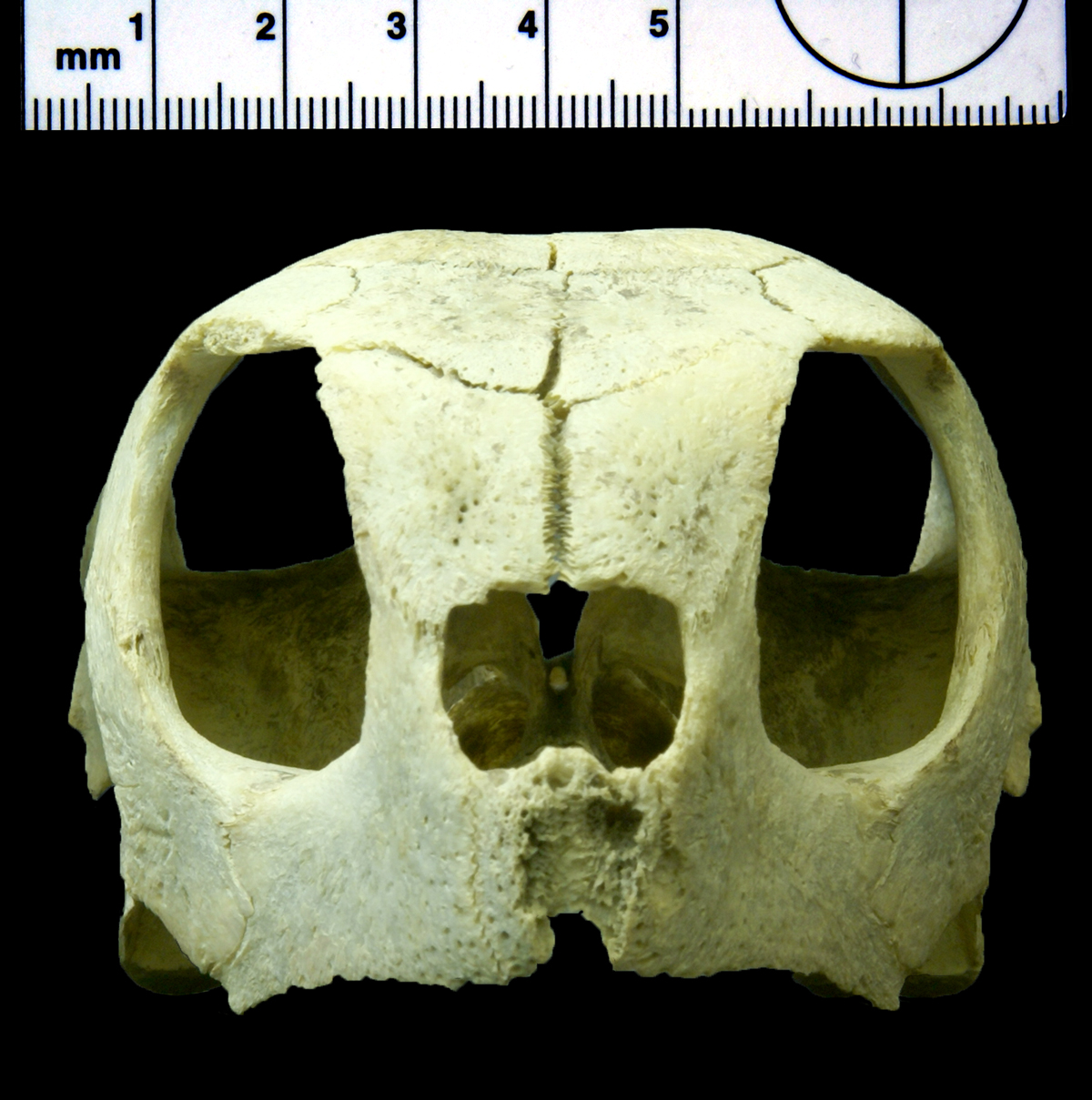
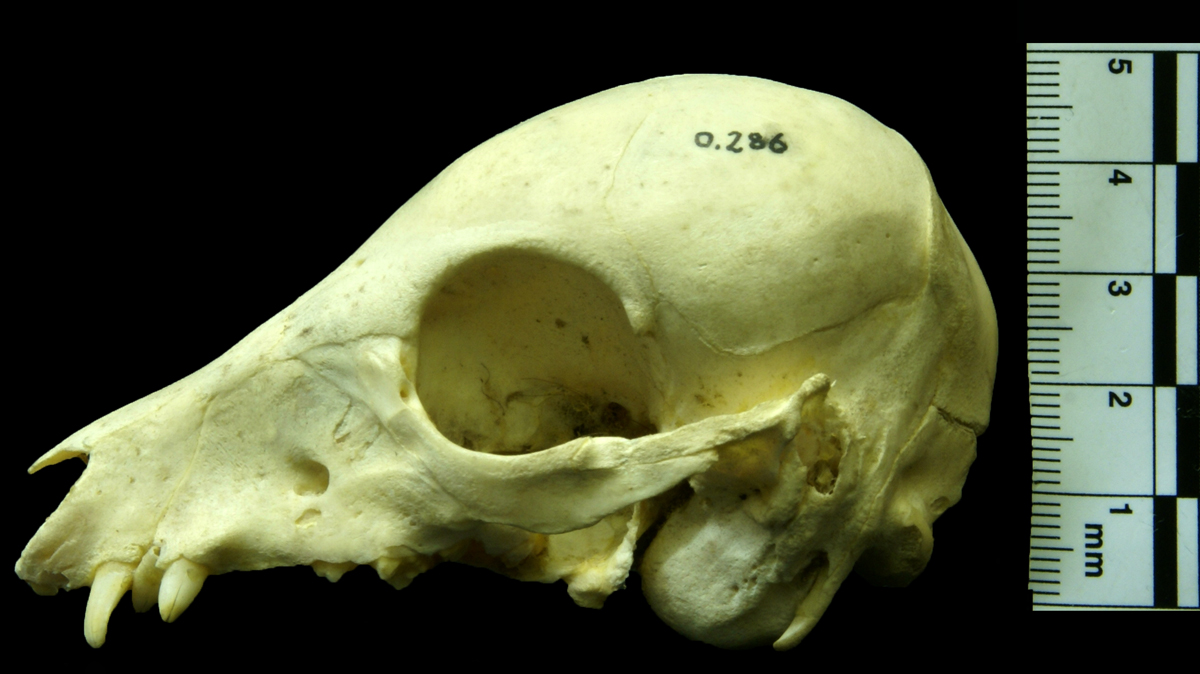
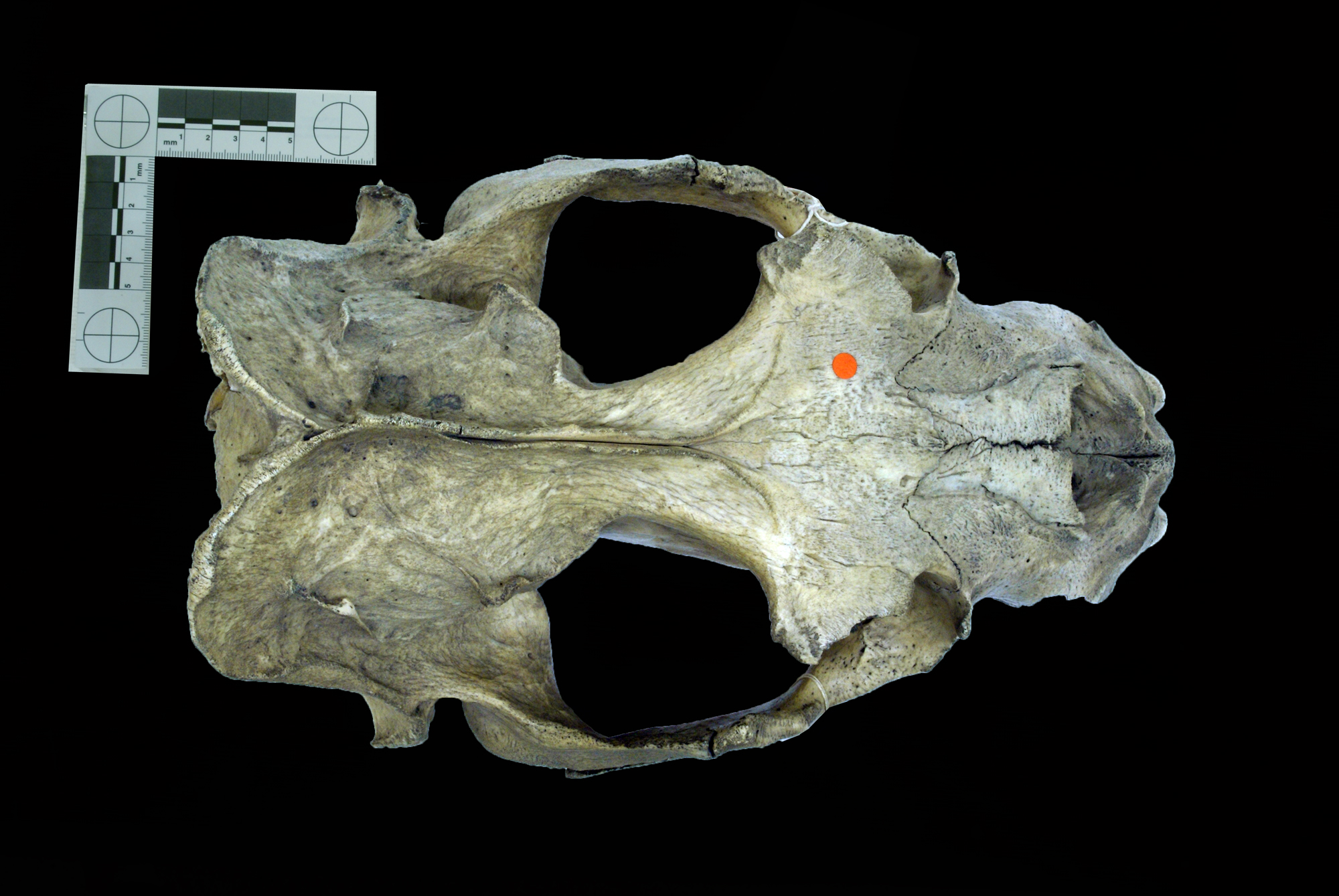
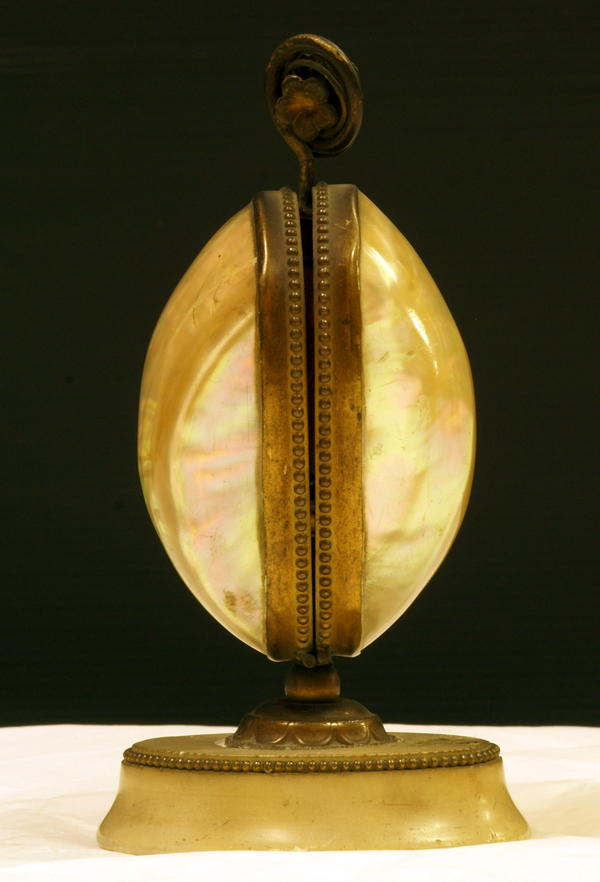
Friday mystery object #67

Here’s a specimen without any identification from the Horniman’s collections. I thought I knew what it was straight-away, but then had to spend ages trying to confirm the identification. I just hope you all come to the same conclusion as I did!

As usual, put your questions, observations and suggestions in the comments section below and I’ll do my best to reply during the day. Good luck!

Friday mystery object #66 answer

On Friday I gave you this mystery object:

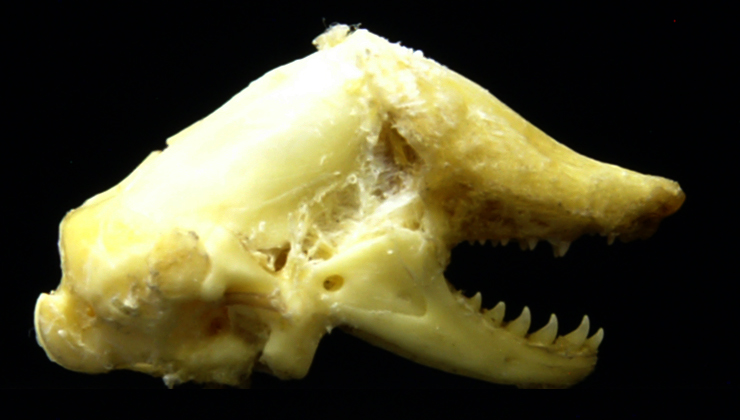
I thought it would be too easy, but I hadn’t factored in that it is the skull of a juvenile, which makes it much harder to identify from just a photograph. I did drop a few hints about what it might be on Twitter when I said it was ‘easy as pie’ and I had a hard time restraining myself from making a give-away comment about it flying when Jake asked if it was a big bat.

Manabu Sakamoto spotted that it was a juvenile and that the canine-like teeth were quite distinctive of a particular group. Neil managed to convey that he knew the answer with a beautifully subtle comment:

After rooting around a bit I think that I have sussed out the answer.

The answer being  Continue reading

Friday mystery object #66

This Friday I have a lot on, so I’m giving you an easy one that the biology and bony types should be able to drop hints about for the less osteocentric amongst you:

I’m sure you’ll all get this in no time, but in case you don’t I’ll do my best to respond to any questions, observations or suggestions in the comments section below. Have fun!

Friday mystery object #65

This week we held a behind the scenes tour for some of the attendees of TAM London, for which I cobbled together A History of the World in a handful of objects. Perhaps I should actually call it a History of the Earth, since my focus was on notable objects that represent key stages in the development of our understanding of our planet and the evolution of life upon it. One of the objects included was this:

Does anyone know what it might be?

As usual, put your questions, observations and questions in the comments section below and I’ll do my best to provide guidance during the day (without giving it away of course). Good luck!

Friday mystery object #64 answer

On Friday I gave you this anthropological object to identify (courtesy of the helpful staff and volunteers at the Horniman’s Study Collections Centre):

I asked you where it was from, what it was for and what it was made from. The first two questions were correctly answered quite quickly – Manabu Sakamoto correctly identified the seal on the side of the vessel as Chinese and Wildaker worked out that it was for holding tea (in leaf form I hasten to add). So, it’s a Chinese tea-caddy.

However, what it was made from was a much trickier issue. Suggestions ranged from Ostrich leather (by Prancing Papio) to knitted silk (by Wildaker). Zigg recognised that it was compressed into shape and that it was plant based, and ObenedO suggested it was made from rice or mushrooms, but nobody (except Melissa, my lovely wife) correctly recognised it as being made from  Continue reading

Friday mystery object #64

I promised an anthropological mystery object this week, so I begged the @MuseumGeekGirls to keep their eyes peeled for something interesting and here it is:

Many thanks to Laura, Pari, Helen and Nick for finding this and bringing it to my attention!

Simple questions – where’s it from, what’s it for and what’s it made of? It stumped me.

As usual you can put your suggestions, observations and questions in the comments section below and I’ll do my best to answer. Good luck!

Friday mystery object #63 answer

On Friday I gave you this weird-looking object to identify:

Steven D. Garber, PhD jumped straight in with the correct identification of what it is – the sternum keel and trachea of a bird. The more tricky part was working out what bird it came from. Dave Godfrey suggested that it was a large bird, possibly a gull, while Zinjanthropus suggested that it might have belonged to a Trumpeter Swan, with support from Carlos Grau (who suggested it could also have been from a pelican). Jonpaulkaiser proposed that it came from a penguin,  a suggestion seconded by Dave Godfrey on the basis of the shape.

So the identification became divided between the swan camp and the penguin camp. Jake joined the swan camp (bringing Zigg with him) and provided a link to a great piece by Darren Naish on his Tetrapod Zoology blog, which focussed on the bizarre tracheae (and sterna) of some birds – including swans, which related to the observation by Zinjanthropus:

Is it a trumpeter swan? They have large, convoluted trachea that goes through the sternal keel so that it can act as a resonating chamber.

It turns out that the swan  camp had the right of it, this sternum and trachea did in fact belong to a  Continue reading

Friday mystery object #63

On Monday I said I may try something cultural, but I’m afraid I lied. This bizarre looking thing caught my eye instead:

Any idea what this is and what it’s from?

As usual, suggestions, observations and questions in the comments section below and I will do my best to provide answers and guidance throughout the day. Good luck!

Friday mystery object #62 answer

On Friday I gave you this specimen and left you to work out what it was by yourselves (for which I humbly apologise):

There were some great observations from the outset – Jake immediately spotted that it had strong jaws and looks like a carnivore and Manabu Sakamoto went on to explain the biomechanical reason for the strong jaws and recognised that it’s a marine mammal. Jake came close when he said that it’s something similar to a Leopard Seal and jonpaulkaiser came even closer with the suggestion of California Sea Lion. Neil subtly hinted that it might be a Stellar’s Sea Lion, but Zigg managed to work out that it is in fact the skull of a  Continue reading

Friday mystery object #62

This Friday I’m returning to skulls (with thanks to Rebecca) – an easy one for those in the biology fold, but hopefully an interesting one:

I’m unlikely to be able to answer questions as regularly as usual, since there is a meeting of NatSCA at the NHM today, where I will be firmly ensconced, although I’ll answer what I can, when I can, so don’t be shy about leaving comments below – and for the biology types who might find this easy, perhaps you could have a go at guiding the less osteologically minded? Good luck!

Friday mystery object #61 answer

On Friday I gave you a bit of a respite from skulls, in the form of this rather beautiful object:

I asked you what it was made from and what function it might serve.

Dave Godfrey immediately recognised that the two halves of this egg-shaped object fold down and likely contained something inside. What the two halves were made from was hinted at by Raymond Ho and Steven D. Garber, PhD (who recognised that it was derived from molluscs) and was explicitly identified by by Dave Godfrey as being mother-of-pearl (or nacre as it’s also known). Jonpaulkaiser went a step further and identified that the nacre came from the shells of  Continue reading

Friday mystery object #61

On Monday I said I may find something different for a mystery object, so I’ve called upon the collections knowledge of Helen (our Collections Access Officer) and Rebecca and India (two of our hard-working volunteers), to help find something from the wider collections of the Horniman (we do have more than just skulls you know…).  As you might guess, I like things with a natural history spin, so I settled on this rather beautiful object that they suggested:

Can you tell me what materials this is made from and what the function of this object might be?

As usual you can put your suggestions, observations and questions in the comments section below and I will do my best to answer. Good luck!

Friday mystery object #60 answer

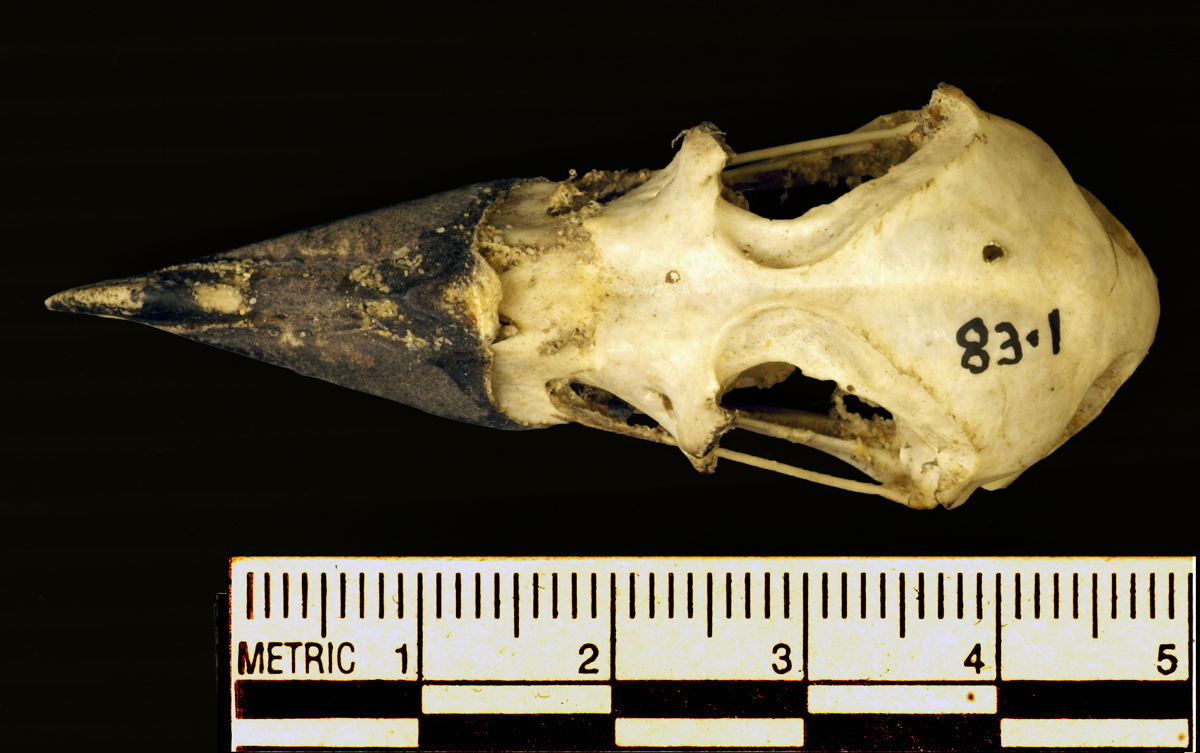
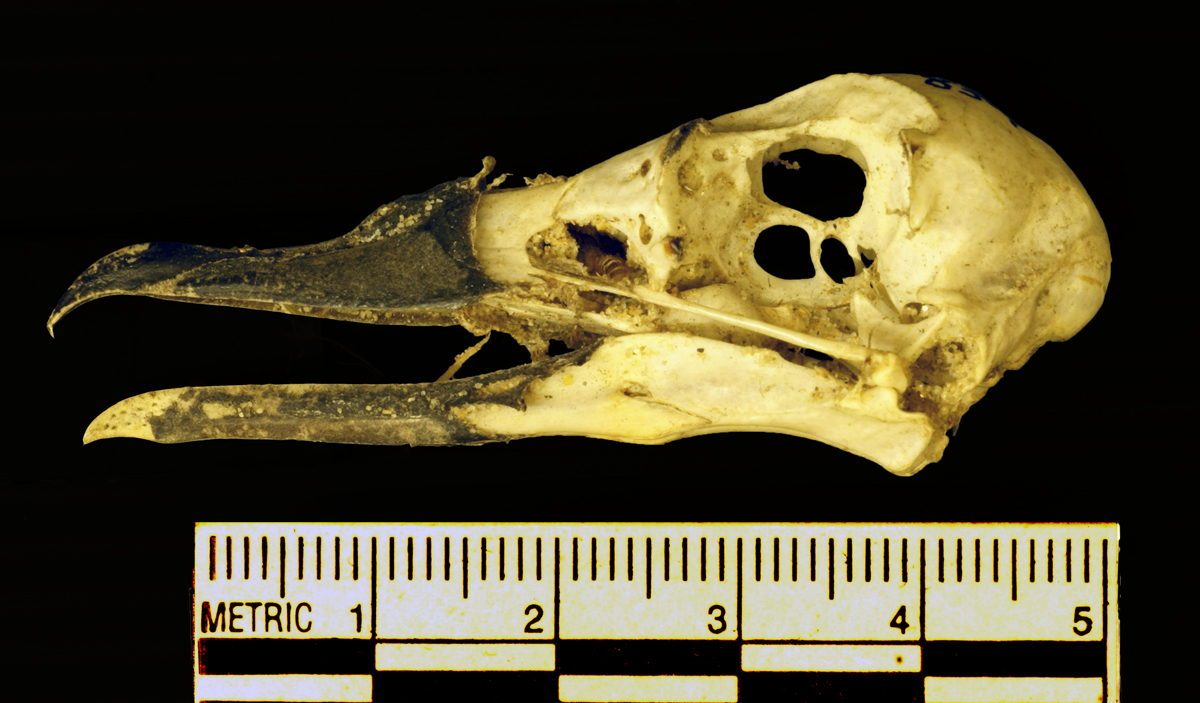
On Friday I gave you this skull to identify from box NH.83.1:

Unfortunately I’ve not been able to respond to comments and this answer is a little late (and short) because I’ve been at a wedding in Ireland (for anyone who knows what this entails you will understand…). I will take the time to respond to comments and elaborate on answers when I get back home and have managed to get more than a couple of hours sleep.

For now I will say that Steven D. Garber, PhD suggested that this was a petrel skull, probably for the reason posited by Cromercrox – it has a tube nose and is therefore from the Order Procellariiformes. David Craven noticed that the skull is too small for an albatross and the beak is too broad at the base to belong to a storm-petrel – both being excellent observations, but the concluding suggestion of something from the Pterodroma was slightly out – they’re a bit too big. A-M (via KateV) and Prancing Papio, FCD also went for species that are a bit too big, but Rachel managed to get something the right size and shape (and distribution working with SmallCasserole’s observation about the other specimens from the same collection). She suggested   Continue reading

Friday mystery object #60

Mystery objects are usually items that I come across whilst working my way through the collections in storage at the Horniman Museum. This means you usually end up with a bit of mammal skull, since that’s what I’ve mostly been working with for the last year. Every now and again I stumble across a real mixed bag (or rather box) of specimens that need identification, so here’s another specimen from one of the boxes labelled NH.83.1 that provided mystery object #57 (click on the images for larger versions): 

I would like to take this opportunity to thank Cack-handed Kate for the loan of her camera and particularly for including the macro lens with it, which has already proved very useful indeed!

As usual, put your observations and suggestions below – but in a break from normal form I’m afraid I won’t be able to answer any questions today, as I am at a wedding and it would be frowned upon for me to be playing with my phone!

Friday mystery object #59

This week I have seen an awful lot of mystery objects at work as I’ve been sorting through some of the boxes of unidentified bone with my volunteers Cat and Jahcob. Mostly we seem to have hundreds of unlabelled sheep vertebrae, but there have been some genuinely interesting objects too.

Alas, without my camera I’ve not been able to take photos of any of this miscellanea – maybe next week… However, I do have a photo of a skull, taken before the death of my camera, that I think is pretty cool (if perhaps a little obvious for some of you):

So, do you have any idea what this beastie might be?

As usual put your questions, suggestions and observations in the comments section below, which I will do my best to respond to. Good luck!

Friday mystery object #58 answer

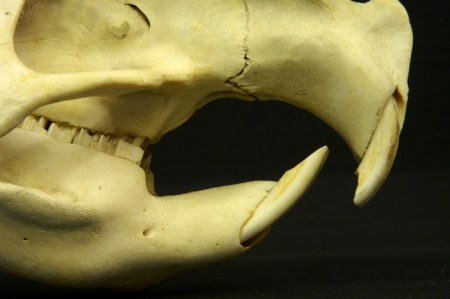
On Friday I gave you this skull as a mystery object, dredged as it was from the memory card of my severely concussed camera:

This was a slightly sneaky object, because I had a feeling that quite a few of you would make the same mistake as I did when I first saw this skull, by assuming that it’s from a large rodent. The large front teeth (the incisors) support this, since enlarged first incisors are a feature of the rodents.

Rodents also have a large gap behind those incisors called a ‘diastema’ – which this skull has for the lower jaw (or mandible), but you may notice that the upper jaw has three incisors in the pre-maxilla (that’s bone in the front bit of the upper jaw) before the diastema. This is easier to see in a side (or lateral) view:
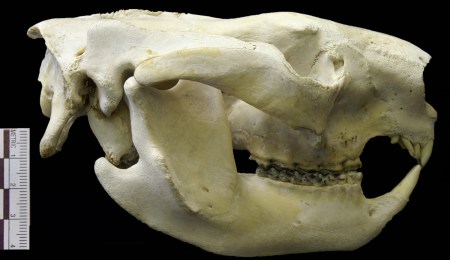
You might notice that there’s a small tooth behind the third incisor in the upper jaw – that’s a canine. You might also notice the faint wiggly line in the bone of the jaw just above the canine – that’s the junction (or suture) between the maxilla and the pre-maxilla bones. The canine is the first tooth in the maxilla and all the incisors are in the pre-maxilla (this is the same for all mammal teeth).

Rodents only have two teeth in the pre-maxilla, not six. They also have no canine teeth in the maxilla. That means this mystery object cannot be a rodent. Here’s what a rodent’s diastema looks like (the suture between maxilla and pre-maxilla is really clear in this photo):
Lagomorphs (rabbits and hares) have teeth similar to rodents, except they have an extra pair of incisors behind the front pair in the maxilla – these are called ‘peg teeth’:

Rabbit_peg-teeth

Peg-teeth in a Rabbit skull

Clearly the mystery object has more incisors than this, plus those canines, so it can’t be a lagomorph either.

So what beastie has six upper and two lower incisors? Several of you worked out that this was a marsupial from the dentition (namely Cromercrox, jonpaulkaiser, David Craven and Zigg), but only Prancing Papio and Jamie Revell managed to get it to species, namely the  Continue reading

Friday mystery object #58

Alas, my camera died after receiving a bit of a knock, so the mystery object I had planned for this week has been replaced by one of the last specimens I took a photo of:

Any idea what this specimen is, where it lives or what it might eat?

Put your suggestions, observations and questions in the comments section below and I’ll do my best to answer as the day goes on. Good luck!

Friday mystery object #57 answer

On Friday I gave you a specimen that I had to identify myself earlier in the week:

The first steps of this identification are quite straight-forward – in the words of Jake it “Looks a bit sheepy and a bit deery” which pins this firmly in the order BovidaeDave Godfrey neatly summarised what makes it look sheepy and deery – “Diastema, lack of upper incisors, and the shape of the teeth“. Rob went a step further and ruled out deer, sheep, goats and camelids – coming to the conclusion that this is an African bovid of some kind. Then David Craven blasted through the narrowing-down process and hit upon the same species as I had concluded it was, namely a  Continue reading

Friday mystery object #57

This Friday I’m taking the mystery object back to its roots, with unidentified specimens that I’ve found in the collections at the Horniman Museum where I am a curator. Yesterday myself and my trusty volunteer Cat came across two boxes labelled NH.83.1, which between them contain twenty unidentified skulls from a variety of different animals, ranging from fish to birds and mammals. This box had been in the collections since the 1930’s and there was little information to help make identifications – perfect material for mystery objects! Here’s one of the specimens I managed to identify – I’d like to see what you come up with…

As usual, put your observations, suggestions and questions in the comments section below and I’ll do my best to give you what information I can. Good luck!

Friday mystery object #56 answer

On Friday I gave you this object to identify:

I must admit that I thought it would be a tricky one, but I was surprised by the number of correct answers that came in, with the first by Prancing Papio who immediately got it to species. Neil made a subtle comment (“Looks like it could go both ways“) that almost passed me by, but which indicated that he knew which group this skull belonged to (see below for elucidation), whilst David Craven and Jamie Revell both pinned it down to species as well. That identification was  Continue reading