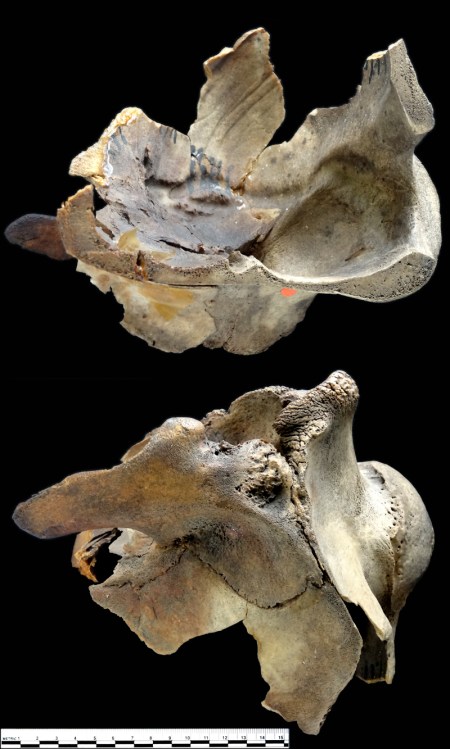
Friday mystery object #184

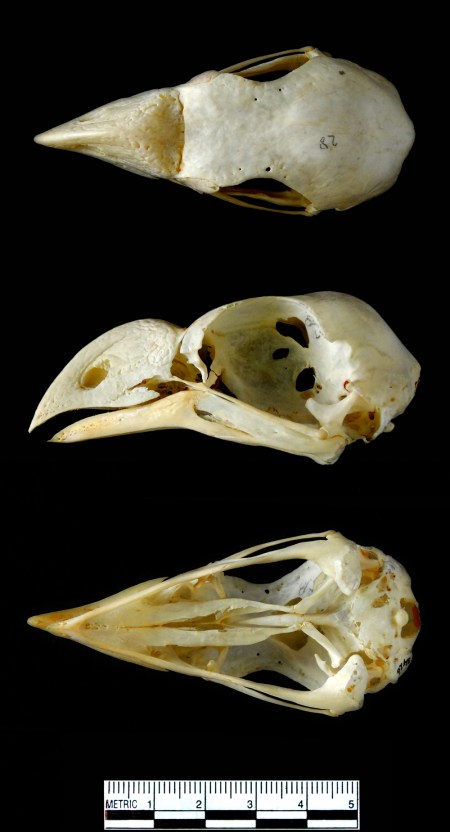
This week I have yet another mystery object that I’ve not managed to identify myself. Do you have any idea what this is and what animal it came from?

mystery184

As usual you can put your comments below and will be eagerly checking them out in the hope that someone recognises this bony structure. Enjoy!

Oddjects No.2

Some interesting things have been coming to light in the reviews going on at the Horniman. Here’s an object that our Anthropology review team uncovered and asked me to identify.

oddjects2a

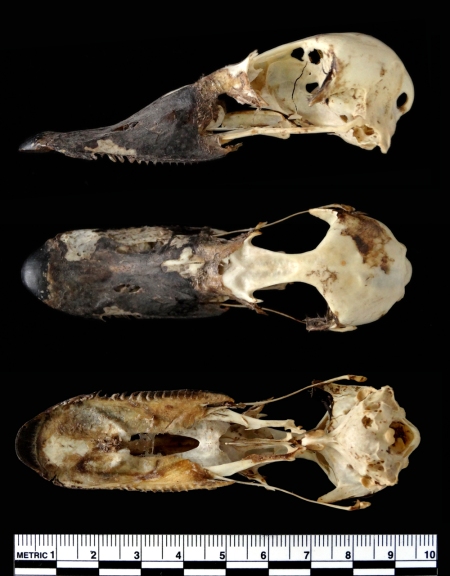
It looks a bit like a bird of prey with a gimp mask, but it’s actually a charm from Nigeria.

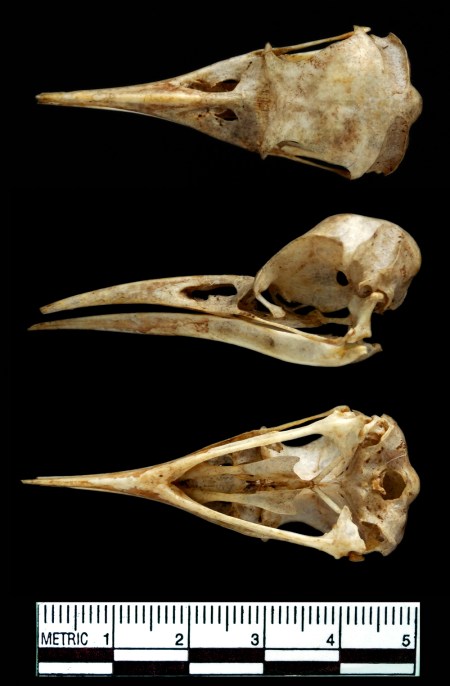
Fortunately, I’d just gone through our bird skull collection and I immediately recognised this becowled bird skull as being from a Lappet-faced Vulture, so it was an easy identification – particularly since the skull is 18cm long and from Africa, which helped narrow down the possibilities considerably!

Here’s the Anthropology specimen compared directly to our Natural History specimen, so you can see what would be under the leather:

Oddject2

We’re also in the middle of our first collections Bioblitz at the moment, so expect to see a lot of activity on the @HornimanReviews Twitter feed!

Friday mystery object #183 answer

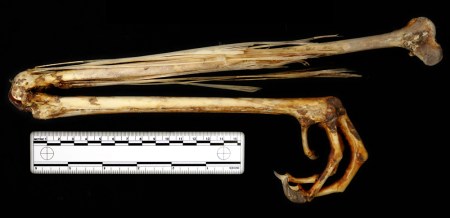
On Friday I asked for help with identifying an object that I came across while working on the Horniman’s bird collections for our forthcoming Bioblitz review:
mystery183a

I must say that I was surprised at how many people came and checked out this post and offered suggestions – largely following a retweet from the excellent QI Elves. Many thanks to everyone who offered their suggestions. In this post I’ll look at some of the suggestions and let you know what I’ve narrowed it down to.

Here’s an annotated version of the image to help make my terminology clear:

mystery183g

There were quite a few suggestions of Moa, Ostrich, Emu, Cassowary or Rhea (which are all Palaeognaths), but this leg is way too small and although the hallux is reduced it is definitely there, whereas in the Palaeognaths the hallux is absent. Here’s the specimen alongside an Ostrich foot:

mystery183f

A Secretarybird was another common suggestion and it was the first possibility that I thought of myself. Secretarybirds use their long legs to walk the plains of Africa in hunt of prey, which they stamp and kick to death. However, when compared to a Secretarybird in the Horniman’s collection it proved to be different in the relative proportions of the tibiotarsus and tarsometatarsus and the total length to the toes:

mystery183d

Seriemas were also suggested – these birds fill the same niche as the Secretarybirds, but in South America. They have one short digit with a sickle-like hunting claw, almost like a Velociraptor, however the mystery object has fairly equal length digits.

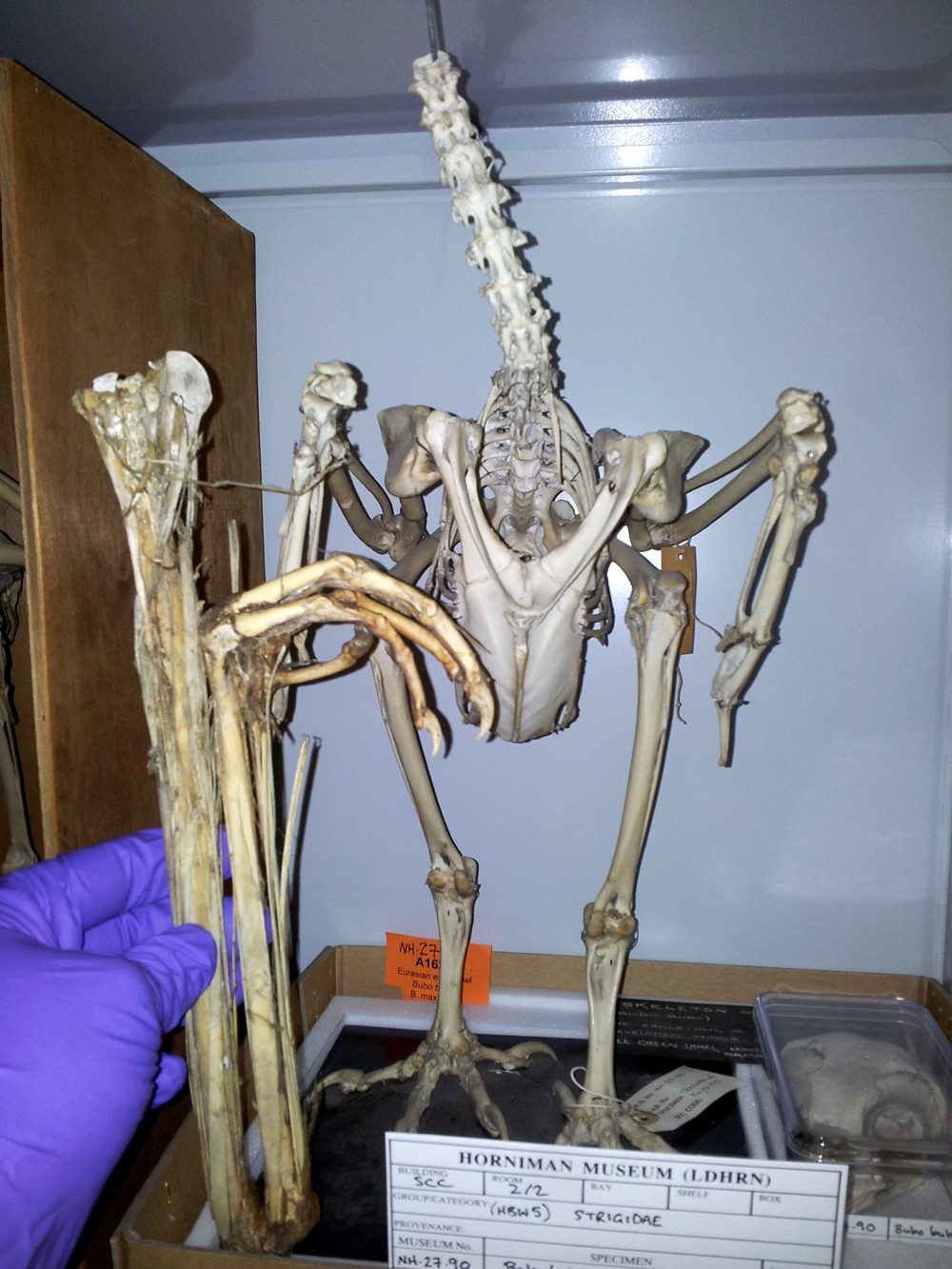
Owls were suggested, but this leg is far too long to have come from any species of Owl. Here’s the specimen compared to the biggest (or second biggest) species, the Eurasian Eagle Owl:

mystery183e

The suggestion of Owl probably arose because of the curved claw, which also looks a bit like it might belong to an Eagle or Vulture. However, the bones don’t seem to be robust enough for any of these kinds of birds. The claw confused me quite a bit, since most of the remaining possibilities are wading birds that don’t have big curved claws. This led me to reassess the claw by straightening out the digit of the mystery object in Photoshop to see if the apparent curve and size of the claw is actually a result of the postmortem clenching of the foot:

mystery183c

When viewed like this, the claw seems proportionally smaller and less likely to be from a predatory bird, especially considering that with flesh and skin on the bone the claw would seem even smaller.

This realisation made me reconsider the long-legged birds that I’d discounted at first – in particular the Herons, Storks and Cranes. I did consider Flamingo, but they have webbed feet and an even more reduced hallux than seen in the mystery object. Conversely, Herons could be excluded because they don’t have such a reduced hallux:

Heron Foot Detail by TexasEagle

Some Storks have limbs with the right sort of proportions – as helpfully summarised by henstridgesj:

The ‘FMO’: 1:0.73
Various Cranes: 1:0.7 – 1:0.8
Marabou Stork: 1:0.74
Maguari Stork: 1:0.75
Lappet-Faced Vulture: 1:0.63
Secretary Bird: 1:1
Flamingo: 1:0.84
Seriema: 1:0.87

But their claws seem too small and straight. That leaves the Cranes – as suggested by The Shonko Kid, André Rodenburghenstridgesj and Skullsite’s Wouter van Gestel. This would fit the proportions of the elements of the leg, the length of the hallux and the size and shape of the claws. It would also agree with the highly ossified tendons – a trait common to Cranes.

So, I don’t have a specific answer for you this week (that’s two weeks in a row!), but I think this leg probably belonged to one of the Cranes. Thanks for your help in getting that far!

Friday mystery object #183

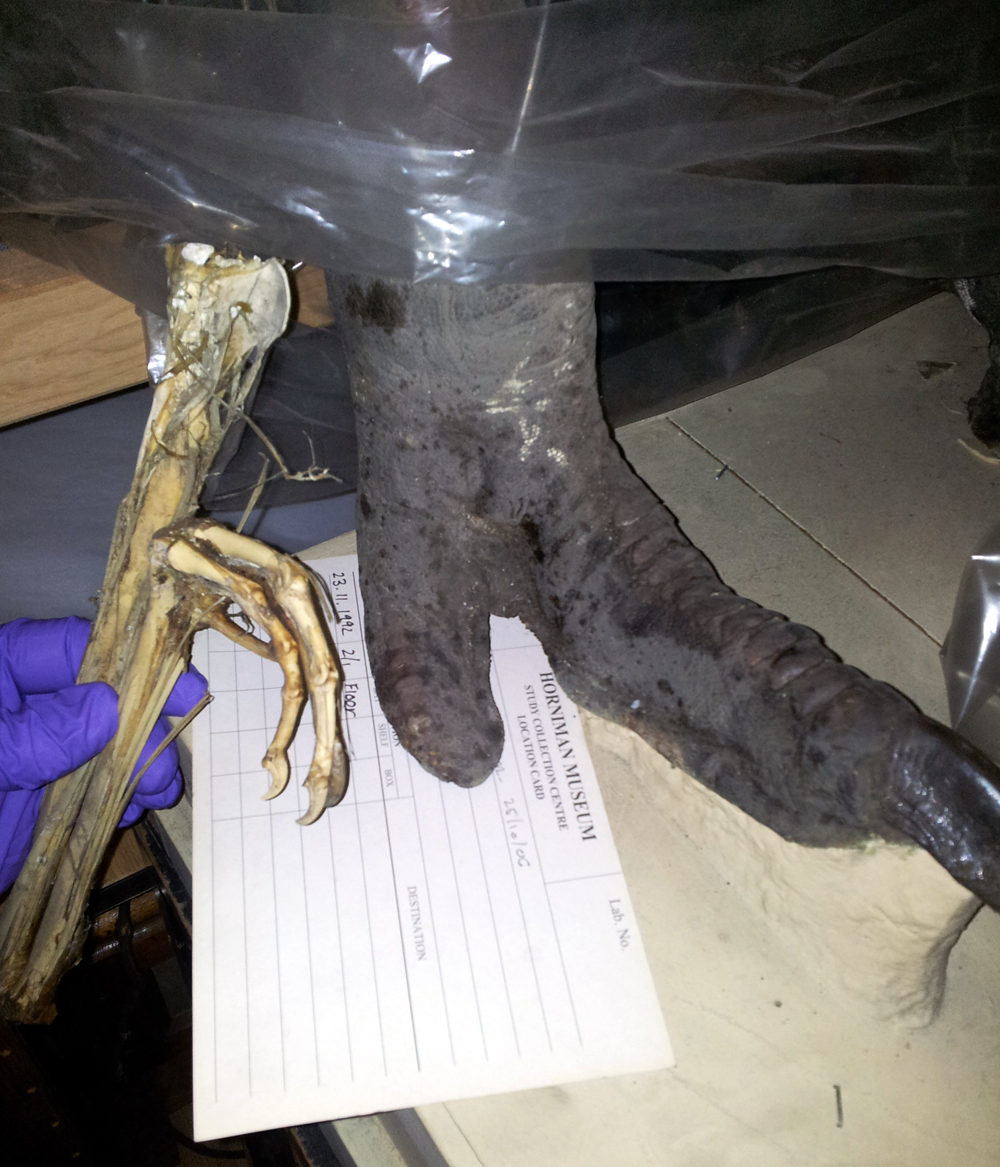
This week I have another genuine mystery object for you to have a go at identifying. I found a pair of legs in the collection and although I can think of a few things that they don’t come from, I’m a bit stumped as to what they did come from. Here’s one to give you an idea of what they look like:

mystery183a


mystery183b

Any suggestions would be appreciated!

Friday mystery object #182 answer

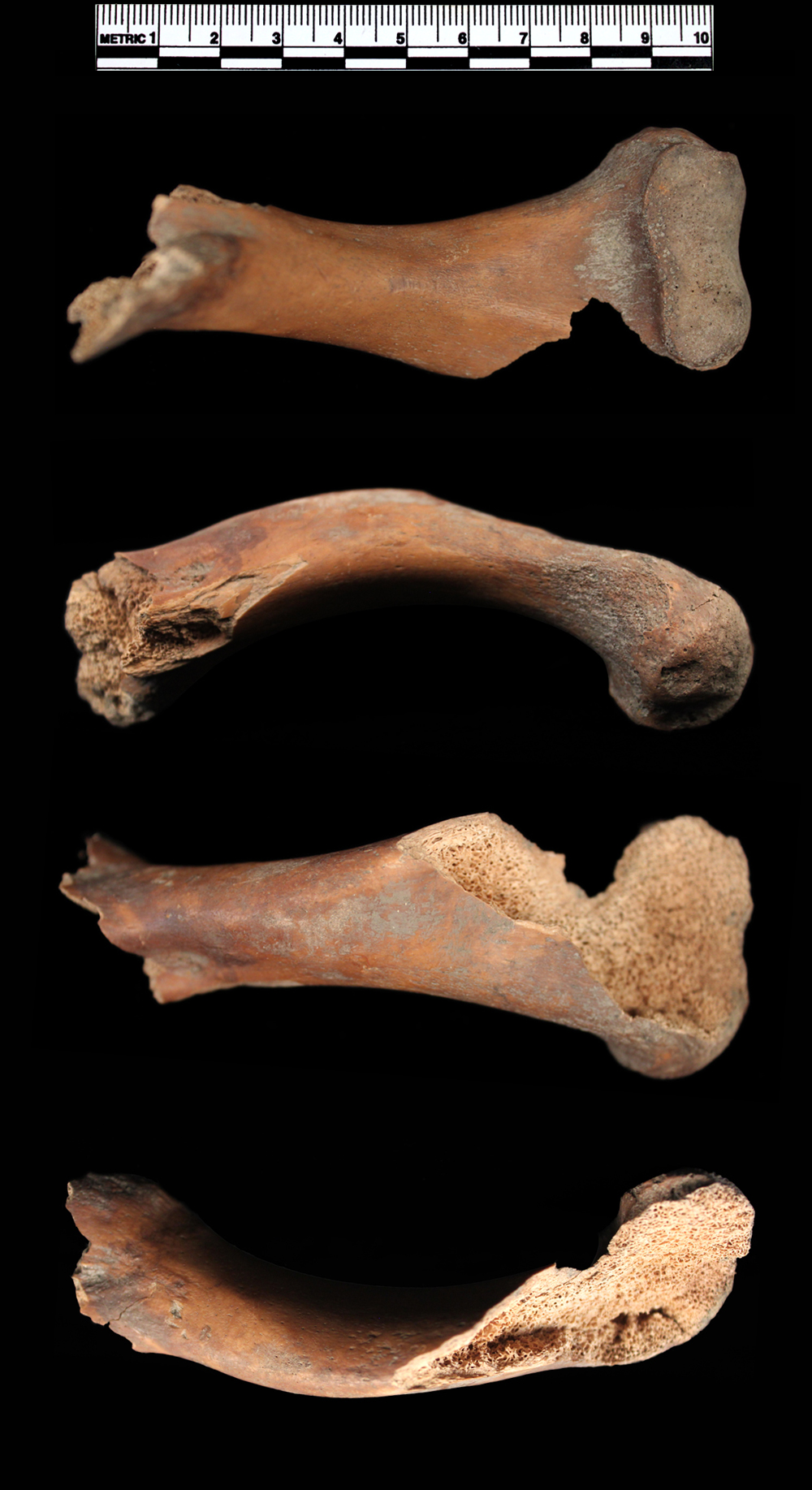
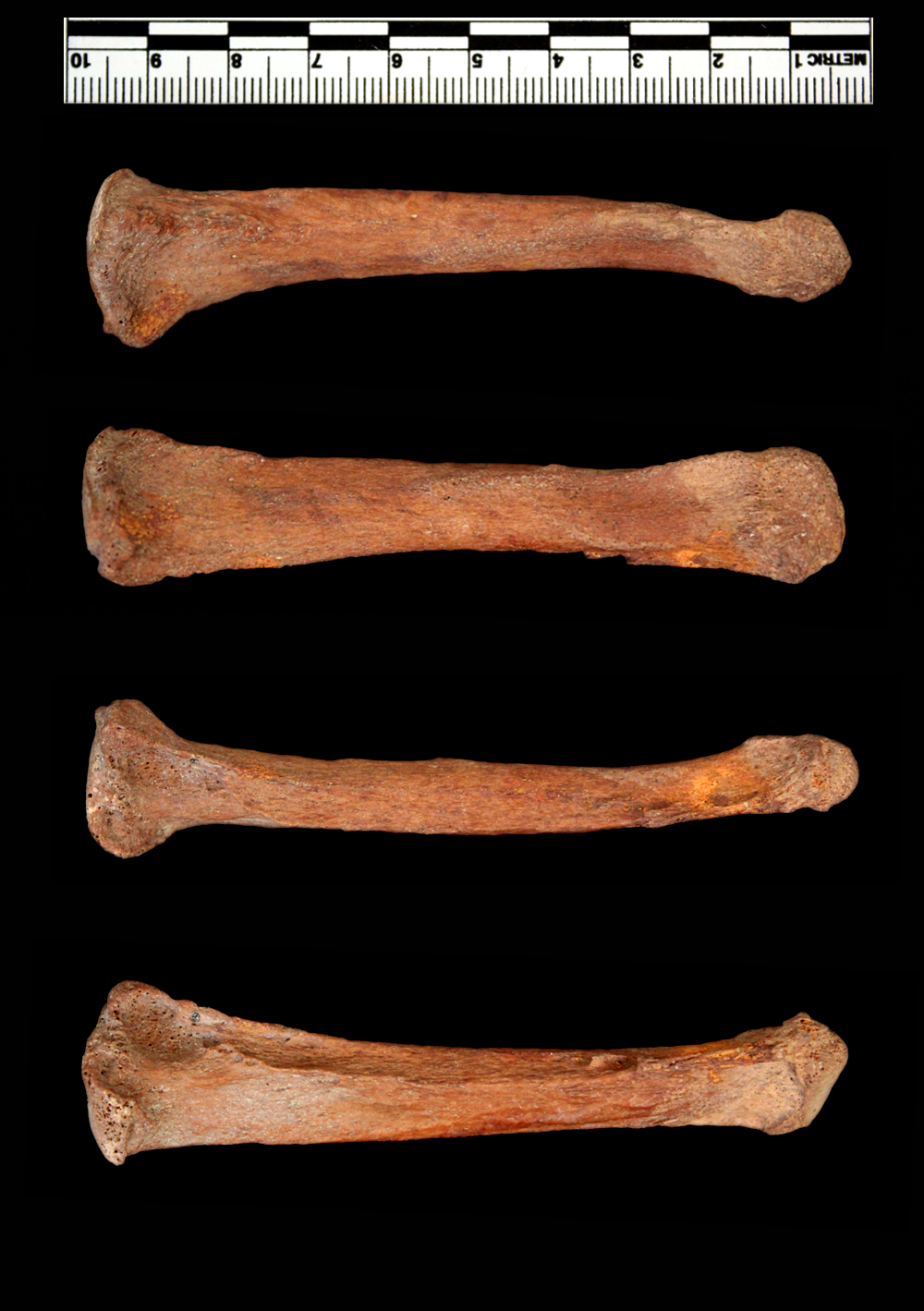
On Friday I gave you these objects to identify from Cyler Conrad, who came across them from an archaeological dig in San Francisco Bay:

mystery182a

mystery182b

I hasten to add that there is no certain answer to what these objects are, but I think there were some useful observations made by contributors and I will share my thoughts. Please feel free to continue the discussion in the comments below.

Barbara Powell and henstridgesj made some great suggestions, mainly focusing on marine mammals, particularly among the Otarids (Sea-lions and Fur-seals). Some of these large mammals certainly occur in the San Francisco Bay area (well, the Northern Fur Seal Callorhinus ursinus, Guadalupe Fur Seal Arctocephalus townsendi, Steller Sea-lion Eumetopias jubatus, California Sea-lion Zalophus californianus are all there) and they have femurs that are broadly the right size and shape as the bone in the top image – the humerus in these species is quite different, possessing a distinctive crest on the shaft.

However, I’m a bit thrown by the articular surface visible in the top image. In the Sea-lions and Fur-seals the femur has two distinct and narrow articulations with the tibia and fibula, since these animals bear weight on their hind flippers. The fact that the top specimen only shows one broad and fairly poorly defined articulation makes me think it may belong to a Phocid seal (which drag their hind flippers), which for this area would either mean a Northern Elephant Seal Mirounga angustirostris or Harbour Seal Phoca vitulina.

Given the size, I would think it would either be the femur from a large male Harbour Seal (although males are only slightly bigger than females) or a smaller female Elephant Seal, but unfortunately I can’t find comparative material to help draw a conclusion. What I have noticed is that the Harbour Seal does tend to have a relatively broader femur than we see here, but without an Elephant Seal femur for comparison I’m stumped.

The other bone looks like the first metacarpal of one of these animals and doesn’t really add much more information.

Alas, sometimes identifications are hard to make with confidence.

Friday mystery object #182

This week I have a bit of break from the norm. Rather than giving you a specimen from the Horniman to identify, I have a couple of guest mystery objects from Cyler Conrad for you to attempt.

These two bones were uncovered in an archaeological site in San Francisco, California, USA and they are proving hard to identify. Any idea what they might be from?

mystery182a

mystery182b

As always, you can put your comments and suggestions below, but please also feel free to engage in discussion about these objects – let’s see what emerges!

Friday mystery object #181 answer

On Friday I gave you this bird skull to identify:

mystery181

I thought it might prove a bit of a challenge, since it belongs to a bird that isn’t found in Europe or North America. However, the skull shape and size is quite unique and I was forgetting the impressive skills of the Zygoma readers, so it didn’t take too long for Barbara Powell, Wouter van Gestel (who I believe may be involved in SkullSite.com – one of my favourite web resources) and henstridgesj to narrow it down to the correct species.

This skull belongs to a member of the Cuculiformes, family Musophagidae (‘banana-eaters’) and to be specific it’s from a   Continue reading

Friday mystery object #181

This week I have yet another bird skull from the collections I’m working on that I thought you might find interesting:

mystery181

Any idea what this skull came from? As usual you can put your suggestions and questions below and I’ll do my best to reply during the day. Good luck!

Friday mystery object #180 answer

On Friday I gave you this skull to identify:

mystery180

It was pretty clear that it’s from a modern animal with a duck-like bill, so either a Platypus or a member of the Anatidae (the family containing ducks, geese and swans).

There are about 140 species within the Anatidae, so narrowing it down to species was the challenge. For me the main features that help identify this duck from all the other species were the concave profile and the width to length relationship of the bill, the shape of the lacrimal bones (the bits in front of the eyes) – with the supraorbital processes bordering the salt glands, and the shape of the palate – with its mid-point deflection and flare.

It seems that some of you spotted some of these features too, since henstridgesj, miekeroth and Barbara Powell came to very similar conclusions. This skull looks like it belonged to a Common Scoter Melanitta nigra (Linnaeus, 1758) and a female Common Scoter at that, since the males have a much more inflated bill than this specimen.

Female Common Scoter photographed by Hilary Chambers

Female Common Scoter photographed by Hilary Chambers

Common Scoters are sea ducks that dive for small crustaceans, molluscs and sometimes fish. They are migratory birds and although there only a few hundred breeding the UK, there are larger flocks of visiting birds over the winter, although they’re hard to spot since they are usually a fair distance out to sea for much of the time.

Friday mystery object #179 answer

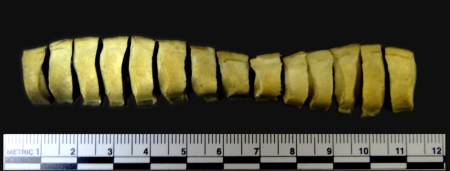
On Friday I gave you this really tricky mystery object to identify:

mystery179

Despite it being one of the hardest so far, Barbara Powell managed to not only work out what piece of morphology this specimen represents, but the species it came from. Remarkable skills Barbara!

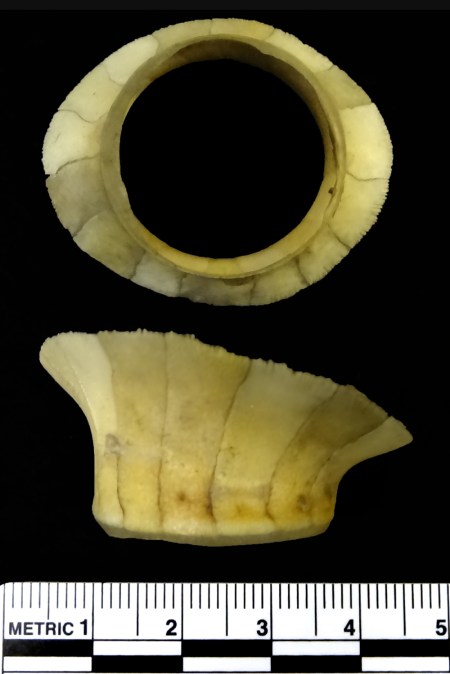
These plates of bone fit together to make a ring like this:

mystery179b

You probably have a better chance of identifying the structure when it’s assembled like this and the tubular shape is characteristic of a particular order of birds. This is the sclerotic ring of an  Continue reading

Friday mystery object #178 answer

On Friday I gave you this piece of a skeleton to identify, to help me track down the specimen it came from:

mystery178

It looks like a wing, but it’s quite oddly shaped. The humerus is strongly curved and the humeral head is small with a very limited area for muscle attachment. This suggests that it wasn’t much use for flying – it also wouldn’t have been much use for swimming underwater or any other kind of locomotion for that matter. This narrows down the possibilities quite a bit.

With these clues RH, henstridgesj and Lena all came to the same conclusion as I did – this wing is from a  Continue reading

Friday mystery object #177 answer

On Friday I gave you this scrappy bit of bone to identify:

mystery177

It came into the Horniman collections from King’s College in the 1980s and it was tentatively identified as a piece of ungulate bone. I’m pleased to say that you managed to do a better job of identifying the specimen than was done originally! In particular Jake managed to narrow it down to being part of the braincase of a cetacean, possibly a species of dolphin or porpoise, with henstridgesj and RH also thinking along the same lines.

When I first saw this piece of bone I also thought it belonged to one of the smaller toothed whales and so moved it from its place among the ungulates to a place in the collection with other cetaceans. This proved to be a fruitful move, since I was checking through the various bit of whale at work the other day and suddenly realised that there was a broken piece of whale rostrum also from the King’s College collection. When I put them together, this is what I got:

mystery177b

A perfect fit! This meant that the identification of toothed whale was confirmed and even better the specimen could be identified as being from a  Continue reading

Friday mystery object #176 answer

On Friday I gave you this specimen to have a go at identifying:

mystery176

It’s a specimen that I came across when sorting out the bird osteology collections in the Horniman stores.

Several of you came to the same conclusion as me about the type of bird, with Jake, palaeosam and henstridgesj all suggesting one of the  Continue reading

Friday mystery object #175 answer

On Friday I gave you this anthropological mystery object to identify:

I asked you what the teeth might have belonged to and where in the world might this necklace be from.

It’s always a bit tricky to identify worked material as it will often be different from what you’d see or expect in the wild state and you lose the context of the rest of the specimen. Nonetheless, these teeth are quite distinctive to a particular group of animals.

Barbara Powell, 23thorns and Robin got the right general area with suggestions of Islands in the South Pacific, in particular New Guinea. 23thorns also nailed the animal group with his suggestion of  Continue reading

Friday mystery object #175

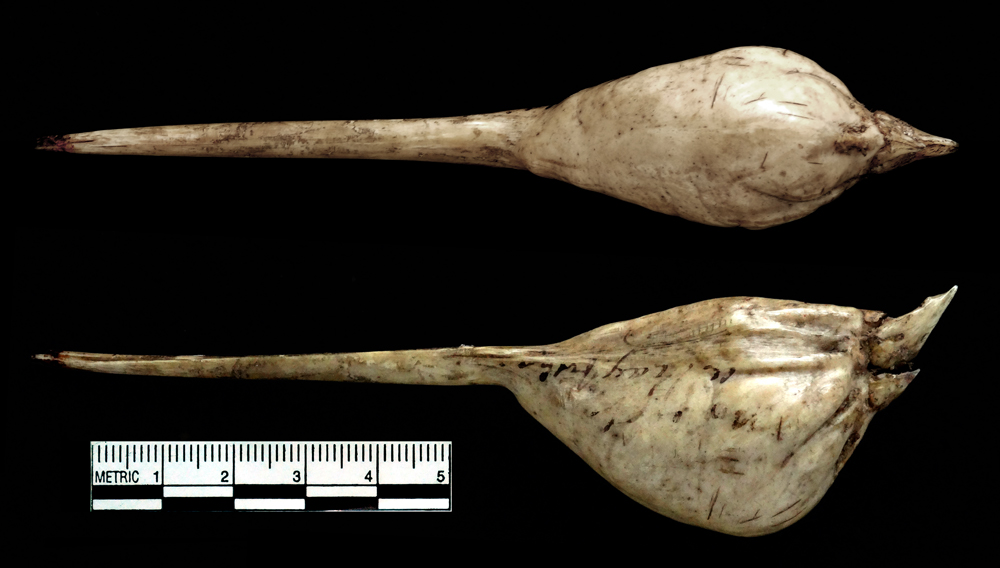
This Friday I have a bit of a change for you – an anthropological mystery object made from animal bits. This specimen was being looked at as part of a review project that we have going on at the Horniman Museum. Any idea what these teeth might belong to and where in the world this necklace might come from?

As usual you can put your suggestions, observations and questions below and I’ll do my best to respond. Good luck!