Oddjects No.6

Next week we’ll be reviewing our mineral collections at the Horniman, which means that I’ve been trying to track down the various minerals in the collection. Amongst them I found this rather lovely sample of bismuth – a non-toxic, silvery, heavy metal that can naturally grow into an intricate step-structure crystal.

Bismuth crystal

As the outer surface of the bismuth crystal oxidises it becomes iridescent, creating a beautiful and multifaceted structure that is really quite gorgeous. Hope you like it!

Friday mystery object #200 answer

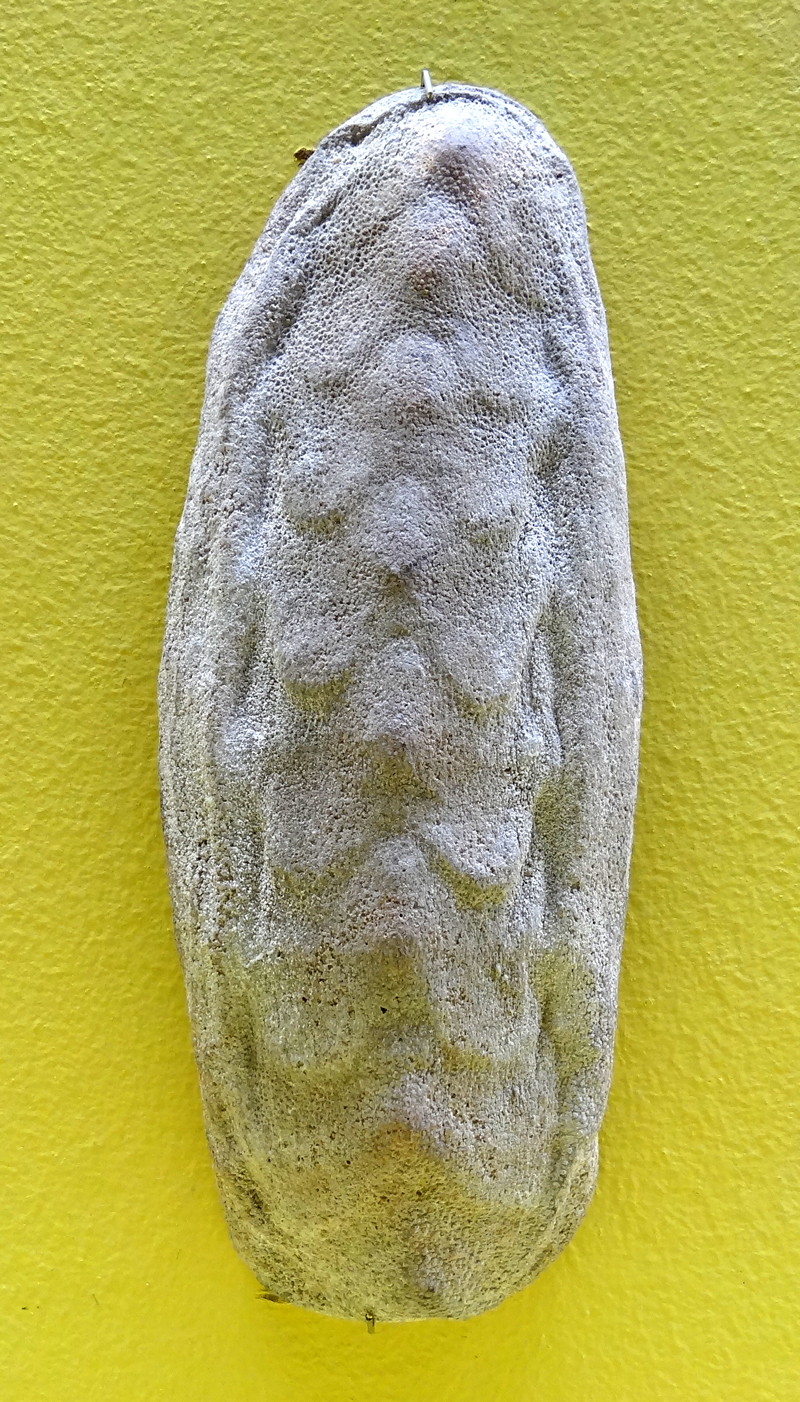
Last week I gave you this object to identify:

mystery200

It was a bit of a mean one, since it had no scale bar and the specimen is quite old and dried out, so it doesn’t look much like the living animal.

I had hoped that this would mean that nobody would manage to identify it, but I wasn’t at all surprised when correct suggestions started coming in.

Dave Hone was the first to get the correct kind of animal, although he was a bit thrown by the outer surface – vannabarber was also on the right track, but thrown by the texture. In fact the texture led to some interesting suggestions, including pumice, fossil, bezoar and Pompeian pinecone.

In the end, henstridgesj made the right connection and identified the species, with Anna Pike, rachel and Crispin Wiles all coming to the same conclusion. This is the dried and shrivelled remnant of a Gumboot (or Giant Western Fiery) Chiton Cryptochiton stelleri (Middendorff, 1847). Also known as the ‘Wandering Meatloaf’ for obvious reasons!

Cryptochiton stelleri (Gum Boot Chiton) by Jerry Kirkhart

Chitons are an ancient class of mollusc called the Polyplacophora – a name that means “bearing many (or several) tablets (or plates)”. They get this name from the eight plates (also known as valves) that they have on their backs.

Most chitons have these valves visible (see below), but the huge Gumboot Chiton has the valves hidden underneath their rubbery girdle.

Tonicella lineata

Tonicella lineata showing the eight valves characteristic of chitons

Chitons are remarkably conservative animals, having changed little since the group arose around half a billion years ago. They have few predators and manage to live a blameless and slow-paced life feeding on algae and detritus on rocks in the world’s oceans, that they rasp off with a fairly simple rasping radula.

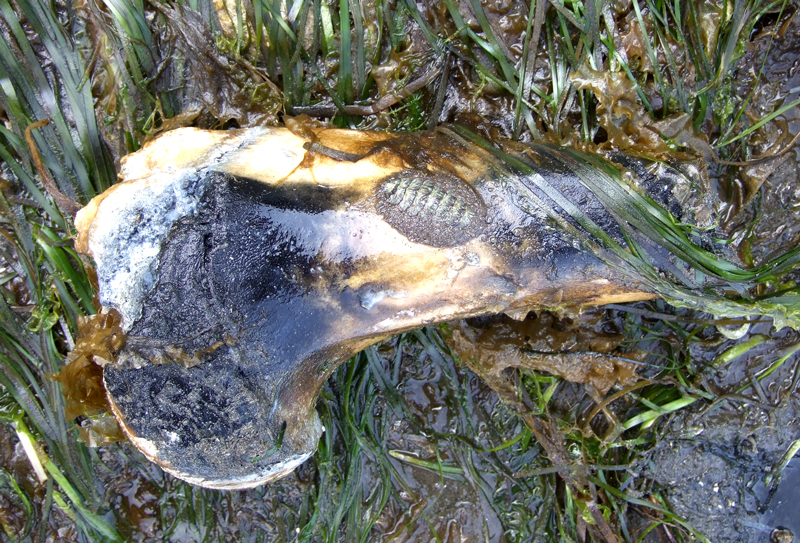
There are few ways of spending time on the sea shore that are more enjoyable than turning over rocks in the quest for chitons. Except maybe finding washed-up bones. Or maybe finding both together!

chiton-bone

Friday mystery object #200

I’m not quite sure how I’ve managed it, but this is my 200th mystery object. 100 objects ago I said that I was running out of ideas for new objects and time for writing answers, but clearly that problem hasn’t stopped me.

However, once again I feel as though I’m in a similar situation, especially with regard to the time I have available for writing answers. Therefore, I have decided to have a go at making the mystery object fortnightly, the answers being published a full week after the mystery object.

This longer turn-around for the answer will let me open the mystery object up for more guest contributions (since getting the answer over a weekend is usually a struggle) and hopefully that will make it more fun for everyone!

On to the object:

mystery200

Do you have any idea what this might be?

Leave your questions, comments and suggestions below – preferably in a cryptic format so others can have a go.

And don’t forget, the answer will be posted next Friday. Enjoy!

Friday mystery object #199 answer

On Friday I gave you this rather beautiful object to identify,which came to light during our mollusc Bioblitz last week:

mystery199

It turns out that it didn’t prove much of a challenge and was identified to species level in no time. So well done to Kevin, Anna Pike, @benharvey1 and Carlos Grau!

In fact, Carlos went a step further than identifying the specimen and told the very story I was planning to tell in this post. It’s great to hear stories like this about specimens or species, so I’ll share it with you in Carlos’ words:

This picture immediately brought back memories of my old seashell-collecting guide I had when I was about 12 and haven’t looked at for years and years (I will look for it next time I’m at my parent’s). The book said that this species was considered so valuable that fakes were made in rice paste by Chinese artisans, and that the counterfeits are now more rare and valuable than the actual shell! I remember finding that bit of information amazing.

It’s been so long I had to Google the book, it’s “Guide to Seashells of the World” by R. Tucker Abbott.

The animal is… Continue reading

Friday mystery object #198 answer

On Friday I gave you these two objects (with a third photo to show the end) to identify.

mystery198

The specimens had me a bit stumped. They are keratinous (keratin is the protein that makes up fingernail, hair and horn amongst other things) and perhaps unsurprisingly they had been labelled as “Artiodactyla horns” given their overall shape. Of course, if they were artiodactyl horns they would be from a bovid (antelope, sheep, cow, etc.), since the other artiodactyls don’t have unbranching horns.

There are nearly 150 bovid species, ranging from the gigantic Gaur to the miniature Royal Antelope, and so far I’ve not been able to find any with horns quite like this. Moreover, the very small size, pattern of growth and relatively shallow depth of the inside chamber of the sheath, don’t really agree with the identification.

My next thought was the spur of a galliform bird, like a Chicken. I compared these specimens to the spur of a male Chicken skeleton in the Horniman’s collection and they looked quite different and much too long, so I gave up on that idea.

Finally I started to consider claws of all sorts of animals, but this didn’t make much sense to me as claws aren’t usually round in cross-section and they have wear facets from being used to walk, climb or dig. You don’t have claws this big if you’re not going to use them and I couldn’t think of much use for a claw like this.

So that left me stumped.

Fortunately, Mieke Roth came to my rescue and made me reassess the Chicken spur identification. It turns out that the Chicken I compared the spur to much have had his spur sheaths  removed and they’d hardly grown back.

As you can see, the spur identification fits perfectly!

Many thanks to everyone for their suggestions on this mystery object. It really helps to have fresh eyes looking at a problem and suggesting something you’ve discarded in error!

Friday mystery object #197 answer

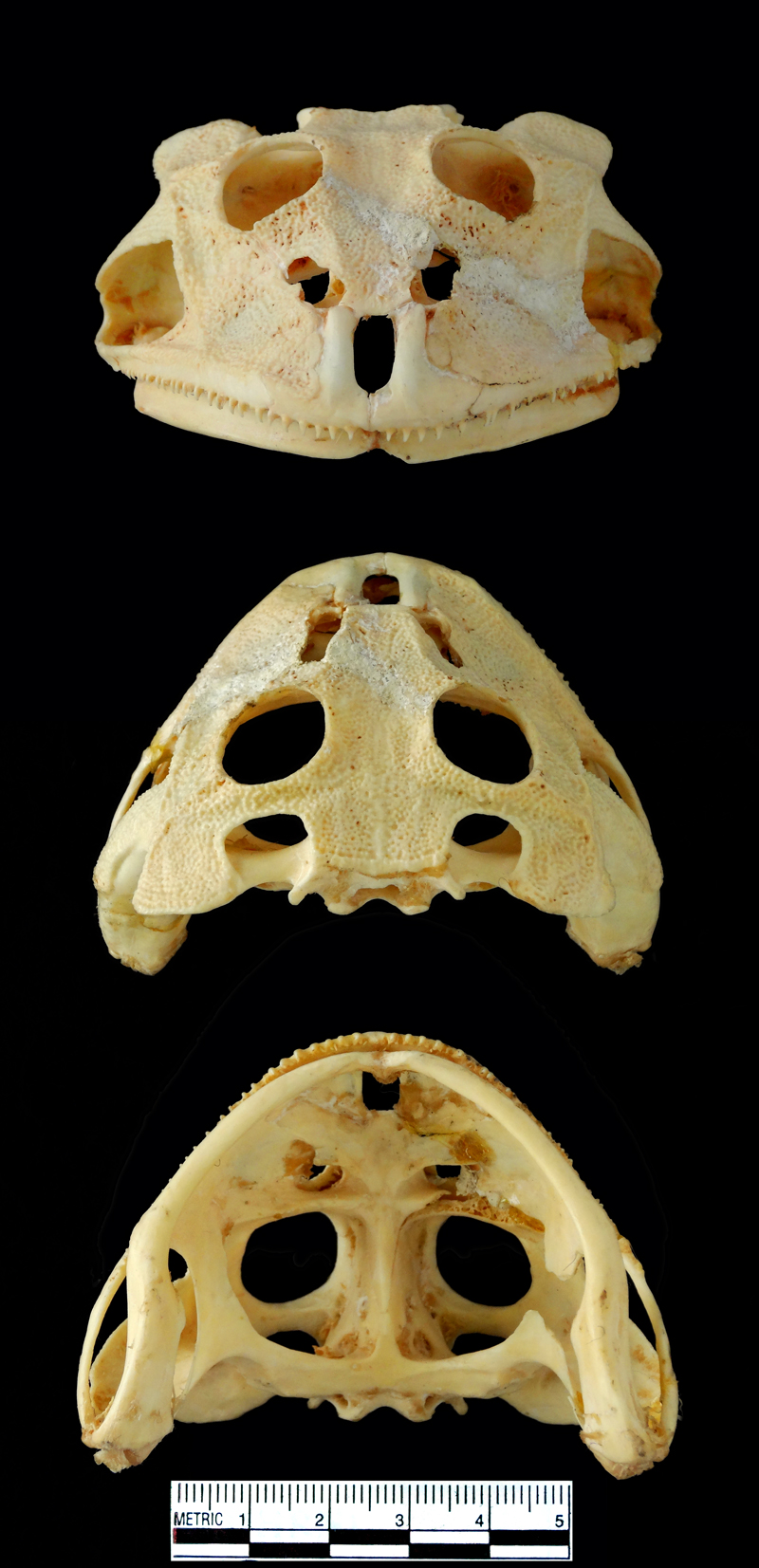
On Friday I gave you this skull to identify:

mystery197

As I suspected, it wasn’t too much of a challenge. Jake got in quick with the suggestion of a Sri Lankan Python, with Gina Allnatt, Kevin and Rhina Duque-Thues all agreeing with a generic Python sp. identification. Nicola Newton also suggested Python, but she was of the opinion that it was probably a Royal Python or Carpet Python on the basis of the size.

I agree with Nicola and think that this is most likely the skull of a Royal (or Ball) Python Python regius (Shaw, 1802), based on the size of the specimen and the shape of the supratemporal and frontal bones compared to other Pythons I was able to find images for (if you don’t know which bones I mean you can see what I mean on a handy annotated picture of a Python skull from the Digimorph website).

Pet ball python - normal phase, probably an import (rescue). By Mokele

The skull is one of several similar specimens from the old King’s College teaching collection, so it’s a pretty good bet that the skulls came from either research animals or pets. The Royal Python is a fairly small African Python that is commonly sold as a pet because it has a mild temperament – so that helps offer a bit of support for the identification, although what’s really needed is a detailed identification key for Python skulls or access to good comparative material.

The lack of good resources for identifying the skulls of snakes is a bit frustrating. After working with bird and mammal skulls, where there are some amazing resources like Skullsite and the Mammalian Crania Photographic Archive I’m still searching for something similar for reptiles. Perhaps the Deep Scaly Project will deliver the goods one day… here’s hoping!

Friday mystery object #197

This week I have a skull for you to identify – to make a change from the more tricky specimens I’ve had recently. Any idea what this belonged to?

mystery197

As usual you can leave your comments, questions and suggestions below and I’ll do my best to respond. Enjoy!

Friday mystery object #196 answer (well, not really)

On Friday I asked you to help me identify this mystery object:

mystery196

Many thanks to everyone who made suggestions about what this sacrum and caudal vertebrae (the bones that make up the tail) could be from. There were some useful ideas that I intend to follow up on, but alas I must apologise to you all because I’ve still not managed to make a confident identification (as yet).

I always struggle with the identification of vertebrae without having good comparative material. Skulls are straightforward to identify as they tend to contain lots of diagnostic features, but with vertebrae there are fewer distinctive feature that allow a straightforward species level identification.

In this case I’m still not sure whether this tail is from a marsupial, a monkey or a mustelid, although I’m pretty certain it’s from a mammal.

I think I may have to mop up some of the loose ends of mystery objects that I’ve not been able to confidently identify at some point, by making a trip to another museum with a bigger collection of postcranial material than I have available at the Horniman.

Of course, sometimes you just have to accept that there isn’t enough information associated with a specimen to make a confident identification at all. Sometimes you also need to ask whether it’s worth the extra time and resources trying to get a good identification for a specimen with no other good data about where, when and by whom it was collected.

This kind of information can turn an interesting display or teaching specimen into an even more useful research specimen, that can be used to address questions about species distribution, population genetics and evolution – amongst other things.

With a specimen that lacks these kinds of data – and which isn’t particularly visually exciting for display – it becomes more difficult to justify going to special efforts to identify it. Nonetheless, I know this specimen will bug me until I work out what it is!

Friday mystery object #195 answer

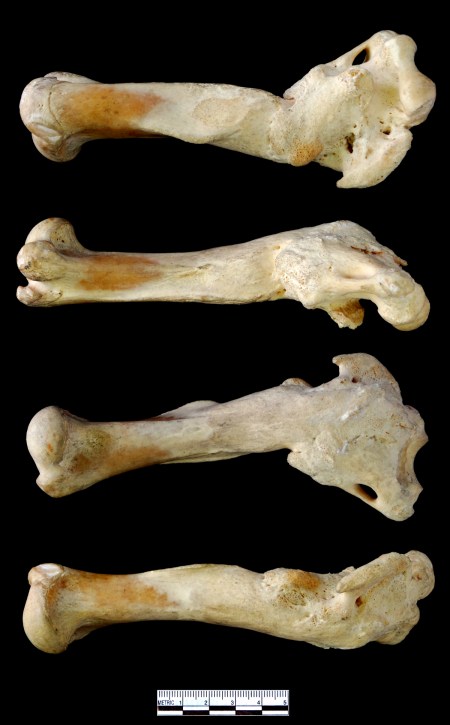
On Friday I gave you this mystery object from the collections at the Horniman Museum to identify:
mystery195

The bone is interesting because it was badly broken when the animal was alive. As Jake pointed out, the bone has healed without the attentions of a vet, so it hasn’t healed straight and there’s a lot of excess bone growth. This makes it harder to work out what the bone originally looked like.

Minioncat recognised that this is the humerus of a juvenile animal and although there were several species suggested on the basis of size, none seemed to quite fit.

Lena made a really helpful observation about the presence of a supracondylar foramen – which is the hole that can be clearly seen on the side of the bone in the top image, near the articulation on the right hand-side of the picture.

This foramen is something seen in some of the carnivores, like cats and mustelids, but the bone itself doesn’t really match any of the cat or mustelid bones that I compared it to.

When I first found this bone I though that it belonged to a tree-climbing (or arboreal) carnivore, because the head of the humerus would allow for a considerable range of movement (plus broken bones are common in arboreal animals). The only thing I could really think of that was likely was a small species of bear, since cat humeri are quite different from this.

However, on Twitter Raymond Vagell made the inspired suggestion that it could be the humerus of a Fossa Cryptoprocta ferox Bennett, 1833 – something that I never even considered.

Fossa (Cryptoprocta ferox) image by Ran Kirlian

I don’t have any Fossa postcrania for comparison and I can’t even find a good image of a Fossa humerus online, so it’s hard to check. There is a Fossa skeleton image on the Museum Victoria website, which shows that the humerus is pretty similar, but alas it’s a clear enough image to be more sure.

Once I started thinking about less commonly occurring carnivores I broadened my search and came across a paper with a comparative drawing of the humerus of a Binturong Arctictis binturong (Raffles, 1822), which is another tree-climbing mammal, with a similar humerus shape.

Binturong (Arctictis binturong) at Overloon, NL by Tassilo Rau

The long and short of it is that I still don’t know what specimen this mystery object came from, but I now have a fresh perspective for renewing my search, thanks to the people who get involved with the Friday mystery object. I will let you know if I get any further in my search for an identification, but I owe you all a big thanks for contributing!

Friday mystery object #195

Today I have a real challenge for you. This bone has a pathology that has significantly changed its appearance and it had no information associated when I found it. So far the best identification I have is very tenuous, so I thought it would be worth seeing if you had any ideas about what it came from:

mystery195

Feel free to put your thoughts, observations and suggestions below. No need for cryptic clues today I think – this specimen is cryptic enough!

Friday mystery object #193 answer

On Friday I gave you this specimen to identify:

mystery193

Unsurprisingly you all recognised it as a tortoise carapace. The species was a bit more difficult though as tortoises can display quite a lot of variation in their colour and shell structure within a species.

There were various good suggestions, but in the comments only Barbara Powell made reference to what Colin McCarthy and myself thought this was from, although Maggie J Watson also identified it in a tweet.

When we saw the specimen we thought that it was probably a  Continue reading

Friday mystery object #193

This week I’ve decided to give you an object to identify that came up in our collections review recently with the splendid Colin McCarthy. We have a lot of these in our collection, most of which were unidentified. Any idea which species this is from?

mystery193

You can leave your suggestions below and I’ll respond during the day. Enjoy the challenge and have a thoroughly enjoyable Easter break!

Friday mystery object #192 answer

On Friday I gave you this unidentified specimen from the Horniman’s collections to take a look at. I had already had a go at working out what it is, but it never hurts to get a second opinion.

mystery192

It’s actually a bit of a generic looking overall shape, perhaps reminiscent of a owl or a maybe a pheasant of some sort. However, the nares (nostrils) are very small and round and set in a bill that is sharp, shortish and very solidly constructed, which is something you only really see in a few passerines, some parrots and the falcons. The skull is too big for a passerine and the bill is totally the wrong overall shape for a parrot, which leaves us with a falcon – a fairly small one at that.

From there the shape of the palate and the proportions of the cranium led me to a species identification that I’m pleased to say agreed with that proposed by Tony Irwin and Wouter van Gestel (who eloquently explained the indicative characters that I mentioned above). We all think that this is the cranium of a  Continue reading

Friday mystery object #192

This week I have a skull with no data that I came across in the collections a little while back. I think I managed to get a decent identification on it, but I’d be interested to see if you all agree:

mystery192

What do you think it is? As usual you can put your suggestions below. Thanks for helping out!

Friday mystery object #190 answer

On Friday I gave you this skull to identify:

mystery190

The animal it comes from is quite distinctive, with loads of character, so it’s no big surprise that so many of you managed to identify it.

So well done to Jake, Dave Godfrey, henstridgesjMieke Roth, Wouter van Gestel, Steven D. Garber and Crispin – this is indeed a  Continue reading

Friday mystery object #190

This week I have a skull with character for you to identify. It will probably prove to be little challenge to some of you, but if you know what it is please try to use cryptic clues so you don’t spoil the game for others:

mystery190

Put your thoughts below and I’ll be sure to make comments during the day. Enjoy!

Friday mystery object #189 answer

On Friday I gave you this skull to have a go at identifying:

mystery189

I didn’t do a very good job of responding to comments I’m afraid, as I was rather busy at day two of this year’s Natural Sciences Collections Association conference at the Yorkshire Museum. Nonetheless, you managed to work out what this specimen came from without any input from me.

Jake spotted that it was the skull of a big reptile, more importantly, a big reptile with heterodont dentition (meaning it’s teeth aren’t all the same shape). That narrowed down the possibilities considerably. From there henstridgesj, Wouter van Gestel and Barbara Powell came to the conclusion that this is the skull of a  Continue reading

Friday mystery object #189

This week I have another interesting skull that came up during one of our recent reviews:

mystery189

Any idea what animal this belonged to? You can put your suggestions below and I’ll do my best to reply, although I will be at the NatSCA conference today, so it will depend on the quality of internet access on my phone.