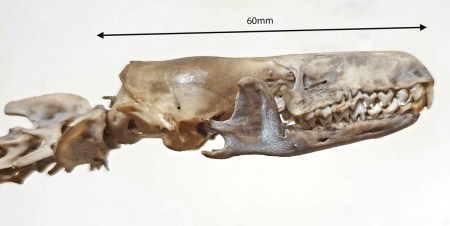
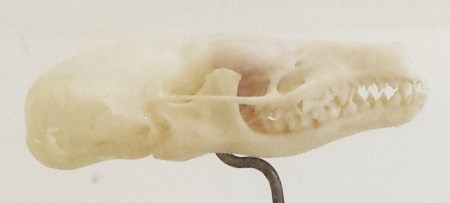
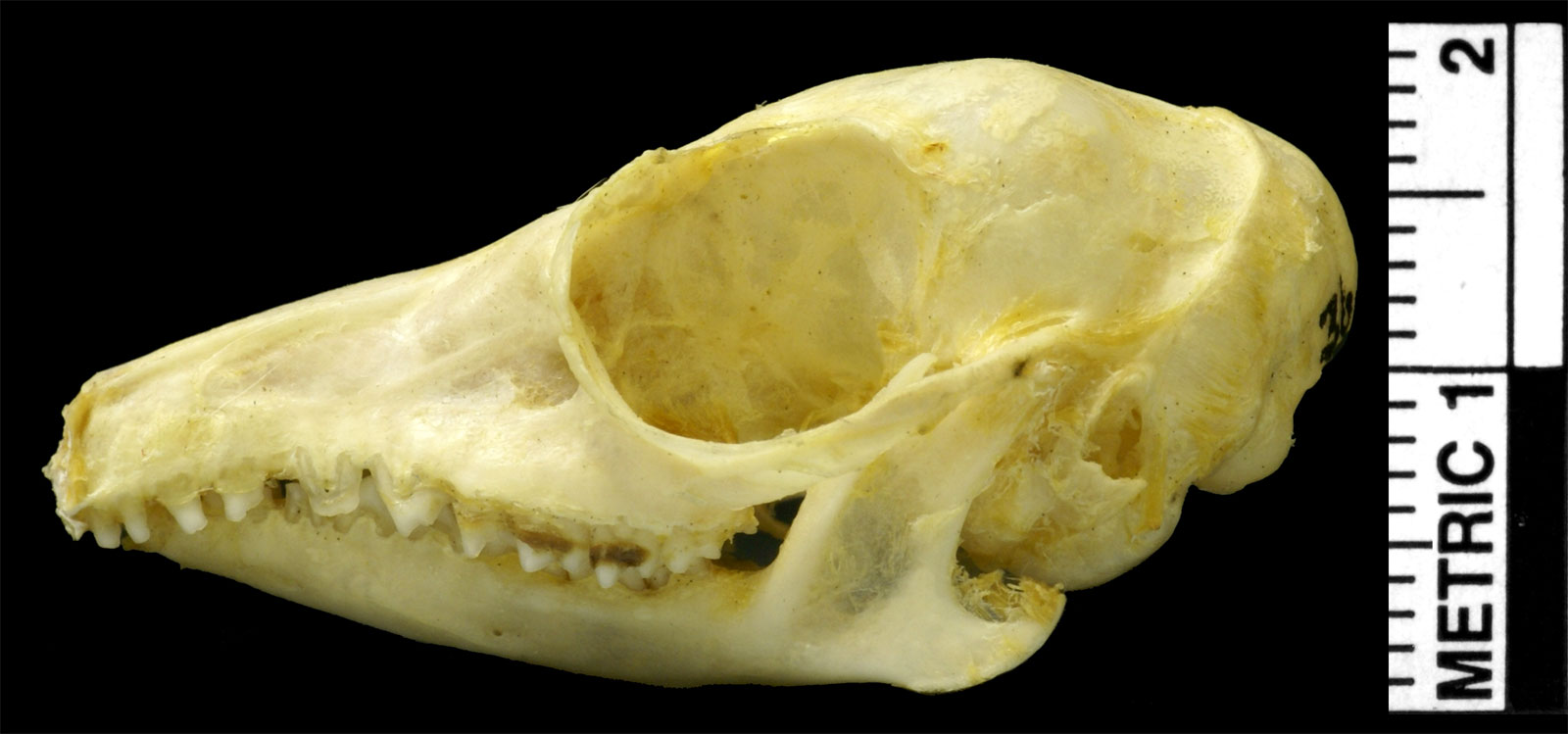
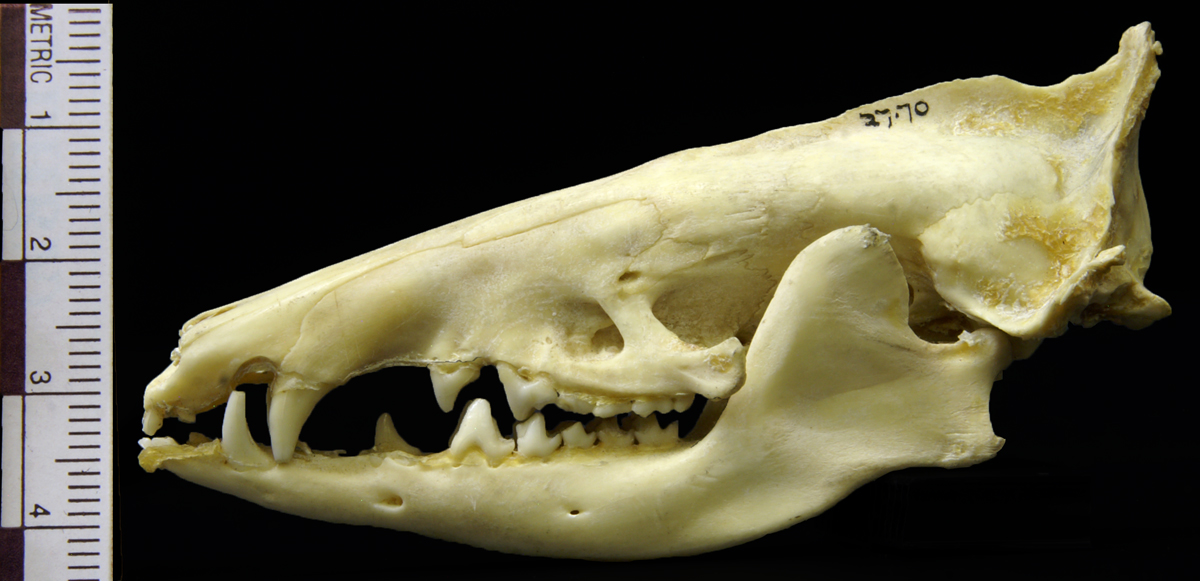
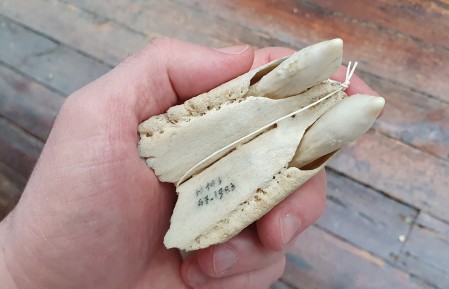
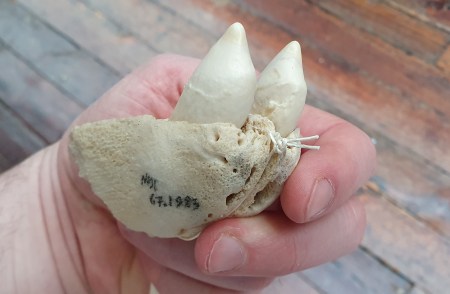
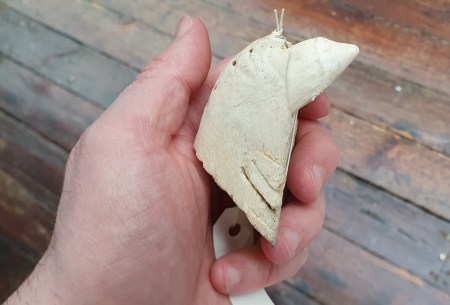
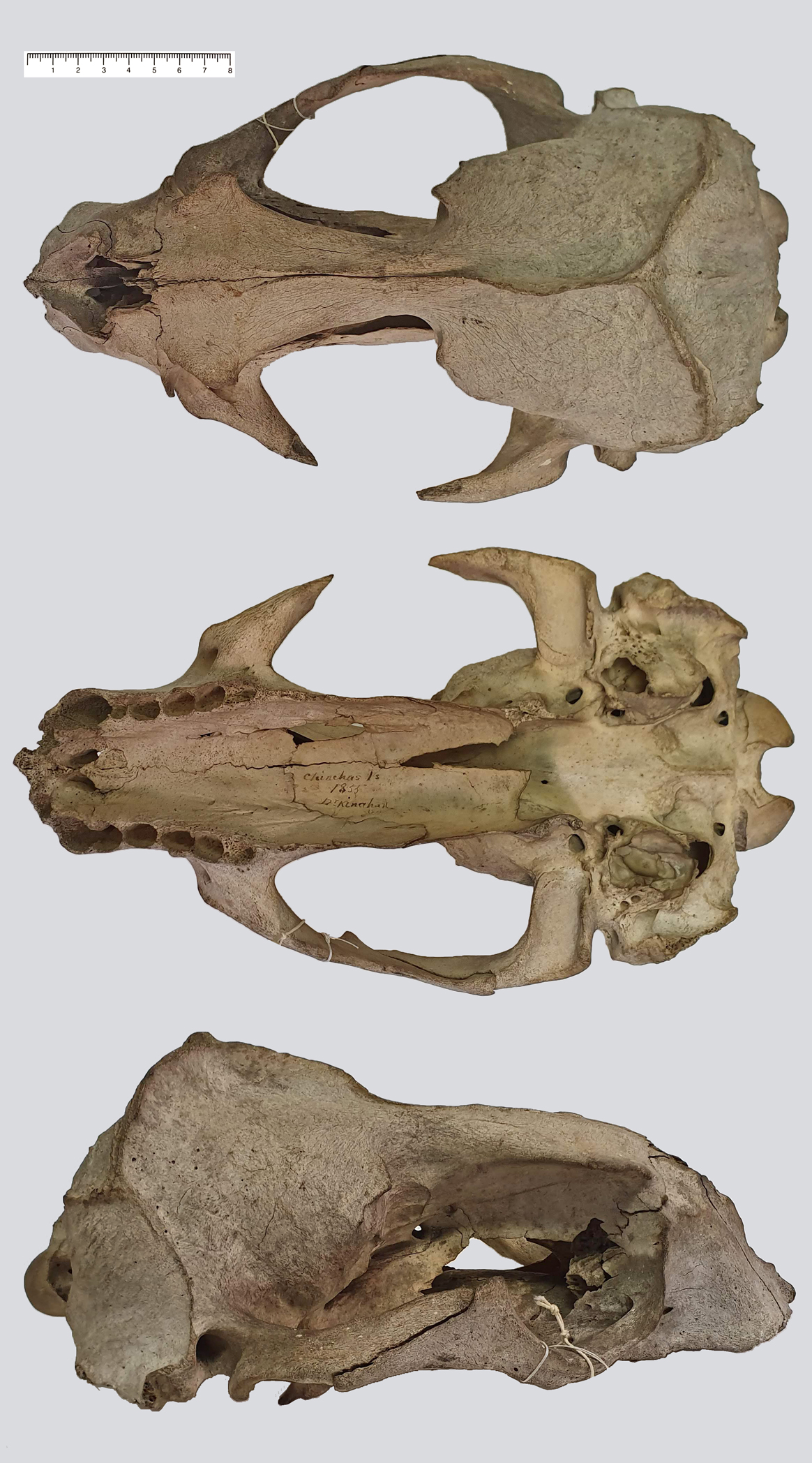
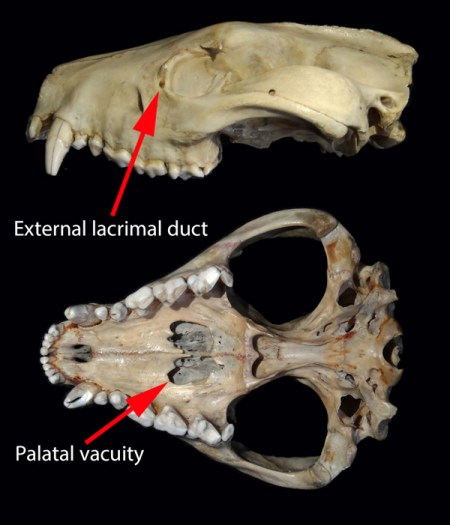
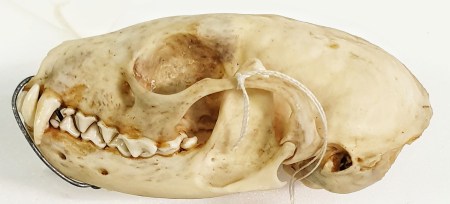
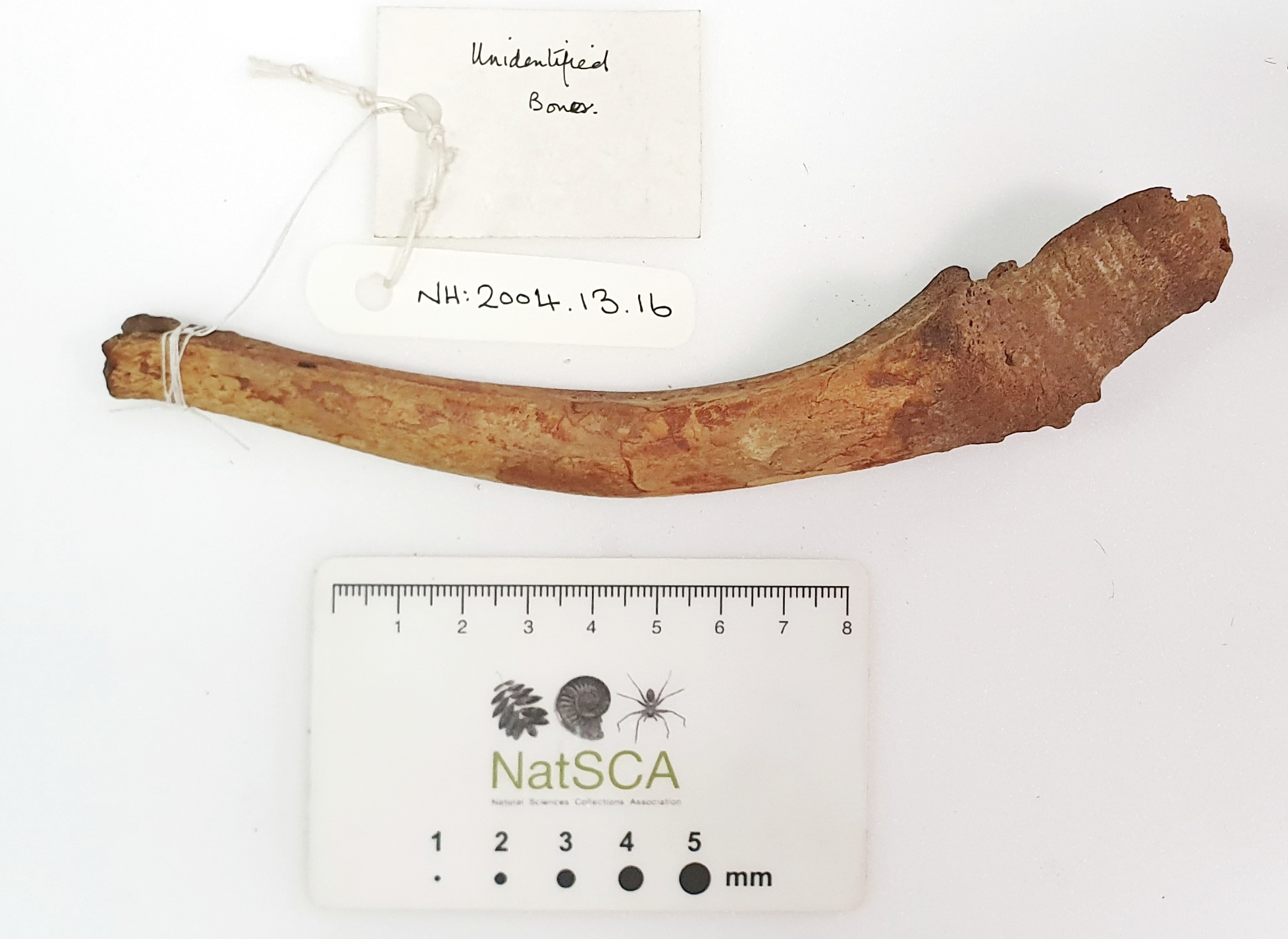
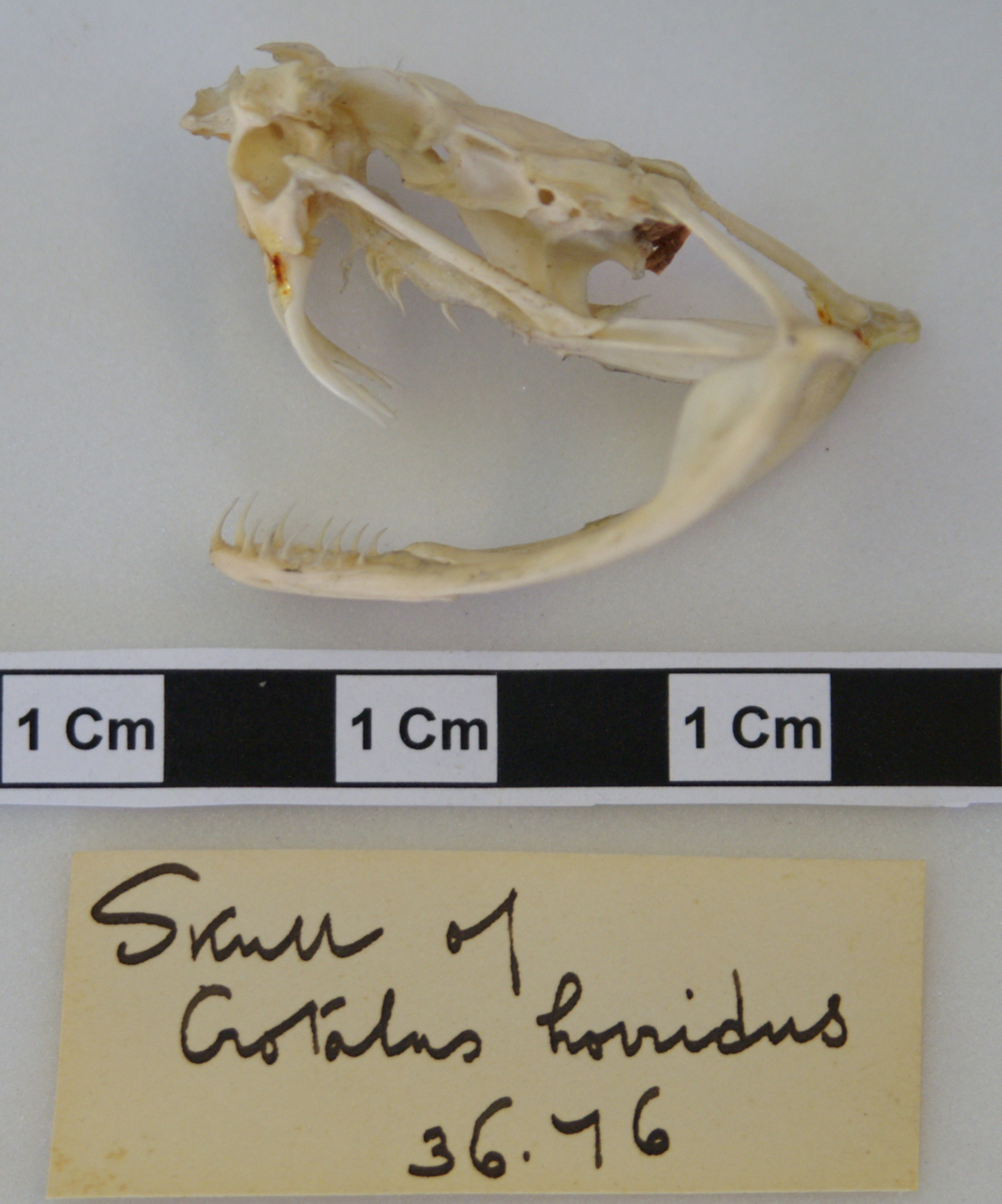
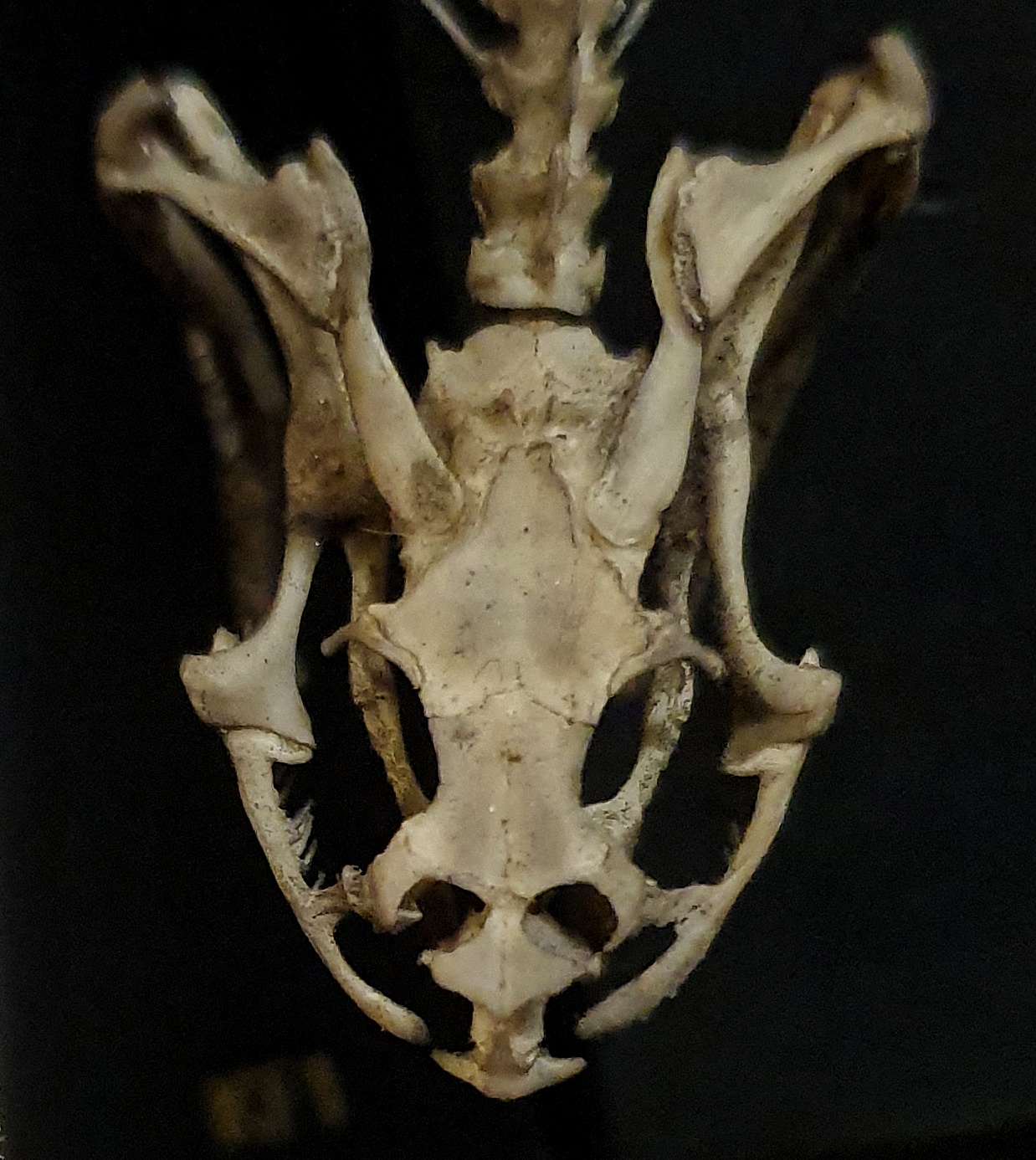
I think the start of 2020 is a good time to get back to skulls on the mystery object. Here’s a pretty cool one for you, although the photos aren’t the best:


Any idea what species this might be from?
Have fun!
I think the start of 2020 is a good time to get back to skulls on the mystery object. Here’s a pretty cool one for you, although the photos aren’t the best:


Any idea what species this might be from?
Have fun!
First of all, I’d like to wish you a very happy and healthy 2020!
Last year I gave you this festive-looking beetle to try your hand at identifying:

It was a bit of a tricky one to get to species, since beetles are notorious for their huge diversity, plus they can vary in appearance quite significantly within a species.
James Bryant recognised this as a member of the Buprestidae, which is a family of wood-boring beetles that are commonly known as Jewel Beetles due to their metallic and iridescent colours. In fact, the wing cases (or elytra) of some of the most colourful of these beetles have been used in traditional beetlewing jewellery in the parts of Asia where they are found.
Going beyond the family, the identification katedmonson provided through a great cryptic clue was spot-on (assuming I understood it properly). This particular specimen is an example of Chrysochroa rajah Gory, 1840, but in the collection it is still labelled under the synonym C. chinensis.
This species is one of those with a wide distribution, several subspecies and a variety of different colours and patterns, which can make it hard to identify based on just an image of the overall body (or habitus as it’s referred to by entomologists). Just to give you an idea of what I mean, here’s an example of the same species in the National Museum, Prague:
So well done to katedmonson for getting this tricky identification. Look out for another mystery next week!
This week I have an insect specimen from the Dead Zoo for you to have a go at identifying. I picked it because it definitely falls into the festive end of the colour spectrum:

Looking forward to hearing your thoughts on what this might be.
The answer will be forthcoming in the New Year – I hope you all enjoy seeing it in!
Last week I gave you these two genuine mystery specimens from Katharine Edmonson to get your thoughts on:


It was most definitely NOT an easy challenge, and I’m still not sure I know the answer to either, even after looking at every species I can think of that might have similar structures.
These are both clearly teeth, considering the internal details:
One image shows the root area of a full tooth, and one shows a section through a tooth – both of which provide really useful information. For example, the full tooth has a central dentine growth that you often find in animals that deal with a lot of strain on the tooth or where infection has got in (I’ve shown this before in elephant ivory).
The sectioned tooth shows a zone of dentine in the middle that suggests some hard use. Notably, that zone matches the shape of the cross section, so those grooves in the sides of the tooth aren’t from wear – they must be intrinsic to the tooth shape.
Generally, tusk cross sectional shape reflects the shape of the socket (until it gets worn down) – so that gives a pretty good way of narrowing down possible options. For example, I’d discount walrus, since they have an almost rectangular section. Warthog tusks have a section somewhere between the number 8 and a mushroom in shape, and Hippopotamuses have a triangular section to their canines, but their incisors are quite circular in section.

Warthog tusk socket
Then there are wear facets, that can give teeth and tusks a characteristic shape. Hippo canines grow in a corkscrew if unworn, but by rubbing against each other they remain sharp and fresh (like rodent teeth).
This means that teeth and tusks can look weird if the normal wear is disrupted, either by not happening or by happening too much.
There are also unexpected tusks that need to be considered, like the Indian Rhinoceros or dugongs that have hidden tusks.
Of course, some animals have really weird tusks, especially when they’re young or if they’ve experience something that leaves the tusks deformed or altered – which can make identification really hard.
There were a lot of suggestions of Sperm Whale tooth, which is a possibility, but I’ve not seen any that really come close. It may be that both of these are tusks from something more unusual, like beaked whales, but I have looked at a lot of examples of beaked whale teeth and I can’t find any examples that match either of these.
On balance, I think that the first of the tusks may be a Hippopotamus incisor that’s been misaligned with another tooth, causing excessive wear and horizontal stress lines to appear during tooth growth – this is rampant speculation I hasten to add. The second looks a lot more like a Warthog tusk in section than anything else, although the end is more spade-like than I’d expect.
So, after a lot of consideration I’m still uncertain of the identification of either of these, and I would be delighted to hear if you have any more thoughts!
This week I have a couple of guest mystery objects for you to have a go at identifying. Here’s the first:


And this is the second mystery object:


These photos are from Katharine Edmonson and they’re real mysteries, so no need for cryptic clues or hints – let’s see if we can work out what these are using our collective knowledge. Should be fun!
Last week I gave you this really nice skull from the Dead Zoo to have a go at identifying:

It proved a little more tricky than I thought it would, but I shouldn’t have been surprised given the poor quality of the photo and the fact that the cranium isn’t properly seated on the mandible (as pointed out by Allen Hazen).
Of course, that didn’t keep you all confused for too long. The large sinuses and relatively undifferentiated and widely-spaced teeth – except for those large canines – suggest that this is the skull of a some kind of seal.
Jeanie and salliereynolds noted the large, depressed opening over the nasal region, which is definitely one of the most distinctive features of this species. However, it also misled in the first place, with discussion of the possibility of it being from an Elephant Seal taking over for a while.
However, salliereynolds got back on the right track, while on Twitter Ray Chatterji was on the right track from the start with his suggestion:
Hooded seal?
— Ray Chatterji (@ray_chatterji) November 29, 2019
The Hooded Seal Cystophora cristata (Erxleben, 1777) is really weird – well, the male is. He has an inflatable bladder on its head and one nostril contains a membrane that he can inflate to show off to other Hooded Seals.
I find it hard to think of this as anything other than nature’s attempt at making slightly disgusting balloon animals.
Well done to everyone who worked it out – I have a couple of fun guest mystery objects for you next week!
This week I have a pretty cool skull from the Dead Zoo for you to have a go at identifying:

It’s one of those that should be easy for anyone who has seen one before, due to its weird morphology, but if you’ve not seen it before then it could be a real challenge.
So, if you know what this is please leave a cryptic clue, and if not feel free to pop your questions, thoughts and suggestions in the comments section below.
Have fun!
Last week I gave you this weird, but rather nice object to have a go at identifying:

Most people seemed to recognise it as the tympanic region (that’s the bony ear-related region) of a whale. But of course, I’m demanding when it comes to getting an identification and there are plenty of species of whale to rule out.
The size immediately narrowed down the possibilities – this is pretty small for a whale. But what really gives it away for the small number of people intimate with the cranial anatomy of whales (which goes beyond even my bone-nerdery), is the spongy bone attached to the tympanic bulla (that’s the bulb-shaped bit of bone that houses the inner ear).
This feature is proposed as a possible pressure receptor that’s found in the Pygmy Sperm Whale Kogia breviceps Blainville, 1838. Amazingly, Conor Ryan identified this on Twitter – his handle of @whale_nerd explains everything you need to know.
These toothed whales only grow to around 3.5m, which is pretty small for a whale. They share some features with their much larger Sperm Whale cousins, particularly in relation to adaptations for echolocation.
I was fortunate enough to meet Conor Ryan at the weekend at the Irish Whale and Dolphin Group conference. There were plenty of whale enthusiasts around and it was fantastic to get a chance to learn more about this incredible group of animals from a lovely bunch of passionate people.
While I was there, I also picked up some useful tips on differentiating between species of dolphin, so I may have to share those with you soon…
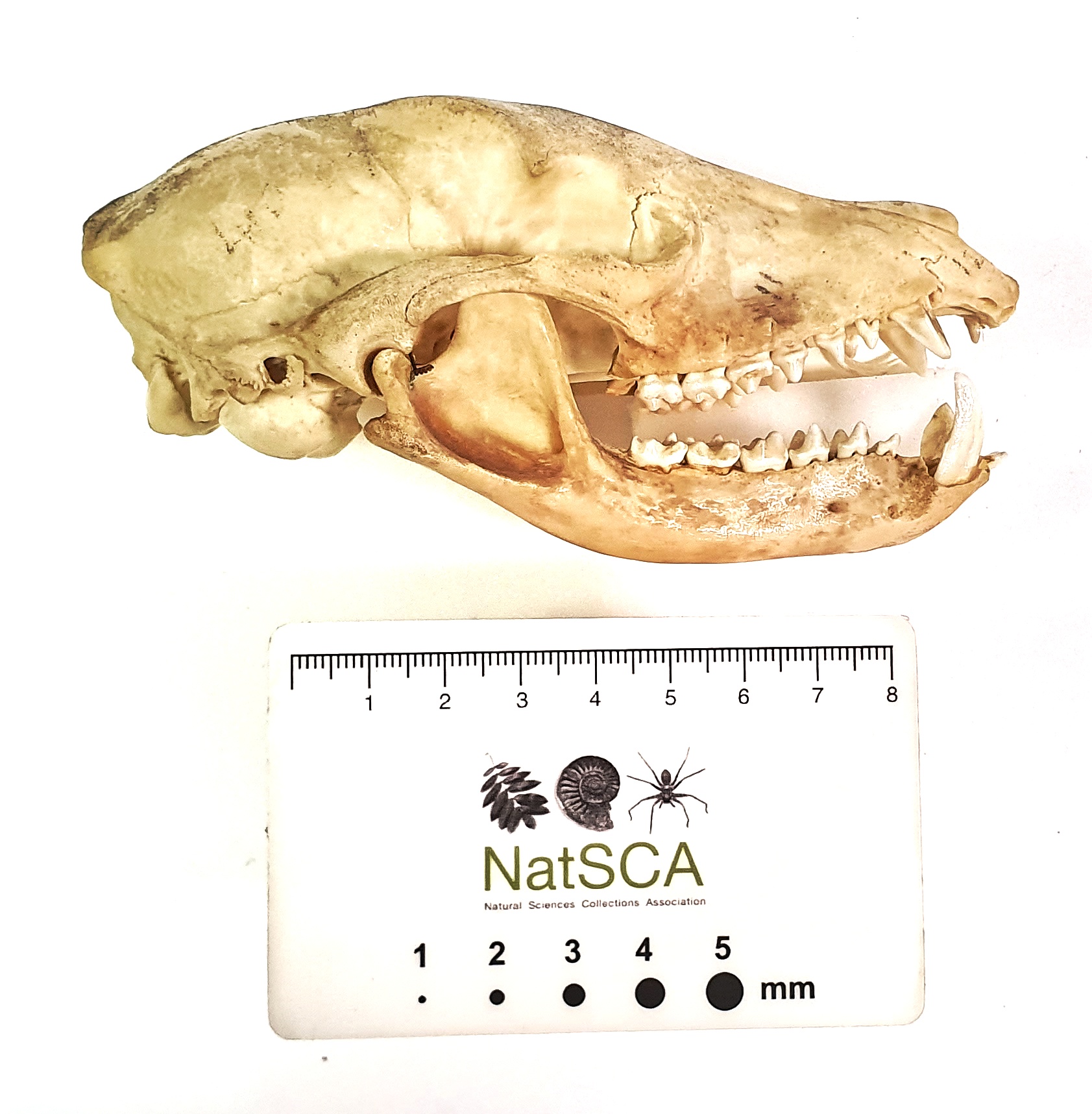
This week I have a nice mystery object for you to have a go at identifying, with views from four angles to help you work out what it is and a nifty NatSCA scalebar to give a clear idea of the size:

If you have any ideas what it might be, you can leave your thoughts, questions and suggestions in the comments section below. Have fun!
Last week I gave you this rather exciting new specimen from County Kerry, Ireland to have a go at identifying:

Perhaps unsurprisingly, it was recognised by pretty much everyone. For people based in the Americas it’s not that unusual a species and for people on the other side of the Atlantic, especially those with an interest in birds, there has been a bit of a stir in the press about this specimen.
This bird is clearly a member of the heron family – the Ardeidae – with its distinctive spear-shaped bill, relatively long legs and long and somewhat kinked neck. But it’s tiny. In fact, this is one of the smallest members of the Ardeidae, perhaps a bit longer in the body than a Dwarf Bittern, but just a bit lighter and quite different in plumage.

Dwarf Bittern in South Africa. Image by Mark Tittley, 2011
And this particular specimen is very light indeed. Sadly it was probably undertaking a migration south from its North American breeding grounds, when it got caught up in hurricane Lorenzo, which blew it off course, forcing it across the Atlantic Ocean, where it finally made landfall in Farranfore in County Kerry, on the west coast of Ireland on 7th October this year.
Exhausted, emaciated and severely dehydrated, the poor bird lasted less than an hour in Ireland, despite efforts to keep it going by John O’Donoghue, the owner of the garden it ended up in. John and his neighbour Anthony O’Connor recognised that it wasn’t a bird normally found in Ireland, so they got in touch with BirdWatch Ireland to find out what it was and let people know about their unfortunate visitor.
Brian Burke and colleagues from BirdWatch Ireland identified the specimen as being a Least Bittern Ixobrychus exilis (Gmelin, 1789) and they got in touch with me at the Dead Zoo about getting the specimen added to the collections, since it’s a first record of this species occurring in Ireland – and only the 10th known to have made it across the Atlantic.
Of course, I was delighted to accept on behalf of the Museum and John arranged to get the bird to me in Dublin via his local Teachta Dála (the Irish equivalent of a Member of Parliament). Now the bird is safely stowed in the Museum’s freezer awaiting assessment by a taxidermist, to see whether it’s in good enough condition to be mounted, or if I’ll need to find another way of preserving the specimen as part of the permanent collection.
If not as taxidermy, this might be as a study skin, a fluid preserved specimen or even a skeleton – each offers different information for future use. But however it gets preserved, it will provide an important physical record of an unusual visitor to the Nation for future scientists and members of the public. After all, that’s a huge part of what collections are for.
This week I have a fantastic mystery object for you to try your hand at identifying:

It was collected in County Kerry, Ireland and is a very recent acquisition. Any ideas what it might be?
Obviously if you already know don’t just blurt it out, have a go at crafting a clever clue to share.
Have fun!
Last week I gave you this unwelcome visitor to the Dead Zoo to identify:

I’ve given you something very similar before, which most people mistakenly identified as being this species.
It’s in the family Ptinidae, home of several species that are considered pests, thanks to their habit of boring holes in various different materials. They all tend to look quite similar, although the shape of the pronotum (the bit between the abdomen and the teensy head) is a useful feature.
As Andy Calver and Thomas Rouillar intimated on Twitter and joe vans hinted in the comments, this particular beetle is normally associated with boring holes in carbohydrate rich substances, which can include drugs, tobacco, bread and biscuits. It’s known as the Drugstore Beetle, Cigarette Beetle, Bread Beetle or Biscuit Beetle depending on your particular interest in what it destroys. Of course, other beetles can share some of these proclivities and therefore claim some of the same names, so for clarity the scientific name is Stegobium paniceum (Linnaeus, 1758).
In museums they can tun up for a variety of reasons. Sometimes they’ll be feeding on starchy glues in book spines, they love a dried plant in a herbarium, they’ll give animal hides and museum specimens a nibble, and about the only thing they like more than poisoned grain used as rodent bait would be some biscuit crumbs.
So well done to everyone who worked it out and if you didn’t manage it then never fear, there’s always next week’s!
This week I have a small (~3mm long) and somewhat dusty mystery object for you:


Any idea what this little charmer might be?
You can put your suggestions in the comments below – if you think you know the species then cryptic clues, rhymes, poems and anecdotes are all very welcome ways to share your knowledge. Have fun!
Last week I gave you this little critter to have a go at identifying:

This particular shrimpy specimen arrived as an enquiry, after it was found in some Irish drinking water.
Prawn cocktails may be a thing, but most of us don’t think of shrimps (or shrimp-like decapod crustaceans) as an ideal addition to a beverage.
According to WHO these critters aren’t actually a health problem if they get into the water supply in temperate regions, where they don’t carry significant parasites or pathogens – but it’s a different story in the tropics.
Knowing which species this is could help in working out how it might have entered the water supply. I’m not an expert on crustaceans by any means, but there are useful keys out there [links to pdf] for working out this kind of information and I’m very fortunate in having to hand the expertise of my predecessor at the Dead Zoo, Mark Holmes, who specialises in crustaceans and is still often at the Museum doing research. Of course, I also have all of you lovely people!
My first thought on seeing this was that it was one of the Gammeridae, based mainly on my exposure to many photos of Gammarus shrimps infected by microsporidian parasites that change them from males into females (which is some fascinating biology). I was therefore delighted when so many of you put forth suggestions in that same area.
By working through the key of Irish shrimp I narrowed it down to Gammarus pulex (Linnaeus, 1758), which was also suggested on Twitter by @RobertsZivtins and @DianeBarlee. It could be G. tigrinus or perhaps G. lacustris – or of course a species not previously recorded from Ireland that doesn’t appear on the key.
However, I got it fresh and there were no stripes and the uropods and telson (taily-bit) looks more pulexy to my eye.
I am now eagerly waiting to hear what Mark thinks – I will update this post as soon as I do!
I have now checked with Mark and he identified this as G. lacustris so it looks like the taily bit isn’t pulexy after all. Thanks Mark!
After 10 years of posting photos from the museums I’ve worked in, I’ve finally posted enough mystery objects to have one a day for a whole year. As long as it’s not a Leap Year of course.
So here’s the 365th Friday mystery object:
Any idea what this mysterious wee beastie might be? N.B. it is a genuine enquiry, so no need to drop cryptic clues – I’m just keen to see if anyone agrees with what I’ve identified it as.
Have fun!
This week I have a mystery object for you that’s a bit of a crusty character:

Any idea what this little critter might be?
As always, you can leave your suggestions, thoughts and suggestions in the comments below. Have fun!
Last week I gave you this skeleton to have a go at identifying:

I thought that it might be a bit on the easy side for some of you – especially Wouter van Gestel who is one on the brains behind the fantastic Skullsite resource, that I expect everyone is familiar with by now.
The skeleton of this bird isn’t really all that distinctive, but the skull – particularly the bill – is very distinctive indeed, although this photo doesn’t capture the full weirdness.

Wouter’s cryptic clue:
Apparently, this species processes sound twice as well as you might expect from a bird.
was a hint at the scientific name Cochlearius cochlearius (Linnaeus, 1766) – playing on the fact that the name comes from the same source as the name for the cochlea, which is a part of the inner ear that has a snail-like shape. The common name, as hinted at by Richard Lawrence is Boat-billed Heron, as you can see a bit more clearly here:

Boat-billed Heron. Photo by Patrick Coin, 2007
These odd looking birds are members of the Ardeidae or heron family, but rather than having the spear-like bill of the classic Grey Heron, they have broad bills used for scooping up prey in the shallow, murky waters of Mangrove swamps in Central and South America.
They have big eyes and that large, sensitive bill to help catch small fish and crustaceans in the shade or at night. This nocturnal habit is common in the Nycticoracidae a subfamily commonly known as night herons, as mentioned by Josep Antoni Alcover in his clue in the comments.
So well done to everyone who recognised this unusual animal – more mysteries next week!
This week I thought you might find this skeleton to be an interesting identification challenge:


Any idea what this might be?
It will probably be a bit on the easy side for some of you (Wouter, I’m looking at you!) so if you know what it is then try to be a bit cryptic with you answer in the comments section below. Have fun!
Last week I gave you what looks like a pickled cauliflower floret to identify:

As most of you worked out, this is a soft coral, although Tony Irwin was more detailed with his cryptic suggestion placing it in the Nephtheidae, and mpbx3003’s clue was spot on.
The name on the jar is Eunephthya florida (Rathke, 1806), but as with the last mystery object, there’s been a change in name. Eunephthya is now only applied to a genus that happens to be found in South Africa. This specimen is now considered to be in the genus Duva and the species name florida is more of a reflection of the fact it has a flushed pink colour in life than any reference to the American state.
Most soft corals they tend to live in warm shallow waters of the Atlantic, so Florida wouldn’t be a bad bet for where this might come from, but it actually happens to be one of the more unusual cold and deep water species. This particular specimen is from off the West coast of Ireland at a depth of between 738-900m (410-500 fathoms in old money).
Unlike the shallow water corals, these ones don’t get enough light to photosynthesise using symbiotic dinoflagellates, so they rely on capturing zooplankton from the dark but rich cold waters of the Atlantic.