Friday mystery object #144 answer

On Friday I gave you another genuine mystery object from the Horniman’s collections:

It was in a box of unidentified and unlabelled bones which I’m pretty sure came from the King’s College teaching collection in the 1980s, when King’s merged with Chelsea College. Quite a large amount of material came to the Museum and unfortunately much of it was jumbled up, missing labels and quite often different parts from the same specimen had become separated.

I have been kept busy trying to make sense of it all, which is no small task, as the collection was mainly used for comparative anatomy meaning it is very diverse. The specimens in the collection could be from anything and from anywhere in the world – which makes it rather difficult to narrow down the options.

This specimen was a bit of a puzzle, since although it is clearly from a fairly large animal, it is quite hard to work out what the full adult size would be, as this bone is from a juvenile (as spotted by Kevin). This is apparent from the unfused ends of the bone (called the epiphyses).

One possibility that occurred to me (and Rhea) was that it may be the bone of an aquatic mammal, such as a seal. However, in aquatic mammals the humeri need to rotate, meaning that they tend to be flattened in two different planes at the proximal and distal ends. This bone is just flattened in one plane, meaning it wouldn’t be great for use in swimming efficiently and it wouldn’t be great for bearing large amounts of weight/force during locomotion – a more rounded cross-section of bone is better for that.

In fact, the general shape of the bone is wide and flat with large tuberosities for muscle attachment – almost like the humerus of a mole:

This is something that  Richard Forrest seems to have picked up on when he suggested that it is the humerus of a fossorial [digging] animal. This narrows down the options quite nicely, as there are only a few large fossorial animals.

The Pangolin was suggested by Dave Godfrey, but the bone is too large. Dave also suggested the Aardvark, which is a good contender, although not quite right. I personally have a different animal in mind –  Continue reading

Steampunk confetti gun

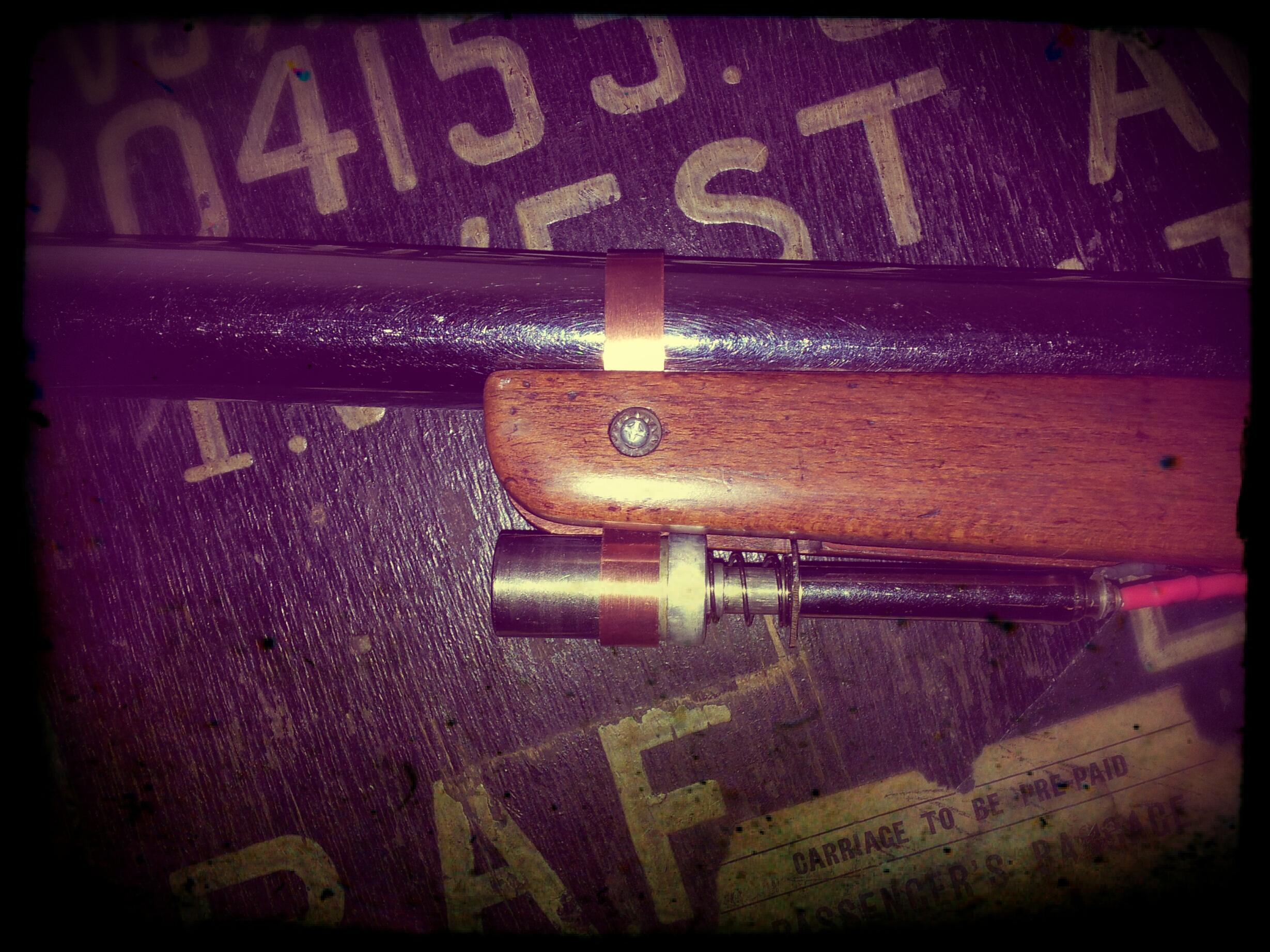
You may well have seen some of this already on Youtube, but I thought I’d do a brief post about my new ‘toy’ – a steampunk confetti gun:

I made this with help from my good friend Graham over a couple of weekends and it was remarkably straightforward.

The barrel and mechanism housing are made from some old vacuum-cleaner tubing and a large washer, the stock is from an old air-rifle and the mountings were all hand made from bits of copper roofing strip that I bent into shape and attached with nuts and bolts, plus some old metal decorative plates I picked up in a junk shop.

The working mechanism is fairly simple, it is an electrical circuit powered from a glow-stick power source that runs through a switch (that makes the trigger) and into a glow-plug  normally used for starting model aircraft engines. The earth return runs out through the bolt that attaches the mechanism housing and trigger-guard to the stock.

The attachment between the working section housing and the barrel is simply a push-fitting, which makes the canon a partial breach-loader, allowing the flash cotton charge that propels the confetti to  be loaded in a way that means it will be ignited by the glow-plug. When the cotton catches it burns incredibly quickly, creating a rapid expansion in the base of the barrel, forcing out the wadding and confetti (see video below).

Now I should say that for the purposes of the video I also used flash tissue, which is slower to ignite than the cotton, meaning that it doesn’t flare up until just after it leaves the gun, giving a spectacular flash of orange fire (or green fire if I use my specially treated paper).

I hope to take the gun along to White Mischief at the weekend, so I may need to swap the flash tissue for tinfoil to avoid setting anyone’s hair on fire, but the burst of confetti will hopefully be enough to celebrate Victoria’s Diamond Jubilee in style!

Friday mystery object #143 answer

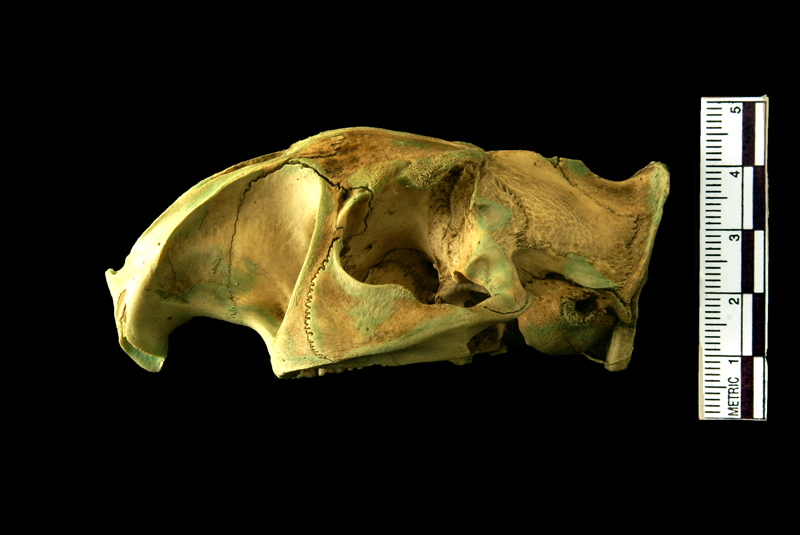
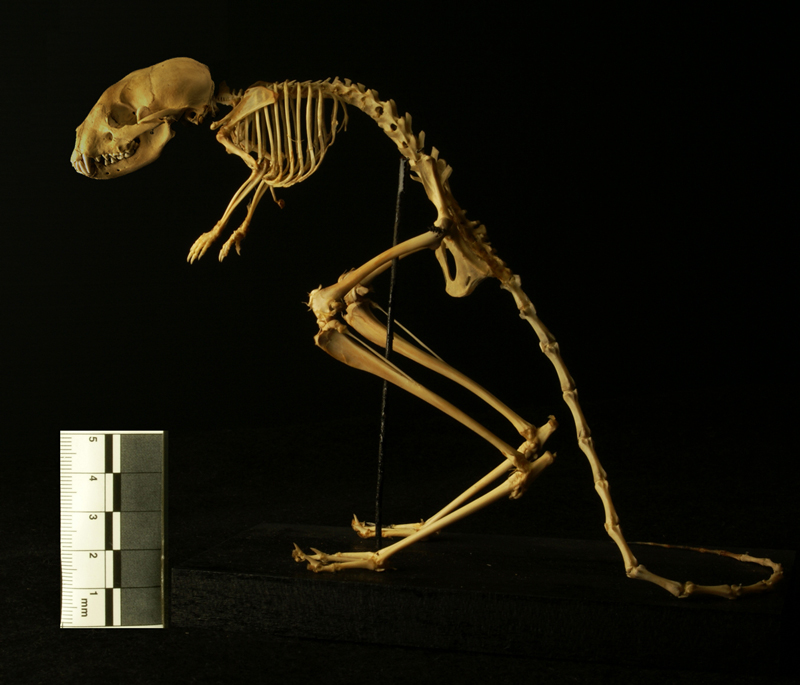
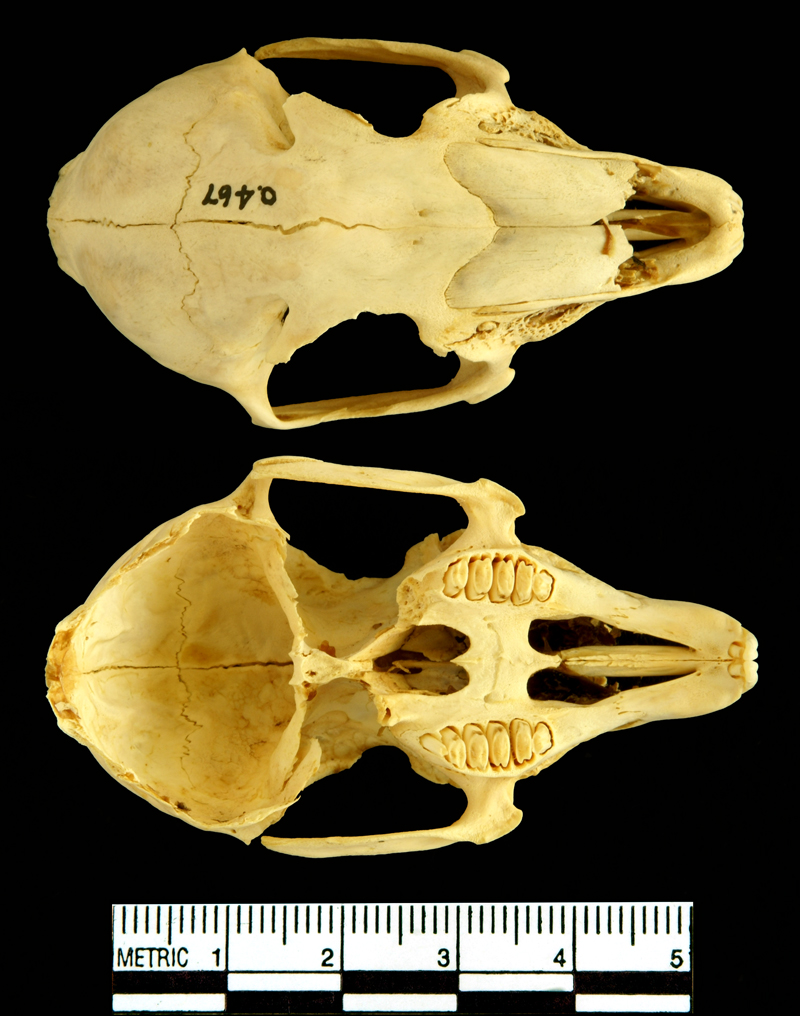
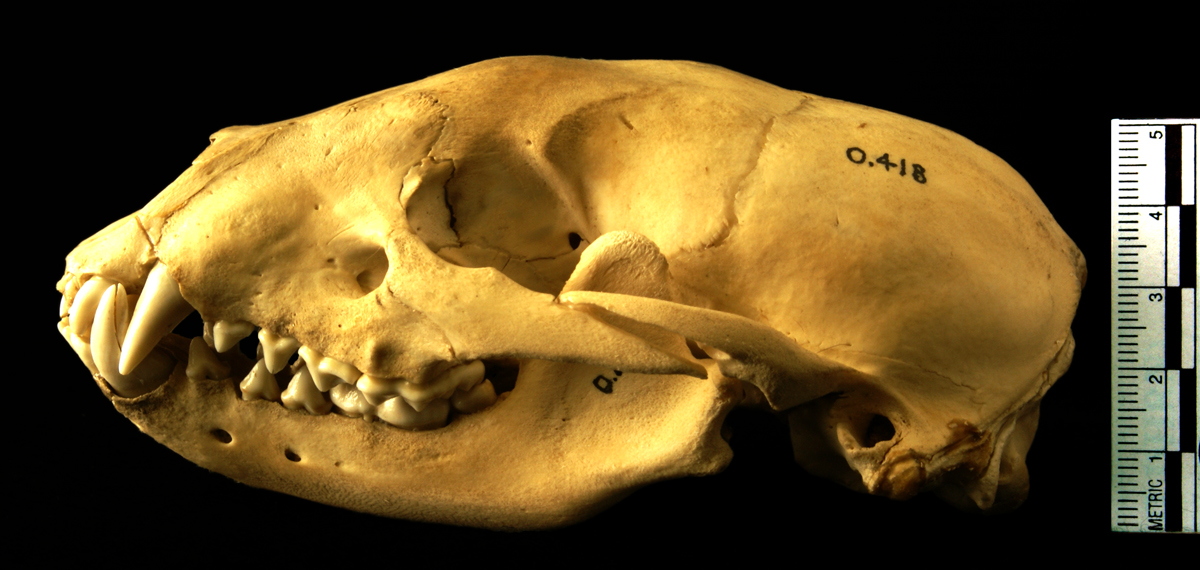
On Friday I gave you another skull to identify from a box of unlabelled material dating from 1974:

At first glance it looks quite similar to the skull of a small dog or fox, but the muzzle area seems a bit short, the braincase too small and the teeth aren’t quite right for a canid – in fact the teeth look more like those of a mustelid (as Jake pointed out). However, mustelids tend to have quite broad and blocky skulls and this one seems a bit elongate and gracile.

Clare P made a very good suggestion when she suggested the Asian Palm Civet Paradoxurus hermaphroditus, although this animal is somewhat smaller than the species that this specimen came from. Size aside, the dentition matches pretty well (if you can work out which tooth sockets belong to each tooth):

Asian palm civet skull and dentition by Paul Gervais (1816-1879)

So it looks like this is the skull of a viverrid. There are still lots of candidates out there and location could help narrow down possible species, but without any labels it can be hard to work out locality information. However, last week’s object was from the same collection and it was an African species, suggesting that Africa would be a good place to start looking for a species match.

Jamie Revell did just that when he suggested the Giant Forest Genet Genetta victoriae, which is a viverrid of about the right size from Africa. Although I already thought I knew what the specimen was, I took Jamie’s suggestion very seriously, as I hadn’t considered that particular species and it fit with most of the features of the specimen.

In the end an online French viverrid identification resource I’d not seen before provided me with the information I needed to exclude the Giant Forest Genet. Mainly it came down to whether the premaxillary bones made contact with the frontal bones – they do in the Giant Forest Genet, but they don’t in this specimen. Also, the area where the temporalis muscle attached is too narrow in this specimen.

In light of these observations and with reference to specimens in the Horniman’s collections (including one that I used as a mystery object a year ago) I am fairly confident in identifying this as  Continue reading

Friday mystery object #142 answer

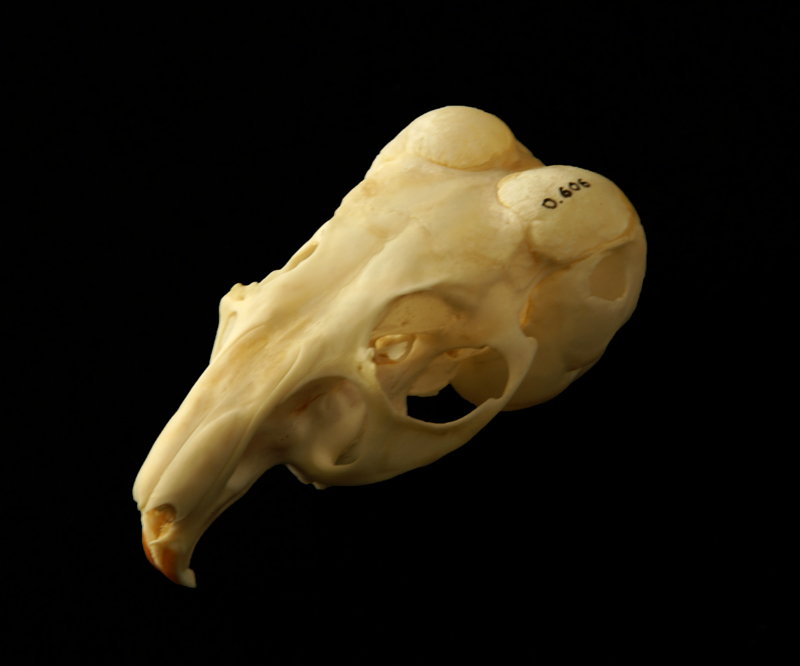
On Friday I gave you this unidentified object from the Horniman’s collections and asked for your help in identifying it:

Suggestions ranged from the Easter Bunny (topical) to Dangermouse (fantastic), but there was a remarkably fast convergence of opinion on what this is.

Jamie Revell, Barbara Powell, henstridgesj and Jake all came to the conclusion that this is the skull of a  Continue reading

Friday mystery object #142

This week I have a genuine mystery object for you. I just stumbled across a couple of big boxes of unidentified skulls and bits of bone, so you can help me work out what some of these things might be from. To start with we have this skull:

Please put your suggestions, comments and questions below and I’ll do my best to respond. Enjoy – and have a nice Easter!

Friday mystery object #141 answer

On Friday I was in rather a rush as I was involved in co-organising this year’s Natural Science Collections Association (or NatSCA) conference. It was a very enjoyable (if hectic) few days of natural history nerdery, but left me limited time to select an object from the FMO. I took my opportunity at the drinks reception at the Grant Museum of Zoology where I tried out the camera on my new phone to get an image of this specimen:

Now it was a fairly easy one to identify as the skull of these animals is very distinctive. Nonetheless, if you haven’t seen the skull of one of these animals before it is a bit of an oddity, with that spike in the face and the apparently strongly protruding maxilla and mandible (which is actually due to unusually elevated frontals). Continue reading

Namibian Jumping-weasel

I thought I’d pen a quick post about an interesting specimen that I discovered the other day:

It’s a species I’d not heard about before and I was intrigued to discover a bit more about it.

It’s a Namibian Jumping-weasel Mustela jocuverus (Primus, 1881) which is a small mustelid native to Namibia and Botswana. It is very similar in habits to other Weasels and Stoats, but it has a very special adaptation – it jumps.

Now other mustelids also jump as part of their hunting technique, as can be seen in this video clip:

But this mustelid hunts in arid desert conditions and it has little cover from vegetation, making it more dependent on high speed bounding to overtake its prey of small rodents, which it quickly overpowers with a bite to the back of the neck from those impressive canines.

Happy April!

Friday mystery object #141

This week I’ve been rather swamped with co-organising the Natural Science Collections Association conference, so I haven’t had much time to think of a good mystery object from the Horniman’s collections. However, here is a nice (if somewhat distinctive) specimen from the excellent Grant Museum of Zoology for you to identify:

image

Any idea what it is?

You can put your comments below and I’ll do my best to respond, as the opportunity arises. Best of luck!

Friday mystery object #140 answer

On Friday I gave you this skull to identify:

I thought it would be an easy one and I wasn’t wrong, although several of you seemed to second-guess my intentions and assumed that I was trying to trick you because it seemed too easy.

The small second incisors (or peg-teeth) just behind the big first incisors were a complete give-away for the group of animals this skull came from – the Lagomorphs, which Jake spotted immediately.

Henstridgesj, Jamie Revell, Debi Linton and Jake all suggested that it came from a  Continue reading

Friday mystery object #139 answer

On Friday I gave you this object to identify:

It didn’t prove to be all that difficult, perhaps since the skull is distinctive in having the general appearance of a ruminant (in particular it is missing the upper incisors), but it also has canines and is very small, with a skull height of just over 5cm. This slightly unusual mixture of characters suggests one of the more primitive ruminants.

Jake suggested it might be a Muntjac or Chinese Water Deer, but as Lena pointed out, Muntjac (and Chinese Water Deer) have a scent gland in front of the eye (called a preorbital gland) that is housed in a big pocket in the skull.  The skull itself is also a bit small even for a Muntjac.

Jack Ashby, Lena, Barbara Powell and Jamie Revell all managed to work out that this skull was from a member of the family Tragulidae. To be more specific it is from a  Continue reading

Friday mystery object #138 answer

On Friday I gave you this object to identify:

The idea was to provide a sense of how tricky it can be to identify bits of postcranial bone, even fairly characteristic bits like the humerus (which is what this is).

There were various suggestions, with sheep, goat and deer all getting a mention, but henstridgesj and Jake both got the same identification as the collector when they suggested  Continue reading

Friday mystery object #138

Postcranial bones are found more often than skulls, but they can be harder to identify since they don’t have such diagnostic characteristics (like teeth). So, any idea what this piece of postcranial skeleton is and what it comes from?

As usual you can put your answers below and I will do my best to respond (within my technological and temporal constraints). I’m sure some of the other biology types will be willing and able to give guidance. Good luck!

Cardinal complains that ‘gays have too much fun for marriage’

Following new government plans for gay marriage, Catholic commentators have crawled out of the woodwork to bitch and moan to anyone who’ll listen, despite the fact that marriage has been around for far longer than the Catholic Church and it has only taken on a strongly religious context after the Church spotted the money-making opportunities in the 12th Century.

Cardinal Keith O’Brien called the plans a “grotesque subversion of a universally accepted human right” and went on to say that “It would create a society which deliberately chooses to deprive a child of either a mother or a father“. (N.B. O’Brien’s claims about gay marriage breaching human rights stem from a misinterpretation of the Universal Declaration of Human Rights)

O’Brien’s comments were described as “a bit rich” by Paolo Viscardi, who went on to say “The need for both a father and mother is a biological one that ends with conception. Further, a human right is only meaningful when enforceable, yet the loss of a parent or parents is impossible to prevent in many instances, thereby making the ‘right’ for a child to have both a mother and father meaningless”.

Viscardi went on to say “There is no reason to suppose that a loving same-sex couple would fail in their care of children – indeed I believe they would do a far better job than, for example, a Catholic orphanage. O’Brien should check John 8:7. Members of the Catholic clergy have committed a host of human rights abuses against children and such abuse has been endemic in parts of the Catholic Church. O’Brien may have apologised for such abuses in the past, but to claim that the loving union of a same-sex couple is an abuse of human rights twists the meaning of that section of the Declaration of Human Rights and it throws the self-deluded sense of sexual morality held by the Catholic clergy into stark relief.”

Image

Cardinal Jack Hackett

*Notably, more priests have stepped up to condemn gay marriage than have gone on record condemning child abuse by members of the Catholic clergy. The Irish Cardinal Jack Hackett, suggested that this was because many priests believe that “Sex is a sin unless it is intended to bring forth new life in the agonies of the woman as God intended. By abusing children the Catholic clergy are teaching them that sex is a dirty business that causes great suffering.”

Cardinal Jack Hackett finished by saying “Gays have too much fun to get married. Marriage is not about having fun, it’s about having babies and being miserable for the glory of God“.

*N.B. This last section may not be entirely true, but it paraphrases the jist of several arguments I’ve heard in the past.

If you disagree with the Catholic Church’s stance on gay marriage, and if you live in the UK, perhaps you would like to sign the Coalition For Equal Marriage’s petition to show your support.

Friday mystery object #137 answer

On Friday I gave you this mystery object to identify:

Unfortunately I was unable to respond to comments on Friday, as my laptop had to go in for repairs and my phone has reached the end of its useful life as an internet device after 4 years faithful service. For the answer this week I had to drag out my old laptop, which has meant 2 hours of twiddling thumbs as the machine started up and dealt with various updates…

In some ways it was a good thing that I wasn’t able to comment, since it would have ruined the fun from the outset. Jake was straight in there, wondering if it was really as easy as it looked – and it was. Rachel, Jack Ashby and Barbara Powell also plumped for the right answer, while several others came very close when they went for a greedy relative. This is in fact the skull of a juvenile  Continue reading

Friday mystery object #136 answer

On Friday I gave you this skull to identify:

I think the oddly inflated and positioned auditory bullae make this look like Gary Oldman in his role as Dracula. Because of this characteristically odd feature the specimen was fairly easy to identify. Of course, that supposes that most people have seen the skull of one of these animals before…

Here is the skull in better detail (for future reference):

The front teeth were a good indication that it was a rodent (we’ve talked about that before) and with the big and upward pointing external auditory meatus (better known as ear-hole) it suggested a very big-eared rodent.

With a skull length of about 7cm the number of possible rodents decreased quite rapidly, as most are much too small to have such a big skull, so I wasn’t surprised when Barbara Powell and David Craven hinted that they had the answer. From then on I started getting cryptic answers about warm fur and cold faces as more of you worked out that this is the skull of a  Continue reading