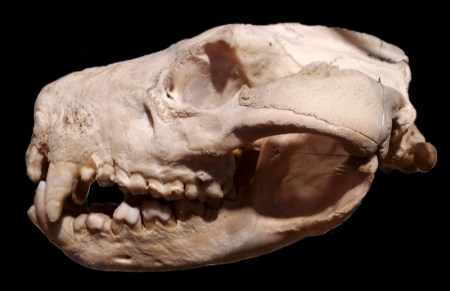
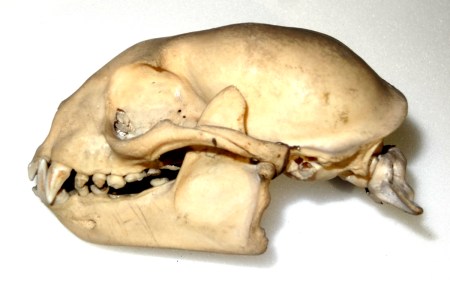
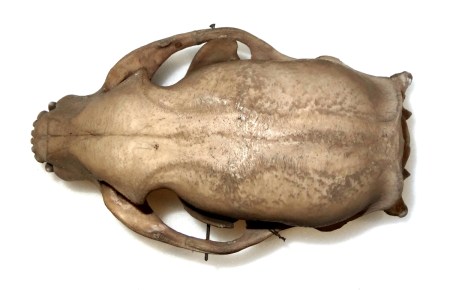
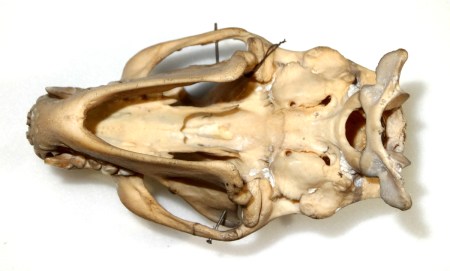
Friday mystery object #305 answer

Last week I gave you this specimen to identify, with a clue about the tail being distinctive:

mystery305bmystery305d

There were lots of correct answers – the first coming from palfreyman1414 who nailed it with this great cryptic clue relating to its scientific name:

Trump assortment pack

It is indeed Potus flavus (Schreber, 1774) or as Allen Hazen and jennifermacaire hinted at with kinky clues, a Kinkajou. They’re also known as Sun Bears, Lirón (which is also the Spanish name for the Dormouse) or Micoleón (lion monkeys).

A Kinkajou at the Paradise Animal Rehabilitation Center, Volcancito, Panama. Image by Dick Culbert, 2008

A Kinkajou at the Paradise Animal Rehabilitation Center, Volcancito, Panama. Image by Dick Culbert, 2008

As the name Micoleón suggests, these South American floofsters are what happens when a carnivore tries to be a monkey. They have dexterous digits for climbing and handling the fruit that makes up the bulk of their diet and they are one of only two carnivores with a prehensile tail (the other is the Binturong) – hence that tail clue.

This tail acts like a fifth limb that helps the Kinkajou climb and in particular it allows the animal to hang down in order to reach fruit at the ends of slender branches:

Kinkajou hanging using its prehensile tail. Image by Damian Manda, 2009

Kinkajou hanging using its prehensile tail. Image by Damian Manda, 2009

Unlike monkeys, the Kinkajou is nocturnal, relying on its sense of smell and touch more than its eyesight to work out which fruit is ripe. It uses its very long tongue to scoop out fruit pulp and sometimes to feed on nectar from flowers.

All in all it’s a very curious little carnivore that looks more like a lemur than it does its closest cousin, the Coatimundis.

Friday mystery object #305

This Friday I’m giving you a game of heads or tails from the Collections Resource Centre of the Dead Zoo:

mystery305amystery305bmystery305cmystery305d

I don’t normally add a photo of the tail, but in this case it should make the identification a doddle – literally a 50:50 shot at getting the right species. If you know what I’m talking about, then please be cryptic in your suggestions – don’t spoil it for everyone else!

If you don’t know why this tail is so significant then you should know that the skull is 10cm long and all will be revealed next Friday!

Good luck!


Friday mystery object #304 answer

Last week I gave you this skull to have a go at identifying:

The skull of specimen LDUCZ-Z144 from the Grant Museum of Zoology
I thought that some of you would find it a bit easy, but the most diagnostic features aren’t visible in the image and it’s a nice specimen, so I went with it.
There is a bit of similarity with the skull of a ruminant, as noted by palfreyman14141, while Gerard pointed out that it’s from Africa and James M. Bryan was the first to drop a solid clue pointing to the correct species. As jennifermccaire says, it’s the very first on the list (assuming the list is alphabetical) – an Aardvark Orycteropus afer (Pallas, 1766).

An Aardvark (or as I prefer to call it, a Tippy-toes McSnuffleface) at Detroit Zoo. Image by MontageMan, 2008
Picking up on palfreyman1414’s observation about it looking like a ruminant, Allen Hazen asked an interesting question about the teeth, because the diet of these bizarre looking animals almost entirely consists of ants and termites, and most other mammals with a similar diet (like Pangolins and Tamanduas) have no teeth at all.
Making the presence of teeth even more weird is the fact that Aardvark stomachs have a muscular pyloric region that grinds up food in a similar way to a bird’s gizzard, so they really don’t need teeth for the major component of their diet. To top it off, the teeth of Aardvarks are utterly unlike any other mammal teeth – they’re made of tubules of dentine (giving the Order the name ‘Tubulidentata’), with no enamel, no pulp-cavity and no root – so they keep on growing:

The weird teeth of the Aardvark, made up of tiny dentine tubules.
All of this suggests that their dentition is distinctly non-standard, so it probably isn’t just a vestigial feature inherited from a toothed ancestor – which reinforces the importance of the question ‘why do they have teeth?’
Bear with me.
A 60-80kg mammal living in hot and water-scarce regions of Africa, will struggle to get enough moisture from ants and termites to survive, even if they are nocturnal and sleeping in burrows during the hottest part of the day. So how do Aardvarks do it?
Cucumbers, that’s how.
There is actually a species of cucumber that has a symbiotic relationship with Aardvarks, and it’s unimaginatively, but descriptively, called the Aardvark Cucumber Cucumis humifructus Stent, 1927.

Aardvark cucumber (not a golf ball). Image by B. Strohbach
These weird fruits develop deep underground and have a tough skin that keeps them viable for months. Outside they’re like a leather golfball, but inside they’re watery like the cucumbers you’d put in a Hendrick’s gin and tonic – and that’s where the Aardvarks get their moisture (the Cucumber, not the G&T).
Nothing but the Aardvark has a nose sensitive enough to detect the plant, or claws powerful enough to dig into the hard-baked earth to access the fruits (or possibly only an animal that mostly eats ants is desperate enough for some culinary excitement to go to all that effort for something that the rest of nature views as a lacklustre garnish). The Cucumber’s seeds need to pass through an Aardvark to become viable and those seeds get distributed underground with a healthy dollop of fertiliser in what is otherwise a harsh environment.
The leathery skin of the Cucumber is almost certainly the reason why Aardvarks have invested so much in teeth for a termite and ant-eating mammal. It also explains why those teeth grow constantly – and why they get so worn down.
I think that’s pretty awesome.
Now you may be wondering if I’m making all this up, but honestly, the world really is that weird (and wonderful) when you look at it closely enough!

Friday mystery object #304

This week I was worried that I didn’t have a mystery object planned, but then I stumbled across this on my phone:

mystery304


It’s probably a bit too easy for some of you, so I’d encourage using some cryptic clues and hints to say what it is in the comments box below.

I’ve had a problem with spam comments recently and have switched on a filter to ensure that people’s first posts are approved (regular posters shouldn’t be affected) – fear not, I will be keeping an eye on it and approving first timers!

Have fun!

Friday mystery object #303 answer

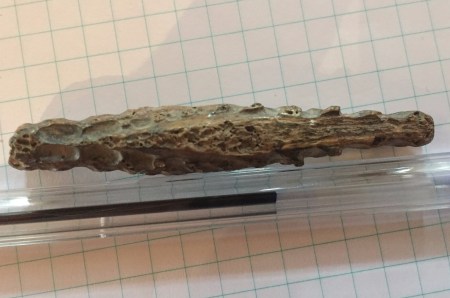
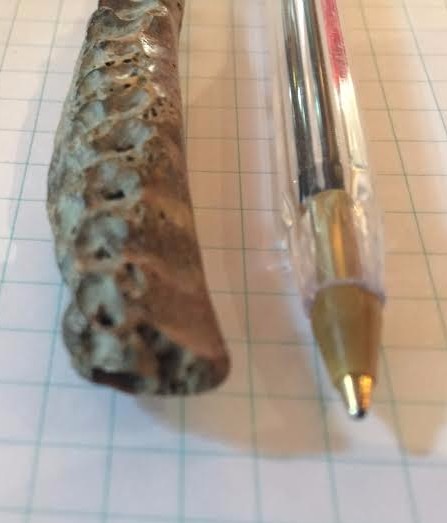
Last week I gave you this mysterious bit of bone from the Thames to have a go at identifying:

mystery303b

A few ideas were put forward, but DrewM was spot on with the suggestion:

I think it’s the synsacrum of a bird, without the ilia fused – the foramina are for spinal nerves.

A synsacrum is a fused section of vertebrae including the sacrum (which is where the pelvis attaches to the spine). General opinion quickly agreed with that suggestion, but the taxonomic group that the synsacrum belongs to remained unguessed.

That is perhaps unsurprising, since it’s hard to find good comparative images of bird synsacra, especially with the hips and lateral (or side) bits knocked off and worn down.

chicken synsacrum

A Chicken synsacrum showing the section preserved in the mystery object

I had a go at looking through some of the comparative bird osteology collections at the Dead Zoo to get a feel for birds with a similar synsacral morphology.

The usual suspect for a bird bone found in the Thames (for me at least) is Chicken, since they’re so closely associated with humans and a lot of the bones washed up on the banks of the Thames are from butchery and food waste. The size was about right, but the vertebral centra (the middle bits) of the Chicken synsacrum become more narrow in the hip-line than in the mystery specimen.

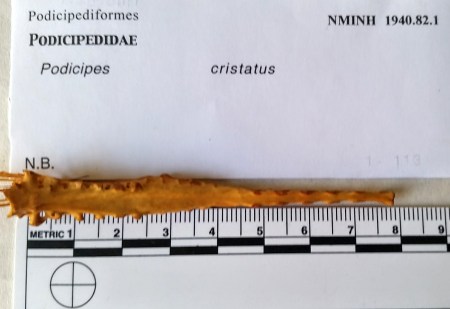
Next I looked at ducks, whose centra taper more in the direction of the tail, then grebes whose whole synsacrum is more narrow overall:

grebe synsacrum

Synsacrum of a Great Crested Grebe

Eventually I made it to the gulls who seem to be a much better fit in terms of shape and the Herring Gull Larus argentatus Pontoppidan, 1763 was a good fit for size:

herring gull synsacrum

Herring Gull synsacrum

Now this doesn’t mean to say that the mystery object is certainly from a Herring Gull. I would want to have the object in my hand and comparative material available from several specimens to check the identification before being sure, but on the basis of the images that Keith Dunmall kindly provided, I think we’re in the right ball park.

More mysteries next week!

Friday mystery object #303

This week I have a real mystery object for you to try your hand at identifying. It’s from the River Thames and it was found by a strandline archaeologist who shared it with Keith Dunmall (who is a Youth Engagement Manager at @WaterAidUK) during a planning meeting for @Thamestidefest.

Keith shared it on Twitter looking for an identification, and he kindly sent me some extra pics:

mystery303amystery303bmystery303c

Do you have any idea what this might be?

No need for cryptic clues, I think this one may be tricky enough to be enough of a challenge as it is!

Have fun!

Friday mystery object #302 answer

Last week I gave you this egg to try your hand at identifying:

mystery302

Eggs can be tricky, since they are largely similar in shape and, since egg collecting was banned many years ago, there are few modern resources for identification.

However, you can pick up clues by thinking about colour and pattern and working out what advantage it may have. So you might expect a brightly coloured egg to be laid in a well disguised and deep nest, where it’s unlikely to be spotted except by the parent, whereas a yellowy speckled egg is more likely to be camouflaged if laid in a fairly open, sandy environment.

So this egg was probably laid somewhere near the sea, which means it’s probably from a charadriiform bird (those are the shorebirds).

Now there are a lot of shorebirds, but this egg is pretty big and it lacks the strongly conical shape you’d expect from a cliff-nester like a Guillemot (the shape means it rolls in tight circle, making it less likely to be blown or knocked off a cliff). That actually narrows it down to a handful of birds that makes comparison easier. Curlew eggs, for example, are a similar size, but they tend to be more grey and have larger blotches, plus they’re a bit less elongated.

This particular egg has the shape and colour of a gull egg and large size means it’s almost certainly the egg of a Greater Black-backed Gull Larus marinus Linnaeus, 1758.

I would say more, but at the moment I’m at the natural history highlight of the year – the NatSCA conference. Here’s the Twitter feed in case you’re interested in the discussion:

Friday mystery object #301 answer

Last week I gave you this mystery tooth to have a go at identifying:

mystery301bmystery301a

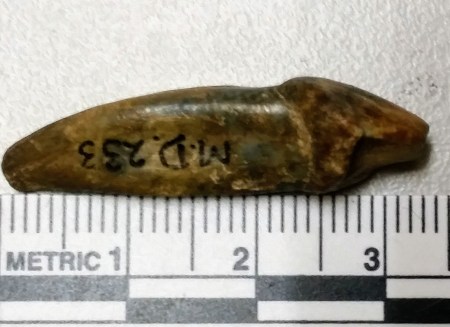
There were a variety of answers, but the first few took this as a worn canine tooth, presumably due to the respectable size and robustness. However, consensus shifted to this being an incisor, meaning it would have to be from a large animal – which is spot on. Moreover, it’s a large animal that was once resident in Ireland.

After that there were a variety of ideas brought up, from all manner of beasts including Sheep, Badger (or perhaps Pine Marten since a cryptic M.m. from the Irish fauna could be either Meles meles or Martes martes), Cave Bear, Coyote, Wolf and even Human. There was one just correct identification however, by Tony Morgan who recognised it as a Hyaena incisor.

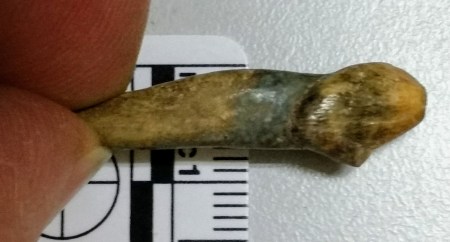
It is in fact the lower left third incisor (or i3) of Crocuta crocuta (Erxleben, 1777) – the tooth you can see in this (very gnarly) Hyaena mandible, although it’s much less worn:

Hyena mandible

Hyaenas have an incredibly thick enamel layer on their teeth which creates a distinct neck on the incisor where it stops, which is further defined by the root of the tooth bulging laterally below – presumably to help deal with the forces of prey capture and perhaps the Hyaena’s impressive bite strength.

mystery70

The robust skull of a specialist bone-crusher

You probably don’t think of Hyaenas as being native to Ireland, but until 39,000 or so years ago they ranged right across Eurasia, including those parts of Europe which were to be cut off by changing sea levels to form Ireland and Britain.

It’s strange to imagine a species normally associated with the African savanna strolling around the Emerald Isle, but it’s worth remembering that the world is a constantly changing place and wildlife moves around to cope as the environment alters. Borders and boundaries are very human concepts and other species only pay attention when you have a genuine barrier, like an ocean, a mountain range or (if you’re a Dormouse) a break in the tree canopy.

That’s one of the problems with current climate change compared to past climate variations. The speed of change is so great that some species don’t have time to move into new habitats and there are fewer suitable habitats available, because humans have cleared them for farming or building. Meanwhile, some other species can find suitable habitats and are able to move – but they will then often be considered an invasive pest. Now  the chances of Hyaenas returning to Ireland are pretty slim, but if they did I expect most people wouldn’t be too pleased, although you never know…

Kevin Richardson kisses hyena. Image by Kevin Richardson, 2007

Kevin Richardson kisses hyena. Image by Kevin Richardson, 2007

Friday mystery object #300 answer

Last Friday I gave you this new acquisition to have a go at identifying:

mystery300

When it arrived on my desk in an decorative box, with bundles of bone wrapped in blue tissue and tied with gold ribbon, it had a small label saying:

Skeleton of Mongoose, Africa.

Now, I know that having the continent would have been of help for the identification, but I didn’t want my 300th challenge to be too easy.

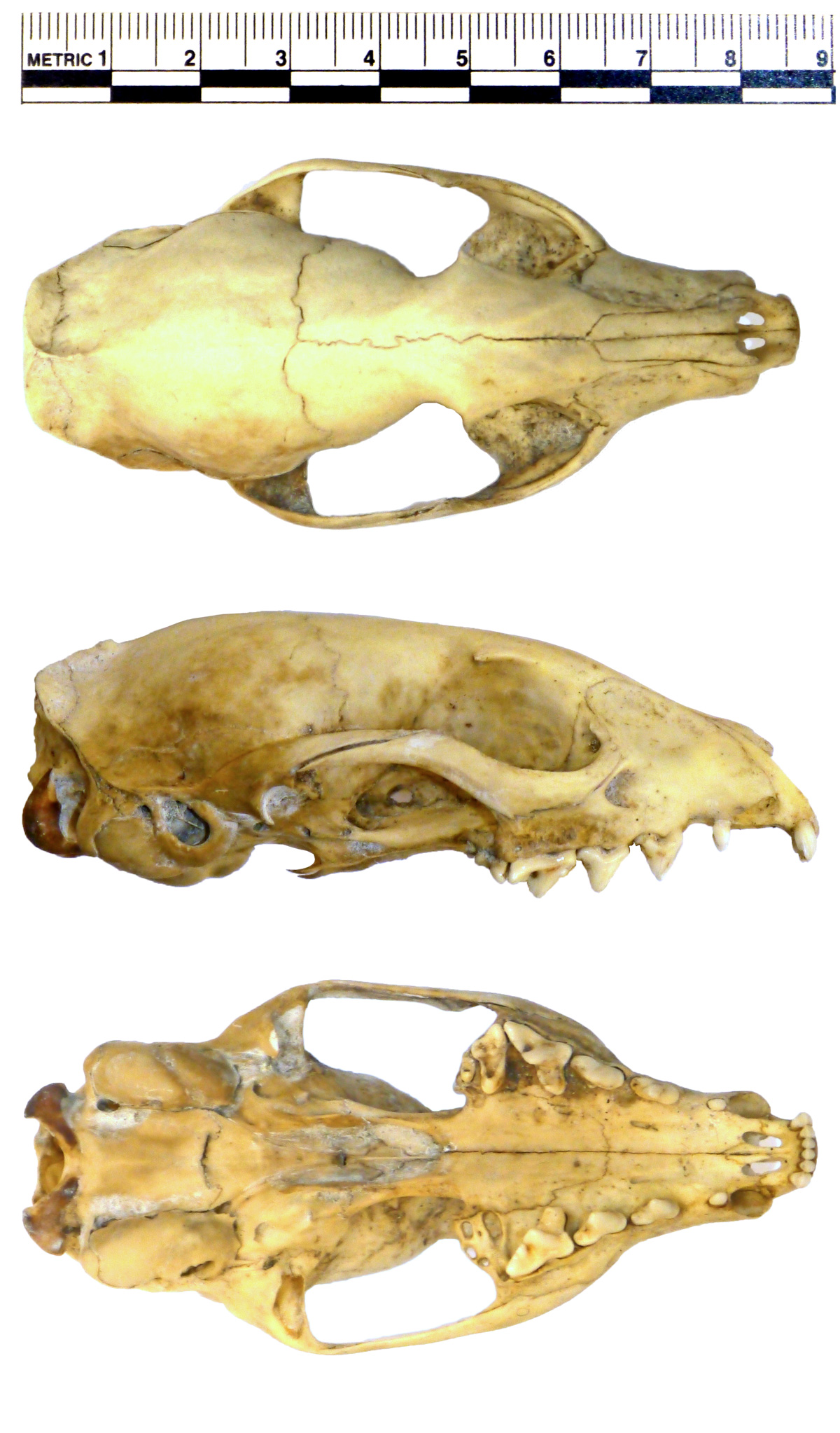
So how was that initial identification of Mongoose? It was certainly up there in the first of the comments, with Ric Morris (expert on British mammal bones, whose book I am eagerly awaiting) providing a beautifully crafted suggestion. Unfortunately it isn’t right, as the mongooses mongeese Herpestidae* tend to have a better developed post-orbital process (that’s the pointy bit on top of the skull, behind where the eye would be) and a corresponding process on the zygomatic (that’s the cheekbone), with the two sometimes meeting to form a post-orbital bar. They also tend to have more robust teeth.

Another (very) cryptic clue came from jennifermacaire who suggested that it was a civet (which can either be a type of viverrid carnivore or a French game stew). This suggestion was supported by henstridgesj and it’s closer than the mongoose suggestion, as the specimen is indeed from a species in the Viverridae. This was noticed by herpderpatologist who provided a handy tip for spotting the difference between mustelids and viverrids:

The split auditory bulla is a clue! It’s something I associate with viverridae;…

If we know that this is a viverrid, it narrows it down to one of  just 38 species…  which is still quite a lot. But by trawling through the images of viverrid specimens on the University of Michigan Animal Diversity Web it becomes easier to start narrowing down the likely group within the Family.

In this case it led me to the genets.

There are quite a few genets, with the Subfamily Genettinae containing in the region of 16 species. Distinguishing between them isn’t entirely simple, as they all look pretty much alike, but there is an excellent French resource that has detailed anatomical characters and images of specimens to help distinguish between genet species.

Working through this I found that the two best options were the Common Genet and the Cape Genet and distinguishing between them is not simple. I’m leaning toward the Cape Genet (or Large-spotted Genet) Genetta tigrina (Schreber, 1776), based on the spacing between the tympanic bullae (the bulbous bones under the skull that house the ear bones), the reduced lingual cusp on the P3 (that’s the tiny bit that sticks out towards where the tongue would be on the upper third premolar) the form of the upper first premolar (P1) and the shape of the maxillary-palatine suture (that’s the junction between the bone of the palate and the part of the upper jaw that supports all the teeth except the incisors).

That’s quite a lot to take in, but by getting your eye in and scanning through images it’s surprising how quickly you can narrow down options by rejecting images where you can see clear differences in the tympanic bulla configuration or cusp pattern on the P3 to leave a couple that need more careful consideration.

And just for the sheer squee of it, here’s what a Genet looks like when it’s alive:

Common Genet, by Peter 2011

Common Genet, by Peter 2011

I hope you enjoyed the challenge of the 300th mystery object!


*N.B. the plural of mongoose is “mongooses”.

Friday mystery object #300

Another milestone for the Friday mystery object – the 300th I’ve shared since it started in July 2009. That means I’ve posted either an object or answer every single Friday for almost 8 years.

The FMO has allowed me to share collections from three fantastic museums: the Horniman, the Grant and now, Dublin’s Dead Zoo – plus a few more random objects ranging from beach finds to pub chairs. It’s also helped bring together a community of people with a shared interest, which is the main reason I’ve kept the blog running for so long. In particular a blog post by Jake McGowan-Lowe about what he’s learned from Zygoma (written 100 objects ago now) makes me feel that the time I put into blogging is totally worthwhile.

This week’s object is an acquisition that’s been waiting for a while to be curated, since the Dead Zoo had been without a Zoology Curator for five years, before I started in December.

The specimen appeared on my desk wrapped up like a gift:

and of course, given my love of bones it was the best gift I could have hoped for – an unidentified skeleton:

mystery_gift_3 - Edited

I got out the Paraloid B-72 (an adhesive we use in museums) to secure in place the loose teeth and detached epiphyses (they’re the ends of the long bones that haven’t fused on to the main shaft of the bone because the animal was young) and I put the specimen in a more appropriate box, but not before taking some photos of the skull to help with the identification:

mystery300

Do you have any thoughts on which species this skull might have come from? I have my suspicions, but I’d love to hear your thoughts.

As usual you can put your observations, questions and suggestions in the comments below. I hope you have fun with this one!


Friday mystery object #299 answer

Last week I gave you this cute critter to try your hand at identifying:

mystery299

I thought the presence of fur would make it easier than usual, but of course, hair hides a lot of rather useful diagnostic features that you can find more easily in the bare bones.

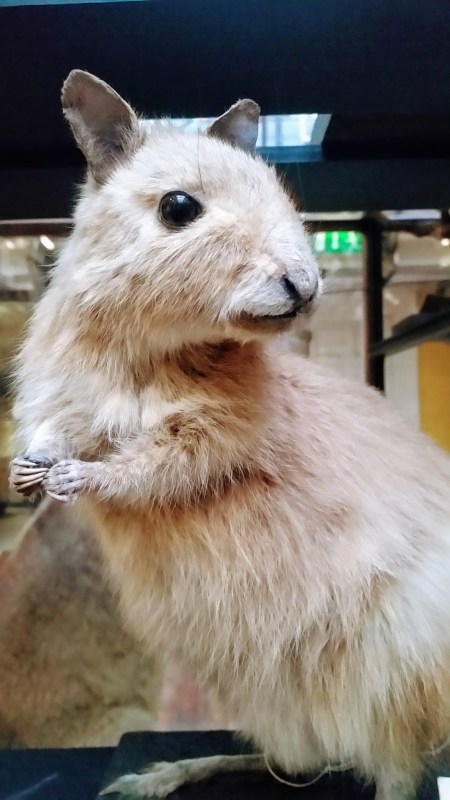
However, you managed to pick up on a couple of the key features that gave this specimen its name: it looks like a lagomorph (one of the hares, rabbits or pikas) or maybe a larger rodent and it looks like a macropod (one of the kangaroos, wallaroos or wallabies). Several people wondered about it being a Kangaroo-rat, but that distinctive back foot, with its big central toe and then the skinny little side toes (you have to look carefully), tells us that it’s the other way round and this is a marsupial that looks like one of the placental glires (that’s the group containing the rodents and the lagomorphs).

The marsupial identification was initially spotted by palfreyman1414 and tenaciously defended by Rebecca, who was on the right track when she veered toward it being something in the Potoroidae (the rat-kangaroos, potoroos and bettongs), a suggestion that was put forward in a more cryptic way by jennifermacaire.

This is in fact a Rufous Hare-wallaby or Mala Lagorchestes hirsutus Gould, 1844, which marsupial wrangler Jack Ashby spotted with ease:

I should say that it is indeed VERY faded, after spending over 100 years in a glass ceilinged gallery.

These small macropods live on a few islands in Western Australia, but their original wider range has been dramatically reduced by changing land use patterns resulting from the breakdown of the relationship between the Aboriginal people and the land, caused by encroachment and systematic persecution by European settlers. It’s not onlyhumans who suffer when people treat each other badly.

Friday mystery object #299

This week I’ve decided to give you a mystery object that has its skin and fur, so in theory it should be really easy to work out what it is. In theory.

mystery299

Any idea what species this adorable little critter belongs to?

As usual you can put your thoughts, questions and suggestions in the comments section below. If you find this too easy then maybe you can try to find a cleverly cryptic way to let me know.

Have fun!

Friday mystery object #298 answer

Last week I gave you this bony mystery object to identify:

mystery298

There was a request for a side view from jennifermacaire, so here you go:

mystery298b

The suggestions were all suitably cryptic, with some nice puns thrown in for good measure, but the gist of all of them was clear that this is the sternum of a bird. After that point, the suggestions started getting a bit more varied, including reference to marine birds.

Responses on Twitter were a bit more varied, ranging from ‘part of a human face’ to an essentially correct answer (admittedly after a bit of Q&A).

If you’re a regular reader you may recall that I featured a sternum a few months ago from the Grant Museum of Zoology, that had a disappointing answer, but nonetheless an answer that provided a number of sternum images that may have helped with this object.

In particular this specimen may have helped:

wp-1480627910740.jpg

Chicken

The long lateral trabeculae (the mystery specimen is upside down, so they’re the side bits that point upward on either side) with a deep gap between them and the carina (the central keel area)  is very distinctive to the Galliformes, as you can see in this Chicken sternum.

Sadly, there is no comprehensive repository of sternum images available online (if I’m wrong please correct me!), so expecting a species identification on this one was a big ask. Instead I’ll just tell you that it’s from a Hazel Grouse Tetrastes bonansia (Linnaeus, 1758) and this one was collected in Russia and accessioned by the Dead Zoo in 1929.

Hazel Grouse, by kallerna, 2009.

Hazel Grouse, by kallerna, 2009.

These secretive birds occur across Eurasia, from Japan to as far west as eastern parts of France. They live in coniferous forests and feed on plants and insects, like most of their pleasantly pheasanty family.


Friday mystery object #298

This week it’s back to bones. I’ve had a couple of very helpful work experience students photographing some specimens from the Dead Zoo comparative osteology collection and here’s a distinctive bone for you to identify. The Order should be easy, the Family simple enough, but the Genus and Species may prove more difficult:

mystery298

So if you think you know what this is please put your suggestions in the comments below. Have fun!

Friday mystery object #297 answer

Last week I gave you this shiny green beetle with white spots (and apparently a penchant for making balloon animals) to identify:

mystery297

I thought it might offer a bit more of a challenge, but I forgot about Google. It turns out that a Google Image search using the key distinguishing features provides some useful images to compare, making this easier than I expected.

As palfreyman1414 correctly recognised (followed by many others), this is the Spotted Flower Beetle Stephanorrhina guttata (Olivier, 1789).

Of course, when dealing with historic museum collections things are never quite that simple, so the specimen on display is actually referred to by the genus name Ceratorrhina which isn’t recognised today. Ceratorhina was synonymised with Cyprolais, which is a subgenus (containing the Horniman Beetle) that’s in the genus Eudicella.

Of course, that means that this specimen may have been named incorrectly in the first place, since I’ve seen nothing to suggest that Ceratorrhina has been directly linked to beetles in the genus Stephanorrhina which sometimes carry the synonym Aphelorhina in older collections information.

It would be interesting to work out how the incorrect name was applied to this display specimen, but I have an inkling that there was once a rogue curator who just liked to cause taxonomic trouble…

Friday mystery object #297

Happy Friday everyone! Once again it’s time for the mystery object and once again I’m in a different country and am relying on a photo I have on my phone to supply you with a specimen for identification. That means the photo isn’t ideal, but it does mean I have something a bit different from the usual skull or bone:

mystery297

Any idea what species this colourful insect and its less lovely larva might be?

As always you can put your questions, observations and suggestions in the comments section below. Have fun!

Friday mystery object #296 answer

Last week I gave you this lovely little shell to try your hand at identifying:

mystery296

It’s a specimen that was given to the Dead Zoo recently by a regular contributor to the collections and it’s particularly interesting because it might be the first record of this species in Ireland (this is currently being researched for publication by the donor, so I won’t give away too much detail).

What I will say is that this is one of the reasons species identifications can be very important, since our understanding of how species move around has implications for various aspects of society and you don’t want to make decisions based on bad information. If you don’t know what I mean by that, I’ll give you some examples.

Zebra mussels arrived in Ireland in the 1990s from the Black and Caspian Seas and they’ve bred prolifically. They altered freshwater ecosystems by filtering out plankton that other species depend on for survival and they form hard-to-remove clusters that foul boat hulls and block drainage and cooling pipes. They’re in North America too, and in 15 years they are estimated to have cost hydroelectric and water treatment plants somewhere in the region of $267 million to remove or defend against. It’s cheaper to defend against them than to remove them and fix the problems they cause, so you need to know what you’re dealing with.

Retrieval of zebra mussel-encrusted Vector Averaging Current Meter near Michigan City, IN. Lake Michigan, June 1999. Photo by M. McCormick, NOAA, Great Lakes Environmental Research Laboratory

Retrieval of zebra mussel-encrusted Vector Averaging Current Meter near Michigan City, IN. Lake Michigan, June 1999. Photo by M. McCormick, NOAA, Great Lakes Environmental Research Laboratory

Signal crayfish are another freshwater invasive species, this time from America, that have caused havoc in Europe because they are linked to the dreaded Crayfish plague (I kid you not). The American crayfish are resistant to this fungal(ish) disease, but they act as hosts and carriers. Ireland is the last country in Europe to be free of the invasive crayfish, but are constantly alert to the dangers they can pose to the native species.

Signal crayfish by David Perez, 2009

Signal crayfish by David Perez, 2009

I should say that the many introduced species aren’t actually all that problematic. I’ve not heard that Little Owls (introduced by the Victorians for the cuteness) or Ring-necked Parakeets (escapees from aviaries) have had any significant impact in the UK. Still, it’s interesting to know when species turn up somewhere, especially if it reflects a change in the environment that may have other impacts.

Little Owl by Arturo Nikolai, 2008

Little Owl by Arturo Nikolai, 2008

Noble False Widow spiders were a harmless addition to the UK fauna back in 1879, that were quietly tucked down in Devon until the changing climate gave them the conditions to move further north. Now they’re up as far as Liverpool thanks to our warmer winters. Similar patterns are seen for a variety of Mediterranean species, demonstrating how we can track changes in our environment by keeping track of where and when certain species are found – but if you don’t get the species right, you don’t have good data. That’s part of why we have museums in the first place, to lodge ‘voucher’ specimens of recorded species so identifications can be double checked in the future.

Steatoda nobilis, Forest Hill, London, by Paolo Viscardi, 2014

Noble False Widow

Of course, I’m sure that you all appreciate the importance of getting identifications correct, since here you are reading my blog which tends to be all about identification! For those of you who recognised the mystery object as a scallop of some sort I tip my hat, but to Daniel Jones I offer congratulations – this is indeed a Calico Scallop Argopecten gibbus (Linnaeus, 1767) which is, as Joe Vans suggested, a juvenile. Normally these are found on the Atlantic coast of America. Well done! I’ll let you know more about the specimen when the paper is published.

More interesting dead stuff to come next Friday…

Friday mystery object #296

This week I’ve been in the USA couriering a loan back from the stunning Corning Museum of Glass (I’ll write about that sometime soon). However, that means I’ve had limited access to specimens for this week’s mystery object and I’m restricted to what I’ve got on my phone. Fortunately, I have this non-vertebrate mystery object for you to try your hand at identifying to species:

mystery296

It’s quite a cool specimen and I’ll tell you why next week! Have fun!