Friday mystery object #351 answer


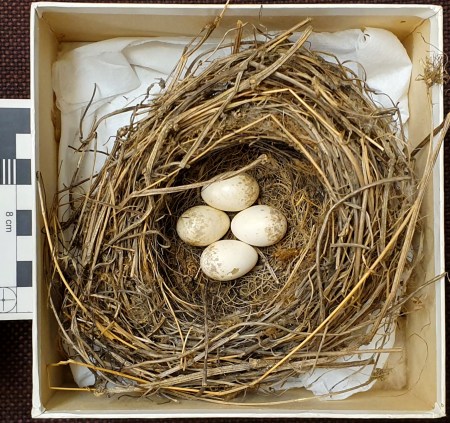
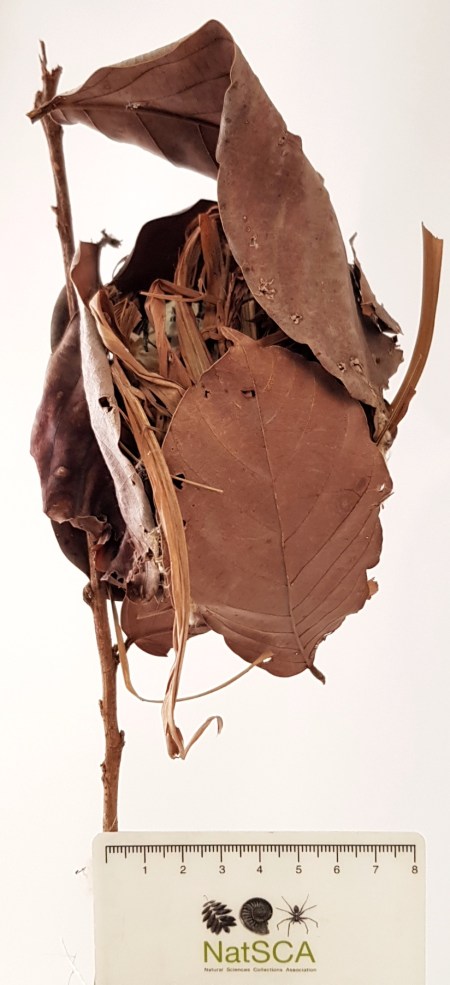
Last week I gave you this unusual object to have a go at identifying:

20190307_121429-2.jpeg

There were a variety of clues and suggestions (some beyond my ken) but they tended towards identifying this as the nest of a Tailorbird. In fact salliereynolds even provided a video of the Common Tailorbird in action:

This was pretty darn close (excuse the pun), but the nest structure isn’t quite what I would expect from a true Tailorbird in the genus Orthotomus, plus I had a bit of extra information on a secondary label suggesting that this nest is from Sierra Leone (although the quality of the handwriting on the primary label made it indecipherable, so I’m not sure if it mentions the species or something else entirely):

20190314_205622.jpg

It’s worth noting that most of the true Tailorbirds are in Asia (mainly the Philippines), but in Africa there are some closely related birds that build similar nests that are a little more similar to the mystery object. A birds in the genus Cisticola is the most likely culprit in Sierra Leone, and I’ve seen Red-faced Cisticola Cisticola erythrops (Hartlaub, 1857) nests that match the structure, leaf selection and construction technique used here, so I think it will be something along those lines, but I simply can’t be sure.

This is a great example of why good, clear handwriting is really important in a museum setting. A bit of time spent with examples of Capt. H. W. Long’s writing might help decipher the original note, assuming such examples exist. Or, it may be that there’s a talented palaeographer who can read the original  note – if you have any thoughts your suggestions would be welcome!

Friday mystery object #350 answer

Last week I gave you this mystery bird as my 350th specimen for identification:

20170213_113309-01.jpeg

It wasn’t particularly easy, although that oddly preserved crest did help narrow it down.

As Wouter van Gestel pointed out, the general shape of the bird, particularly the legs and sternum, suggest that it’s a passerine. There are quite a lot of crested passerines, from Crested Tits to Crested Jays, but the bill shape on this specimen only matches a few.

Bob Church worked it out and left a nice cryptic clue:

Well, I could be wrong and might bomb this one, but perhaps if I wax poetic, I could wing it a bit.

Taking bomb, wax and wing clearly relates to the waxwings in the genus Bombycilla.

For the full species definition there was a response on Twitter from the Scarborough Museums Trust Collections Team:

“Chattering silk-tail” is a direct translation of the scientific name Bombycilla garrulus – which is spot on!

They get their common name from the waxy red tips on their secondary feathers and their ‘Bohemian’ lifestyle – in the 19th Century sense of them being wanderers. They migrate thousands of miles and have a huge distribution across the Northern Hemisphere.

768px-bombycilla_garrulusii

Bombycilla garrulus by Andreas Trepte, 2012

I find their silky plumage and rich but quite blended colouring particularly beautiful – something that is a bit lacking in the mystery specimen.

Friday mystery object #350

This week marks a minor milestone for my blog – the 350th mystery object. Thanks to everyone who comes to take a look at the specimens I’ve been sharing from the various museums I’ve worked in over the years. I hope you’ve enjoyed them!

This week I have a funky specimen from the Dead Zoo for you to have a go at identifying:20170213_113309-01.jpeg

It stands around 17cm high, including the crest, which is a particularly striking feature to be preserved on a skeleton.

Any ideas what this is? As usual, you can put your questions, observations and suggestions in the comments below. Most importantly, have fun!

Friday mystery object #349 answer

Last week I gave you this long, pink, wrinkly specimen to have a go at identifying:

20190126_154418-01.jpeg

There was a lot of discussion about whether it has limby bits, fins, flaps left over from damage during preparation or some other unnamed and dubious appendages. I’m relieved to confirm that it has limbs – albeit rather reduced limbs.


The limbs are important, since they allow us to rule out all the legless groups of similar critters, like Caecilians (limbless amphibians), Synbranchidae (swamp eels), Amphisaenidae (worm lizards) or of course snakes (not that any self-respecting snake would have a face that looks like it belongs to a poorly made sock-puppet).

The state of the legs, especially the very reduced state of the front limbs, also allows us to rule out a variety of Olms, Sirens and other Salamanders – except for one odd little genus called Amphiuma.

There are only three living species of Amphiuma – the One-toed, Two-toed and (believe it or not) Three-toed. Someone in the past hedged their bets and labelled the mystery specimen as follows:

20190126_154418-02.jpeg

Since the Three-toed salamander is Amphiuma tridactylus Cuvier, 1827 and the Two-toed is Amphiuma means Garden, 1821 this label is misleading.

The Three-toed salamander does have three visible toes on the forelimb and this specimen clearly doesn’t – with just a vestigial wriggly bit (that doesn’t make it the One-toed salamander however, as they are smaller and they have an even more reduced hind limb). So this is the Two-toed Amphiuma means.


1024px-amphiuma_28two-toed29

Amphiuma means, Virginia, United States. Image by Brian Gratwicke, 2010


Finally, it might be a bit confusing that the mystery object is a pink thing, while the living animal is a mottled muddy colour. That’s just an artefact of it being preserved in ethanol for the last 125 years. Trust me, no-one looks good after that much exposure to alcohol.

Friday mystery object #348 answer

Last week I gave you this mystery object to try your hand at identifying:

20190122_123720-01-01.jpeg

It was both a bit tricky and a bit easy. It was tricky because it’s the skull of a cat, and as I’ve discussed before, cats are a morphologically conservative group that are quite difficult to differentiate between, due to their relatively recent divergence as a group. It was easy because of the context provided by the previous mystery object, as commented on by Wouter van Gestel who immediately worked out what this skull came from.

This is the skull of a large male Clouded Leopard Neofelis nebulosa (Griffith, 1821). These beautiful, elusive and rare big cats from Asia have the longest canines in relation to body size of all the modern cats – making them an occasional comparison for the sabre-toothed cats of prehistory.

Clouded Leopard in Cincinnati Zoo, Charles Barilleaux, 2012.

Clouded Leopard in Cincinnati Zoo, Charles Barilleaux, 2012.

Although they may look adorable, they use those long canines to take down a variety of vertebrate prey, including monkeys, deer and even armoured snack-beasts like Asiatic porcupines and the overly-put-upon pangolins. They are one of the few truly arboreal cats, able to climb head-first down trees and even scoot along the underside of branches, giving them an advantage as an ambush hunter in forest environments.

So well done to everyone who figured that the mystery skull belonged to this fantastic feline!

Friday mystery object #347 answer

Last week I gave you these teeth to have a go at identifying:

20181018_130907-02.jpeg

It was a bit mean of me to only show the incisors, but I thought it would be way too easy otherwise and I thought that some of you would manage to get it. I was not wrong.

Despite the sparse information, James Bryant, Jennifer Macaire, Allen Hazen, sallie reynolds, Michelle Tabencki, Kaitlyn, Rémi and a tentative few others leaned towards one of the sabre-toothed cats, with most people opting for Smilodon. That is indeed what these teeth belonged to and if you want to be specific they’re from Smilodon fatalis Leidy, 1869.

742px-bc-018t-sabercat-tarpit-r2-lo

Reconstruction of Smilodon fatalis skull. Image by Bone Clones, 2000

The mystery specimen and I go way back as it’s the one in the Geology Department of Bristol University, where I did my undergraduate degree many years ago. It inspired me to do a project on Smilodon, which sent me around a variety of UK museums in search of specimens to measure.

That was the start of my behind-the-scenes experience in museums and I met some fantastic people, including the legendary Andy Currant at the NHM, London, who was so helpful, knowledgeable and welcoming that it left an indelible mark on my attitude to collections access and curation.

I still have a soft spot for Smilodon and of all the palaeontological questions that I’d love to see resolved it’s how their bizarre canines worked. I never considered the “Akersten canine-shear-bite” [opens as pdf] as being biomechanically plausible, not least because it requires the jaws to close during the bite, which would in turn require these incisors to penetrate the skin and some (or all) of the underlying tissue of the prey.

While these incisors are robust, they’re just not the right kind of shape for that type of action as the straight and fairly level row would dissipate force quite evenly during a bite, rather than allowing the high point loads well suited to penetration.

There are other, more plausible methods proposed (e.g. Brown, 2014), but without seeing Smilodon in action it’s one of those mysteries that may never be satisfactorily resolved. And who wouldn’t want to see something as terrifying as a gigantic, sabre-toothed feline in action?

Smilodon californicus and Canis dirus fight over a Mammuthus columbi carcass in the La Brea Tar Pits. By Robert Bruce Horsfall, 1913

Smilodon californicus and Canis dirus fight over a Mammuthus columbi carcass in the La Brea Tar Pits. By Robert Bruce Horsfall, 1913


Friday mystery object #346 answer

Last week I gave you this funky fossil from the National Museum of Ireland to have a go at identifying:

20181208_161002-01.jpeg

Everyone in the comments immediately recognised that this is the fossil of something that flies, thanks to the slender bones. The general consensus from the outset was that it was Archaeopteryx, but I wonder how much of that is because this specimen is preserved in the same Middle Jurassic lithographic limestone from Solnhofen that preserves the first bird?

The Berlin Archaeopteryx

The Berlin Archaeopteryx

However, Allen Hazen noticed the long slender finger that marks the mystery object as something different, when he correctly suggested that it was a pterosaur, winning over palfreyman1414 and sallie reynolds. On Twitter, @Robertgagliano1 went one better and got the correct genus when he suggested Germanodactylus.

This is indeed a fossil of Germanodactylus cristatus (Wiman, 1925). These small Jurassic pterosaurs were about the size of a raven and it is thought that they may have fed on marine crustaceans and molluscs, based on their fairly robust teeth.

This particular specimen is currently on display in our Jurassic Skies exhibition (that I talked about a fortnight ago), as it helps represent the successful group of flying reptiles that were already in the air 150 million years ago, when feathered dinosaurs first took to the skies.

In an unexpected twist, research was published just a week after we opened the exhibition, describing the first evidence for feathers in pterosaurs. This was unexpected, although fur-like filaments had already been recognised in the group. This means it’s possible that feathers originated in a common ancestor of dinosaurs and pterosaurs – which may have even included the group that is today represented by the crocodiles.

This means it’s possible that the ancestors of crocodiles would have been feathered and modern crocodiles have lost this covering, possibly thanks to their specialisation for living in water. I find it quite interesting that a reticence to add feathers to representations of dinosaurs (in things like Jurassic Park) has been influenced in part by the scaly skin of modern crocodiles (the nearest living relatives to dinosaurs that are not birds), but now we find out that crocodiles may have had feathers and lost them, making prehistory a much more fuzzy place than we ever dreamed!

Friday mystery object #345 answer

Last week I gave you this squee squamate to have a go at identifying:

As usual the comments were insightful and bang on target, with a correct identification by Chris, jennifermacaire, sallie reynolds and Allen Hazen. In the comments there was even a link to a very useful paper provided by jennifermacaire and a mention of the value of the tail-tip shape as a way of distinguishing between species of flying gecko.

Unfortunately the end of this specimen’s tail was hidden behind a label, so it wasn’t visible in any photos, but if it was it would show that this is a Common Flying Gecko Ptychozoon kuhli Stejneger, 1902. Distinctive tail-tips aside, the comments also picked up on some very interesting points about gliding replies. As Allen Hazen mentions:

… So gliding with a patagium along the side of the body (not supported by the arms and legs as it is in typical mammalian gliders) has evolved at least FOUR times in reptiles (reptilia sensu very lato): these guys, Draco, Kueneosaurus, and another fossil form I can’t remember the name of. …

Which is both interesting and pertinent to the main reason I picked this object, as it’s one of the specimens I selected for the temporary exhibition Jurassic Skies we just opened at the National Museum of Ireland at our Collins Barracks site, which is about the origins of flight in dinosaurs (i.e. birds).

This slideshow requires JavaScript.

Gliding lizards don’t have much to do with the origin of birds directly, but the high frequency with which they seem to pop up is a good indicator that there’s a clear benefit to being at least partially air-worthy.

Escaping predators, reaching inaccessible food and exploiting otherwise hard-to-reach habitats can all play a role in tempting animals into the air. The interesting thing that I’ve realised from doing this exhibition is that we’re currently in a bit of a dull patch when it comes to flying critters.

In the Jurassic the pterosaurs dominated the skies, with birds arising and finding a niche despite being newcomers to the aerial scene. By the Cretaceous both birds and pterosaurs were very diverse, with giant Quetzalocoatlus pterosaurs the size of a small plane and toothed and toothless birds living in a variety of habitats.

The K-T boundary mass extinction seems to have wiped out a huge amount of vertebrate diversity in the skies and despite the huge number of bird species alive today, the diversity of forms seems lower than it has in the past.

If you happen to be in Dublin before 24th March 2019 I suggest popping over to the Collins Barracks museum site to take a look at the exhibition. It’s free and it offers a chance to see some of our specimens that have never been on display before, plus a rather lovely new model of Archaeopteryx that we commissioned for the show.20181211_162925

Friday mystery object #344 answer

Last week I gave you this impressive insect to have a go at identifying:

mystery344.jpeg

No scale for this, but it’s probably safe to say it’s bigger than you’d be comfortable with.

By not giving the scale I was being a bit mean by holding back a useful clue. This fly (as recognised by palfreyman1414, Richard Blackmore and joe vans) is around 45mm long, making it one of the biggest of its kind – its kind being one of the Asilidae or robber flies.

The species is from Australia and it’s called the Giant Yellow Robber Fly Blepharotes coriarius (Wiedemann, 1830). They’re active hunters that prey on other insects, grabbing them in flight and carrying them off to a perch where they suck out their victim’s internal organs. Nice.

Apologies for the short answer this week – I’m just in the process of installing an exhibition and this specimen is one that is going on display to represent the Diptera. Hopefully I’ll be able to share some images of what I’ve been working on next week.

Friday mystery object #344

This week I have a specimen that I’ve been considering for display for you to have a go at identifying:

mystery344.jpeg

No scale for this, but it’s probably safe to say it’s bigger than you’d be comfortable with.

For some of you this will be too easy, for others it may pose more of a challenge, so if you do know what it is, please keep your suggestions cryptic to keep things fun for everyone!

Friday mystery object #343 answer

Last week I gave you this mystery skull from the Ulster Museum to have a go at identifying:

If you’re a regular follower of Zygoma then you may have seen some of my previous posts talking about the skulls of the various smallish carnivores like mongooses, mustelids and viverrids. Generally though, mongooses have a more domed region above the eyes, while mustelids have a shorter snout, so this is most likely one of the viverrids.

It’s a difficult one to get down to species, since it’s from a group of carnivores that have have a fairly uniform skull shape, so it takes some detailed investigation to work out exactly what we’re dealing with. However, as I have talked about before (and as palfreyman1414 remembered), there’s a very helpful identification guide developed by some French researchers which summarises some of the most useful characters to use in identification.

Most useful to my mind is the matrix of characters that allows you to narrow down the possibilities until you’re left with the most likely species (watch out, the security certificate has expired). Once you’re down to a few possibilities based on those specific characters it can help to check the specimen images on the Animal Diversity Web which lets you get a better idea of overall shape and things like tooth form.

As it turns out, my 270th mystery object also provided a useful image for comparison:

mystery270

The reduced upper second molar (or M2) and the shape of the M1 in this specimen from the Grant Museum of Zoology is remarkably similar to the Ulster Museum specimen and it turns out it’s also from a species that made it to my shortlist using the matrix. So I’m fairly sure that this is an Abyssinian Genet Genetta abyssinica (Rüppell, 1836).

To give you an idea of what they look like, here’s a Common Genet in Wrocław Zoo by Guérin Nicolas, 2008

Well done to everyone who worked out we were dealing with a genet, but particular props to palfreyman1414 who was spot on when he said:

I’m wondering if, … this is related to the Abyssinian thingy you spent hours checking on from a complicated table of characteristics across 27 species…

Well remembered palfreyman1414, well remembered…

Friday mystery object #343

Last week I had the good fortune to visit the collections of the Ulster Museum in Belfast with the National Museums Northern Ireland’s Curator of Vertebrates Angela Ross. It’s always a valuable experience seeing other museum stores and it was a real pleasure to meet Angela and talk about our shared experiences with collections. 

As you might expect, as with every museum in the world, there are one or two specimens that have lost labels or that have never been identified, so I was fortunate enough to be get some photos of one such example for today’s mystery object. Any idea what this skull was from?

It has similarities to specimens I’ve featured in the past, and in the answers to those I’ve provided links to identification resources. If you have a rough idea of what this is, it may be worth your while using the search box in the top right corner of the blog to look for more information to help you narrow it down.

Have fun hunting for an identification – I know I will!

Friday mystery object #342 answer

Last week I gave you this flouncy fish to try your hand at identifying:

20180907_114949-01.jpeg

It proved a tricky one, because it seems that based on genetic data it may be a species that has undergone convergent evolution with another type of fish to produce something very similar morphologically, but not actually closely related.

The similar fish would be the Sea Robins in the family Triglidae, as several of you opted for, but Wouter van Gestel and Rémi were a little more accurate in their cryptic suggestions of Flying Gurnard Dactylopterus volitans (Linnaeus, 1758).

These fish don’t really fly and only a few sources suggest that they can get any kind of glide going. Mostly they stick near the ocean bottom in shallow waters, using those oddly leg-like front fins to manage their more pedestrian movement and using the wing-like large fins to ‘fly’ underwater.

This particular specimen has lost its colour, thanks to the process of being preserved in alcohol, but when they’re alive they’re very colourful, with electric-blue spots on the fins. Perhaps more interestingly, this specimen was collected by Sir Frances Leopold McClintock, who achieved renown for his polar exploration and who was stationed in the Royal Navy’s North America and West Indies station as Commander-in-chief between 1879 and 1884. Since this specimen is from Jamaica, it seems likely that it collected in that period.

More mysteries next week!