Friday mystery object #243 answer

Last week I gave you this nightmarish looking mystery object to identify:

mystery243

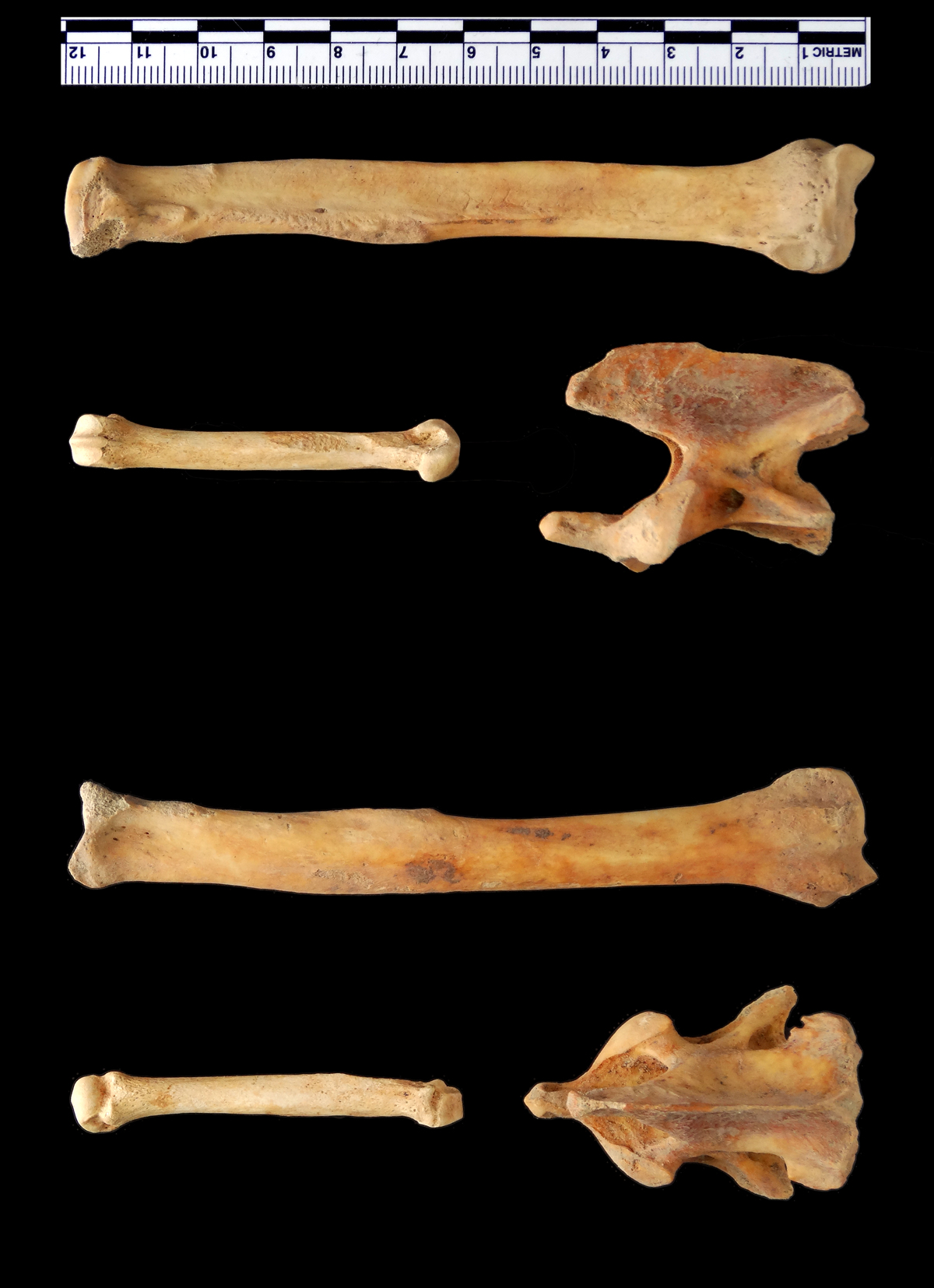
There were lots of great suggestions about what it might be, with most of you in the right area of the animal kingdom with a legless critter in mind. In particular a fairly primitive type, with aglyphous or ‘groove-less’ teeth (as opposed to snakes characterised by having opsithoglyphous or ‘backward grooved’, proteroglyphous or ‘forward grooved’ and solenglyphous or ‘pipe grooved’ teeth).

There were several suggestions of Boa constrictor – specifically the right maxilla (upper jaw), but they have a straighter top to the maxilla and a differently shaped process that connects with the frontal and ectopterygoid bones (check out Udo Savalli’s snake skull anatomy page to see what those terms mean).

Anaconda was also suggested, but the anterior (front) part of  the maxilla is not squared off enough.

Nicola Newton, rachel and Alex Kleine all suggested Python, which is what I think it is. I’m not certain of the species, but it’s definitely a big one – I’m leaning towards the Reticulated Python Python reticulatus (Schneider, 1801).

Just to give you a better idea of which bone it is, here it is compared to the skull of another large Python skull from the Horniman’s collection:

mystery243b

and to give a better sense of scale, here it is with my (fairly large) hand for comparison:

mystery243a

My very rough estimate of the length of the animal, based on other skeletal material I’ve seen, is around 5m – that’s one snake I wouldn’t want to get on the wrong side of!
Friday mystery object #242 answer

A very Happy New Year to everyone!

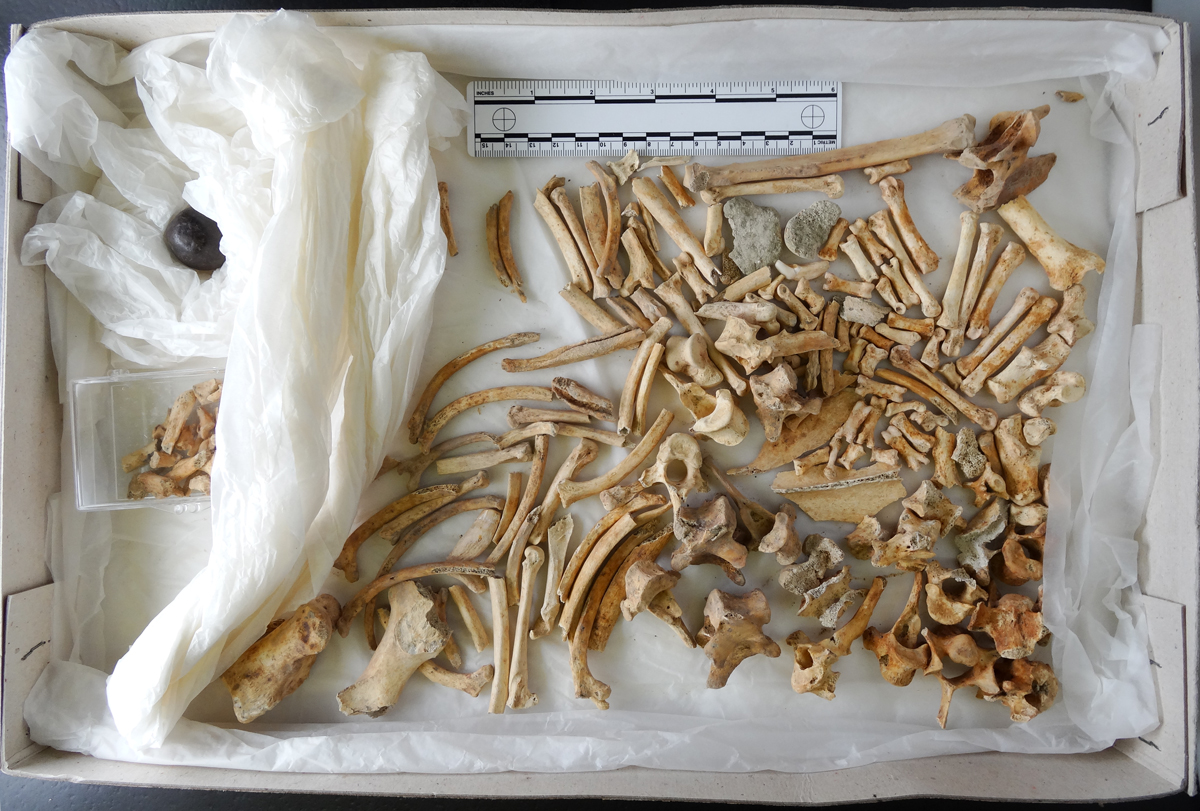
Last week (and indeed last year) I gave you this box of bones and one non-bony object, dug up on the Isle of Sheppey to identify:

mystery242a

Everyone correctly spotted that the bones were canid (and by everyone I mean Ric Morris, witcharachne, Jake, Paleotool, Allen Hazen and Sam Misan), either Dog or possibly Fox, as suggested by Sam Misan.

The length of the bones would fit both Dog and Fox, but they’re a bit too robust for Fox – here’s a comparison of a radius from the box and a Fox:

mystery242d

So we have a Dog in the box, but the non-bony object has posed more of a challenge:

mystery242b

mystery242bb

The initial thought was that it might be a musket ball, but it’s rather on the big side for that – more like a small cannon ball or piece of grapeshot.

The material its made of may provide a clue as to what it is. It’s not magnetic and there’s no red coloured oxidisation on the surface, so it’s not iron. It doesn’t have any casting marks, it’s too hard to be lead and although it’s dense, it doesn’t seem to be metal.

To my mind it seems likely to be a naturally formed mineral concretion. It could be a phosphatic nodule, pyrite or marcasite (they contain iron, but they’re not magnetic) or maybe a quartz mineral, like flint (which is what I’m leaning towards).

This may be naturally occurring in the area, but if the materials were collected together it seems likely that the ball had been used by someone for something. The possibility I’m inclined to go for is as ammunition for a sling.

All a bit speculative I’m afraid, but that’s how the game sometimes works out. Thanks to everyone for your input!

Friday mystery object #242

Seasons greetings! Since it’s Boxing Day, I thought it would be appropriate to give you a box of bones from an archaeological dig to have a go at identifying:

mystery242a

Here are a couple of detailed images of some of the bones to help you:

mystery242c

And here is a detail of the non-bony object that’s associated:

mystery242b

You can put your questions, observations and suggestions in the comments box below and maybe we can work out what’s been dug up!

Friday mystery object #241 answer

Last Friday I gave you this object, that I’ve been working on, to identify:

mystery241

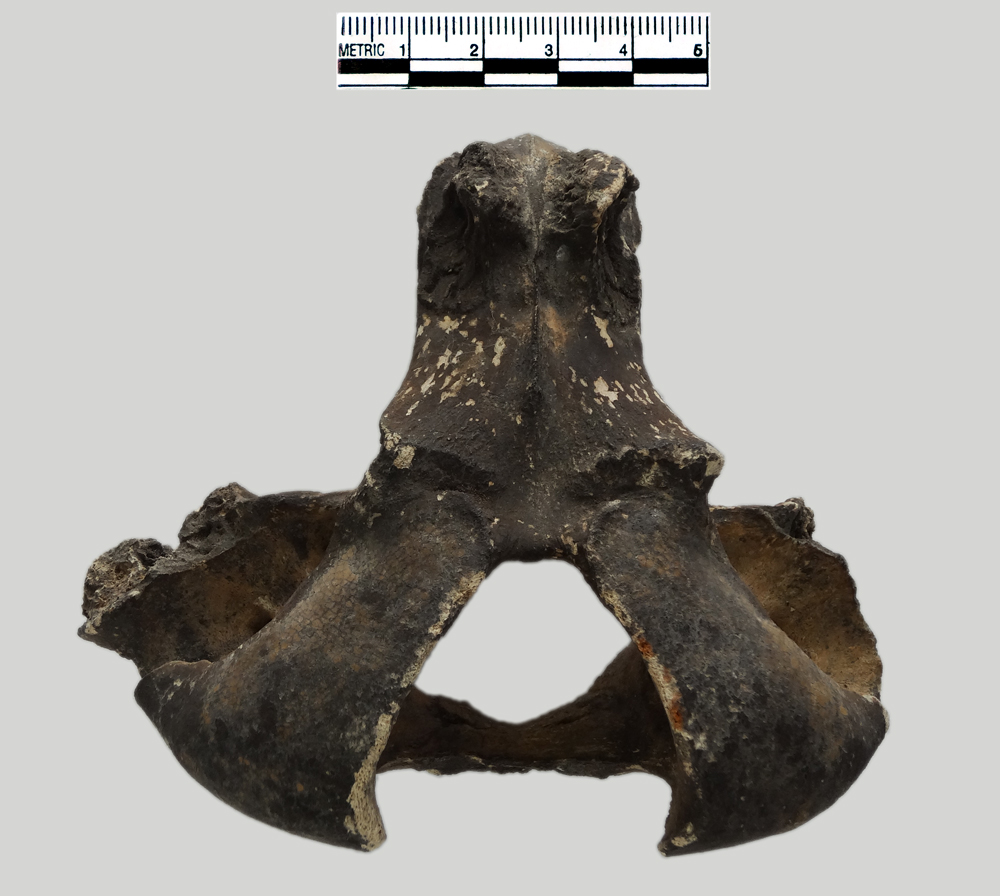
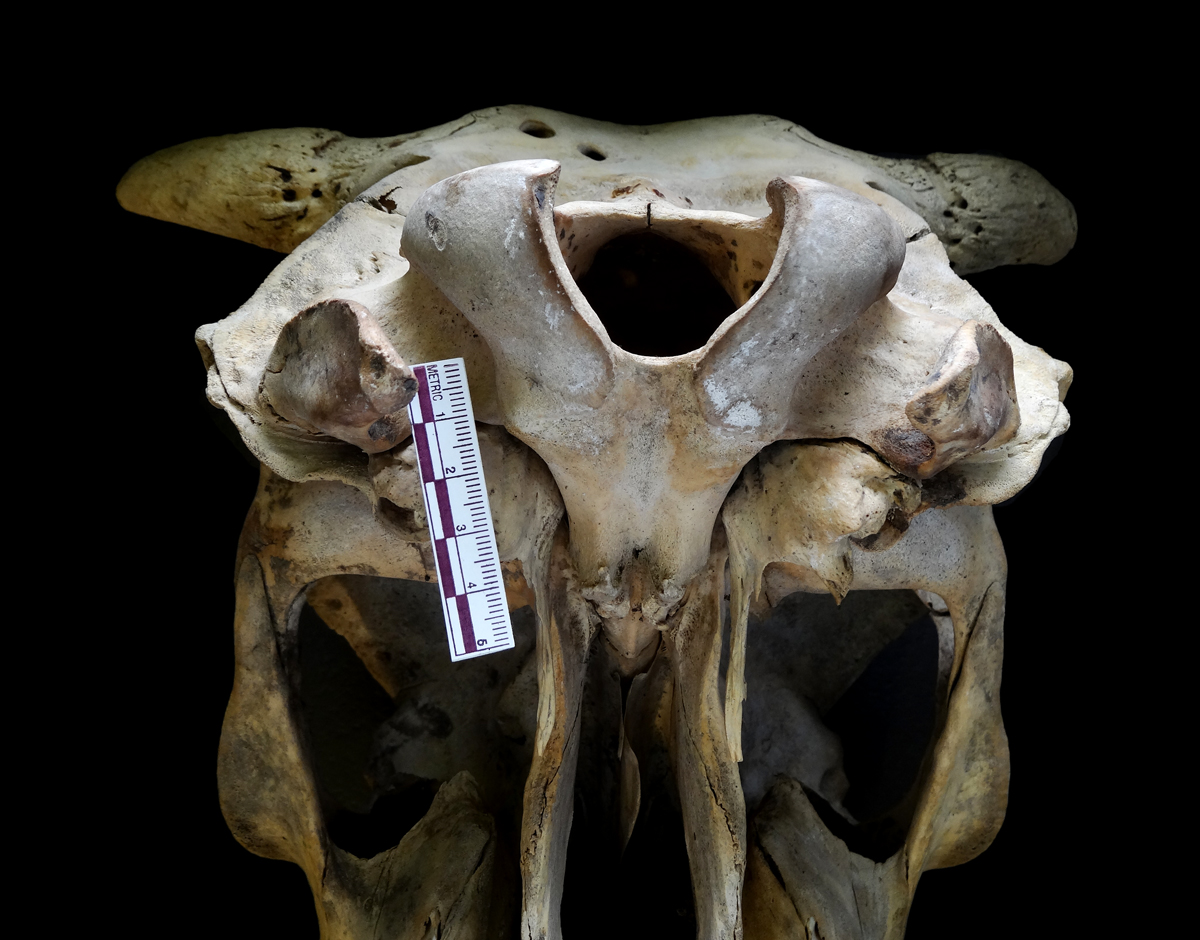
Ric Morris was straight in with the nicely disguised correct answer of occipital bone viewed from the basal aspect, correctly suggesting something bovine as the source.

mystery241b

This is the kind of object that you often come across from archaeological sites, where material may have been dug up from a butchery site, kitchen midden or similar assemblage.

Fragmentary bits can be quite hard to identify compared to complete skulls, but when you get a fairly complete chunk like this it makes things a bit more straightforward. In particular the hole of the foramen magnum and bordering occipital condyles provide a clear indication of where in the body it comes from. The shape and size of the condyles also helps narrow down the species.

Expect some more burnt and broken bits of bone in future mystery objects!

Friday mystery object #241

Recently I’ve been working through boxes of mixed archaeological bone and bone fragments. So here’s one of the objects I had to identify as part of that process:

mystery241

Any idea what it might be?

As usual you can put your observations, suggestions and questions in the comments box below. If you find it easy, please try to use a cryptic clue so other people get a chance to get involved. Have fun!

Friday mystery object #240 answer

Last Friday I gave you this characteristic skull to identify:

mystery240

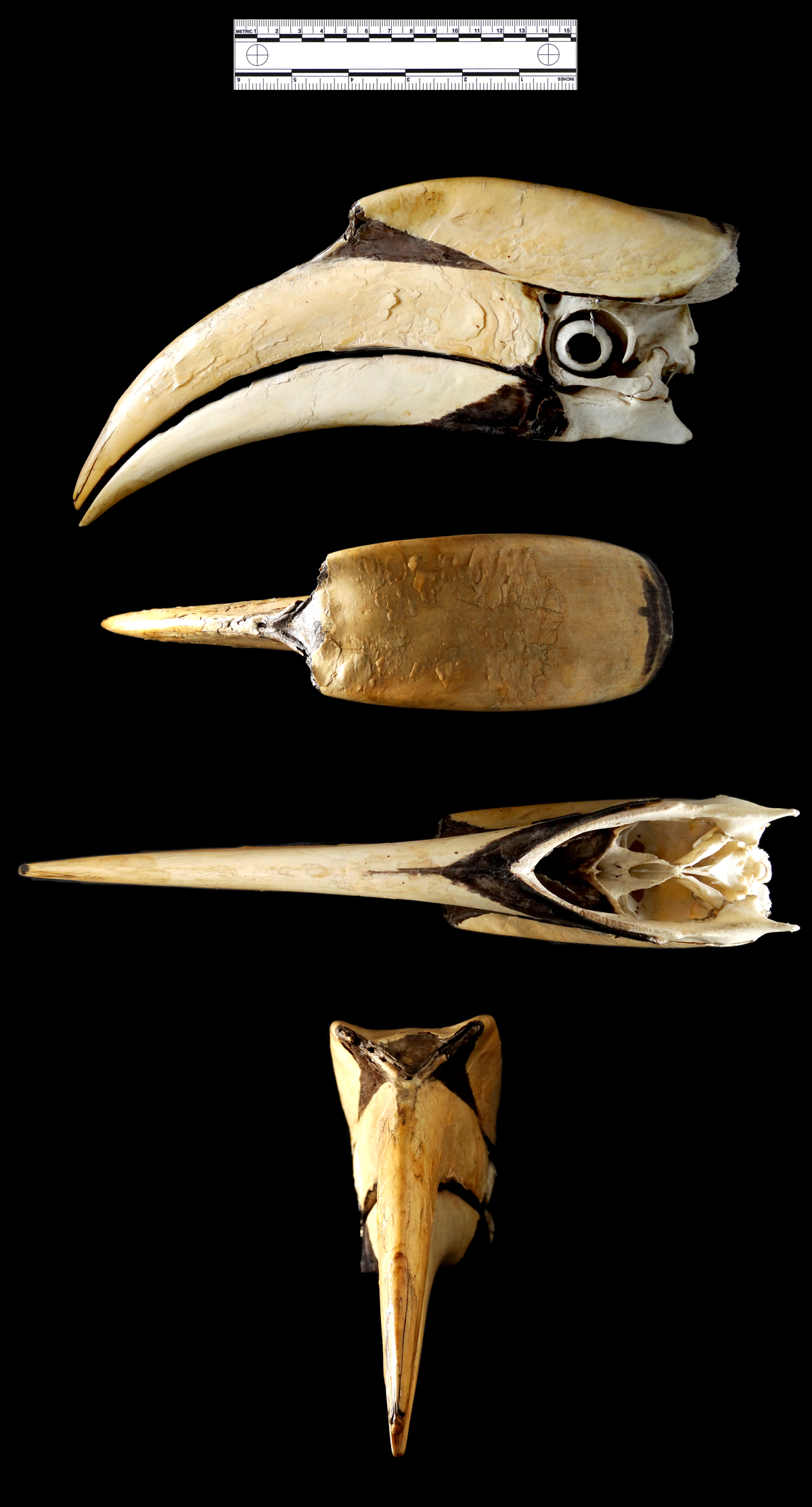
Many of you recognised that this is the skull of a Hornbill, and Martin Edvardsson, ClareP, Jamie Revell, paleomanuel, witcharachne, marcuschua all managed to identify it as a Great Hornbill Buceros bicornis Linnaeus, 1758.

You may be surprised to know that this specimen was originally misidentified as a Black-and-white-casqued Hornbill Bycanistes subcylindricus (Sclater, 1870) by the taxidermists who prepared it – quite a basic error for a natural history professional!

The Great Hornbill is a large Asian bird that feeds on fruit and any small critters that end up at the wrong end of that impressive bill – from insects to owls. Their distinctive black and white plumage is used by a lot of native people in Southeast Asia in costume, leading to pressure on the bird’s population due to hunting.

Great Hornbills have a somewhat odd system for breeding, with the female walling herself up inside a hole in a tree using faeces, and the male delivering food to her and the chicks through a narrow hole. It works for Great Hornbills…

Friday mystery object #240

After the last mystery object, which was really difficult, I have an easier one for you to identify:

mystery240

Apologies for the rather odd-looking set of images – the specimen proved quite hard to get level for photography.

As usual for easy objects, please try to be a bit discrete with your answer so everyone gets a chance to test their identification skills. I look forward to some interesting answers!

Friday mystery object #239 answer

Last Friday I gave you a really difficult mystery object to identify, in the form of this mysterious caramel-brown lump:

mystery239

It turns out that for the first time in ages, nobody managed to get the right identification, although there were a lot of great suggestions ranging from “headless, legless rubber chicken. Which has been burned in a fire some great time ago” by Matt H., to a hyperostotic fish spine, which Jake and henstridgesj had in mind.

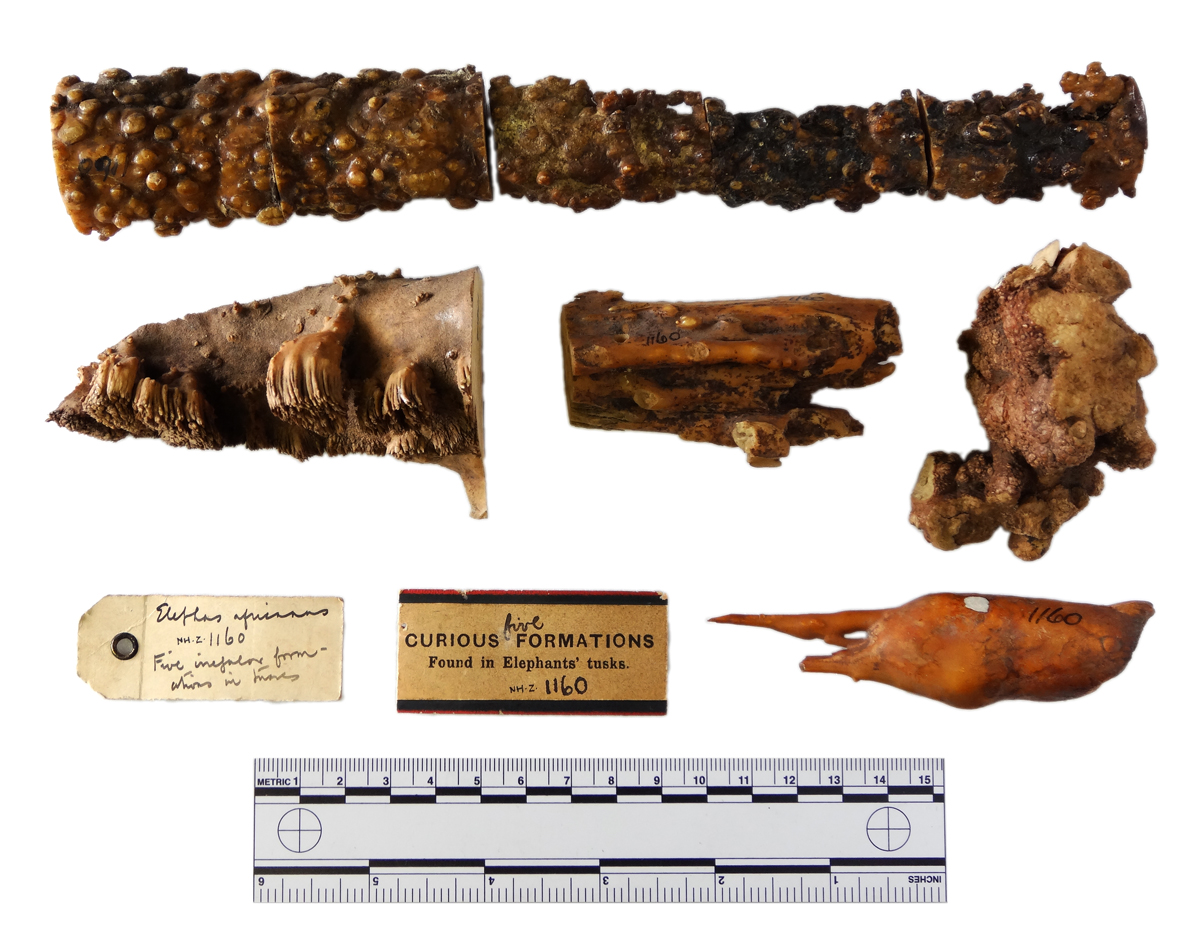
This lump is in fact a dentine nodule from inside the tusk of an African Elephant Loxodonta africana (Blumenbach, 1797).

These sorts of internal growths form when a tusk gets damaged and the pulp inside becomes infected. New dentine is laid down in response to the infection, walling off the affected tissue and preventing the further spread of bacteria.

These growths come in a variety of forms – none of which look much like ivory. Here’s a selection to give you an idea:

mystery239answer

So the next time you find something that looks like a burnt rubber chicken, or an overly firm bit of ginger, you may want to check to make sure it’s not ivory.

Friday mystery object #238 answer

Last Friday I gave you this creepy clown doll made of bone to identify:

mystery238

There were some great cryptic responses from yogicbear, Claire Miles, Jake, henstridgesj, Daniel Calleri, Robin Birrrdegg and Anne Åslaug Holder identifying that it’s been made from a wishbone, with the unfortunate donor being a Chicken Gallus gallus domesticus (Linnaeus, 1758).

The wishbone is somewhat larger and better formed than the usual one you’ll find in a modern chicken, since modern birds tend to be eaten when they’re much younger than this bird would have been. It came to the Horniman in 1923, donated by English folklorist Edward Lovett.

The second part of last week’s mystery was this sound provided by Cheryl Tipp, curator of the British Library Wildlife Sound Archive:

Again, there were some brilliant cryptic answers to the sound, with an anagram from Claire Miles and two lovely pieces of verse relating to the animal provided by Harry. It is of course the characteristic creaking call of the Corncrake Crex crex (Linnaeus, 1758).

Corncrake by Rachel Davies, 2009

Corncrake by Rachel Davies, 2009

So a big congratulations to everyone who took part – that’ll be the last of the sounds for the time being, next week I’ll have to think about some more specimens to pose a challenge!

Friday mystery object #238

Since it’s Halloween I thought it might be appropriate to have something a bit creepy to identify – and what’s more creepy than clowns? Apart from maybe dolls. So here’s a clown doll:

mystery238

Any idea what this creepy little object is made from?

While you’re pondering on that you may want to also have a think about what this eerie noise from the British Library Wildlife Sound Archive is made by:

…and it’s not the sound of a tiny wild clown chasing sheep in the dead of night.

Probably.

Friday mystery object #237 answer

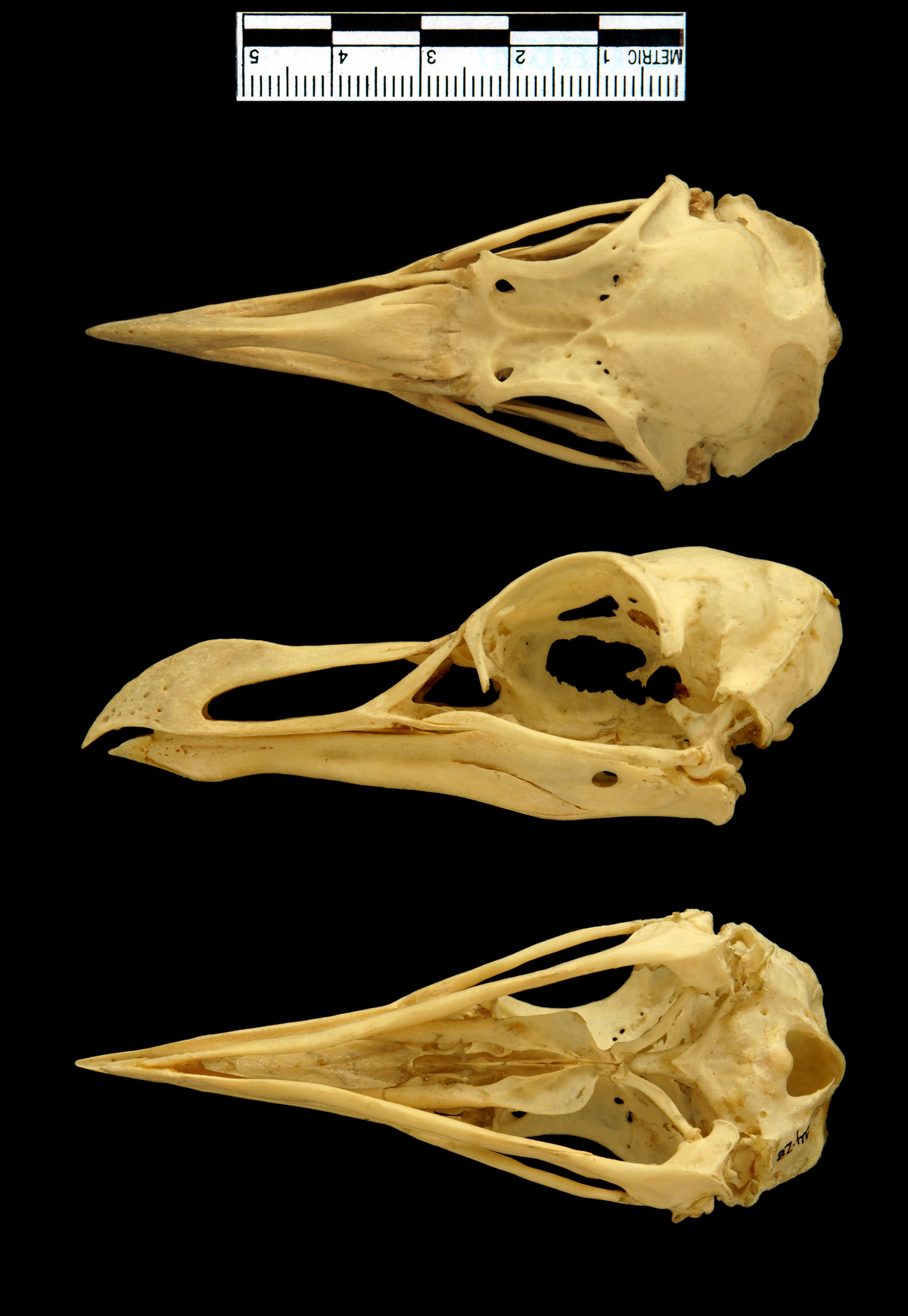
Last Friday I gave you this sound and skull combination to have a go at identifying:

mystery237

As many of you worked out, the skull and call belong to quite different species that share a love of the seaside.

The call belongs to the somewhat enigmatic Common Eider Somateria mollissima (Linnaeus, 1758) as identified by mark b, Chris, Melanie, Henry McGhie, Anne Åslaug Holder and stuart petch.

A male Somateria mollissima (Common Eider) at the London Wetland Centre, Barnes, UK. By Diliff, 2013

A male Somateria mollissima (Common Eider) at the London Wetland Centre, Barnes, UK. By Diliff, 2013

These large marine ducks are at home on the water, where they feed on molluscs and crustaceans. They are probably best known for their super-soft downy breast feathers, that the females use to line their nests and humans use to fill their pillows.

The skull belongs to a Razorbill Alca torda Linnaeus, 1758, as identified by Ric Morris, mark b, Chris, Melanie, Henry McGhie, Anne Åslaug Holder and stuart petch.

Razorbill at bird cliff in Westfjords, Iceland. By Gsd97jks, 2005

Razorbill at bird cliff in Westfjords, Iceland. By Gsd97jks, 2005

These birds are great divers, using their wings to ‘fly’ underwater. They feed on small fish and other slippery critters, caught using that characteristic bill.

Congratulations to everyone who managed to work out what the two species were – there’ll be a final mystery sound from the British Library Wildlife Sound Archive to identify next week, courtesy of curator Cheryl Tipp!

Friday mystery object #237

This week I have another mystery sound from Cheryl Tipp at the British Library Wildlife Sound Archive and skull from the Horniman Museum & Gardens:

mystery237

Do you think the sound and the skull are from the same species, and can you recognise which species?

You can send your answers on a postcard, or if you prefer just pop them in the comments section below… Have fun!

Friday mystery object #236 answer

Last week I gave you this mystery sound and skull to identify, with a the additional challenge of asking whether they belong to the same species:

mystery236

As it turns out several of you managed to get the bird in question. The wide variation and complexity of the song suggested a passerine bird, with a high degree of control of its syrinx. In fact, this species is named for its ability to produce loud and intricate calls containing a range of phrases (incidentally including mimicry of noises it has heard) – it’s a Song Thrush Turdus philomelos Brehm, 1831.

Song Thrush singing a song in a tree. By Taco Meeuwsen 2006

Song Thrush singing a song in a tree. By Taco Meeuwsen 2006

So well done to mark b, Mieke Roth and Melissa Harrison, who all managed to get the right bird. A big thanks also goes to Cheryl Tipp, curator of the Wildlife Sound Archive at the British Library, for supplying the song. I’d heartily recommend checking out the ‘language of birds‘ pages for more information on birdsong!


Friday mystery object #236

This week I have a double mystery for you.  There is a sound recording from the British Library SOund Archive, courtesy of curator Cheryl Tipp and there is also a skull for you to identify:

mystery236

Do you think that the sound and the skull belong to the same species, or do you think I’m trying to trick you?

You can put your thoughts, questions and suggestions in the comments section below. Have fun!

Friday mystery object #235 answer

Last Friday I gave you this mystery sound to identify courtesy of curator Cheryl Tipp at the British Library Sound Archive:

It provided a nice break from the usual bones and gave some of the live animal fans among you a chance to identify something that the usual bone fans might miss.

This distinctive call was recognised by stuart petch (@thelightoutside) and Kiki with henstridgesj coming close. It is the call of a male Black Grouse Tetrao [or Lyrurus depending on your taxonomic authority of choice] tetrix (Linnaeus, 1758).

Black Grouse by Vnp 2011

Black Grouse by Vnp 2011

In the Spring, these striking birds take part in something called a lek, where the males competitively show-off in order to impress the females. They strut about in a special arena, flash their tails and make the call you heard in the recording. This allows the females to pick the most impressive specimen to father their offspring, presumably in order to have healthy young.

This kind of mating system is quite common in birds and song plays an important role, so I will be back with another song next Friday!

Friday mystery object #235

This week I don’t really have a mystery object, I have a mystery sound for you to identify from the British Library Sound Archive via the Curator of  Wildlife Sounds, Cheryl Tipp.

Any idea what this is?

Patches is listening carefully

Patches is listening carefully

As usual you can put your thoughts in the comments section below. Have fun!

Friday mystery object #234 answer

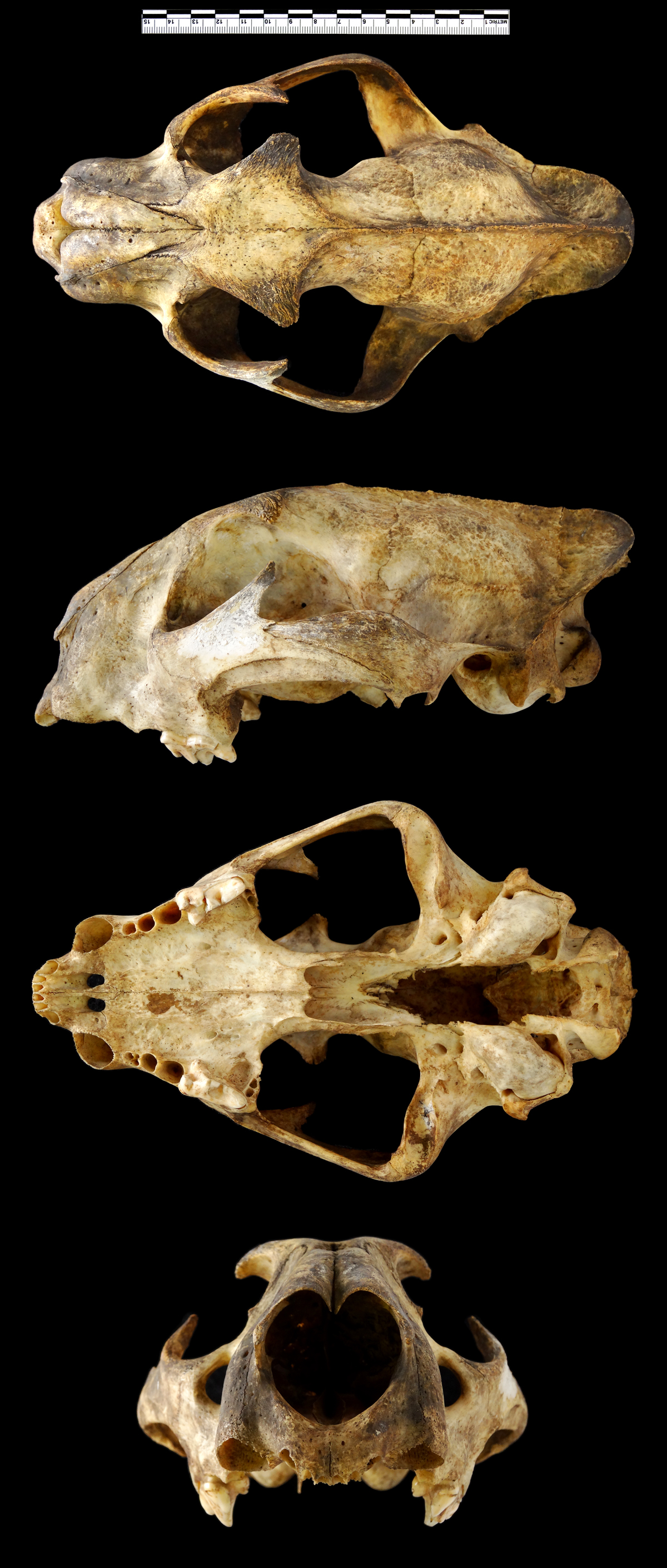
Last Friday I gave you this mystery skull to identify, which I discovered in a box of unidentified bits and bobs:

mystery234

It was pretty obvious that it was the skull of a big cat of some kind, with most of you suggesting a Jaguar or Cheetah (either of which would make me very happy as we have the skull of neither in the Horniman collection). Unfortunately it appears to belong to neither.

As I’ve mentioned  before, cats are quite difficult to differentiate from each other as they haven’t been diverging for all that long and their widespread distributions can mean that populations within a particular species can be quite variable in morphology. Leopards are a good example of this, with a (once continuous) range from Korea to South Africa.

Global distribution of the leopard (Panthera pardus) by Tommyknocker

Global distribution of the leopard (Panthera pardus) by Tommyknocker

As it turns out, this specimen is most likely from a Leopard Panthera pardus (Linnaeus, 1758), since it’s from an adult animal (as is clear from the well formed sagittal crest) but is on the small side for a Lion or Tiger and too big for a Cougar or Cheetah. It also lacks the broad post orbital region seen in the Cheetah and Snow Leopard, and it lacks the concave profile of both the Snow Leopard and Jaguar. All of these identification pointers can be found in this handy pdf by Margaret “Cookie” Sims.

Just to show you what I mean about the variability within a species, here’s a second skull from the same box, that also matches the Leopard identification.

Leopards

I expect the big difference in size is largely down to sexual dimorphism, but as you can see the overall proportions are quite different as well. This may be a difference between widely separated populations, or it could just be individual variation – either way it goes to show that cats are hard to identify.

Friday mystery object #234

This week I have a mystery skull from the collections of the Horniman Museum & Gardens for you to have a go at identifying:

mystery234

The family it belongs to may be easy to work out, but as we’ve experienced in the past, the species can be more difficult to establish.

Cryptic answers would be much appreciated, to give the less experienced a chance to work it out. Have fun!