This week I have another specimen from the Grant Museum of Zoology for you to have a go at identifying:

This specimen has an identification, but I’m not sure I agree with it, so I want to see what you think it is.
Have fun with it!

This week I have another specimen from the Grant Museum of Zoology for you to have a go at identifying:
This specimen has an identification, but I’m not sure I agree with it, so I want to see what you think it is.
Have fun with it!
Last week I gave you this crocodilian skull from the Grant Museum of Zoology to see if you had any thoughts about which species it might be:

It turns out that you did indeed have some excellent thoughts about the identification, with Cindy Nelson-Viljoen immediately getting it right, with astute observations from David Godfrey and palfreyman1414, plus another correct responses from Joe Vans (as well as Tone Hitchcock and Henry McGhie not via the comments section).
This is a skull of the Dwarf Crocodile Osteolaemus tetraspis Cope, 1861. It’s small size is the first clue, but given how crocodiles grow this could pass as the skull of a young individual of a much larger species. As David Godfrey pointed out, there may be some paedomorphism (where adults look like juveniles) in effect in this species, since the adults as well as being small, have relatively short snouts and big eyes – which are features of juvenile animals as you can see in this display of crocodile development I did for Dinosaurs! Monster Families just before leaving the Horniman:
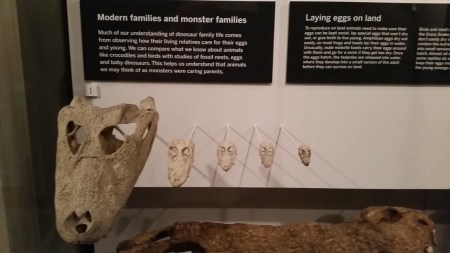
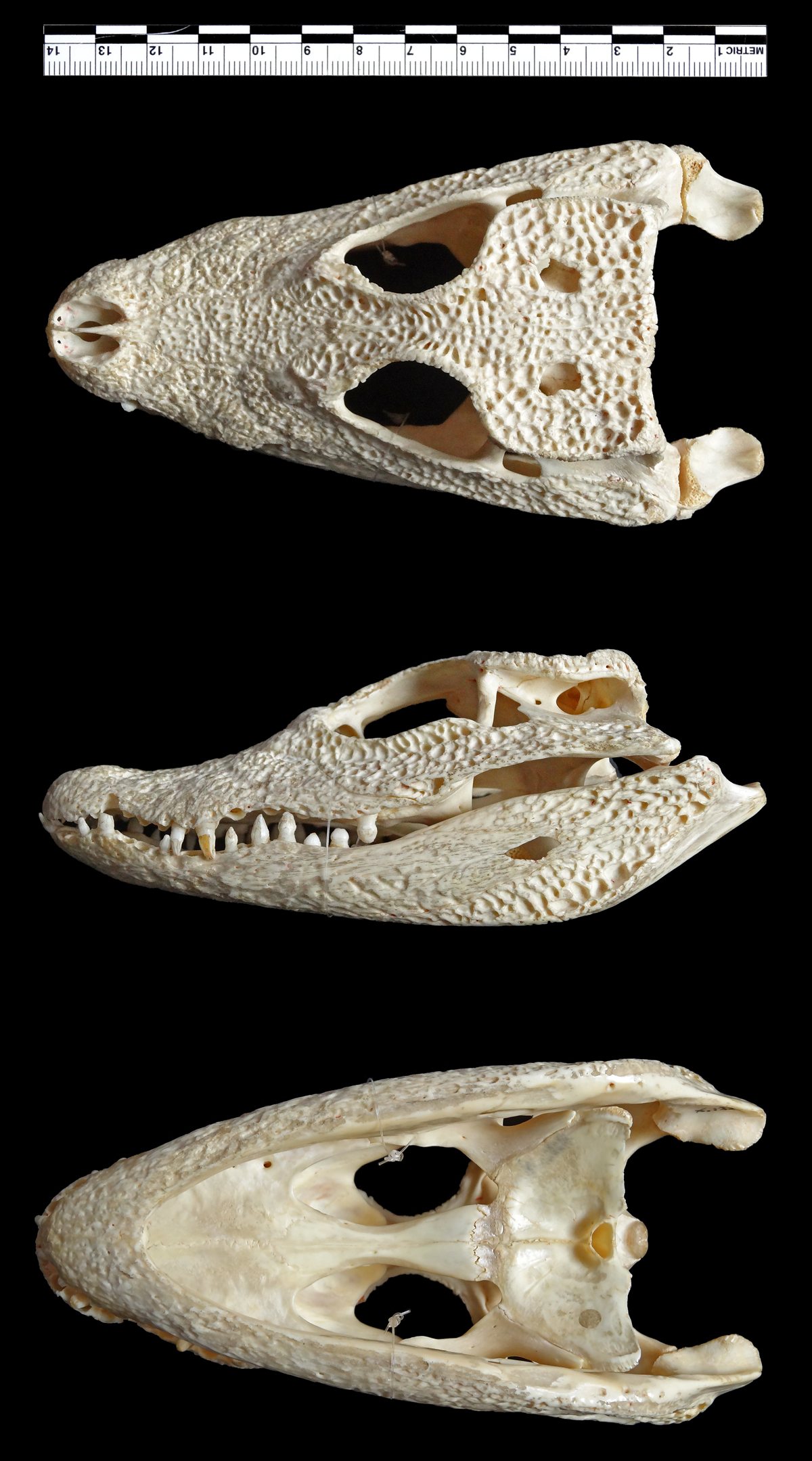
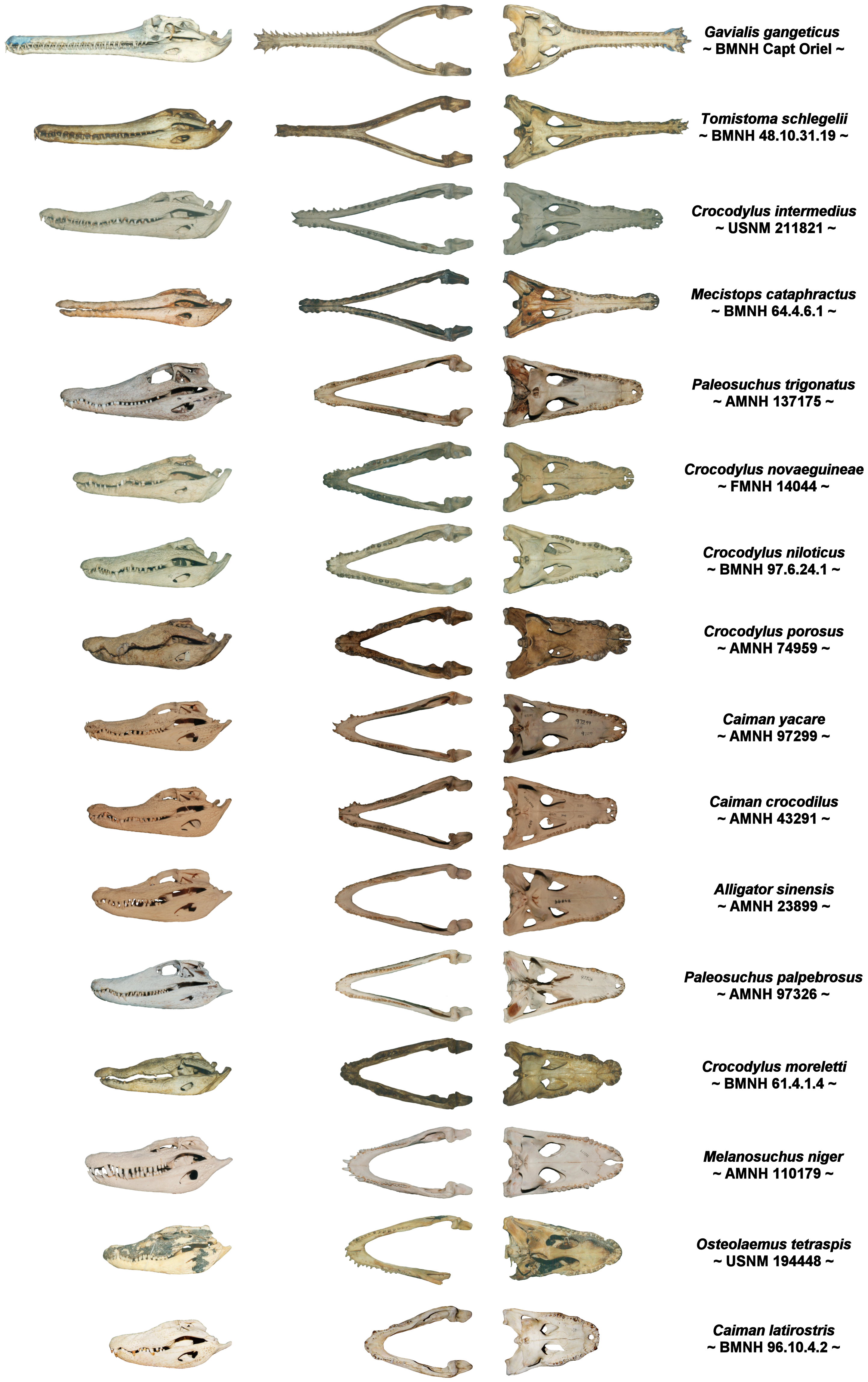
Part of my reason for wanting to show you this specimen was to force myself to look for some good online resources to get more familiar with crocodilian morphology. As it turns out, I did find a very useful comparative image, which shows the size and shape of the mandibular foramen (a large gap between the bones in the side of the lower jaw) is a helpful feature:
In this species the foramen is small, which when considered with the overall proportion is quite distinctive. Of course, this image does not include all 24(ish) living crocodilian species, but it does provide a pretty good range. Hopefully this will help speed up future croc skull identifications, at least allowing certain species to be discounted.
If you have any good tips for crocodile identification please share below!
Last week the answer to the mystery object was a Gharial – a very weird crocodilian from India. I realised that I didn’t know much about identifying the Crocodyliformes, so I thought it might be fun to have a go at working out what this species might be:
As always, I would love to hear your thoughts below and let’s see if we can find some good diagnostic features!
Last week I gave you this mystery object to identify:

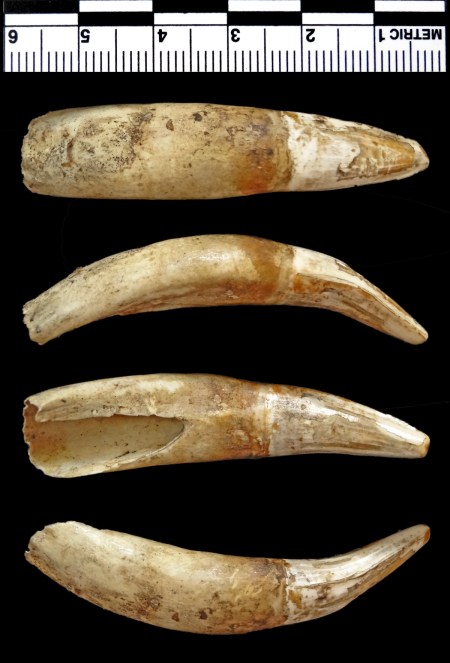
It’s the kind of thing you find in museum collections quite often, but it will commonly be misidentified – especially in anthropology collections where (in my experience) it will commonly be referred to as a claw or big cat tooth.
However, nobody who commented went down that route, recognising that the hollow base and well defined crown indicates that it’s an open rooted tooth of some sort. In mammals an open root at this size that would suggest a pig tusk or perhaps a whale tooth, but this isn’t mammalian.
In fact, this tooth is from something even less cuddly than a whale, something crocodilian. This was recognised first by Carlos Grau, but others who came to the same conclusion included Jonathan Larwood, Daniel Jones, palfreyman1414, Wouter van Gestel and Charne. More specifically, this tooth is from a Gharial, Gavialis gangeticus (Gmelin, 1789). This Gharial from the Grant Museum of Zoology in fact:

Grant Museum of Zoology Specimen LDUCZ-Y215
Gharial teeth are a bit less conical than the teeth of most crocodiles and alligators. Presumably the curve helps prevent their main diet of fish from getting free when caught.
Gharials are sexually dimorphic, with the adult males bearing a big rounded bony knob on the end of their rostrum, this is where the name Gharial comes from, as this feature resembles a local earthenware pot called a “ghara”. Sadly, these distinctive crocodilians are critically endangered, with just a few hundred left alive in the wild. They are affected by habitat loss, egg theft and use in traditional medicines.
More mysteries next week and if you fancy hearing me talking about animals you might be interested in coming to Animal Showoff at the Grant Museum of Zoology next Thursday evening!
This week I have the kind of mystery object that you find a lot of in museum collections. Sometimes they reside in the bottom of a box. Sometimes they sit in a cupboard. Sometimes they might even have a label, although that label than will often be vague and sometimes misleading.
Any idea what this is?
As usual, you can leave your suggestions below and please try to keep them cryptic if you’re confident that you know what it is. Have fun!
Last week I gave you this mystery object from the Grant Museum of Zoology to get your thoughts on:
Most people spotted that this was a canid of some sort – but there was a lot of discussion about exactly what sort.
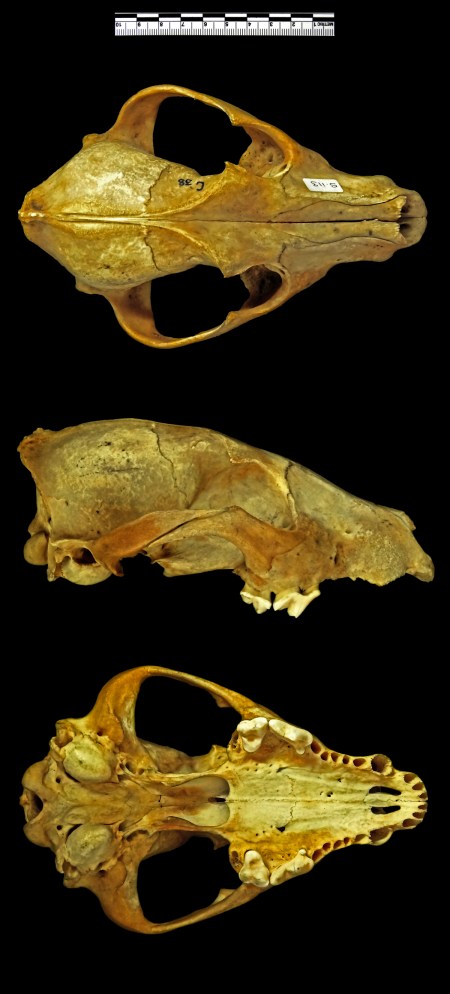
Allen Hazen made an interesting observation about the reduced second molar (missing in the specimen, but the socket shows that it was there and smaller than you’d expect from most dogs), plus the remarkably convex facial profile. Useful observations that have a bearing on the identification.
The short and broad muzzle, combined with the convex skull and distinctive molar morphology led Latinka Hristova to suggest Dhole, an identification agreed with by Lupen, palfreyman1414, Richard Lawrence, joe vans, Henry McGhie – and myself as it turns out.
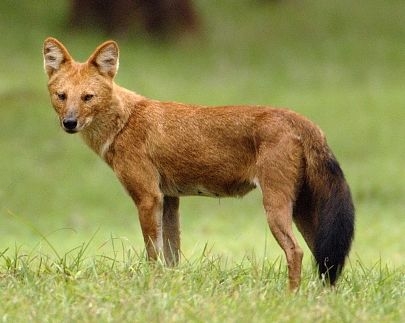
Dhole (Cuon alpinus) by Kalyanvarma
The Dhole Cuon alpinus (Pallas, 1811) is an endangered Asiatic Wild Dog, that hunts in clans and feeds on a variety of medium to large mammals that are usually killed after an extended chase.
I’d not seen the skull of one of these before, but I was aware that they have a convex profile, so it was my immediate suspicion when I saw the mystery object and the species was confirmed by the unusually simple structure of the first molar and very reduced second molar, which are almost cat-like in their adaptation for shearing meat.
All in all, an exciting skull to find – and there are other unidentified canids in the same box that I’m itching to take a look at, so keep your eyes peeled for more mystery mutts.
This week I have a specimen for you that I found in the stores of the Grant Museum of Zoology:

I have a strong suspicion that I know what it’s from, but I’d really appreciate your thoughts!
Last week I gave you this pretty cool skull from the Grant Museum of Zoology to identify:

On Twitter the prevailing hypothesis was that this is the skull of an Alien Xenomorph, which was also proposed by Daniel Calleri, but most the comments here on Zygoma were a bit more down to Earth.
The identification started being narrowed down by Sisyphus47 and palfreyman1414 who recognised it as a reptile, which was narrowed down further by joe vans to a fossorial (or burrowing) lizard.
Allen Hazen, John D’Angelo and Daniel Calleri took it another step further and identified this as an amphisbaenian or worm lizard, but Rebecca Watling went even better and identified it as the skull of a Red Worm Lizard Amphisbaena alba Linnaeus, 1758. The morphology is very close and the size is right, so that’s the identification I’d also reached.

Amphisbaena alba by Diogo B. Provete
I’ve talked about Amphisbaenia before, but this one is a good bit bigger than most other species and the skull is oddly similar to that of a Weasel. I’m not really sure why, because the diet of these strange reptiles is very poorly known. It seems likely that they’ll eat invertebrates and small vertebrates, presumably in burrows, which does actually sound similar to a Weasel.
Weird, but pretty awesome!
This week I have a pretty interesting little skull from the Grant Museum of Zoology for you to try your hand at identifying:
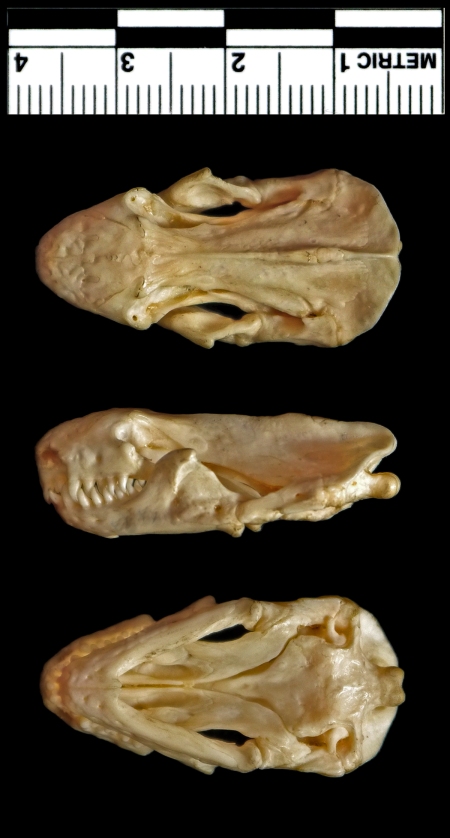
Any ideas what this might be from?
As usual you can leave your answers below – I have a feeling that some of you will find this easy, so please try to be a bit cryptic with your suggestions. Have fun!
Last week I gave you this specimen of “Pygostylia” to try your hand at identifying:

It was a bit of a tricky one, since the alizarin preparation technique has left an adult bird looking like a newly hatched chick. However, even long-billed birds like snipe and curlews start out with a relatively short bill that grows as they mature. The confusion caused by the bill led to suggestions of Cormorant, Little Bittern, Ibis, Scolopacidae and Whimbrel.
There were a few key pointers to help identify the family that this bird belongs to, not least the tiny legs, although one of them has fallen off as noted by John D’Angelo in a neat cryptic clue.
There are a few other pointers – the back and top of the skull shows an interesting feature where the hyoid loops around, which is much clearer here:
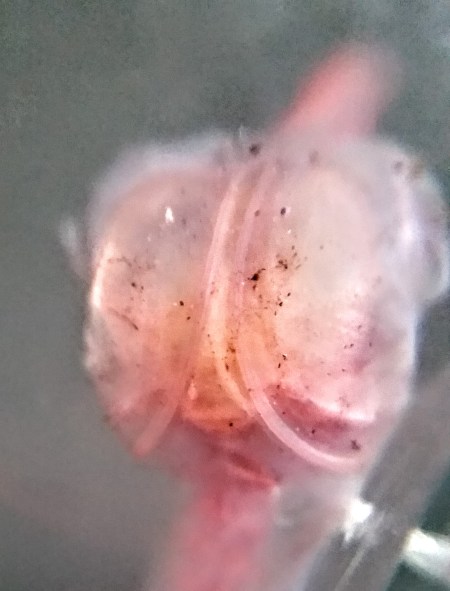
This is something I normally associate with woodpeckers, but you also see it in some other birds with very long tongues.
There is also a very short humerus, which is what clinched it for me:

The long bill and tongue and short legs and humerus make this a hummingbird (as spotted by Henry McGhie on Twitter).
Unfortunately I don’t think there’s enough information visible on the specimen to confidently identify it to species or even genus, but I think it’s probably a member of the Trochilinae, possibly one of the Mangos in the genus Anthracothorax F. Boie, 1831.
I’d like to write more, but it’s NatSCA conference time and I’m having too much fun catching up with wonderful people!
This week I have a mystery specimen for you that was only identified only as “Pygostylia” when it came back from being conserved:

It look a few minutes for me to work out what family this bird belongs to, because it’s been treated with alizarin and it just looks plain weird (if you want a bit more information about this sort of preparation check out my latest Specimen of the Week on the Grant Museum of Zoology blog). I still haven’t narrowed it down to genus yet, so your thoughts would be much appreciated. Have fun!
Last week I gave you this bird skull to have a go at identifying:
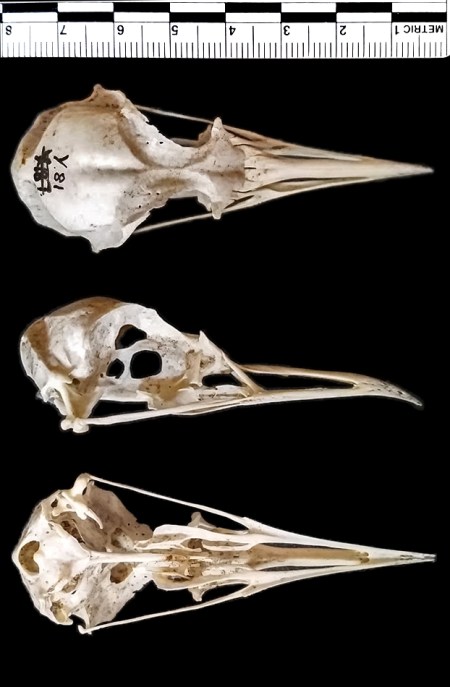
I must admit that I was a little mean, because although this didn’t have an identification, it did come with a little more information than I gave you – mainly that it was found on the Welsh coast and it had a black head.
This information probably doesn’t actually help as much as you might think, although it does help narrow the likely possibilities to birds from a particular geographical area and likely habitat type. Plus those with a black head of course.
Also, I realise now that there has been some perspective distortion between the scale bar and the skull, making it look shorter than it really is – when measured it was 83mm long. But it turns out that you didn’t really need the information anyway, as the clues from the skull were enough, even with a slightly dodgy scale.
A clue by joe vans alluded to the salt gland scars above the orbits, which indicate that is a marine bird. Flick Baker also hinted at a bird of the sea – a Common Gull, which fits the bill (if you’ll excuse the pun), but this skull seems a bit on the short side if you compare with the specimen on skullsite.com.

Common Gull (Larus canus) in winter plumage, by NotFromUtrecht, 2010
A bit closer in size was the suggestion by palfreyman1414 of Black-headed Gull, which would also fit with the note about the specimen’s head.
.jpg)
Black-headed gull at but not in the Antwerp Zoo, Belgium by Hans Hillewaert, 2008
Daniel Calleri also suggested something closer in size and with a black head, but it was the Mediterranean Gull. You might think this is less likely given the additional information about it coming from Wales, but they now range over much of Europe and the British Isles.

Mediterranean Gull in Sweden, by Martin Olsson, 2007
However, both of these are generally a little smaller than this specimen. Richard Lawrence wrapped up nicely with the following:
Size is everything with salt glands like that… too big to be the smallest, to small to be the commonest, too bulky to be the one with the darkest head… I’m plumping for the one with three fingers…
…which is an allusion to Rissa tridactyla (Linnaeus, 1758) – the Kittiwake.
.jpg)
Adult Kittiwake in Vardø, Norway by Yathin S Krishnappa, 2012
Now, the Kittiwake skull on skullsite.com is a little longer and as you can see there is no black head on the adult bird. However, I agree with Richard and think that this may be a young individual, which would explain the slightly smaller size and the presence of a black(ish) head.
So thanks for all your suggestions – they’ve been really helpful in sorting through the options! More mysteries next week…
This week I have a genuine mystery skull for you to identify from the Grant Museum of Zoology:
I think I know what it is, but I’d be keen to see if you agree with me.Probably a bit on the easy side, so please keep your answers cryptic to avoid spoiling the fun for others!
Oh and apologies for the substandard photos – I used my phone with a tripod, which sort of worked, but it’s not ideal. Hope it’s good enough for you to make an identification!
Last week I gave you this ungulate skull to try your hand at identifying:

It isn’t made any easier by the fact that it’s a female, so it lacks the horns or antlers that make identification easier. As with many ungulates it looks a bit sheepy (as I’ve mention before), but it has some clear indicators that helped you rule out what it’s not.
Jake spotted that the size was about right for a Roe Deer, but the auditory bullae (the bulbs on the underside of the skull that house the ear bones) are too massive and the proportions of the braincase are quite different.
Joe vans also ruled out deer, since it lacks lacrimal pits (large openings in front of the eyes that hold scent glands in cervids). Joe also noticed that the mandible is extremely pinched in just behind the incisors.
The incisors themselves caught the attention of Allen Hazen, who noted the extreme size of the first incisor, which he correctly recognised as being a bit of a giveaway to some people, although only when considered in the context of a variety of other features.
While Daniel Calleri summarised these odd features and added the observation of the decent sized occiptial condyl (the place where the atlas vertebra attaches to the skull) and small paracondylar processes (the bony extensions either side of the occipital condyl and just behind the auditory bullae).
These sorts of observations are exactly what are needed to differentiate between species that are very similar in overall morphology. However, without either an excellent reference collection, or even better, a well researched key, it’s almost impossible.
Fortunately, there is a skull key for a subset of Antelope that occur in Tanzania, created by the Field Museum and the mystery object this week happens to be from a genus present in Tanzania. I’d recommend having a go at using the key, but if you’d rather just find out the answer I’ve provided a link to what it is here. Have fun with the key and enjoy your Easter!
Last week I talked about ungulates in collections being incorrectly identified as sheep. This week I have a specimen for you that is also not a sheep, although it does look a bit sheepish. Can you work out what it is?

You can leave your thoughts in the comments section below – I’m not sure they need to be cryptic, but it certainly adds to the fun!
Last week I gave you this mystery object to get your input on:

It was labelled Ovis aries, which didn’t ring quite true for me, so I thought it would be good to see if you also had other ideas, since I’ve noticed that there is a tendency for ungulates of a certain size in museum collections to be assumed to be Sheep.
In other museums I’ve found female Red Deer, Gerenuk and on one occasion even a Badger skull that had been labelled “Sheep”.
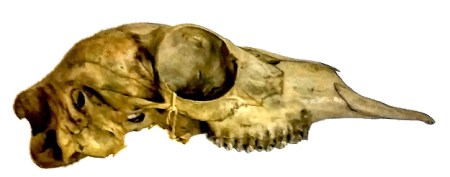
Labelled “Sheep” but actually a Gerenuk.
This is what a sheep looks like:
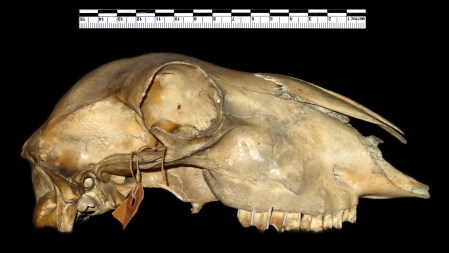
You’ll probably notice the “Roman nose” that is quite distinctively sheepy, it also has no gaps between the premaxilla and maxilla and there is a small depression in front of the eye.
When you look underneath, one of the key things that jumps out is the difference in size of the auditory bullae (mystery on the left, sheep on the right):
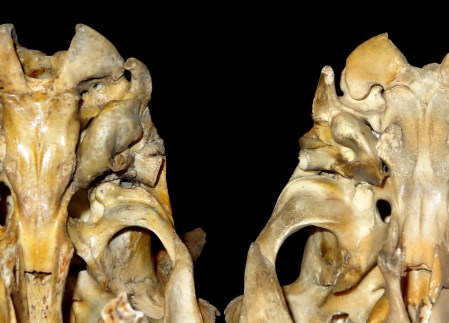
So I’m pretty sure that the mystery object isn’t a sheep, but what is it?
There were lots of suggestions of exotic and interesting ungulates, but after looking at the skulls of a huge number of ungulates I can to the conclusion that Latinka Hristova and Jake were on the right track with the simple suggestion of Goat Capra hircus (Linnaeus, 1758).
Taking a look at Goat specimens on the incredibly useful Mammalian Crania Photographic Archive has convinced me that this is what the mystery object actually is. Not a million miles from Sheep I suppose, but they are different and it’s helpful finding some small differences that help distinguish between them.
Thanks for your input!
This week I have another mystery object from the Grant Museum of Zoology for you to have a go at identifying:

I didn’t believe the identification that it had attached, so I’d be interested to get some other opinions to see if my lack of faith is justified. Any ideas what it might be?
As usual you can leave your suggestions in the comments section below. Have fun with it!
Last Friday I gave you this skull to identify:
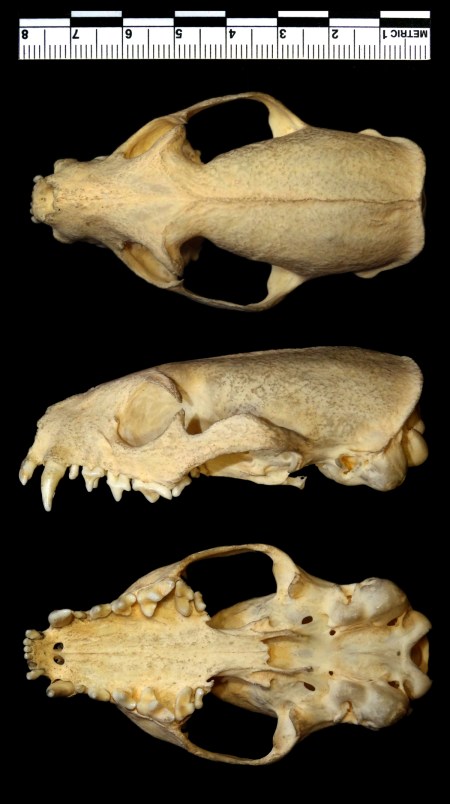
It was a bit of mean one, because although the family is fairly distinctive, it has poor species representation in online resources or indeed the literature.
The cranium is quite low and long, with some similarities to an otter, but the rostrum (or muzzle) is a bit too narrow and the teeth aren’t quite the right shape. Also the orbits are orientated more vertically, whereas otters have orbit that are at more of an angle so the eyes are closer to the top of the head.
The overall shape, dental configuration and median lacerate foramen all suggest it’s a member of the Herpestidae.
Narrowing down the species was a step too far however, after all, there are around 34 species spread across Africa, Madagascar and Asia and Europe and they are generally quite similar in cranial morphology, with only a few species having good descriptions of the skull.
To help challenge the lack of images of mongoose crania online, I’m pleased to say that this specimen does have an identification – it’s a Ruddy Mongoose Herpestes smithii Gray, 1837. While the name Ruddy Mongoose makes it sound like it’s annoyed me, it actually refers to the reddish-brown of its coat.

A Ruddy mongoose from Daroji wildlife sanctuary in Karnataka, India. By Kalyanvarma, 2009
This species is endemic to India and Sri Lanka, where it lives in dry, forested hills and feeds on pretty much anything it can get hold of, from snakes to bird eggs. As with other mongooses (or should that be mongeese?), they have a mutation that prevents snake neurotoxins from bonding at receptor sites, meaning that they are immune to some types of venom – pretty handy if you’re going to eat snakes!
This week I have another specimen from the Grant Museum of Zoology for you to try your hand at identifying:

I have a feeling that it may be easy to get this identification to Family level, but species may prove a little bit more tricky.
I’d love to hear what you think it might be, so leave your suggestions in the comments box below. Have fun!
Last Friday I gave you this odd looking V-shaped bone to identify:

It led to a lot of speculation on Facebook and Twitter, with ideas including a bird wishbone, hyoid or mandible. However, the comments on the blog tended to be a little more focussed in the area of the mandible of an ant-eating mammal.
The two little prongs at the anterior of this lower jaw are a bit of a give-away about which type of ant-eating mammal it is, as they are only seen on one family. When you look at the additional image I provided it becomes even easier to work out which:

As most of you correctly worked out, this is a specimen of Pangolin, of which there are four species in the genus Manis (thanks Allen Hazen for the correction – there are more like eight species in the family). I found this nice illustration of the skulls of the various species, to help narrow it down even further:
.jpg)
Anatomical and zoological researches: comprising an account of the zoological results of the two expeditions to western Yunnan in 1868 and 1875; and a monograph of the two cetacean genera, Platanista and Orcella. John Anderson, 1878.
So it appears from the morphology of the premaxilla, zygomatic region and nasals that this is a Sunda Pangolin, Manis javanica Desmarest, 1822.

Manis javanica by Piekfrosch, 2006
These unusual scaly insectivores are critically endangered due to poaching for their meat, skin and scales for the Chinese market, with their population suspected to have declined by 80% in the last 20 years, despite having a protected status. Sad to say that their ability to roll into an armoured ball does nothing to protect them from people.
 Zygoma