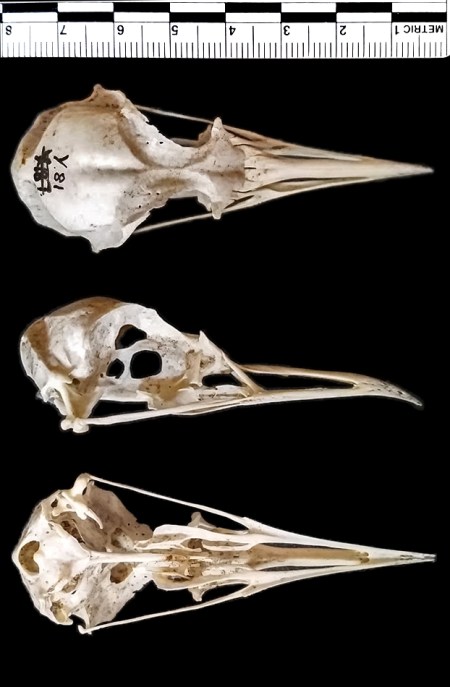
Friday mystery object #271

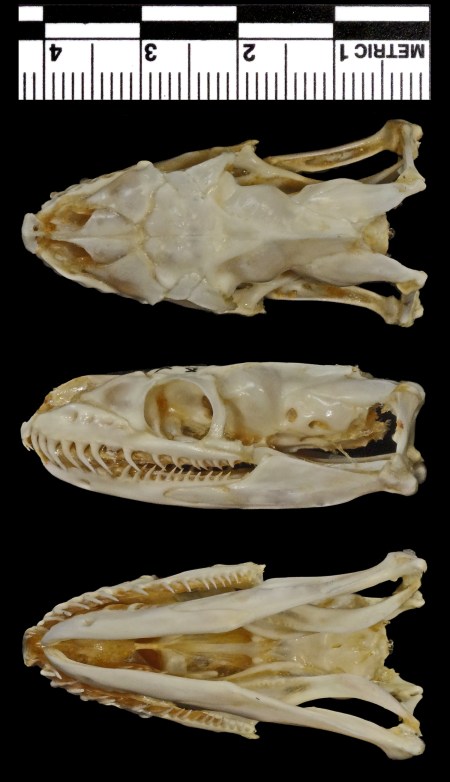
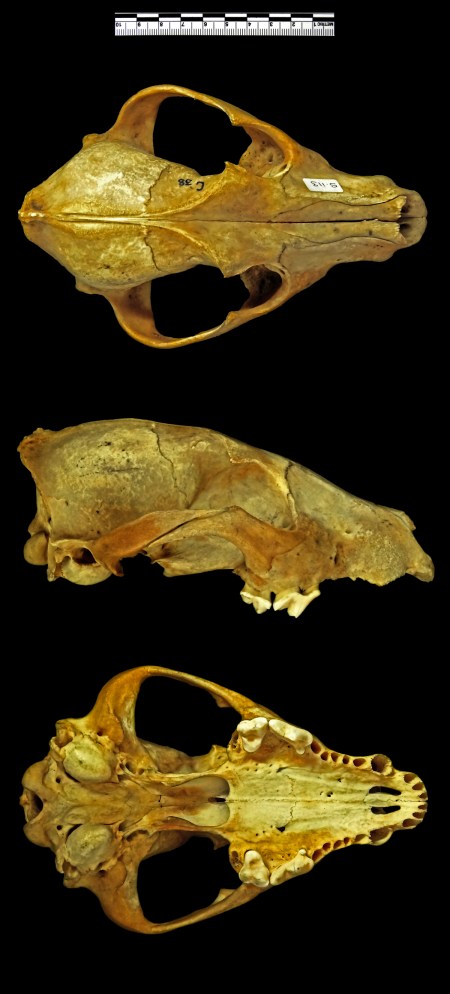
This week I have a mystery object for you from the Grant Museum of Zoology that’s either a bit too easy, or a bit mean:

mystery271a

If you’re not a fully paid-up bonegeek, you might like to have a bit of an additional clue; if so, click here.

Please keep your answers in the comments section cryptic, so everyone gets a chance to have a go at working it out without spoilers. Have fun!

Friday mystery object #270 answer

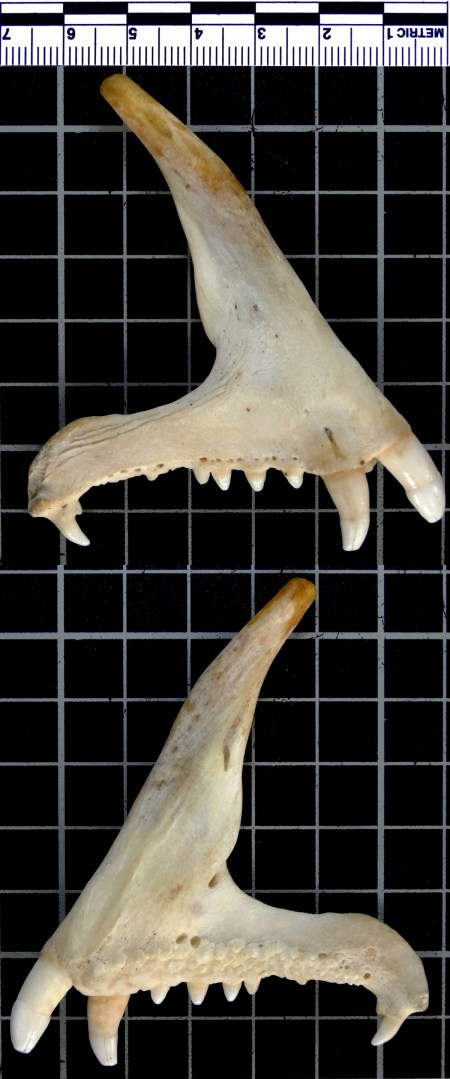
Last week I gave you a tricky object from the Grant Museum of Zoology to identify:

mystery270

While obviously a carnivore of some sort – that much is clear from the canines and shape of the upper fourth premolar – it’s one of a type that has a large number of species and is generally not very familiar to most people.

However, despite being tricky, consensus in the comments moved towards the right family; the Viverridae. Then palfreyman1414 narrowed it down to the correct genus – Genetta.

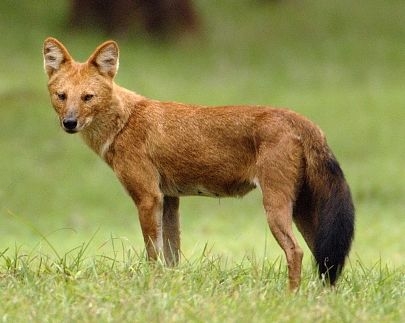
Common Genet in Wrocław Zoo by Guérin Nicolas, 2008

Common Genet in Wrocław Zoo by Guérin Nicolas, 2008

Unfortunately, it was difficult to identify to species level, partly because it’s missing its auditory bullae (the rounded structures on the underside of a mammal skull that house the bones of the ear). These bullae are useful in distinguishing between the different species in this genus, of which there are many. I can’t say exactly how many, as the number of properly recognised species varies, partly due to hybridisation, but there are about 17.

Nevertheless, palfreyman1414 provided a link to a very useful resource that, with a bit of digging, provided a table of skull and tooth characters (amongst others) for identification of Genets.

Working through the visible characters described in this matrix, removing species that didn’t correspond with the mystery specimen, I was left with just the Abyssinian Genet Genetta abyssinica (Rüppel, 1836).

So many thanks to everyone (but particularly palfreyman1414) for all your help in solving this mystery – without your help I would probably have been stuck at a genus level identification for this specimen, when now I have a pretty robust species identification.

More again next week!

Friday mystery object #269 answer

Last week I gave you this mystery object from the Grant Museum of Zoology to have a go at identifying:

mystery269

If you’ve been checking the mystery object recently you’ll notice that this specimen has a feature of the palate that I made reference to in the answer to mystery object #267 – the Tasmanian Devil. It’s incompletely ossified, which is a characteristic of marsupials.

The large curved canines and pointed premolars suggest some predatory activity, while the flattened molars suggest some grinding of vegetation, making this one of the marsupial omnivores, in the Order Peramelemorphia.

The large size of the skull and the long curved canines make this specimen rather distinctive – as first spotted by Richard Lawrence, this is indeed a Continue reading

Friday mystery object #268 answer

Happy New Year! I hope everyone had a lovely festive period.

I gave you this distinctive specimen from the Grant Museum of Zoology to try your hand at identifying:

mystery268

Despite being distinctive, it raised some discussion about the identification, because there are few resources available for comparison.

Phil Cox was the first to get the right Family (at least in the comments – @MelanieGbones got it on Twitter) – the Chrysochloridae or Golden Moles. Then the discussion got a bit more involved as species were discussed and the possibility of the convergent Marsupial Moles was considered.

There are 21 species of Golden Mole, all of which occur in southern Africa, which could have made this a very difficult identification to species, if it wasn’t for the large size of the skull and the very characteristic large and vertically-posteriorly flaring zygomatic arch that continues round to near the back of the skull. This narrows it down to one of two species in the genus Chrysospalax.

The extent of this feature in this specimen, plus the shape of the palate, suggest to me that this particular specimen is from the

Continue reading

Friday mystery object #268

Merry Christmas mystery solvers!

This week I have an unusual object from the Grant Museum of Zoology for you to identify:

mystery268.jpg

It’s pretty distinctive, but I’ve not seen many of these, so hopefully it’ll make an interesting object to identify. As usual, if you think you know what it is, please leave a hint or cryptic clue rather than just writing down the answer – it makes it more fun for other people that way.

Have fun!

Friday mystery object #267 answer

Last Friday I gave you this specimen to identify:

mystery267

It was a pretty distinctive one, but a great specimen – and a nice robust example of this particular species.

The partially ossified palate and nasolacrimal (or tear) duct on the external border of the orbit shows that this is a marsupial, and the pointy, robust teeth suggest that it’s highly carnivorous with a penchant for carion, which narrows down the options pretty effectively.

As many of you recognised, this is a Tasmanian Devil Sarcophilus harrisii (Boitard, 1841) – so well done to Tone Hitchcock, Chris, Cindy Nelson-Viljoen, Ric Morris, henstridgesj, palfreyman1414, Lauren McCafferty, joe vans, Daniel Jones and Daniel Calleri, Allen Hazen and Michelle for getting this one right. The key was definitely in those marsupial characters, which immediately ruled out any of the highly diverse placental carnivores.

Tasmanian Devil (Sarcophilus harrisii), Tasmanian Devil Conservation Park, Taranna, Tasmania, Australia by JJ Harrison 2010.

As several of you alluded to, the Tasmanian Devil is undergoing a major decline in population at the moment, mainly due to a particulary nasty transmissible disease that causes tumours to develop on the face, preventing feeding. The tumours are spread between individuals when they bite each other, especially when feeding, which is pretty common Devilish behaviour.

In fact, Devils are pretty rough and tumble creatures in many of their behaviours. When breeding they have a large litter of up to 30 young, which have to compete for just 4 nipples in the pouch. Unsurprisingly, few of the litter survive and presumably those that do are pretty pushy.

Hopefully the Devils will survive their current population crash. There are some individuals who show some resistance to the facial tumour disease, which reflects the importance of genetic diversity within populations. It would be a great shame if the Devils went the same way as the other large marsupial carnivore, the Thylacine.

Friday mystery object #266 answer

Last week I gave you this distinctively weird looking skull to identify:

mystery266

As I suspected, many of you worked out what it was straight away, but I wonder if it would have been as easy if the side view hadn’t included the mandible?

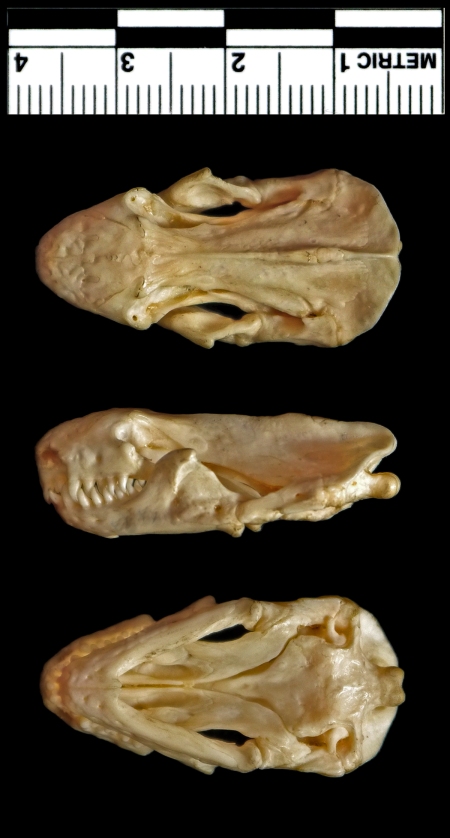
The upper dentition, especially the pair of incisors, is somewhat similar to that of a rodent, but that mandible is ludicrously massive and could only really belong to the weirdest primate in the world: the Aye-aye Daubentonia madagascariensis É. Geoffroy, 1795

So very well done to Tone Hitchcockhenstridgesj, Chris, Cindy Nelson-Viljoen, Daniel Jones, steve tornaAgata Stachowiak, palfreyman1414, boneman2014Lee Post, joe vans, Allen Hazen, Dave Taylor, Michelle, witcharachne, and Daniel Calleri.

The Aye-aye’s incisors are an adaptation for gnawing holes in wood to get at grubs inside. It finds these tasty morsels using a tapping finger and crazy bat-like ears to detect the tunnels the larvae create when feeding, with a system a bit like seismic ground response analysis.

Aye-aye by Frank Vassen 2008

Aye-aye by Frank Vassen 2008


Once the squishy prey has been detected and an entry point has been gnawed, the Aye-aye fishes it out using a specially adapted long, thin finger with a hooked claw.

Aye-aye fingers by Dr. Mirko Junge 2009

Aye-aye fingers by Dr. Mirko Junge 2009

Basically, the Aye-aye feeds rather like a woodpecker, but with the benefit of fingers and teeth. Perhaps it’s weird, but it’s most definitely wonderful!Aye_aye

Friday mystery object #265 answer

Last week I gave you this lovely primate skull from the Grant Museum of Zoology to identify:

mystery265

When I first saw it I assumed it was a Macaque of some kind. It’s obviously in the Cercopithecidae (or an Old World Monkey) based on the number of premolars – 4 in the upper jaw instead of the 6 you’d get in a Platyrrhini (or New World Monkey). Macaques are common in collections and they have a similar overall appearance to this specimen.

However, I then noticed the particularly deep hollows under the eyesockets and the flaring of the maxilla where it meets the nasals, which is not a characteristic of Macaques.

Monkey_skull

It actually reminded me a bit of a toned down version of a Mandrill skull, so I started by looking at the phylogeny of primates to get an idea of which species were more closely related to the genus Mandrillus.

gr2

Primate phylogeny from Goodman et al. 2005. Trends in Genetics. 21(9):511–517

As you can see the Mandrills share a sister relationship with the genus Cercocebus, which are the White-eyelid Mangabeys, so that’s where I started looking. It turns out that these infraorbital depressions are a Mangabey feature, so I then looked at the various types of Mangabey (not just those in the genus Cercocebus).

It wasn’t easy finding specimens for comparison, but I did find a very useful (if a bit old) paper on Mangabeys by Groves (1978), which gave good descriptions of the various species, allowing me to rule out the Sooty Mangabey and narrow the likely species down to the Golden-bellied Mangabey or, my personal preference, the Agile Mangabey Cercocebus agilis (Milne-Edwards, 1886).

These monkeys have a shorter, relatively broader face than the more familiar Sooty Mangabey, with deeper and broader hollows under the orbits.

So well done to everyone who recognised that this skull belonged to an Old World Monkey, with particular congratulations to Cindy Nelson-Viljoen and palfreyman1414, who all came close in terms of taxonomy and a big round of applause for inkydigit who narrowed it down to the right genus!

More mysteries to come next week…

Friday mystery object #265

This week I have a specimen that I’ve been looking at recently that you might like to have a go at identifying:

Mystery monkey

Mystery monkey

This was being used in handling sessions and needed a tooth to be reattached (huzzah for Paraloid B72), but I noticed that it lacked an identification beyond ‘monkey’ and I thought that could be improved upon.

Here it is laid out more usefully for identification purposes:

mystery265I know what I’ve narrowed it down to, but I’d love to hear your thoughts in the comments section below!

Friday mystery object #264 answer

Last week I gave you a tricky mystery object in the form of a dusty bag:

Bag o-bones

Of course, I’m not truly that mean, so I also provided a characteristic part of the specimen:

mystery264

Despite being a bit broken, it’s fairly clearly the mandible of a felid, given the shape of that one molar and the limited sockets for the missing premolars, suggesting something with a very reduced tooth count – something that most of you spotted straight away.

The size is a bit small for a Tiger or Lion, it’s a bit big for a Puma or Cheetah and it’s not quite as robust as I’d expect from a Jaguar, leaving us with the likely identification of Leopard Panthera pardus (Linnaeus, 1758). So well done to joe vans and palreyman1414 for ‘spotting’ what it was (terribly pun, I know).

Here’s a nice Leopard skull from the Grant Museum of Zoology collections to give a sense of scale.

leopard

More mystery objects to come from the Grant next week, but if you’d like to see another specimen from the collection, my latest specimen of the week, that looks at the darker side of the Walrus might be of interest.

Friday mystery object #264

As I’ve mentioned a few times, I have recently started a new job as Curator of the Grant Museum of Zoology at UCL. If you’ve never visited, you should pop by, and if you have visited then why not vote for us in the Time Out Love London Awards, preferably right now, since voting closes today. I’d love it if we could beat our heavyweight neighbour, the British Museum!

PV_micrarium_2

Moving on to the real subject of the blog, I have finally had a chance to start hunting for specimens in the Grant to see if there are any unidentified items tucked away that might make good mystery objects – and my new colleague Tannis knew just where to look:

Bag o-bones

This bag-o-bones came to us from the Royal Free Hospital and was completely sealed up, making it hard to see inside. For those of you who like a challenge I’ll leave you with just this image, but if you’d like a slightly less tricky image to work from, you can see the single most distinctive part of the specimen here.

Do you have any idea what it might be? It’s pretty easy if you check out the distinctive bit, so please keep your answers cryptic if you can!

Oh, and if you like skulls, you might be interested in my first Specimen of the Week on the Grant Museum blog.

Friday mystery object #263 answer

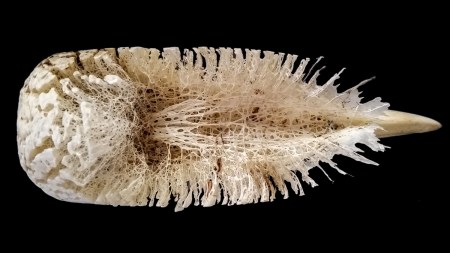
Last Friday I gave you this mystery object that came up at a natural materials identification course that I delivered at the Royal Albert Memorial Museum in Exeter last week:

mystery263

There were a variety of suggestions as to what it might be, but everyone (correctly) discounted the information on the label that it was a tooth.

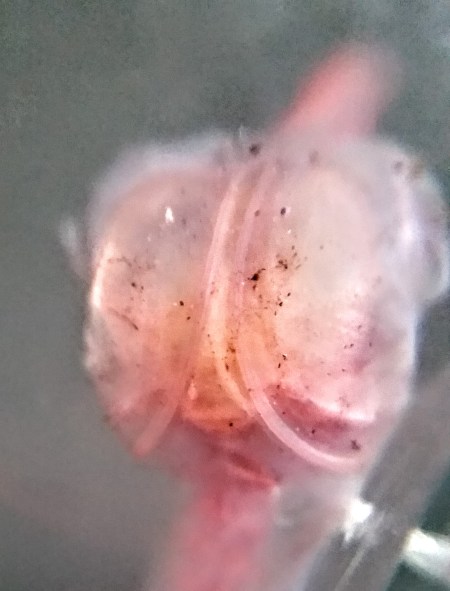
There were some suggestions of wood and ivory, but there were two suggestions which were definitely in the right ball-park. Daniel Calleri suggested it might be something fishy, while Krista got it pretty much spot on when she suggested a dorsal barb from a skate or ray.

I’m pretty sure that it’s the spine from the leading edge of the first or second dorsal fin of a Spurdog shark in the genus Squalus Linnaeus, 1758.

Spiny Dogfish (Squalus acanthias) by Dornhai

Spiny Dogfish (Squalus acanthias) by Dornhai

These turn up every so often in collections, sometimes as decoration, sometimes as items found in Native American middens. Presumably they’re composed of keratin, which is a commonly occurring structural protein in vertebrate skin that can also form hair, horn, scales and claw.

Thanks for all your comments and well done to Krista!

Friday mystery object #263

It’s been a hectic couple of weeks and I almost forgot the mystery object again because I lost track of the days!

I was hoping to use an object from my new job at the Grant Museum of Zoology today, but I never got the chance as I’ve been zipping around all over the place. Yesterday for example I was at the lovely Royal Albert Memorial Museum (RAMM) in Exeter, delivering a training session on identifying natural materials.

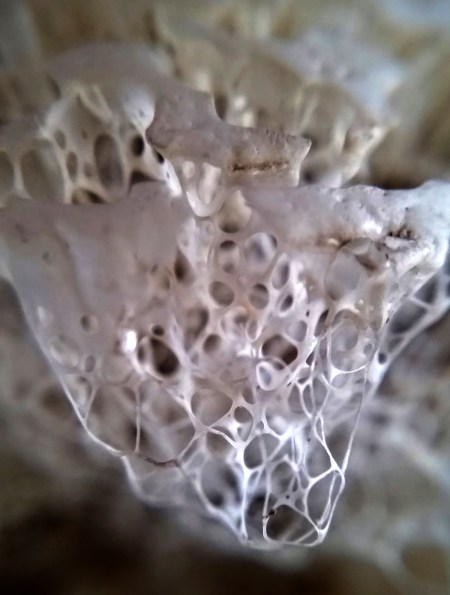
There were a couple of items that curator Holly wanted me to look at while I was there and I thought one of them might be good for a mystery object. Apologies for the poor quality of the photo – I didn’t have my usual set-up to hand:

Mystery object at RAMM, Exeter

Mystery object at RAMM, Exeter

Any idea what this might be? If you want more information about it, just ask in the comments and I’ll do my best to reply. Have fun!

Friday mystery object #262 answer

Last Friday I gave you this pretty characteristic mystery object from the Berlin Museum für Naturkunde to try your hand at identifying:


There were lots of great comments – I must apologise for not responding to many (and for posting the answer to this mystery object so late), my excuse is that I’ve had an insanely busy week finishing up my old job at the Horniman Museum and Gardens and then getting started in my new job at the fantastic Grant Museum of Zoology at University College London (more to come about my big paolov.files.wordpress.com/…/mystery262.jpgmove). I also got started on a really interesting project looking at Gorilla osteology and I’m feverishly trying to prepare a training workshop on identifying natural materials for next week.
Back to the object. Several of you noticed the presence of a baculum (or penis bone) which shows us quite definitively that this was a male animal (although, I later realised that this baculum does not belong to this specimen!).


It also suggests that the specimen was prepared and mounted without the prudishness that many historical mounts were affected by (see Jack Ashby’s comments about this in his post on the Grant Muesum’s Ringtail).
Many of you also correctly recognised that the plantigrade (or flat-footed) posture, short tail and robust build suggested a bear of some sort.

The distinctive sagittal crest was the final feature needed for identification for some of you to work out that this is the skeleton of a Giant Panda Ailuropoda melanoleuca (David, 1869).

I tend to think of Panda skulls as looking like a cross between those of a Hyaena and a Gorilla, which makes sense when you consider the adaptations of the jaw musculature required for the Panda to process the large volumes of tough bamboo needed to provide enough energy for survival. The bone of the skull has to be able to manage the large forces produced by all this chewing, resulting in a big and robust sagittal crest, a thick and deep mandible and really deep muscle scars on the coronoid process.

These are all features you also see in big chewers like the Gorilla and Hyaena, but not in rodents and ungulates – I think this reflects the difference between groups that rely on temporalis muscle (which runs along the side of the braincase) in chewing compared to the masseter muscle (which attaches to the zygomatic arch or cheekbone).
The final clue to confirm that this is a Giant Panda is the ‘thumb’ on the front limbs:

This handy (excuse the pun) extra ‘digit’ is actually the radial sesamoid bone of the Panda’s wrist, that has been commandeered by evolution for use as a bamboo holder. There are a few other species that have done weird things with wrist bones to gain a digit, but this is clearly not a Mole or Elephant and Red Pandas have a much longer tail.
I hope you enjoyed some of the interesting bony features of this specimen – it’s great to have a chance to see under the surface of such an iconic animal!

Friday mystery object #262

Last week I had an enjoyable trip to Berlin where (probably unsurprisingly) I visited the Museum für Naturkunde. The collections were fantastic, with specimens like this absolutely spectacular Archaeopteryx:

Archaeopteryx

but that’s a pretty obvious object, much too familiar to use for the Friday mystery object. So here’s something that might be a little less familiar to test your skills:

mystery262

It’s a pretty distinctive specimen, but hopefully it won’t be quite as familiar as the iconic Archaeopteryx.

If you recognise it straight away, please use your imagination and leave a cryptic answer so others get a chance to test their identification skills. Have fun!

Friday mystery object #261 answer

Last Friday I gave you this object from the Horniman Museum and Gardens to identify:

mystery261

It’s an odd looking bone, but that makes it distinctive, so I wasn’t too surprised that everyone recognised it as being from something aquatic. In particular, Ric Morris and joe va both recognised it as the radius of a pinniped.

The broad end that articulates with the wrist is lacking its epiphysis, indicating that this is from a younger animal. This also makes it a little harder to make a definitive species identification.

I think that Ric Morris’s cleverly disguised suggestion of Grey Seal is pretty good, although I’m leaning slightly more towards Harbour Seal Phoca vitulina Linnaeus, 1758.

The odd shape is of course one adaptation of the forelimb that reflects a change in biomechanical requirements away from the load-bearing limb of a terrestrial ancestor and towards the hydrofoil shape and drag-force-resistant flipper of an active aquatic pursuit predator.

Seal underwater by Chillum, 2007

I will never ceases to be impressed by the power of evolution as a mechanism to reshape bone to better suit new purposes!