Friday mystery object #150 answer

Normally Monday mornings are the time that the answer to the mystery object is posted on my blog, but this weekend I’ve been involved in the Enlightenment Cafe, which has meant I’ve been too busy  to write the usual full answer. Here are a couple of images of me doing my bit in the show (photo on stage courtesy of @sillypunk):

This slideshow requires JavaScript.

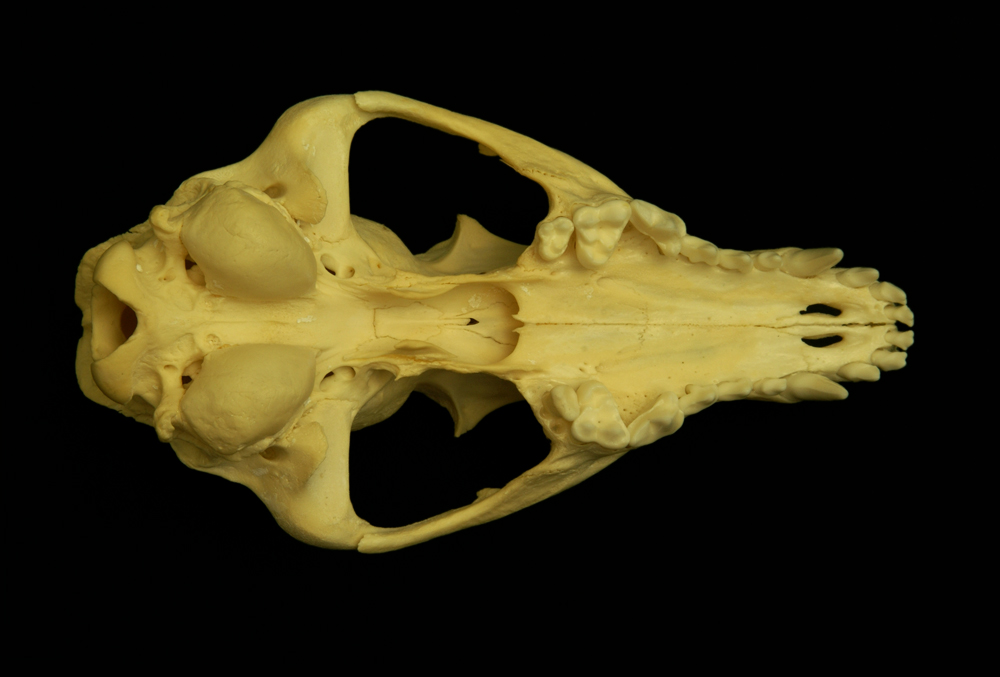
But excuses for tardiness aside, here is the mystery object I would have been writing a proper answer for if I wasn’t on a stage talking to a room full of people:

You all spotted that it was a type of canid (dog) straight away, but the species was a little bit more tricky. Many went for a fox of some kind, as it is quite a small specimen, but Barbara Powell, Jamie Revell and Ethan plumped for the correct answer of  Continue reading

Friday mystery object #150

Apologies for the slight late running of this, my sesquicentennial Friday mystery object – I was giving a talk about mermaids last night that went on until quite late (and which had an exciting special guest), but more about that later.

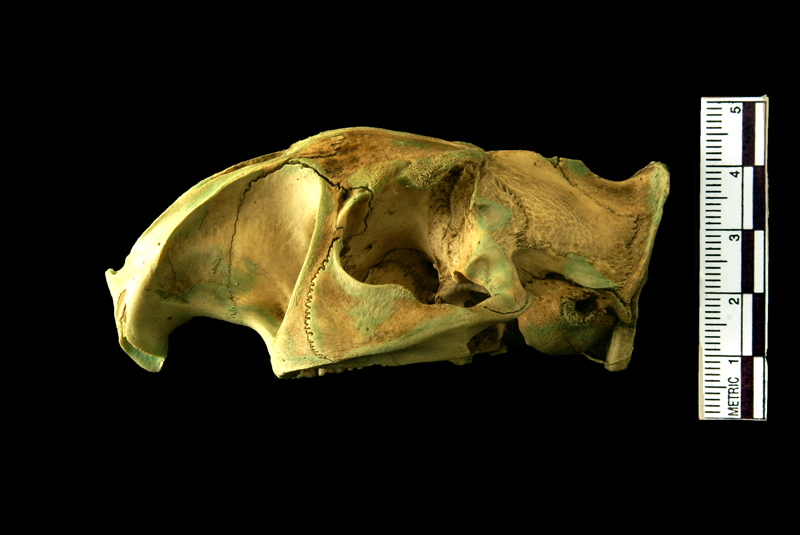
I’ve been waiting to do this object for a while – it’s a favourite of mine, which is good, since it is part of my own personal collection. Any idea what it is?

As usual you can put your questions, comments and suggestions below and I’ll do my best to respond. I will also add that I will have this specimen, along with the others in my collection, at the Enlightenment Cafe this Saturday and Sunday at the Old Vic Tunnels. There may also be the special guest who appeared at my talk last night, but that is a story for later… Good luck!

Friday mystery object #149 answer

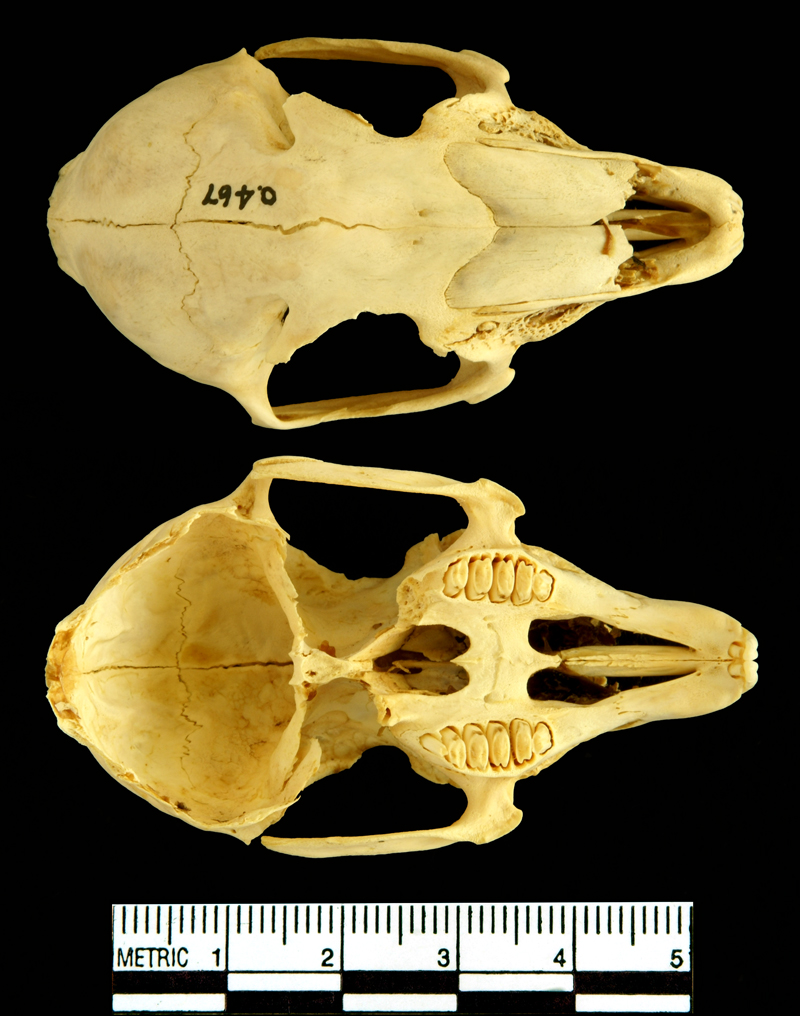
On Friday I gave you a bit of a spot-the-difference with these two skulls, wanting to know if they were two individuals from the same species or if they were from two different species:

I must say that it was a bit of a tricky identification without the added complexity of a between specimen comparison, yet you all did remarkably well.

As usual Jake was the first to comment, correctly identifying that the specimens are both rodents and squirrels at that. He also recognised that both were adult animals, although one was probably older than the other when it died, based on the degree of wear on the teeth (assuming the diet was similar). The squirrel identification was also supported by Will, henstridgesj, Dave Godfrey, Jamie Revell and Barbara Powell.

Barbara also picked up on the feature that made me consider that these specimens may have been from different species – the sutures between the premaxilla, maxilla, nasals and frontal bones that make up the rostrum (the nosey bit). This is something that Lena and Jamie Revell also commented upon.

The position of the sutures (or junctions) between the various bones that make up the rostrum can certainly be useful in diagnosing differences between species – it’s a handy one for distinguishing between Lions and Tigers for example:

Lion vs Tiger sutures

However, in this case I don’t think that the differences between the sutures are all that diagnostic, I think the differences may simply be down to either sexual dimorphism (that’s where males and females of the same species develop differently) or differences between the ages of the individuals. In fact, given that the specimen with the more heavily worn teeth is smaller and less robust than the other specimen I wouldn’t be surprised if it was an older female and younger male of the same species that are being compared.

One of the reasons I don’t think the sutures are diagnostic comes down to timing of their fusion. According to Wilson & Sánchez-Villagra, 2009 the pattern of closure of the cranial sutures in rodents follows a fairly standard pattern, with the rostral elements being amongst the last to fuse. This suggests that those sutures are more likely to vary between animals of different ages and between animals with different life histories. That said, there are geographical variations in this species, so these specimens may represent individuals of different subspecies from different parts of the range – something I can’t check because there is no locality information with them (at least not that I’ve found yet).

With the spot-the-difference dealt with, I will leave you with the correct species identification as made by henstridgesj, these are the skulls of  Continue reading

Friday mystery object #149

This Friday I have a pair of skulls (top and underside) for you to have a go at identifying. Do you think they are from the same species, or do you think they represent two different species? (N.B. You can click the image for a bigger version)

As usual you can put your questions, comments and suggestions below and I’ll do my best to reply. Good luck!

Friday mystery object #147 answer

On Friday I gave you this object to identify:

I chose this object because it gave me a chance to take a photo using my new phone camera and a hand lens (inspired by an article by Nigel Larkin in the latest NatSCA News). I thought it might be a bit of a challenge, but I was proven wrong once again, as Jake tentatively identified the part of the skeleton this bone is from straight away – it is indeed a baculum or os penis (that’s the Latin for penis bone).

The species was a bit more difficult, but Barbara Powell was quick to identify that it came from a Mustelid and then there was a bit of disagreement between Barbara, Ric Morris and Dawn about whether it was from a  Continue reading

Friday mystery object #146

This week I haven’t had a chance to photograph a new mystery object, so here’s an old image I took of a specimen from a while back:

Any idea what this skull might belong to? I’ve deliberately omitted the scale bar to make it a bit harder, but if you want to see the scale just click on the image.

As usual you can leave your questions, comments and suggestions below and I’ll do my best to respond. Good luck!

Friday mystery object #145 answer

Apologies for the somewhat tardy answer to the mystery object that I gave you on Friday. Not only is it tardy, it’s not really an answer, as I still haven’t ruled out all of the possible options as to what this skull is from:

Now I’m quite happy to say it’s from a member of the crow family or corvid of some sort, but there are quite a lot of corvids out there. My first thought was Jackdaw Corvus monedula (Linnaeus, 1758), which is also what Jake thought. However, when compared to the Jackdaw on the Skullsite the bone between the eyes looks too narrow.

Barbara Powell very helpfully provided some measurements from Jackdaws in her collection, that make me think that this may still be a Jackdaw, but I have reservations, since there are several other corvids with skulls in the same size range as this specimen (6.9 cm long). The Magpie Pica pica (Linnaeus, 1758) is one that was suggested by several people (biologycurator and Leigh) and henstridgesj suggested it could be one of the North American Jays.

The big problem here is that there aren’t many features of the skull of the corvids that help distinguish them from each other, apart from the size and the bill shape. However, Magpies and Jackdaws are a bit too similar in these features. Other characters may be able to help, such as the shape of the bones of the palate (which I think favours the Magpie), but without a large sample size for comparison it is hard to tell what variation is due to species differences and what is due to individual differences.

Given that this specimen is from the King’s or Chelsea College collection, which contains material from around the World, we can’t even rule out species from other countries. All of this makes identification a bit too uncertain, so for now I will simply keep the identification to ‘corvid’ and make a note of the various species it is most likely to be. Better to be uncertain than to be wrong.

Thanks for your help!

Friday mystery object #145

Once again I have a genuine mystery object for you to identify this Friday. I have been going through some of the material from the old King’s College Collection in an effort to identify some material with no data that would be suitable for the Horniman’s handling collection.

I found this bird skull that I think would be ideal – I think I know what it is, but I need to make sure that I’m not mistaken and that it isn’t an important or rare species. I will check the identification myself and I will see if you all come to the same conclusions as me about what this is:

Please leave your comments and suggestions below and let’s see what we come up with!

Friday mystery object #143 answer

On Friday I gave you another skull to identify from a box of unlabelled material dating from 1974:

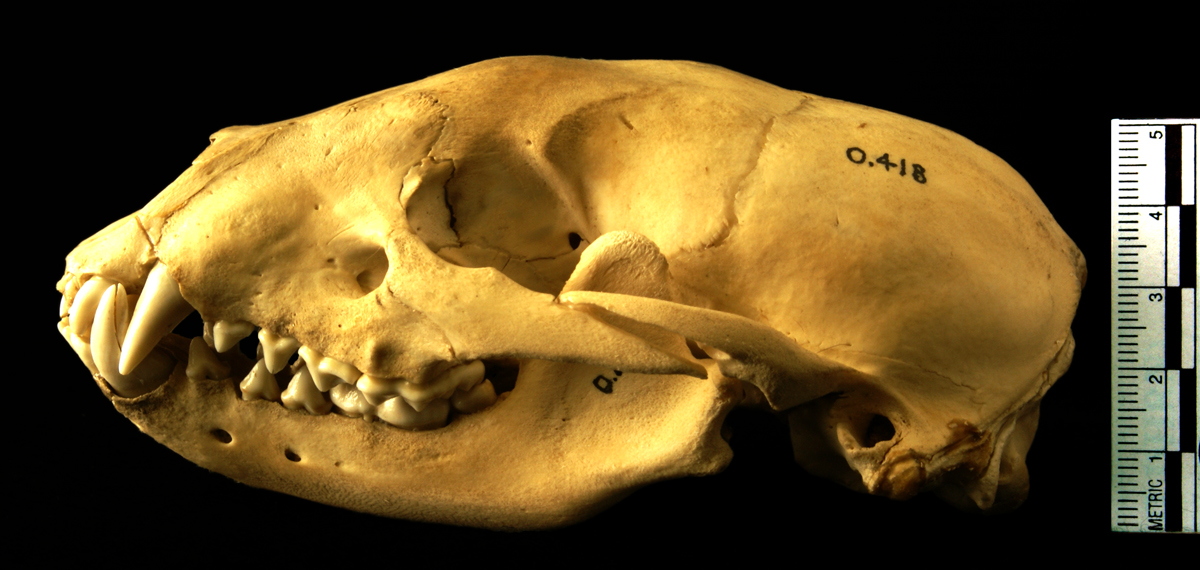
At first glance it looks quite similar to the skull of a small dog or fox, but the muzzle area seems a bit short, the braincase too small and the teeth aren’t quite right for a canid – in fact the teeth look more like those of a mustelid (as Jake pointed out). However, mustelids tend to have quite broad and blocky skulls and this one seems a bit elongate and gracile.

Clare P made a very good suggestion when she suggested the Asian Palm Civet Paradoxurus hermaphroditus, although this animal is somewhat smaller than the species that this specimen came from. Size aside, the dentition matches pretty well (if you can work out which tooth sockets belong to each tooth):

Asian palm civet skull and dentition by Paul Gervais (1816-1879)

So it looks like this is the skull of a viverrid. There are still lots of candidates out there and location could help narrow down possible species, but without any labels it can be hard to work out locality information. However, last week’s object was from the same collection and it was an African species, suggesting that Africa would be a good place to start looking for a species match.

Jamie Revell did just that when he suggested the Giant Forest Genet Genetta victoriae, which is a viverrid of about the right size from Africa. Although I already thought I knew what the specimen was, I took Jamie’s suggestion very seriously, as I hadn’t considered that particular species and it fit with most of the features of the specimen.

In the end an online French viverrid identification resource I’d not seen before provided me with the information I needed to exclude the Giant Forest Genet. Mainly it came down to whether the premaxillary bones made contact with the frontal bones – they do in the Giant Forest Genet, but they don’t in this specimen. Also, the area where the temporalis muscle attached is too narrow in this specimen.

In light of these observations and with reference to specimens in the Horniman’s collections (including one that I used as a mystery object a year ago) I am fairly confident in identifying this as  Continue reading

Friday mystery object #142 answer

On Friday I gave you this unidentified object from the Horniman’s collections and asked for your help in identifying it:

Suggestions ranged from the Easter Bunny (topical) to Dangermouse (fantastic), but there was a remarkably fast convergence of opinion on what this is.

Jamie Revell, Barbara Powell, henstridgesj and Jake all came to the conclusion that this is the skull of a  Continue reading

Friday mystery object #142

This week I have a genuine mystery object for you. I just stumbled across a couple of big boxes of unidentified skulls and bits of bone, so you can help me work out what some of these things might be from. To start with we have this skull:

Please put your suggestions, comments and questions below and I’ll do my best to respond. Enjoy – and have a nice Easter!

Friday mystery object #141 answer

On Friday I was in rather a rush as I was involved in co-organising this year’s Natural Science Collections Association (or NatSCA) conference. It was a very enjoyable (if hectic) few days of natural history nerdery, but left me limited time to select an object from the FMO. I took my opportunity at the drinks reception at the Grant Museum of Zoology where I tried out the camera on my new phone to get an image of this specimen:

Now it was a fairly easy one to identify as the skull of these animals is very distinctive. Nonetheless, if you haven’t seen the skull of one of these animals before it is a bit of an oddity, with that spike in the face and the apparently strongly protruding maxilla and mandible (which is actually due to unusually elevated frontals). Continue reading

Friday mystery object #141

This week I’ve been rather swamped with co-organising the Natural Science Collections Association conference, so I haven’t had much time to think of a good mystery object from the Horniman’s collections. However, here is a nice (if somewhat distinctive) specimen from the excellent Grant Museum of Zoology for you to identify:

image

Any idea what it is?

You can put your comments below and I’ll do my best to respond, as the opportunity arises. Best of luck!

Friday mystery object #140 answer

On Friday I gave you this skull to identify:

I thought it would be an easy one and I wasn’t wrong, although several of you seemed to second-guess my intentions and assumed that I was trying to trick you because it seemed too easy.

The small second incisors (or peg-teeth) just behind the big first incisors were a complete give-away for the group of animals this skull came from – the Lagomorphs, which Jake spotted immediately.

Henstridgesj, Jamie Revell, Debi Linton and Jake all suggested that it came from a  Continue reading

Friday mystery object #139 answer

On Friday I gave you this object to identify:

It didn’t prove to be all that difficult, perhaps since the skull is distinctive in having the general appearance of a ruminant (in particular it is missing the upper incisors), but it also has canines and is very small, with a skull height of just over 5cm. This slightly unusual mixture of characters suggests one of the more primitive ruminants.

Jake suggested it might be a Muntjac or Chinese Water Deer, but as Lena pointed out, Muntjac (and Chinese Water Deer) have a scent gland in front of the eye (called a preorbital gland) that is housed in a big pocket in the skull.  The skull itself is also a bit small even for a Muntjac.

Jack Ashby, Lena, Barbara Powell and Jamie Revell all managed to work out that this skull was from a member of the family Tragulidae. To be more specific it is from a  Continue reading

Friday mystery object #137 answer

On Friday I gave you this mystery object to identify:

Unfortunately I was unable to respond to comments on Friday, as my laptop had to go in for repairs and my phone has reached the end of its useful life as an internet device after 4 years faithful service. For the answer this week I had to drag out my old laptop, which has meant 2 hours of twiddling thumbs as the machine started up and dealt with various updates…

In some ways it was a good thing that I wasn’t able to comment, since it would have ruined the fun from the outset. Jake was straight in there, wondering if it was really as easy as it looked – and it was. Rachel, Jack Ashby and Barbara Powell also plumped for the right answer, while several others came very close when they went for a greedy relative. This is in fact the skull of a juvenile  Continue reading