Friday mystery object #224 answer

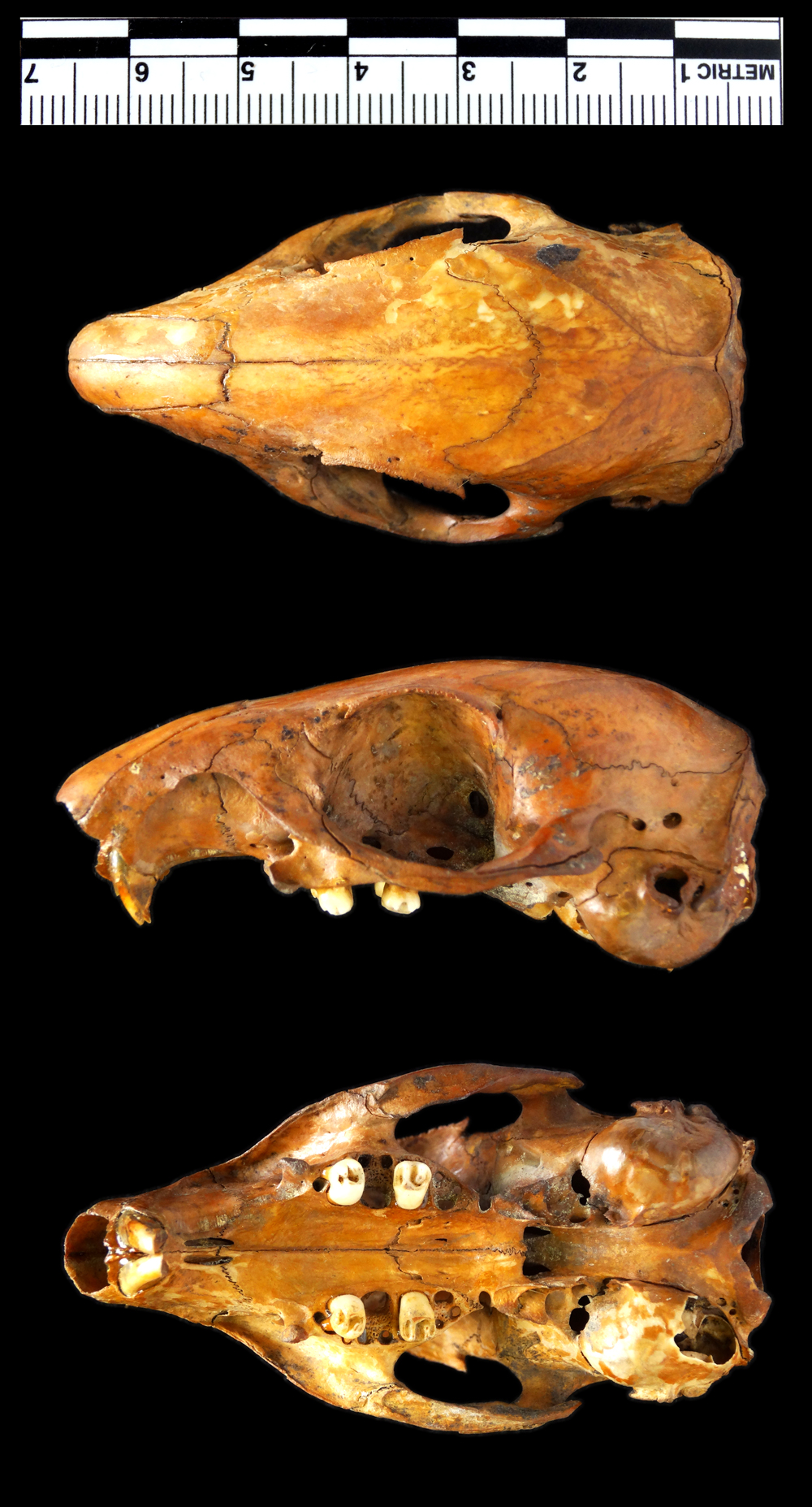
Last Friday I gave you this felid skull to have a go at identifying:

mystery224

The size was larger than the previous cat skulls I’ve shown you, which helped reduce the possibilities a bit – after all, there are more smaller cats than bigger ones.

As it turns out, Sam Misan and henstridgesj both managed to work out that this is the skull of a Serval Leptailurus serval (Schreber, 1776).

A Serval cat at Serengeti National Park, Tanzania, by Bob, 2007

A Serval cat at Serengeti National Park, Tanzania, by Bob, 2007

These long-legged cats have a relatively small head, but huge ears – and the large external auditory meatus (ear hole) with a very pronounced ridge above for attachment of the muscles of the pinna (the fleshy part of the ear) helps reflect that.

The long legs and the big ears are key to the Serval’s hunting technique in the long grasses of the African savannah, where they listen for the movement of rodents which they dramatically leap on. Probably easier to appreciate this method by seeing it:

Friday mystery object #224

For the last few weeks I’ve been using cat skulls as mystery objects, because they are really hard to tell apart and I was hoping that some useful distinguishing features might get spotted when you try to identify them.

I certainly feel like I’ve learned something, but I’m pleased to say that there aren’t too many more skulls to go, because it’s really difficult. This next one should hopefully be a bit easier than some of the recent cats:

mystery224

Any idea what fine felid this skull comes from?

As usual I would really appreciate your thoughts in the comments section below – let’s see if we can crack this!

Friday mystery object #223 answer

Last Friday I gave you this fine feline to have a go at identifying:

mystery223

I was a little suspicious of the identification attached to the specimen, but Al Klein suggested the same species – the Jaguarundi Puma yagouaroundi (É. Geoffroy Saint-Hilaire, 1803) [link opens pdf].

My reasons for suspicion were the nature of the post-orbital constriction (the narrowing of the braincase behind the eyes), the nature of the zygomaticotemporal suture between the temporal process of the zygomatic and the zygomatic process of the temporal bone (the bit where two bones meet to make the arch of the cheek) and the shape of the nasal bones where they meet the frontals (the V shaped bones above the nose area).

The observation by henstridgesj that the skull was similar to the previous mystery object (Leopardus tigrinus) was a good one, so I decided to research the genus Leopardus in a bit more detail, to see if there was a better match.

It turns out that the skull I found that matched this one most closely – especially with regard to the relative lack of a post-orbital constriction and the nasal-frontal junction – was the highly arboreal Margay Leopardus wiedii (Schinz, 1821) [link opens pdf].

Margay - Leopardus wiedii, Summit Municipal Parque, Panama. By Brian Gratwicke.

I’m always a bit reticent to re-identify specimens that have original labels from the supplier attached as this one does, but this comes from suppliers (Dr.s Schlüter & Mass) that I know have seriously misidentified or mislabelled specimens in the past (e.g. labelling a African Lappet-faced Vulture as an Andean Condor from Bolivia).

Of course, the real identification may be even more complicated, since the South American cats have a bit of a track record for hybridising to the point of masking distinct species, so any identification I make will be laden with disclaimers and caveats. The joy of real-world animals when contrasted against nice simple biological concepts…

Friday mystery object #223

I hope you’re not all fed up with cats yet, because here’s another:

mystery223

I have concerns about the identification attached to this one, so let’s see if your thoughts agree with what I have written on the label.

As always, you can put your thoughts below and they will be very welcome!

The Mermaid

As you may already know, I’ve been doing a lot of work on a mermaid specimen in the collections of the Horniman Museum & Gardens over the last few years.

The upshot of all that activity is that I have a paper written in a journal that will be hitting the bookshelves any day now. As you may have heard me say before, the specimen is not made of a monkey attached to a fish – I know that after undertaking painstaking examination of the specimen using CT scanning equipment and DNA sampling and good old fashioned anatomical investigation.

IMGP0507

OLYMPUS DIGITAL CAMERA

OLYMPUS DIGITAL CAMERA

Instead it appears to be a real creature of uncertain taxonomic affiliation. The teeth suggest a link to the Wrasse family, the tail to the Carp and the torso to no known living group, so I have designated this specimen as the type for its species and have named it Pseudosiren paradoxoides. Full details can be found in the paper which is due out next week in the Journal of Museum Ethnography – I’m so excited!

Friday mystery object #222 answer

Last Friday I gave you this fabulous feline skull to have a go at identifying:

mystery222

No one got quite the right species, but several people (Crispin, manwhohunts, Maxine and Alex Klein) managed to narrow it down to the correct genus.

The flat frontals give the forehead a slope rather than the usual curve we’ve seen in previous cats of this size, making the cranium appear very domed in contrast. The post orbital processes are quite short and gracile (slender). The jaw is quite short while maxilla bone above the canines appears pinched in and the nasals are steep and protruding somewhat.  These are features that appear in the genus Leopardus – the South and Central American small spotted cats.

How to distinguish between different species of Leopadus is more of a problem. Daniel Jones picked up on the incredibly robust bone margin of the foramen magnum (the hole the spinal chord goes into), which may be distinctive, but so far I’ve not seen the underside of other small Leopardus species skulls, so I can’t be sure.

All I know is that this is the skull of an Oncilla Leopardus tigrinus (Schreber, 1775), a small and mainly ground-hunting South American forest cat. I’ve said it before and I’ll say it again, cats are so difficult to identify!


Friday mystery object #221 answer

Last Friday I gave you this cat skull to identify:

mystery221

It is about the same size as a Domestic Cat and is very similar in morphology. But it’s not a Domestic Cat. 

The auditory bullae (the bulbs under the skull that hold the hearing apparatus) and the external auditory meatus (ear holes) are a bit bigger, the skull is a bit broader and the interpterygoid notch (the gap at the back of the palate that the airway emerges from) is squarer and has a slight ridge in front of it on the palate (and I’m not sure that ANY of these are particularly significant).

There were plenty of suggestions about what this skull might belong to, but only henstridgesj hit the nail on the head with a correct identification of Southern African Wildcat Felis silvestris cafra Desmarest, 1822. So well done Stephen!

Southern African Wildcat (Felis silvestris cafra) in Kgalagadi Transfrontier Park. Image taken by on  Johann du Preez 24 December 2007

Southern African Wildcat (Felis silvestris cafra) by Johann du Preez 2008

Friday mystery object #220 answer

Last week I gave you this lovely skull to identify:

mystery220

As I suspected, everyone immediately recognised it as a type of cat. The characteristic two large blade-like premolars with a gap (diastema) behind the long canines and the straight incisor row were a dead give-away.

Then came the difficult bit. There are around 40 living cat species recognised in the world and because they didn’t diverge from a common ancestor until just 10 million years ago (or thereabouts), they all tend to look quite similar.

There were lots of suggestions, ranging from Lynx to Jungle Cat, but only Jake managed to recognise this short and highly domed skull (with impressively long canines) as belonging to a Marbled Cat Pardofelis marmorata (Martin, 1836).

The Marbled Cat is an tree-dwelling species from South and Southeast Asia that isn’t really very well known. They have a ridiculously long and chunky tail to help with their arboreal lifestyle and beautiful patterns on their coat, which gives them their name.

Photo of a Marbled cat (Pardofelis marmorata) spotted in Danum Valley Conservation Area, Borneo, by Johan Embréus 2009

Since cats are so hard to tell apart do you think I should post a few more over the next few weeks? Between us we may be able to spot some useful distinguishing features…

Friday mystery object #219 answer

On Friday 7th Feb I gave you this mystery skull to identify:

mystery219

The post got lots of activity from both regulars and biology students from the University of Chicago Laboratory School, which means there were lots of helpful comments!

The specimen was quite clearly from a rodent, due to the paired incisors, but there are a LOT of different rodents out there.

The type of rodent was narrowed down by bugblokenz who suggested the skull was from a squirrel of some sort and Jake pointed out how we know that is the case – the specimen has a spiky postorbital process:

rodentpostorbitalprocess

The presence of a spiky postorbital process (see top skull) suggests that it was from a type of squirrel. Most other rodents either lack this process (see bottom skull), or the process is more stout and blunt.

Narrowing it down to a squirrel is helpful, but there are still around 285 different species to choose from and many squirrels have very similar skulls. This is where the real challenge lay, especially since it clearly wasn’t the British Red Squirrel Sciurus vulgaris or the more widespread Eastern Grey Sciurus carolinensis, as I showed you on Friday 14th. Other suggestions included the Southern Flying Squirrel Glaucomys volans (which is a bit on the small side) and Eastern Fox Squirrel Sciurus niger (which has a really interesting method you can use to identify it).

The relatively narrow zygomatic breadth, combined with a relatively wide breadth between the orbits suggests a ground squirrel of some sort, which many people recognised, leading to suggestions of Poliocitellus frankliniiSpermophilus sp., Otospermophilus sp. and Tamias sp. – for which this useful reference provides some great comparative specimens (huge thanks to Crispin for sharing this).

However, none of the North American ground squirrels quite matched up, with the closest suggestions of Otospermophilus variegatus or Poliocitellus franklinii still being different in a variety of ways, particularly in relation to the width of the skull, relative zygomatic breadth and shape of the postorbital process.

After much consideration it came to me that we may be looking on the wrong continent and it turns out that African ground squirrels are more similar to this specimen. Fortunately, there is a very useful resource providing images of specimens of African rodent species available through the Belgian Biodiversity Platform. This fantastic site has enabled me to make a reasonably confident identification of Striped Ground Squirrel Xerus erythropus (Geoffroy Saint-Hilaire, 1803).

Striped Ground Squirrel (Xerus erythropus) by BOISSEL Philippe

Striped Ground Squirrel (Xerus erythropus) by BOISSEL Philippe

I’d still like to get my mystery skull to a comprehensive physical collection, just to make some fine detail checks (there are some issues with the shape of the posterior margin of the palate I’m not 100% happy about), but overall I’m happy with this – but please let me know if you think I’ve missed something!

Big thanks to everyone who has contributed their ideas on this specimen – let’s see what I can find for you to identify this coming Friday…

[Further information available in this species description PDF]

Friday mystery object #219 answer coming soon…

Apologies for not having the answer to last week’s mystery object posted yet – it’s been a busy week and I simply haven’t had a chance to prepare a decent answer.

However, I have an image of last week’s object alongside a Grey Squirrel (the lighter coloured specimen), to give you an idea of how they differ, so I hope that will prove of interest until I can get a proper post prepared:

Grey_Squirrel_vs_Mystery_219

Friday mystery object #218 answer

Last Friday I gave you this skull to identify:

mystery218

There was strong consensus on this being a mustelid – which is good, because that’s what it is. There was also good agreement on it being one of the Martens, which is where things become a bit more difficult.

After looking at a lot of different Marten skulls online without much success in finding a way of telling them apart, this diagram  proved quite helpful.

Images compiled by Mariomassone

Skulls in the sequence: M. zibellina, M. martes, M. foina

If you look at the skull in the middle of the top and centre rows, the auditory bullae (the rounded bones under the skull that house the anatomy used in hearing) have quite distinctive shapes in the three species pictured.

In addition, the the little nub of bone (called the mastoid process) that sticks out behind the ear hole (or external auditory meatus as it’s also known) is very differently developed in the three species. Looking at this character and checking back against other Marten skulls online the clues suggested that the mystery object is the skull of a Pine Marten Martes martes (Linnaeus, 1758).

So well done to everyone who commented – particularly Jake who got the ball rolling with a Martes identification from the start!

Friday mystery object #217 answer

Last Friday I gave you this lovely skull to identify:

mystery217

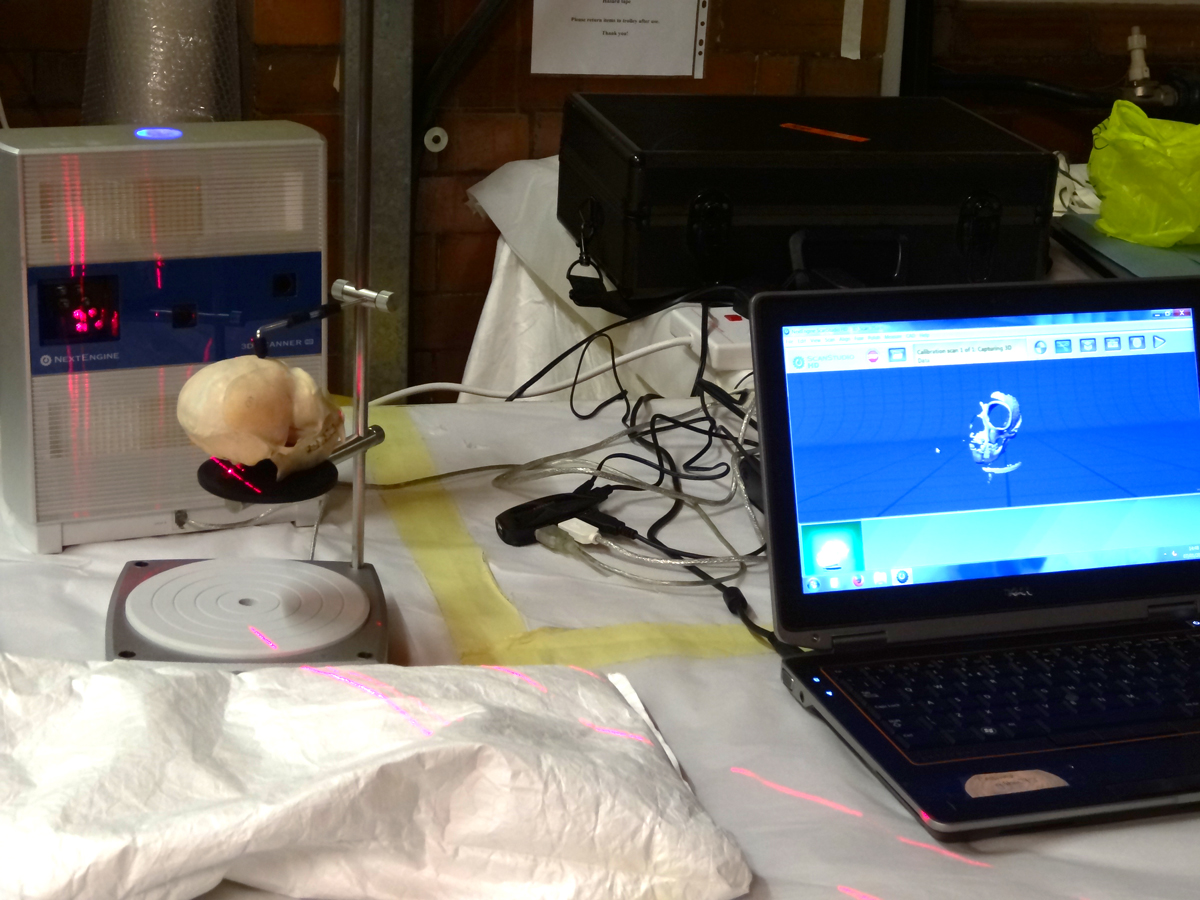
I chose it because it was being used for an interesting project by a student at UCL, involving 3D surface laser scanning of the specimen to identify landmark characters of the skeletal structure of the faces of this family of primates:

mystery217scan

This is a specimen that we actually have a fair amount of information about. It’s a male Grey Gibbon Hylobates muelleri Martin, 1841 collected before 1909, from Melian on the Hanta River in North Borneo. So of all the suggestions, Crispin (@brainketchup) was the closest (with agreement from henstridgesj) when he suggested White-handed Gibbon.

It turns out that this skull also has a taxidermy skin associated with it (which Jake has mentioned before), which shows a common feature of taxidermy specimens where the skull has been prepared separately – it’s mouth is stitched shut:

GreyGibbon

This makes for slightly dodgy taxidermy, but at least it means the skull is available for future research, instead of being stuck in a specimen intended mainly for display.

The skin of this specimen has also seen recent use, but for art rather than science. Artist Paul Robinson has used it as the basis of this somewhat freaky, but striking piece of work:

GIBBON by Paul Robinson

GIBBON by Paul Robinson

It goes to show that specimens in museums can find themselves being used in all sorts of interesting ways. To my mind this is really what museum collections are for – being used by people.

Friday mystery object #216 answer

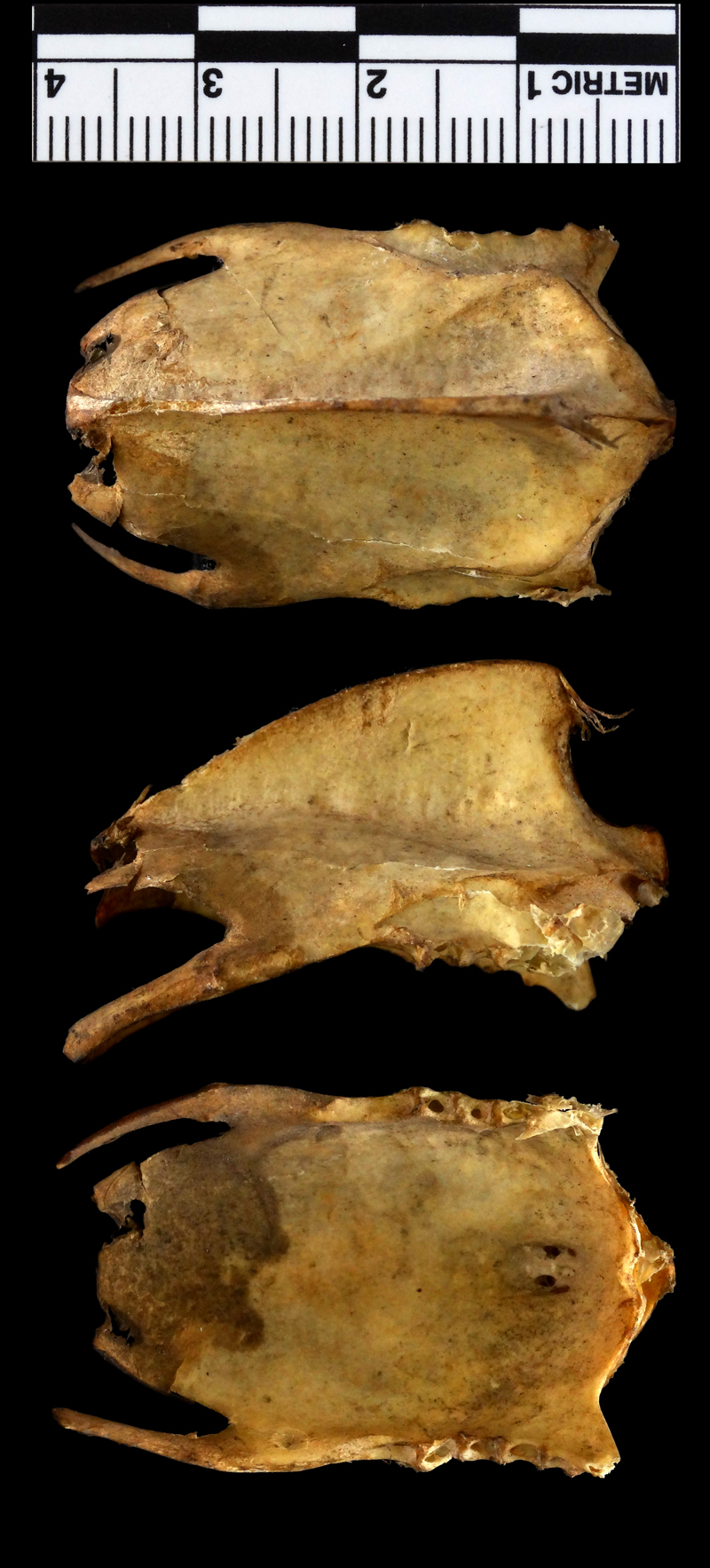
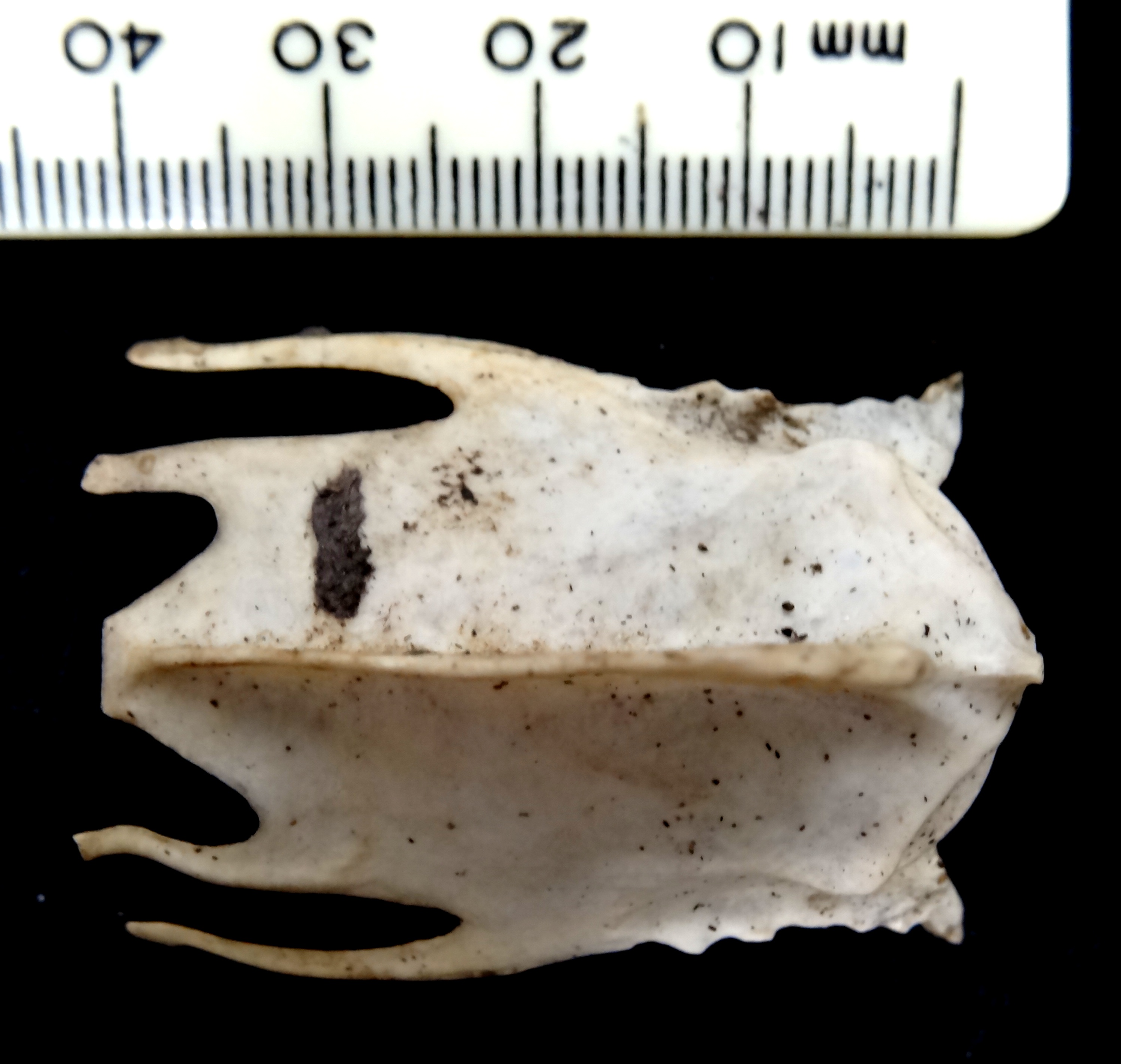
Last Friday I gave you this mystery sternum to identify:

mystery216

I had a rough idea of the family, but I was less certain about the species. As it turns out I’m now less sure of the family than I was before, in light of some useful comments.

At first I thought this was the sternum of a member of the Strigidae or the ‘True Owls’ – something that Jake also thought with his suggestion of Tawny Owl Strix aluco, but henstridgesj and Daniel Jones raised the possibility of it being from a seabird and Daniel Calleri suggested it could also be from a member of the Halcyonidae or the ‘Tree Kingfisher’ family.

With the Christmas and New Year break I haven’t had a chance to get to our stores to check specimens, but there is a very useful website that deals with seabird osteology (helpfully called Seabird Osteology) which has some images of sterna. Several of the Procellariiformes (the order containing the Albatrosses, Petrels, Shearwaters, etc.) have a similarly short sternum with a double notched bottom margin, as do some of the Laridae or the Gull family.

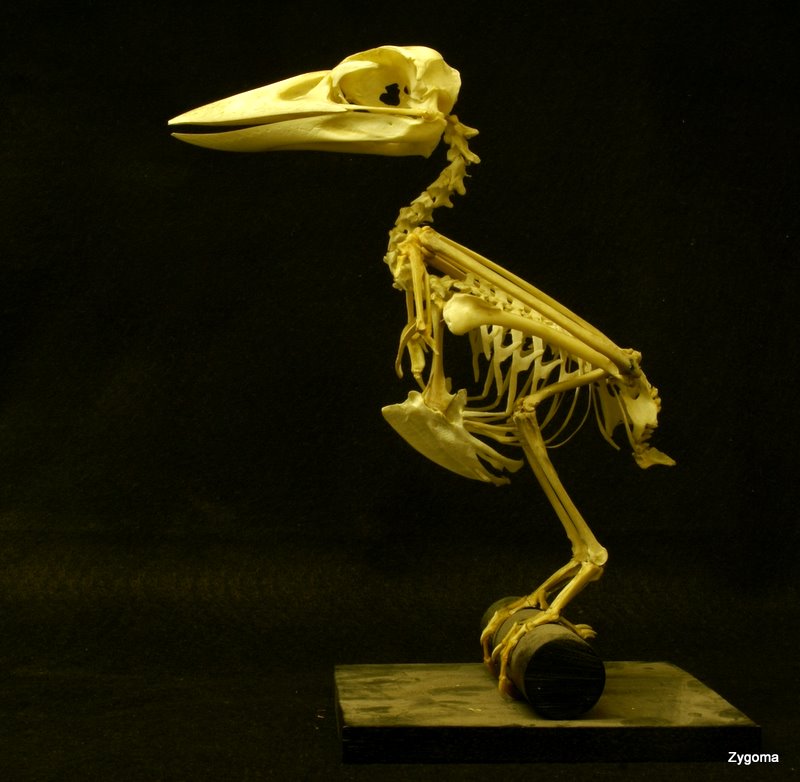
I also checked an image of a Kookaburra from a previous mystery object, which doesn’t show the sternum well, but which does hint at a double notched bottom margin:
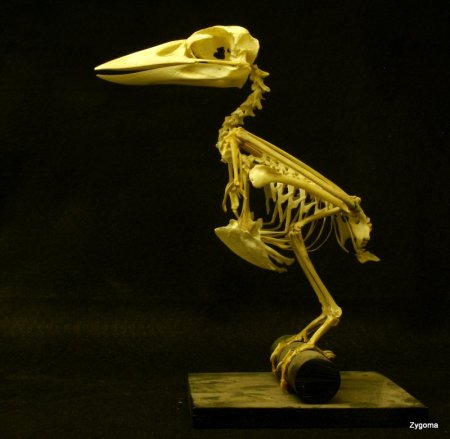
Laughing Kookaburra Dacelo novaeguineae skeleton

Laughing Kookaburra (Dacelo novaeguineae) skeleton

This has left me slightly less confident that last week’s mystery object is from an owl, but here are a couple of other owl sterna for comparison:

Barn Owl Tyto alba sternum and coracoid

Barn Owl (Tyto alba) sternum and coracoid

As you can see, the Barn Owl sternum above doesn’t quite have the double notch, although the size is about right. The Eurasian Eagle Owl sternum below (ignore the coracoids and other bits of the pectoral girdle) is a much closer fit, although substantially larger.

Bubo_bubo_sternum_coracoid

Eurasian Eagle Owl (Bubo bubo) sternum, coracoid, furcula and scapula

I’ll see if I can find a Tawny Owl sternum to check against, because the shape does seem pretty good for one of the Strigidae and the size is about the same as a Barn Owl, which is in a different family, but has a size range that overlaps with the Tawny Owl. Of course, it could also be from one of the other medium sized owls, like the Long-eared or Short-eared Owls… more to come!

UPDATE 14:30 on 3rd January 2014

Here’s a Tawny Owl sternum!
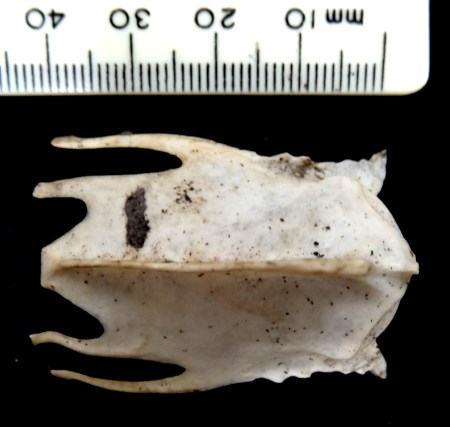
Tawny Owl (Strix aluco) sternum

It’s pretty close, but the notches seem a bit deeper, so perhaps one of the Asioninae (Eared Owls) might be a better match for the mystery object?

Friday mystery object #216

I hope you all had an enjoyable Yuletide, I’ve certainly been glad of the excuse for a lie-in over the last few days.

The mystery object is a bit late today, but I hope you’ll forgive me in light of the general seasonal torpor.

Here’s a sternum that I’ve been puzzling over for a while – I can make a pretty good guess at the family it comes from, but I’m less sure of the species:

mystery216

I’d appreciate seeing what you think it might be – let’s see if we can work this out!