Last week’s object was a bit too difficult – passerine skeletons are tricky to identify. This week I have something a bit easier for you to identify:


Put your questions, comments and suggestions below and I’ll do my best to respond. Good luck!

Last week’s object was a bit too difficult – passerine skeletons are tricky to identify. This week I have something a bit easier for you to identify:
Put your questions, comments and suggestions below and I’ll do my best to respond. Good luck!
Today is World Rhino Day. It is a day for raising awareness about the threats to the future survival of the five species of Rhino in the world today.

Historically Rhinos have been hunted for their horn – which has been made into trophies in Europe, into high-status jambiya handles in Yemen and into intricately carved libation cups in China.
Today, despite the fact that Rhinos are protected by international law, which makes it illegal to trade in modern and unworked antique horn, there is an active black market for Rhino horn in parts of Asia (mainly in Thailand, Vietnam, China).
This market is mainly driven by demand for horn used in Traditional Chinese Medicine (TCM), particularly following recent (totally spurious) claims that it can treat cancer (N.B. it was never used as an aphrodisiac in TCM).
In reality the horn has no more health benefits than cow horn or even fingernails, since it is composed of the same material – keratin. Unfortunately this fact has done little to stop the demand for illegal Rhino horn.
Actually, much of the demand is probably artificial, driven by wealthy businesses stockpiling horn against future shortages as Rhinos disappear (as identified in this report on Taiwan from 20 years ago). Their actions have made the average Rhino horn worth more than a 24-carat gold ice-cream cone filled with the highest grade cocaine.
So far this year 287 Rhinos have been illegally killed for their horn in South Africa alone – a figure closing in on last year’s all time high of 333. Many of these Rhinos have died from the process of having their horn removed using a chainsaw, which cuts through the flesh and bone of the end of the skull.
On top of this bloody harvest, the demand for Rhino horn has led smuggling cartels to seek alternative methods of getting hold of horn.
These have ranged from using Thai prostitutes to pose as legal game shooters (I kid you not) to acquiring historic horn through a legal loophole.
The biggest surprises came in a sale of rhinoceros horn carvings, in which 30 lots, estimated at $3.9 million, sold for $30 million. (example of black market influence on Rhino horn value in art sale, from The Telegraph, 31st May 2010)
When it was noticed that Asian buyers were paying well over the odds for antique Rhino horn the loophole was closed, but by then historic horn had become well established as a commodity and therefore attractive to the criminal element involved in the Rhino horn trade.
This led to several thefts of horn from South African museums in 2010 and European targets started being hit from February 2011. Since then there has been a spate of 30 or so thefts of horn from museums, auction rooms and historic houses around Europe. These thefts have led many museums, including the Horniman, to take their Rhino horn off display and move it into secure storage.
The Natural Science Collections Association (of which I am a committee member) has provided some guidance to museums about Rhino horn in collections and somehow I’ve found myself giving interviews to the Museums Association and the BBC about this issue.
In the face of all the depressing Rhino horn developments over the past couple of years, it’s been heartening to see politicians and even Traditional Chinese Medicine educators backing the moves to dispel the myths about Rhino horn as a cancer medicine.
I must also admit to having a (slightly guilty) sense of schadenfreude when I think of the nasty chemicals that have been used to treat Rhino horn in museums over the years (including arsenic and mercury).
Risks aside, there are still rich people who will naively use ‘medicines’ that they don’t understand, but which they put their faith in anyway (Elle Macpherson for example).
So the situation looks bleak for the future of Rhinos, unless misinformation about medicinal effects of their horn can be overcome and the demand for illegal horn removed.
——————————————————–
Pdf fact sheets on all 5 Rhino species from http://www.rhinoconservation.org:
On Friday I gave you this object to identify:

Rather unusually no-one managed to identify it. It’s not native to the UK and looks similar to quite a large variety of other species, because it’s a member of the Passeriformes (the perching birds), which is a hugely diverse and numerous group of birds. These factors make identifying the bird tricky, but without the plumage there to provide clues it was a very difficult task.
The plumage would have been a big help here, since the name of this bird is taken largely from a description of the plumage.

As you can probably work out from the photo above, it’s a Long-tailed Glossy Starling Lamprotornis caudatus (Statius Muller, 1776).
These tropical African birds are similar in diet and habits to the European Starling that we see more commonly – they just look a lot prettier.
Following on from Rachel’s difficult guest object last week, I have another bird for you to identify:
(N.B. the skull is 53mm long)
Any ideas what it is?
As usual, put your questions, comments and suggestions below and I’ll do my best to respond. Good luck!
Below is Rachel’s follow-up guest post answer to last Friday’s challenging mystery object. Many thanks Rachel – it was a good one!
Well, I seem to have led you all a merry dance this week! Admittedly, it was sneaky to not include a scale bar or provide you with another view of the skull, but if I’d put the top view in I think it would have been game over in about five minutes…

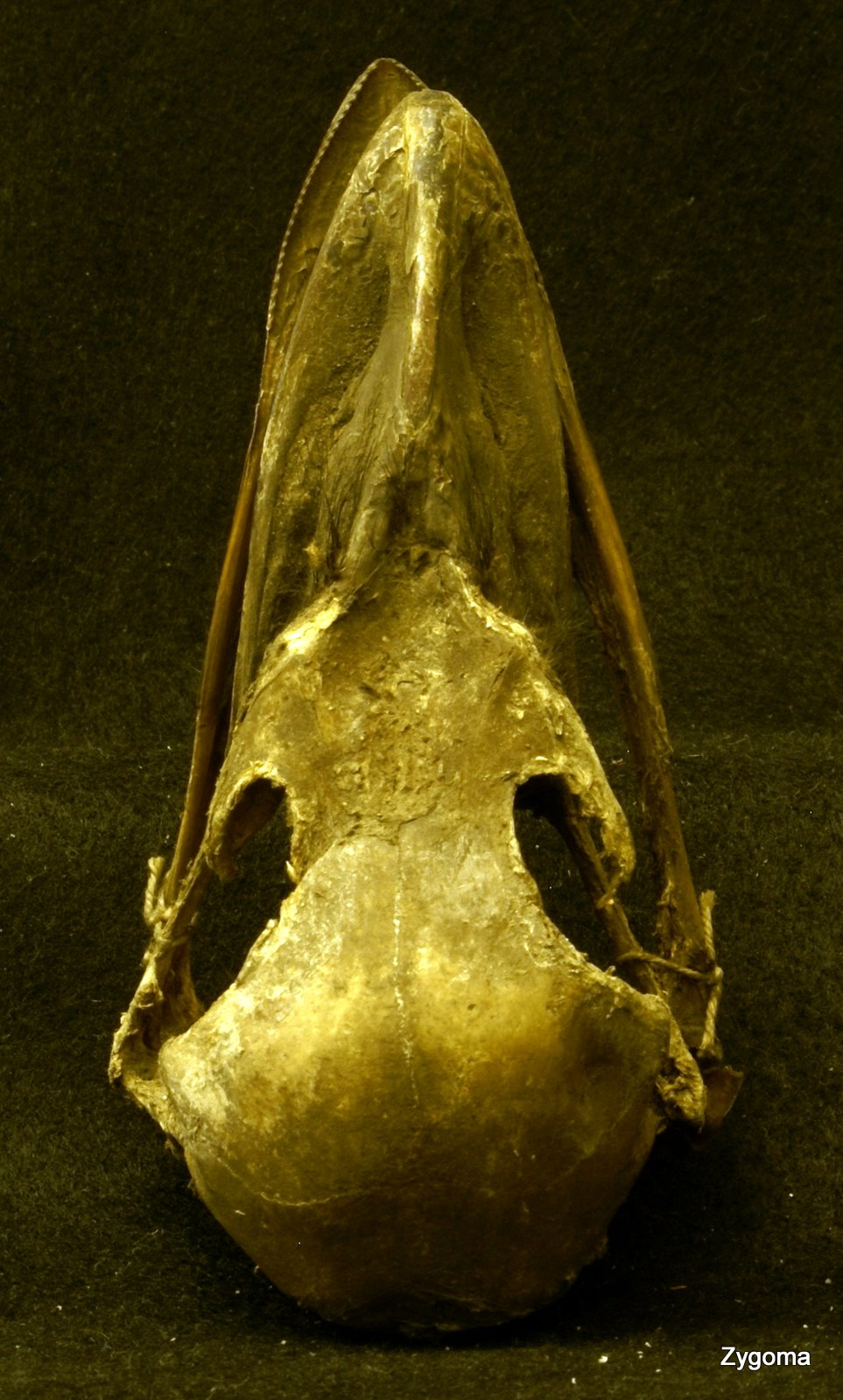
As cromercrox so rightly pointed out, it is a bird skull. Many of the guesses tended towards water birds, with suggestions including goose, gull, and rail.
Manabu Sakamoto was the first to suggest a ratite, and later tentatively guessed ostrich, while Matt King went for a rhea.
Paolo and I actually thought it might be a rhea to start with, but after comparing it to an identified rhea skull in the collections and the ratite images on Skullsite, we decided that it is in fact an Continue reading
This week I’m handing over to a colleague, crossword competitor and member of the Mystery Object community, Rachel:
Welcome to my first (and hopefully not last) guest Friday Mystery Object. I hope what I’ve chosen isn’t too glaringly easy; if it is, please feel free to allow yourself a smug smile and a pat on the back, but do try to resist shouting out the answer until Sunday so as not to spoil the game for others. Cryptic clues are much more fun.
Today’s object is, as usual, from the collections of the Horniman Museum. I will hopefully be available over the weekend to offer feedback on suggestions or questions, and I’ll provide the answer on Monday.
Good luck!
On Friday I gave you this object (from the NHM) to identify:

It was a bit of a tricky one for those of you who haven’t seen the First Time Out exhibition (jackashby and David Godfrey obviously did see it). This fossil skull looks like it belonged to some kind of pig rather than a primate – yes, that’s right, I said primate.
The main feature visible here that indicates that this skull may belong to a primate is the enclosed orbit, which isn’t a particularly strong characteristic since various ungulates also have an enclosed orbit – as I said, it’s a tricky one.
The type of primate is the Koala Lemur Megaladapis edwardsi Forsyth Major, 1894 from Madagascar. It was an arboreal, slow moving, gorilla-sized folivore – with superficial similarities to Koalas (hence the name). It is hypothesised that the extended bony nasal region may have supported a prehensile top lip, that would have been beneficial when foraging for leaves in the trees.
I won’t go into much detail here, because other curators have provided their interpretation for this object as part of the First Time Out project, so I will leave you with a link to that information. However, I would be interested in taking a closer look at the dentition and complete skeleton of one of these animals – I’d like to get a better grip on this apparent convergence on a suid cranial morphology and more gorilla-like body. I wonder what it might have looked like?

This week I’ll give you one that’s probably way too easy, but it’s a fascinating specimen:
As usual you can leave your questions, comments and suggestions below and I’ll do my best to reply. Good luck!
On Friday I gave you these objects to identify:

Apart from their superficial similarity to chocolate pralines or denuded molluscs several of you managed to identify that these are in fact teeth.
In particular Dave Godfrey, David and Styracosaurus Rider pwned this object with a definitive genus identification of Continue reading
This week I’ve decided to give you something that’s a bit of a change from the usual skulls:
Any idea what these objects are?
As usual you can leave your questions, comments and suggestions below and I’ll try to respond during the day. Good luck!
It seems that Friday’s mystery object led you on a merry chase.

Not a Crab-eating Raccoon!
This skull clearly perplexed everyone, given the number of suggestions and guesses that were made. Representatives of pretty much every major carnivore family were suggested.
Peter Harrison was the first to suggest a species from the right genus on the label (the slightly stuck-up looking nasals are can be a good clue that you’re looking at a procyonid) and Styracosaurus Rider made a good observation about the dentition. Eventually the correct answer on the label came from henstridgesj, backed up by Rachel, Styracosaurus Rider and David – it’s allegedly a Continue reading
This week I’ve decided to go back to mammal skulls. Any idea what this belonged to?
N.B. length of skull approx 12-13cm
As usual you can leave your questions, comments and suggestions below and I’ll try to provide some pointers. Good luck!
On Friday I gave you this chunky object to identify:

It proved more of a challenge than I expected and I think that may be because I included a scale bar. Normally it’s the other way round – the scale bar helps rule out options based on size, but on this occasion it seems to have thrown a spanner in the works.
Clare P came close when she suggested a Pygmy Hippo and Jack Ashby, Matt King (sort of) and Styracosaurus Rider backed up that identification, but henstridgesj came closest with the suggestion of ‘Embryonic Hippo’.
This is actually the right front leg of a juvenile Continue reading
This week’s mystery object is a bit more chunky than the birds of the last few weeks:
Any idea what it is?
As usual you can leave your questions, comments and suggestions below and I’ll do my best to respond. Good luck!
This week we have a mystery object chosen by Melita and Laura who shadowed me on Wednesday as I worked in the Horniman’s collections:

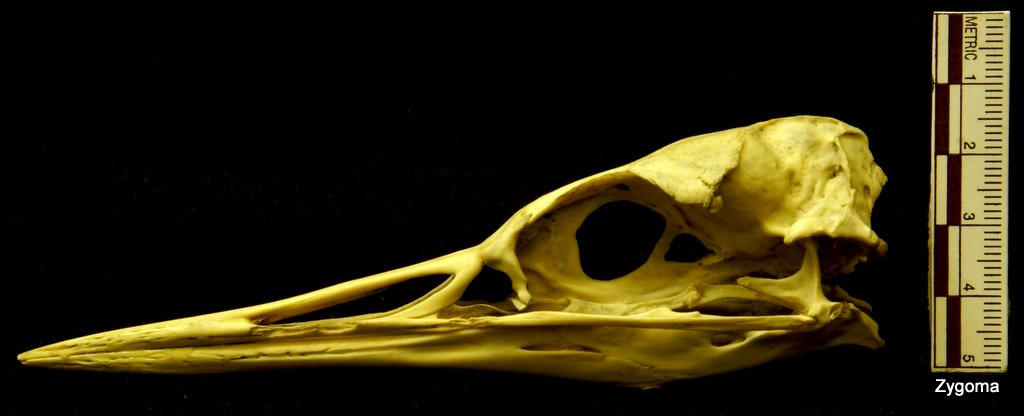
It’s another bird and given last week’s impressive identification skills I expect that several of you will get this in no time.
As usual you can leave your questions, comments and suggestions below and I’ll do my best to respond. Good luck!
On Friday I gave you this specimen to identify:

I thought that it might prove a difficult one, but it seems I should have had more faith in the identification skills of my readers (you talented bunch), since the correct answer was delivered with little ado.
The long legs suggested that it was a wading bird to curatorialtrainee and Harry then tentatively suggested what turned out to be the correct answer, which was consolidated by the observations of henstridgesj and the input of David. Jake also spotted what bird this was by comparing the skull to the images on the very useful skullsite.com Continue reading
Last week’s bird was so popular I thought I’d give you another to identify this week. It’s a bit harder than last week’s Kookaburra and I’ll be very impressed indeed if anyone gets it to species, but I’m sure many of you will manage to identify it to family level.
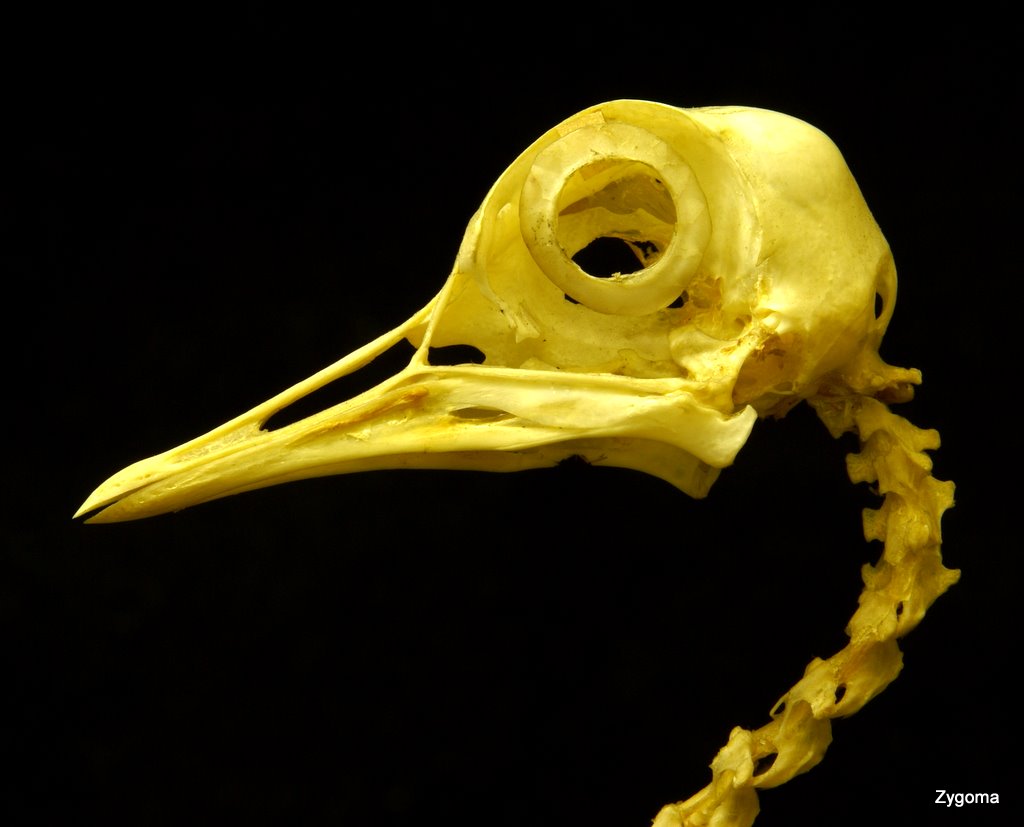
I will be teaching young folk about skulls and mermaids at Camp Quest in Somerset this Friday, so I might not get a chance to respond to comments, although I’ll do my best.
Good luck!
I was a bit taken aback by the response to the second anniversary mystery object last Friday. There were a huge number of comments and unfortunately I was tied up all day and was unable to respond – my sincere apologies!
To give you a change from the usual mammal skulls I gave you this bird to identify:
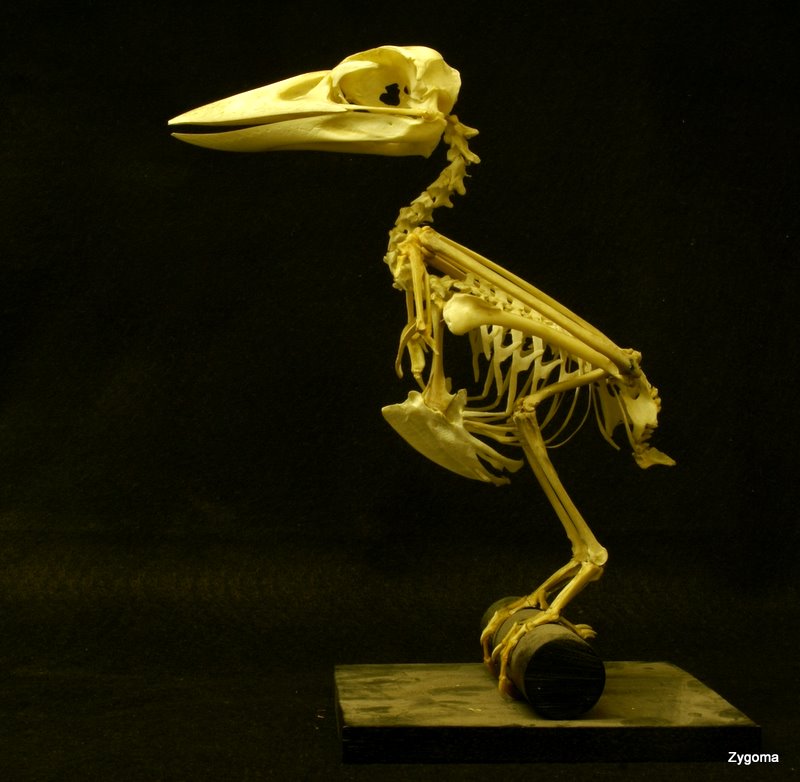
It’s quite a characteristic bird, so I decided to make it more of a challenge by leaving out the usual scale bar – if you’re interested the head of this specimen is about 10cm long.
Obviously the comparatively large head and massive bill were key features that were picked up on, giving the following answers:

I’m pleased to say that the vast majority of you managed to get the correct identification; it is indeed the skeleton of a Kookaburra, more specifically the Laughing Kookaburra Dacelo novaeguineae (Hermann, 1783).

Laughing Kookaburra perched in a eucalypt tree. Taken in December 2008 in Victoria, Australia by Fir0002
These large antipodean kingfishers have a very distinctive call, which sounds to me like the laugh of a clown from a nightmare. In fact, I expect these birds are a bit of a nightmare for any small critters that live in their vicinity. That big robust bill is powerful and they use it to eat a wide range of animals including worms, snakes, rats and even some fairly decent sized birds.
They aren’t subtle about their hunting either. They simply grab their prey in their bill and smash it on the ground, on a branch or on a rock then swallow it whole. Often they keep smashing it for quite a while – after all, swallowing a live snake or rat probably isn’t a great idea.
If you look at the skull you might notice a deep groove around the back and a deep indentation on the lower jaw or mandible:

These are muscle scars and it’s quite unusual to find such impressive areas for muscle attachment in bird skulls, but then most birds don’t rely quite as much on brute force to catch and subdue their prey. Kookaburras mean business.
Well, it’s the second anniversary of the Friday Mystery Object – how time flies! Speaking of flying, I’ve decided to give you a bird skeleton to identify this week. Any idea what this is:
Comments below as usual – I’m sure that some of you will work it out straight-away, so please drop hints rather than give-away the answer to those less familiar with the anatomy of our feathered friends.
Best of luck!
On Friday I gave you this Anthropological object and asked what is it, where is it from and what is it made from:
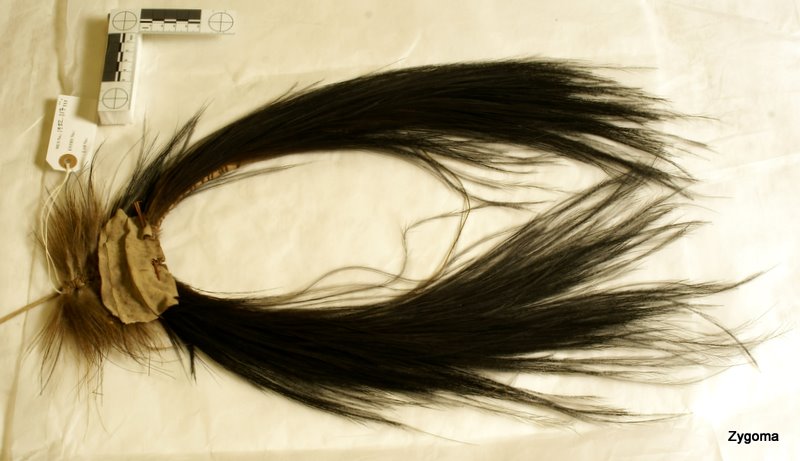
As some of you spotted, this object is not made of hair, but of feathers that look like hair. This indicates that the feathers are from a flightless bird – and given their length it would be a big bird. That narrows it down to a ratite (also known as a Struthioniform).
There are large ratites in Africa (Ostriches), South America (Rheas), Australia (Emus and Cassowaries) and New Guinea (Cassowaries), so this object must come from one of these places.
Given the shape and size it seems fairly clear that the object is a headdress, so the easy way to identify what this object is made from (and therefore the area of the world from which it originated) is to do an image search for ‘*type of ratite* headdress’, after all, there are only 4 options. Sneaky but effective.
To save you the trouble I will tell you that it is in fact made from Cassowary feathers – probably Northern Cassowary Casuarius unappendiculatus (Blyth, 1860) and it’s from New Guinea, which David Craven successfully identified – well done!

Northern Cassowary (Casuarius unappendiculatus) at Bali Bird Park by http://www.viajar24h.com
 Zygoma