Friday mystery object #312 answer

Last week I gave you this specimen to identify, which came in as an enquiry after being found in someone’s toilet:

There were a variety of great responses, with some fantastic cryptic clues, including an anagram by Claire Miles (great stuff!). Most opted for this being Stegobium paniceum, which is also known by the aliases Drugstore Beetle, Biscuit Beetle or Bread Beetle.

Stegobium paniceum by Sarefo, 2007

Stegobium paniceum by Sarefo, 2007

However, the mystery critter has a subtly different pronotum (that’s the plate over the thorax that extends over the head).

Another suggestion was woodworm or one of the false powderpost beetles, which covers a range of wood-boring beetles, with Liberty Hightower correctly giving the more taxonomically constrained suggestion, of something from the Tribe Anobiini (which includes Stegobium). However, my colleague Olivier sent me an email with a very definitive identification, informed by a past experience with this particular pest – the Furniture Beetle Anobium punctatum De Geer, 1774.

These beetles have a distinctive pronotum that supposedly looks like a monk’s cowl, with a more distinctive hump and slightly pinched looking back section than the more smoothly curving pronotum of the Stegobium. They fall into the broad category of woodworm because their larvae feed on wood, making tunnels hidden from view and only becoming visible when they emerge from small holes in the wood as adults, leaving a little pile of wood dust as they go.

The presence of these beetles in a toilet isn’t related to the water in the bowl or even wood of the seat – it turns out that there was a window above the toilet and the adult beetles, in an attempt to leave the building after emerging, were attracted to the light from the window and flew into the glass only to bounce off and land in the toilet.

This attraction towards light in the dispersing adult stage of the beetle is a handy behaviour if you want to keep track of these pests. If you’re concerned you may have active woodworm it’s worth checking your windowsills in the summer to see if you have any of these adult beetles lying around. Of course, there are other species that would also be worth checking for, since there are plenty of beetles whose larvae would be considered woodworm. Keep your eyes peeled!

Friday mystery object #311 answer

For the last couple of weeks I’ve been offering up what has been affectionately nicknamed ‘cave snot’ for identification:

mystery311a

The initial goop was a bit too difficult to identify from a photo, so I dug in and pulled out the critter responsible:

mystery311c

This proved much more identifiable, with Chris immediately recognising that it’s the larva of a Caddisfly (not really a fly, but a more moth-like insect in the Order Trichoptera – which means ‘hairy wings’ as palfreyman1414 mentioned). Natalia Maas went one better by alluding to the family – the Philopotamidae or Finger-net Caddis, explaining the goop, which is actually made up of little silk nets shaped like fingers (hence the common name for the family). These nets are used to collect organic detritus and diatoms from flowing water, which the larvae then feed on.

I provided a couple of extra images to help narrow down the identification, since there are only five species in three genera of Finger-net Caddis in Ireland (and England for that matter), which are able to be differentiated from the anterior margin of their frontoclypeus (see the diagram below if you’re not sure what that is).

caddis-frontoclypeus

There’s an excellent website looking at Trichoptera in Ireland, descriptively called TrichopteraIreland, where you can find the details of how to tell the larvae of different genera apart, but the short version is to look at the frontoclypeus and if it has a deep U-shaped notch in it you have a Chimarra marginata, if it has a shallow V-shaped notch in it then you have Philopotamus montanus and if it’s a smooth curve then you have a species in the genus Wormaldia (which could be W. subnigra, W. mediana or W. occipitalis).

Unfortunately you can’t readily tell Wormaldia species apart when they’re larvae, so unless I’m missing a well-hidden notch in the frontoclypeus, we can’t identify this to anything better than genus level – but that’s still a substantial improvement on simply calling it cave snot.

I’ll be taking the specimen to the previous Entomology curator of the Museum, since his area of specialist interest is Caddis, so I’m sure he’ll be able to confirm the identification and I expect there may be some interest in where it came from.

More mysteries next week!
Friday mystery object #311 part 2

Last week I gave you this delightful jar of ‘cave snot’ to have a go at identifying:

mystery311a

Perhaps unsurprisingly, nobody came close to identifying what this is. I didn’t have a clue until I dived in and dissected out a small sample:

mystery311b

Notice the little critter on the left of the image? This immediately made it much more obvious what this stuff was – not something living in its own right but something produced by an animal.

Removing the goop reveals what we’re really dealing with:

mystery311c

mystery311e

mystery311d

I think I’ve given you all the images needed to work out what this is, so rather than just tell you, I’m making this part 2 of the mystery object, with quite a lot more to go on than the first post. So, as usual, you can put your questions, thoughts and suggestions in the comments section below. Have fun!

Friday mystery object #311

This week I have a real mystery object for you, which came in as an enquiry from the bottom of a mine in Ireland that was flooded to the roof with freshwater. It’s earned itself the delightful name of the ‘Clonkeen snot’ thanks to its appearance and texture:

mystery311

If you click on the image, it will open a large version so you can have a really good look at the fascinating gunk that was fished from the subterranean dankness.

Any ideas what this might be?

As always you can leave your questions, thoughts and suggestions in the comments section below. Have fun!

Friday mystery object #309 answer

There are lies, damn lies and statistics* and then there are inaccurate statements made from assumptions that are based on insufficient knowledge and poor research. Last week I fell into this sort of untruth when I offered up this diminutive mystery object that I said was from Ireland:

20170719_094633-01

My excuse for that untruth is the fact that the specimen was in a part of the collection dealing with native species (which I forgot also includes British taxa, because the collection is old enough to have been split into “native” and “foreign” before Ireland stopped being part of the UK) and I’d quickly checked the distribution with reference to a handy online checklist of British and Irish Hymenoptera, but I then missed the bit under the species that said the range was restricted to England. I assumed based on context and as a result I got it wrong – and we all know that we should never ASSUME, because when you ASSUME, you make an ASS of U and ME*.

So thanks to jennifermacaire  and David Notton for pointing out my mistake – it is much appreciated. I should have checked the label for the collection locality, but unfortunately the image was taken as a snap on my phone while bagging the drawer containing this specimen (while I was preparing hundreds of of other such drawers and insect boxes as part of a major collections move) so I didn’t get the chance. This is actually a bit of a problem for digitisation when insects are pinned like this, because the label is invisible from above.

insect room

Insect boxes bagged for transport and freezing

If I was more familiar with the insect fauna of Britain and Ireland it would have helped, but as you may be aware, my main area of experience is in bones and the critters that have them, so my knowledge of insects tends to be quite generalised or restricted to particularly important or interesting species that I’ve had reason to research.

Skull of female Jaguar in the Dublin Dead Zoo

The kind of specimen I really understand

This is one of the challenges in my role as curator of Zoology and Entomology at the National Museum of Ireland, where I work with somewhere in the region of 2 million specimens, covering the whole of the animal Kingdom, from all over the world.

Normally museums with collections of this size would have a few specialist curators to focus on the main taxonomic divisions, but for the time being I’m dealing with the lot, so I have a steep learning curve to get up to speed with the whole collection. Of course, it’s well worth it, as there are some incredible specimens in there – either because of what they are, or who they were collected by and how important they are for science and culture.

Wasps collected by Charles Darwin during the Voyage of the Beagle.

Wasps collected by Charles Darwin during the Voyage of the Beagle.

Anyway, excuses aside, I expect you’re keen to find out what that small hymenopteran was. Chris very quickly identified it as one of the small, solitary carpenter bees. This is the only one that is “native” – in that it occurs in Southeast England – and even then it’s pretty rare to find it except in downlands in the South, mainly in East Hampshire.

The name is Ceratina cyanea (Kirby, 1802) and the female excavates a burrow in the stem of a dead plant, making tiny cells with walls of sawdust in which she lays eggs – hence the name “carpenter bees” for the group that shows this behaviour.

Another mystery object to come next week – this time it will hopefully be a bit less misleading!


*Attributed to Benjamin Disraeli, by Mark Twain

*I’m attributing that to the fictional character Dawn Summers from Buffy the Vampire Slayer because that’s where I heard it first, but it was coined by Jerry Belson

Friday mystery object #308 answer

Last week I gave you this beautiful insect to try your hand at identifying:

mystery308

From the start it was pretty clear it’s a wasp (just look at that characteristic waistline) and palreyman1414 pointed out the key things to look for in making sure it isn’t a fly pretending to be a wasp:

I believe that there are some flies that are camouflaged to look like wasps, but a close look suggests that this thingy has a full complement of four wings, instead of the two plus two halteres (?) that characterises the flies

Now there are a LOT of wasps out there – somewhere in the region of 150,000 species (more than all of the vertebrates put together) so that doesn’t narrow it down much. However, that waist isn’t just pinched-in like your average wasp, it’s petiolate (that’s science-talk for “stalked”), which means it’s one of the Sphecidae.

The large size also helps – most wasps are tiny, so big ones like this are relatively scarce, especially bright metallic green-blue jobs. This distinctive appearance brings to mind for me the Steel-blue Cricket Hunter (see below), but it’s from the wrong part of the world (and it’s more green than blue).

640px-chlorion_aerarium_2_biml_usgs

Chlorion aerarium from Maryland, USA, July 2012. Image by USGS Bee Inventory and Monitoring Laboratory

However, we know there are a lot of wasps, so it’s worth looking at close relatives in the Sphecidae, to see if there is anything from the right part of the world (that’s made reasonably easy by using an appropriate reference with a checklist).

It turns out that we don’t need to look too far, as the mystery specimen looks like it’s in the same genus of Cricket Hunters – Chlorion (as suggested by Ilyas) and checking out the species occurring in India has me leaning towards Chlorion lobatum (Fabricius, 1775), which is what abcdefg200 hinted at.

These active hunters don’t eat Crickets themselves, they actually get their energy from nectar, so they’re helpful pollinators. The Crickets face a more grisly fate than just being killed and eaten – they are paralysed, then buried alive with a wasp egg laid on them, which subsequently hatches and the larvae eat the still-living Cricket. Nightmare fodder.

There are a few subspecies of this particular species of wasp, but I’m not even going to try to work out which this might be, since even carrying out a proper identification to species would require time with a microscope and a lot more experience than I have with this diverse, fascinating and above all nightmarish group of insects.

Friday mystery object #307 answer

Last week I gave you this specimen from the Irish Room of the Dead Zoo to try your hand at identifying:

mystery307

Now it’s not a particularly difficult species to identify for a keen birder, so I asked for cryptic clues to the identity, and I was not disappointed. Some suggestions were so cryptic I still haven’t managed to work them out!

First in was Jennifer Mccaire who quoted a brief line of poetry:

“…Thou hast no sorrow in thy song, No winter in thy year.”

This is a section of a poem published in 1770 by John Logan – the title being “Ode to the Cuckoo“. Now, it seems likely that Scottish born Logan wrote this about the Common Cuckoo Cuculus canorus Linnaeus, 1758 that breeds in Europe and which looks like this:

Common Cuckoo. Image by Chris Romeiks, 2011

Common Cuckoo. Image by Chris Romeiks, 2011

Clearly it’s a different bird (one which mimics the appearance of a female Sparrowhawk) and it’s not quite the same as the mystery object – although there are similarities. However, we must keep in mind that Jennifer is of the North American persuasion, so her thoughts on Cuckoos will probably veer towards the Black-billed Cuckoo or Yellow-billed Cuckoo (or maybe the Mangrove Cuckoo, but that’s not as widespread as the other two).

If you don’t know the difference between these two North American Cuckoos, here’s a handy illustration to help differentiate:

Black-billed Cuckoo (left), Yellow-billed Cuckoo (right). Watercolour by Louis Agassiz Fuertes between 1910 and 1914.

Black-billed Cuckoo (left), Yellow-billed Cuckoo (right). Watercolour by Louis Agassiz Fuertes between 1910 and 1914.

Continue reading

Friday mystery object #307

The last few months have been particularly busy for me as I’ve been working on a lighting project in the Irish Room of the Dead Zoo in Dublin, so I’ve not had much opportunity to dig out mystery objects and get good images for you to identify.

However, I have moved pretty much every specimen in the gallery and if you want to see how much stuff that entails there’s a 3D interactive map of the space available here (if you want to have a virtual tour of the whole museum check this out). All this moving means I’ve seen a lot of specimens, so here’s one of them for you to have a go at identifying:

mystery307

For a some of you this will be way too easy, so let’s have your best cryptic clues, hints and riddles as to what this is.

Have fun!

Friday mystery object #306 answer

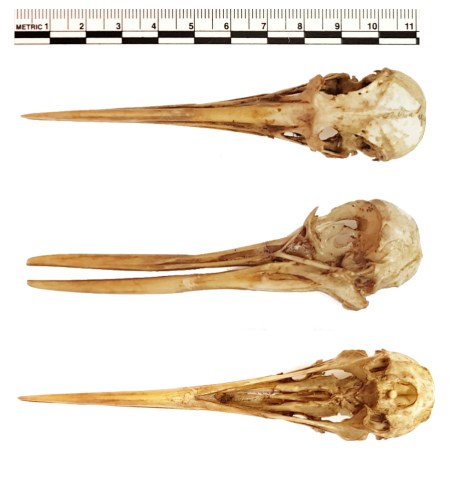
Last week I gave you this interesting skull to identify:

Specimen LDUCZ-Z1058 from the Grant Museum of Zoology

Specimen LDUCZ-Z1058 from the Grant Museum of Zoology

I didn’t mention that top of the cranium had been removed, probably as part of a postmortem, which is quite common for zoo specimens. Of course, this made the identification a bit more tricky.

That absent skullcap led to several suggestions of Tasmanian Devil, since they do have a very similar looking facial region to this specimen, with a short and blunt muzzle, robust zygomatic arch and even the same toothcount in the upper jaw. However, the Devils have an angular process of the mandible that projects medially (towards the midline) rather than backwards in a hook, so you wouldn’t see it in a side view.

mystery166

The correct answer was first tenuously suggested by palfreyman1414 in a pleasingly cryptic manner:

I’d have sworn this was a commie go-between for Cressida and Troilus

Which hints at “Red” and “Pandarus” giving us the Red Panda Ailurus fulgens F. Cuvier, 1825.

Red Panda image by Mathias Appel, 2016

Red Panda image by Mathias Appel, 2016

These charismatic critters are another example of an arboreal carnivore that is adapted to feed on a highly vegetarian diet, but unlike the previous mystery object (a Kinkajou) these cuddlesome floofballs eat mainly bamboo rather than fruit – rather like their very distant relative the Giant Panda (despite the similarity in diet and common name, the Red Panda is actually more closely related to the Kinkajou than it is the Giant Panda).

Red Pandas are a bit less highly specialised for feeding on bamboo than the Giant Pandas, probably because they have a more varied diet that also includes fruit, eggs, birds and small mammals. The poor nutritional quality of bamboo does mean that they spend a lot of time sleeping and they tend to move fairly slowly in order to conserve energy, although they can be very playful, especially in captivity where they can access higher quality foods.

Sadly, this playfulness and supreme floofyness is a bit of a problem for the wild Red Panda population. There is demand for wild caught Red Pandas in the pet trade and they are hunted for their thick fur right across their range through the foothills of the Himalayas, despite being protected by legislation in every country.

Friday mystery object #305

This Friday I’m giving you a game of heads or tails from the Collections Resource Centre of the Dead Zoo:

mystery305amystery305bmystery305cmystery305d

I don’t normally add a photo of the tail, but in this case it should make the identification a doddle – literally a 50:50 shot at getting the right species. If you know what I’m talking about, then please be cryptic in your suggestions – don’t spoil it for everyone else!

If you don’t know why this tail is so significant then you should know that the skull is 10cm long and all will be revealed next Friday!

Good luck!


Friday mystery object #304 answer

Last week I gave you this skull to have a go at identifying:

The skull of specimen LDUCZ-Z144 from the Grant Museum of Zoology
I thought that some of you would find it a bit easy, but the most diagnostic features aren’t visible in the image and it’s a nice specimen, so I went with it.
There is a bit of similarity with the skull of a ruminant, as noted by palfreyman14141, while Gerard pointed out that it’s from Africa and James M. Bryan was the first to drop a solid clue pointing to the correct species. As jennifermccaire says, it’s the very first on the list (assuming the list is alphabetical) – an Aardvark Orycteropus afer (Pallas, 1766).

An Aardvark (or as I prefer to call it, a Tippy-toes McSnuffleface) at Detroit Zoo. Image by MontageMan, 2008
Picking up on palfreyman1414’s observation about it looking like a ruminant, Allen Hazen asked an interesting question about the teeth, because the diet of these bizarre looking animals almost entirely consists of ants and termites, and most other mammals with a similar diet (like Pangolins and Tamanduas) have no teeth at all.
Making the presence of teeth even more weird is the fact that Aardvark stomachs have a muscular pyloric region that grinds up food in a similar way to a bird’s gizzard, so they really don’t need teeth for the major component of their diet. To top it off, the teeth of Aardvarks are utterly unlike any other mammal teeth – they’re made of tubules of dentine (giving the Order the name ‘Tubulidentata’), with no enamel, no pulp-cavity and no root – so they keep on growing:

The weird teeth of the Aardvark, made up of tiny dentine tubules.
All of this suggests that their dentition is distinctly non-standard, so it probably isn’t just a vestigial feature inherited from a toothed ancestor – which reinforces the importance of the question ‘why do they have teeth?’
Bear with me.
A 60-80kg mammal living in hot and water-scarce regions of Africa, will struggle to get enough moisture from ants and termites to survive, even if they are nocturnal and sleeping in burrows during the hottest part of the day. So how do Aardvarks do it?
Cucumbers, that’s how.
There is actually a species of cucumber that has a symbiotic relationship with Aardvarks, and it’s unimaginatively, but descriptively, called the Aardvark Cucumber Cucumis humifructus Stent, 1927.

Aardvark cucumber (not a golf ball). Image by B. Strohbach
These weird fruits develop deep underground and have a tough skin that keeps them viable for months. Outside they’re like a leather golfball, but inside they’re watery like the cucumbers you’d put in a Hendrick’s gin and tonic – and that’s where the Aardvarks get their moisture (the Cucumber, not the G&T).
Nothing but the Aardvark has a nose sensitive enough to detect the plant, or claws powerful enough to dig into the hard-baked earth to access the fruits (or possibly only an animal that mostly eats ants is desperate enough for some culinary excitement to go to all that effort for something that the rest of nature views as a lacklustre garnish). The Cucumber’s seeds need to pass through an Aardvark to become viable and those seeds get distributed underground with a healthy dollop of fertiliser in what is otherwise a harsh environment.
The leathery skin of the Cucumber is almost certainly the reason why Aardvarks have invested so much in teeth for a termite and ant-eating mammal. It also explains why those teeth grow constantly – and why they get so worn down.
I think that’s pretty awesome.
Now you may be wondering if I’m making all this up, but honestly, the world really is that weird (and wonderful) when you look at it closely enough!

Friday mystery object #304

This week I was worried that I didn’t have a mystery object planned, but then I stumbled across this on my phone:

mystery304


It’s probably a bit too easy for some of you, so I’d encourage using some cryptic clues and hints to say what it is in the comments box below.

I’ve had a problem with spam comments recently and have switched on a filter to ensure that people’s first posts are approved (regular posters shouldn’t be affected) – fear not, I will be keeping an eye on it and approving first timers!

Have fun!

Friday mystery object #302 answer

Last week I gave you this egg to try your hand at identifying:

mystery302

Eggs can be tricky, since they are largely similar in shape and, since egg collecting was banned many years ago, there are few modern resources for identification.

However, you can pick up clues by thinking about colour and pattern and working out what advantage it may have. So you might expect a brightly coloured egg to be laid in a well disguised and deep nest, where it’s unlikely to be spotted except by the parent, whereas a yellowy speckled egg is more likely to be camouflaged if laid in a fairly open, sandy environment.

So this egg was probably laid somewhere near the sea, which means it’s probably from a charadriiform bird (those are the shorebirds).

Now there are a lot of shorebirds, but this egg is pretty big and it lacks the strongly conical shape you’d expect from a cliff-nester like a Guillemot (the shape means it rolls in tight circle, making it less likely to be blown or knocked off a cliff). That actually narrows it down to a handful of birds that makes comparison easier. Curlew eggs, for example, are a similar size, but they tend to be more grey and have larger blotches, plus they’re a bit less elongated.

This particular egg has the shape and colour of a gull egg and large size means it’s almost certainly the egg of a Greater Black-backed Gull Larus marinus Linnaeus, 1758.

I would say more, but at the moment I’m at the natural history highlight of the year – the NatSCA conference. Here’s the Twitter feed in case you’re interested in the discussion:

Friday mystery object #301 answer

Last week I gave you this mystery tooth to have a go at identifying:

mystery301bmystery301a

There were a variety of answers, but the first few took this as a worn canine tooth, presumably due to the respectable size and robustness. However, consensus shifted to this being an incisor, meaning it would have to be from a large animal – which is spot on. Moreover, it’s a large animal that was once resident in Ireland.

After that there were a variety of ideas brought up, from all manner of beasts including Sheep, Badger (or perhaps Pine Marten since a cryptic M.m. from the Irish fauna could be either Meles meles or Martes martes), Cave Bear, Coyote, Wolf and even Human. There was one just correct identification however, by Tony Morgan who recognised it as a Hyaena incisor.

It is in fact the lower left third incisor (or i3) of Crocuta crocuta (Erxleben, 1777) – the tooth you can see in this (very gnarly) Hyaena mandible, although it’s much less worn:

Hyena mandible

Hyaenas have an incredibly thick enamel layer on their teeth which creates a distinct neck on the incisor where it stops, which is further defined by the root of the tooth bulging laterally below – presumably to help deal with the forces of prey capture and perhaps the Hyaena’s impressive bite strength.

mystery70

The robust skull of a specialist bone-crusher

You probably don’t think of Hyaenas as being native to Ireland, but until 39,000 or so years ago they ranged right across Eurasia, including those parts of Europe which were to be cut off by changing sea levels to form Ireland and Britain.

It’s strange to imagine a species normally associated with the African savanna strolling around the Emerald Isle, but it’s worth remembering that the world is a constantly changing place and wildlife moves around to cope as the environment alters. Borders and boundaries are very human concepts and other species only pay attention when you have a genuine barrier, like an ocean, a mountain range or (if you’re a Dormouse) a break in the tree canopy.

That’s one of the problems with current climate change compared to past climate variations. The speed of change is so great that some species don’t have time to move into new habitats and there are fewer suitable habitats available, because humans have cleared them for farming or building. Meanwhile, some other species can find suitable habitats and are able to move – but they will then often be considered an invasive pest. Now  the chances of Hyaenas returning to Ireland are pretty slim, but if they did I expect most people wouldn’t be too pleased, although you never know…

Kevin Richardson kisses hyena. Image by Kevin Richardson, 2007

Kevin Richardson kisses hyena. Image by Kevin Richardson, 2007