Friday mystery object #172 answer

Apologies for the late posting of the mystery object answer, I’m at  a conference in Edinburgh and I didn’t get a chance to write until now.

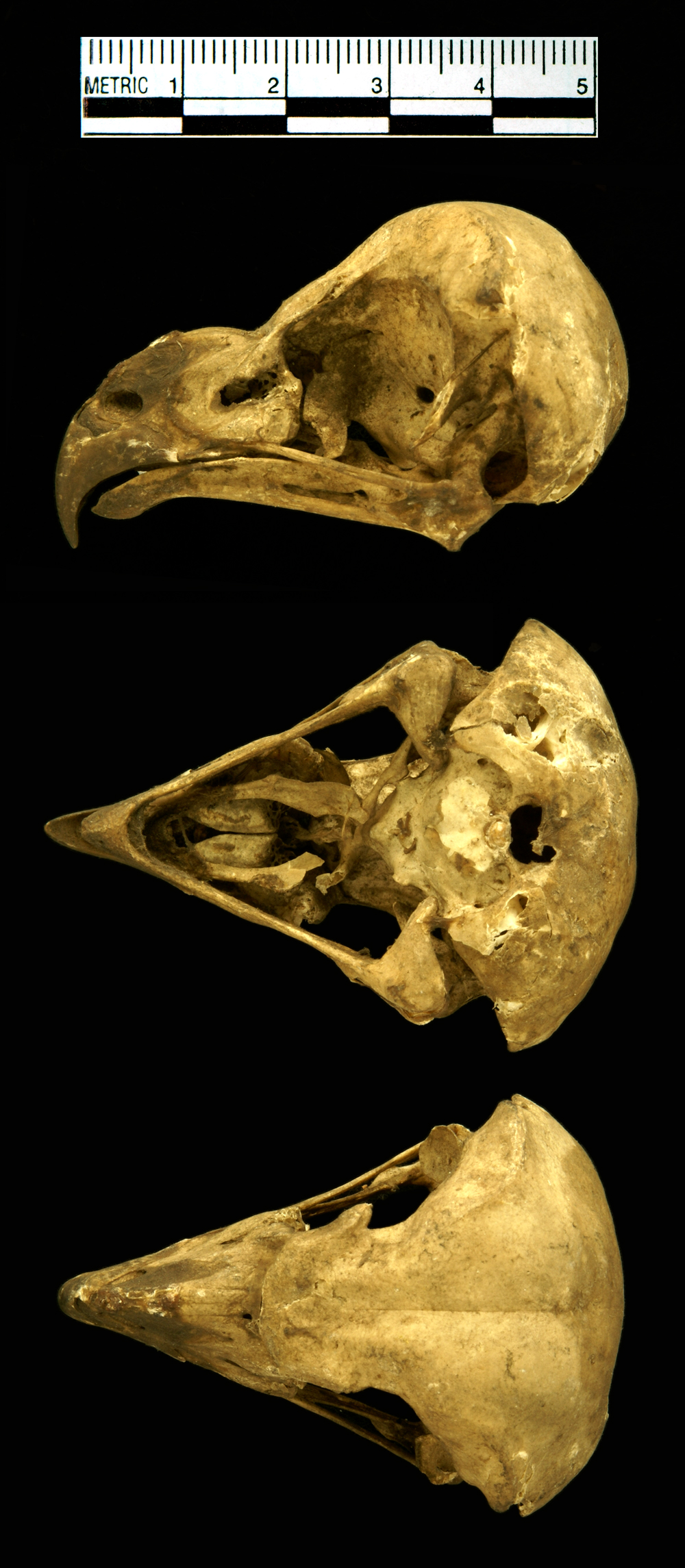
On Friday I gave you this bird skull to identify:

I thought it might be an easy one, but I was hoping to catch a few people out, which use exactly what happened.

This skull is a nice example of morphological convergence – looking a lot like a Pigeon skull, but it is actually the skull of a  Continue reading

Friday mystery object #172

This week I have another bird skull for identification from my big box of assorted bone. It’s probably a bit too easy, but hopefully it’ll still be fun:

Any idea what it is?

As usual, you can put your comments, questions and suggestions below and I’ll do my best to respond. Good luck!

Friday mystery object #171 answer

On Friday I gave you this fragment of bill to identify:

It’s quite distinctive in shape, so I shouldn’t have been surprised when so many of you came to the same conclusion as I did about what it was from. As it is, everyone recognised this as being part of the bill from a member of the Phalacrocoracidae (Cormorant family). Well done everybody!

There are around 40 species of Cormorant, so getting this to species is a bit more tricky and a few possibilities were mooted. However, the two which best fit the shape and size of this bill are the Little Black Cormorant Phalacrocorax sulcirostris and the European Shag Phalacrocorax aristotelis. A quick comparison of the two on the excellent SkullSite.com (P. sulcirostris and P. aristotelis) show that the bill proportions and shape of the bony palate in the mystery specimen are closest to the  Continue reading

Friday mystery object #171

Apologies for the slightly late mystery object this week – blame Dara O’Briain, who I went to see in Hammersmith last night.

This week I have another specimen that came from the mixed box of bits for you to identify. Any idea what this beak is from?

As usual you can put your comments, questions and suggestions below and I’ll do my best to respond. Good luck!


Friday mystery object #170 answer

On Friday I gave you this pair of bones to identify:

It didn’t take long for the type of bone to be identified, with Anthony Wilkes immediately spotting that these are the quadrates of a bird. Then things got more tricky as the type of bird became the focus of the identification.

Robin was the first to recognise the family and likely type of bird, with henstridgesj concurring, with the agreement being on these quadrates being from a  Continue reading

Friday mystery object #170

This week I’ve got two bits of bone (photographed to show the shape from each side) that I identified at work last week – can you work out what these are and what animal they’re from?

As usual you can put your suggestions, comments and questions below and I’ll do my best to respond. Good luck!

Friday mystery object #169 answer

On Friday I gave you this specimen to identify:

It was one of those specimens that if you’d seen one before it was easy, if not it’s quite hard to work out.

In gross shape the skull has some similarities to that of a reptile, perhaps something like a Monitor lizard (albeit a little narrower). However, it actually belongs to a fish.

Cam Weir recognised this and managed to identify the kind of fish to genus and then species level, along with henstridgesj, 23thorns, Barbara Powell and Robin. Leigh and Ethan were also in the right ball-park with their identifications. This is the skull of the  Continue reading

Friday mystery object #168 answer

On Friday I gave you this specimen to identify:

As I suspected, the distinctive shape of the skull makes this specimen easily recognisable as an owl (family Strigiformes). However, there are a couple of hundred species of owl, so there were plenty of possibilities to make a more specific identification.

This specimen has quite a distinctive slope to the forehead in profile view and a very clear groove down the midline of the cranium, which combined with the length of around 58mm narrowed down the likely suspects considerably.

Jake was the first to suggest the species I think it’s most likely to be, with palaeosam suggesting the other possible option and RH cautiously suggesting both. This skull belongs to an owl in the genus  Continue reading

Friday mystery object #168

This week I’ve been doing identifications from boxes of old specimens that haven’t been looked at for some time. Here’s one of the specimens that came out:

It should be a fairly straightforward one to identify to family level, but can you work out what species it is? Cryptic answers appreciated, to keep the game fun for everyone. Good luck!


Friday mystery object #167 answer

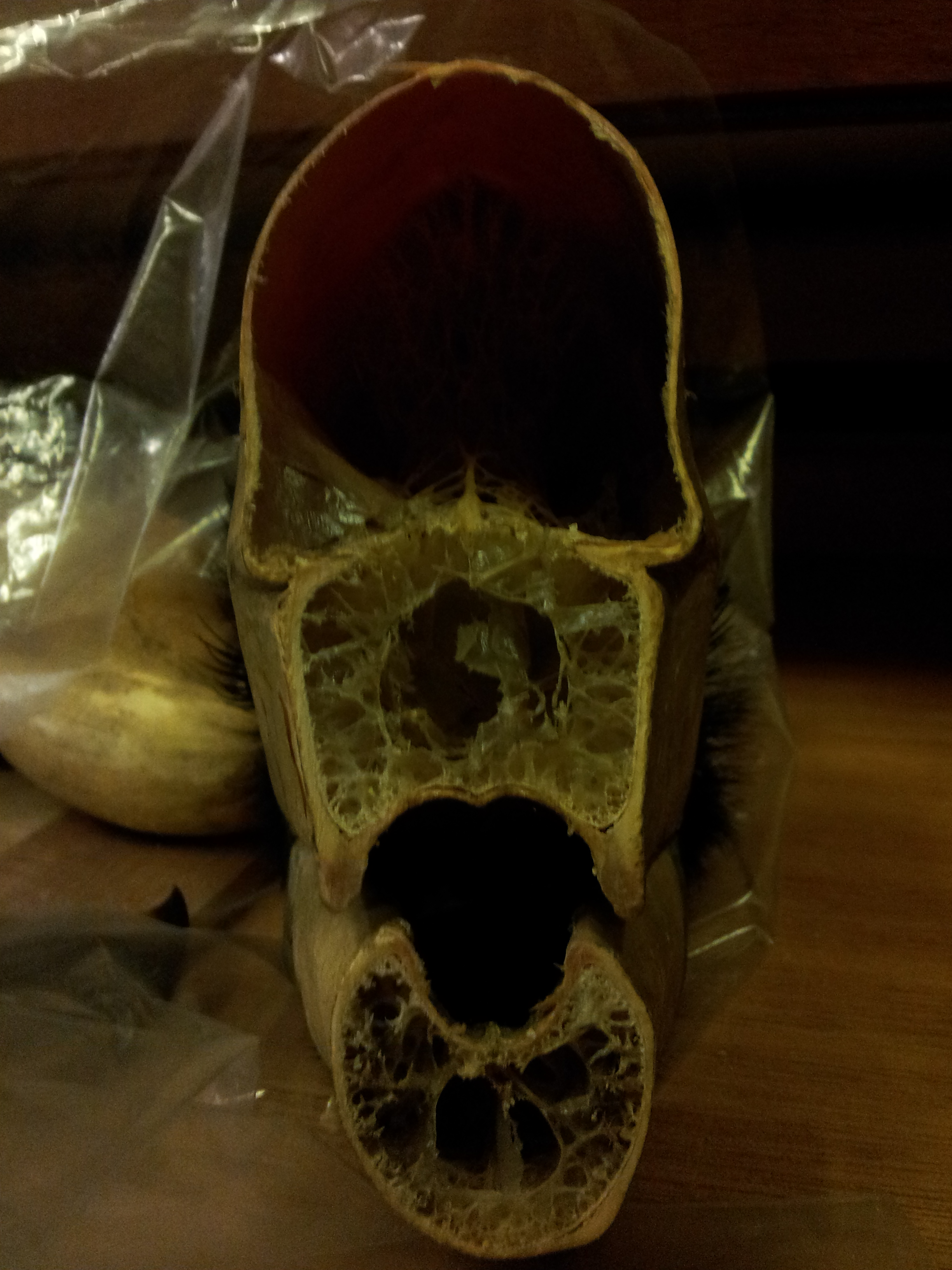
On Friday I gave you this object to identify:

It was a bit of a tricky one at first, because there wasn’t much context to help identify it. Suggestions included a section through the skull of a horse or whale, but skullguy, henstridgesj and Jake managed to spot enough clues to work out that it’s a section through the bill of a  Continue reading

Friday mystery object #166 answer

On Friday I gave you this great skull from the Grant Museum of Zoology to identify:

A big list of you (Mieke RothJakemcarnall, Anthony wilkes, 23thorns, Cam Weir, henstridgesj, Rhea, leigh and Robin) managed to work out what this specimen was from and there were some really interesting explanations about how you came to your conclusions in response to Steven D. Garber’s comment:

Now, I’d like it even more if people explained why this skull looks the way it does.

This is a really interesting thing to consider, as it underlies the process of recognition and identification. As a biologist I might start by saying that the lacrimal foramina is on the edge of the orbit (as henstridgesj pointed out) which is indicative of a marsupial and that the dentition is indicative of a carnivorous mammal that isn’t a member of the placental Carnivora as it lacks carnassials, plus the dental formula appears to be ‘primitive’ from the photo ?.1.3.4/?.1.2.4 which narrows down the possibilities to just a few marsupial carnivores, and given the scale of the skull there is just one that fits the bill.

However, if I’m honest I’d say that the overall shape and robust structure of this specimen is very similar to specimens I’ve seen before belonging to the  Continue reading

Friday mystery object #166

I’ve not been working in the collections much over the summer, which means I’ve been relying on a stockpile of photos for the mystery object. I’ve finally run out of specimens from the Horniman this week, so I have a mystery object that I photographed at the fantastic Grant Museum of Zoology for you to have a go at identifying (apologies for the indifferent quality of the photo):

You can put your suggestions, questions and observations below (preferably in a cryptic format) and I’ll do my best to respond.

I’ll be back in the collections from next week, so there will be some fresh Horniman specimens coming to light!

Friday mystery object #165 answer

On Friday I gave you this object from the Horniman collections to identify:

It’s fairly obvious that it’s a claw, but the question is what is it a claw from?

This claw was originally identified as being from a big cat of some kind, but it isn’t the right shape. A big cat claw has a thicker body with an acute sharp point – as with this Tiger claw:

Although different from the Tiger claw, the mystery claw has several similarities – mostly the fact that it’s laterally flattened. This suggests it’s from a mammal since birds have more rounded talons, as mentioned by henstridgesj. The mystery claw has a strong and long curve, that looks like an adaptation for climbing. The large size narrows it down to just a few possibilities and the little bump in the middle of the inside edge is quite distinctive.

There is a handy picture with a variety of claws that Carlos G found, which proved to be useful:

Robin and Carlos G managed to get it down to the right family and palaeosam and henstridgesj identified it to species. It’s the claw of an  Continue reading

Friday mystery object #165

This week I have an object for you to identify that I recently re-identified from the Horniman’s collections. Any idea what this is:

I’m at a conference today, so I may not be able to respond to questions and comments, but please feel free to ask them anyway and I’ll do my best to reply. Good luck!

Friday mystery object #164 answer

On Friday I gave you this object to identify:

It was a bit of a tricky one, since a few vertebrae aren’t a huge amount to go on. However, the large size helps narrow it down, as do the distinctively long neural spines.

As Ric Morris and henstridgesj spotted, the vertebrae are very compressed, not providing much scope for movement, suggesting an animal that relies on a rigid backbone for support and transferring large forces. This is not something you see in whales (at least not after the cervical and first few thoracic vertebrae), since water supports their weight and they maintain some flexibility in their spine for changing their orientation in the water when swimming. That leaves us with very few terrestrial mammals big enough to have vertebrae of this size – particularly considering that these vertebrae are from a juvenile animal.

The neural spines are long, but not laterally flattened. This suggests that they are not from a large Buffalo, Hippopotamus or Rhinoceros, since all of these animals have their neural spines orientated as a dorsal blade. The only animal of the right size that has dorso-ventrally flattened neural spines in the mid-thoracic region (that I’m aware of) is the  Continue reading

Friday mystery object #163 answer

On Friday I gave you this object from the collections of the Horniman Museum to identify:

The specimen had lost its label at some point in the past, so I had to identify it myself and was hoping to get your opinion on what it might be.

When I first saw it I noticed an odd scar running diagonally across the top of the cranium, which made me wonder if it was some kind of marine bird with an odd salt glad. Then I realised that the scar indicated something else entirely, which gave me the clue I needed to make the identification.

It seems that most of you also noticed the scar and came to similar conclusions, so  23thorns, cackhandedkate, Ric Morris, Jake and Steven D. Garber all recognised it as a woodpecker of some sort and given the length of the skull rachel and henstridgesj arrived at the same conclusion about species as I did, which is the  Continue reading

WHY I AM NO LONGER A SKEPTIC

No, not me – this is my brief response to a post by Stephen Bond.

There are some valid points in his article for the sceptical skeptic, but as is often the case with polemic writing there is a lot of cherry-picking, generalisation and reliance on ecological fallacy.

He makes the point that most Muslim women don’t wear burkhas, but he then misses the point that any community is shaped by all of its members, not just a handful of highly visible (or visibly invisible) individuals. This applies to skeptics as well – the famous, loud and/or obnoxious are more visible, but they do not represent the whole.

I did toy with the idea of dissociating myself with skepticism a year or so ago, for several of the reasons stated by Stephen. Fortunately I discussed this with my friend and colleague James and we decided to do something a bit more positive, which led to us setting up PubSci and later Hackney Skeptics with Alice. These events are more focussed on science and socialising than bashing people we don’t agree with.

I think it’s a shame that Stephen has embraced the typical polemic style adopted by skeptics for his piece, as I think that style is one of the most damaging tools used in modern skepticism. It lacks nuance and is fundamentally unhelpful when trying to encourage consideration of a different perspective and it can alienate those with more moderate views.

In my opinion, polemic needs to be dropped if skepticism is to avoid becoming an echo chamber populated by a smug and mouthy minority.