This week I have another genuine mystery object for you to have a go at identifying. I found a pair of legs in the collection and although I can think of a few things that they don’t come from, I’m a bit stumped as to what they did come from. Here’s one to give you an idea of what they look like:
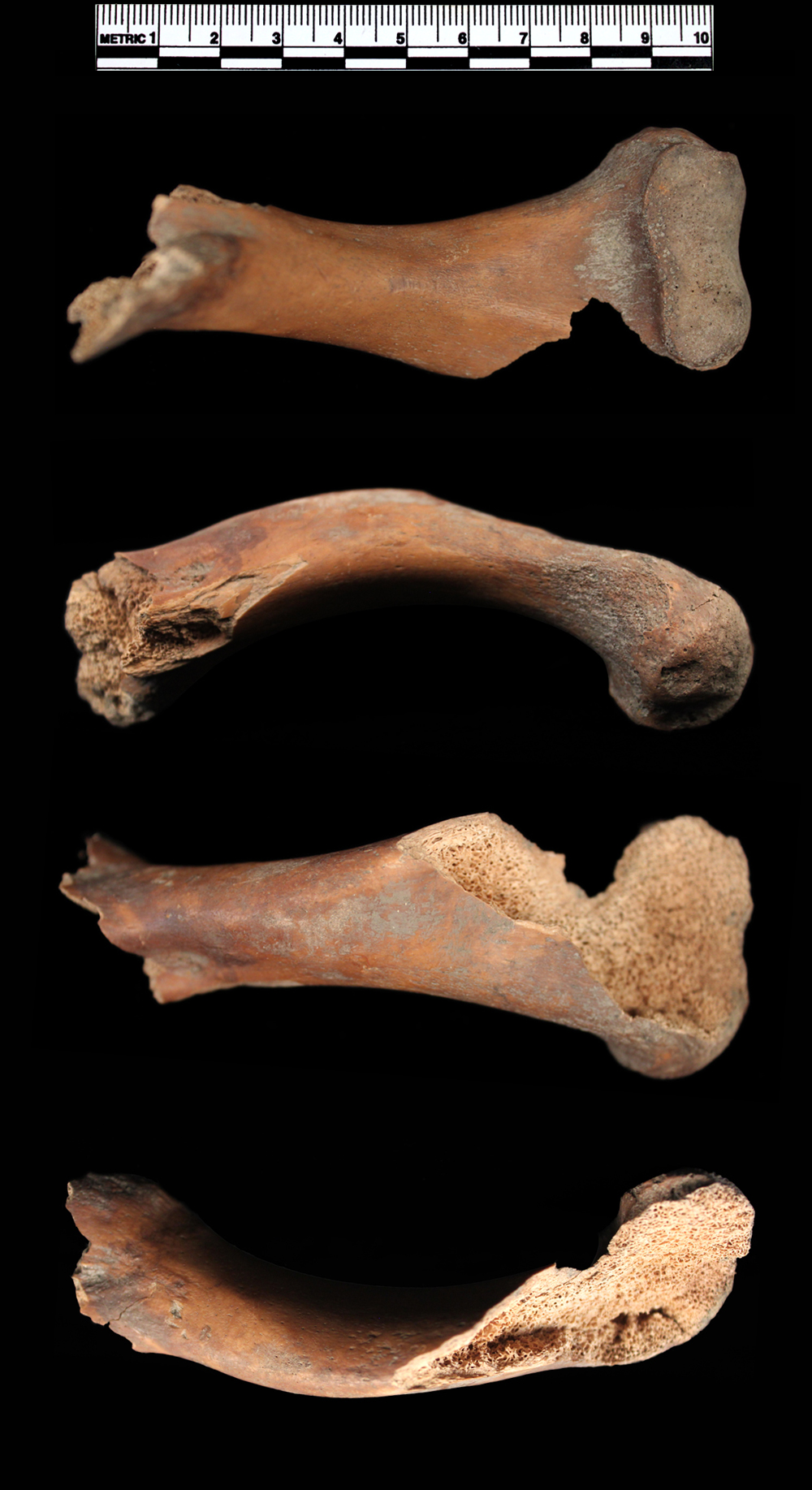
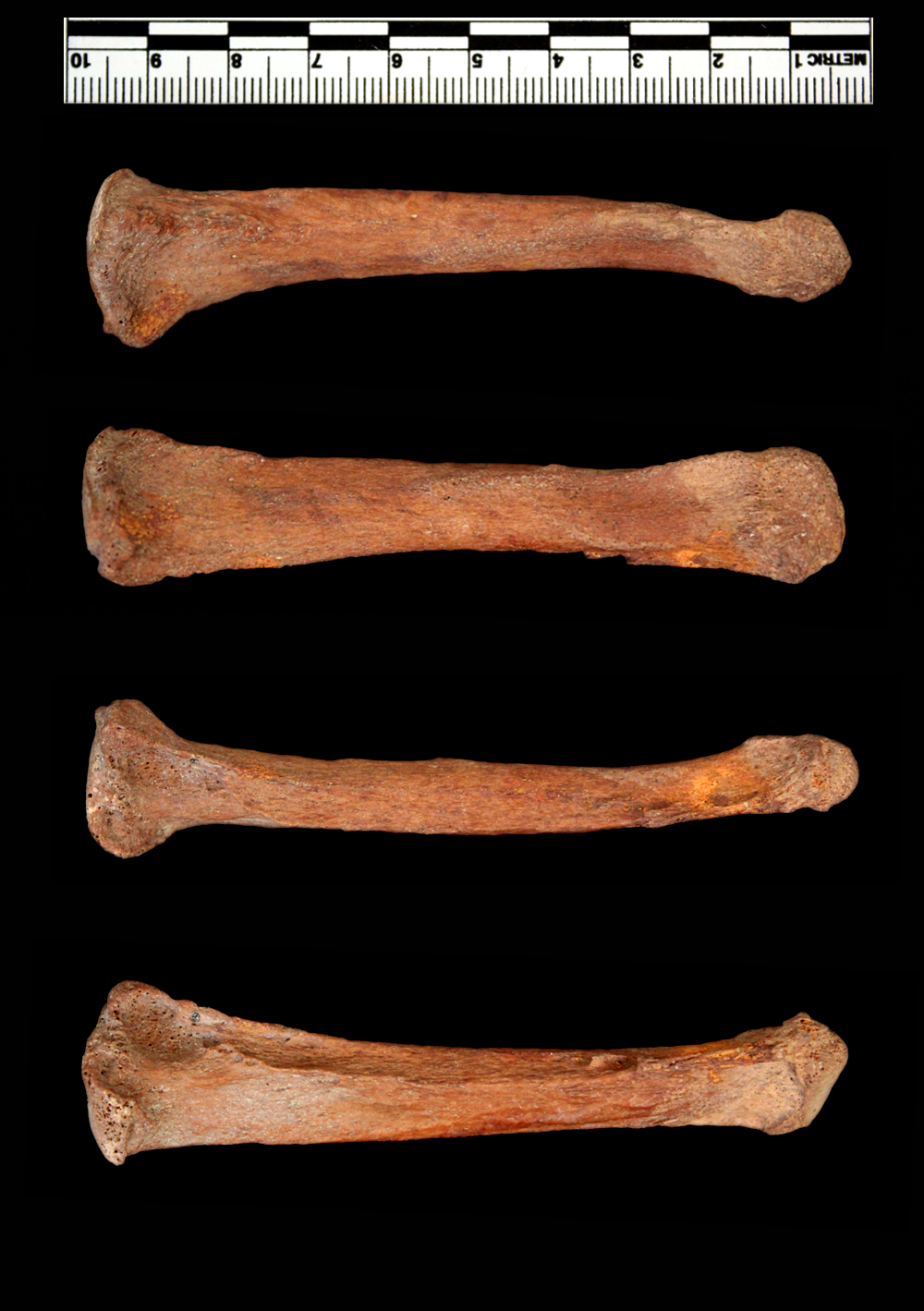
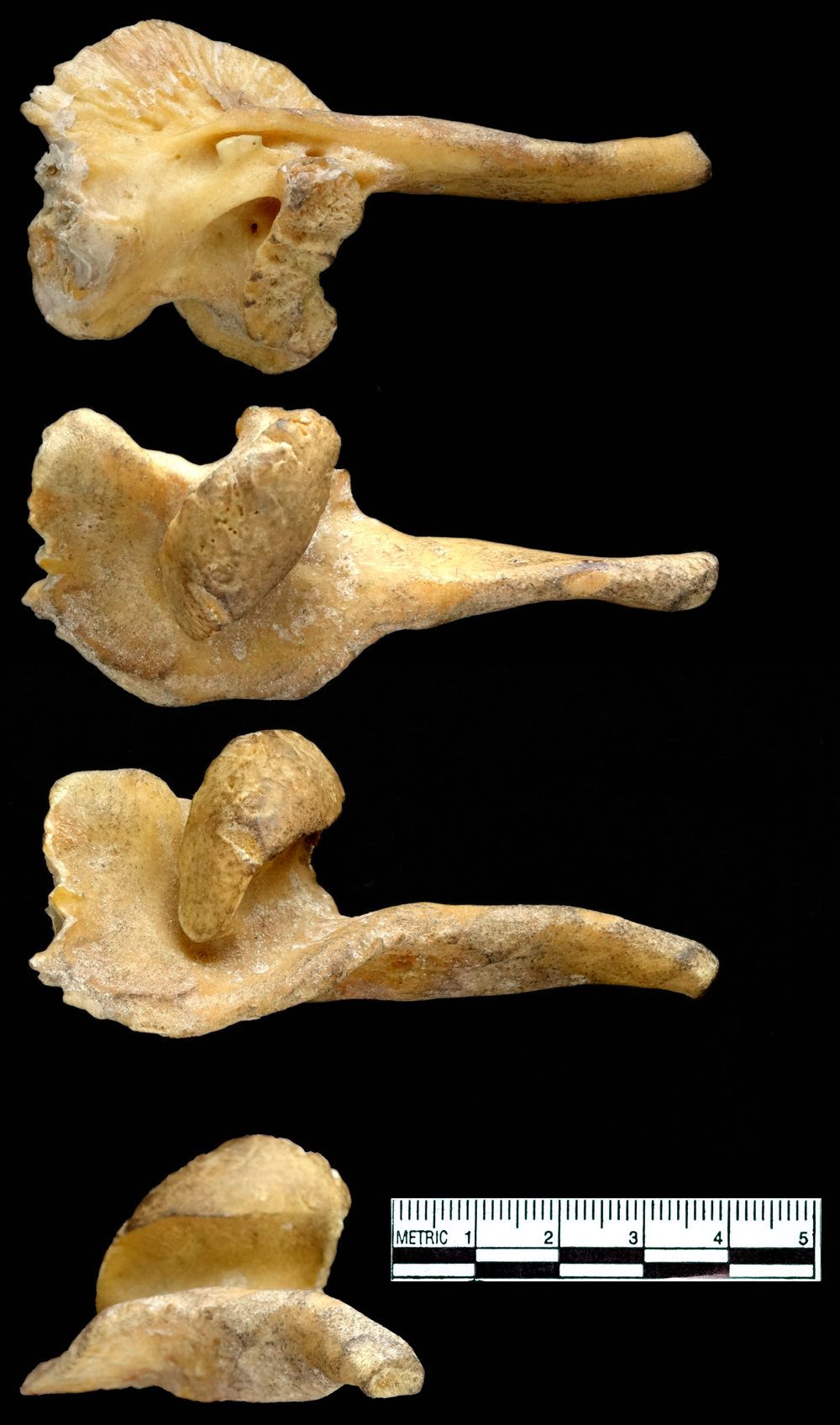
On Friday I gave you these objects to identify from Cyler Conrad, who came across them from an archaeological dig in San Francisco Bay:
I hasten to add that there is no certain answer to what these objects are, but I think there were some useful observations made by contributors and I will share my thoughts. Please feel free to continue the discussion in the comments below.
Barbara Powell and henstridgesj made some great suggestions, mainly focusing on marine mammals, particularly among the Otarids (Sea-lions and Fur-seals). Some of these large mammals certainly occur in the San Francisco Bay area (well, the Northern Fur Seal Callorhinus ursinus, Guadalupe Fur Seal Arctocephalus townsendi, Steller Sea-lion Eumetopias jubatus, California Sea-lion Zalophus californianus are all there) and they have femurs that are broadly the right size and shape as the bone in the top image – the humerus in these species is quite different, possessing a distinctive crest on the shaft.
However, I’m a bit thrown by the articular surface visible in the top image. In the Sea-lions and Fur-seals the femur has two distinct and narrow articulations with the tibia and fibula, since these animals bear weight on their hind flippers. The fact that the top specimen only shows one broad and fairly poorly defined articulation makes me think it may belong to a Phocid seal (which drag their hind flippers), which for this area would either mean a Northern Elephant Seal Mirounga angustirostris or Harbour Seal Phoca vitulina.
Given the size, I would think it would either be the femur from a large male Harbour Seal (although males are only slightly bigger than females) or a smaller female Elephant Seal, but unfortunately I can’t find comparative material to help draw a conclusion. What I have noticed is that the Harbour Seal does tend to have a relatively broader femur than we see here, but without an Elephant Seal femur for comparison I’m stumped.
The other bone looks like the first metacarpal of one of these animals and doesn’t really add much more information.
Alas, sometimes identifications are hard to make with confidence.
This week I have a bit of break from the norm. Rather than giving you a specimen from the Horniman to identify, I have a couple of guest mystery objects from Cyler Conrad for you to attempt.
These two bones were uncovered in an archaeological site in San Francisco, California, USA and they are proving hard to identify. Any idea what they might be from?
As always, you can put your comments and suggestions below, but please also feel free to engage in discussion about these objects – let’s see what emerges!
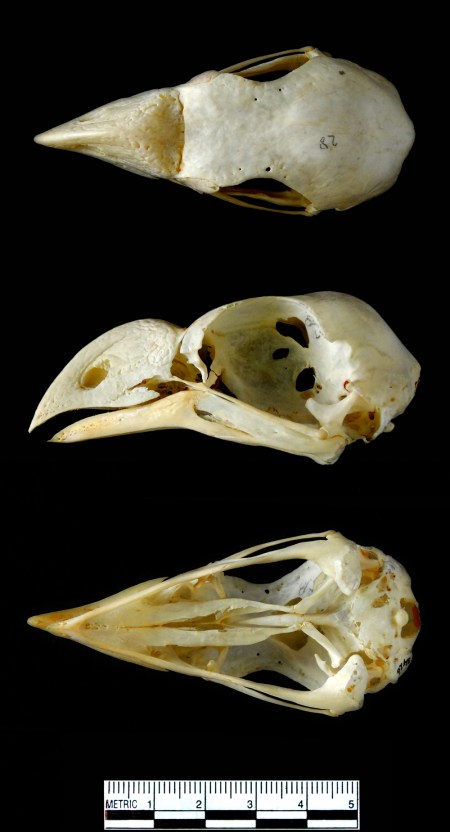
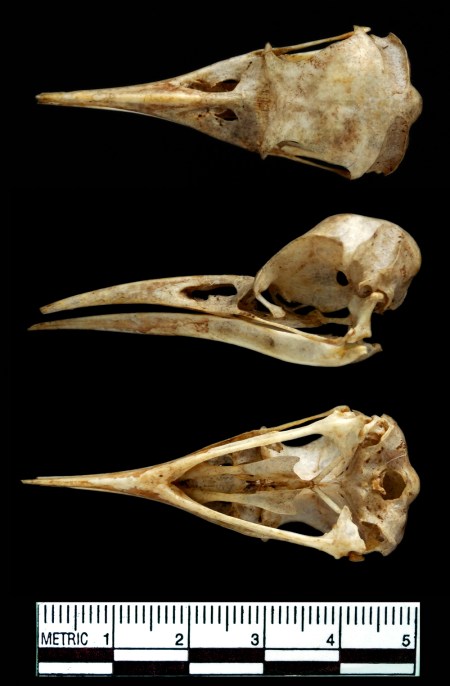
I thought it might prove a bit of a challenge, since it belongs to a bird that isn’t found in Europe or North America. However, the skull shape and size is quite unique and I was forgetting the impressive skills of the Zygoma readers, so it didn’t take too long for Barbara Powell, Wouter van Gestel (who I believe may be involved in SkullSite.com – one of my favourite web resources) and henstridgesj to narrow it down to the correct species.
The WordPress.com stats helper monkeys prepared a 2012 annual report for this blog.
Here’s an excerpt:
19,000 people fit into the new Barclays Center to see Jay-Z perform. This blog was viewed about 66,000 times in 2012. If it were a concert at the Barclays Center, it would take about 3 sold-out performances for that many people to see it.
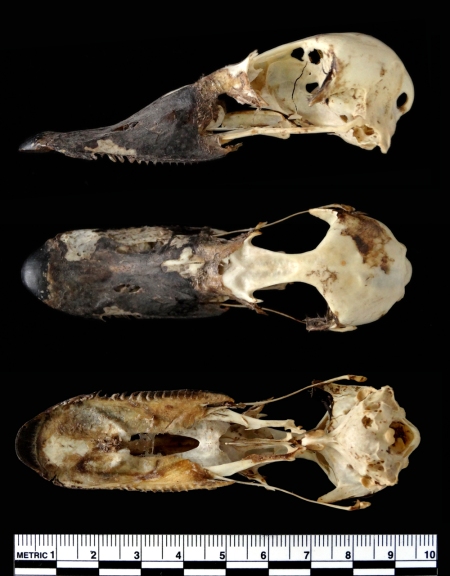
It was pretty clear that it’s from a modern animal with a duck-like bill, so either a Platypus or a member of the Anatidae (the family containing ducks, geese and swans).
There are about 140 species within the Anatidae, so narrowing it down to species was the challenge. For me the main features that help identify this duck from all the other species were the concave profile and the width to length relationship of the bill, the shape of the lacrimal bones (the bits in front of the eyes) – with the supraorbital processes bordering the salt glands, and the shape of the palate – with its mid-point deflection and flare.
It seems that some of you spotted some of these features too, since henstridgesj, miekeroth and Barbara Powell came to very similar conclusions. This skull looks like it belonged to a Common Scoter Melanitta nigra (Linnaeus, 1758) and a female Common Scoter at that, since the males have a much more inflated bill than this specimen.
Female Common Scoter photographed by Hilary Chambers
Common Scoters are sea ducks that dive for small crustaceans, molluscs and sometimes fish. They are migratory birds and although there only a few hundred breeding the UK, there are larger flocks of visiting birds over the winter, although they’re hard to spot since they are usually a fair distance out to sea for much of the time.
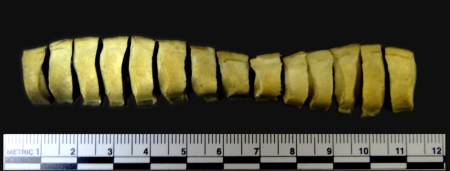
On Friday I gave you this really tricky mystery object to identify:
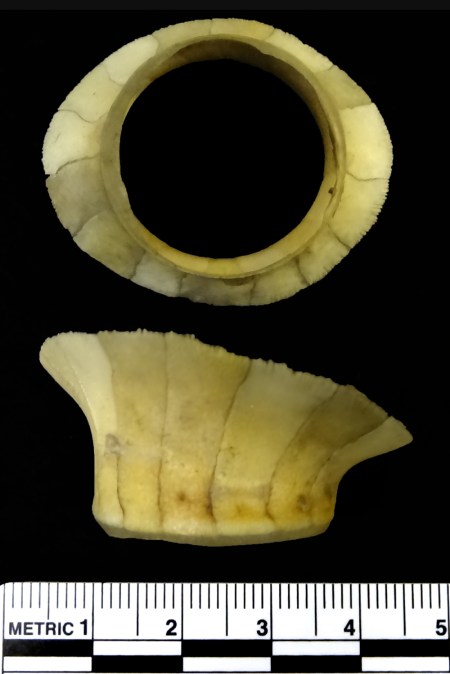
Despite it being one of the hardest so far, Barbara Powell managed to not only work out what piece of morphology this specimen represents, but the species it came from. Remarkable skills Barbara!
These plates of bone fit together to make a ring like this:
You probably have a better chance of identifying the structure when it’s assembled like this and the tubular shape is characteristic of a particular order of birds. This is the sclerotic ring of an Continue reading →
On Friday I gave you this piece of a skeleton to identify, to help me track down the specimen it came from:
It looks like a wing, but it’s quite oddly shaped. The humerus is strongly curved and the humeral head is small with a very limited area for muscle attachment. This suggests that it wasn’t much use for flying – it also wouldn’t have been much use for swimming underwater or any other kind of locomotion for that matter. This narrows down the possibilities quite a bit.
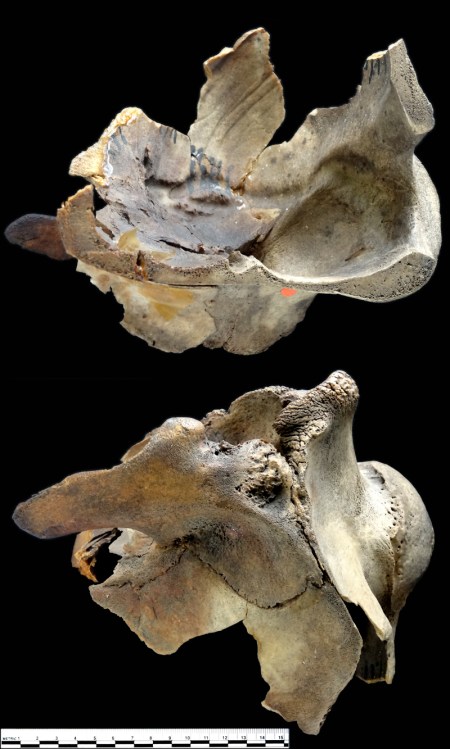
On Friday I gave you this scrappy bit of bone to identify:
It came into the Horniman collections from King’s College in the 1980s and it was tentatively identified as a piece of ungulate bone. I’m pleased to say that you managed to do a better job of identifying the specimen than was done originally! In particular Jake managed to narrow it down to being part of the braincase of a cetacean, possibly a species of dolphin or porpoise, with henstridgesj and RH also thinking along the same lines.
When I first saw this piece of bone I also thought it belonged to one of the smaller toothed whales and so moved it from its place among the ungulates to a place in the collection with other cetaceans. This proved to be a fruitful move, since I was checking through the various bit of whale at work the other day and suddenly realised that there was a broken piece of whale rostrum also from the King’s College collection. When I put them together, this is what I got:
A perfect fit! This meant that the identification of toothed whale was confirmed and even better the specimen could be identified as being from a Continue reading →
On Friday I gave you this anthropological mystery object to identify:
I asked you what the teeth might have belonged to and where in the world might this necklace be from.
It’s always a bit tricky to identify worked material as it will often be different from what you’d see or expect in the wild state and you lose the context of the rest of the specimen. Nonetheless, these teeth are quite distinctive to a particular group of animals.
Barbara Powell, 23thorns and Robin got the right general area with suggestions of Islands in the South Pacific, in particular New Guinea. 23thorns also nailed the animal group with his suggestion of Continue reading →
This Friday I have a bit of a change for you – an anthropological mystery object made from animal bits. This specimen was being looked at as part of a review project that we have going on at the Horniman Museum. Any idea what these teeth might belong to and where in the world this necklace might come from?
As usual you can put your suggestions, observations and questions below and I’ll do my best to respond. Good luck!
On Friday I gave you a bit of a tricky mystery object to identify:
I thought it might prove a tricky one and judging by many of the responses I wasn’t wrong. However, I was impressed by the speed with which the archaeologists managed to work it out – in particular Lena, Pocki and Robin.









 Zygoma