Friday mystery object #275 answer

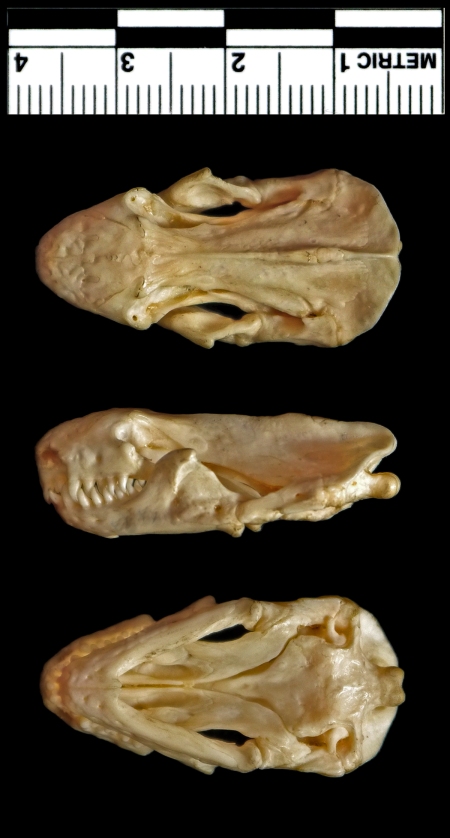
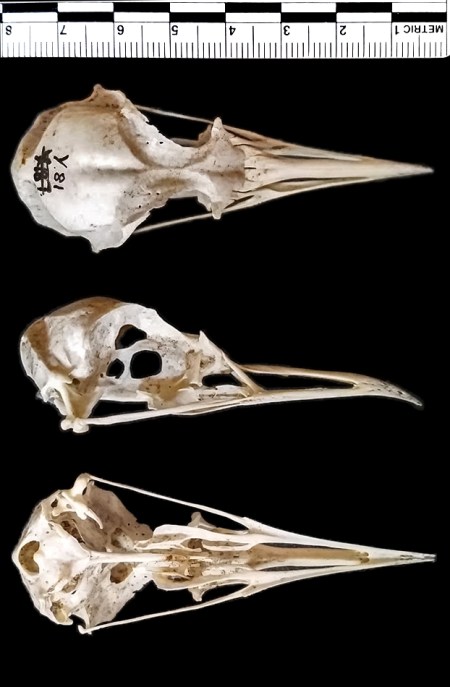
Last week I gave you this bird skull to have a go at identifying:
mystery275

I must admit that I was a little mean, because although this didn’t have an identification, it did come with a little more information than I gave you – mainly that it was found on the Welsh coast and it had a black head.

This information probably doesn’t actually help as much as you might think, although it does help narrow the likely possibilities to birds from a particular geographical area and likely habitat type. Plus those with a black head of course.

Also, I realise now that there has been some perspective distortion between the scale bar and the skull, making it look shorter than it really is – when measured it was 83mm long. But it turns out that you didn’t really need the information anyway, as the clues from the skull were enough, even with a slightly dodgy scale.

A clue by joe vans alluded to the salt gland scars above the orbits, which indicate that is a marine bird. Flick Baker also hinted at a bird of the sea – a Common Gull, which fits the bill (if you’ll excuse the pun), but this skull seems a bit on the short side if you compare with the specimen on skullsite.com.
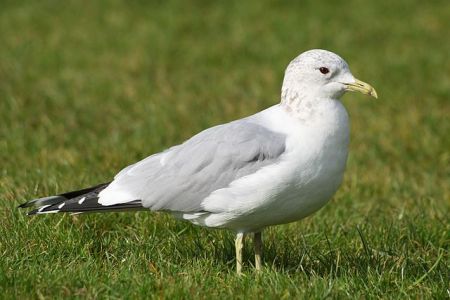
Common Gull (Larus canus) in winter plumage, by NotFromUtrecht, 2010

Common Gull (Larus canus) in winter plumage, by NotFromUtrecht, 2010

A bit closer in size was the suggestion by palfreyman1414 of Black-headed Gull, which would also fit with the note about the specimen’s head.
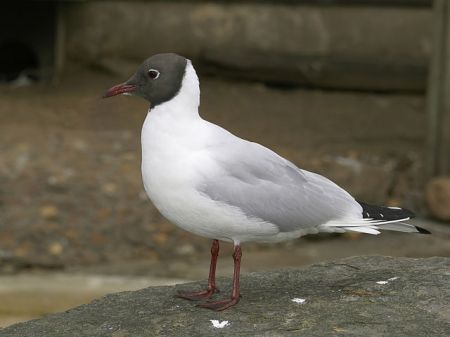
Black-headed gull at but not in the Antwerp Zoo, Belgium by Hans Hillewaert, 2008

Black-headed gull at but not in the Antwerp Zoo, Belgium by Hans Hillewaert, 2008

Daniel Calleri also suggested something closer in size and with a black head, but it was the Mediterranean Gull. You might think this is less likely given the additional information about it coming from Wales, but they now range over much of Europe and the British Isles.
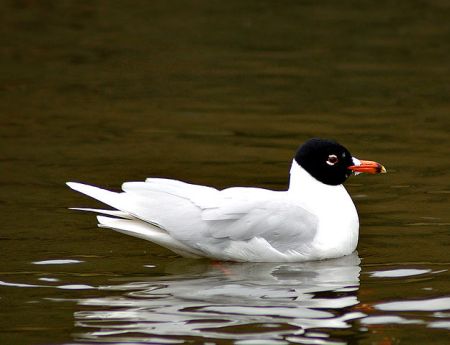
Mediterranean Gull in Sweden, by Martin Olsson, 2007

Mediterranean Gull in Sweden, by Martin Olsson, 2007

However, both of these are generally a little smaller than this specimen. Richard Lawrence wrapped up nicely with the following:

Size is everything with salt glands like that… too big to be the smallest, to small to be the commonest, too bulky to be the one with the darkest head… I’m plumping for the one with three fingers…

…which is an allusion to Rissa tridactyla (Linnaeus, 1758) – the Kittiwake.

Kittiwake in Vardø, Norway by Yathin S Krishnappa, 2012

Adult Kittiwake in Vardø, Norway by Yathin S Krishnappa, 2012

Now, the Kittiwake skull on skullsite.com is a little longer and as you can see there is no black head on the adult bird. However, I agree with Richard and think that this may be a young individual, which would explain the slightly smaller size and the presence of a black(ish) head.

So thanks for all your suggestions – they’ve been really helpful in sorting through the options! More mysteries next week…

Friday mystery object #275

This week I have a genuine mystery skull for you to identify from the Grant Museum of Zoology:

mystery275

I think I know what it is, but I’d be keen to see if you agree with me.Probably a bit on the easy side, so please keep your answers cryptic to avoid spoiling the fun for others!

Oh and apologies for the substandard photos – I used my phone with a tripod, which sort of worked, but it’s not ideal. Hope it’s good enough for you to make an identification!

Dinosaur Eggshibition!

It’s been a while since I last wrote much on my blog, apart from the regular Friday mystery object. Mainly that’s because I’ve been busy getting to grips with a new collection at the Grant Museum of Zoology, where I am now the Curator. Just before I left my previous job at the Horniman Museum & Gardens I curated an exhibition that has a nice Eastery link (which will become apparent), that I thought might be worth writing about.

The exhibition is a touring show developed under the title Hatching The Past, which was brought to my attention by palaeontologist, science blogger and old friend Dr Dave Hone who’s a lecturer at Queen Mary University of London. I went to the Città della Scienza in Naples with some colleagues from the Horniman to take a look (which is an interesting story in its own right, since the main part of the museum had been burned down by the Mafia in 2013).

Despite the suboptimal exhibition space in Naples (thanks to the fact that the building it was meant to be displayed in was a pile of charcoal), the quality of the science, the objects in the exhibition and the vibrant and exciting artwork by the awesome palaeoartist Luis Rey made it well worth considering for the Horniman, which tries to get in a blockbuster temporary exhibition every year.

This exhibition focuses on the eggs, offspring and parental care of dinosaurs. A family focus is right up the Horniman’s street, and that’s what led to the change in the exhibition title, to bring more focus on that family element, without losing sight of the DINOSAURS!

Tarbosaurus

Star of the exhibition

Of course, making an exhibition intellectually fit into a museum takes more than just changing the name, so the temporary exhibitions at the Horniman include objects from the permanent collection, with links to activities and other content. So while working out my notice from the Horniman I was feverishly selecting objects and writing text to help build that link before I left.

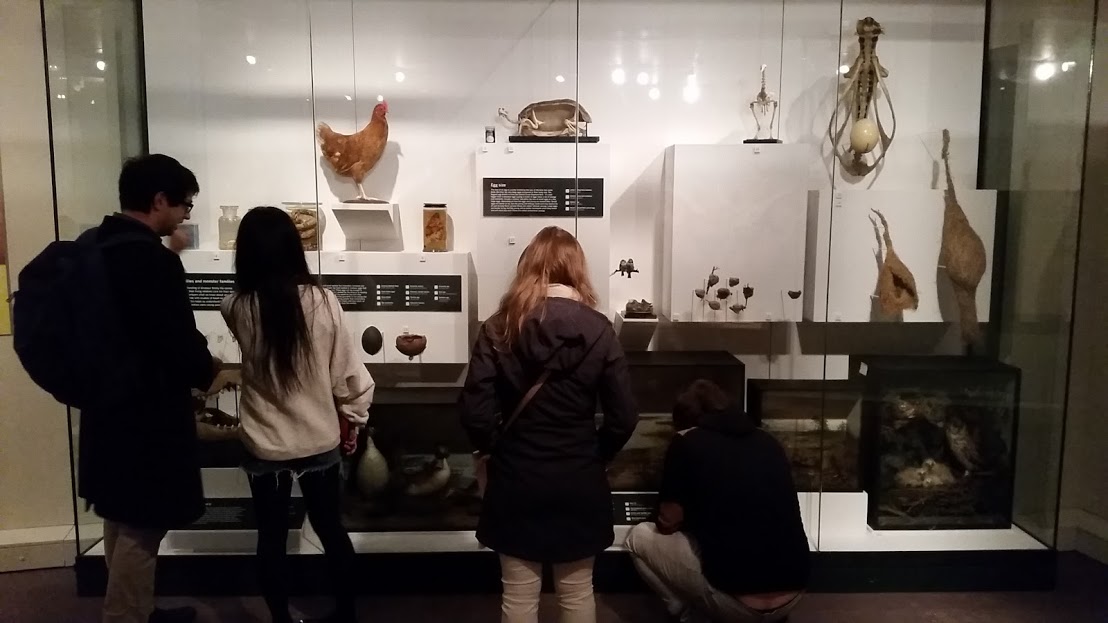
Horniman_case

It has to be said that seeing members of the public engaging with your work is incredibly satisfying, so when the exhibition opened in February I was delighted to see people reading my text and really getting interested in the objects I’d picked to tell the story of parental care in living animal groups.

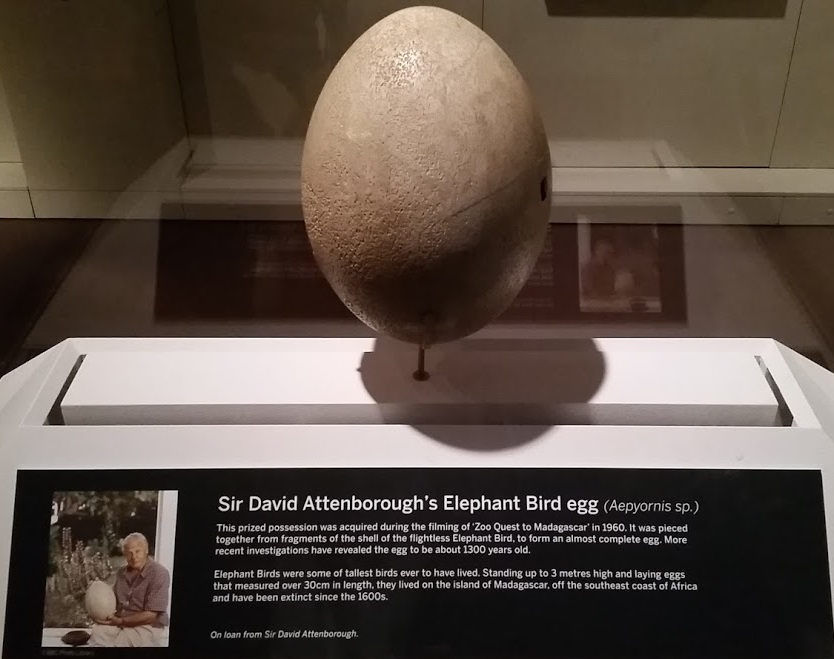
Aepyornis_egg

I was also keen to take the opportunity to help the Horniman build closer links with one of their patrons (and a living legend for pretty much every naturalist out there), Sir David Attenborough, who kindly agreed to loan the Elephant Bird egg he found when filming Zoo Quest in Madagascar. This for me is the ultimate version of an egg hunt.

Have a great Easter weekend – I hope you get all the eggs you could ask for!

Friday mystery object #274 answer

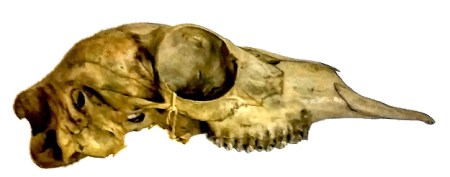
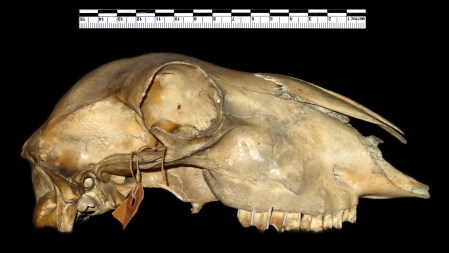
Last week I gave you this ungulate skull to try your hand at identifying:

mystery274

It isn’t made any easier by the fact that it’s a female, so it lacks the horns or antlers that make identification easier. As with many ungulates it looks a bit sheepy (as I’ve mention before), but it has some clear indicators that helped you rule out what it’s not.

Jake spotted that the size was about right for a Roe Deer, but the auditory bullae (the bulbs on the underside of the skull that house the ear bones) are too massive and the proportions of the braincase are quite different.

Joe vans also ruled out deer, since it lacks lacrimal pits (large openings in front of the eyes that hold scent glands in cervids). Joe also noticed that the mandible is extremely pinched in just behind the incisors.

The incisors themselves caught the attention of Allen Hazen, who noted the extreme size of the first incisor, which he correctly recognised as being a bit of a giveaway to some people, although only when considered in the context of a variety of other features.

While Daniel Calleri summarised these odd features and added the observation of the decent sized occiptial condyl (the place where the atlas vertebra attaches to the skull) and small paracondylar processes (the bony extensions either side of the occipital condyl and just behind the auditory bullae).

These sorts of observations are exactly what are needed to differentiate between species that are very similar in overall morphology. However, without either an excellent reference collection, or even better, a well researched key, it’s almost impossible.

Fortunately, there is a skull key for a subset of Antelope that occur in Tanzania, created by the Field Museum and the mystery object this week happens to be from a genus present in Tanzania. I’d recommend having a go at using the key, but if you’d rather just find out the answer I’ve provided a link to what it is here. Have fun with the key and enjoy your Easter!

Friday mystery object #274

Last week I talked about ungulates in collections being incorrectly identified as sheep. This week I have a specimen for you that is also not a sheep, although it does look a bit sheepish. Can you work out what it is?

mystery274

You can leave your thoughts in the comments section below – I’m not sure they need to be cryptic, but it certainly adds to the fun!

Friday mystery object #273 answer

Last week I gave you this mystery object to get your input on:

mystery273

It was labelled Ovis aries, which didn’t ring quite true for me, so I thought it would be good to see if you also had other ideas, since I’ve noticed that there is a tendency for ungulates of a certain size in museum collections to be assumed to be Sheep.

In other museums I’ve found female Red Deer, Gerenuk and on one occasion even a Badger skull that had been labelled “Sheep”.

mystery273-gerenuk

Labelled “Sheep” but actually a Gerenuk.

This is what a sheep looks like:

mystery273-sheep

You’ll probably notice the “Roman nose” that is quite distinctively sheepy, it also has no gaps between the premaxilla and maxilla and there is a small depression in front of the eye.

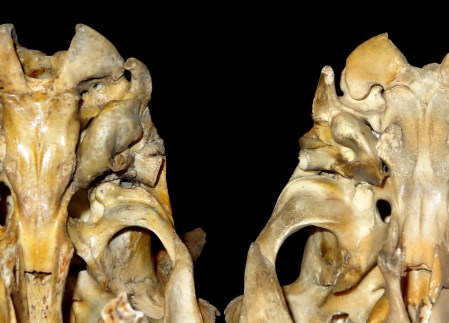
When you look underneath, one of the key things that jumps out is the difference in size of the auditory bullae (mystery on the left, sheep on the right):

mystery273-mystery_and_shee

So I’m pretty sure that the mystery object isn’t a sheep, but what is it?

There were lots of suggestions of exotic and interesting ungulates, but after looking at the skulls of a huge number of ungulates I can to the conclusion that Latinka Hristova and Jake were on the right track with the simple suggestion of Goat Capra hircus (Linnaeus, 1758).

Taking a look at Goat specimens on the incredibly useful Mammalian Crania Photographic Archive has convinced me that this is what the mystery object actually is. Not a million miles from Sheep I suppose, but they are different and it’s helpful finding some small differences that help distinguish between them.

Thanks for your input!

Friday mystery object #272 answer

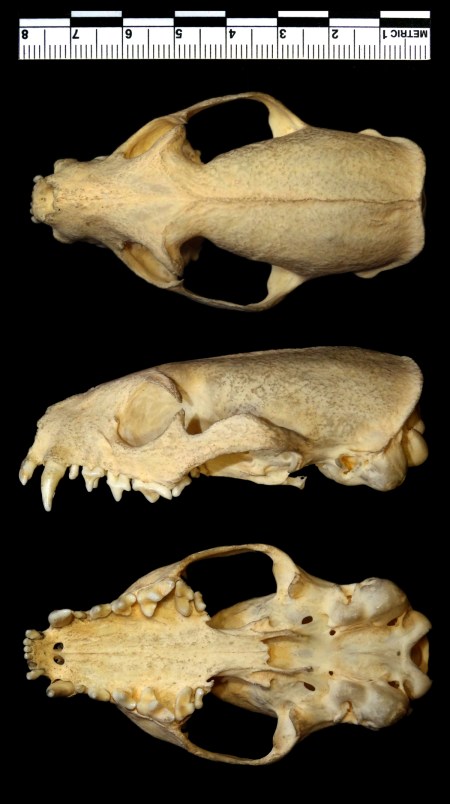
Last Friday I gave you this skull to identify:

mystery272

It was a bit of mean one, because although the family is fairly distinctive, it has poor species representation in online resources or indeed the literature.

The cranium is quite low and long, with some similarities to an otter, but the rostrum (or muzzle) is a bit too narrow and the teeth aren’t quite the right shape. Also the orbits are orientated more vertically, whereas otters have orbit that are at more of an angle so the eyes are closer to the top of the head.

The overall shape, dental configuration and median lacerate foramen all suggest it’s a member of the Herpestidae.

Narrowing down the species was a step too far however, after all, there are around 34 species spread across Africa, Madagascar and Asia and Europe and they are generally quite similar in cranial morphology, with only a few species having good descriptions of the skull.

To help challenge the lack of images of mongoose crania online, I’m pleased to say that this specimen does have an identification – it’s a Ruddy Mongoose Herpestes smithii Gray, 1837. While the name Ruddy Mongoose makes it sound like it’s annoyed me, it actually refers to the reddish-brown of its coat.

A Ruddy mongoose from Daroji wildlife sanctuary in Karnataka, India. By Kalyanvarma, 2009

A Ruddy mongoose from Daroji wildlife sanctuary in Karnataka, India. By Kalyanvarma, 2009

This species is endemic to India and Sri Lanka, where it lives in dry, forested hills and feeds on pretty much anything it can get hold of, from snakes to bird eggs. As with other mongooses (or should that be mongeese?), they have a mutation that prevents snake neurotoxins from bonding at receptor sites, meaning that they are immune to some types of venom – pretty handy if you’re going to eat snakes!

Friday mystery object #272

This week I have another specimen from the Grant Museum of Zoology for you to try your hand at identifying:

mystery272

I have a feeling that it may be easy to get this identification to Family level, but species may prove a little bit more tricky.

I’d love to hear what you think it might be, so leave your suggestions in the comments box below. Have fun!

Friday mystery object #271 answer

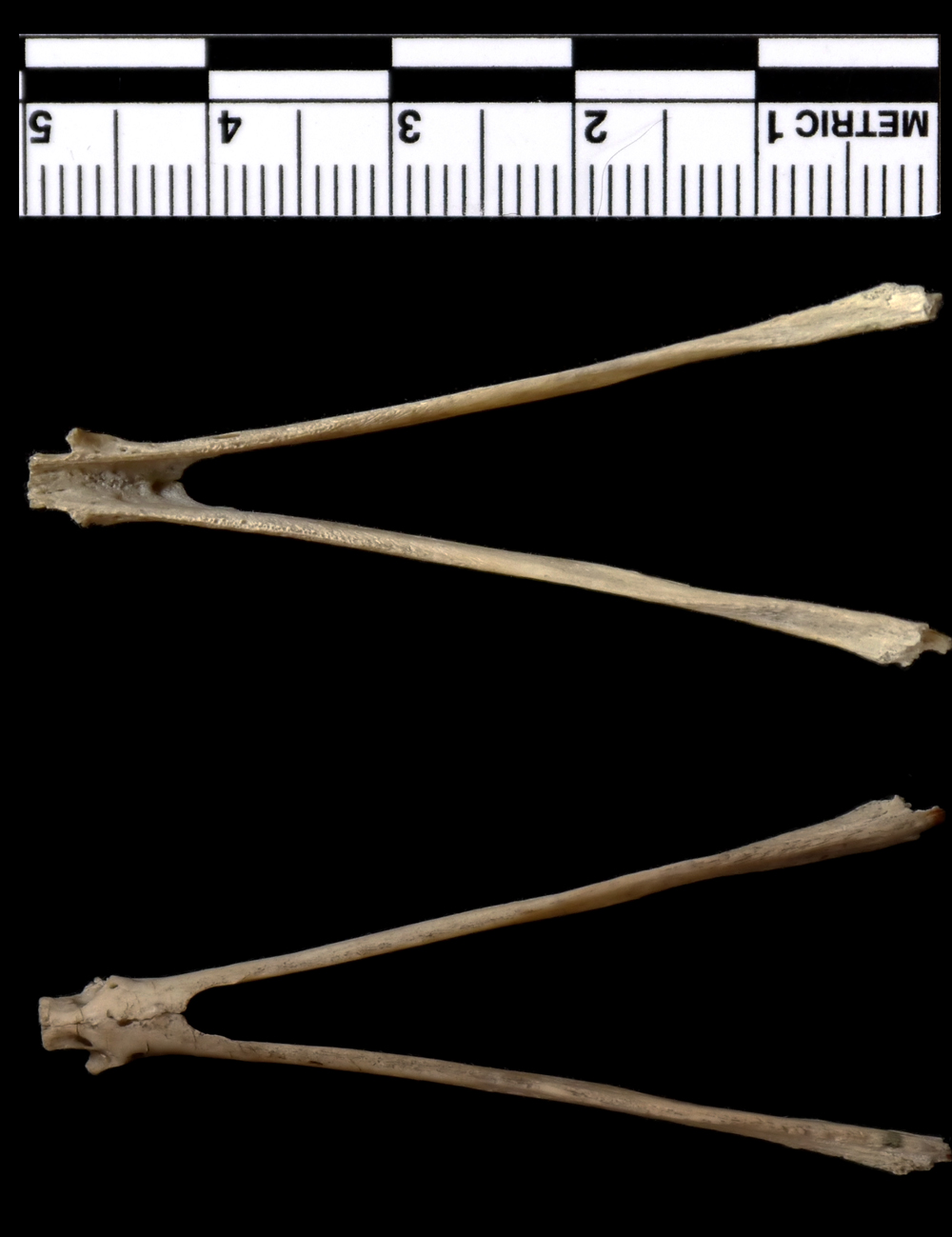
Last Friday I gave you this odd looking V-shaped bone to identify:

mystery271a

It led to a lot of speculation on Facebook and Twitter, with ideas including a bird wishbone, hyoid or mandible. However, the comments on the blog tended to be a little more focussed in the area of the mandible of an ant-eating mammal.

The two little prongs at the anterior of this lower jaw are a bit of a give-away about which type of ant-eating mammal it is, as they are only seen on one family. When you look at the additional image I provided it becomes even easier to work out which:

mystery271b

As most of you correctly worked out, this is a specimen of Pangolin, of which there are four species in the genus Manis (thanks Allen Hazen for the correction – there are more like eight species in the family). I found this nice illustration of the skulls of the various species, to help narrow it down even further:

Anatomical and zoological researches: comprising an account of the zoological results of the two expeditions to western Yunnan in 1868 and 1875; and a monograph of the two cetacean genera, Platanista and Orcella. John Anderson, 1878.

Anatomical and zoological researches: comprising an account of the zoological results of the two expeditions to western Yunnan in 1868 and 1875; and a monograph of the two cetacean genera, Platanista and Orcella. John Anderson, 1878.

So it appears from the morphology of the premaxilla, zygomatic region and nasals that this is a Sunda Pangolin, Manis javanica Desmarest, 1822.

Manis javanica by Piekfrosch, 2006

Manis javanica by Piekfrosch, 2006

These unusual scaly insectivores are critically endangered due to poaching for their meat, skin and scales for the Chinese market, with their population suspected to have declined by 80% in the last 20 years, despite having a protected status. Sad to say that their ability to roll into an armoured ball does nothing to protect them from people.

Friday mystery object #271

This week I have a mystery object for you from the Grant Museum of Zoology that’s either a bit too easy, or a bit mean:

mystery271a

If you’re not a fully paid-up bonegeek, you might like to have a bit of an additional clue; if so, click here.

Please keep your answers in the comments section cryptic, so everyone gets a chance to have a go at working it out without spoilers. Have fun!

Friday mystery object #270 answer

Last week I gave you a tricky object from the Grant Museum of Zoology to identify:

mystery270

While obviously a carnivore of some sort – that much is clear from the canines and shape of the upper fourth premolar – it’s one of a type that has a large number of species and is generally not very familiar to most people.

However, despite being tricky, consensus in the comments moved towards the right family; the Viverridae. Then palfreyman1414 narrowed it down to the correct genus – Genetta.

Common Genet in Wrocław Zoo by Guérin Nicolas, 2008

Common Genet in Wrocław Zoo by Guérin Nicolas, 2008

Unfortunately, it was difficult to identify to species level, partly because it’s missing its auditory bullae (the rounded structures on the underside of a mammal skull that house the bones of the ear). These bullae are useful in distinguishing between the different species in this genus, of which there are many. I can’t say exactly how many, as the number of properly recognised species varies, partly due to hybridisation, but there are about 17.

Nevertheless, palfreyman1414 provided a link to a very useful resource that, with a bit of digging, provided a table of skull and tooth characters (amongst others) for identification of Genets.

Working through the visible characters described in this matrix, removing species that didn’t correspond with the mystery specimen, I was left with just the Abyssinian Genet Genetta abyssinica (Rüppel, 1836).

So many thanks to everyone (but particularly palfreyman1414) for all your help in solving this mystery – without your help I would probably have been stuck at a genus level identification for this specimen, when now I have a pretty robust species identification.

More again next week!

Friday mystery object #269 answer

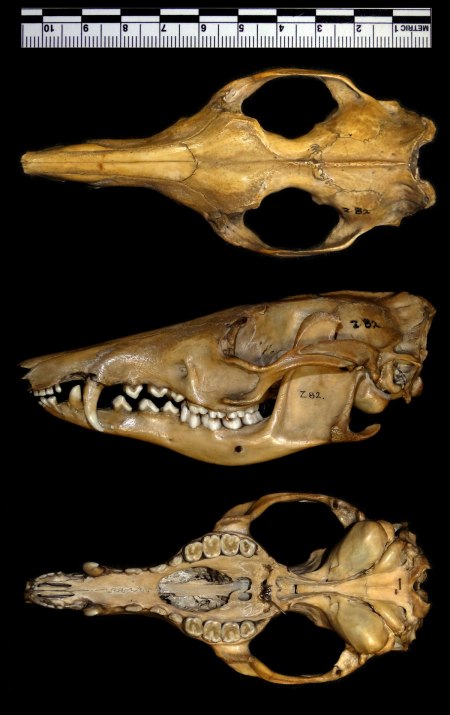
Last week I gave you this mystery object from the Grant Museum of Zoology to have a go at identifying:

mystery269

If you’ve been checking the mystery object recently you’ll notice that this specimen has a feature of the palate that I made reference to in the answer to mystery object #267 – the Tasmanian Devil. It’s incompletely ossified, which is a characteristic of marsupials.

The large curved canines and pointed premolars suggest some predatory activity, while the flattened molars suggest some grinding of vegetation, making this one of the marsupial omnivores, in the Order Peramelemorphia.

The large size of the skull and the long curved canines make this specimen rather distinctive – as first spotted by Richard Lawrence, this is indeed a Continue reading

Friday mystery object #268 answer

Happy New Year! I hope everyone had a lovely festive period.

I gave you this distinctive specimen from the Grant Museum of Zoology to try your hand at identifying:

mystery268

Despite being distinctive, it raised some discussion about the identification, because there are few resources available for comparison.

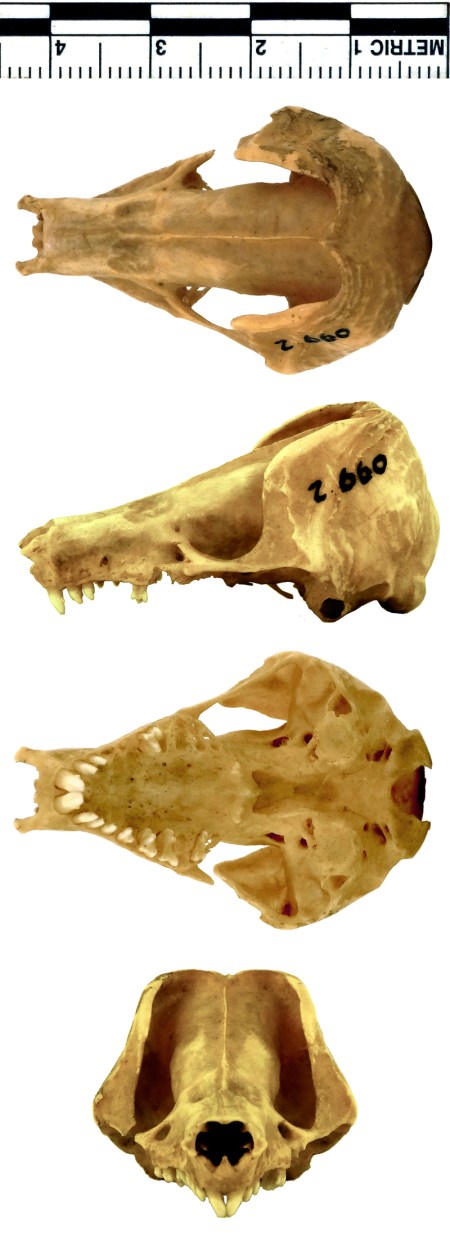
Phil Cox was the first to get the right Family (at least in the comments – @MelanieGbones got it on Twitter) – the Chrysochloridae or Golden Moles. Then the discussion got a bit more involved as species were discussed and the possibility of the convergent Marsupial Moles was considered.

There are 21 species of Golden Mole, all of which occur in southern Africa, which could have made this a very difficult identification to species, if it wasn’t for the large size of the skull and the very characteristic large and vertically-posteriorly flaring zygomatic arch that continues round to near the back of the skull. This narrows it down to one of two species in the genus Chrysospalax.

The extent of this feature in this specimen, plus the shape of the palate, suggest to me that this particular specimen is from the

Continue reading

Friday mystery object #268

Merry Christmas mystery solvers!

This week I have an unusual object from the Grant Museum of Zoology for you to identify:

mystery268.jpg

It’s pretty distinctive, but I’ve not seen many of these, so hopefully it’ll make an interesting object to identify. As usual, if you think you know what it is, please leave a hint or cryptic clue rather than just writing down the answer – it makes it more fun for other people that way.

Have fun!

Friday mystery object #267 answer

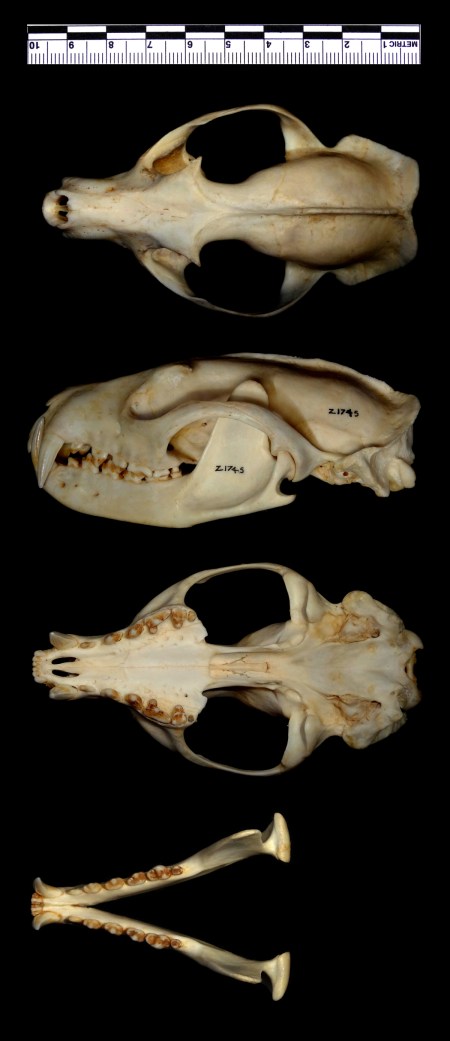
Last Friday I gave you this specimen to identify:

mystery267

It was a pretty distinctive one, but a great specimen – and a nice robust example of this particular species.

The partially ossified palate and nasolacrimal (or tear) duct on the external border of the orbit shows that this is a marsupial, and the pointy, robust teeth suggest that it’s highly carnivorous with a penchant for carion, which narrows down the options pretty effectively.

As many of you recognised, this is a Tasmanian Devil Sarcophilus harrisii (Boitard, 1841) – so well done to Tone Hitchcock, Chris, Cindy Nelson-Viljoen, Ric Morris, henstridgesj, palfreyman1414, Lauren McCafferty, joe vans, Daniel Jones and Daniel Calleri, Allen Hazen and Michelle for getting this one right. The key was definitely in those marsupial characters, which immediately ruled out any of the highly diverse placental carnivores.

Tasmanian Devil (Sarcophilus harrisii), Tasmanian Devil Conservation Park, Taranna, Tasmania, Australia by JJ Harrison 2010.

As several of you alluded to, the Tasmanian Devil is undergoing a major decline in population at the moment, mainly due to a particulary nasty transmissible disease that causes tumours to develop on the face, preventing feeding. The tumours are spread between individuals when they bite each other, especially when feeding, which is pretty common Devilish behaviour.

In fact, Devils are pretty rough and tumble creatures in many of their behaviours. When breeding they have a large litter of up to 30 young, which have to compete for just 4 nipples in the pouch. Unsurprisingly, few of the litter survive and presumably those that do are pretty pushy.

Hopefully the Devils will survive their current population crash. There are some individuals who show some resistance to the facial tumour disease, which reflects the importance of genetic diversity within populations. It would be a great shame if the Devils went the same way as the other large marsupial carnivore, the Thylacine.

Friday mystery object #266 answer

Last week I gave you this distinctively weird looking skull to identify:

mystery266

As I suspected, many of you worked out what it was straight away, but I wonder if it would have been as easy if the side view hadn’t included the mandible?

The upper dentition, especially the pair of incisors, is somewhat similar to that of a rodent, but that mandible is ludicrously massive and could only really belong to the weirdest primate in the world: the Aye-aye Daubentonia madagascariensis É. Geoffroy, 1795

So very well done to Tone Hitchcockhenstridgesj, Chris, Cindy Nelson-Viljoen, Daniel Jones, steve tornaAgata Stachowiak, palfreyman1414, boneman2014Lee Post, joe vans, Allen Hazen, Dave Taylor, Michelle, witcharachne, and Daniel Calleri.

The Aye-aye’s incisors are an adaptation for gnawing holes in wood to get at grubs inside. It finds these tasty morsels using a tapping finger and crazy bat-like ears to detect the tunnels the larvae create when feeding, with a system a bit like seismic ground response analysis.

Aye-aye by Frank Vassen 2008

Aye-aye by Frank Vassen 2008


Once the squishy prey has been detected and an entry point has been gnawed, the Aye-aye fishes it out using a specially adapted long, thin finger with a hooked claw.

Aye-aye fingers by Dr. Mirko Junge 2009

Aye-aye fingers by Dr. Mirko Junge 2009

Basically, the Aye-aye feeds rather like a woodpecker, but with the benefit of fingers and teeth. Perhaps it’s weird, but it’s most definitely wonderful!Aye_aye