Friday mystery object #363 answer

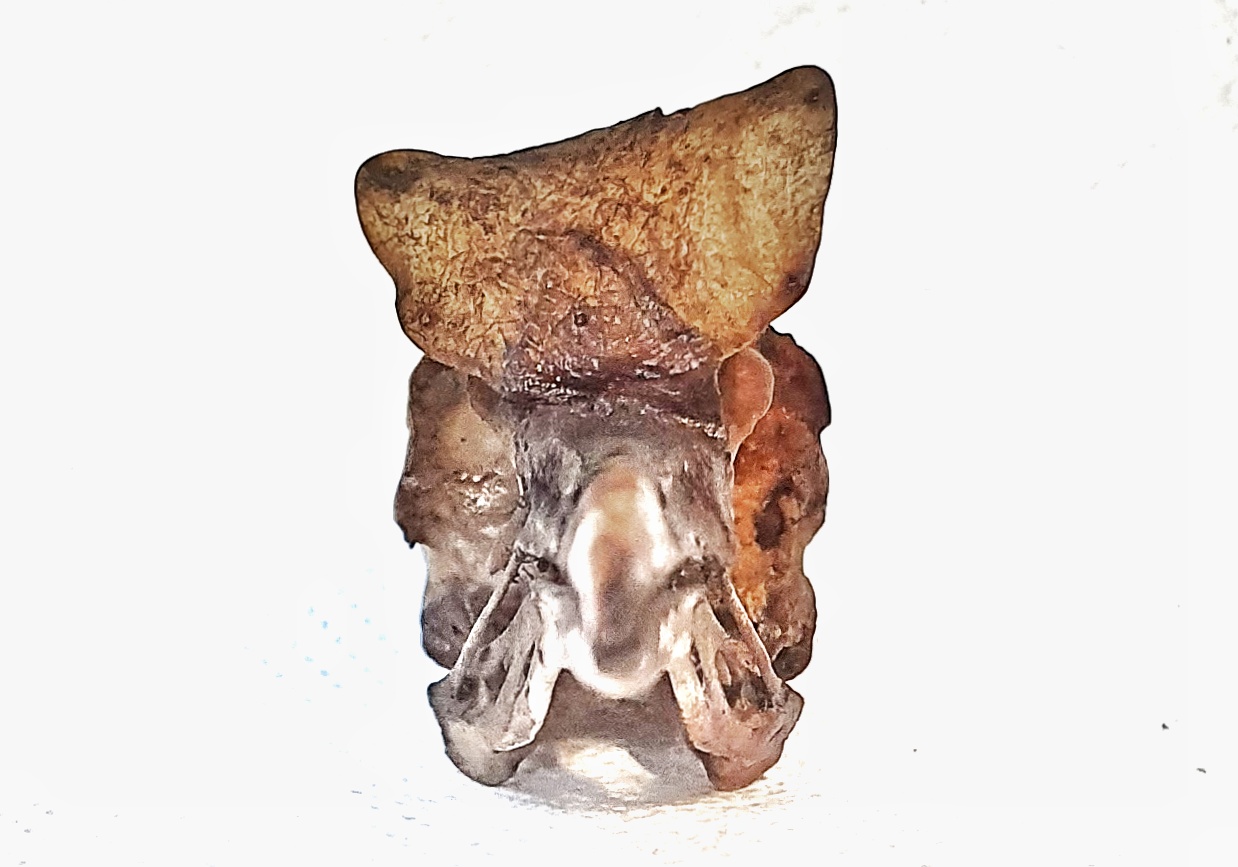
Last week I gave you this crusty critter to identify:

20190808_155401-01.jpeg

It’s not the easiest mystery object, since there are around 850 species of crab, and several converge on similar forms. However, the triangular body and spindly legs meant that everyone recognised this as a species of spider crab in the Superfamily Majoidea.

Beyond that it gets harder, although there are resources out there to help. The Marine Species Identification Portal has a useful key for species that occur in the North Sea. I know that’s not always useful in these instances, but as it turns out, this particular species has a range across the East Atlantic and into the Mediterranean, including populations in the North Sea.

This little crab is Pisa armata (Latreille, 1803), which is one of several spider crabs that camouflage themselves with sessile animals and algae from their local environment, earning them the name Decorator Crabs.

Decorator crab covered in stinging hydroid polyps, which defend the crab while benefiting from food scraps and greater mobility. Image by Nick Hobgood, 2006

Decorator crab covered in stinging hydroid polyps, which defend the crab while benefiting from food scraps and greater mobility. Image by Nick Hobgood, 2006

Bit of an obscure one for you, but Diane Barlee did figure it out on Twitter, so it was manageable. Watch out for more mysteries next week!

Friday mystery object #362 answer

Last week I gave you this skeleton to have a go at identifying:

20190808_160231-01.jpeg

I thought that it might be a bit on the easy side for some of you – especially Wouter van Gestel who is one on the brains behind the fantastic Skullsite resource, that I expect everyone is familiar with by now.

The skeleton of this bird isn’t really all that distinctive, but the skull – particularly the bill – is very distinctive indeed, although this photo doesn’t capture the full weirdness.

20190808_160312-01.jpeg

Wouter’s cryptic clue:

Apparently, this species processes sound twice as well as you might expect from a bird.

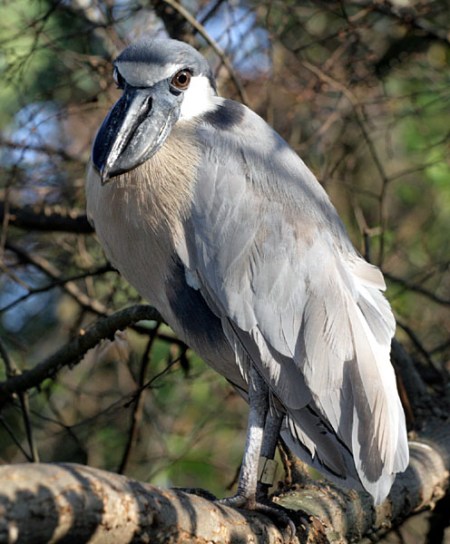
was a hint at the scientific name Cochlearius cochlearius (Linnaeus, 1766) – playing on the fact that the name comes from the same source as the name for the cochlea, which is a part of the inner ear that has a snail-like shape. The common name, as hinted at by Richard Lawrence is Boat-billed Heron, as you can see a bit more clearly here:

cochlearius_cochleariapcca20071227-8443b

Boat-billed Heron. Photo by Patrick Coin, 2007

These odd looking birds are members of the Ardeidae or heron family, but rather than having the spear-like bill of the classic Grey Heron, they have broad bills used for scooping up prey in the shallow, murky waters of Mangrove swamps in Central and South America.

They have big eyes and that large, sensitive bill to help catch small fish and crustaceans in the shade or at night. This nocturnal habit is common in the Nycticoracidae a subfamily commonly known as night herons, as mentioned by Josep Antoni Alcover in his clue in the comments.

So well done to everyone who recognised this unusual animal – more mysteries next week!

Friday mystery object #361 answer

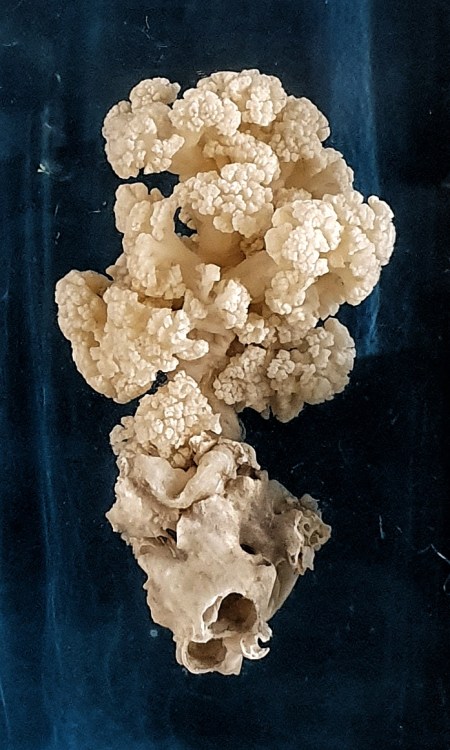
Last week I gave you what looks like a pickled cauliflower floret to identify:

20190725_103325-01.jpeg

As most of you worked out, this is a soft coral, although Tony Irwin was more detailed with his cryptic suggestion placing it in the Nephtheidae, and mpbx3003’s clue was spot on.

The name on the jar is Eunephthya florida (Rathke, 1806), but as with the last mystery object, there’s been a change in name. Eunephthya is now only applied to a genus that happens to be found in South Africa. This specimen is now considered to be in the genus Duva and the species name florida is more of a reflection of the fact it has a flushed pink colour in life than any reference to the American state.

Most soft corals they tend to live in warm shallow waters of the Atlantic, so Florida wouldn’t be a bad bet for where this might come from, but it actually happens to be one of the more unusual cold and deep water species. This particular specimen is from off the West coast of Ireland at a depth of between 738-900m (410-500 fathoms in old money).

Unlike the shallow water corals, these ones don’t get enough light to photosynthesise using symbiotic dinoflagellates, so they rely on capturing zooplankton from the dark but rich cold waters of the Atlantic.

Friday mystery object #360 answer (not really)

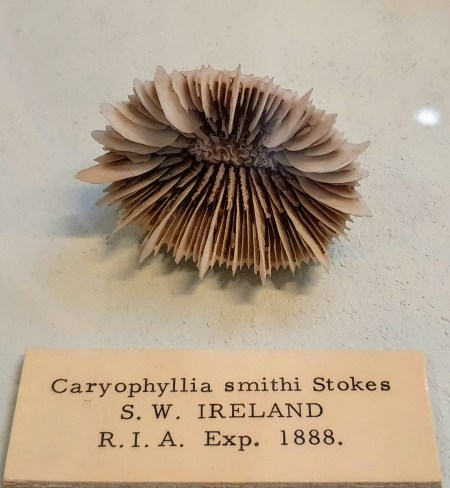
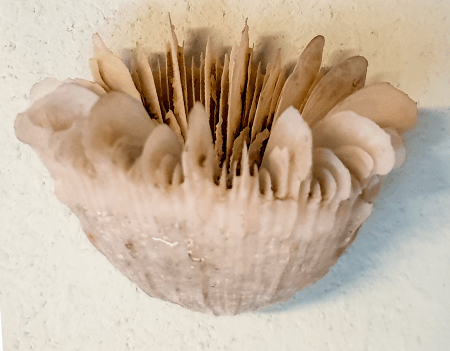
Last week I gave you a specimen with a radial arrangement to mark the 360th mystery object:

Adobe_20190711_174234.jpg

It’s a stony coral of some sort, as everyone in the comments recognised. The shape also suggests that it’s a solitary coral, as it forms one cup containing the radial arrangement of septa.

I picked this specimen as it’s one on the (currently inaccessible) balcony in the Dead Zoo and I was a bit doubtful about the identification on the label (see below).

coral

I must admit, I did liked the idea of this being a giant Caryophillia smithi, since that’s the Devonshire Cup Coral and the previous mystery object was a Cornish Sucker, so I thought it would be nice to do a tour around the Southwest of England in specimens.

However, I don’t think that’s possible, since Devonshire Cup Corals are much smaller than this (up to a maximum of about 25mm across). I also harbour doubts that this specimen was collected in S.W. Ireland, so I think there may have been a mix up with the labels. This can happen for a variety of reasons, but most commonly when an object gets temporarily moved and not put back with the right label.

The specimen does look like one of the Caryophylliidae, although corals are notoriously difficult to identify as different families can converge on very similar forms. There is a great key dealing with stony corals that should shed some light on this, but unfortunately I’ve not had a chance to put it to use yet.

At some point I will need to go through all of the labels in the exhibitions at the Dead Zoo to check the accuracy, since most are over 100 years out of date and changes in taxonomy mean that the majority of labels on display will have some kind of error now. With around 10,000 specimens on display this is not a job that can be done overnight…

Friday mystery object #359 answer

Last week I gave you this fishy mystery to have a go at solving:

20190619_131741-01.jpeg

I find fish a bit tricky, simply because there are so many different species out there – 33,100 described so far and rising. That’s more than all other vertebrates combined, so it’s not surprising that they can be a challenge.

However, this cartoonish looking little fish has some quite distinctive features that help narrow down the identification. There’s the duck-face with a couple of little barbels between its eyes and the clumping of the fins to the tail end. It also has a nice colour, but as I regularly say, that’s seldom a very reliable guide.

Generally, fish shaped like this don’t swim fast, they don’t lie flat on the sea bed and they don’t wriggle through weeds. This is the shape of a clinging fish – the kind that hold fast to a surface and let the world wash over them.

There are a good fish that do this, but I did say that this one is from Ireland, which helps narrow it down even more – enough for Chris to identify it correctly. This is a Cornish Sucker Lepadogaster purpurea (Bonnaterre, 1788). These weird little fish are pretty awesome. They cling to rocks along the shore with a suction cup made from their fused pelvic fins and they can change colour to blend into the rocks they attach to. Partly this will be for camouflage to avoid predators, but it will also be to help them ambush the smaller fish and crustaceans that they feed on.

One small issue for me is that the name on the label for this specimen is Lepadogaster lepadogaster (Bonnaterre, 1788). The taxonomy of this genus was reassessed in 2002 and the northern population of Lepadogaster (including those from the UK and Ireland) was found to be distinct from the more southerly distributed population. So once again, I need to update a label because advances in taxonomy have messed up our 100+ year old information. That’s the trouble with science – it keeps finding out new stuff.

Friday mystery object #358 answer

Last week I gave you this skull from customs to have a go at identifying:

Adobe_20190613_200131.png

The long horns rising in line with the plane of the face are a distinctive feature of the genus Oryx, which most of you spotted straight-off.

However, after that it gets a bit more tricky, not least because there are several species of Oryx and within the species there are different subspecies and populations from different parts of the African continent.

The first species that’s easy to rule out is the Scimitar Oryx, O. dammah since they have strongly curved horns which don’t diverge as much as this specimen. This species is currently extinct in the wild and individuals only survive in captivity.


Scimitar Oryx in Werribee Open Range Zoo in Victoria, Australia. Image by Waddey, 2009


Next up is the Arabian Oryx O. leucoryx which used to be extinct in the wild, but which is one of the few species to have become reestablished in the wild by captive breeding and release programmes. This is the smallest Oryx and the mystery specimen’s horns are way too long to be from this species.
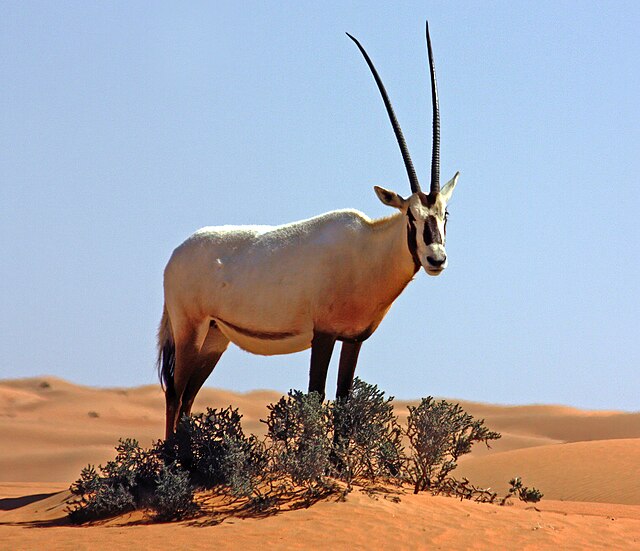
Arabian Oryx in the Dubai Desert Conservation Area. Image by Sharp Photography, 2014 

Getting to the more likely species, there’s the East African Oryxwhich either has a couple of subspecies or is two different species – the Common Beisa O. beisa, which is endangered and the Fringe-eared Oryx O. callotis, which is threatened. The other possibility is that it’s a Gemsbok O. gazella, which is still doing well in the wild.

Common Beisa. Image by Steve Garvie, 2010

Fringe-eared Oryx. Image by Riaan Marais, 2009
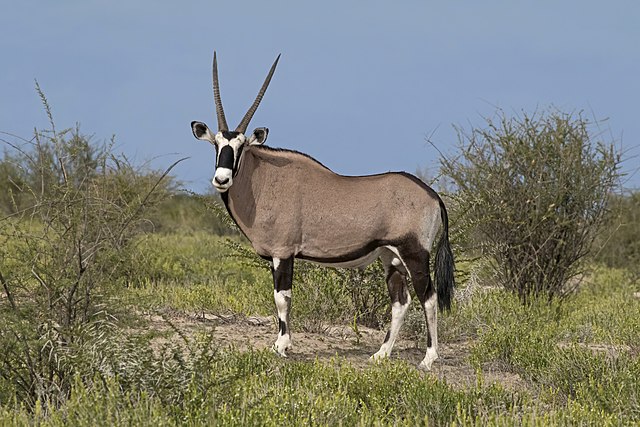
Gemsbok. Image by Sharp Photography, 2018

As you’ve probably worked out, part of why customs are interested in knowing which species this specimen belongs to is knowing what level of protection it has under CITES, should they need to pursue a prosecution. Regardless, the specimen was seized because it wasn’t properly prepared and it entered Ireland without the appropriate information.

Of course, differentiating between the Gemsbok, Beisa and Fringe-eared Oryx using only the skull is tricky (and even harder if you only have photos).

Fortunately, there is literature that can help, with measurement ranges for certain features, like horn length, distance between horn tips and number of rings on the horn. Of course, these are only indicative, but they offer a guide to most likely species. Ungulate Taxonomy by Groves & Grubb, 2011 has a handy table of these, which I used to narrow down the options to just one – a population of Gemsbok Oryx gazella (Linnaeus, 1758) from the Nata River in the northeastern region of Botswana.

Of course, DNA sampling can offer a more certain diagnosis these days, but only if there is a good quality reference sequence to compare against and it assumes there is the equipment and expertise available to do the sampling and analysis. This is why identification from morphology can still play an important role in managing wildlife crime.

Friday mystery object #358

Another Friday, another mystery object. This week I’m going back to my favourite subject – skulls. This particular specimen has been brought in to the Dead Zoo for identification by customs and although I’ve narrowed it down, I’m still not 100% sure of the species just yet:

Adobe_20190613_200131.png20190613_200359.jpg

It’s a fairly straightforward genus for anybody who knows their ungulates, so cryptic clues are appreciated. However, the species is harder to work out, so bonus points for detail. Have fun!

 Friday mystery object #357 answer

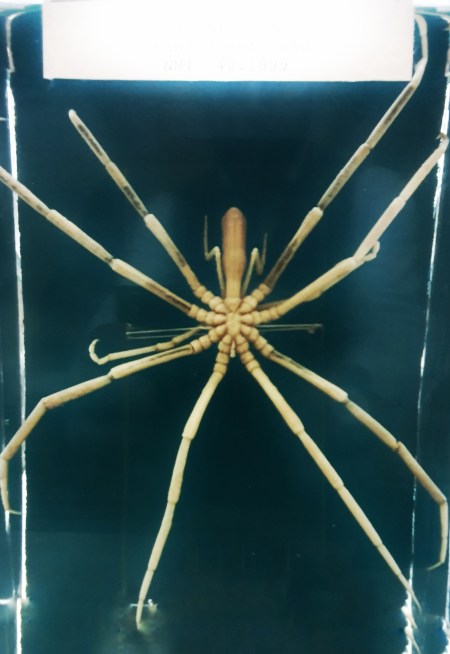
Last week I gave you this leggy mystery object to have a go at identifying:

20190523_111957-01.jpeg

Despite it having a passing resemblance to a Xenomorph Facehugger, it’s a real animal from planet Earth, although not from earthy bit. As many of you recognised, this is one of the pycnogonids or sea spiders.

This group of arthropods is placed in the Chelicerata along with spiders and horseshoe crabs on the basis of their morphology, although genetics suggest that their roots may lie nearer the base of the arthropod family tree.

You’re unlikely to encounter one of these giants since they live in the deep sea, but smaller types (usually only around a 1cm long) are found on most rocky shores, where they feed on bryozoans and hydroids.

This one is from around Franz Josef Land, an archipelago in the Russian Arctic. Several people dropped hints to the genus – in particular Hilary, Chris, Wouter van Gestel, Daniel Calleri & Dan Jones, but Andrew Taylor just came out with it: Colossendeis. The clue there is really in the size.

However, this is a tricky one to narrow down to species. There is an online key to the pycnogonids but unfortunately it’s not totally comprehensive. That said, this species is represented in the key and it’s actually quite distinctive because of its huge proboscis (N.B. the head points upwards in this specimen), quite compact almost disc-shaped body and lack of eyes.

These characteristics match the description for Colossendeis proboscidea (Sabine, 1824), which is more commonly known as the Blind Pycnogonid. Now I want to find out who collected this specimen and donated it to the Dead Zoo back in 1899.

There weren’t too many Arctic expeditions prior to 1900 and this specimen is almost certainly from one of those few. It could possibly be from the Austro-Hungarian North Pole expedition. In 1872 they discovered Franz Josef Land and in 1874 named one of the islands in the archipelago McClintock Island after the notable Irish Arctic explorer Francis Leopold McClintock. It’s not impossible that they would have sent specimens to McClintock or the Museum in Ireland, so it may be time to hit the books to see if I can find any more information!

 Friday mystery object #356 answer

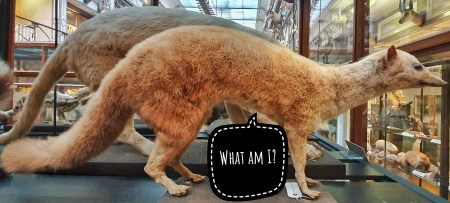
Last week I gave you this rather improbable-looking fuzzball to have a go at identifying:

20190516_164207-01.jpeg

Initial consensus on Twitter suggested that it was some kind of taxidermist’s mash up of a tenrec / shrew / weasel and fox. Particular favourites were:

and:

A similar theme emerged in some comments on the blog, but a useful rule of thumb was shared by ch:

Anything that weird looking is either a taxidermists joke or comes from Madagascar- you’d need to look in every ‘nouc’ and cranny to identify this weasily overlooked carnivoran.

https://paoloviscardi.com/2019/05/17/%ef%bf%bc-friday-mystery-object-356/#comment-67302

Madagascar is well known for weird animals, since the island became isolated from the Indian subcontinent over 85 million years ago, allowing a unique variety of species to evolve and fill the ecological niches present. The oddities present include the Aye-aye (a mammal trying to be a woodpecker), the Fossa (a mongoose trying to be a cat) and the Web-footed tenrec (a tenrec trying to be an otter).

Of course, ch left an additional clue hinting at the correct identification (‘nouc’) which was picked up on by several others. There were also plenty of people on Twitter who recognised this distinctive animal.

The mystery object is a Falanouc Eupleres sp. Doyère, 1835 – notice the sp. There are two species of Falanouc – Eastern (E. goudotii) and Western (E. major), but this species split was only recognised in 2010. Therefore, it’s very difficult to know which this one is, especially without details of where in Madagascar it was collected.

Assuming it was collected in Madagascar. I say that, because it was purchased from London based supplier Gerrard & Sons. This means it could have been acquired from London Zoo, since Gerard had a relationship with the Zoo and often got dead specimens from them.

It’s also tricky to identify the species from morphology, since the differences between the species are most noticeable in the skull. The fur colour can provide a clue as well, but 100+ years of being on display in a gallery illuminated with daylight means the colour is pretty much guaranteed to no longer be as it was in life.

So I think we may have to leave it there, unless I can find any additional information about the specimen in the Dead Zoo’s archives. Whatever the species, I think this mongoose-like insectivorous carnivore with a fox-like body and shrew-like face is as charming as it is improbable.

 Friday mystery object #355 answer

Last week I gave you a unfairly tricky mystery object:

My excuse for the poor photography and lack of scale was the fact I was preoccupied with the epic NatSCA conference (whose hashtag is still yielding some great photos and thoughts if you want to see what it was all about).

It probably doesn’t help that this specimen is missing the toes from its right foot, because it makes it hard to tell if the two toes on its left are the natural state for the bird, or if one toe just happens to be missing. This is an important distinction, as picked up on by sallie reynolds, since a bird with two forward-facing toes will have two rear-facing toes, which is a condition known as zygodactyly and it helps narrow down the possible group of birds it belongs to.

As it turns out, the left foot is intact and the specimen does have the zygodactyl toe arrangement, so it will be from one of nine possible groups (owls, ospreys, parrots, cuckoos, cuckoo-rollers, mousebirds, turacos, some swifts and most woodpeckers and their relatives). The bill makes it pretty clear that this isn’t an owl, osprey, parrot, mousebird, or swift. The big head narrows it down further – more than enough for Wouter van Gestel to identify that it’s a Barbet (in Dutch “Baardvogel” or bearded bird), but it doesn’t really provide enough information to get a species identification.

As it turns out, the taxonomy of the existing identification was more than a little out of date, with the label from 1881 reading Heliobucco bonapartii. Now Heliobucco has not been used as a valid genus for at least 100 years, but fortunately the species name indicates that it was named after Bonaparte (not the Emperor, but a French ornithologist who did happen to be the Napoleon’s nephew). This meant that the fantastic Eponym Dictionary of Birds by Beolens, Watkins & Grayson was able to yield the information I was after. The valid name is now Gymnobucco bonapartei Hartlaub, 1854 which is the Grey-throated Barbet.

gray-throated_barbet_-_kakamega_kenya_06_1744

Grey-throated Barbet. Photo by Francesco Veronesi, 2006

My apologies for setting such a tricky object – I promise to try harder to make it easier next week!

 Friday mystery object #355

It’s NatSCA conference week here in Dublin – the best time of the natural history collections year. If you want to hear about what’s going on you should check it out on Twitter under the hashtag #NatSCA2019.

Of course, that means I this week’s mystery object has been taken from a snap on my phone, as I’ve been a bit bust – so here’s a slightly less than ideal photo of an old and slightly grubby bird skeleton to have a go at identifying:

Any idea what this might be? All suggestions gratefully received!

Friday mystery object #354 answer

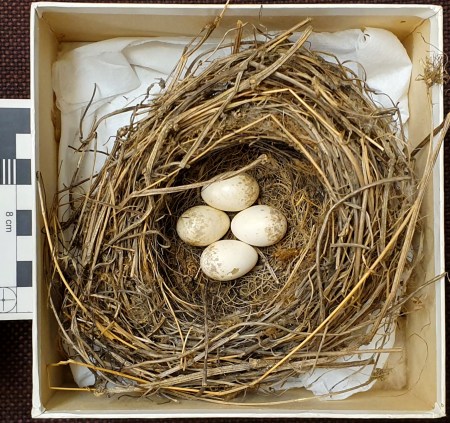
Last week I gave you this Eastery object to have a go at identifying:

20190418_165821-01.jpeg

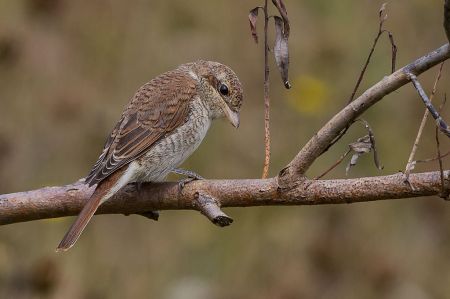
It proved a bit of a tricky one, with most people recognising it as the nest and eggs of a passerine bird, but Bernard was absolutely spot-on with an identification of Red-backed Shrike Lanius collurio Linnaeus, 1758 – kudos to Bernard!

1024px-red-backed_shrike_28lanius_collurio29

Female Red-backed Shrike. Pierre Dalous, 2012

Generally, being able to identify eggs and nests has become a less commonplace skill in Europe over the last few decades. This is partly because people with an interest in nature tend to steer clear of nests in order to avoid disturbing breeding birds.

In the first half of the 20th Century collecting wild bird eggs was a popular hobby in many parts of Europe, so people would learn the skills needed to identify eggs from different species. However, these sorts of collections negatively impacted on bird populations and helped motivate development of legislation protecting birds and their nests.

Red-backed Shrikes used to regularly visit and breed in the UK, but they largely ceased nesting in Britain around 30 years ago and they are very rare visitors to Ireland. Recently however, there have been records of some successful breeding pairs in the South West of Britain, so they may be making a shift back into Britain.

Of course, if they do start breeding in the UK they’ll need suitable habitats, which mostly means the thorny scrub in wet areas that they prefer (see Svendsen et al, 2015). This is assuming that these sites avoid the current trend of being netted by developers to prevent birds from nesting.

This cynical practice that has recently become quite widespread in the UK is a used as a mechanism to deter birds from nesting in particular suitable sites, which can delay development thanks to the legal protection on nesting birds that was introduced to help protect bird populations (there’s an interesting article on the topic in the Guardian). By limiting access to nesting sites the developers may avoid breaking the letter of the law, but with suitable habitats in decline, depriving birds of nesting sites does seem to be breaking the spirit in which the laws were made. Not cool.