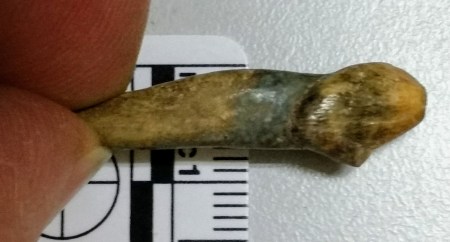
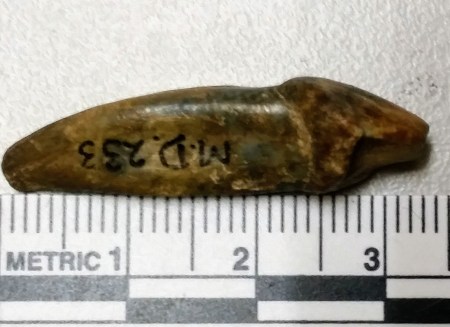
Friday mystery object #300 answer

Last Friday I gave you this new acquisition to have a go at identifying:

mystery300

When it arrived on my desk in an decorative box, with bundles of bone wrapped in blue tissue and tied with gold ribbon, it had a small label saying:

Skeleton of Mongoose, Africa.

Now, I know that having the continent would have been of help for the identification, but I didn’t want my 300th challenge to be too easy.

So how was that initial identification of Mongoose? It was certainly up there in the first of the comments, with Ric Morris (expert on British mammal bones, whose book I am eagerly awaiting) providing a beautifully crafted suggestion. Unfortunately it isn’t right, as the mongooses mongeese Herpestidae* tend to have a better developed post-orbital process (that’s the pointy bit on top of the skull, behind where the eye would be) and a corresponding process on the zygomatic (that’s the cheekbone), with the two sometimes meeting to form a post-orbital bar. They also tend to have more robust teeth.

Another (very) cryptic clue came from jennifermacaire who suggested that it was a civet (which can either be a type of viverrid carnivore or a French game stew). This suggestion was supported by henstridgesj and it’s closer than the mongoose suggestion, as the specimen is indeed from a species in the Viverridae. This was noticed by herpderpatologist who provided a handy tip for spotting the difference between mustelids and viverrids:

The split auditory bulla is a clue! It’s something I associate with viverridae;…

If we know that this is a viverrid, it narrows it down to one of  just 38 species…  which is still quite a lot. But by trawling through the images of viverrid specimens on the University of Michigan Animal Diversity Web it becomes easier to start narrowing down the likely group within the Family.

In this case it led me to the genets.

There are quite a few genets, with the Subfamily Genettinae containing in the region of 16 species. Distinguishing between them isn’t entirely simple, as they all look pretty much alike, but there is an excellent French resource that has detailed anatomical characters and images of specimens to help distinguish between genet species.

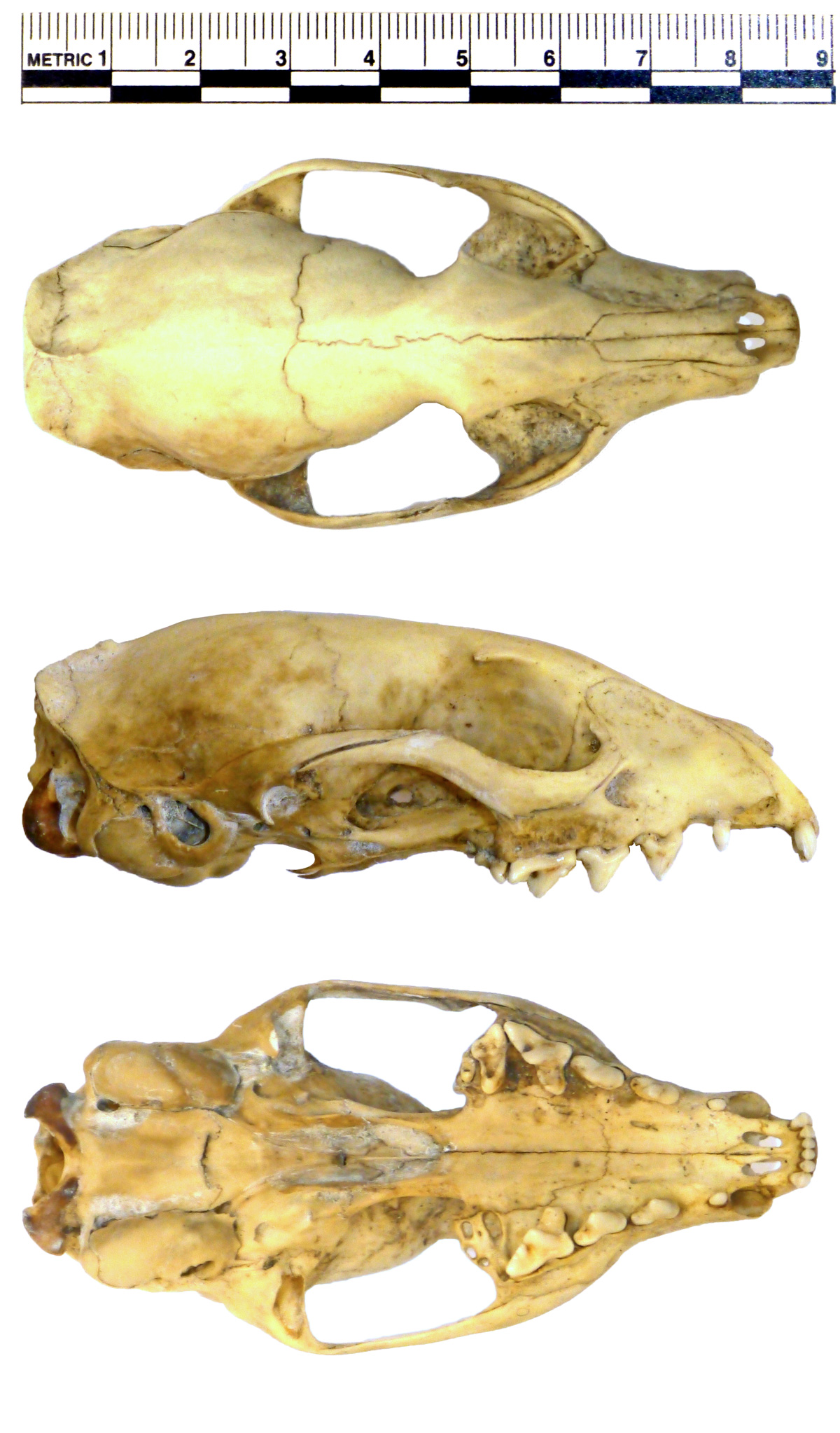
Working through this I found that the two best options were the Common Genet and the Cape Genet and distinguishing between them is not simple. I’m leaning toward the Cape Genet (or Large-spotted Genet) Genetta tigrina (Schreber, 1776), based on the spacing between the tympanic bullae (the bulbous bones under the skull that house the ear bones), the reduced lingual cusp on the P3 (that’s the tiny bit that sticks out towards where the tongue would be on the upper third premolar) the form of the upper first premolar (P1) and the shape of the maxillary-palatine suture (that’s the junction between the bone of the palate and the part of the upper jaw that supports all the teeth except the incisors).

That’s quite a lot to take in, but by getting your eye in and scanning through images it’s surprising how quickly you can narrow down options by rejecting images where you can see clear differences in the tympanic bulla configuration or cusp pattern on the P3 to leave a couple that need more careful consideration.

And just for the sheer squee of it, here’s what a Genet looks like when it’s alive:

Common Genet, by Peter 2011

Common Genet, by Peter 2011

I hope you enjoyed the challenge of the 300th mystery object!


*N.B. the plural of mongoose is “mongooses”.

Friday mystery object #300

Another milestone for the Friday mystery object – the 300th I’ve shared since it started in July 2009. That means I’ve posted either an object or answer every single Friday for almost 8 years.

The FMO has allowed me to share collections from three fantastic museums: the Horniman, the Grant and now, Dublin’s Dead Zoo – plus a few more random objects ranging from beach finds to pub chairs. It’s also helped bring together a community of people with a shared interest, which is the main reason I’ve kept the blog running for so long. In particular a blog post by Jake McGowan-Lowe about what he’s learned from Zygoma (written 100 objects ago now) makes me feel that the time I put into blogging is totally worthwhile.

This week’s object is an acquisition that’s been waiting for a while to be curated, since the Dead Zoo had been without a Zoology Curator for five years, before I started in December.

The specimen appeared on my desk wrapped up like a gift:

and of course, given my love of bones it was the best gift I could have hoped for – an unidentified skeleton:

mystery_gift_3 - Edited

I got out the Paraloid B-72 (an adhesive we use in museums) to secure in place the loose teeth and detached epiphyses (they’re the ends of the long bones that haven’t fused on to the main shaft of the bone because the animal was young) and I put the specimen in a more appropriate box, but not before taking some photos of the skull to help with the identification:

mystery300

Do you have any thoughts on which species this skull might have come from? I have my suspicions, but I’d love to hear your thoughts.

As usual you can put your observations, questions and suggestions in the comments below. I hope you have fun with this one!


Friday mystery object #299 answer

Last week I gave you this cute critter to try your hand at identifying:

mystery299

I thought the presence of fur would make it easier than usual, but of course, hair hides a lot of rather useful diagnostic features that you can find more easily in the bare bones.

However, you managed to pick up on a couple of the key features that gave this specimen its name: it looks like a lagomorph (one of the hares, rabbits or pikas) or maybe a larger rodent and it looks like a macropod (one of the kangaroos, wallaroos or wallabies). Several people wondered about it being a Kangaroo-rat, but that distinctive back foot, with its big central toe and then the skinny little side toes (you have to look carefully), tells us that it’s the other way round and this is a marsupial that looks like one of the placental glires (that’s the group containing the rodents and the lagomorphs).

The marsupial identification was initially spotted by palfreyman1414 and tenaciously defended by Rebecca, who was on the right track when she veered toward it being something in the Potoroidae (the rat-kangaroos, potoroos and bettongs), a suggestion that was put forward in a more cryptic way by jennifermacaire.

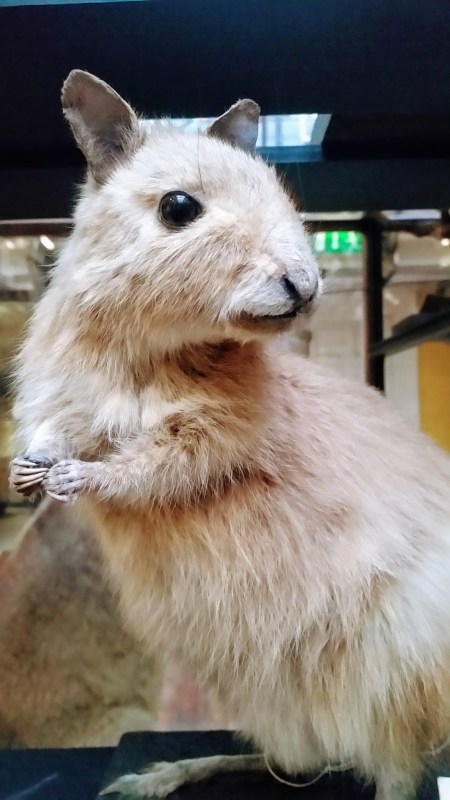
This is in fact a Rufous Hare-wallaby or Mala Lagorchestes hirsutus Gould, 1844, which marsupial wrangler Jack Ashby spotted with ease:

I should say that it is indeed VERY faded, after spending over 100 years in a glass ceilinged gallery.

These small macropods live on a few islands in Western Australia, but their original wider range has been dramatically reduced by changing land use patterns resulting from the breakdown of the relationship between the Aboriginal people and the land, caused by encroachment and systematic persecution by European settlers. It’s not onlyhumans who suffer when people treat each other badly.

Friday mystery object #299

This week I’ve decided to give you a mystery object that has its skin and fur, so in theory it should be really easy to work out what it is. In theory.

mystery299

Any idea what species this adorable little critter belongs to?

As usual you can put your thoughts, questions and suggestions in the comments section below. If you find this too easy then maybe you can try to find a cleverly cryptic way to let me know.

Have fun!