Friday mystery object #234 answer

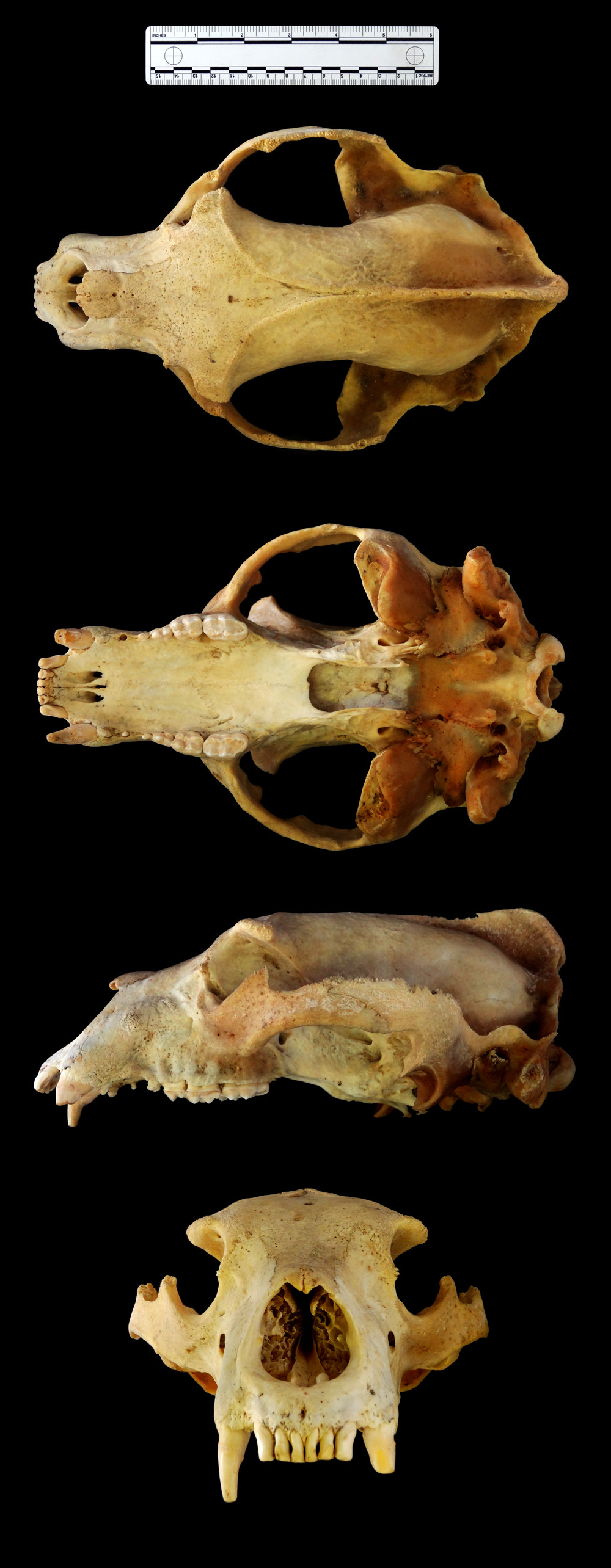
Last Friday I gave you this mystery skull to identify, which I discovered in a box of unidentified bits and bobs:
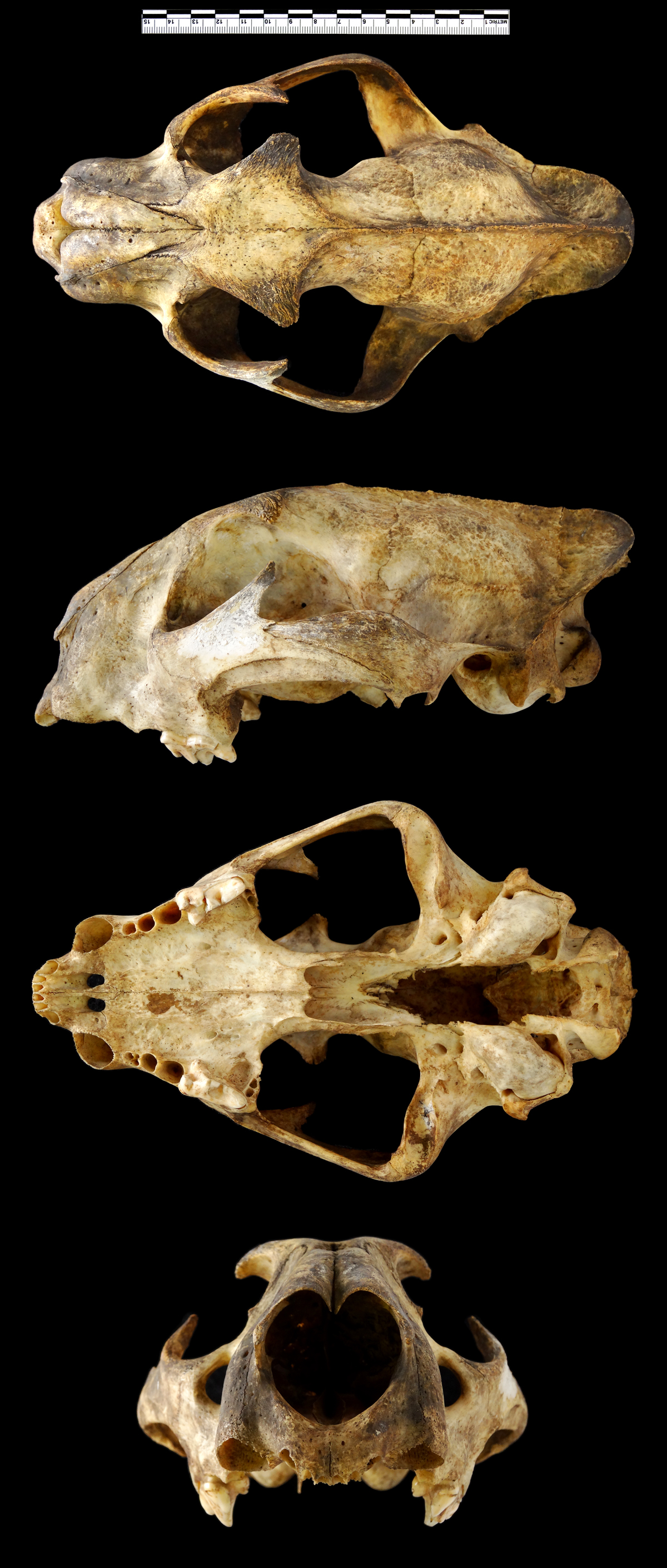
mystery234

It was pretty obvious that it was the skull of a big cat of some kind, with most of you suggesting a Jaguar or Cheetah (either of which would make me very happy as we have the skull of neither in the Horniman collection). Unfortunately it appears to belong to neither.

As I’ve mentioned  before, cats are quite difficult to differentiate from each other as they haven’t been diverging for all that long and their widespread distributions can mean that populations within a particular species can be quite variable in morphology. Leopards are a good example of this, with a (once continuous) range from Korea to South Africa.

Global distribution of the leopard (Panthera pardus) by Tommyknocker

Global distribution of the leopard (Panthera pardus) by Tommyknocker

As it turns out, this specimen is most likely from a Leopard Panthera pardus (Linnaeus, 1758), since it’s from an adult animal (as is clear from the well formed sagittal crest) but is on the small side for a Lion or Tiger and too big for a Cougar or Cheetah. It also lacks the broad post orbital region seen in the Cheetah and Snow Leopard, and it lacks the concave profile of both the Snow Leopard and Jaguar. All of these identification pointers can be found in this handy pdf by Margaret “Cookie” Sims.

Just to show you what I mean about the variability within a species, here’s a second skull from the same box, that also matches the Leopard identification.

Leopards

I expect the big difference in size is largely down to sexual dimorphism, but as you can see the overall proportions are quite different as well. This may be a difference between widely separated populations, or it could just be individual variation – either way it goes to show that cats are hard to identify.

Friday mystery object #234

This week I have a mystery skull from the collections of the Horniman Museum & Gardens for you to have a go at identifying:

mystery234

The family it belongs to may be easy to work out, but as we’ve experienced in the past, the species can be more difficult to establish.

Cryptic answers would be much appreciated, to give the less experienced a chance to work it out. Have fun!

Friday mystery object #233 answer

Last Friday I gave you a variety of mandibles to have a go at identifying. They lacked a scale bar and represented a range of different species that have similarities in mandible shape.

There were some great cryptic suggestions of identities, but it must be said that Jake came through with a really clear and pretty much spot-on list of suggestions. So here are the answers in a handy form that might be useful for reference:

mystery233b

The Sheep and Cow have a distinctive upward inflexion at the end of the mandible, with the Cow’s being so strong that the incisors start above the level of the top of the molar tooth row – unlike the Sheep’s.

This inflexion is much less marked in the Red Deer, which has a narrower body of the mandible, presumably relating to the less intensive chewing of a browser compared to grazers (grass is tough stuff). The Deer also has a notch along the bottom of the jaw, which Jake pointed out as a useful feature.

The Pig mandible tapers less overall, but is thicker at the end with the articulation – presumably because the omnivorous Pig is chewing differently, using the temporal muscles more than the masseter muscles and therefore needing a different area of the jaw for muscle attachment. The teeth are also pretty distinctive. Like the Pig, the Donkey mandible lacks the long and hooked coronoid process, but is also very triangular in shape with quite squared teeth – features typical of an equid.

So hopefully that gives you some pointers for telling some common herbivore mandibles apart when you don’t have a scale bar – a more common problem for some of us than you might think…

Friday mystery object #233

This Friday I have a challenge for you. Can you work out which five different species these mandibles come from?

mystery233

They are all different sizes and the lack of scale bars is deliberate – this is about trying to find useful features from the shape rather than the size, It’s not easy!

You can put your answers in the comments section below. Good luck!

Friday mystery object #232 answer

Last Friday I gave you this nice robust skull to identify:

mystery232

There was a healthy discussion about possible identifications, with the importance of scale mentioned more than once (by Jake, palaeosam, Lena and Robin Birrrdegg). Not only is this a robust skull, it’s also quite large, ruling out the British carnivores – and it clearly is a carnivore judging by the canines and the well-defined sagittal crest.

The lack of cutting and puncturing premolars and molars means that cats, dogs, hyaenas and other very carnivorous large carnivores can be ruled out, narrowing down the likely options in the right size range to the bears, as recognised by palaeosam, Ric Morris, Robin Birrrdegg, Will Viscardi, cromercrox, cackhandedkate, Lena, Daniel Calleri, henstridgesj and Carlos.

The species is a bit more difficult to work out, but the big sagittal crest and fused sutures suggests that this is not an juvenile bear, meaning it’s too small for a bear of the Brown  or Polar variety. That still leaves quite a range of other possible bears, but the pronounced forehead and long square muzzle rules out the Giant Panda, Sun Bear, Spectacled Bear and Asiatic Black Bear, while the big robust incisors rule out the Sloth Bear. That leaves the American Black Bear Ursus americanus Pallas, 1780.

Ursus americanus by Mike Bender/U.S. Fish and Wildlife Service, 2008

Ursus americanus by Mike Bender/U.S. Fish and Wildlife Service, 2008

So well done to cromercrox, Carlos and Robin Birdeggg who all got the species correct!

Friday mystery object #231 answer

Last Friday I gave you this distinctive skull to identify:

mystery231

I knew it would be a bit of an easy one, given the highly unusual teeth, but it seemed too interesting a specimen to not use.

As cryptically suggested by many of you (Jamie Revell, Nigel Monaghan, henstridgesj, rachel, cromercrox, Robin Birrrdegg, Allen Hazen and Crispin), this is indeed the skull of a Crabeater Seal Lobodon carcinophaga (Hombron & Jacquinot, 1842).

Jerzy Strzelecki, 2000

These seals are specialised for catching krill, hence the strange shape and tightly fitting nature of their teeth, which act as a filter to strain the tiny crustaceans from ocean water.

Because these seals live in the waters all around the Antarctic, monitoring their population is particularly difficult, so estimates of their numbers vary considerably, from 2 million to 12 million (which is the more likely figure).

As with most abundant animals they have predators, in particular Leopard Seals. Apparently 78% of adult Crabeaters bear scars of Leopard Seal attacks, which can be seen clearly on the live individual in the image above. Most of the attacks happen before the Crabeaters reach a year old and get a bit too big to be easy prey, but in that first year there is apparently a huge mortality rate, with only 20% of seals making it to their first birthday. Good old Mother Nature is never one for sentiment.

Friday mystery object #231

This week I have a very distinctive skull for you to identify:

mystery231

Because I expect some of you to work out what it is straight away, can you make your answer cryptic please, to give other people an opportunity to work it out.

I look forward seeing some cunning and clever hints at what this is!


Friday mystery object #230 answer

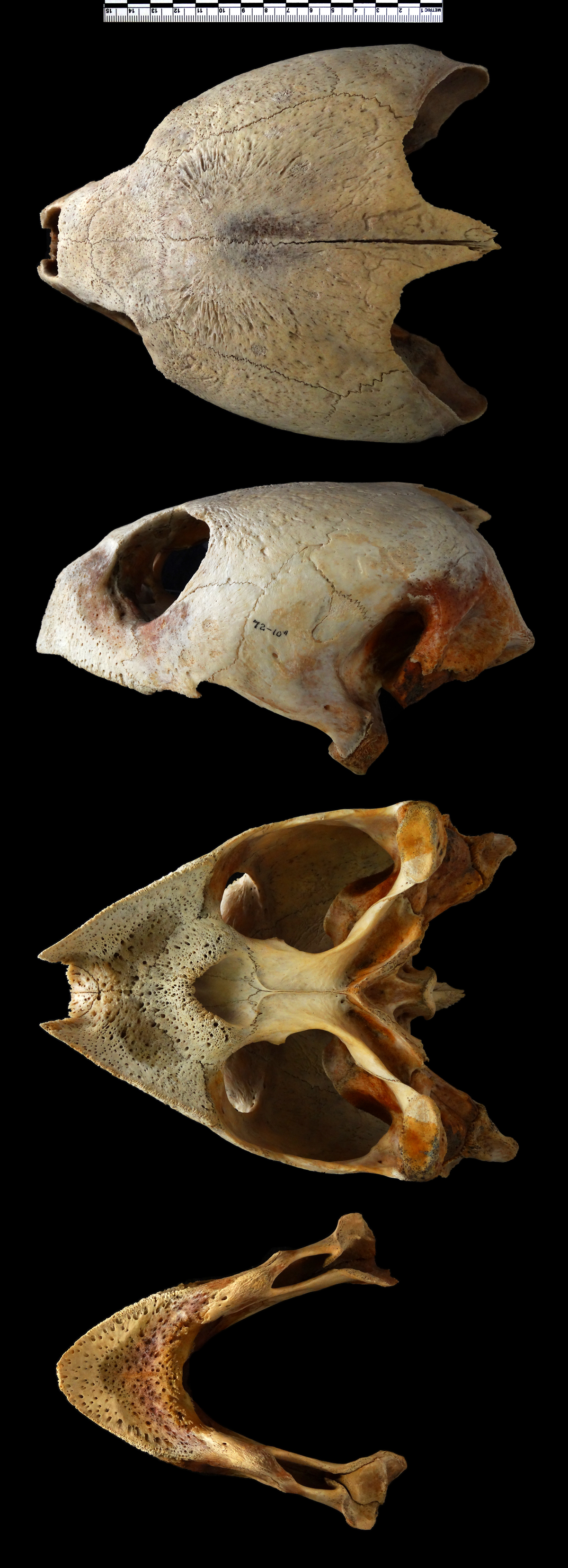
Last Friday I gave you this skull to identify:

mystery230

It was obvious to everyone who had a go at answering that it was the skull of a marine turtle of some sort, but that’s where it got a bit more tricky. There are only seven species of marine turtle, but their skulls all look quite similar to the untrained eye – mine included.

However, when I found this specimen I decided to improve my skills and I searched for a decent identification guide for turtle skulls, which I was fortunate to find hosted by Florida Atlantic University.

Checking through the characters I discovered that the palate of turtles can be very helpful in identifications, so here’s a colour coded and labelled diagram prepared from the image above that should help illustrate a key diagnostic feature:

Loggerhead_palate

As some of you may have noticed, the maxilla (tinted red) on either side of the palate meet in the middle, which is a characteristic only seen the Loggerhead Caretta caretta Rafinesque, 1814. The other turtles have the maxilla separated by the vomer (tinted green). Well done to  mark b, cromercrox and donald who managed to get the right turtle species!

Loggerhead Turtle. Photo by ukanda, 2006

Loggerhead Turtle. Photo by ukanda, 2006

These large marine turtles will eat pretty much anything they can find, from jellyfish to crabs and sponges. Unfortunately that includes things like plastic, which causes all sort of problems for their digestive system. Just one problem that they face, on top of getting tangled up in fishing tackle and poor survival of their young due to predation from pretty much everything (from foxes to crabs and gulls to sharks). Sadly, it’s not much fun being a turtle.

Friday mystery object #229 answer

Last Friday I was at the SPHNHC, NatSCA and GCG joint conference in Cardiff, which provided a fantastic opportunity to catch up with natural science curators, conservators and collections managers from all over the world, but which gave me limited time to spend on the mystery object.

As a result you ended up with an object that made an appearance in a ‘feely box’ at a fun pub quiz organised by guys at the Oxford Museum of Natural History.

Feely boxes in action

Feely boxes in action

Lurking within...

Lurking within…

It’s not the prettiest object but it’s characteristic shape and structure makes it readily identifiable using touch.

Jake spotted that it was a horizontal section through a skull, including the palate and Maxine and Julie Howard recognised the tusk alveoli extending from the maxilla, and correctly suggested Pumbaa, or Warthog Phacochoerus africanus (Gmelin, 1788).

Touch is an often under-appreciated sense in science, but it can be used to identify some specimens and provide a new perspective on the evolution of forms in nature. This is something I came to realise when working at the National Museum of Ireland – Natural History in Dublin, where I was fortunate enough to meet evolutionary biologist Dr Geerat Vermeij, who has been blind since birth, yet is able to identify shells to species and read part of their life history from touch alone.

Geerat Vermeij, Evolutionary Biologist, Reading A Shell’s Story from Shape of Life on Vimeo.


Bonus mystery object

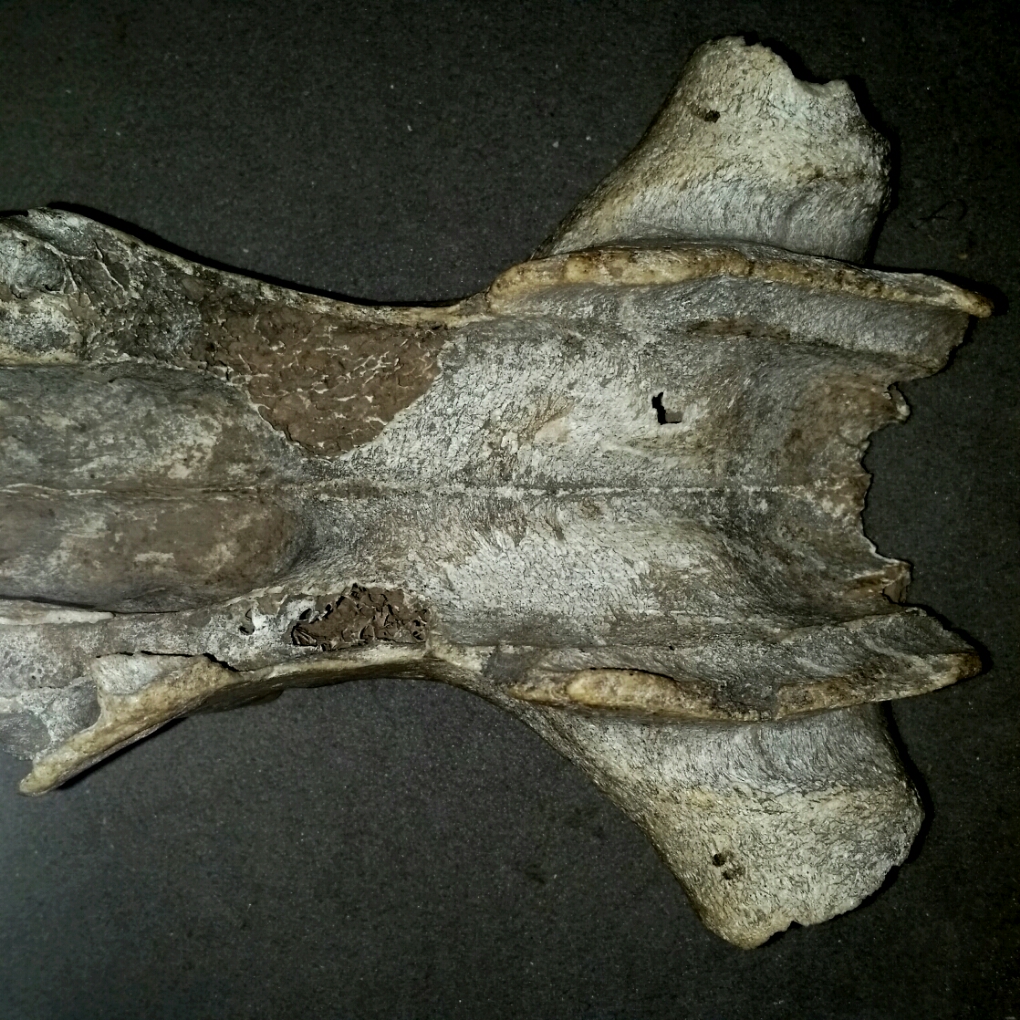
I usually offer up a mystery object on Friday, but here’ a bonus object that landed on my desk this morning.

image

Apparently it was found in a horsefield in Kent, I have narrowed down the likely species of the animal that ‘donated’ the bone to a couple of options, but thought you might like to have a go as well, before the specimen is handed over to our Anthropologists to inspect the engraved designs.

As usual can can leave your comments below. Have fun!

Friday mystery object #228 answer

Last Friday I gave you these bits of mystery forelimb (scapula and humerus) to identify:

mystery228

I thought it would be an easy one, since it’s from a very common species with a near global distribution – plus the humerus has quite a characteristic crest along the proximal end, from the shoulder articulation to the middle of the bone.

Most people who commented noticed this crest and Jake suggested that it had adaptive features (along with the scapula), maybe for a specialised way of life.

As it turns out, these bones come from an animal that is probably best described as a specialist generalist – a Brown Rat Rattus norvegicus (Berkenhout, 1769).

Rattus norvegicus, the Brown Rat. Image by National Park Service

These versatile and intelligent animals are very good climbers and brilliant swimmers, using their forelimbs to both get around and manipulate food.

This particular rat was a male pet rat purchased from Harrods in October 1960 – I get the impression it didn’t survive for that long, since the humerus head hasn’t fully fused. You can’t buy pets from Harrods any more, so this specimen not only shows us what a rat’s humerus and scapula look like, but it also represents a teeny-tiny piece of British history.

Friday mystery object #228

This week’s mystery object is a bit of a break from the cat skulls. Any idea what these two bones are and what species they’re from?

mystery228

As always, you can put your thoughts and suggestions in the comments section below, but if you think it’s easy please try to be a bit cryptic in your response, to give other people a chance. Enjoy!

Friday mystery object #227 answer

On Friday I asked you to spot the differences between these two cat skulls and I wondered whether anyone could identify them:

mystery227

Both henstridgesj and Allen Hazen made some good observations, the first being about the difference in size, then about morphological features that I’ve marked on this image:

comparing_cats

Now henstridgesj also correctly identified one of the skulls – the one on the right of the image is from a Domestic Cat Felis catus Linnaeus, 1758.

As it turns out, this was a bit of a trick mystery object, since BOTH of the skulls belong to Domestic Cats, so this gives us a useful idea of the kind of variation we might expect within a species.

I think that the main cause of variation between these two animals is probably sex, with the male on the left and the female on the right. There may also be differences based on age (although I don’t think that’s a major factor), breed and perhaps disease (the larger specimen looks like it had an infection that affected the surface of the bone).

After taking various measurements, the most useful difference I’ve found between the two skulls is shown with the yellow line. I think that the ratio of these two measurements may provide a way to tell the difference between a male and female cat (in the male it’s around 1 or less than 1, in the female it’s greater than 1) but I’ll need to make a LOT more measurements to test this.

Two other ideas that could be tested were suggested by henstridgesj and Allen Hazen. Allen said: “My impression is that the presence and development of sagital crests, among felidae, correlates pretty strictly with size” and henstridges said: “It seems that if the species of cats are arranged in increasing size order, then the anterior half of the skull (forward of the frontal-parietal suture) seems to increase in size more than the posterior half”.

I’d better take a look to see if this has been tested before…

Friday mystery object #227

This week I thought I should mop up the last of the smaller cats as a spot-the-difference:

mystery227

What do you think are the diagnostic features that separate these two skulls (bonus points for species identifications)?

I’m really keen to get your thoughts on this, so please put your observations in the comments section below. Thanks!

Friday mystery object #226 answer

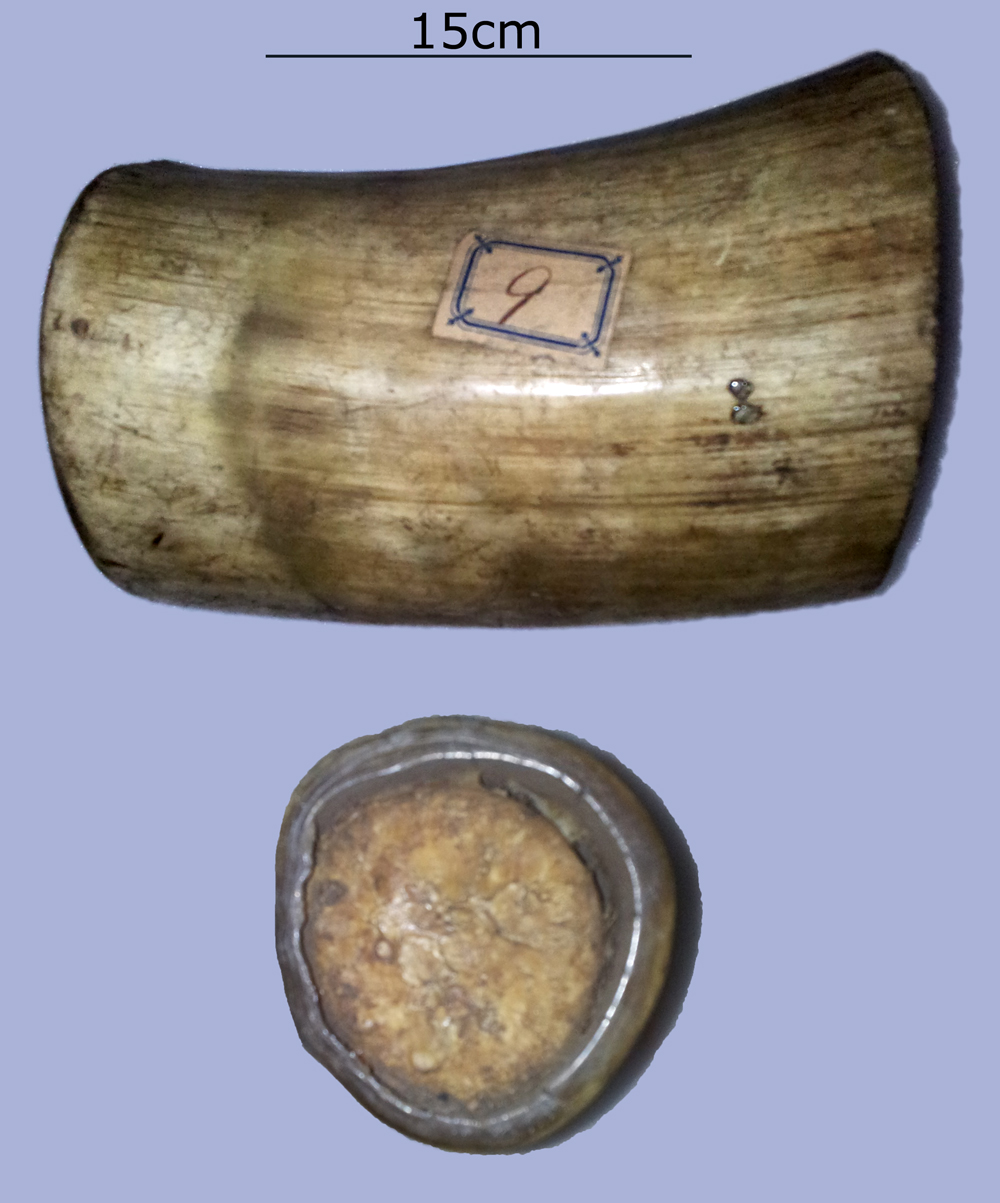
Last week I gave you this rough and ready mystery object to identify:

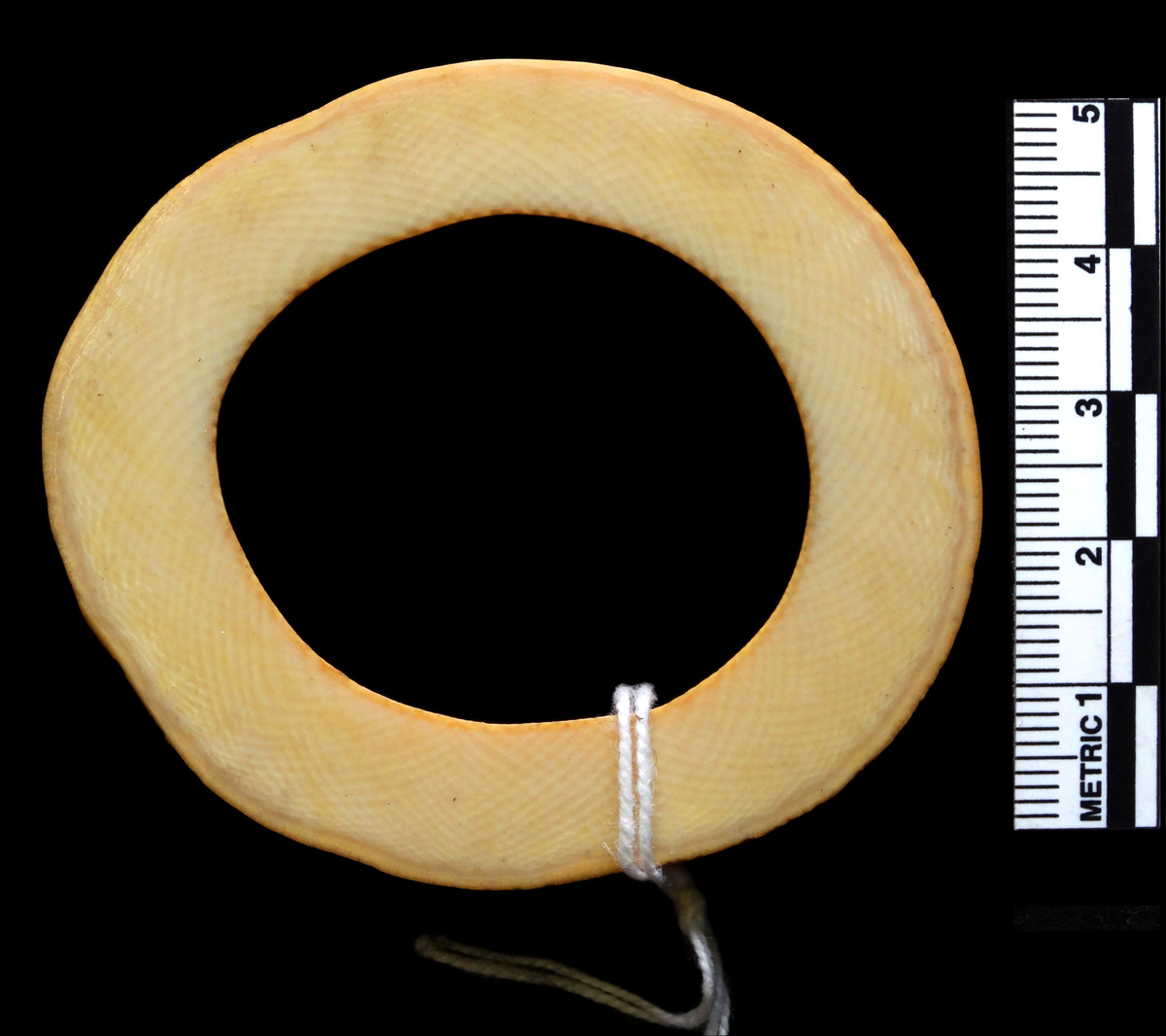
mystery226

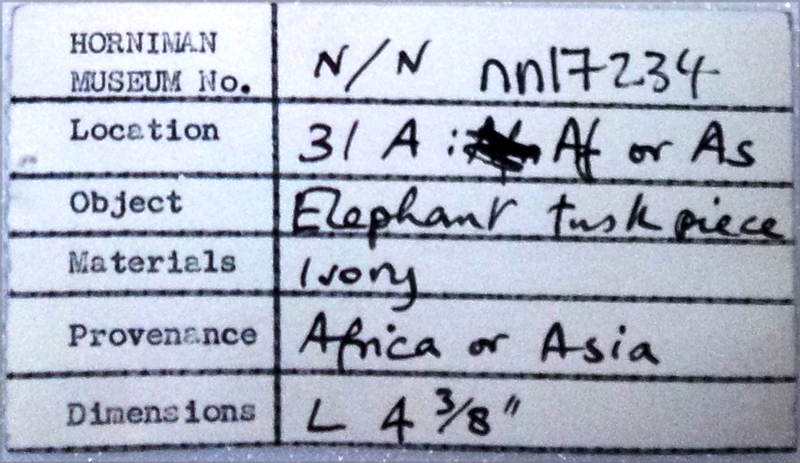
I thought it might be a bit of a challenge as it had originally been misidentified as a piece of elephant tusk by someone in the museum, many years ago, so it was obviously not a straight-forward identification.

mystery226-label


One of the key identifying characteristics of ivory are the Schreger lines, as pointed out by Carlos and rachel. These lines are an optical effect caused by light interacting with the dentinal tubules that provide the structure of the tusk:

Schreger_lines

Tusk section showing Schreger lines

However, these lines aren’t always visible and it will depend on the angle of the cut of the tusk and the angle and intensity of the light.

Another factor to keep in mind is the nature of the material. If you look at a cut section of elephant tusk you note that you get clean edges, because the tusk is quite hard and keeps its structure when cut. It can also show faint growth rings, radiating from the pulp cavity (nearer the tip the cavity is filled in):

elephant_tusk_section

Section of elephant tusk showing clean edges

Instead, the mystery object has a very rounded edge and no clear structure. This suggests to me that it’s horn that has been treated with heat to mould it into shape (keratin that makes horn and hair has thermoplastic properties, which is why hair straighteners work).

So what this mystery object appears to be is a piece of bovine horn – probably cow – that has been melted and shaped at one end to form a cup. The superficial similarity to elephant tusk may or may not have been accidental, after all, elephant ivory is a much sought after material.


International Museum Day: why are museums important?

Today is International Museum Day, which provides a nice opportunity to share some thoughts on why museums are important for society.

Museums are a source of knowledge, enjoyment and inspiration

The first point is that they contribute to the economy – in the UK tourism is a significant contributor to the economy, accounting for  9.0% of GDP, so tourism is big business. Why do tourists come to the UK? Because we have things they want to visit of course – things like museums. 32.8 million tourists came to the UK last year and they made 21 million visits to the 16 DCMS sponsored museums. It’s probably not unreasonable to say that an estimated 64% of tourists to the UK visit museums as part of their experience, bearing in mind that there are around 1,800 accredited museums in the UK, there’s a pretty good chance that the total number of tourist visits to museums in the UK is quite a bit greater than that 21 million.

recent report on tourism by Deloitte recognises this and explicitly states:

The supply side offer of tourist infrastructure also extends to attractions, and standards in this area can have a significant influence on the appeal of the overall tourism offer of the UK. Some of Britain’s most well-known attractions have long suffered from inadequate infrastructure, such as parking, visitor centres, and museums and educational facilities. It will be important for Britain to maintain and improve in this infrastructure as competitor destinations invest in infrastructure which may risk diverting visitors away from the UK.

In addition, museums generate revenue at a more local level, attracting visitors who need to eat and drink, or buy things from museum shops, like greetings cards, plastic dinosaurs and copies of brilliant books like Jake’s Bones.

jakesbonesbook

Museums aren’t just scrounging from the government, they generate revenue and contribute to the local and national economy

Beyond the immediate economic argument, museum collections provide a physical record of the life and culture on our planet, both past and present. They provide the hard evidence to recognise and describe the different species on Earth and they provide a historical record of how things once were, for comparison against the present, helping us to better understand change and make better predictions for the future. So museums can help us shape a better future by understanding the past and present.

Museum collections document the amazing diversity of life and the diversity of human material culture

Part of this role is fulfilled by making collections accessible to the public for their information, education and entertainment (because entertainment helps us learn too – I’m a big proponent of informal learning). However, there is also a need for research that feeds into academia and the informing of local, national and international policy decisions.

Even research that doesn’t seem to have immediate practical application is useful for testing ideas, exploring human creativity and gaining a deeper insight into other people’s minds and cultures. This sort of work may not rock the world of politics or science, but it can be effective for engaging the public and encouraging a deeper interest in topics that have a benefit to society that, at least to my mind, stretches far beyond the outcome of the X-Factor finals or which minor celebrity is divorcing which other minor celebrity.

Museums are there to nurture, support and inspire a fascination with the wider world, and really that’s why I think they’re important.

Friday mystery object #226

A rushed mystery object today I’m afraid, as I was doing talks at a late event last night and I have a painfully early start this morning – plus I’ve not been in the stores this week, so no opportunity to get a good mystery object to photograph!

So here’s an object that I was asked to identify a while back, that I took some snaps of on my phone. Apologies for the poor image quality:

mystery226

Any idea what this might be? As usual you can put your observations, questions and suggestions in the comments section below.


Friday mystery object #225 answer

Last Friday I gave you this felid skull to identify:

mystery225

As with the other cats over the last few weeks, it’s been difficult to find really clear diagnostic features.

The size helps narrow down the possibilities and the lack of divided auditory bullae rules out some of the species of Lynx, as does the presence of the small first premolar.

However, beyond that there isn’t much to really differentiate this cat from other species, apart from general features of relative proportion (height vs width vs length) and perhaps the angle of the rear part of the sagittal crest (which will probably vary between individuals).

Nonetheless, henstridgesj managed to correctly identify this as an Ocelot Leopardus pardalis (Linnaeus, 1758), one of the largest of the small cats in South America.

Ocelot, 2003 from US Fish & Wildlife Service, Image Archive

My challenge is going to be find a way to pull together the variety of cat skulls we’ve had for the last few weeks, to help make cat skulls a little easier to identify in the future – if that’s even possible. No pressure…