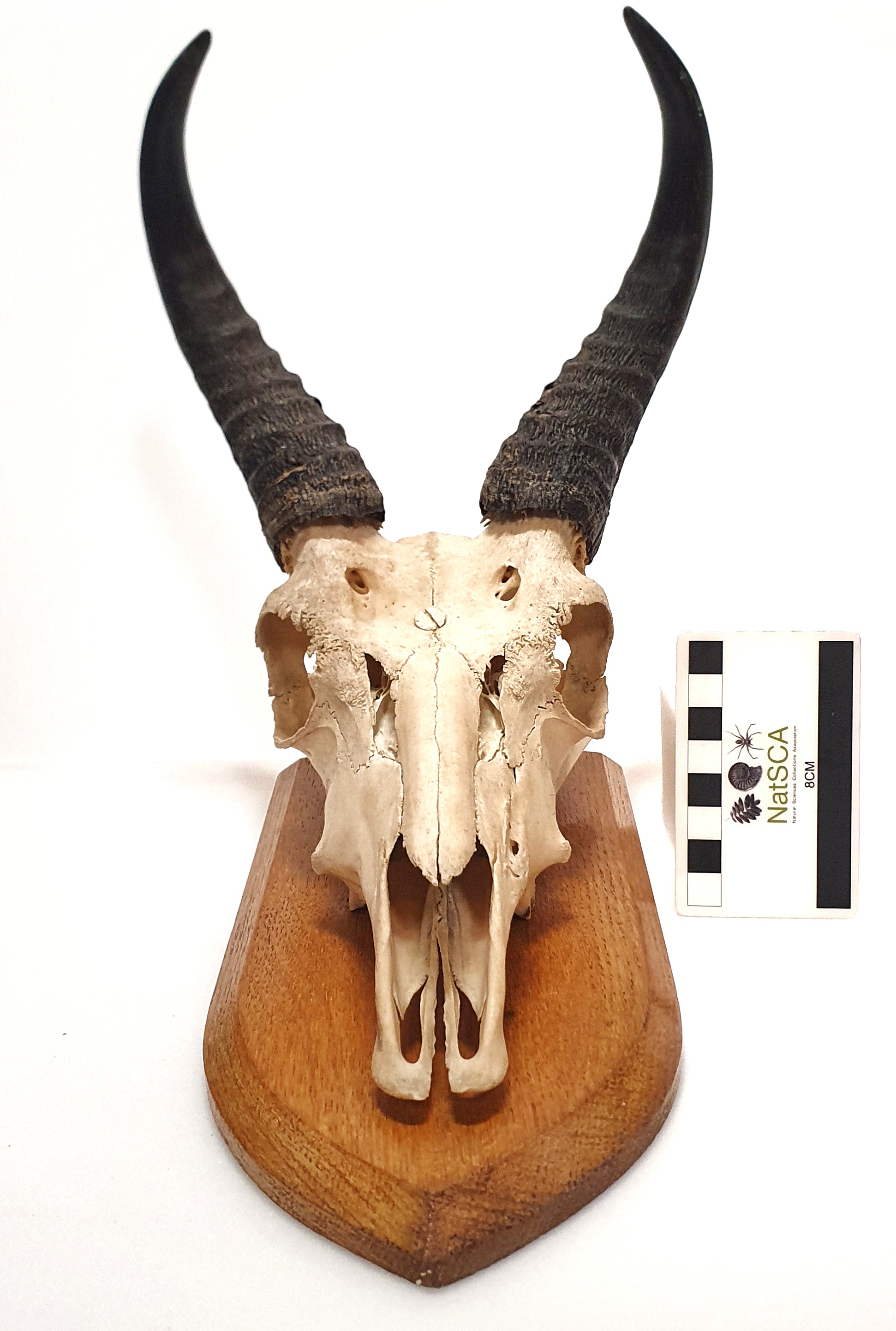
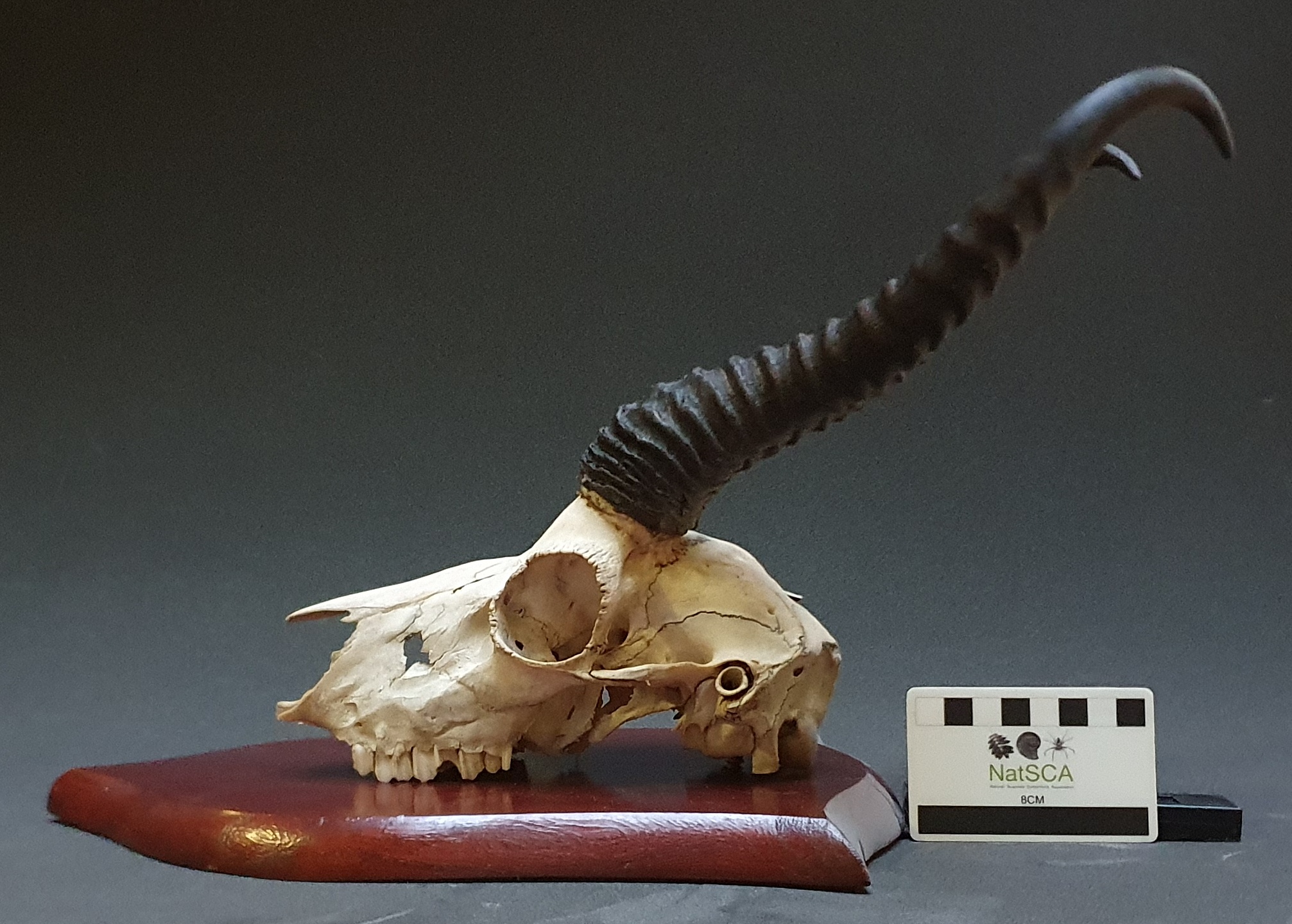
Last week I gave you this skull from the Dead Zoo to have a go at identifying:
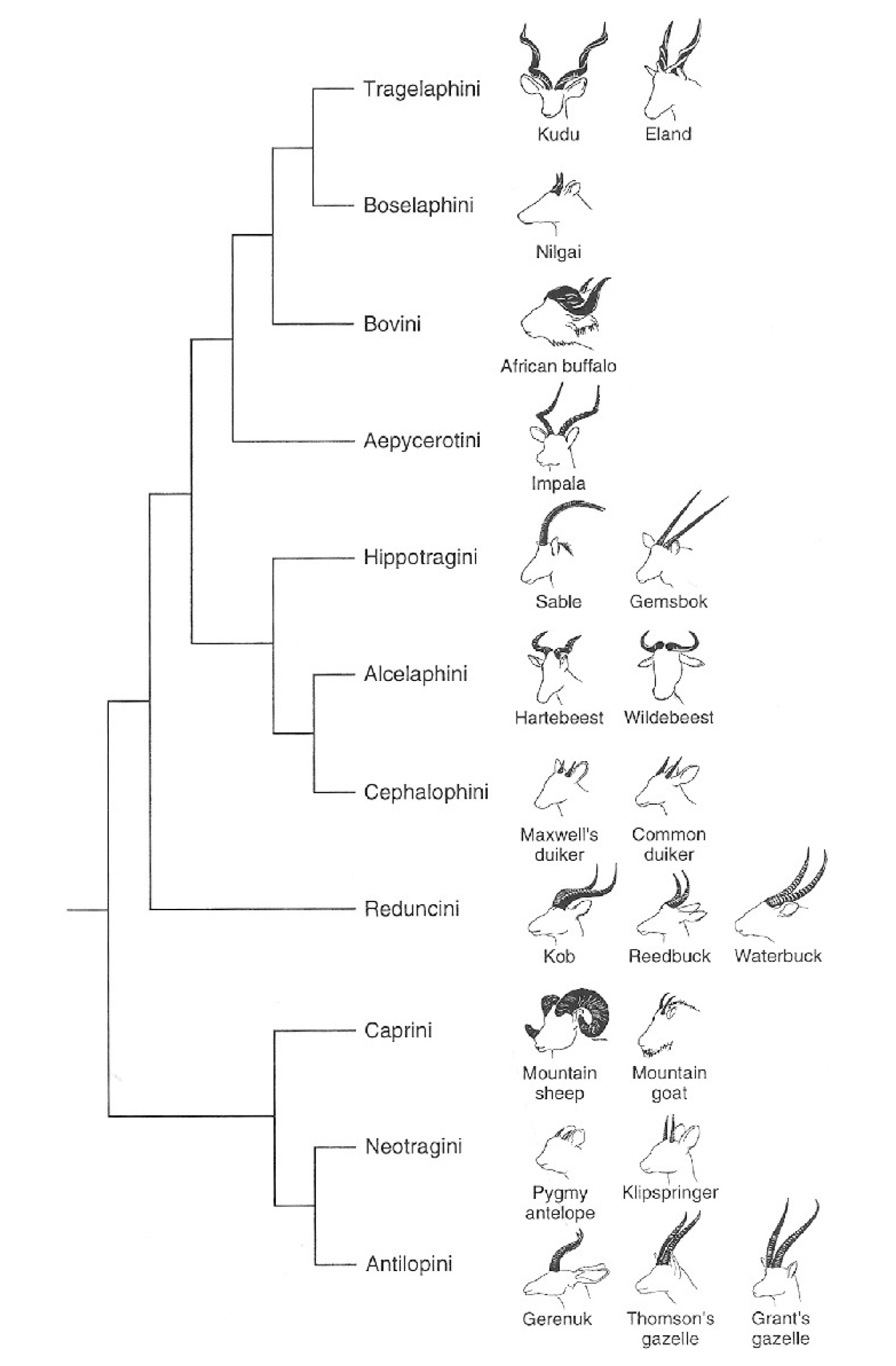
Obviously the horns let us know that it’s some kind of bovid, but as has been noted before, there are a LOT of bovids. Overall horn configuration is a useful indicator of which general part of the bovid family tree to consider and I always find myself needing to check references to make sure I remember the general configurations.
A very helpful overview of horn morphology for the main subfamilies within the Bovide is illustrated by M. Van Bolt in a paper by Barbara Lundrigan from 1996*
Horn morphology in the main subfamilies within the Bovide. Illustrated by M. Van Bolt in Lundrigan, 1996*
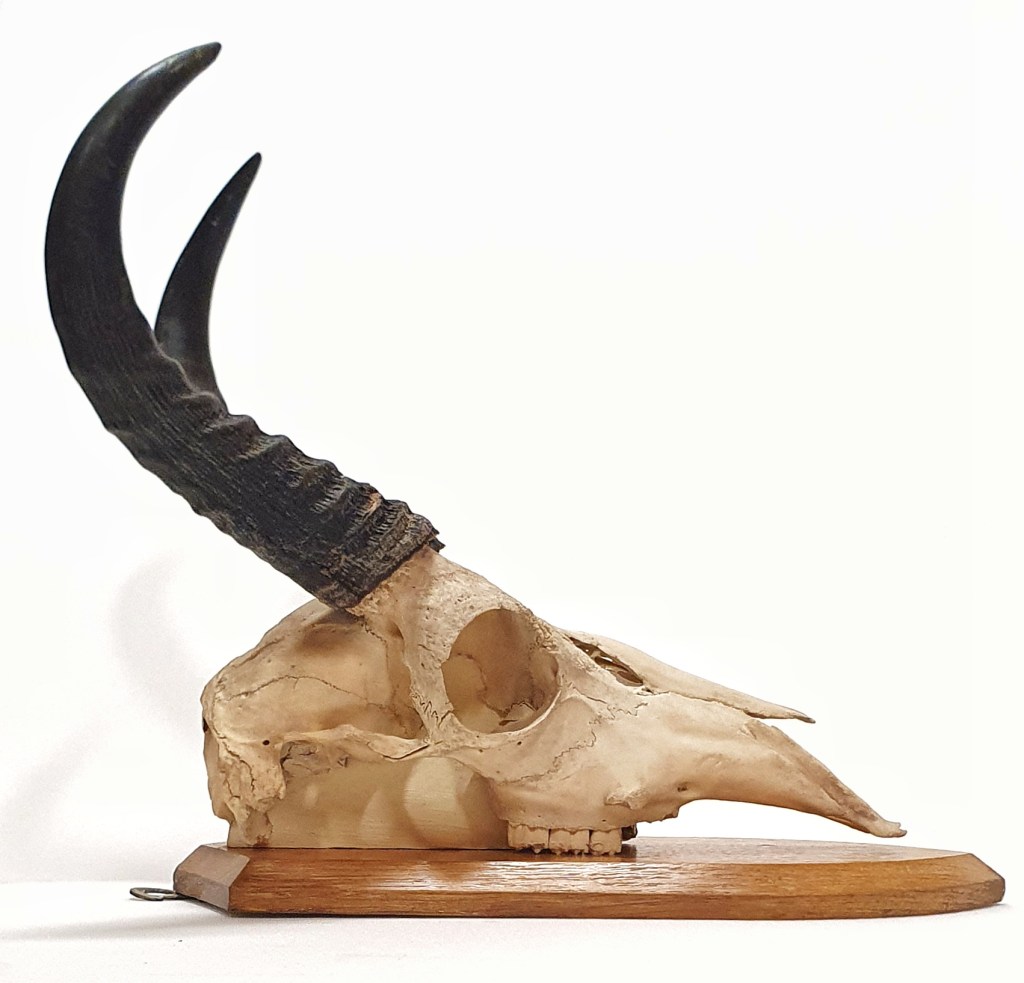
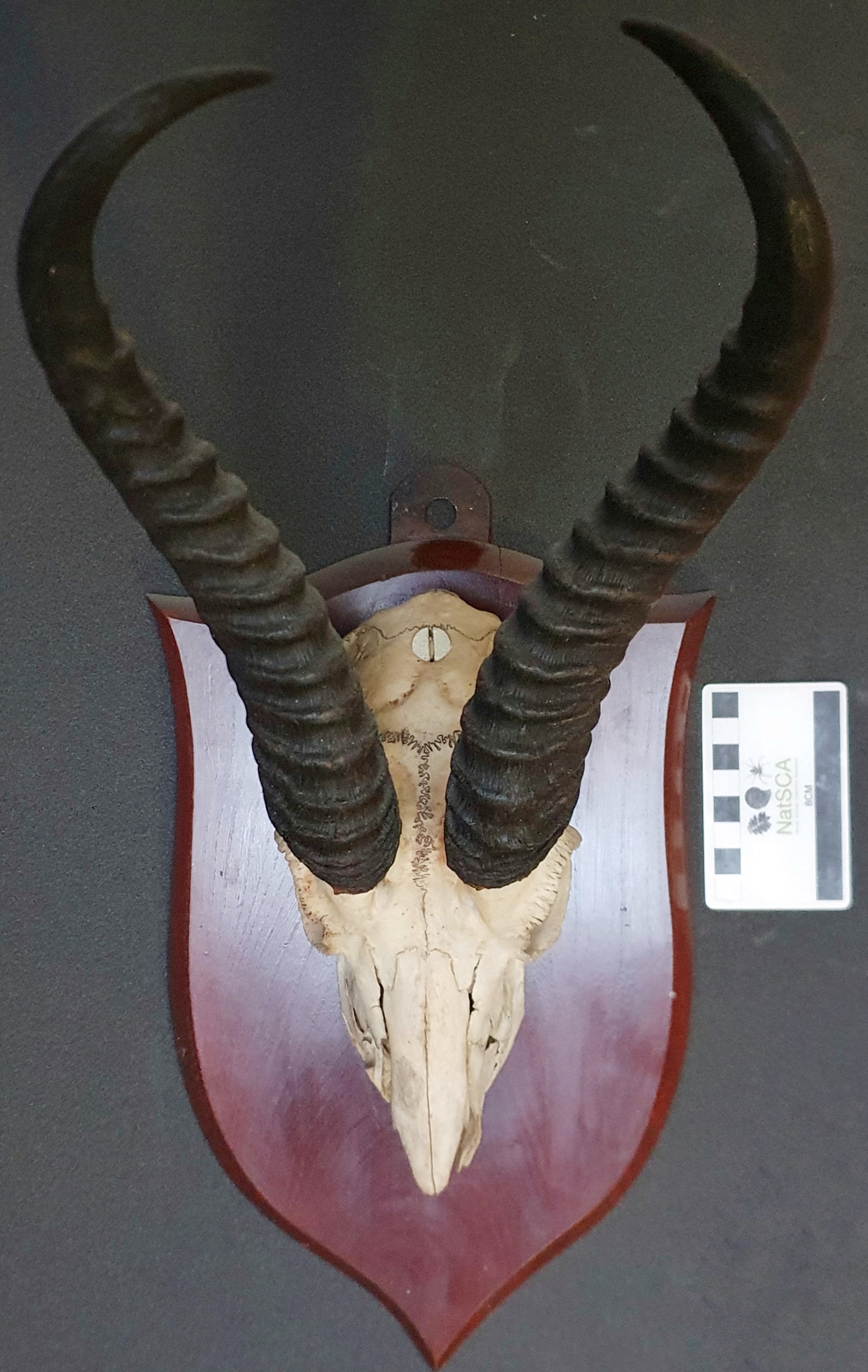
Capturing the horn angle accurately in a photograph can be quite tricky, which is why I provided more than one angle:
A quick check shows that the horn shape of this specimen is distinctively Reedbuck. There are three species in the Genus Redunca, with fairly clear differences in things like the proportions of the maxilla and the shape of the orbit, but again the horns offer a clue.
Mountain Reedbucks have short horns, only in the region of about 15cm, a bit on the short side for this specimen, where they look to be around 25cm or so. The Southern Reedbuck has much longer horns in the range of 35-45cm, a bit bigger than this specimen. That leaves one Goldilocks species with horns 25-35cm long – the Bohor Reedbuck Redunca redunca (Pallas, 1767).
So well done to everyone who recognised this as a Reedbuck and special props to Goatlips who suggested Bohor Reedbuck. Hopefully the illustrated phylogeny I shared will help with future identifications.
Last week I finally got a chance to share a nice skull from the Dead Zoo for you to identify:
Bird skulls are always an interesting challenge, because the bill can give away some useful clues and there is a fantastic online resource available to help with their identification, in the form of SkullSite, run by Zygoma regular Wouter van Gestel. Perhaps unsurprisingly Wouter tends to be one of the first to get a correct answer when the mystery object is avian – and this one was no exception.
One of the useful features on SkullSite is the ability to do a custom search, which allows you to restrict the size range of skulls and the bill shapes to search through. This allows easy comparison between the skulls of possible taxa, making identification more straightforward, once you get your eye trained to recognise useful features.
In this case there are a few species in the same size range with similar shaped bills. The closest species in size and shape (that’s not a close relative) is the Great Bustard. However, the Great Bustard has much longer nares (the fancy name for nose-holes) than the mystery object and the bustard’s lacrimal bones (the small bones that flare out just to the front of, and above, the eye sockets) are much smaller and less pronounced than what we see in the mystery specimen.
That leaves the two species in the Family Cariamidae (or Seriemas) to pick from. The size of the specimen alone makes that fairly straightforward, as there’s around 15mm difference in the skull length between the two. However, if you want a morphological feature, the mandibular fenestra (the ‘window’ visible in the side of the lower jaw slightly back from the midway point) is proprtionally a lot larger in the Black-legged Seriema compared to that of the Red-legged Seriema.
The fenestra is small in the mystery object, while the skull is large, making this a specimen of the Red-legged Seriema Cariama cristata (Linnaeus, 1766).
A Red-legged Seriema in Reserva Ambiental, Piraju, São Paulo, Brazil. Image by Dario Sanches, 2010
I tend to think of Seriemas as the South American equivalent of the Secretarybird, since they are ground-hunting predators in scrubby environments that have a fondness for venomous snake snacks.
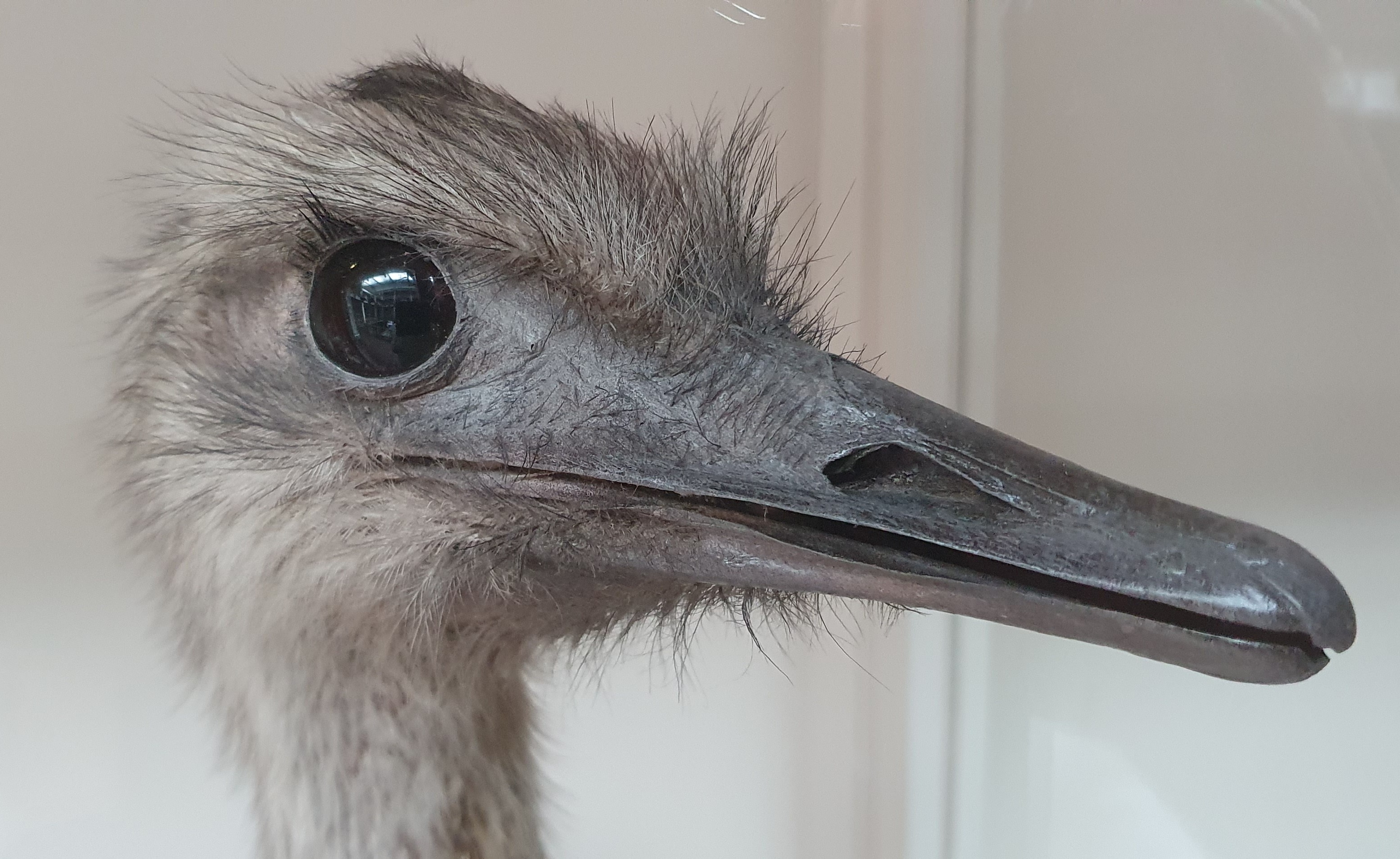
Both have long legs and small feet, neither fly much and both have eyelashes, as pointed out by Goatlips on Twitter:
I’d never really consider the bird eyelashes thing and it makes perfect sense for terrestrial birds foraging on the ground in arid environments to have some extra eye protection from sun and dust afforded by filamentous feathers around the eyes. It turns out this holds true for birds like Ostriches, Emus, Cassowarys, Rheas, Road-runners and the Ground Hornbills.
However, some other Hornbills that live in very different environments also have eyelashes as do those odd arboreal Hoatzins, so there must be something else going on with those lovely lashes that I’m missing.
I hope you enjoyed this bony challenge – please feel free to add your thoughts on the eyelash situation and perhaps mention any species you’ve noticed this feature in before. You never know, together we might figure out what those lashes are all about.
Happy Friday everybody! This week I have a genuine mystery object to solve from the Dead Zoo:
This specimen has no location information and only a generic name associated with it – the only other information is that it was collected by Major St. Leger Moore. That might help. Or it might not. Let’s see what you manage to come up with!
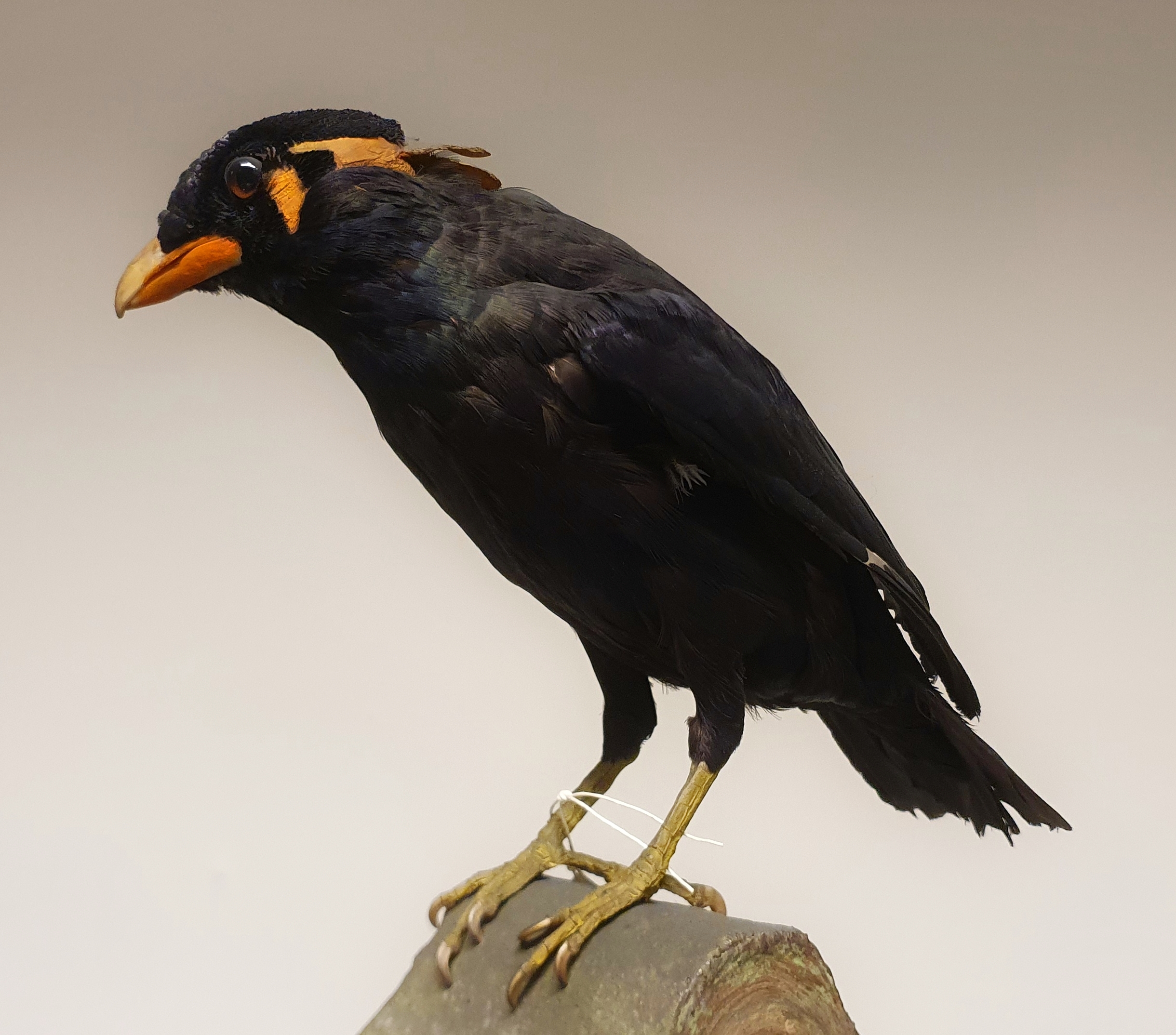
This week I’ve decided to go ornithological for the mystery object:
Do you recognise this feathery friend from the collections at the Dead Zoo? If you’re a keen birder and this is easy for you, maybe drop some hints rather than give it away. No matter your skill with bird identification, I hope you have fun!
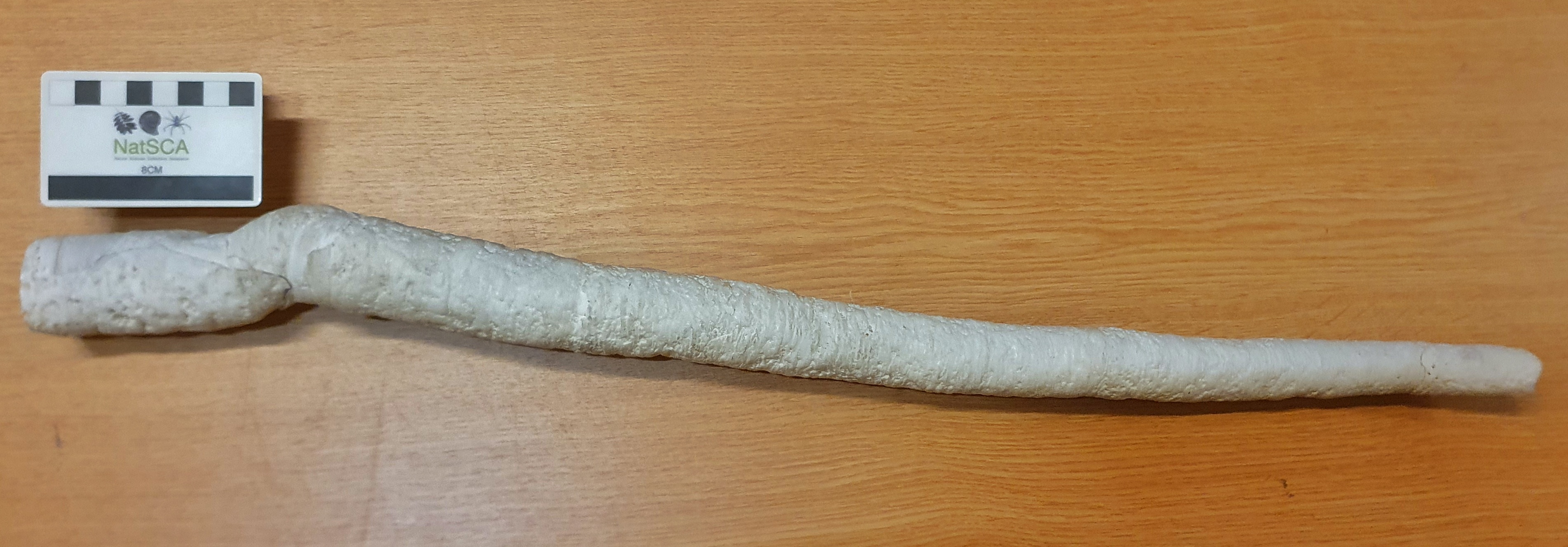
This week’s mystery object is one I’ve been sitting on for about seven years and I’ve held off posting it because I think it might not be much of a challenge for some of you. However, it’s an incredibly cool object and I think it’s time to share it:
If you know what this is, please keep your answers nice and cryptic so the people who don’t recognise it can enjoy the challenge. Have fun!
Last week we hit the 400th mystery object, which was this specimen from the Dead Zoo:
Horned beasties can be tricky since there are over 140 species in the Bovidae. There is quite a lot of diversity in size and in horn shape, but there are some general patterns, with spirals, twists, curves and recurves. A good place to trawl through for comparisons is the Animal Diversity Web, which has plenty of images.
However, this is one of the better known species, with nicely lyrate horns, so quite a few people recognised it without having to go searching. This is a Springbok Antidorcas marsupialis (Zimmermann, 1780), a South African antelope that has given its name to the nation’s rugby team. Well done to everyone who figured it out, particularly Goatlips, who got there first!
This specimen is one of 333 game heads that we’re in the process of decanting from the Museum, as part of a project that includes moving thousands of invertebrates and birds, as well as a couple of whales. If you’re interested in how we’re dealing with the game heads we recently reported on it at the NatSCA Conservation Twitter conference, which I’ve shared below:
1. The Dublin Dead Zoo has been largely unchanged for generations – a much loved museum of a museum that transports visitors back in time. Part of the timeless feel is created by the historic cases and game heads lining all available pillars and walls @Nat_SCA#NatSCAConservationpic.twitter.com/MgLAr34TZQ
2. Unfortunately, our historic building is in much need of renovation. In particular the roof has reached the end of its life and is in dire need of replacement.
3. Game heads are skulls or taxidermied heads, mounted on a trophy shield or hung directly on a vertical surface. They are old, heavy, fragile in places, inaccessible, dusty, pest damaged & often laden with pesticides such as arsenic and mercuric chloride #NatSCAConservationpic.twitter.com/p9mVN9U4M8
4. Safely getting the heads down took careful planning & discussion with @MWArtHandling
We couldn't use scaffolding due to lack of space & poor floor loading. We used ladders for access. Ropes and lifting straps were then used to lower the heads to the floor #NatSCAConservationpic.twitter.com/GslvO4tAym
5. We have no lift! 😱We needed an efficient way of packing, handling & transporting heads from the building. We chose to use a handling board, with a stretcher to carry it down stairs. The board allowed safe handling and provided securing points for transport #NatSCAConservationpic.twitter.com/qdrwmJTuy8
6. We chose strong boards 180mm thick, narrow enough to fit through the smallest doorway (750mm or less), and at a standard length (2m). A few oversized specimens needed bespoke boards.
7. The boards were heatsealed in Polyethylene and frozen at -30°C for a week to kill pests. To avoid damaging the plastic, sharp edges were taped & horns were capped with Plastazote. Fragile specimens were buffered with acid-free tissue to avoid freezer damage #NatSCAConservationpic.twitter.com/MjW8LoI7i0
9. After freezing & cleaning, the heads enter the main collections storage area. Depending on their condition and dimensions, they are either stored flat with cushioning against physical forces, or hung on mesh to minimise future damage but allow easy access #NatSCAConservationpic.twitter.com/mxpTttT3cd
10. So far we're about halfway through the decant of our game heads, but we're also moving other object ranging from worms to whales. To see more about the work we're doing check out the #DeadZooDiary hashtag on Twitter #NatSCAConservationpic.twitter.com/VuRR4R40Ok
All the decant work plus post-Christmas catching-up activity hasn’t left me much time to hunt down mystery objects, but I had this cutie in my office and I thought it might be a nice little challenge:
Any idea what it might be?
As always, you leave your questions, thoughts and suggestions in the comments below. Have fun!
Last year I gave you this mystery skeleton for you to have a go at identifying:
That erect stance and those super-short and chonky wing bones are a dead giveaway that this is one of those charismatic flightless waiter birds (and before you ask, yes the “i” is intentional).
There are around 20(ish) species of penguins or pengwings if you’re Benedict Cumberbatch.
Although the various species look superficially similar, with their black and white base colour scheme and tubby yet streamlined shape, they do have some distinguishing characteristics. Unfortunately, the most obvious relate to plumage and that’s missing here.
Size can help with narrowing it down – and this particular specimen is small. Admitedly it’s hard to tell that without a scale bar, but the large species have relatively small skulls in proportion to their body size, so they can be ruled out.
Bill length and shape can also provide some good indications even from non-skeletal birds and you can of course check out my favourite online resource (SkullSite.com) to see skulls of most of the main penguin genera, if not all the species (yet!). In the comments, James Bryant and Wouter van Gestel (creator of the aforementioned SkullSite) recognised that this is a Little, Blue or Fairy Penguin Eudyptula minor (J.R.Forster, 1781).
Little Penguin in the Melbourne Zoo. Image by fir0002, 2009.
This is the smallest species of penguin, it has breeding colonies in Australia and New Zealand and the population on Phillip Island has become a bit of a tourist attraction. They feed on small fish, like anchovies and pilchards or small invertebrates including squid and jellyfish.
There will be more mystery objects to come for 2021 – let’s hope this year works out better for everyone than 2020…
I’m going to start this week’s blog mystery object with an apology – it’s going to be a short one, as I’m in the final throes of taking down our Fin whale, which means I’m exhausted after several long weeks of hard graft. Check out the #DeadZooDiary hashtag on Twitter if you want to get an idea of what’s involved.
Last week I gave you this somewhat smaller skeleton from the Dead Zoo to have a go at identifying:
It wasn’t too difficult to narrow it down to one of a few species, thanks to the very distinctive knee region.
There are only a small number of birds that have adopted this extreme elongation of the cnemial crest on their tibiotarsus and patela. These are all specialist foot-propelled swimmers that need that long lever to help power their diving strokes. This is a feature limited to just the grebes and the loons/divers.
Most people figured out that this is the skeleton of one of the loons. The skull provides some clues, but unfortunately the angle of the photo doesn’t make it easy to figure out which of the five species it is.
The scale does rule out the larger of the species (Gavia immer or G. pacifica), but there are three other possibilities. For me the postorbital region suggests that this is the Arctic Loon Gavia arctica (Linnaeus, 1758), which fortunately matches the label.
I hope you enjoyed this weird kneed bird – congratulations to Goatlips and everyone else who figured it out!
Last week I gave you this bumpy little critter to identify:
I think everyone recognised the mystery object as some kind of Nudibranchia or sea slug. The general type of sea slug is identifiable by that ring of gill filaments known as a branchial plume that you can see at the top of the specimen. This is characteristic of the suborder Euctenidiacea, also known as the dorids.
I called it bumpy, but if you look closely you’ll see that the bumps are pinched at the base and actually look rather warty. There’s a clue in that – and several of you spotted it.
There were a number of wart-related nudibranch suggestions that were close, but jennifermacaire was spot on with her comment: Doris has warts?
This is indeed a Warty Dorid or Doris verrucosa Linnaeus, 1758.
This specimen isn’t quite as faded as everyone expected – they’re usually a fairly muted orange, yellow or a greenish colour, not too different to the mystery object. This probably serves as camouflage against the background of the Warty Dorid’s favourite food, the Crumb-of-bread Sponge, which also varies in colour from bright yellow to darker shades depending on the depth of the water in which they live.
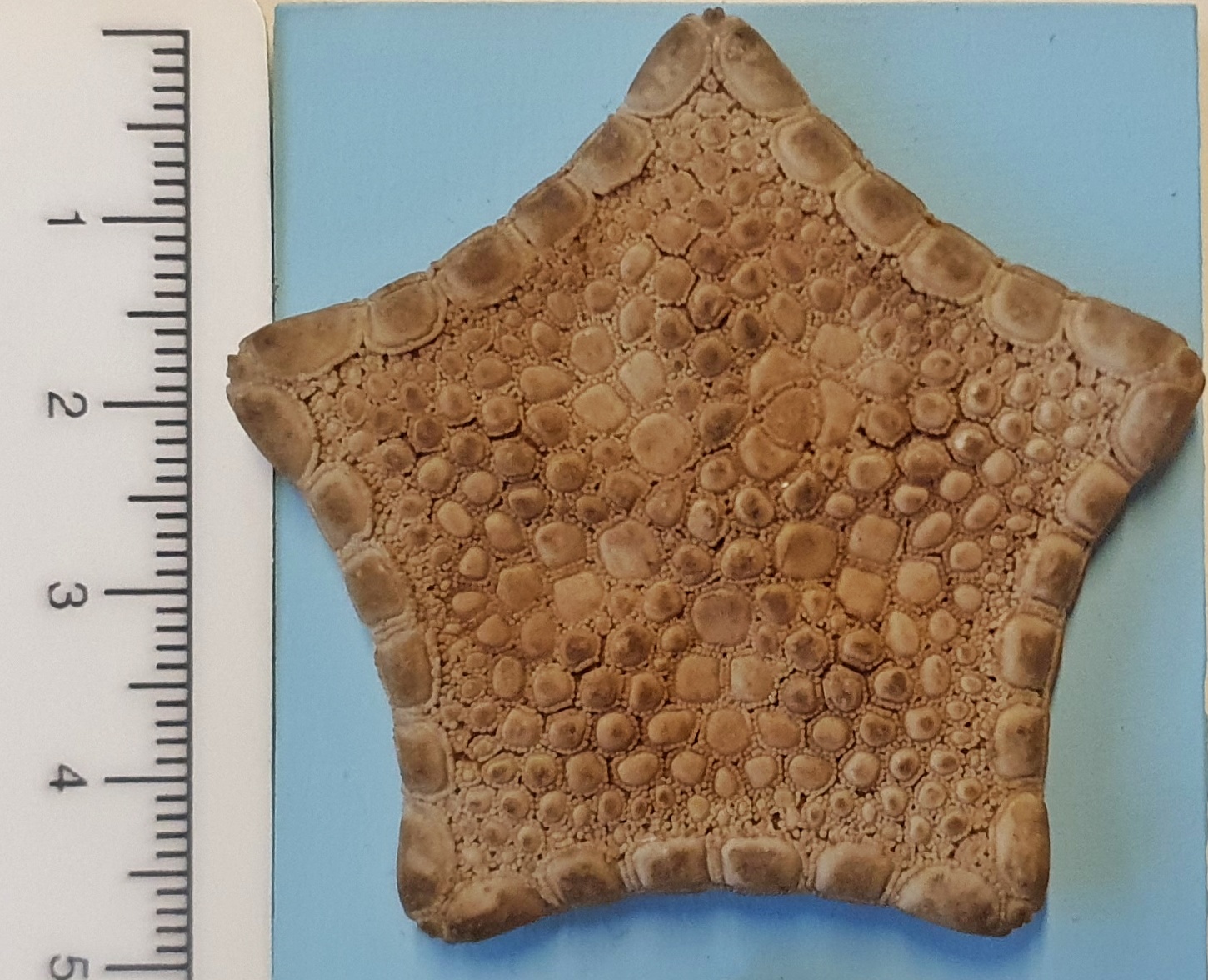
Last week I gave you this mystery object to have a go at identifying:
Clearly it’s some kind of sea-star, but there are a LOT of different species .
Remarkably, that doesn’t seem to have posed a problem. The five stumpy arms narrowed it down to one of the cushionstars or biscuitstars and it seems that was more than enough for some of you.
Salliereynolds flagged one of the diagnostic features and dropped a hint to the species name: “Six lumps to a side? From down under?”
But Goatlips took the mystery object to a whole new level with a biscuit recreation:
Last week I gave you this specimen from the Dead Zoo to have a go at identifying:
It was a bit mean of me to not include a scale, but several of you managed to work it out regardless.
The overall group is fairly easy to spot, since it has 10 legs, the front pair bearing claws (or chela if you want to get technical) and the main body area is rounded. So it’s a crab.
In addition, the long legs and small body give it an overall shape reminiscent of a spider, so it’s a good bet that it’s some kind of spider crab.
Now, there are quite a lot of types of spider crab out there, but that sub-triangular body shape and those long legs help narrow down the possibilities further. In fact, it does share some similarities to the gigantic Japanese Spider Crab.
Japanese Spider Crab specimen at American Museum of Natural History. Image from Popular Science Monthly, June 1920
Unlike the Japanese Spider Crab (which was suggested), this doesn’t have extremely elongated chela. So not one of them. It’s also way too small, although my lack of a scale bar doesn’t make that obvious – sorry! However, the mystery object is in the same family (the Inachidae).
Once you start looking at the genera in the Inachidae there’s only one that matches the mystery object’s proportions, and that’s the Macropodia. Once you get that far, it becomes a case of discounting possibilities based on much more detailed features.
The Marine Species Identification Portal is a fantastic resource for checking this finer level identification. Going through the various species descriptions in there helps spot the key features for distinction between species.
In this case, the mystery object is particularly similar to M. tenuirostris and M. rostrata and it’s mainly the shape of the carapace around the ‘shoulders’ where the chela attach to the body that help confirm this to be the Long-legged Spider Crab Macropodia rostrata (Linnaeus, 1761).
So it was a good effort for everyone who managed to get this to family level, I congratulate those who worked this out to the genus and I doff my hat to anyone who managed to identify it to species. So jennifermacaire, my hat is doffed!
















 Zygoma