Friday mystery object #276 answer

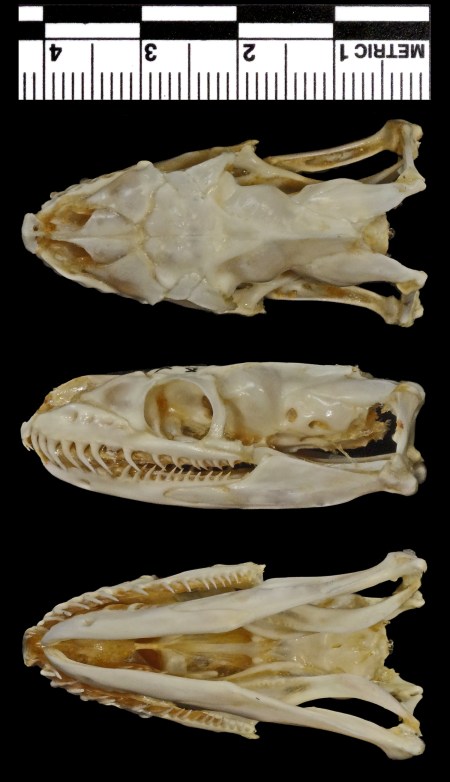
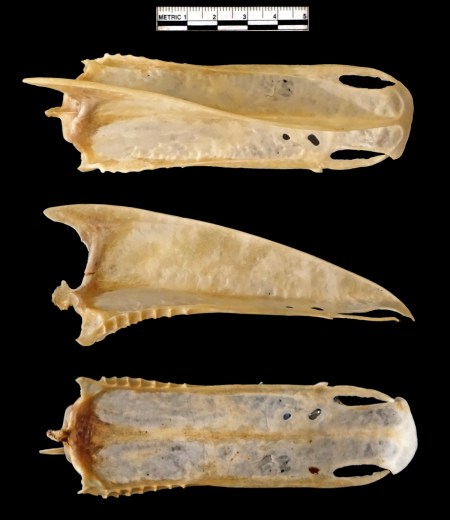
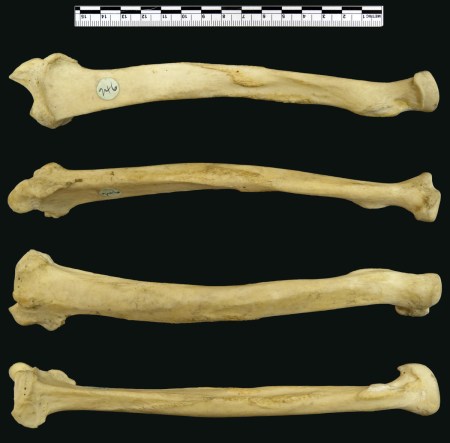
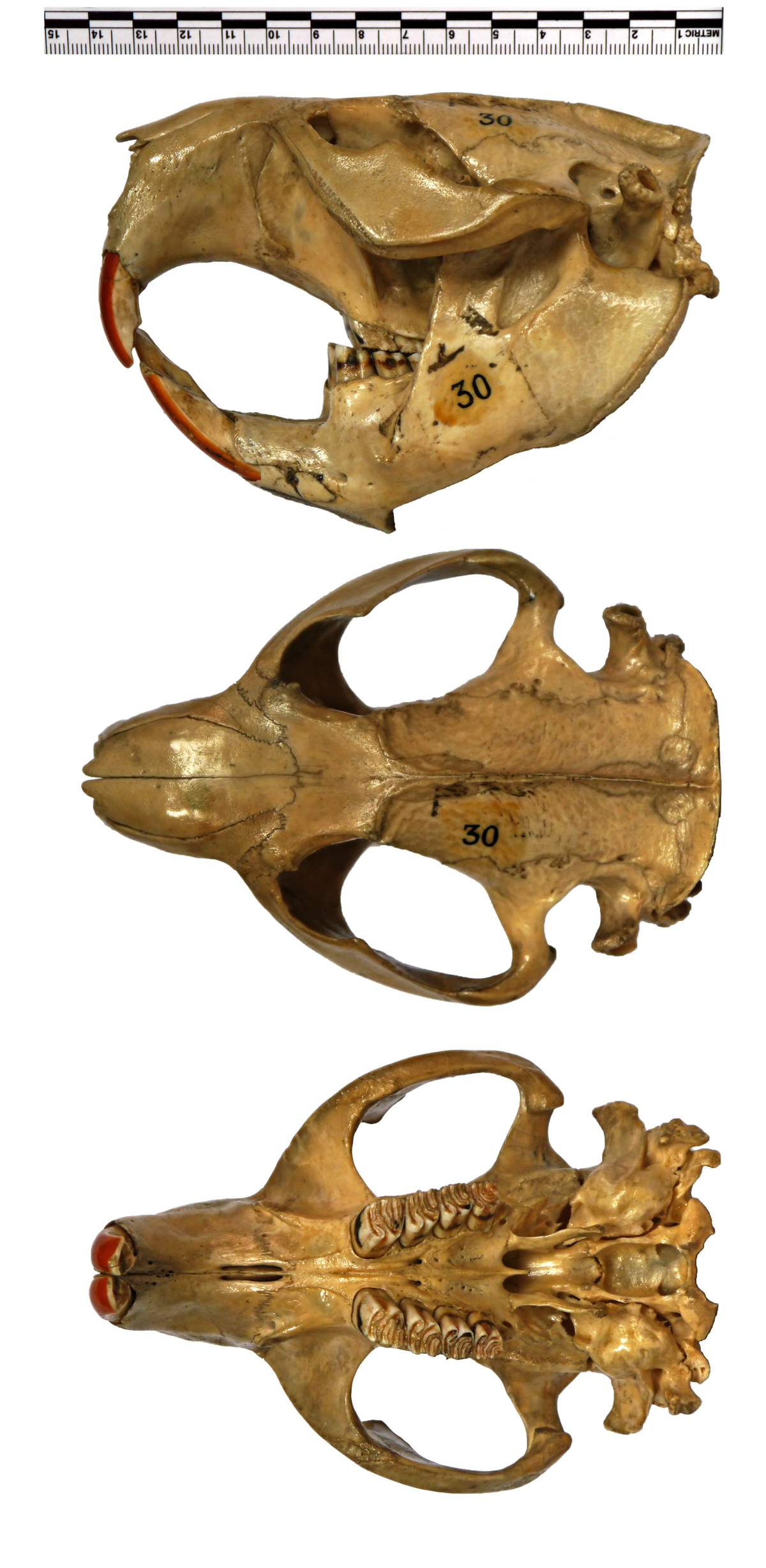
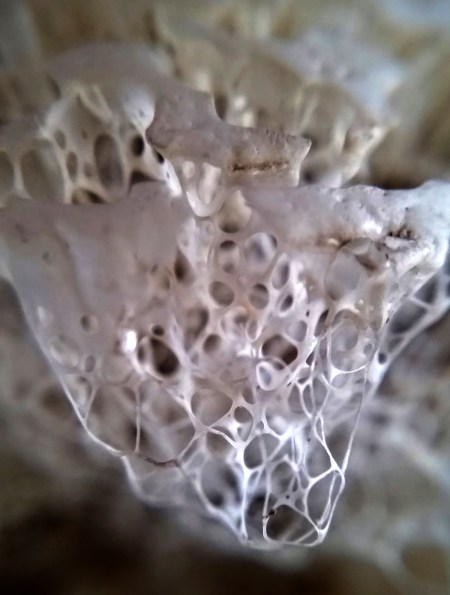
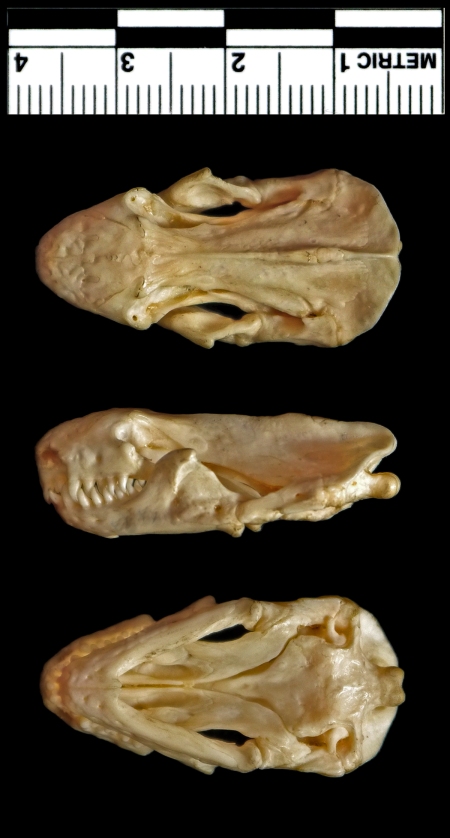
Last week I gave you this specimen of “Pygostylia” to try your hand at identifying:

Click for large image

It was a bit of a tricky one, since the alizarin preparation technique has left an adult bird looking like a newly hatched chick. However, even long-billed birds like snipe and curlews start out with a relatively short bill that grows as they mature. The confusion caused by the bill led to suggestions of Cormorant, Little Bittern, Ibis, Scolopacidae and Whimbrel.

There were a few key pointers to help identify the family that this bird belongs to, not least the tiny legs, although one of them has fallen off as noted by John D’Angelo in a neat cryptic clue.

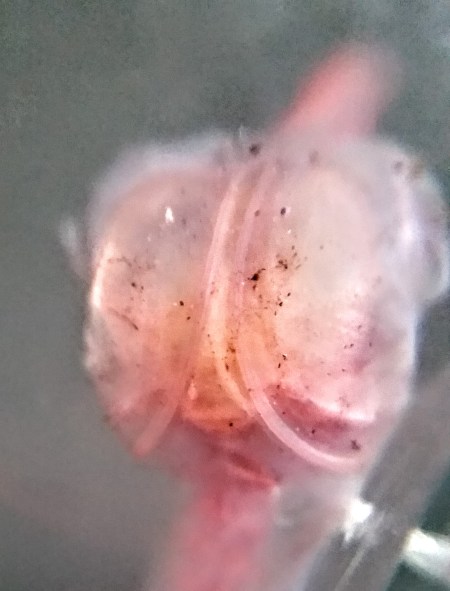
There are a few other pointers – the back and top of the skull shows an interesting feature where the hyoid loops around, which is much clearer here:

hyoid

This is something I normally associate with woodpeckers, but you also see it in some other birds with very long tongues.

There is also a very short humerus, which is what clinched it for me:

wing

The long bill and tongue and short legs and humerus make this a hummingbird (as spotted by Henry McGhie on Twitter).

Unfortunately I don’t think there’s enough information visible on the specimen to confidently identify it to species or even genus, but I think it’s probably a member of the Trochilinae, possibly one of the Mangos in the genus Anthracothorax F. Boie, 1831.

I’d like to write more, but it’s NatSCA conference time and I’m having too much fun catching up with wonderful people!

Friday mystery object #276

This week I have a mystery specimen for you that was only identified only as “Pygostylia” when it came back from being conserved:

Click for large image

It look a few minutes for me to work out what family this bird belongs to, because it’s been treated with alizarin and it just looks plain weird (if you want a bit more information about this sort of preparation check out my latest Specimen of the Week on the Grant Museum of Zoology blog). I still haven’t narrowed it down to genus yet, so your thoughts would be much appreciated. Have fun!

Friday mystery object #274 answer

Last week I gave you this ungulate skull to try your hand at identifying:

mystery274

It isn’t made any easier by the fact that it’s a female, so it lacks the horns or antlers that make identification easier. As with many ungulates it looks a bit sheepy (as I’ve mention before), but it has some clear indicators that helped you rule out what it’s not.

Jake spotted that the size was about right for a Roe Deer, but the auditory bullae (the bulbs on the underside of the skull that house the ear bones) are too massive and the proportions of the braincase are quite different.

Joe vans also ruled out deer, since it lacks lacrimal pits (large openings in front of the eyes that hold scent glands in cervids). Joe also noticed that the mandible is extremely pinched in just behind the incisors.

The incisors themselves caught the attention of Allen Hazen, who noted the extreme size of the first incisor, which he correctly recognised as being a bit of a giveaway to some people, although only when considered in the context of a variety of other features.

While Daniel Calleri summarised these odd features and added the observation of the decent sized occiptial condyl (the place where the atlas vertebra attaches to the skull) and small paracondylar processes (the bony extensions either side of the occipital condyl and just behind the auditory bullae).

These sorts of observations are exactly what are needed to differentiate between species that are very similar in overall morphology. However, without either an excellent reference collection, or even better, a well researched key, it’s almost impossible.

Fortunately, there is a skull key for a subset of Antelope that occur in Tanzania, created by the Field Museum and the mystery object this week happens to be from a genus present in Tanzania. I’d recommend having a go at using the key, but if you’d rather just find out the answer I’ve provided a link to what it is here. Have fun with the key and enjoy your Easter!

Friday mystery object #274

Last week I talked about ungulates in collections being incorrectly identified as sheep. This week I have a specimen for you that is also not a sheep, although it does look a bit sheepish. Can you work out what it is?

mystery274

You can leave your thoughts in the comments section below – I’m not sure they need to be cryptic, but it certainly adds to the fun!

Friday mystery object #273 answer

Last week I gave you this mystery object to get your input on:

mystery273

It was labelled Ovis aries, which didn’t ring quite true for me, so I thought it would be good to see if you also had other ideas, since I’ve noticed that there is a tendency for ungulates of a certain size in museum collections to be assumed to be Sheep.

In other museums I’ve found female Red Deer, Gerenuk and on one occasion even a Badger skull that had been labelled “Sheep”.

mystery273-gerenuk

Labelled “Sheep” but actually a Gerenuk.

This is what a sheep looks like:

mystery273-sheep

You’ll probably notice the “Roman nose” that is quite distinctively sheepy, it also has no gaps between the premaxilla and maxilla and there is a small depression in front of the eye.

When you look underneath, one of the key things that jumps out is the difference in size of the auditory bullae (mystery on the left, sheep on the right):

mystery273-mystery_and_shee

So I’m pretty sure that the mystery object isn’t a sheep, but what is it?

There were lots of suggestions of exotic and interesting ungulates, but after looking at the skulls of a huge number of ungulates I can to the conclusion that Latinka Hristova and Jake were on the right track with the simple suggestion of Goat Capra hircus (Linnaeus, 1758).

Taking a look at Goat specimens on the incredibly useful Mammalian Crania Photographic Archive has convinced me that this is what the mystery object actually is. Not a million miles from Sheep I suppose, but they are different and it’s helpful finding some small differences that help distinguish between them.

Thanks for your input!

Friday mystery object #272 answer

Last Friday I gave you this skull to identify:

mystery272

It was a bit of mean one, because although the family is fairly distinctive, it has poor species representation in online resources or indeed the literature.

The cranium is quite low and long, with some similarities to an otter, but the rostrum (or muzzle) is a bit too narrow and the teeth aren’t quite the right shape. Also the orbits are orientated more vertically, whereas otters have orbit that are at more of an angle so the eyes are closer to the top of the head.

The overall shape, dental configuration and median lacerate foramen all suggest it’s a member of the Herpestidae.

Narrowing down the species was a step too far however, after all, there are around 34 species spread across Africa, Madagascar and Asia and Europe and they are generally quite similar in cranial morphology, with only a few species having good descriptions of the skull.

To help challenge the lack of images of mongoose crania online, I’m pleased to say that this specimen does have an identification – it’s a Ruddy Mongoose Herpestes smithii Gray, 1837. While the name Ruddy Mongoose makes it sound like it’s annoyed me, it actually refers to the reddish-brown of its coat.

A Ruddy mongoose from Daroji wildlife sanctuary in Karnataka, India. By Kalyanvarma, 2009

A Ruddy mongoose from Daroji wildlife sanctuary in Karnataka, India. By Kalyanvarma, 2009

This species is endemic to India and Sri Lanka, where it lives in dry, forested hills and feeds on pretty much anything it can get hold of, from snakes to bird eggs. As with other mongooses (or should that be mongeese?), they have a mutation that prevents snake neurotoxins from bonding at receptor sites, meaning that they are immune to some types of venom – pretty handy if you’re going to eat snakes!

Friday mystery object #271 answer

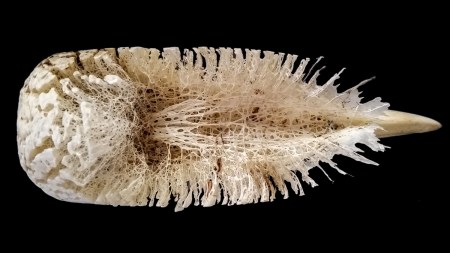
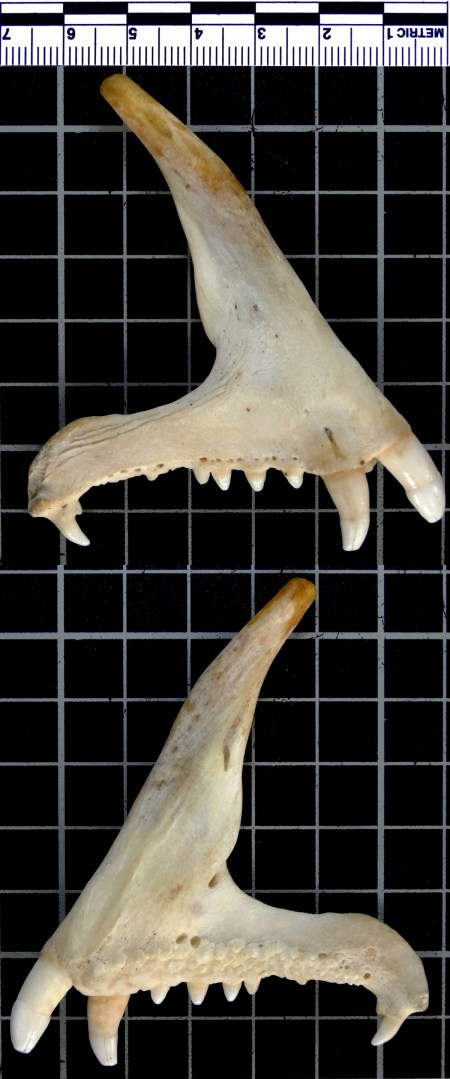
Last Friday I gave you this odd looking V-shaped bone to identify:

mystery271a

It led to a lot of speculation on Facebook and Twitter, with ideas including a bird wishbone, hyoid or mandible. However, the comments on the blog tended to be a little more focussed in the area of the mandible of an ant-eating mammal.

The two little prongs at the anterior of this lower jaw are a bit of a give-away about which type of ant-eating mammal it is, as they are only seen on one family. When you look at the additional image I provided it becomes even easier to work out which:

mystery271b

As most of you correctly worked out, this is a specimen of Pangolin, of which there are four species in the genus Manis (thanks Allen Hazen for the correction – there are more like eight species in the family). I found this nice illustration of the skulls of the various species, to help narrow it down even further:

Anatomical and zoological researches: comprising an account of the zoological results of the two expeditions to western Yunnan in 1868 and 1875; and a monograph of the two cetacean genera, Platanista and Orcella. John Anderson, 1878.

Anatomical and zoological researches: comprising an account of the zoological results of the two expeditions to western Yunnan in 1868 and 1875; and a monograph of the two cetacean genera, Platanista and Orcella. John Anderson, 1878.

So it appears from the morphology of the premaxilla, zygomatic region and nasals that this is a Sunda Pangolin, Manis javanica Desmarest, 1822.

Manis javanica by Piekfrosch, 2006

Manis javanica by Piekfrosch, 2006

These unusual scaly insectivores are critically endangered due to poaching for their meat, skin and scales for the Chinese market, with their population suspected to have declined by 80% in the last 20 years, despite having a protected status. Sad to say that their ability to roll into an armoured ball does nothing to protect them from people.

Friday mystery object #271

This week I have a mystery object for you from the Grant Museum of Zoology that’s either a bit too easy, or a bit mean:

mystery271a

If you’re not a fully paid-up bonegeek, you might like to have a bit of an additional clue; if so, click here.

Please keep your answers in the comments section cryptic, so everyone gets a chance to have a go at working it out without spoilers. Have fun!

Friday mystery object #269 answer

Last week I gave you this mystery object from the Grant Museum of Zoology to have a go at identifying:

mystery269

If you’ve been checking the mystery object recently you’ll notice that this specimen has a feature of the palate that I made reference to in the answer to mystery object #267 – the Tasmanian Devil. It’s incompletely ossified, which is a characteristic of marsupials.

The large curved canines and pointed premolars suggest some predatory activity, while the flattened molars suggest some grinding of vegetation, making this one of the marsupial omnivores, in the Order Peramelemorphia.

The large size of the skull and the long curved canines make this specimen rather distinctive – as first spotted by Richard Lawrence, this is indeed a Continue reading

Friday mystery object #268 answer

Happy New Year! I hope everyone had a lovely festive period.

I gave you this distinctive specimen from the Grant Museum of Zoology to try your hand at identifying:

mystery268

Despite being distinctive, it raised some discussion about the identification, because there are few resources available for comparison.

Phil Cox was the first to get the right Family (at least in the comments – @MelanieGbones got it on Twitter) – the Chrysochloridae or Golden Moles. Then the discussion got a bit more involved as species were discussed and the possibility of the convergent Marsupial Moles was considered.

There are 21 species of Golden Mole, all of which occur in southern Africa, which could have made this a very difficult identification to species, if it wasn’t for the large size of the skull and the very characteristic large and vertically-posteriorly flaring zygomatic arch that continues round to near the back of the skull. This narrows it down to one of two species in the genus Chrysospalax.

The extent of this feature in this specimen, plus the shape of the palate, suggest to me that this particular specimen is from the

Continue reading

Friday mystery object #268

Merry Christmas mystery solvers!

This week I have an unusual object from the Grant Museum of Zoology for you to identify:

mystery268.jpg

It’s pretty distinctive, but I’ve not seen many of these, so hopefully it’ll make an interesting object to identify. As usual, if you think you know what it is, please leave a hint or cryptic clue rather than just writing down the answer – it makes it more fun for other people that way.

Have fun!

Friday mystery object #266 answer

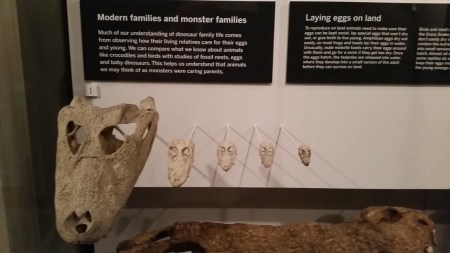
Last week I gave you this distinctively weird looking skull to identify:

mystery266

As I suspected, many of you worked out what it was straight away, but I wonder if it would have been as easy if the side view hadn’t included the mandible?

The upper dentition, especially the pair of incisors, is somewhat similar to that of a rodent, but that mandible is ludicrously massive and could only really belong to the weirdest primate in the world: the Aye-aye Daubentonia madagascariensis É. Geoffroy, 1795

So very well done to Tone Hitchcockhenstridgesj, Chris, Cindy Nelson-Viljoen, Daniel Jones, steve tornaAgata Stachowiak, palfreyman1414, boneman2014Lee Post, joe vans, Allen Hazen, Dave Taylor, Michelle, witcharachne, and Daniel Calleri.

The Aye-aye’s incisors are an adaptation for gnawing holes in wood to get at grubs inside. It finds these tasty morsels using a tapping finger and crazy bat-like ears to detect the tunnels the larvae create when feeding, with a system a bit like seismic ground response analysis.

Aye-aye by Frank Vassen 2008

Aye-aye by Frank Vassen 2008


Once the squishy prey has been detected and an entry point has been gnawed, the Aye-aye fishes it out using a specially adapted long, thin finger with a hooked claw.

Aye-aye fingers by Dr. Mirko Junge 2009

Aye-aye fingers by Dr. Mirko Junge 2009

Basically, the Aye-aye feeds rather like a woodpecker, but with the benefit of fingers and teeth. Perhaps it’s weird, but it’s most definitely wonderful!Aye_aye

Friday mystery object #262 answer

Last Friday I gave you this pretty characteristic mystery object from the Berlin Museum für Naturkunde to try your hand at identifying:


There were lots of great comments – I must apologise for not responding to many (and for posting the answer to this mystery object so late), my excuse is that I’ve had an insanely busy week finishing up my old job at the Horniman Museum and Gardens and then getting started in my new job at the fantastic Grant Museum of Zoology at University College London (more to come about my big paolov.files.wordpress.com/…/mystery262.jpgmove). I also got started on a really interesting project looking at Gorilla osteology and I’m feverishly trying to prepare a training workshop on identifying natural materials for next week.
Back to the object. Several of you noticed the presence of a baculum (or penis bone) which shows us quite definitively that this was a male animal (although, I later realised that this baculum does not belong to this specimen!).


It also suggests that the specimen was prepared and mounted without the prudishness that many historical mounts were affected by (see Jack Ashby’s comments about this in his post on the Grant Muesum’s Ringtail).
Many of you also correctly recognised that the plantigrade (or flat-footed) posture, short tail and robust build suggested a bear of some sort.

The distinctive sagittal crest was the final feature needed for identification for some of you to work out that this is the skeleton of a Giant Panda Ailuropoda melanoleuca (David, 1869).

I tend to think of Panda skulls as looking like a cross between those of a Hyaena and a Gorilla, which makes sense when you consider the adaptations of the jaw musculature required for the Panda to process the large volumes of tough bamboo needed to provide enough energy for survival. The bone of the skull has to be able to manage the large forces produced by all this chewing, resulting in a big and robust sagittal crest, a thick and deep mandible and really deep muscle scars on the coronoid process.

These are all features you also see in big chewers like the Gorilla and Hyaena, but not in rodents and ungulates – I think this reflects the difference between groups that rely on temporalis muscle (which runs along the side of the braincase) in chewing compared to the masseter muscle (which attaches to the zygomatic arch or cheekbone).
The final clue to confirm that this is a Giant Panda is the ‘thumb’ on the front limbs:

This handy (excuse the pun) extra ‘digit’ is actually the radial sesamoid bone of the Panda’s wrist, that has been commandeered by evolution for use as a bamboo holder. There are a few other species that have done weird things with wrist bones to gain a digit, but this is clearly not a Mole or Elephant and Red Pandas have a much longer tail.
I hope you enjoyed some of the interesting bony features of this specimen – it’s great to have a chance to see under the surface of such an iconic animal!

Friday mystery object #261 answer

Last Friday I gave you this object from the Horniman Museum and Gardens to identify:

mystery261

It’s an odd looking bone, but that makes it distinctive, so I wasn’t too surprised that everyone recognised it as being from something aquatic. In particular, Ric Morris and joe va both recognised it as the radius of a pinniped.

The broad end that articulates with the wrist is lacking its epiphysis, indicating that this is from a younger animal. This also makes it a little harder to make a definitive species identification.

I think that Ric Morris’s cleverly disguised suggestion of Grey Seal is pretty good, although I’m leaning slightly more towards Harbour Seal Phoca vitulina Linnaeus, 1758.

The odd shape is of course one adaptation of the forelimb that reflects a change in biomechanical requirements away from the load-bearing limb of a terrestrial ancestor and towards the hydrofoil shape and drag-force-resistant flipper of an active aquatic pursuit predator.

Seal underwater by Chillum, 2007

I will never ceases to be impressed by the power of evolution as a mechanism to reshape bone to better suit new purposes!

Friday mystery object #260 answer

Last week I broke the news that in October I’ll be taking on the role of curator at the Grant Museum of Zoology at UCL. Many thanks to everyone for their congratulations and kind comments – it’s wonderful to have so much support!

I’m excited to get started in my new role, but I will be sad to no longer be the go-to person for identifying materials used in the Horniman’s Anthropology collections. This gave me the chance to see some lovely objects, like this little statue:
mystery260
I asked if you had any thoughts on what it might be, and you gave some great answers, mostly involving an ungulate canon bone or metacarpal / metatarsal. However, palaeosam and palfreyman1414 spotted that this isn’t made of bone, while Chris went one better by making a nice reference to ‘Horsing around near the river’ – a reference to the meaning of the name Hippopotamus.

The key to identifying this is to look at the curve of the statue and the view from underneath. That cavity shape (plus the gentle curve) is exactly what you’d expect from the upper canine of Hippopotamus amphibius Linnaeus, 1758 – so well done Chris!

There’s a helpful guide to identification of ivories by the US Fish & Wildlife Service, which is well worth a look to help with this sort of thing. Hopefully that’ll be a helpful resource for my colleagues at the Horniman in my absence… although they know where to find me if they need help in future!

Friday mystery object #258

This week I have a mystery object that had been sitting a box for about 30 years with the tenuous description:

Tail section from marine mammal

Here it is:

mystery258

I don’t believe it – do you have any thoughts on what it might be?

As usual, you can put your thoughts, questions and suggestions in the comments section below. Hope you have fun with this one!

Friday mystery object #257 answer

Last week I gave you this slender bone to try your hand at identifying:

mystery257

You didn’t have much to go on, but most of you recognised that it’s a fibula (well spotted Ric Morris, Kevin, Mieke Roth and Flick Baker) and I was impressed by the variety of clever clues used to communicate that knowledge. However, Michelle went a step further and identified this as being from a large felid, in the size range of a Mountain Lion, earning loads of bonegeek points.

It took me a little while to work out what this was myself, since it was in a box with Ostrich bones and my first thought was that it might be from another bird. It has articulations at either end and a long midshaft, so it was obviously one of the long bones, but it’s very slender and wouldn’t be able to carry much weight on its own, so it was either a radius or fibula.

I started by looking at the radii of a some large birds, like Albatross and Flamingo. However, on comparison with a few specimens it became obvious that I was looking in the wrong area, since the articulations didn’t fit with those on a bird radius at all. They also didn’t fit the shape of any mammal radius I could think of, so I started considering fibulae.

I knew it couldn’t be a bird fibula, since they are fused with the tibiotarsus and would lack an articulation at the distal end, so I started looking at mammals. It was a bit slender for a dog, but pretty similar to a cat, if on the big side.

Then I remembered that I had a box of postcrania from the same collection as the Ostrich that this bone shared a box with. So I checked the mystery object against that and was pleased to find that there was only one fibula in that box, it was from the other leg and it was a mirror image. So it looks like this bone has not only been identified, but reunited with the Cheetah Acinonyx jubatus (Schreber, 1775) skeleton it came from!

Cheetah in Kruger National Park (South Africa). Image by Mukul2u, 2008

Cheetah in Kruger National Park (South Africa). Image by Mukul2u, 2008