Friday mystery object #317 answer

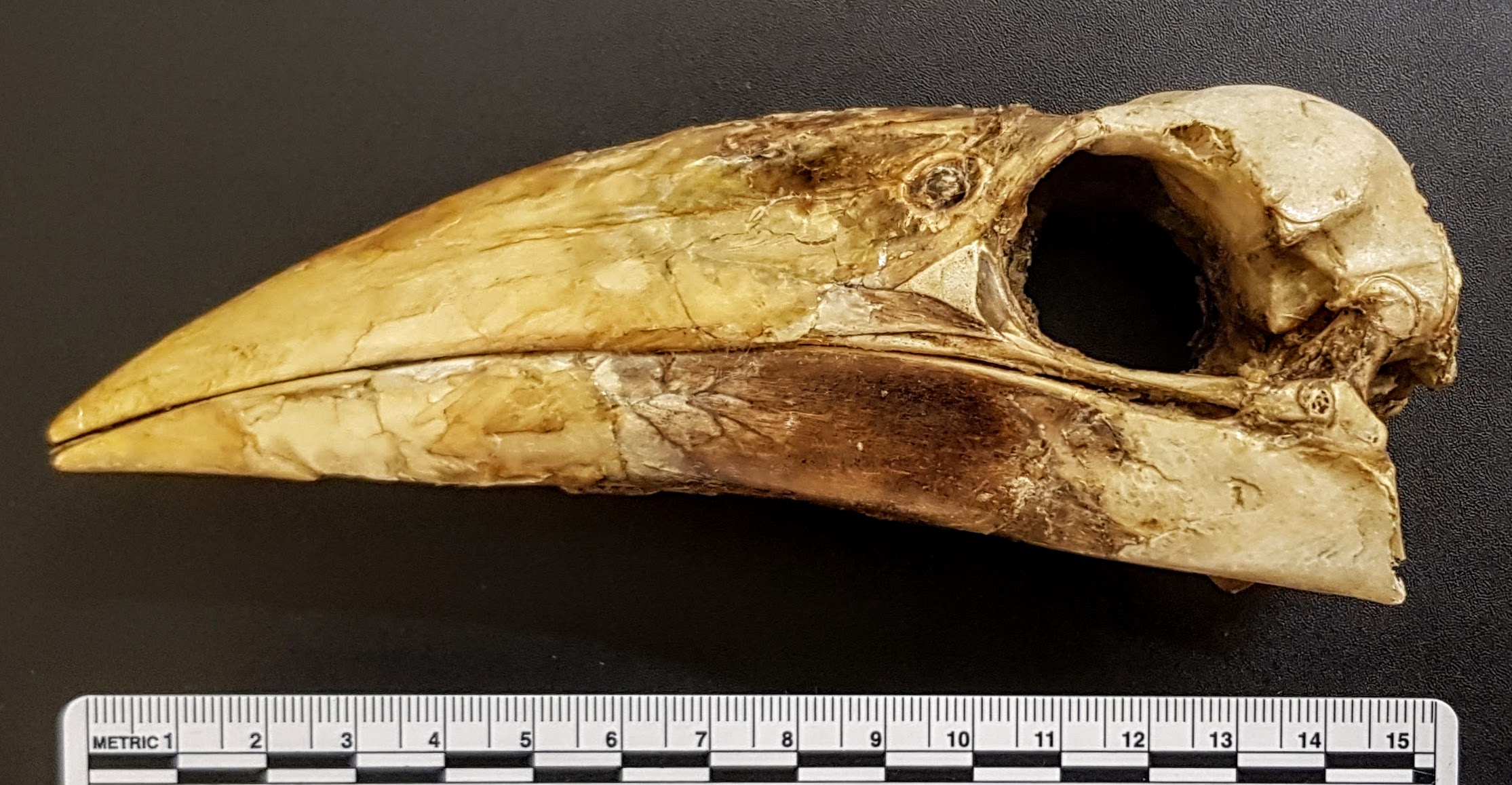
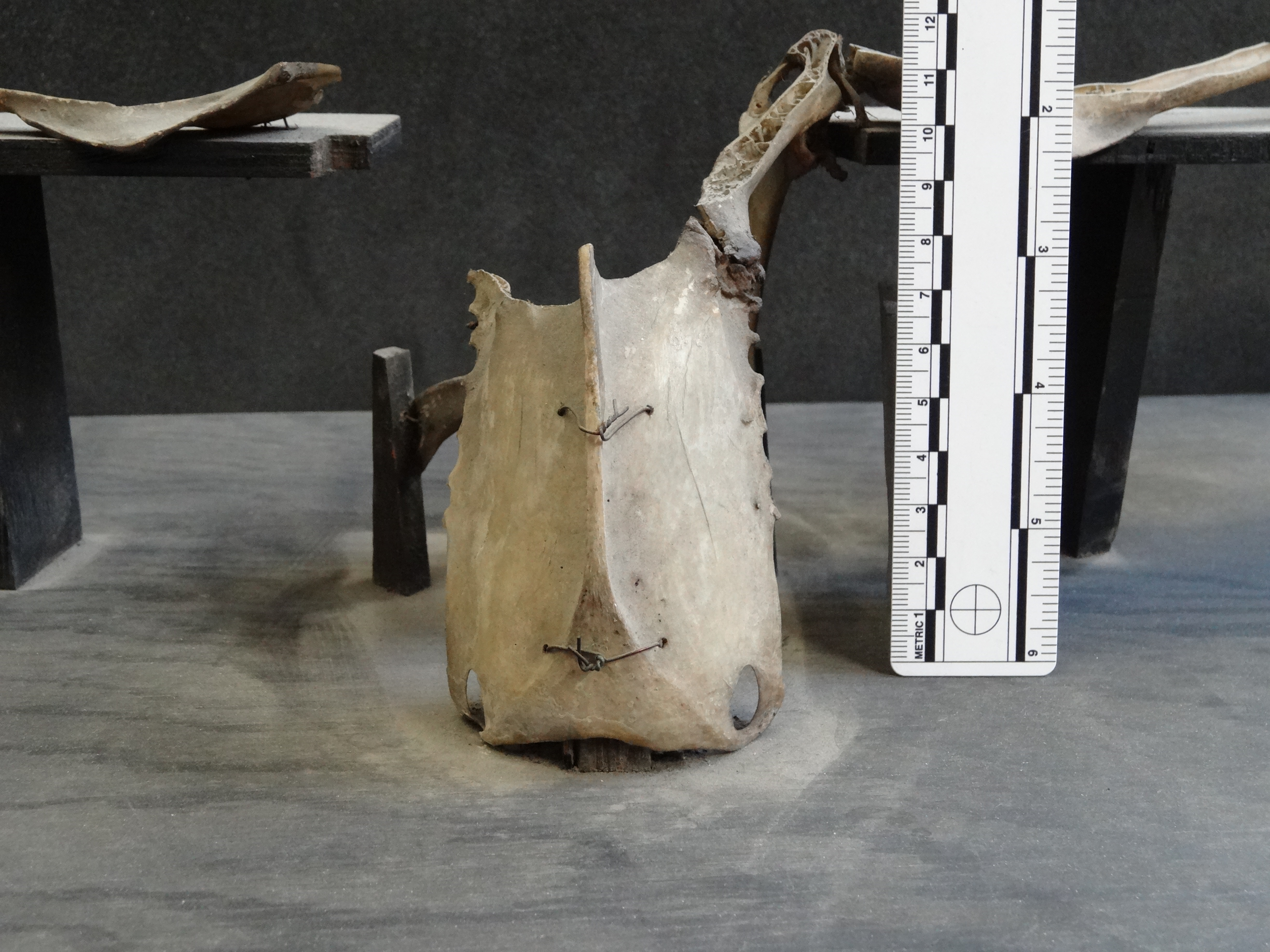
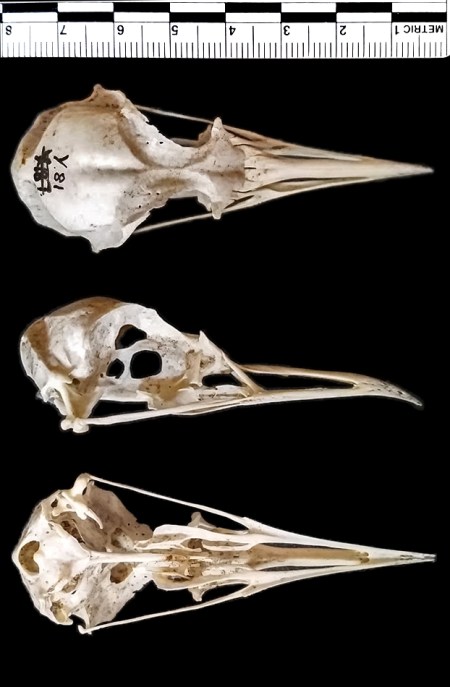
Last week I gave you this unidentified bird skull from the Dead Zoo to try your hand at identifying:
mystery317

It seems that everyone recognised it as being from a charadriiform, and one of the waders at that. The first response was from Chris, who made reference to Lewis Carroll’s poem the Walrus and the Carpenter in which the eponymous characters eat an enormous quantity of oysters – hinting that this is an Oystercatcher.

There were some other suggestions that it could be from one of the birds in the genus Tringa, which includes the ‘shanks’ (Redshank, Greenshank, etc.), but the morphology fits one of the Oystercatchers better – in particular that weird constriction about halfway down the mandible when you look at the skull in profile.

This mandibular ‘waist’ is quite unusual and it doesn’t even seem to occur strongly in all of the Oystercatchers, which helps narrow down the likely species within the genus Haematopus, especially when you factor in things like the relative bill proportions, although you have to be careful doing this as there is some sexual dimorphism in the shape of the bill, with the females’ being longer.

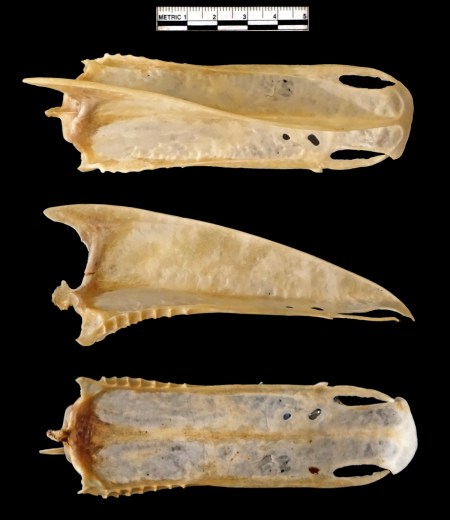
The three closest species are the American Oystercatcher, the Sooty Oystercatcher and the Blackish Oystercatcher, but unfortunately I’ve not been able to find good reference skulls all of these species to be able to look for any distinguishing cranial characters. Based on bill morphology I’m leaning towards this being the skull of the American Oystercatcher, Haematopus palliatus Temminck, 1820.
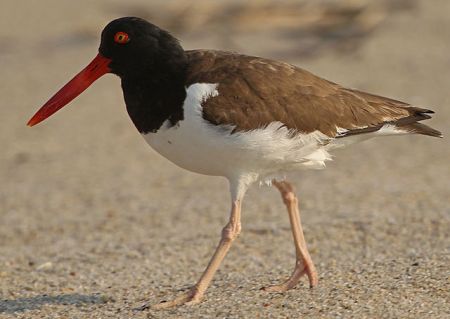
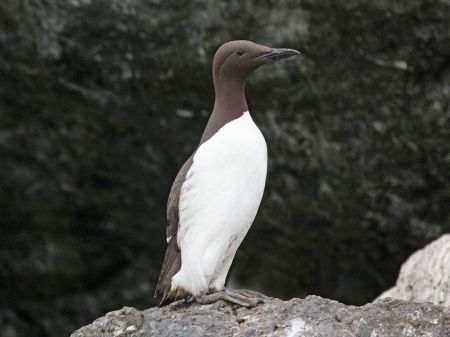
American Oystercatcher by DonaldRMiller, 2010

American Oystercatcher by DonaldRMiller, 2010

My next step will be to check through our collections to see if we have comparative material to check the identification (once I get some time – a sadly rare commodity). If I can’t confirm I’ll just stick with Haematopus sp. on the label.

If you’re not familiar with Oystercatchers, they walk along the tideline either prying or breaking open bivalves. In my experience they seem more fond of mussels than oysters, but what do I know?

Another mystery next week!

Friday mystery object #307 answer

Last week I gave you this specimen from the Irish Room of the Dead Zoo to try your hand at identifying:

mystery307

Now it’s not a particularly difficult species to identify for a keen birder, so I asked for cryptic clues to the identity, and I was not disappointed. Some suggestions were so cryptic I still haven’t managed to work them out!

First in was Jennifer Mccaire who quoted a brief line of poetry:

“…Thou hast no sorrow in thy song, No winter in thy year.”

This is a section of a poem published in 1770 by John Logan – the title being “Ode to the Cuckoo“. Now, it seems likely that Scottish born Logan wrote this about the Common Cuckoo Cuculus canorus Linnaeus, 1758 that breeds in Europe and which looks like this:

Common Cuckoo. Image by Chris Romeiks, 2011

Common Cuckoo. Image by Chris Romeiks, 2011

Clearly it’s a different bird (one which mimics the appearance of a female Sparrowhawk) and it’s not quite the same as the mystery object – although there are similarities. However, we must keep in mind that Jennifer is of the North American persuasion, so her thoughts on Cuckoos will probably veer towards the Black-billed Cuckoo or Yellow-billed Cuckoo (or maybe the Mangrove Cuckoo, but that’s not as widespread as the other two).

If you don’t know the difference between these two North American Cuckoos, here’s a handy illustration to help differentiate:

Black-billed Cuckoo (left), Yellow-billed Cuckoo (right). Watercolour by Louis Agassiz Fuertes between 1910 and 1914.

Black-billed Cuckoo (left), Yellow-billed Cuckoo (right). Watercolour by Louis Agassiz Fuertes between 1910 and 1914.

Continue reading

Friday mystery object #302 answer

Last week I gave you this egg to try your hand at identifying:

mystery302

Eggs can be tricky, since they are largely similar in shape and, since egg collecting was banned many years ago, there are few modern resources for identification.

However, you can pick up clues by thinking about colour and pattern and working out what advantage it may have. So you might expect a brightly coloured egg to be laid in a well disguised and deep nest, where it’s unlikely to be spotted except by the parent, whereas a yellowy speckled egg is more likely to be camouflaged if laid in a fairly open, sandy environment.

So this egg was probably laid somewhere near the sea, which means it’s probably from a charadriiform bird (those are the shorebirds).

Now there are a lot of shorebirds, but this egg is pretty big and it lacks the strongly conical shape you’d expect from a cliff-nester like a Guillemot (the shape means it rolls in tight circle, making it less likely to be blown or knocked off a cliff). That actually narrows it down to a handful of birds that makes comparison easier. Curlew eggs, for example, are a similar size, but they tend to be more grey and have larger blotches, plus they’re a bit less elongated.

This particular egg has the shape and colour of a gull egg and large size means it’s almost certainly the egg of a Greater Black-backed Gull Larus marinus Linnaeus, 1758.

I would say more, but at the moment I’m at the natural history highlight of the year – the NatSCA conference. Here’s the Twitter feed in case you’re interested in the discussion:

Friday mystery object #295

For many of you, last week’s mystery object answer was a little disappointing, since I was unable to pin down what the specimen was. Normally with birds it’s not so difficult, because of useful resources like skullsite.com, but the fact is that some bird groups are still quite poorly represented in collections and finding comparative material is difficult, especially online.

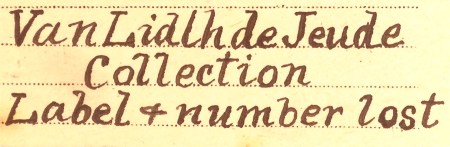
The most frustrating thing about last week’s object is that it did once have a label, but at some point in the past it was lost, so the only information with the specimen now is this:

mystery295_label

However, this label does offer a glimmer of hope, since it identifies the specimen as being from a particular collection and that can often mean there will be more information somewhere.

As it turns out, this specimen is one of several that were purchased in 1867 from an auction of the collections of Dutch anatomist Theodoor Gerard van Lidth de Jeude. This is helpful because auction catalogues can contain information like the species names of the specimens being sold. It is particularly helpful when you have the original catalogue with annotations about the specimens bought by your institution.

Fortunately, at the Dead Zoo we have the auction catalogues. Unfortunately we bought quite a lot of stuff, so working out which of the specimens our mystery object represents is still quite a lot of work.

However, if other specimens from the auction have their names and numbers, it should be easier to narrow down the ones that lost their labels. It also can also help to have an identification of the specimen to track back to the catalogue, which is why I was keen to get your thoughts last time and why this week’s mystery object is from the same collection.

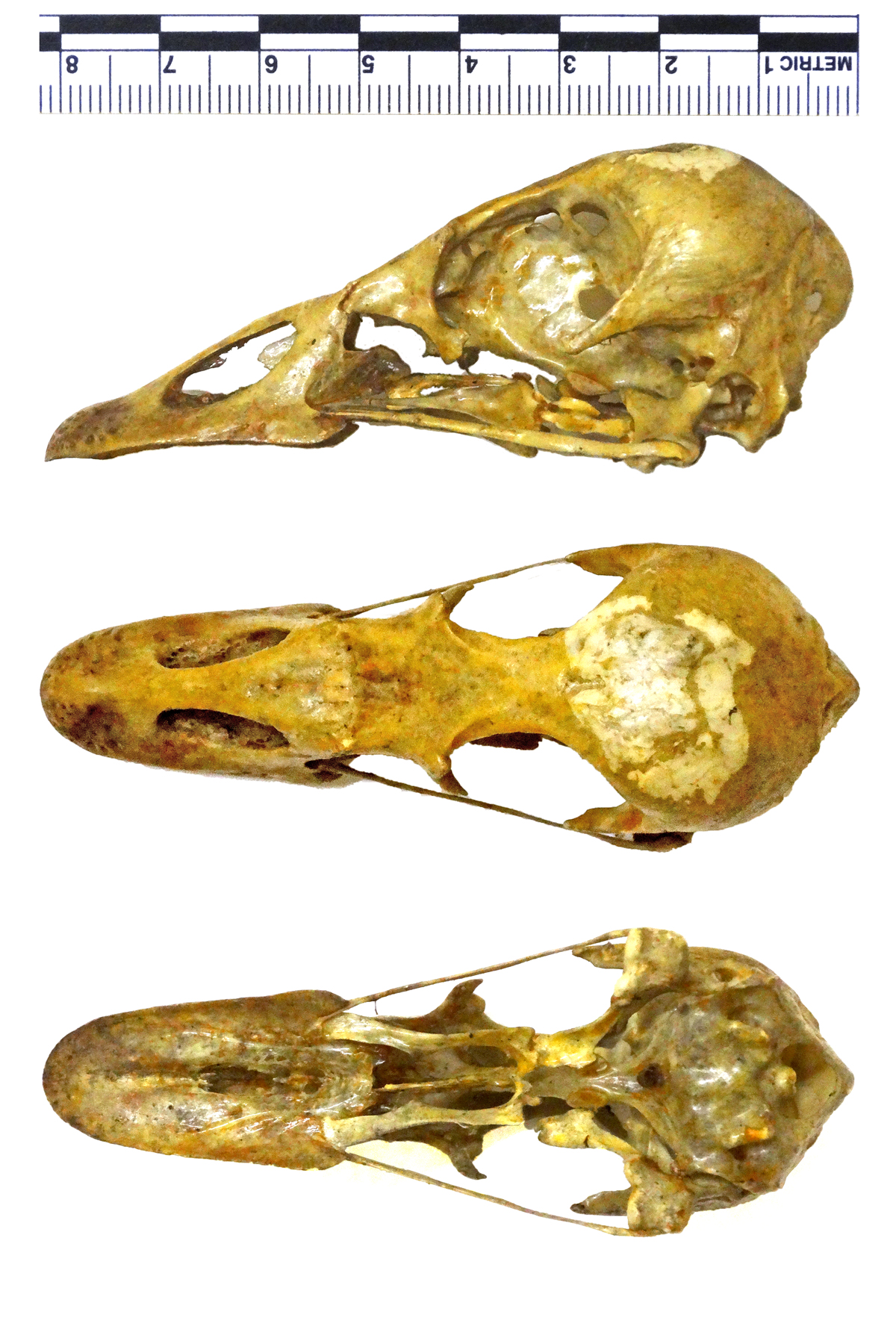
So can you help me work out what species this skull belonged to?

mystery295

No need for cryptic clues, but if you want to show off your taxonomic prowess you could always offer the 1860’s scientific name or the name of what you think it is in Dutch.

I hope you have fun with this one!

Friday mystery object #293 answer

Last Friday I gave you this unidentified specimen from Dublin’s Dead Zoo and asked you to help me work out what it was:

mystery293

The response was incredibly helpful and it was great to see that most of you were drawn by the morphology to make a similar identification to me.

The fact that it’s from the family Anatidae (the ducks, geese and swans) was immediately noticed, and from there the likely genus was quickly narrowed down to Branta, based on the morphology. This is the genus containing the ‘burnt’ geese (that’s what ‘branta’, derived from the Old Norse, means), which includes: the Brant Goose; Barnacle Goose; Canada Goose; Cackling Goose; Red-breasted Goose, and Hawaiian Goose.

However, the nominate examples of all these species (that means the ones derived from the type on which the species name is based) are either the wrong shape or a bit too large to have this skull, which you can see by checking them on the excellent Skullsite by Wouter van Gestel.

The closest species in terms of morphology are the Cackling Goose (B. hutchinsii), Canada Goose (B. canadensis) and Barnacle Goose (B. leucopsis), but it turns out that there are various subspecies of each and one (that was previously recognised as a subspecies of Canada Goose, but which is now considered a subspecies of Cackling Goose) is rather small, as flagged by the subspecies name minima.

This smallest subspecies seems to fit both the morphology and the size very well, so I’m quite confident to identify the mystery specimen as the Small Cackling Goose Branta hutchinsii minima (Ridgway, 1885).

640px-small_cackling_goose_brood

A family of Small Cackling Geese, by Tim Bowman, USFWS, 2003

So thanks to you all for helping me to narrow down where in the Anatidae to start looking! More mysteries from the Dead Zoo next week.

Friday mystery object #293

This week I have the first of what I hope will be many mystery objects from my new job as zoology curator at the National Museum of Ireland:

mystery293.jpg

I haven’t quite got myself a proper photographic set up yet, but I hope this photo of an unidentified skull in the collection will be good enough for you to be able to help me work out what species it belongs to.

As usual you can leave your thoughts, questions and suggestions in the comments section below. Have fun!

Friday mystery object #292 answer(ish)

Last week I gave you a final mystery object from the Grant Museum of Zoology to help me identify:

dsc06030

Part of the reason for that was because I knew I’d be starting my new job in Dublin where there is a great collection of comparative bird osteology that I thought I’d get a chance to look at in time to write this post.

Alas, I’ve had a whirlwind first week at Dublin’s Dead Zoo and although I’ve managed to take a look at a few sterna, I’ve not had much time to really think about them or consider the identification. I’ve also had limited opportunity to follow up on everyone’s very useful suggestions, although I have tried to use them as a guide to narrow down my perusal of the comparative collections.

However, I did get a chance to take some quick snaps of a range of bird sterna with my phone, so I’m going to provide you with a veritable feast of breast bones to compare the mystery specimen against:

You can click on each image to see a large version – hopefully this will prove useful for future identifications!

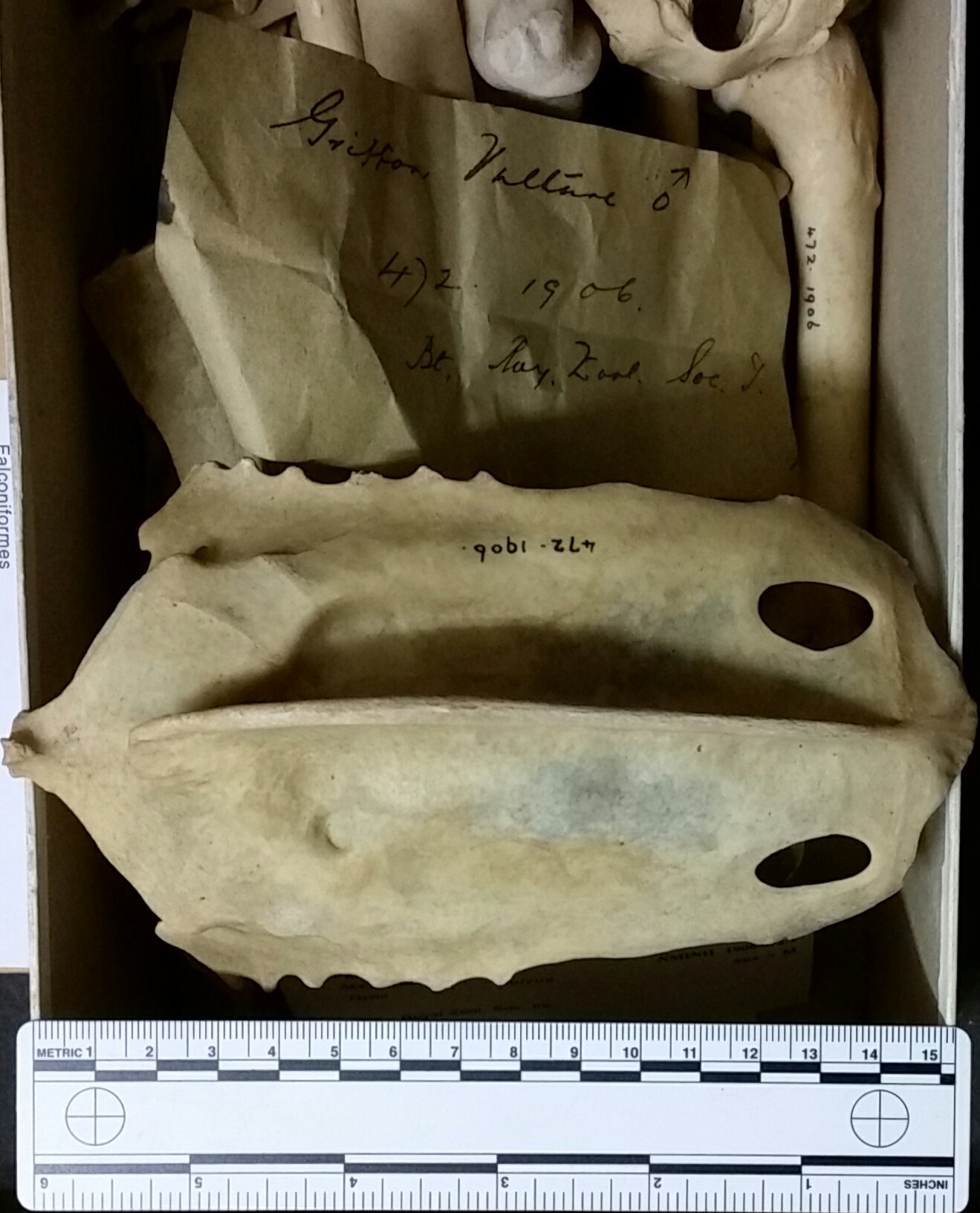
None of them quite match the combination of having perforations near the straight and truncated bottom of the mystery specimen, which sports a broad triangular flattening of the lower portion of the carina or keel. This may be a feature of the particular individual, or it might be diagnostic – herein lie the problem with using strongly functional features for identification, as a juvenile or zoo specimen may have differences due to developmental progress of lack of use of a feature. To illustrate, this keel from a Griffon Vulture from the Royal Zoological Society of Ireland shows a significant asymmetry (although it’s hard to see the deformation in the image due to the shadow – I’ll see if I can get a better image):

Griffon Vulture sternum

Griffon Vulture sternum

It’s also worth noting that the Grant specimen has had the top of the sternum cut off, so the overall shape is a little misleading. From comparing the sterna of a variety of bird groups I’m in agreement with the emerging group consensus that this is probably from a pretty large bird of prey.

Thanks for your input on this – I will check some more next week when I have a zooarchaeologist looking at the comparative bird collection and I’ll get the chance to dig out some more material.

Cheers!

Friday mystery object #292

This week I have my last mystery object from the Grant Museum of Zoology, since I am starting my new job as Assistant Keeper of Natural History at the National Museum of Ireland next week. However, there is one specimen that’s been getting on my nerves the whole time I’ve worked at the Grant, as it says on its label that it’s from an Albatross, but I simply don’t believe it. Can you help me work out what this rather dusty specimen actually comes from?:

dsc06030No need for cryptic clues I think, since it’s probably going to be a little bit of a challenge and some discussion seems likely – which will be easier if we all know we’re talking about the same thing.

Have fun with this one!

Friday mystery object #286 answer

Last week I gave you this mystery object to identify, found on a beach in Ireland:

mystery286

It led to a lot of great cryptic comments relating to marine birds and sternum keels, but Lena was the first to comment and was spot on with the species (or at least as far as I can tell!)

Bird sterna are quite distinctive, with overall shape giving an indicator of mode of life. Long narrow but well-developed keels like this tend to be seen in marine birds that use their wings to fly underwater. The shape of the bottom and sides of the sternum tend to be quite specific to particular genera and species, making sterna pretty good for identification.

Of course that depends on having good comparative material and I was delighted to find John Rochester’s very helpful Flickr page, that has a comparison of British Auks (in this case we’re talking about the geographical British Isles rather than the sociopolitical concept of Britain).

If you take a look at those images you’ll notice that one fits the shape very well indeed – the Guillemot or Common Murre Uria aalge (Pontoppidan, 1763).

1024px-common_murre_rwd2

Guillemot with its meat and feathers on. Image by Dick Daniels, 2011

So that’s the identification I gave to Emer, Ronan, Rory and Paddy who found it on their hols!


Friday mystery object #276 answer

Last week I gave you this specimen of “Pygostylia” to try your hand at identifying:

Click for large image

It was a bit of a tricky one, since the alizarin preparation technique has left an adult bird looking like a newly hatched chick. However, even long-billed birds like snipe and curlews start out with a relatively short bill that grows as they mature. The confusion caused by the bill led to suggestions of Cormorant, Little Bittern, Ibis, Scolopacidae and Whimbrel.

There were a few key pointers to help identify the family that this bird belongs to, not least the tiny legs, although one of them has fallen off as noted by John D’Angelo in a neat cryptic clue.

There are a few other pointers – the back and top of the skull shows an interesting feature where the hyoid loops around, which is much clearer here:

hyoid

This is something I normally associate with woodpeckers, but you also see it in some other birds with very long tongues.

There is also a very short humerus, which is what clinched it for me:

wing

The long bill and tongue and short legs and humerus make this a hummingbird (as spotted by Henry McGhie on Twitter).

Unfortunately I don’t think there’s enough information visible on the specimen to confidently identify it to species or even genus, but I think it’s probably a member of the Trochilinae, possibly one of the Mangos in the genus Anthracothorax F. Boie, 1831.

I’d like to write more, but it’s NatSCA conference time and I’m having too much fun catching up with wonderful people!

Friday mystery object #276

This week I have a mystery specimen for you that was only identified only as “Pygostylia” when it came back from being conserved:

Click for large image

It look a few minutes for me to work out what family this bird belongs to, because it’s been treated with alizarin and it just looks plain weird (if you want a bit more information about this sort of preparation check out my latest Specimen of the Week on the Grant Museum of Zoology blog). I still haven’t narrowed it down to genus yet, so your thoughts would be much appreciated. Have fun!

Friday mystery object #275

This week I have a genuine mystery skull for you to identify from the Grant Museum of Zoology:

mystery275

I think I know what it is, but I’d be keen to see if you agree with me.Probably a bit on the easy side, so please keep your answers cryptic to avoid spoiling the fun for others!

Oh and apologies for the substandard photos – I used my phone with a tripod, which sort of worked, but it’s not ideal. Hope it’s good enough for you to make an identification!

Friday mystery object #251 answer

Last week I gave you this object to have a go at identifying:

mystery251

I thought it looked a bit like an Ewok’s weapon, but fairly obviously it’s a bit of some critter’s leg. The question is, which critter?

In comments by David M WatsonDavid Honetaihaku and palfreyman1414  it was quickly recognised as being from a ratite (the group of flightless birds that include Emus, Cassowaries, Kiwis, Rheas and Ostriches – plus some extinct examples like Moas and Elephant Birds), but it was henstridgesj who narrowed it down to a tarsometatarsus (fused ankle and foot bones) of the correct ratite – the Ostrich Struthio camelus Linnaeus, 1758.

The size is a bit smaller than you’d expect for an adult Ostrich and the top of the bone (the bit on the left) is less well fused, so it appears to be from a subadult individual. The reason it can be distinguished from some of the other suggested ratites is all down to the number of trochlea (the rounded and grooved end bits that the toes attach to). Ostriches only have two toes, whereas the other ratites have three or four and this is reflected in those trochlea.

Ostrich foot by Tony Wills, 2007

Ostrich foot showing the two toes. Image by Tony Wills (2007)

So well done to everyone who took part, especially henstridgesj who was spot on!

Friday mystery object #244 answer

Last week i gave you this colourful specimen to identify:

mystery244

As I suspected, some of the keen birders out there were straight on the case and GrrlScientist (unsurprisingly to me) immediately knew the species and an awful lot about its taxonomy, offering helpful hints and clues to other commentators.

After some discussion it became clear that this is a Finch and one of the Neotropical varieties at that. The bright yellow belly, emerald green head, throat, chest and wing, brilliant blue nape, back and eye ring all suggest that this is a male Blue-naped Chlorophonia Chlorophonia cyanea longipennis (Du Bus, 1855) from Peru.

There are other subspecies of Blue-naped Chlorophonia, but they have some slight differences in appearance, such as a yellow forehead, yellow tinged crown or green feathers in the mantle.

Here’s one of the little chaps in action:

So a big well done to everyone who managed to work it out!

Friday mystery object #244

This week I thought I’d give you a beautiful bird skin from the Horniman collections to have a go at identifying:

mystery244

Any idea what this colourful critter might be?

You can leave your suggestions in the comments box below – but please try to be cryptic if you find it easy, so other people get a chance to work it out themselves. Enjoy!

Friday mystery object #240

After the last mystery object, which was really difficult, I have an easier one for you to identify:

mystery240

Apologies for the rather odd-looking set of images – the specimen proved quite hard to get level for photography.

As usual for easy objects, please try to be a bit discrete with your answer so everyone gets a chance to test their identification skills. I look forward to some interesting answers!

Friday mystery object #237 answer

Last Friday I gave you this sound and skull combination to have a go at identifying:

mystery237

As many of you worked out, the skull and call belong to quite different species that share a love of the seaside.

The call belongs to the somewhat enigmatic Common Eider Somateria mollissima (Linnaeus, 1758) as identified by mark b, Chris, Melanie, Henry McGhieAnne Åslaug Holder and stuart petch.

A male Somateria mollissima (Common Eider) at the London Wetland Centre, Barnes, UK. By Diliff, 2013

A male Somateria mollissima (Common Eider) at the London Wetland Centre, Barnes, UK. By Diliff, 2013

These large marine ducks are at home on the water, where they feed on molluscs and crustaceans. They are probably best known for their super-soft downy breast feathers, that the females use to line their nests and humans use to fill their pillows.

The skull belongs to a Razorbill Alca torda Linnaeus, 1758, as identified by Ric Morris, mark b, Chris, MelanieHenry McGhieAnne Åslaug Holder and stuart petch.

Razorbill at bird cliff in Westfjords, Iceland. By Gsd97jks, 2005

Razorbill at bird cliff in Westfjords, Iceland. By Gsd97jks, 2005

These birds are great divers, using their wings to ‘fly’ underwater. They feed on small fish and other slippery critters, caught using that characteristic bill.

Congratulations to everyone who managed to work out what the two species were – there’ll be a final mystery sound from the British Library Wildlife Sound Archive to identify next week, courtesy of curator Cheryl Tipp!

Friday mystery object #237

This week I have another mystery sound from Cheryl Tipp at the British Library Wildlife Sound Archive and skull from the Horniman Museum & Gardens:

mystery237

Do you think the sound and the skull are from the same species, and can you recognise which species?

You can send your answers on a postcard, or if you prefer just pop them in the comments section below… Have fun!

Friday mystery object #236 answer

Last week I gave you this mystery sound and skull to identify, with a the additional challenge of asking whether they belong to the same species:

mystery236

As it turns out several of you managed to get the bird in question. The wide variation and complexity of the song suggested a passerine bird, with a high degree of control of its syrinx. In fact, this species is named for its ability to produce loud and intricate calls containing a range of phrases (incidentally including mimicry of noises it has heard) – it’s a Song Thrush Turdus philomelos Brehm, 1831.

Song Thrush singing a song in a tree. By Taco Meeuwsen 2006

Song Thrush singing a song in a tree. By Taco Meeuwsen 2006

So well done to mark b, Mieke Roth and Melissa Harrison, who all managed to get the right bird. A big thanks also goes to Cheryl Tipp, curator of the Wildlife Sound Archive at the British Library, for supplying the song. I’d heartily recommend checking out the ‘language of birds‘ pages for more information on birdsong!