This week I have a mini mystery object for you in the form of this specimen from the Grant Museum of Zoology Micrarium:
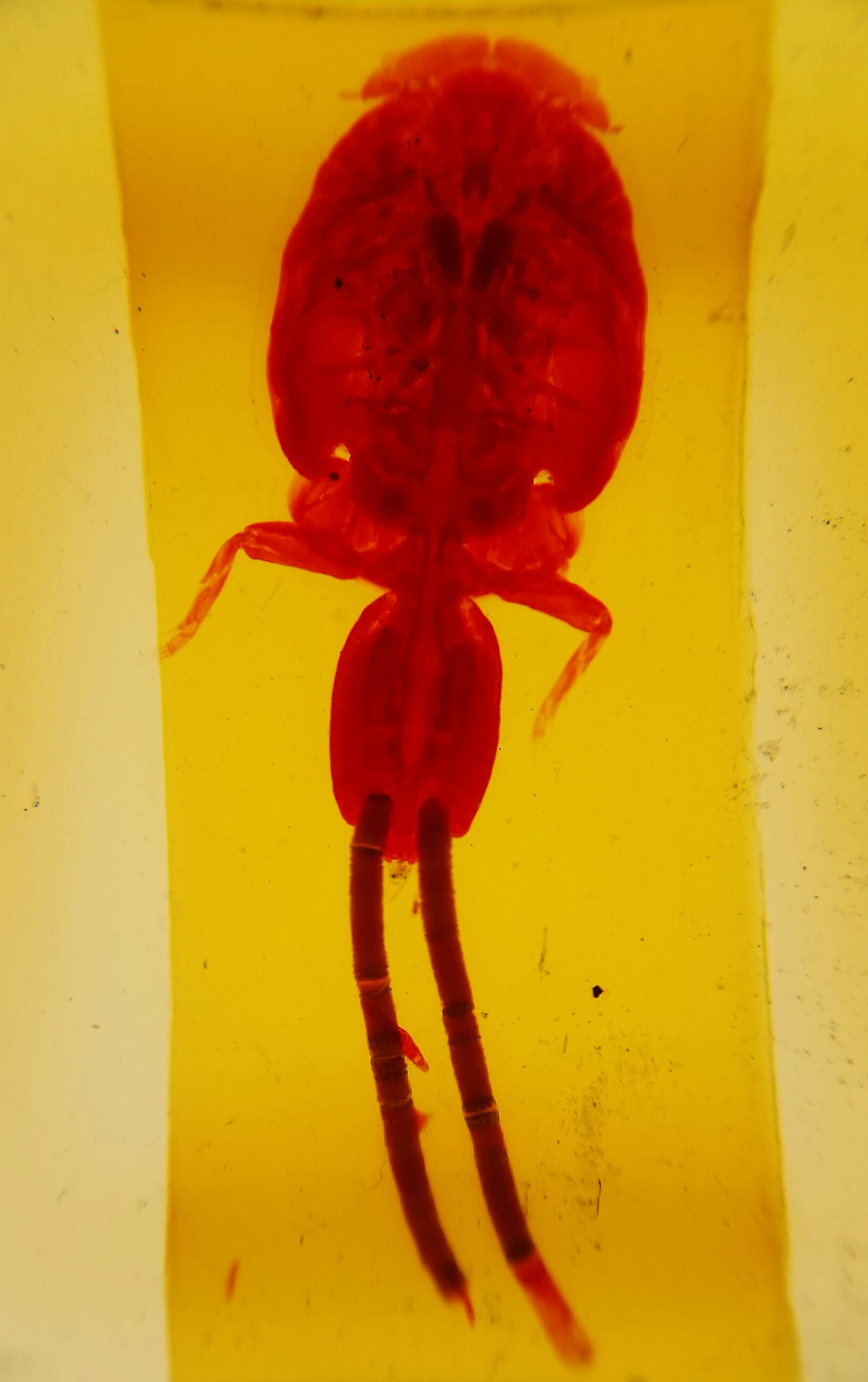
Any ideas what this might be?
As usual you can put your thoughts in the comments section below. Comedy responses welcome!

This week I have a mini mystery object for you in the form of this specimen from the Grant Museum of Zoology Micrarium:
Any ideas what this might be?
As usual you can put your thoughts in the comments section below. Comedy responses welcome!
Last week I gave you this mystery object to identify, found on a beach in Ireland:
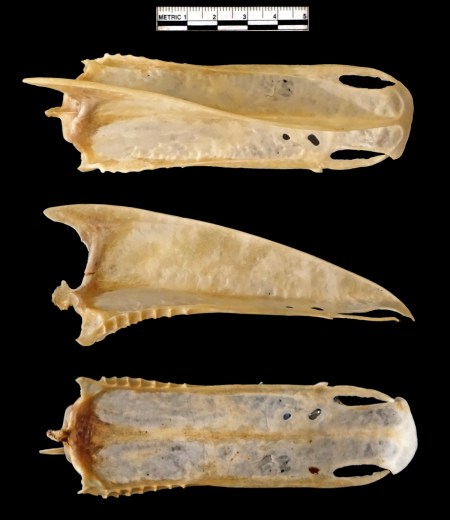
It led to a lot of great cryptic comments relating to marine birds and sternum keels, but Lena was the first to comment and was spot on with the species (or at least as far as I can tell!)
Bird sterna are quite distinctive, with overall shape giving an indicator of mode of life. Long narrow but well-developed keels like this tend to be seen in marine birds that use their wings to fly underwater. The shape of the bottom and sides of the sternum tend to be quite specific to particular genera and species, making sterna pretty good for identification.
Of course that depends on having good comparative material and I was delighted to find John Rochester’s very helpful Flickr page, that has a comparison of British Auks (in this case we’re talking about the geographical British Isles rather than the sociopolitical concept of Britain).
If you take a look at those images you’ll notice that one fits the shape very well indeed – the Guillemot or Common Murre Uria aalge (Pontoppidan, 1763).
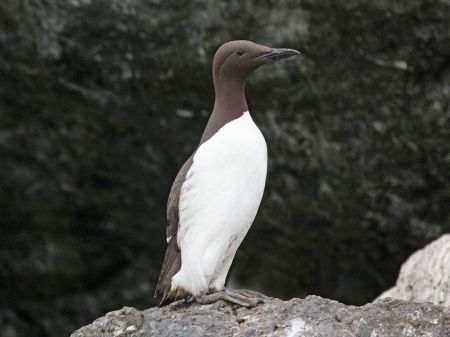
Guillemot with its meat and feathers on. Image by Dick Daniels, 2011
So that’s the identification I gave to Emer, Ronan, Rory and Paddy who found it on their hols!
Every summer museums get an influx of objects discovered on beaches by holidaymakers. This week’s mystery object is from a beach in Kerry, Ireland, found by Emer, Ronan, Rory and Paddy:
Any idea what this is and what it comes from?
You can leave your questions, thoughts and suggestions in the comments box below. Have fun!
Last week I gave you this unassuming bit of bone, that I found with no identification in the Grant Museum of Zoology stores:
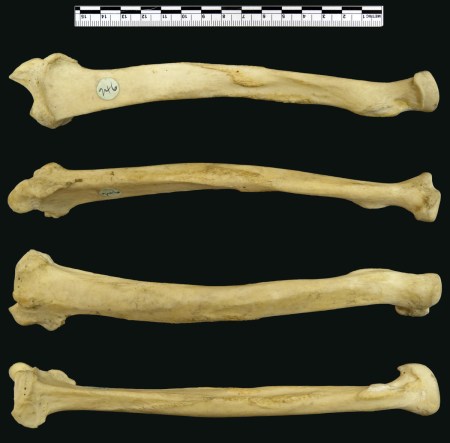
Daniel Jones and Daniel Calleri identified the element as a radius, but beyond that there was a general feeling that identification of species was a bit on the tricky side. Palfreyman1414 pointed out that it’s something approximately human sized, with Lena ruling out an ungulate, suggesting that it could be from a carnivore or possibly a marsupial.
I must admit that my mind immediately went to carnivores and I initially thought it could be from a Black Bear, since it’s fairly robust and about the right length. However, after checking the ever helpful Adams & Crabtree book I realised that bears are even more chunky than this.
It didn’t look right for a dog since they are straighter, have a flatter profile and a narrower distal end. However, it did look right for a big cat and I’m fairly certain that it’s from a Leopard Panther pardus (Linnaeus, 1758). If you want to compare a Leopard with a Dog radius you can see them compared in this paper, along with a good description of the bones of the Leopard forearm.
A bit of a tricky challenge – so next time I may try to do something a bit more distinctive!
This week I have an unidentified postcranial element for you to identify, which I came across in the Grant Museum of Zoology stores this week:
Any idea what it is and, more importantly, what it’s from?
You can leave your comments, questions and suggestions in the comments section below. Have fun!
Last week I gave you this part of a skull to have a go at identifying:

It’s quite a distinctive structure and very particular to one particular group of mammals. It is of course an external auditory meatus (or ear hole as it’s more commonly known), but instead of opening directly into the auditory bulla (the inflated bony bulb that holds the ear bones) it has a long and robust tube.
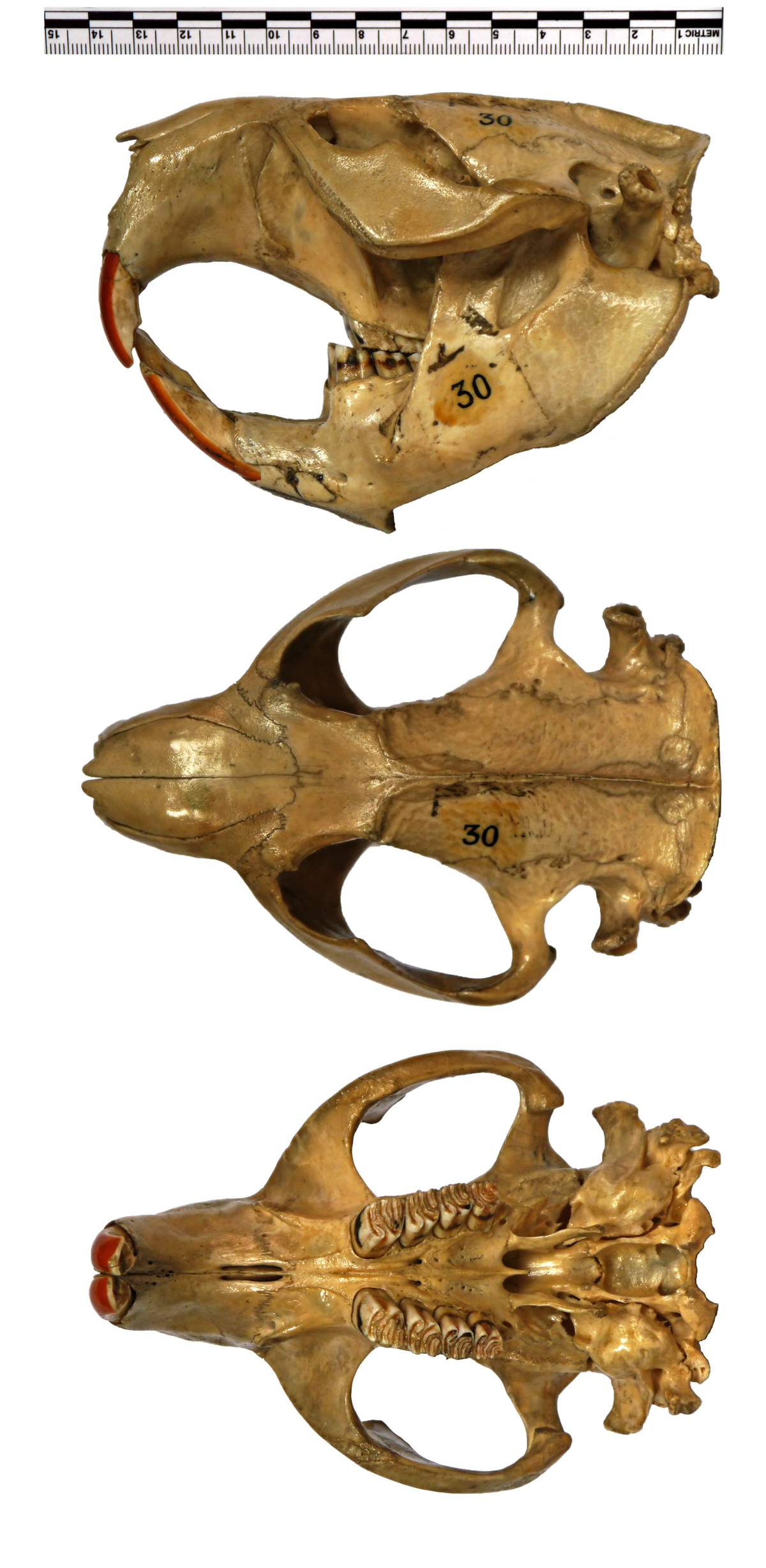
Lee Post, Daniel Calleri & Dan Jones and Allen Hazen recognised this characteristic feature as belonging to a Beaver and Richard Lawrence went one better and narrowed it down to Castor canadensis Kuhl, 1820 – an identification that I agree with having seen the whole skull:
I’m not sure if there’s any real functional reason for the ear tube, but it looks to me like it might be a “spandrel” a feature that’s an artefact of another adaptive feature – in this case the articulation of the mandible.

Gnawing through a tree trunk is no easy task, so it’s not surprising that the Beaver has some serious adaptations to deal with the work involved. Unlike carnivores, which have a fixed lateral mandibular articulation powered mainly by the temporalis muscles, rodents have a dorso-ventral articulation usually powered by the masseter muscles, which allows the jaw to move backward and forward. In the Beaver the sagittal crest suggests that the temporal muscles are more involved than usual which, with the orientation of the articulation, may necessitate the ear tubes as lateral braces against which the mandible can secondarily articulate. That’s my guess…
Great work on identifying this specimen using very limited information!
Sticking with a close-up theme, have you got any idea what this very distinctive bit of bone is from?
As usual, you can leave your suggestions, comments and questions below. If you find this too easy feel free to spice up your answer with some cryptic clues. Have fun!
Last week I gave you this zoomed in picture of a specimen to have a go at identifying:
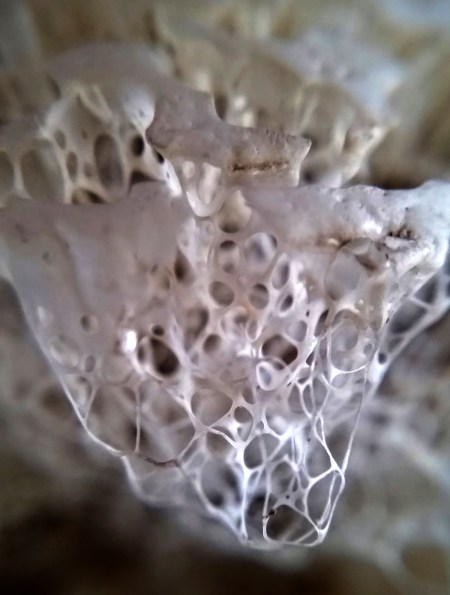
It was a bit tricky, so I also gave you this bonus clue to help:
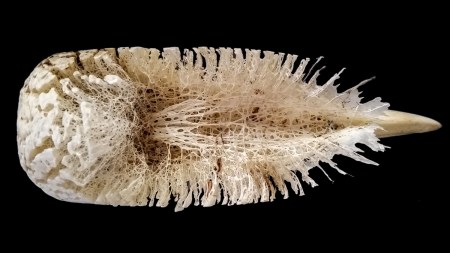
I was impressed to see that, despite the limited information available from the images provided, many of you managed to work out that this shows the lightweight ‘honeycomb’ structure that supports the casque of a hornbill.
That was the first challenge but, as ever, I was keen to see if you could get the identification to species – far more of a challenge considering the lack of a side view of the skull and lack of a scale. To make up for that I’ve decided to provide the necessary image here:

I won’t say what species this is in this post, as I normally would, just to give some more of you a chance to make the identification yourself. However, what I will say is that the very first response by Wood contained a link to an image of the correct species and later to a blogpost featuring this very specimen. In that post there is a discussion about the appearance of the casque, with speculation about whether it had been damaged during preparation, resulting in its appearance. However, as Richard Lawrence pointed out, this appearance is actually normal for the skulls of several species of hornbill.
I will also say that the discussion between Daniel Calleri & Dan Jones and Richard Lawrence about whether it was a hornbill from a genus starting with A or B was interesting and I initially thought it was an A, but am now convinced that it’s a C.
If you’re desperate to know which species it’s from, here’s a link to the skullsite.com page about it.
This week I have a mystery object for you that’s a bit different from the usual. Any idea what this zoomed in picture is showing?
It’s probably a bit of a tricky one, so if you want an extra image that makes it much easier you can click on this link for a bonus clue.
Please leave your suggestions in the comments below – I’d love to find out your thoughts and let me know if you needed the clue. Have fun!
Last week I gave you this mystery object supplied by Dr David Hone: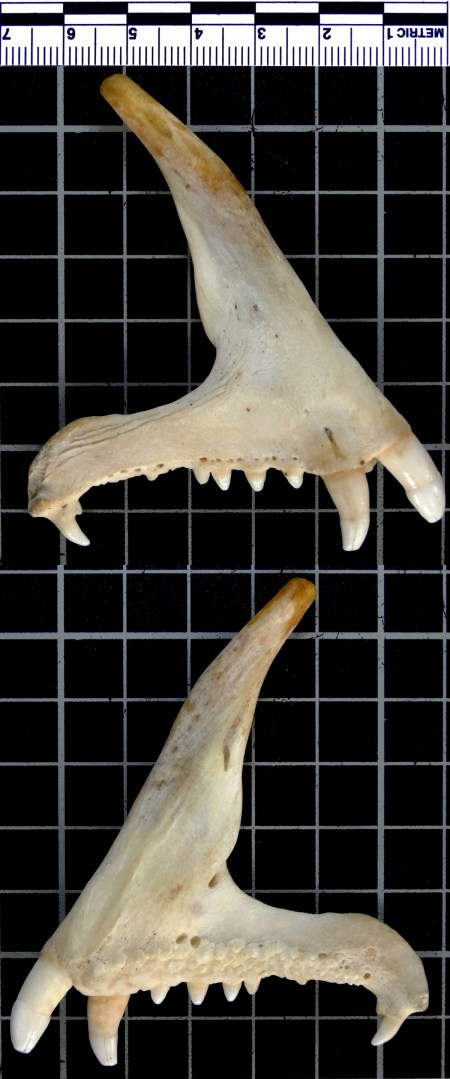
This is the premaxilla of a fish, but that doesn’t narrow things down much, since there are 28,000 species of bony fish, leaving a huge range of possibilities.
There were several suggestions of Wolf Fish, which is what I originally thought it was myself, but that’s not what it is. Then the suggestions of various Wrasse species started cropping up – which is a lot more likely.
My first look at Wrasse teeth came when I tried to identify the fish used in the Horniman’s Merman:

There are a lot of Wrasse, over 600 species in fact, so it can be hard to narrow down the species, especially when few comparative specimens are available.
One very helpful osteology resource for identifying fish from their bony bits is Osteobase which lets you pick a bone and start making comparisons. It’s worth keeping in mind that you need to really explore the taxonomic tree on the left of the page to get a real appreciation of how useful it is – so for example, after selecting the premaxilla, if you look at the Perciformes (the Order containing the Wrasse) you see a huge range of premaxilla specimens that help narrow down the bone you’re trying to identify.
This clearly shows that the Labridae is definitely the right family for the mystery object and the Mexican Hogfish Bodianus diplotaenia (Gill, 1862) is a very close match.
So congratulations to Richard Lawrence who I think has it right, especially since the specimen was found within the range of this species. I hope you all enjoyed the challenge!
This week I have a mystery specimen from Dr David Hone who showed me it when he came and spoke about Tyrannosaurus at PubSci the other night (if you want to see the talk take a look at the Periscope feed from the evening). Here it is:
Do you have any ideas of what bone it is and from which family of animals? If you can work out the species I will be both surprised and very impressed.
As usual if you think it’s too easy, please be sure to leave a cryptic clue in the comments section below. I hope you have fun with this!
Last week I asked for your opinion on this mystery object:
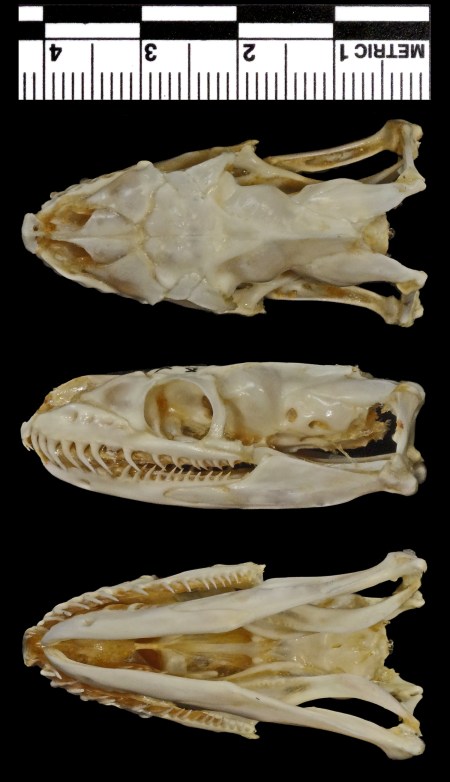
It had originally been identified as Boa constrictor and then reidentified as Green Anaconda, but I didn’t believe either of those options.
There was some activity in the comments, from the initial observation that it’s a snake from Wood, to Andy Mills’ suggestion of Python, with palfreyman1414 and Daniel Jones and Daniel Calleri’s discussing how to tell whether it’s a boid or pythonid.
In fact, palfreyman1414 did some sterling work tracking down characteristics to help distinguish between these commonly confused groups, with this handy comment:
“The postfrontal bone, usually present, borders the orbit behind, rarely also above, and in the pythons a supraorbital bone is intercalated between it and the prefrontal bone.”
And..
“Boids are, however, distinguished from the pythons in that none has postfrontal bones or premaxillary teeth”
The character of the presence or absence of teeth in the premaxilla (the frontmost bone of the upper jaw in the midline of the skull) is particularly useful, although it’s not unusual for the premaxilla to fall out of snake skulls.
The postfrontal character is a bit less obvious and I’m not fully convinced by it – not because there isn’t an extra bone in the pythons compared to the boas (there is), it’s just whether it’s a postfrontal, a supraorbital or a post orbital. That depends on the reference you read. To help get an idea of the bits we’re talking about, I’ve highlighted them here (purple for premaxilla, pink for the bit missing in boids, call them what you like):

It’s probably worth mentioning that Anacondas are members of the boid family, so it’s clear that this specimen is a pythonid rather than a boid. But that doesn’t tell us what species it is (if you want to see a Boa constrictor skull there’s a video of one here).
Comparing overall skull shapes in snakes is not very effective, since the skull is very loosely articulated to allow it to deform when swallowing large prey, so when mounted they can be very variable in shape. Because of this you need to compare the shapes of the various bones that make up the skull to narrow it down.
There is a very helpful image resource called BioLib that has validated photos of skulls amongst other images, so it’s well worth checking out. Trawling through I didn’t manage to find a species with the same shapes in the nasals, prefrontals, frontals, parietals and supratemporal – but I did discover a specimen photo by Jean-Christophe Thiel that fit (not to mention a previous mystery object) – so I’m fairly confident that this is a Royal Python Python regius (Shaw, 1802).
Many thanks to everyone for their comments – it’s been a fun challenge where I know I’ve learned an awful lot. I hope you have too!
This week I have another specimen from the Grant Museum of Zoology for you to have a go at identifying:

This specimen has an identification, but I’m not sure I agree with it, so I want to see what you think it is.
Have fun with it!
Last week I gave you this crocodilian skull from the Grant Museum of Zoology to see if you had any thoughts about which species it might be:

It turns out that you did indeed have some excellent thoughts about the identification, with Cindy Nelson-Viljoen immediately getting it right, with astute observations from David Godfrey and palfreyman1414, plus another correct responses from Joe Vans (as well as Tone Hitchcock and Henry McGhie not via the comments section).
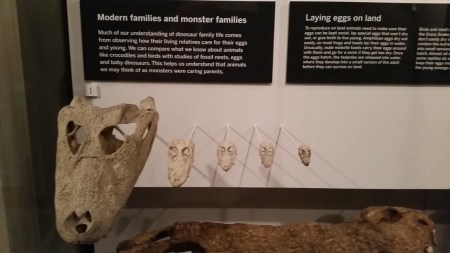
This is a skull of the Dwarf Crocodile Osteolaemus tetraspis Cope, 1861. It’s small size is the first clue, but given how crocodiles grow this could pass as the skull of a young individual of a much larger species. As David Godfrey pointed out, there may be some paedomorphism (where adults look like juveniles) in effect in this species, since the adults as well as being small, have relatively short snouts and big eyes – which are features of juvenile animals as you can see in this display of crocodile development I did for Dinosaurs! Monster Families just before leaving the Horniman:
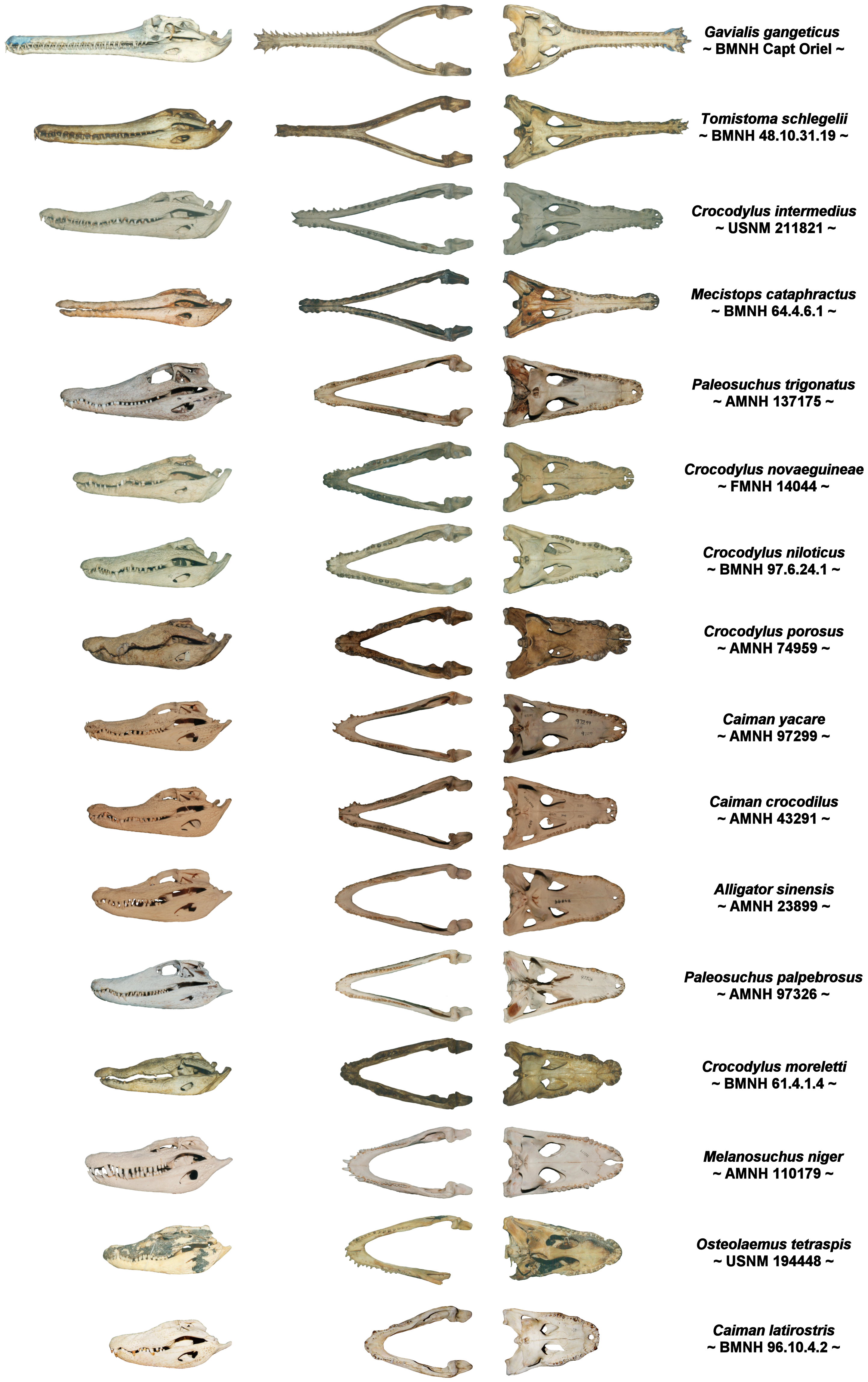
Part of my reason for wanting to show you this specimen was to force myself to look for some good online resources to get more familiar with crocodilian morphology. As it turns out, I did find a very useful comparative image, which shows the size and shape of the mandibular foramen (a large gap between the bones in the side of the lower jaw) is a helpful feature:
In this species the foramen is small, which when considered with the overall proportion is quite distinctive. Of course, this image does not include all 24(ish) living crocodilian species, but it does provide a pretty good range. Hopefully this will help speed up future croc skull identifications, at least allowing certain species to be discounted.
If you have any good tips for crocodile identification please share below!
Last week the answer to the mystery object was a Gharial – a very weird crocodilian from India. I realised that I didn’t know much about identifying the Crocodyliformes, so I thought it might be fun to have a go at working out what this species might be:
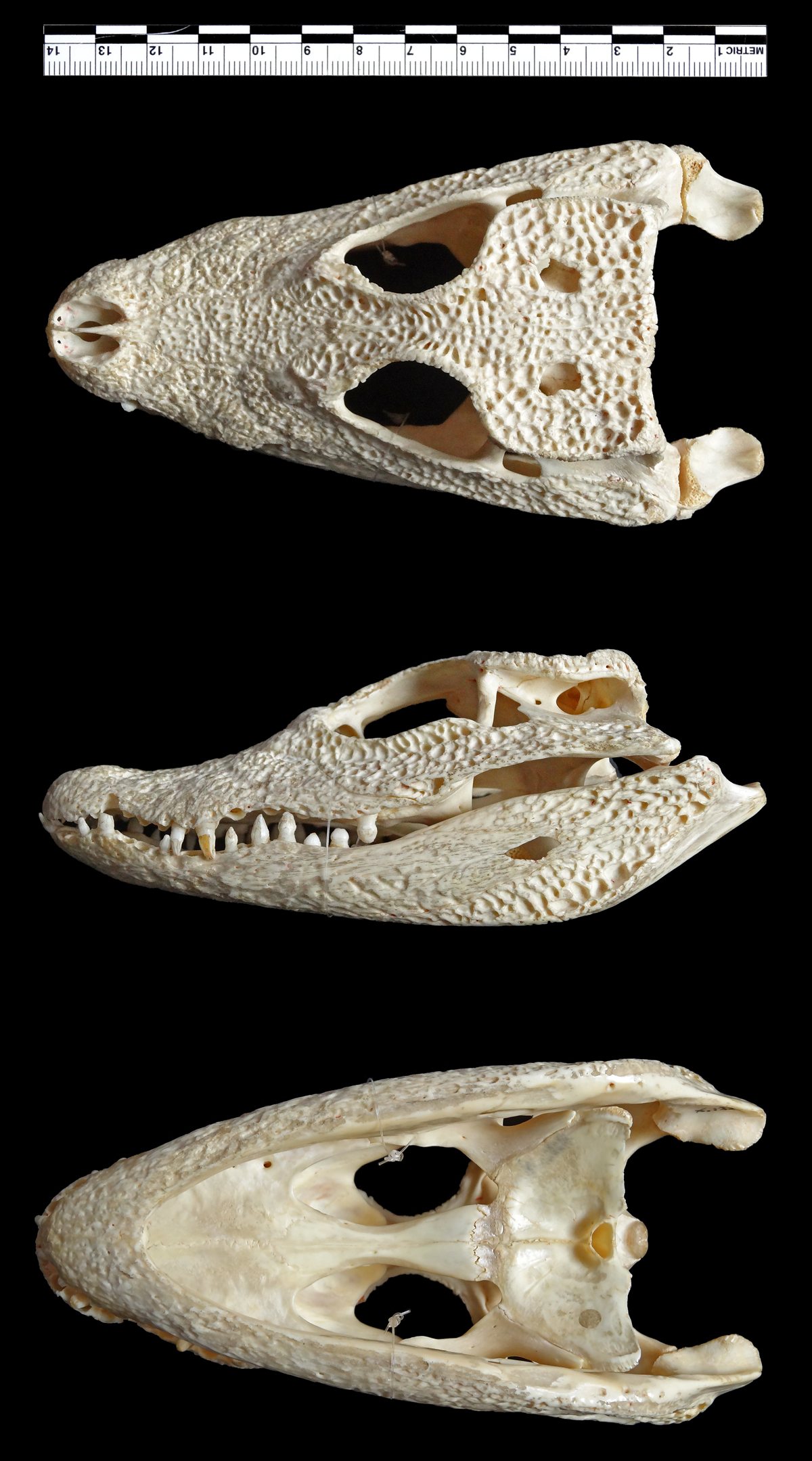
As always, I would love to hear your thoughts below and let’s see if we can find some good diagnostic features!
Last week I gave you this mystery object to identify:

It’s the kind of thing you find in museum collections quite often, but it will commonly be misidentified – especially in anthropology collections where (in my experience) it will commonly be referred to as a claw or big cat tooth.
However, nobody who commented went down that route, recognising that the hollow base and well defined crown indicates that it’s an open rooted tooth of some sort. In mammals an open root at this size that would suggest a pig tusk or perhaps a whale tooth, but this isn’t mammalian.
In fact, this tooth is from something even less cuddly than a whale, something crocodilian. This was recognised first by Carlos Grau, but others who came to the same conclusion included Jonathan Larwood, Daniel Jones, palfreyman1414, Wouter van Gestel and Charne. More specifically, this tooth is from a Gharial, Gavialis gangeticus (Gmelin, 1789). This Gharial from the Grant Museum of Zoology in fact:

Grant Museum of Zoology Specimen LDUCZ-Y215
Gharial teeth are a bit less conical than the teeth of most crocodiles and alligators. Presumably the curve helps prevent their main diet of fish from getting free when caught.
Gharials are sexually dimorphic, with the adult males bearing a big rounded bony knob on the end of their rostrum, this is where the name Gharial comes from, as this feature resembles a local earthenware pot called a “ghara”. Sadly, these distinctive crocodilians are critically endangered, with just a few hundred left alive in the wild. They are affected by habitat loss, egg theft and use in traditional medicines.
More mysteries next week and if you fancy hearing me talking about animals you might be interested in coming to Animal Showoff at the Grant Museum of Zoology next Thursday evening!
This week I have the kind of mystery object that you find a lot of in museum collections. Sometimes they reside in the bottom of a box. Sometimes they sit in a cupboard. Sometimes they might even have a label, although that label than will often be vague and sometimes misleading.
Any idea what this is?
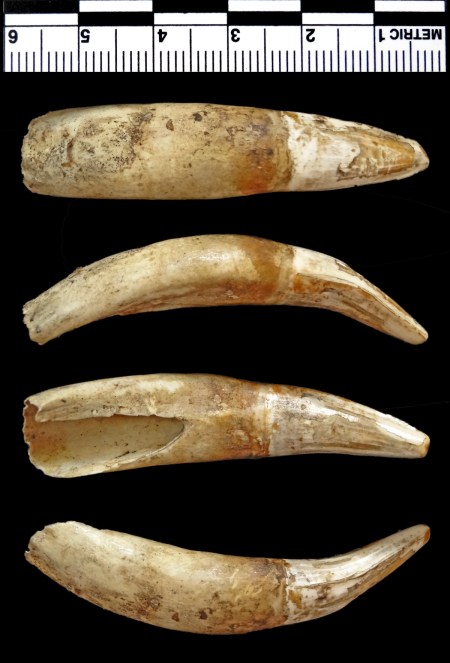
As usual, you can leave your suggestions below and please try to keep them cryptic if you’re confident that you know what it is. Have fun!
Last week I gave you this mystery object from the Grant Museum of Zoology to get your thoughts on:
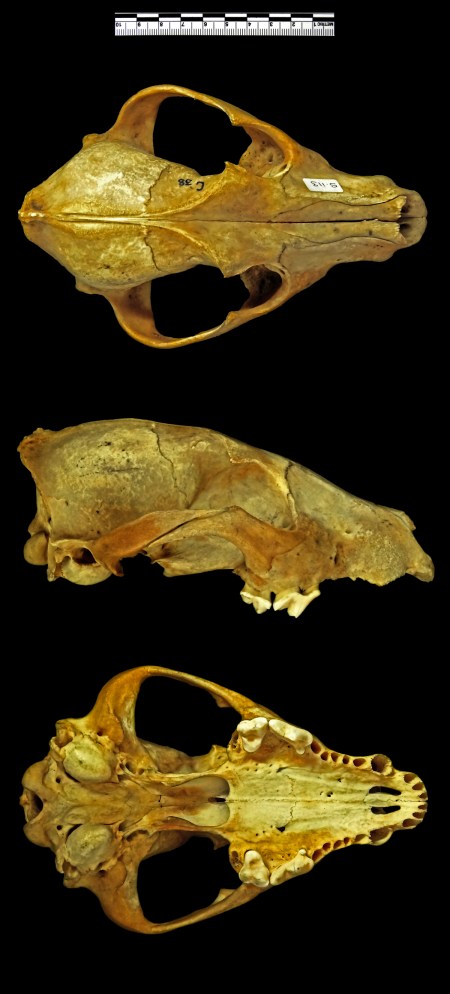
Most people spotted that this was a canid of some sort – but there was a lot of discussion about exactly what sort.
Allen Hazen made an interesting observation about the reduced second molar (missing in the specimen, but the socket shows that it was there and smaller than you’d expect from most dogs), plus the remarkably convex facial profile. Useful observations that have a bearing on the identification.
The short and broad muzzle, combined with the convex skull and distinctive molar morphology led Latinka Hristova to suggest Dhole, an identification agreed with by Lupen, palfreyman1414, Richard Lawrence, joe vans, Henry McGhie – and myself as it turns out.
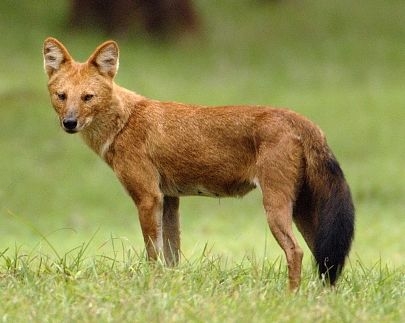
Dhole (Cuon alpinus) by Kalyanvarma
The Dhole Cuon alpinus (Pallas, 1811) is an endangered Asiatic Wild Dog, that hunts in clans and feeds on a variety of medium to large mammals that are usually killed after an extended chase.
I’d not seen the skull of one of these before, but I was aware that they have a convex profile, so it was my immediate suspicion when I saw the mystery object and the species was confirmed by the unusually simple structure of the first molar and very reduced second molar, which are almost cat-like in their adaptation for shearing meat.
All in all, an exciting skull to find – and there are other unidentified canids in the same box that I’m itching to take a look at, so keep your eyes peeled for more mystery mutts.
This week I have a specimen for you that I found in the stores of the Grant Museum of Zoology:

I have a strong suspicion that I know what it’s from, but I’d really appreciate your thoughts!
Last week I gave you this pretty cool skull from the Grant Museum of Zoology to identify:

On Twitter the prevailing hypothesis was that this is the skull of an Alien Xenomorph, which was also proposed by Daniel Calleri, but most the comments here on Zygoma were a bit more down to Earth.
The identification started being narrowed down by Sisyphus47 and palfreyman1414 who recognised it as a reptile, which was narrowed down further by joe vans to a fossorial (or burrowing) lizard.
Allen Hazen, John D’Angelo and Daniel Calleri took it another step further and identified this as an amphisbaenian or worm lizard, but Rebecca Watling went even better and identified it as the skull of a Red Worm Lizard Amphisbaena alba Linnaeus, 1758. The morphology is very close and the size is right, so that’s the identification I’d also reached.

Amphisbaena alba by Diogo B. Provete
I’ve talked about Amphisbaenia before, but this one is a good bit bigger than most other species and the skull is oddly similar to that of a Weasel. I’m not really sure why, because the diet of these strange reptiles is very poorly known. It seems likely that they’ll eat invertebrates and small vertebrates, presumably in burrows, which does actually sound similar to a Weasel.
Weird, but pretty awesome!
 Zygoma