Friday mystery object #51 answer

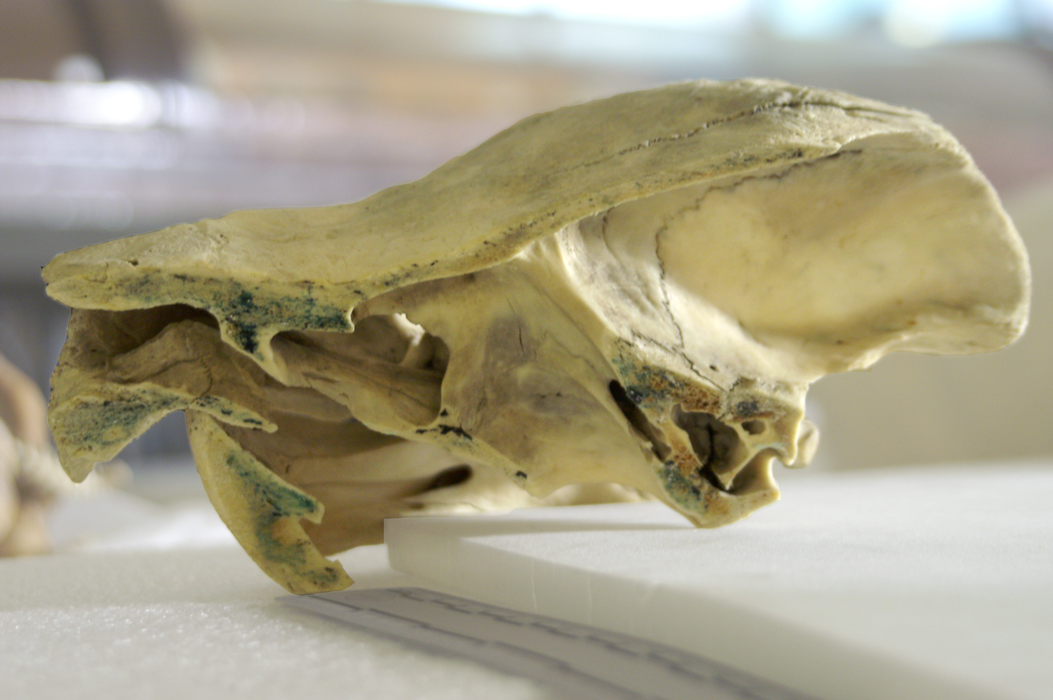
On Friday I gave you a fairly straightforward mystery object to identify – at least straightforward in that it wasn’t an odd section or a fragment of bone, instead it was a very characteristic skull:

As a result a good number of you correctly identified this, with zinjanthropus first past the post with a general identification, Neil with the correct genus and David Craven with the full species identification. So well done everyone, this specimen is indeed the skull of a Continue reading

Friday mystery object #50 answer

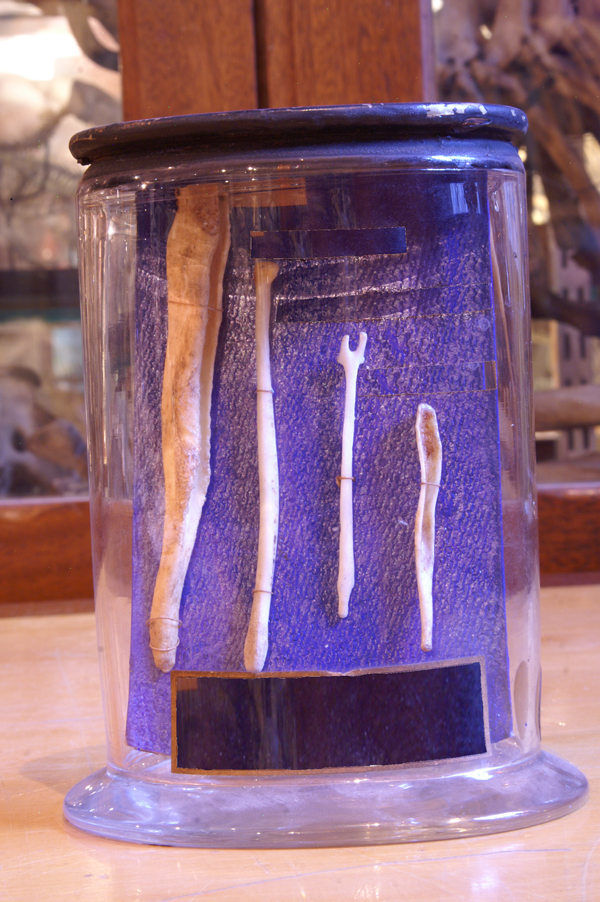
On Friday I gave you a multipart mystery object from the wonderful Grant Museum of Zoology:

This was easy in part and horribly difficult in part. The bones themselves were quickly identified as being bacula (plural of baculum) or os penes (penis bones) by Shane and SmallCasserole, but then there was confusion about which species they might  belong to. Matthew Partridge got one right, but after that the guesses went a bit wide. Here’s an unedited image that has the labels attached: Continue reading

Friday mystery object #50

Crikey, it’s my 50th mystery object already – in two weeks that means it will have been running for a full year. How time flies. To mark the half century of these posts I’m giving you a real challenge supplied by the excellent Grant Museum of Zoology, which has just closed its doors in order to be relocated whilst building works take place. The museum will be closed to the public until next February, when it will reopen in a new location. So here’s the challenge:

Any idea what these are, and (here’s the incredibly trick bit) which four species they might belong to? Can I request that those of you with a biological background concentrate on the harder question, as it will give my non-specialist audience an opportunity to work out what these bits are.

As usual, answers, observations and questions in the comments section below. Good luck!

Friday mystery object #49 answer

On Friday I gave you one of the specimens on display at the Horniman Museum, photographed from an unusual angle, as the mystery object:

I thought it might prove tricky, but jonpaulkaiser managed to identify it within 16 minutes of it being posted. Impressive stuff! Matt King also managed to spot what general type of beastie this bit of bone belonged to; a Continue reading

Friday mystery object #49

The Natural History Gallery at the Horniman has been undergoing a bit of a spring clean. The lighting in the cases has been upgraded and during the process the cases and specimens have been dusted (very carefully mind). During the process I’ve spotted a few of our display specimens from unusual angles and out of their usual context. Here is an example of a nice one that I thought might make a nice mystery object:

So any ideas what this is?

Put your suggestions and questions in the comments section below and I will do my best to point you in the right direction without giving too much away. Have fun with it!

Friday mystery object #48 answer

On Friday I gave you this lovely skull to identify:

It seems to have been a bit more tricky than I had expected. It was immediately identified as a carnivore, which is spot-on, but from there it got a bit murky. I must admit that I could have been a bit more generous with clues, particularly when David Craven asked if this was a viverrid (the family containing the civets) – I took the question at the family level, so I said ‘no’, but I should probably have asked for clarification since this skull belongs to a member of a family that falls into the infraorder Viverroidea (according to some sources).

This is in fact the skull of a Continue reading

Friday mystery object #48

This Friday I’ve taken bit more effort than usual to get a decent picture of a specimen for the mystery object. It’s amazing the difference it makes when you use a tripod and allow a good long exposure. I’m sure you’ll all identify this in no time, but hopefully you’ll enjoy the image while you’re at it – there are few things quite as beautiful as bones:

Feel free to ask questions, make suggestions or just leave your thoughts in the comments section below – I’ll do my best to answer or drop hints as the day goes on. Good luck and I hope you enjoy!

Friday mystery object #47 answer

On Friday I gave you what I consider to be a rather interesting mystery object:

I must apologise for my tardy responses to the excellent questions asked, on Friday I was at a fascinating conference about using DNA from natural history collections for research, hosted by the NHM, and I didn’t get an opportunity to address the questions until quite late.

The questions were astute from the outset, with Bob O’H asking if it was a bird – no doubt inspired by the lightweight structure of the bone. SmallCasserole suggested that it was the sectioned skull of a Cassowary, based on the presence of the bony crest (or more accurately the casque) – an opinion that was widely supported. However, Dave Godfrey raised the possibility that this skull belonged to a hornbill, a suggestion that Neil developed to arrive at the correct genus with David Craven delivered the coup de grace with the correct species identification of Continue reading

Friday mystery object #47

It’s Friday again (huzzah!) so that means it must be time for my mystery object. This week I’m going to give you something that is being moved from the Natural History offices at the Horniman to our Study Collection Centre, where our reserve collection is housed. The delicate bony structure of this object really caught my eye and I hope you find it as interesting as I do (click on image for higher resolution):

As always, feel free to ask questions about the object or make suggestions about what you think it looks like – I’ll do my best to answer or respond, although I’m at a conference, so apologies if my answers are sporadic and perhaps a little brief. Good luck!

Friday mystery object #46 answer

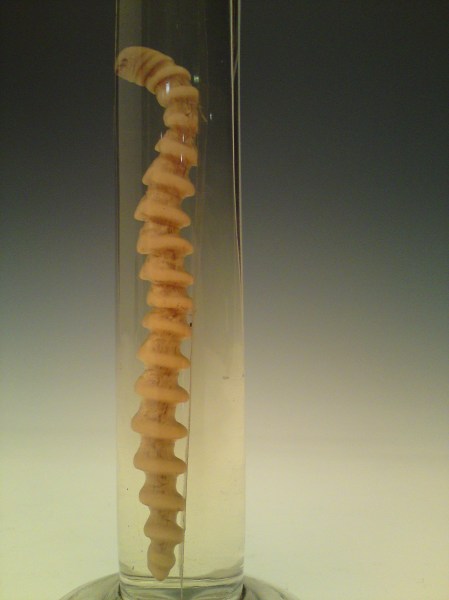
Last Friday Mark Carnall from the Grant Museum of Zoology provided a guest mystery object in the rather unpleasant looking form of this:

It looks a bit like part of a spinal column, but it isn’t. It looks like a worm of some kind, but it isn’t. So what is it?

David Craven and Dave Godfrey came through with the goods on this one. It is a parasitic crustacean related to the tongue worms (a misnomer because they are not worms at all) and it is in the genus Continue reading

Friday mystery object #46

This Friday we have a guest mystery object, supplied by the curator of the excellent Grant Museum of Zoology, Mark Carnall (the man who threatened the whole of humanity with the doomsday virus in Back from Extinction). Any idea what this fluid preserved specimen might be?

Given the general look of it and Mark’s history of terrormongery I wouldn’t be surprised if it was a body-snatching alien, if such things were in general circulation. If you’d like to see this critter  from a different angle click here.

As usual, suggestions and questions below in the comments section and I’ll do what I can to point you in the right direction. Good luck!

Friday mystery object #45 answer

On Friday, whilst I was in the lovely friendly town of Portaferry catching up with some old friends,  I gave you this mystery object to identify:

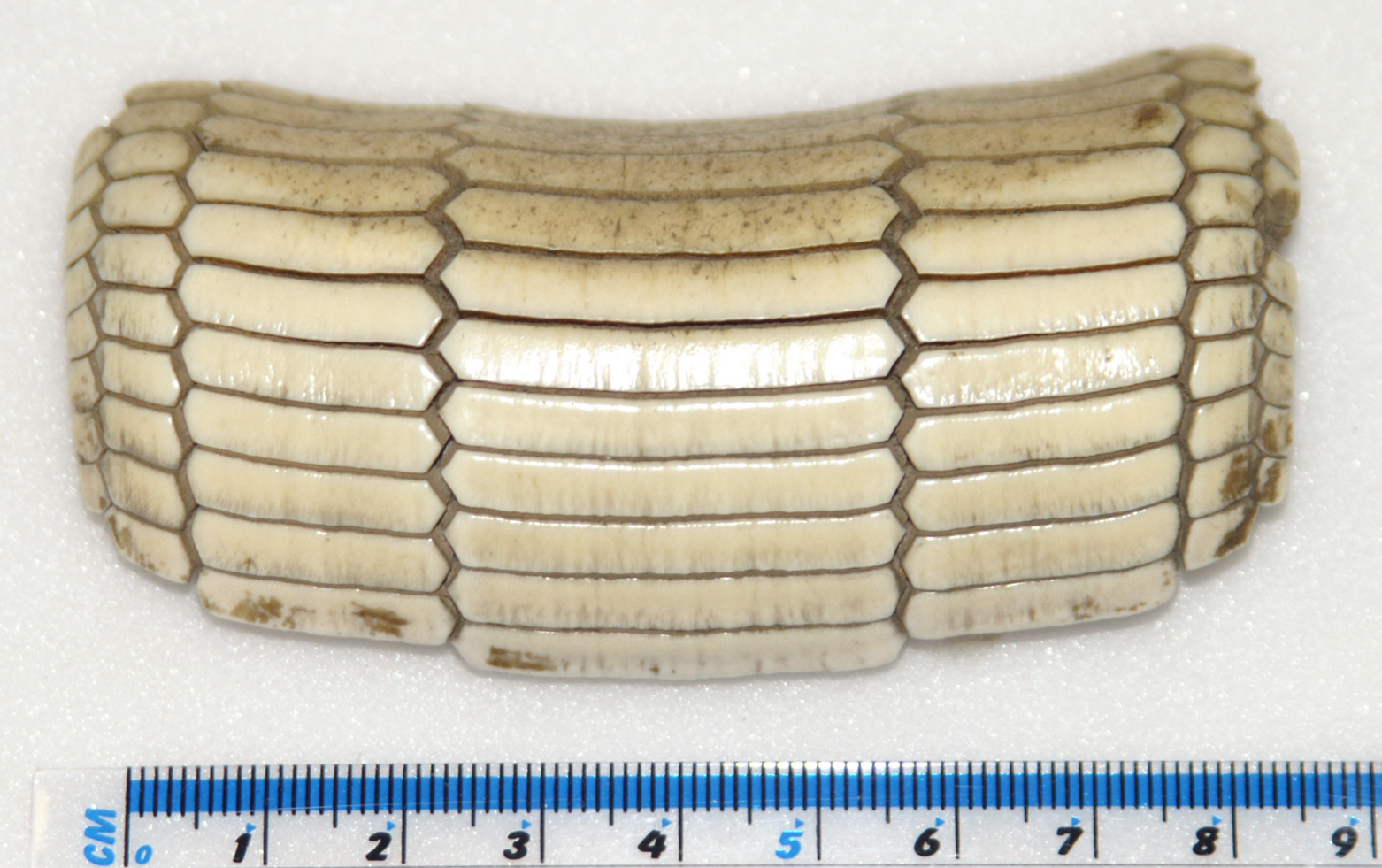
Unfortunately my phone seemed reticent to work properly, making it hard to respond to everyone’s questions, so thanks to Debi Linton for fielding some of the questions/suggestions. This object is one of those that is so characteristic in its structure that once you’ve seen one you will probably be able to spot another with ease, even though they have a huge variety of shapes, as pointed out by Benjamin Brooks in his comment (which provides a link to an image hosted by the Oceans of Kansas Paleontology site who incidentally have a mystery object of their own).

If you click on the image I provided you’ll see more detail, which makes it very clear that this is something composed of interlocking units that look like shiny bone. Shiny bone (that looks like a piece of ceramic) usually means bone with an enamel layer, which usually means teeth. These teeth are arrayed in a plate and if you look at the top of the plate you’ll see that it is discoloured, pitted and well worn. Clearly only this top part of the plate has seen much use and that use has been heavy, given the wear.

So why have all the rest of the tooth plate if it isn’t being used? Of course, the rest of the plate will be used, it just hasn’t moved into position yet – so what animal has teeth that move like a conveyor belt and are constantly being replaced? Sharks are the first things to come to my mind, but they don’t tend to have big flat plates, so think of something related to sharks that might need big flat plates for crushing something that very hard, probably marine molluscs.

If you haven’t worked it out already, this is a tooth plate from a  Continue reading

Friday mystery object #45

This Friday’s mystery object is one of those that you immediately recognise, or are immediately puzzled by. However, with appropriate questions and a bit of reasoning you can probably work out what this is (click image for bigger): 

If you are one of the people that recognises what it is immediately, can I request that you try to provide an answer using a bit of ingenuity (riddles, poetry, links), so it gives others a chance to work it out for themselves?

As usual I will do my best to answer any questions, although I am in Northern Ireland down by Strangford Lough for a long weekend, so I can’t guarantee reception on my phone – I will do my best though. Best of luck!

Friday mystery object #44 answer

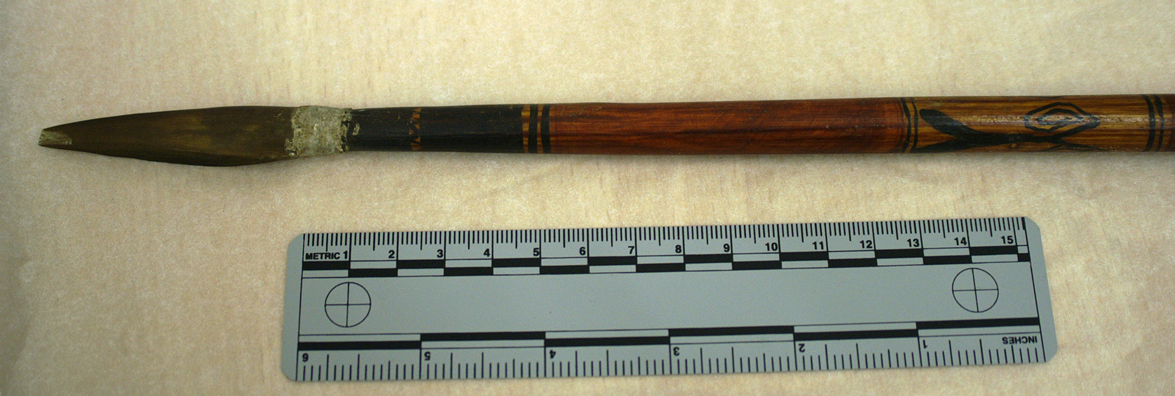
On Friday I gave you an Anthropological mystery object for a bit of a change:

I asked what it was, what the head is made from and where is it from and I got some great answers, including the (more or less) correct one. The fact that this is a projectile weapon was quickly identified, although there was some wavering between spear and arrow.

The locality was harder to pin down and the composition of the head was a real challenge. In the end, Neil managed to get it right (apart from the spear vs arrow issue) – it’s an Continue reading

Friday mystery object #44

It’s been a busy week looking at cat skulls with Manabu Sakamoto from Bristol Uni. Lots of lovely pics which will hopefully eventually make their way on to the Horniman website once Rupert (our new Documentation Manager) works his magic with our database. Since cat skulls are pretty easy to identify I was a bit concerned that I might not find a sufficiently challenging mystery object for today, but fortunately Helen (our Collections Access Officer) and Nick (one of our awesome volunteers) came through with this (click for bigger):

So what is this object (easy) and more importantly, what is the head of it made from (tricky) and where does it come from (pretty easy once you get what it’s made from)?

Suggestions and questions below – I’ll do my best to answer in good time. Good luck!

Friday mystery object #43 answer

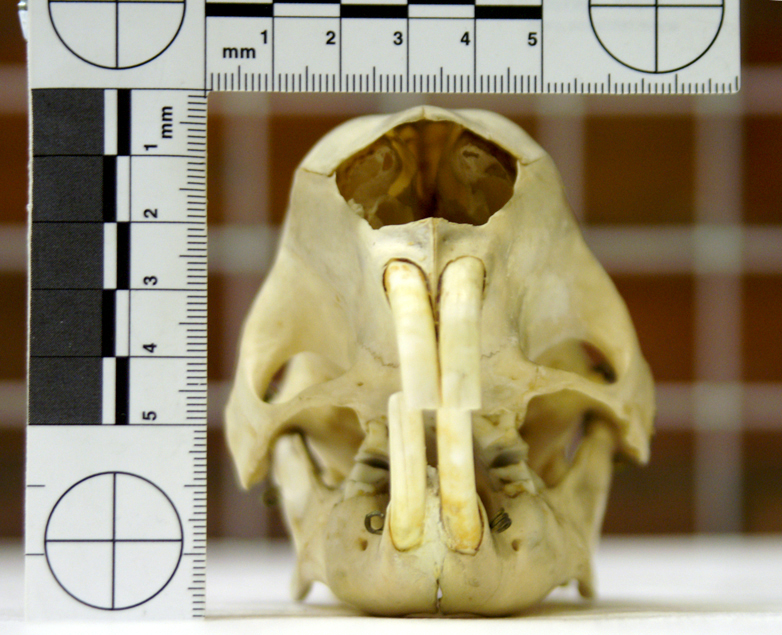
On Friday I gave you this skull to identify:

I used this skull because the shape really appealed to me when I stumbled across it in one of my office drawers – here are another couple of views of the same specimen:

Most of you quickly worked out that this skull belongs to a rodent – and a big rodent at that.  The inflated nasal region was also quickly picked up by some of you and I think that’s what led Jonpaulkaiser to the correct answer first, followed by Neil who also managed a species level identification. Well done to everyone though, there were lots of very close attempts, with several of you missing out by a quill’s breadth – if you’ll excuse the frankly awful pun. This is of course (if you didn’t guess from the bad pun) a Continue reading

Friday mystery object #43

I am back at the Horniman this week, after last week’s soujourn to Plymouth. Yesterday I was working through some of the collections that I’ve been in the process of transferring from my office space to our stores building, when I came across this specimen:

I love the shape of this skull so much that I just had to have it as a mystery object. It would be too easy if I gave you a side-view, so you’ll just have to wait for that until Monday. Make your suggestions below and I’ll do my best to respond (although my home internet has been down for the past week, so I may be limited in how much opportunity I have to reply to questions).

Best of luck!

Friday mystery object #42 answer

On Friday I was at the NatSCA conference, hosted by the Plymouth City Museum and Art Gallery. The conference was excellent (thanks Jan and Helen) and I really enjoyed the natural history collections on display – particularly this piece of partially made taxidermy:

I asked you to identify what species of bird this mannequin is intended to represent. The only actual bits of the bird are the legs, head and wings, so these are the bits you should have concentrated on.

I was a bit surprised that no-one managed to get this. Most people went down the line of thinking that it was a fairly long-legged and long-necked bird, but that is without taking into account that the feathers are missing! Feathers considerably alter the shape of a bird, smoothing the contours of the neck (which has a strong curvature in life which shortens it) and providing a substantial amount of insulation. Feathers also layer quite densely on top of one another, with a stiff rachis down the middle of each, which provides structural support, changing the outline.

In the end there was one person who came close – Neil, who correctly identified that it was a corvid of some description and his suggestion was supported by Bob O’H. It is in fact a Continue reading

Friday mystery object #42

This Friday the mystery object is coming to you from Plymouth where I am currently attending the Natural Science Collections Association conference. The natural history gallery here has some great material and I thought it might be nice to have one of the specimens as this week’s object. So do you have any idea what this partially stuffed bird is:

As usual you can put your suggestions in the comments section below – I will endeavour to answer any questions, although I may not have much opportunity whilst the conference is in full flow.

Hope you enjoy it!