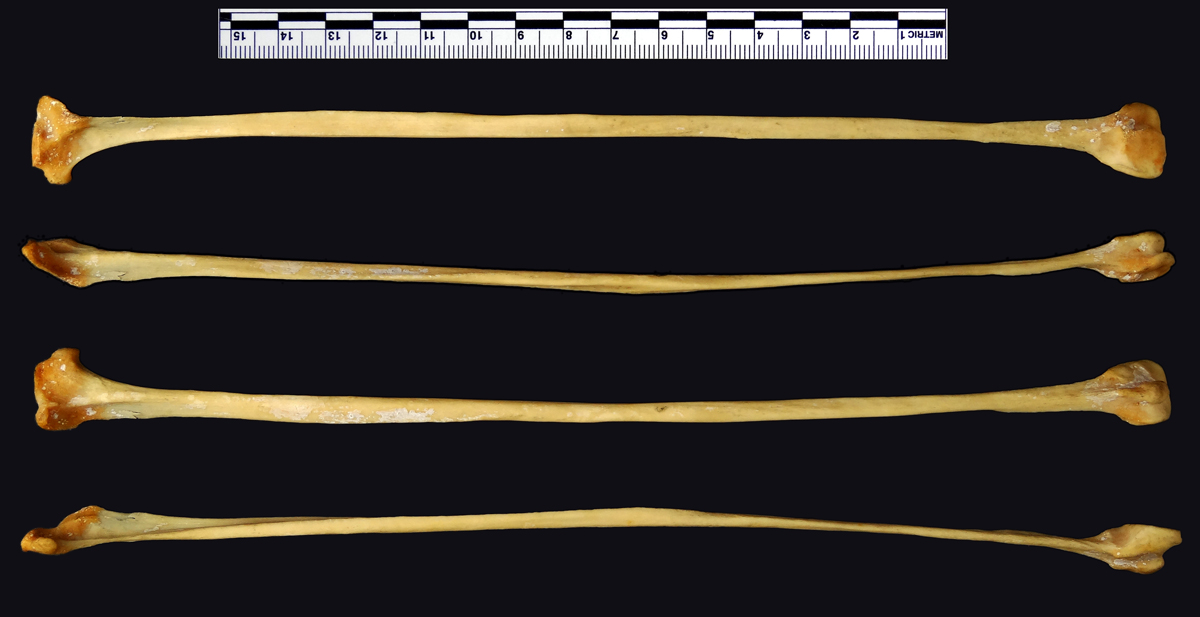
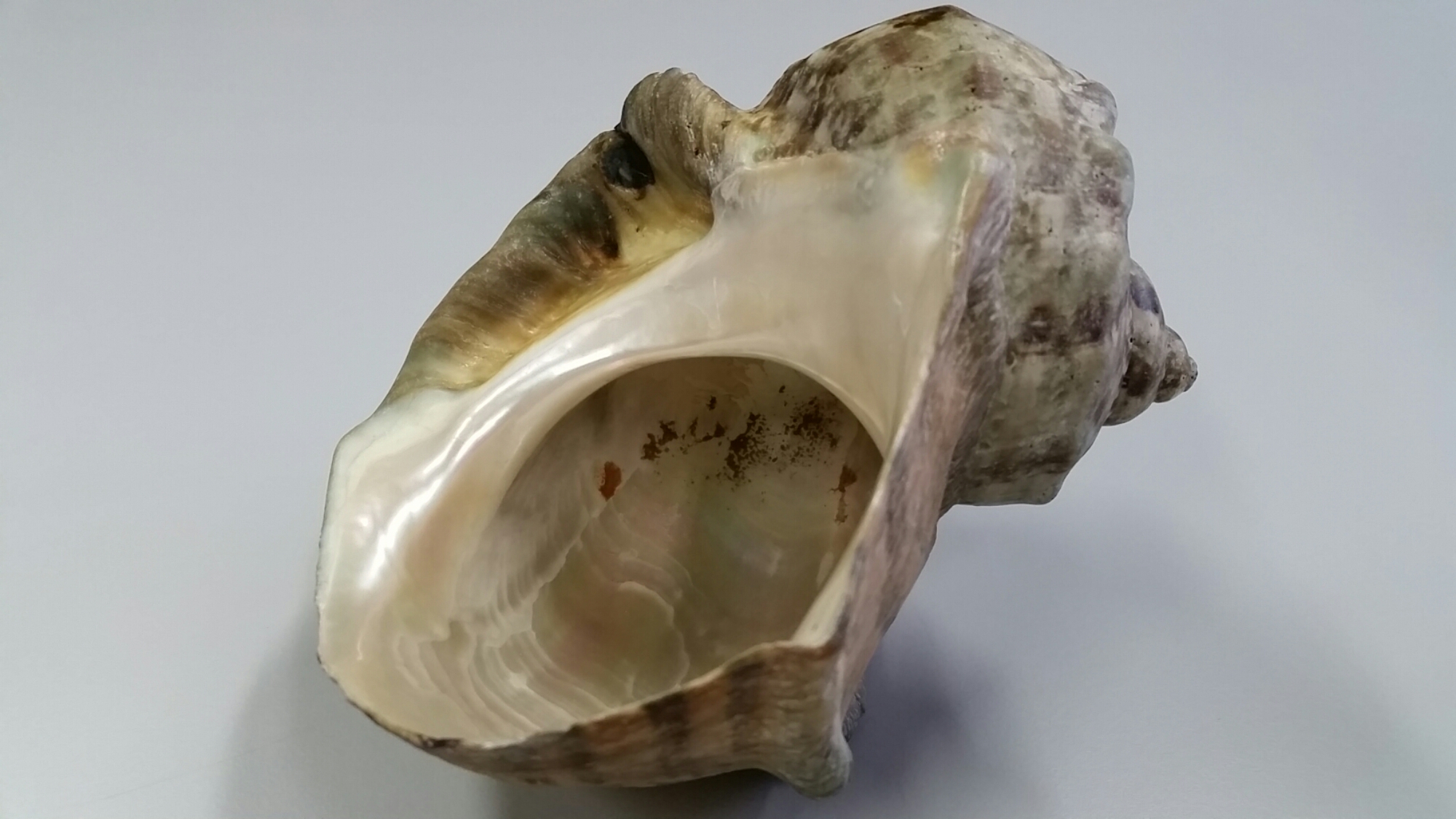
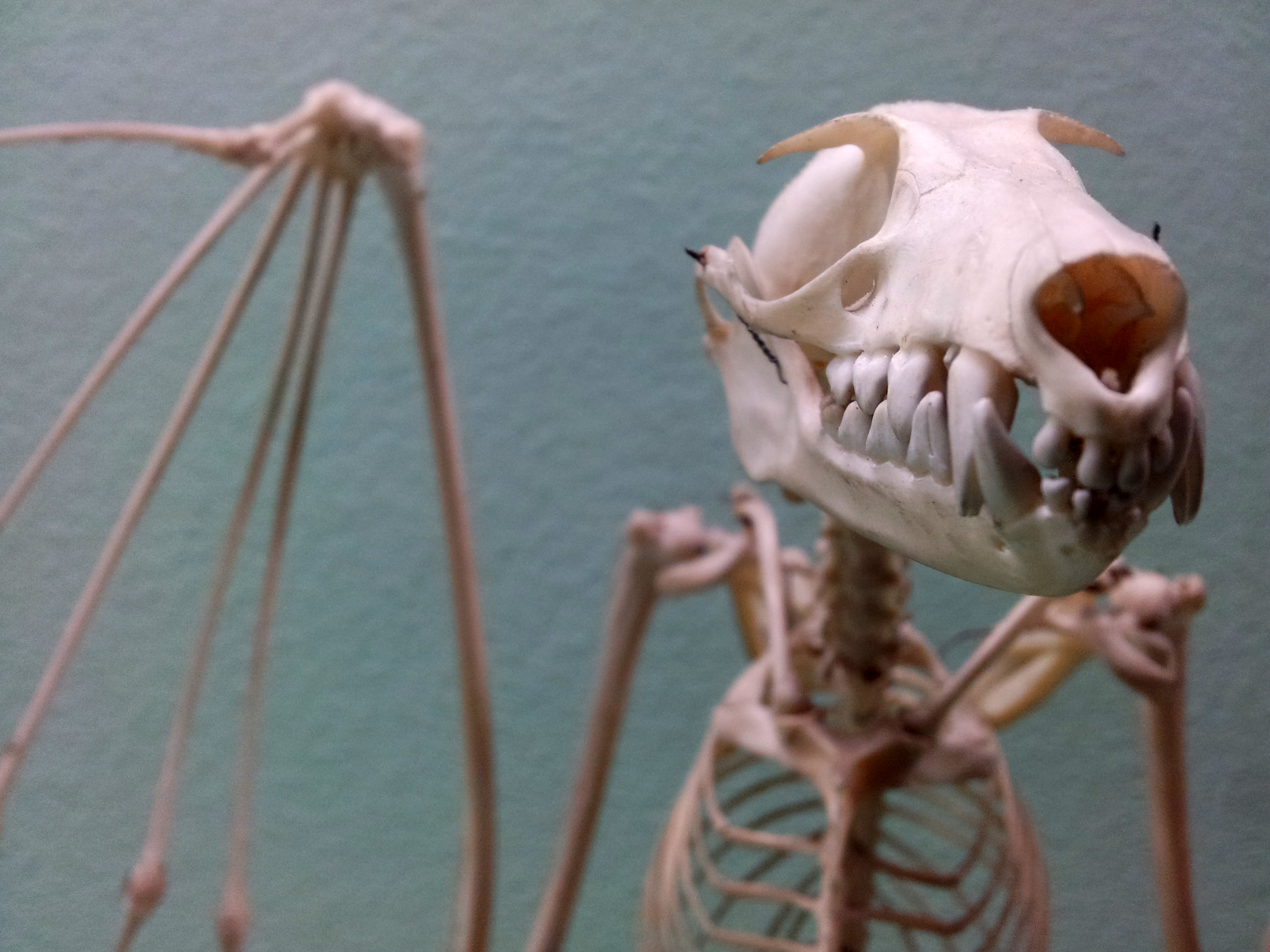
Friday mystery object #262

Last week I had an enjoyable trip to Berlin where (probably unsurprisingly) I visited the Museum für Naturkunde. The collections were fantastic, with specimens like this absolutely spectacular Archaeopteryx:

Archaeopteryx

but that’s a pretty obvious object, much too familiar to use for the Friday mystery object. So here’s something that might be a little less familiar to test your skills:

mystery262

It’s a pretty distinctive specimen, but hopefully it won’t be quite as familiar as the iconic Archaeopteryx.

If you recognise it straight away, please use your imagination and leave a cryptic answer so others get a chance to test their identification skills. Have fun!

Friday mystery object #261 answer

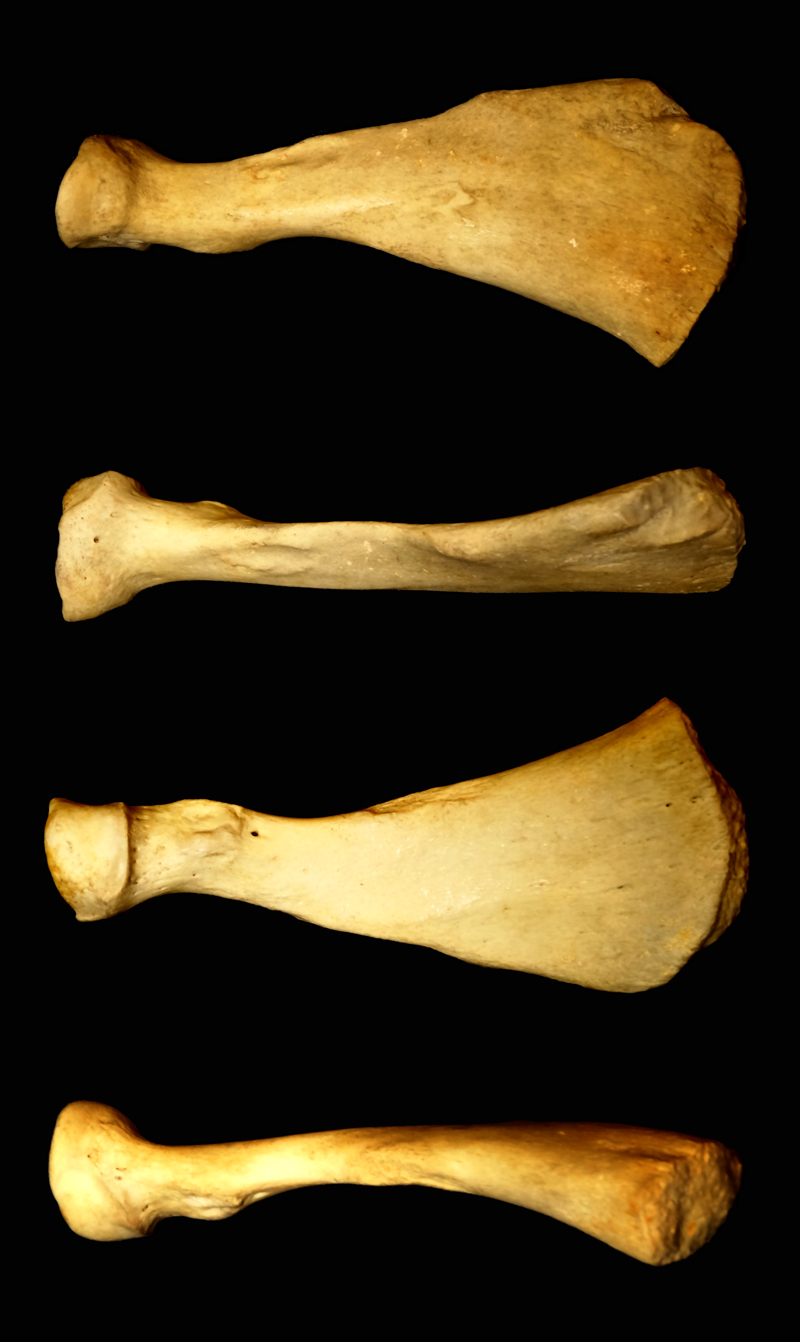
Last Friday I gave you this object from the Horniman Museum and Gardens to identify:

mystery261

It’s an odd looking bone, but that makes it distinctive, so I wasn’t too surprised that everyone recognised it as being from something aquatic. In particular, Ric Morris and joe va both recognised it as the radius of a pinniped.

The broad end that articulates with the wrist is lacking its epiphysis, indicating that this is from a younger animal. This also makes it a little harder to make a definitive species identification.

I think that Ric Morris’s cleverly disguised suggestion of Grey Seal is pretty good, although I’m leaning slightly more towards Harbour Seal Phoca vitulina Linnaeus, 1758.

The odd shape is of course one adaptation of the forelimb that reflects a change in biomechanical requirements away from the load-bearing limb of a terrestrial ancestor and towards the hydrofoil shape and drag-force-resistant flipper of an active aquatic pursuit predator.

Seal underwater by Chillum, 2007

I will never ceases to be impressed by the power of evolution as a mechanism to reshape bone to better suit new purposes!

Friday mystery object #261

This week I have a mystery object for you, that I stumbled across when preparing a talk for the Natural Sciences Collections Association’s Bone Day last week:

mystery261

It’s a bit of an odd one, so I’d love to hear what you think it might be. As usual, if you recognise what it is please give everyone else a chance by sharing your knowledge below in the guise of a rhyme or cryptic clue.

Have fun!

Friday mystery object #260 answer

Last week I broke the news that in October I’ll be taking on the role of curator at the Grant Museum of Zoology at UCL. Many thanks to everyone for their congratulations and kind comments – it’s wonderful to have so much support!

I’m excited to get started in my new role, but I will be sad to no longer be the go-to person for identifying materials used in the Horniman’s Anthropology collections. This gave me the chance to see some lovely objects, like this little statue:
mystery260
I asked if you had any thoughts on what it might be, and you gave some great answers, mostly involving an ungulate canon bone or metacarpal / metatarsal. However, palaeosam and palfreyman1414 spotted that this isn’t made of bone, while Chris went one better by making a nice reference to ‘Horsing around near the river’ – a reference to the meaning of the name Hippopotamus.

The key to identifying this is to look at the curve of the statue and the view from underneath. That cavity shape (plus the gentle curve) is exactly what you’d expect from the upper canine of Hippopotamus amphibius Linnaeus, 1758 – so well done Chris!

There’s a helpful guide to identification of ivories by the US Fish & Wildlife Service, which is well worth a look to help with this sort of thing. Hopefully that’ll be a helpful resource for my colleagues at the Horniman in my absence… although they know where to find me if they need help in future!

Friday mystery object #260

This Friday I have some news as well as a mystery object.

After eight enjoyable years at the Horniman Museum & Gardens, I have just accepted a new role as curator of the fantastic Grant Museum of Zoology at University College London, starting in October!

For those of you who don’t know the Grant, it’s named for Robert Edmond Grant, Professor of Comparative Anatomy at UCL from 1827-1874. It contains around 68,000 specimens, including a lot of fantastic osteology that I’ve featured on this blog before. I’ll be the fourteenth curator, with some big shoes to fill (information on my predecessors can be found in this series of posts).

I will of course be very sad to leave the Horniman, which has been a fantastic place to work, filled with wonderful people who I’ll miss. I’ll also miss helping out with identification of materials in the Horniman’s Anthropology and Musical Instrument collections, which is the inspiration of this mystery object:

mystery260

Any idea what this object is made from?

As usual you can leave your thoughts and suggestions in the comments box below.

Soon there will be a new collection for me to explore and I hope to be able to share the excitement of that process with you!

Friday mystery object #259 answer

Last Friday I gave you this section of an object that I found in an unmarked box during a reshuffle of the Horniman’s bone room:
mystery259

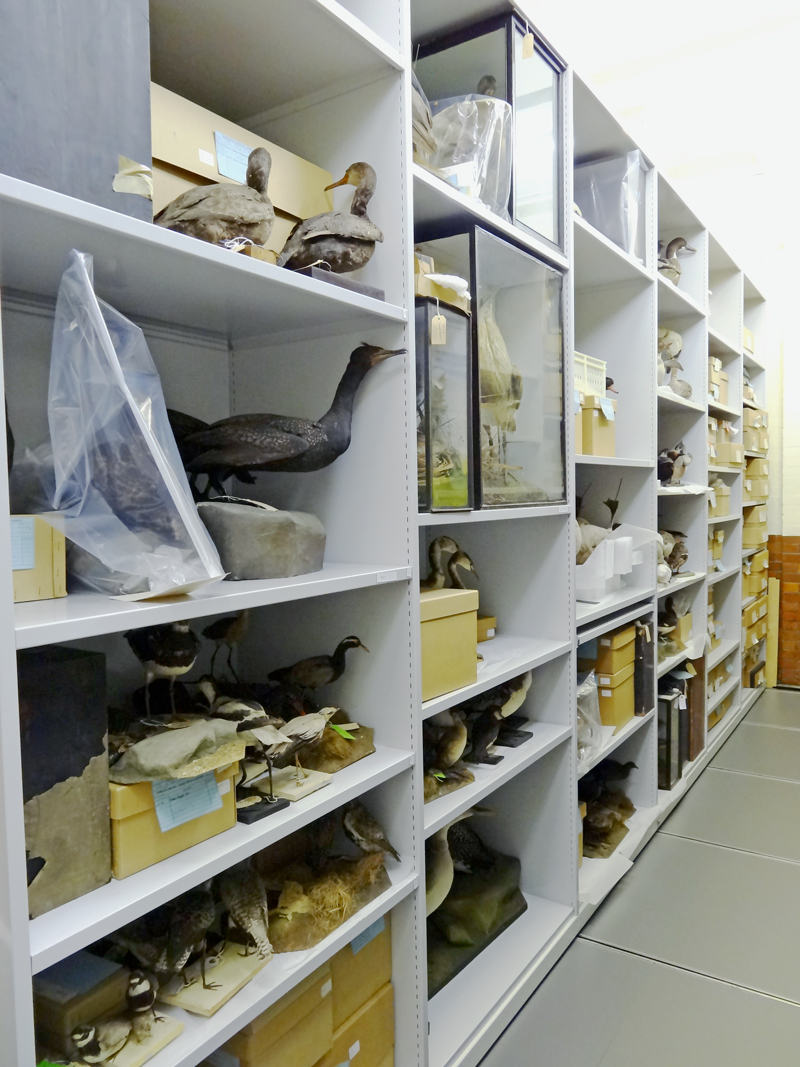
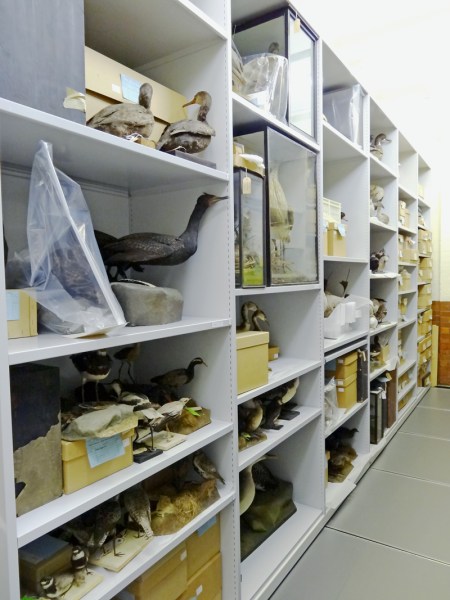
The reshuffle is part of a project to make space for temporarily housing specimens while our taxidermy storage space is upgraded. This is a fairly big undertaking, since it means finding enough nooks and crannies to accommodate a full room’s worth of stuffed critters, to allow the room they came from to be fitted out with long span shelving and roller racking – which should double its capacity.
taxidermy_storage

Bone room invaded by taxidermy birds

This reshuffle has also given me the opportunity to dig through the shrinking number of boxes of unidentified fragmentary material to see if any more can be matched back to specimens or rehoused in smaller boxes, thereby saving space. That’s where the mystery object comes in.

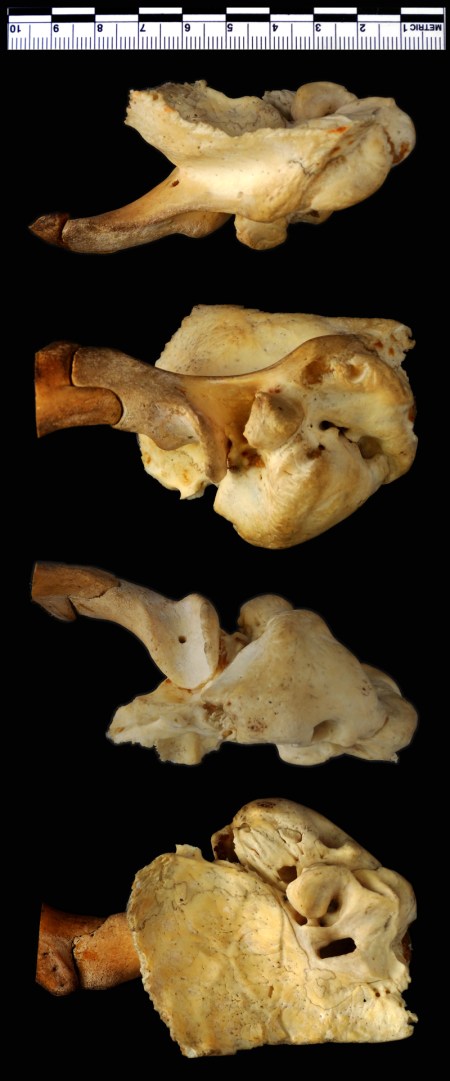
It has quite a distinctive shape, with a robust zygomatic arch (cheekbone), inflated tympanic bulla (bony bulb that houses the earbones) and thin squamosal (a bone of the side of the the skull – all of these parts fused together like this can also be called the temporal bone).

The structure of the glenoid fossa (joint where the mandible articulates) suggests it’s a carnivore of some sort, since herbivores tend to have a more open articulation that allows their mandible to move freely in order to grind tough vegetation more effectively. Carnivores need a more precise bite, to cut or clamp their food, which requires a tighter articulation.

However, the thin bone of the squamosal is less usual in a carnivore of this size, since this region normally deals with large bite forces and needs to be reinforced. This suggests an animal that isn’t relying on a powerful bite. The tympanic bulla is also quite open in structure, which I would associate with an animal that dives underwater and needs to be able to equalise differences in internal pressure effectively. These clues suggest that this piece of bone is from a seal of some sort.

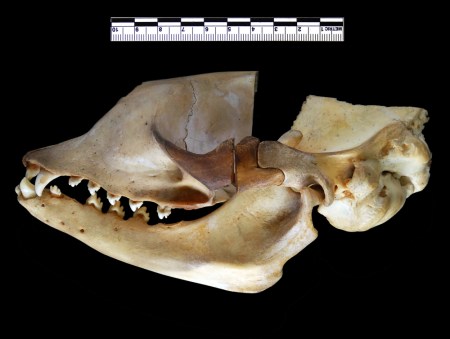
Figuring this out let me compare the mystery object to seal specimens, to see if any were missing the temporal region. As it turns out I did indeed find a fragmentary seal specimen that fit the bill:
seal

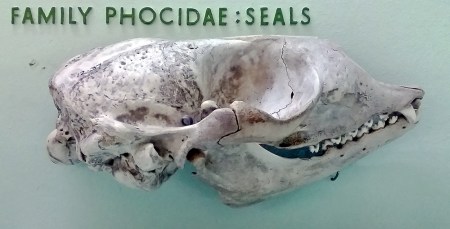
This specimen was acquired in 1912 and had been sawn up in order to mount the other half for display on the Natural History Balcony at the Horniman:
Seal_NH.12.37

In the register it was recorded as “Skull of Seal (Phoca annulata)” which is an out-of-date name for the Ringed Seal Pusa hispida (Schreber, 1775), but I have my doubts about this identification after consulting this useful piece of research on identification of archaeological seal remains by Hodgetts, 1999 [opens as pdf]. The tympanic bulla, mandible and dentition (plus the suture on the zygomatic arch) make me think that this may in fact be a Harp Seal Pagophilus groenlandicus (Erxleben, 1777).

So well done to henstridgesj, Ric Morris, Bobby Boessenecker and Lee Post, who all worked out that the mystery object was from a seal. Please feel free to add more thoughts on whether you agree with my identification of Harp Seal!

Friday mystery object #259

This week I have an object that I found hiding in an unnumbered box during a reshuffle of the Horniman bone room (more about that later):

mystery259

I managed to work out what it was and reunite it with other parts of the same specimen, which was very satisfying, but it took me four attempts where I checked against other specimens to get the correct identification. Do you think you can do better?

As always you can leave your questions, thoughts and suggestions in the comments box below. Good luck!

Friday mystery object #258 answer

Last Friday I gave you this object to identify:

mystery258

It already had an identification of sorts on a label, but I didn’t believe it for a moment:

mystery258_label

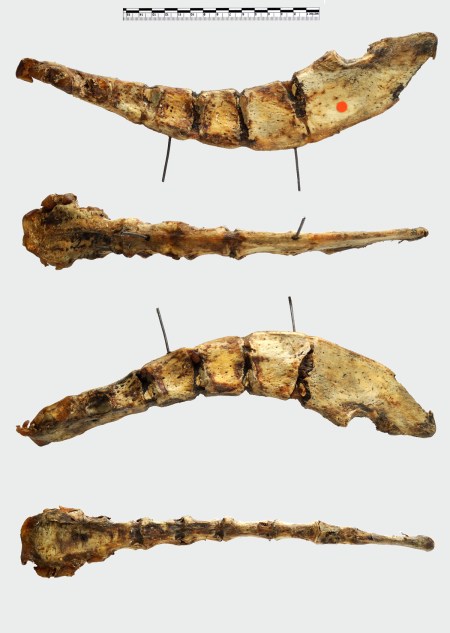
I’m pleased to say that neither did any of you and Jake got the ball rolling by identifying it as a sternum rather than a tail.

This didn’t necessarily make the identification much easier, since different sterna shapes are not really all that familiar for many of us and there is relatively little comparative material available.

Despite this, there were some good attempts, ranging from Polar Bear to Horse (via the mysterious clue “Losing voice we hear?” by Flick Baker, which for some reason I struggled to figure out… to my shame I have never been any good at cryptic crosswords).

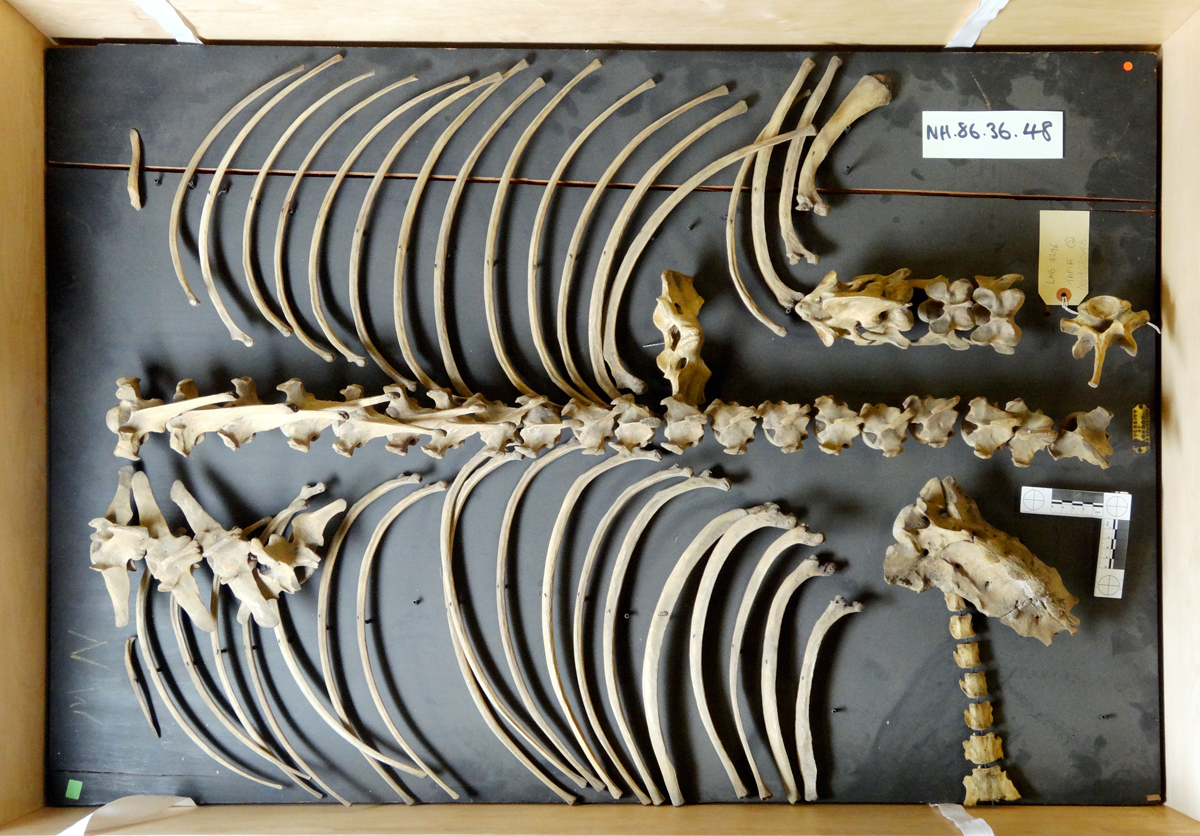
I had a bit of an advantage in identifying this object, because I had some insider curatorial information. The metal rods sticking out of the specimen make it clear that it has been mounted in a somewhat unusual way, characteristic of some laid-out skeletons that we acquired from King’s College in 1986 and the Lab number (added by our Conservation team when they treated it) was in the same range as other King’s College specimens.

One such specimen included this Tapir, which as you may notice, is lacking its sternum:

Tapir_apendicular_skeleton Tapir_axial_skeleton

This inspired me to take a look at some Tapir sterna, and I was pleased to find that they matched this mystery object very well indeed – so it looks like Flick was pretty close with her perissodactyltastic suggestion.

Malayan Tapir at the San Diego Zoo, by Sepht, 2006.

Malayan Tapir at the San Diego Zoo, by Sepht, 2006.

I have talked about Tapirs before, so I won’t bore you with more about them right now, except to issue a warning: Tapirs may look comedic and a bit harmless, but they are perfectly capable of biting a human arm clean off. So it’s probably safest to avoid messing with Tapirs, unless they’re in a museum.

Friday mystery object #258

This week I have a mystery object that had been sitting a box for about 30 years with the tenuous description:

Tail section from marine mammal

Here it is:

mystery258

I don’t believe it – do you have any thoughts on what it might be?

As usual, you can put your thoughts, questions and suggestions in the comments section below. Hope you have fun with this one!

Friday mystery object #257 answer

Last week I gave you this slender bone to try your hand at identifying:

mystery257

You didn’t have much to go on, but most of you recognised that it’s a fibula (well spotted Ric Morris, Kevin, Mieke Roth and Flick Baker) and I was impressed by the variety of clever clues used to communicate that knowledge. However, Michelle went a step further and identified this as being from a large felid, in the size range of a Mountain Lion, earning loads of bonegeek points.

It took me a little while to work out what this was myself, since it was in a box with Ostrich bones and my first thought was that it might be from another bird. It has articulations at either end and a long midshaft, so it was obviously one of the long bones, but it’s very slender and wouldn’t be able to carry much weight on its own, so it was either a radius or fibula.

I started by looking at the radii of a some large birds, like Albatross and Flamingo. However, on comparison with a few specimens it became obvious that I was looking in the wrong area, since the articulations didn’t fit with those on a bird radius at all. They also didn’t fit the shape of any mammal radius I could think of, so I started considering fibulae.

I knew it couldn’t be a bird fibula, since they are fused with the tibiotarsus and would lack an articulation at the distal end, so I started looking at mammals. It was a bit slender for a dog, but pretty similar to a cat, if on the big side.

Then I remembered that I had a box of postcrania from the same collection as the Ostrich that this bone shared a box with. So I checked the mystery object against that and was pleased to find that there was only one fibula in that box, it was from the other leg and it was a mirror image. So it looks like this bone has not only been identified, but reunited with the Cheetah Acinonyx jubatus (Schreber, 1775) skeleton it came from!

Cheetah in Kruger National Park (South Africa). Image by Mukul2u, 2008

Cheetah in Kruger National Park (South Africa). Image by Mukul2u, 2008

Friday mystery object #256 answer

Last week I gave you an object to identify that I found hiding in a box of Ostrich bones:

mystery256

I’m pleased to say that Laura McCoy, Michelle, Joey Williams and Lena worked out that it’s the right femur of a Perissodactyl, but there was a lack of agreement about which kind of Perissodactyl it might be.

Rhino’s weren’t considered, since their femurs are distinctively massive, but both Tapirs and Equids were suggested (which could include Horse, Donkey, Zebra, maybe even Quagga).

My first thought was Horse, mainly because it looks very much like a Horse femur and they are quite common in collections – but that’s not really good enough for the purposes of real identification.

On inspection of images of a Tapir femur in a veterinary manual (link opens pdf) I had to have a rethink and now I am really not sure about the identification, particularly since I know that there is a big box of Tapir postcrania that came into the Horniman from the same collection as the Ostrich. Other specimens from that acquisition have also been mixed up, for example a box of Lion postcrania I was working in today had Manatee atlas and axis vertebrae and a Pig femur in the same box, while the box of Pig postcrania held the Lion atlas and axis.

Lion postcrania, with some unexpected additions

Lion postcrania, with some unexpected additions

Now I need to get back into the collections to see if this bone does belong to the Tapir, or if it is indeed Horse. So I’m sorry to say that the answer is not really an answer, but stay tuned and it will be resolved…

Friday mystery object #256

I was working my way through a box of large ratite bone the other day and stumbled across this out-of-place object: mystery256 Any ideas on what it might have come from and why it might have been in a box of Ostrich bits? As usual, you can put your questions, thoughts and suggestions below – if you think it’s easy then maybe try using a clue to give other people a chance of working it out for themselves. Have fun!

Friday mystery object #255 answer

Last Friday I gave you this rather interesting looking object to identify, preferably using a rhyme:

wpid-img_20150626_095757-1_20150626095918070.jpg

Believe it or not the photographs show either side of the same object – on one side it just looks like a rugose lump and on the other it shows a rather nice natural spiral.

Aside from some great humorous comments by 4utu and Henrik Nielsen, there were some of you who worked out that this is the operculum from a marine snail and even managed to explain that in rhyme – so very well done to Barbara, Chris and especially Lee Post who upped the ante by writing a full verse:

oh purr Q lum from foreign shores
possibly from a near ites door
side door -back door does not exist
main door -strong door , built to resist

Flick Baker went a step further (taxonomically) by identifying that this operculum is from a snail in the genus Turbo with the rhyme: “Gives your engine serious puff, even when she’s running rough“.

Green Turban Shell (Turbo marmoratus) showing aperture closed by the operculum

Green Turban Shell (Turbo marmoratus) showing aperture closed by the operculum

More specifically, this operculum is from the South African Turban Shell Turbo sarmaticus Linnaeus, 1758.

The operculum is a part of many snails that is often forgotten about – it forms a protective trapdoor that the snail closes behind itself when it retreats inside its shell (‘operculum’ means ‘cover’ or ‘lid’ in Latin). This trapdoor helps prevent desiccation in land snails and helps protect against predators in marine snails.

When the animal dies the operculum will often fall off as the body of the animal decays or is eaten, so often it won’t find its way into a museum collection with the rest of the shell. However, opercula can be quite distinctive and are sometimes more useful for identifying a species than the rest of the shell – a handy point to remember.

Friday mystery object #254 answer

Last Friday I gave you this odd bit of bone (or should I say bones) from a box of mixed objects to identify:

mystery254

As Ellen Going immediately recognised, it’s a scapula and clavicle – which in itself tells us that it can’t be from a Carnivore or Ungulate, since they lack a well-developed clavicle.

The open articulation with large acromial and coracoid processes and the symmetrical, blade-like scapula body suggest that this is an animal with a lot of movement in the shoulder, and reciprocal movement at that (hence the symmetry). This suggests a flapping animal, but without the extreme clavicle adaptation (i.e. the wishbone) seen in birds.

So as Flick Baker, Ric Morris and Joey Williams all realised, this is the shoulder and clavicle of a large fruit bat, in the family Pteropodidae. Good work!

fruitbat-processed

Friday mystery object #253 answer

Last Friday I gave you this lovely specimen from the King’s College Museum of Life Sciences to try your hand at identifying:

mystery253

It wasn’t easy, since there were limited views, so the dentition wasn’t entirely visible and the bones of the palate are not shown. Also, there was no scale bar – something that Ric Morris gently reprimanded me for.

Despite these limitations, many of you correctly managed to work out that this is the skull of a Mongoose of some sort. So congratulations to bugblokenzFlick Bakerhenstridgesj, Michelle and Allen Hazen for recognising that this is a member of the Herpestidae.

Narrowing it down beyond that is more of a challenge and without better images it’s a bit unfair to expect a species level identification – but I’m going to have a go.

Scouring through Mongoose skulls in collections and various images online (especially using the fantastic Animal Diversity Web resource, the ever helpful Skulls Unlimited and the brilliant Mammals of Tanzania Skull Key), I came to realise that the teeth are visible enough to discount many Mongoose species. Also, the shape of the zygomatic region and facial profile was quite distinctive (most Mongooses have cheekbones that are flat under the eye sockets – but not this chap).

Excluding the options that didn’t quite fit, left me with a few that did – the Egyptian Mongoose Herpestes ichneumon, Slender Mongoose Herpestes sanguinea, and White-tailed Mongoose Ichneumia albicauda.

Not a clear-cut identification, but better than nothing, and it might be possible to refine it by looking at the specimen in the flesh… as it were.

Friday mystery object #253

This week I have a lovely specimen from the hidden gem that is the King’s College Museum of Life Sciences for you to try your hand at identifying:

mystery253

Any idea what this specimen might be? As usual you can put your questions, observations and suggestions below – let’s see if we can work out what this is!

Friday mystery object #252 answer

Last Friday I gave you this object from the Horniman’s Anthropology collection and asked you to identify what it’s made from and what function it may have served:

mystery252

The identification turned out to be the easiest question to answer, despite the modification of the bone. The shape of the end of the bone is a result of the epiphyses (the ends of the bone) detaching from the diaphysis (the midshaft of the bone), which tells us that the animal was a juvenile at time of death and that the bone is actually formed from two bones that have fused together down their length – which is why a similar pattern is repeated on the left and right side of the bone.

This sort of fusion is normally seen in the hand and foot bones of artiodactyls, which narrows down the possible species. Judging by the size and general proportions it would be from something the size of a Roe Deer, although a bit more chunky. The closest species I could find for comparison was the the Goat Capra aegagrus hircus (Linnaeus, 1758), although it may be from a close relative, the Serow:

A Serow (Capricornis sumatraensis) by Melanochromis, 2007


As for the function, there were some great suggestions (from weaving comb to needle-case), but apparently this is the key to a set of handcuffs!

The variety of anthropological uses of bone is huge, and it’s always exciting to find something outside of our expectations – which this object most definitely is for me!