Friday mystery object #321 answer

Last week I gave you this fuzzy object from the stores of the Dead Zoo:

mystery321

It’s a slightly generic looking creature and I’m not surprised a few ideas for identification were mooted, because it lacks any single distinctive feature in this image (partly because the characteristic grizzled facial hair is a bit indistinguishable due to historic soot). That didn’t stop Wouter van Gestel, Mike Shanahan, RobinBirrrd, James Bryant, and jor from recognising it though.

This is the wonderfully weird Bearcat or Binturong Arctictis binturong Temminck, 1824 which is a South and Southeast Asian carnivore in the viverid family (those are the civets) that is one of only two carnivores with a prehensile tail (I’ve talked about the other one, the Kinkajou, in a previous blogpost).

Like the Kinkajou, the Binturong isn’t a very carnivorous carnivore. It eats more figs than meat and it lacks the restless dynamism of the average predator, plodding flat-footedly on the ground and climbing well, albeit in a much slower and more measured way than other arboreal carnivores that take killing a bit more seriously.

Binturong by Greg Hume, 2017

Binturong displaying characteristic levels of activity. Image by Greg Hume, 2017

Apart from the unusual prehensile tail, the living Binturong has one other unusual characteristic (as pointed out by RobinBirrrd) – it smells like popcorn. This is due to the emissions of its musk gland, situated conveniently near the genitals and anus. Sadly our specimen smells more like a half-washed dog that’s been rolling in mothballs.

More mysteries next week!

Friday mystery object #321

This week I thought I’d give you a break from the bones and offer up a fuzzball for some Friday fun:mystery321

Any idea what this (slightly dusty looking) critter from the collections might be?

It’s probably a bit too easy for some of you, so cryptic clues and subtly veiled hints would be appreciated in the comments section please. Have fun!

Friday mystery object #320 answer

Happy New Year everyone!

Last week I gave you this skull to identify from the collections of the Dead Zoo in Dublin :

King Vulture Sarcoramphus papa (Linnaeus, 1758)

I also included the label, since it offers an interesting taxonomic twist.20171228_163420.jpg

If there’s one principle that I hope I’ve managed to convey over the last eight and half years of doing the Friday mystery object, is that you should never fully trust the label.

For starters, the number NMINH:2006.12.1698 could be misleading, as it reflects the year the specimen was catalogued rather than the year it was acquired. To explain, the NMI uses a very sensible numbering system that starts with the collection (NMINH = National Museum of Ireland Natural History) the year of registration (usually the year of acquisition) which allows you to know which register to look in, followed by the lot number (a sequential number reflecting how many acquisitions have come in that year), followed by the individual object number (the sequential number of that individual item in a particular lot). This system can have additional numbers added if necessary, such as if a piece of an individual object is removed for sampling.

However, some older objects were not registered when they entered the collection and as such they get a number that reflects the year they were documented rather than the year they were acquired. In this case the specimen was registered in 2006, but purchased from an auction of the collections of van Lidth de Jeude who died in 1863, as Nigel (the Dead Zoo Keeper) helpfully pointed out in the comments.

If the specimen had been accessioned and numbered on entering the collection back in the 1860’s then issues with the name would be expected since taxonomy constantly changes and old names are often wrong, but because of the new label and the 2006 date, you’d generally expect the name to be more up-to-date. However, it appears that the information on an old label was directly transcribed without being updated.

This is relevant because the name Orogyps auricularis is what we call a junior synonym, which means it has been used to describe a species that already has an older valid name. When this happens the older name takes precedence. In this case, Orogyps auricularis is a name applied in 1867 by Degland and Gerbe to a species that had already been named Vultur tracheliotos  by J.R. Forster in 1796 and which is now placed in a different genus, giving the name Torgos tracheliotos (Forster, 1796) – where the parentheses around the author name indicate that the scientific name has changed from the original version that was published by Forster.

These taxonomic and documentation twists are however rendered redundant as soon as you realise that this specimen is from a totally different species. In fact it’s not really anything like Torgos tracheliotos the Lappet-faced Vulture:

lappet-faced_vulture.jpg

Lappet-faced vulture

In fact, the only real similarity lies in the tip of the beak, which is a functional feature for tearing meat and which is convergent between the Old World Vultures and the New World Vultures. The Lappet-faced Vulture is an African species, while the mystery object has the distinctive deflection of the bill in the nasal region that indicates it’s a species from the Americas. This discrepancy in region was noted by palfreyman1414 and Gerard van den Brink.

Once you focus on the New World Vultures it becomes quite easy to make an identification, since there are only seven species and at 121mm this specimen is the third largest species after the condors – something easy to check on Skullsite. So well done to everyone who recognised the skull as belonging to the King Vulture Sarcoramphus papa (Linnaeus, 1758), especially palfreyman1414 who got there first.

514px-sarcoramphus_papa_-national_zoo_-washington_-usa-8a

King Vulture by Eric Kilby, 2008

As you can see, not only was the taxonomy very out of date for this specimen, it was also completely wrong, because it was misidentified 150 years ago. This is why you should never fully trust labels – they will often be wrong and if you base research on misidentified specimens, that will be wrong too.

Another mystery specimen next week!

Friday mystery object #320

I hope everyone had a lovely Christmas break!

This week I have another specimen from the Dead Zoo to identify – this one has an identification already, but the taxonomy is rather archaic and I think that once you’ve investigated the modern version of the name, you’ll realise that it’s wrong.

20171228_131937-01-01.jpg20171228_132026-01.jpg

20171228_132058-01.jpg

Skull length = 121mm

20171228_163420.jpg

So, any idea what this name should actually be and, more importantly, what the identification actually is?

As always, you can put your thoughts, questions and suggestions in the comments box below – have fun!

Friday mystery object #319 answer

Last week I gave you this unidentified skull from the Dead Zoo to have a go at identifying:

20171214_175153-01.jpeg

It seems that everyone recognised this as the skull of a gull straightaway – the scars from the salt-glands on the top of the head and the shape of the bill combined to make it a bit of a give-away.

However, working out which species of gull is a bit more tricky, since many are remarkably similar in morphology, making size an important factor for consideration (I’ve talked about this before).

Now size is always a somewhat tricky thing to use for identification, for a variety of reasons. One is that there may be an overlap in size between species, another is that there will often be sexual dimorphism within a species that means you can’t just compare the length against another specimen of a species without considering sex. Then of course there’s age – if it’s not fully grown, it’s going to be smaller. Of course you also have to consider whether the bill sheath is present or absent, as this will add a few millimetres.

On top of all these issues, there’s the problem of how you actually measure the length in the first place. This is something I’ve researched in the past (link to pdf) and it’s a more significant problem than you might think. For example, when looking at the image I originally provided for the mystery object, it looks like the skull measures around 125mm, but if I chop the scale bar from the image, reduce the transparency to 50% and lay it directly over the centreline of the image of the specimen, it turns out to be around 128mm.

mystery319

Length is apparently 128mm

Add to this the fact that in the original image you can see a shadow under the scale bar, it becomes clear that the scale is somewhat elevated. This is because I raise the scale to be near the vertical midline of the specimen, to help keep everything in focus and limit the effect of parallax error. Normally this is good, because it allows a more accurate estimation of the length of a 3D specimen with a longest axis near the vertical midline, but in this case the longest part of the specimen is actually at the lowest part of the skull, so the elevated scale will make it look slightly shorter than it really is (due to the parallax error I was hoping to avoid…). This means that the specimen is probably closer to 129mm or 130mm in length.

With this in mind, the discussion about the lengths of various gull skulls between Wouter van Gestle (of Skullsite fame), Ric, Tim Dixon, Richard Lawrence, Gerard van den Brink and jennifermacaire needs to be reconsidered.

Richard Lawrence reported skull lengths for a variety of gulls as follows:

6x GBBG: 129 to 141 mm
2x LBBG: 117 mm
6x HG: 111 to 117mm
9x YLG: 111 to 126 mm ( larger with beak sheath though so would be smaller without).

So factoring in a length of 129-130mm for the mystery object it seems to fit well into the range for the Great Black-backed Gull Larus marinus Linnaeus, 1758. So well done to everyone who went for GBBG – this does seem most likely to be a skull from the largest gull species.

Great Black-backed Gull by Andreas Trepte, 2010

Great Black-backed Gull by Andreas Trepte, 2010

Friday mystery object #318 answer

Last week I gave you this bird skull from the Dead Zoo in Dublin to have a go at identifying:

20171129_162916.jpg

It’s a fairly distinctive looking specimen with that massive bill, immediately narrowing down the possible families to two likely contenders – the Toucans (Ramphastidae) or the Hornbills (Bucerotidae).

On closer examination it lacks the serrated bill margins and remarkably long medial (in this case that means ‘towards the midline of the skull’) process of the quadrate bone (a part of the jaw in birds that I’ve blogged about before) that you see in Toucans. So, it’s a Hornbill – as everyone correctly spotted in the comments – but then we have the question of the species.

There are around 60 Hornbill species, with most of them sporting quite distinctive casques which make them quite identifiable (I’ve blogged about several before):

Ceratogymna atrata skull

Black Hornbill Ceratogymna atrata

mystery240

Great Hornbill Buceros bicornis

Bucorvus abyssinicus (Boddaert, 1783) sectioned skull

Northern Ground-hornbill Bucorvus abyssinicus

However, this specimen seems to be lacking a casque. This could be due to a few reasons. There are some casqueless species, such as the Sri Lanka Grey Hornbill, it could be a young female adult from a small casqued species with sexual dimorphism in casque development, or it could be a young juvenile from a species that has a small casque that grows as the animal matures.

Assuming it’s one of these, it’s easy to check the few casqueless species by looking at the overall bill shape, the position of the nares (nostrils) relative to the orbits (eye sockets) and checking the structure of the jugal and quadratojugal (the thin bones on the side of the skull under the orbit) – this last only if you can find a reliable skull image for comparison.

Using Skullsite and images on the internet it’s time-consuming, but straightforward to rule out a lot of possibilities, since most Hornbills have a fairly robust jugal/quadratojugal and nares located much further away from the orbit than you see in the mystery specimen. In fact the only Hornbills with a similar nares/orbit position and gracile (skinny) jugal/quadratojugal and in the right size range (that I was able to find) were in the genus Rhyticeros L. Reichenbach, 1849.

Unfortunately I’ve not found good skull images of juveniles for all of the species to make a final comparison and you can’t just compare the skull of a juvenile with an adult and expect to see the same configuration and development of features, as there’s still growth to happen (something else I’ve talked about before).

So based on the information it looks like jennifermacaire was the closest with her suggestion of Wreathed Hornbill, although I’m leaning slightly more towards the Papuan Hornbill Rhyticeros plicatus (J.R.Forster, 1781).

20171207_180748.jpg

Hope you enjoyed the challenge!

Friday mystery object #317 answer

Last week I gave you this unidentified bird skull from the Dead Zoo to try your hand at identifying:

mystery317

It seems that everyone recognised it as being from a charadriiform, and one of the waders at that. The first response was from Chris, who made reference to Lewis Carroll’s poem the Walrus and the Carpenter in which the eponymous characters eat an enormous quantity of oysters – hinting that this is an Oystercatcher.

There were some other suggestions that it could be from one of the birds in the genus Tringa, which includes the ‘shanks’ (Redshank, Greenshank, etc.), but the morphology fits one of the Oystercatchers better – in particular that weird constriction about halfway down the mandible when you look at the skull in profile.

This mandibular ‘waist’ is quite unusual and it doesn’t even seem to occur strongly in all of the Oystercatchers, which helps narrow down the likely species within the genus Haematopus, especially when you factor in things like the relative bill proportions, although you have to be careful doing this as there is some sexual dimorphism in the shape of the bill, with the females’ being longer.

The three closest species are the American Oystercatcher, the Sooty Oystercatcher and the Blackish Oystercatcher, but unfortunately I’ve not been able to find good reference skulls all of these species to be able to look for any distinguishing cranial characters. Based on bill morphology I’m leaning towards this being the skull of the American Oystercatcher, Haematopus palliatus Temminck, 1820.

American Oystercatcher by DonaldRMiller, 2010

American Oystercatcher by DonaldRMiller, 2010

My next step will be to check through our collections to see if we have comparative material to check the identification (once I get some time – a sadly rare commodity). If I can’t confirm I’ll just stick with Haematopus sp. on the label.

If you’re not familiar with Oystercatchers, they walk along the tideline either prying or breaking open bivalves. In my experience they seem more fond of mussels than oysters, but what do I know?

Another mystery next week!

Friday mystery object #317

For this week’s mystery object I’ve decided to stick with my favourite subject of skulls. This time it’s a bird from the Dead Zoo’s collection, that was in a drawer labelled “Unidentified” – let’s fix that!

mystery317

Any idea what species this skull belonged to? I have my suspicions, but I’d love to hear what you think.

As always, you can leave your clues, questions and suggestions in the comments section below. Have fun!

Friday mystery object #316 answer

Last week I reverted to my favourite topic of skulls for the mystery object, with this specimen:

mystery316

Everyone recognised this as a member of the dog family, but surprisingly few of you pursued it much further than dog or maybe fox.

mystery82

A distinctive doggy forehead

The small size and lack of a distinct forehead (don’t mistake that bump at the top of the nasal region the head for a forehead by the way, it’s in the wrong place for a dog – see above) says it’s most likely one of the foxes or ‘weird’ dogs rather than a domestic type. By weird dogs I mean Raccoon Dog or Bush Dog type things.

mystery150c

The ‘weird’ Raccoon Dog

In fact, the bump in the area where the frontals and nasals meet in front of the eyes is not too disimilar to the shape of a Dhole skull (see below), but the size and robustness aren’t right.

mystery278

Dhole skull, with its inflated frontal/nasal region

After looking through the various dog skulls I could find it became clear that the mystery specimen is smaller than the smallest of the non-weird canids outside those commonly referred to as foxes (which includes canids other than the ‘true’ foxes in the genus Vulpes).

So that helped me narrow down the options to around 20 species which, after checking a variety of online resources, I was able to trim down on the basis of the profile of the skull (especially that frontal/nasal region), the breadth of the muzzle (rostrum if you prefer) and the dentition (the upper second molar is a little smaller than usual and the protocone on the upper 3rd premolar is quite well developed).

In the end there was just one species left and I was delighted that it matched both my expectation and michiganmeetsnewmexico‘s suggestion of Arctic Fox Vulpes lagopus Linnaeus, 1758.

For me the inflated frontal/nasal region hinted at an animal with large nasal turbinates, which are an adaptation to dry and cold conditions, creating a large area in which to heat air that’s being breathed in (to help prevent water in the lungs from freezing) and trap water that would otherwise be breathed out.

If you’re interested in how I narrowed down the species and the resources I used to do it, take a look at my spreadsheet here, which contains my notes and links to fox skull images.

I hope you enjoyed that challenge – there will be another mystery next week!

Friday mystery object #316

Back to bones this week, with a mystery skull for you to identify. Any idea what species this skull belonged to?

mystery316

I don’t think it will prove too much of a challenge for the bone geeks among you, so please try to be a bit cryptic with your answers to keep it fresh and fun for those who are not so familiar – and that’s a cryptic clue about what it’s not right there 🙂

Have fun!

Friday mystery object #315 answer

Last week I gave you this big bug to identify:

mystery315

I had a feeling it would be fairly straightforward for some of you, since insects as big as this are reasonably distinctive, and I was therefore not disappointed with the flurry of correct identifications.

The first with a correct identification in the comments was Chris, who hinted at the scientific name with this suggestion:

Trying to identify this Cic-sac? Tho phar, Tho good! (Excuth the lithp!)

On social media people made suggestions relating to the common name for the species, mostly pointing out that it’s very loud. Putting the various hints together gives you the Double-drummer Cicada Thopha saccata (Fabricius, 1803).

Cicadas are weird. They’re in the Order Hemiptera (the true bugs) and the Suborder Homoptera (although that’s disputed and it’s probably safer to say Auchenorrhyncha). Best known for being noisy and having some species with synchronised emergence times that vary between every year and up to every 17 years, or somewhere in-between depending on species and environment. They have widely spaced eyes and a blunt head that is pretty distinctive.

As jennifermacaire pointed out regarding cicadas:

According to Plato, “[This species] used to be human beings who lived before the birth of the Muses. When the Muses were born and song was created for the first time, some of the people of that time were so overwhelmed with the pleasure of singing that they forgot to eat or drink; so they died without even realizing it. It is from them that the race of the [these insects] came into being; and, as a gift from the Muses, they have no need of nourishment once they are born. Instead, they immediately burst into song, without food or drink, until it is time for them to die. After they die, they go to the Muses and tell each one of them which mortals have honored her.”
– Phaedrus

The implications of this is that adult cicadas have a general inability to feed, although this isn’t quite true, since adult cicadas may still feed on sap.

This particular cicada is Australian and is one of the loudest insects on the planet, able to produce a call of over 120 decibels – loud enough to cause permanent hearing damage if right up against a human ear.

The abdomen is fairly hollow in the males of these insects, creating a resonating chamber, but sadly the last segment of this specimen has fallen off, making it hard to be sure of the gender on the basis of the genitals. However, the males have a couple of resonating sacs behind the hind-wing that is missing from this specimen, suggesting that it’s a female.

As far as noisy neighbours go, these insects are an occasional disruption, popping up every 4-6 years and making a noise that is apparently similar to high-pitched bagpipes.

It doesn’t sound great to me, so I’m (not so) secretly glad that I only have to deal with dead examples of these fascinating insects.

More mystery object fun next week!

Friday mystery object #315

It’s been another week of working with the Dead Zoo insect collection for me, so I thought I’d give you one of them to have a go at identifying:

mystery315

A big bug  at around 135mm wingtip to wingtip

I don’t think it’ll be particularly difficult for some of you, so please try to offer cryptic suggestions if you know what is, to keep it challenging for others who aren’t as familiar with these impressive invertebrates.

Have fun!

Friday mystery object #314 answer(ish)

Last week I gave you this guest mystery object, courtesy of Joseph van Sambeek:

Mystery object. Image by Joseph van Sambeek, January 2000

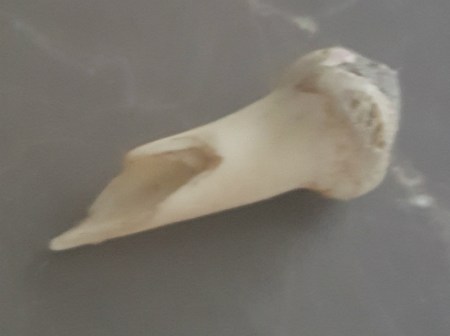
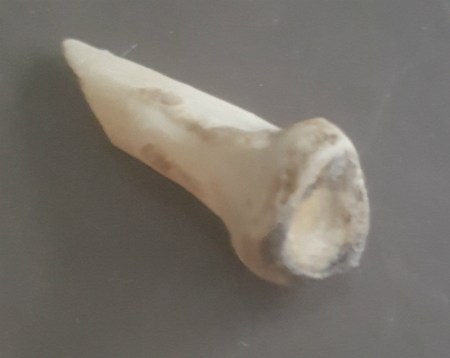
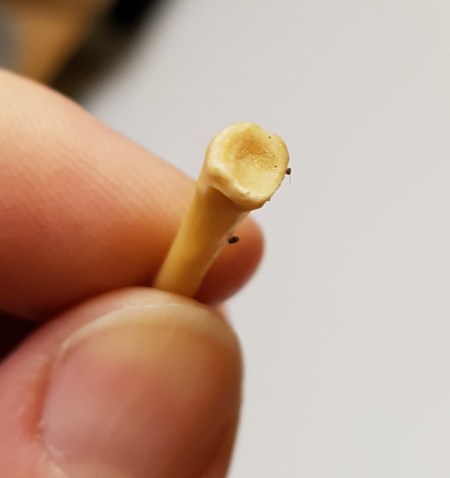
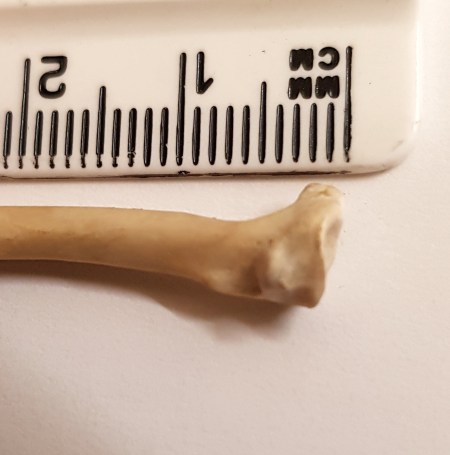
The bony struts reinforcing thin plates of bone show it’s from something that lives in water all the time and which lacks lungs – you can tell this because this structure is what you get when you’re dealing with forces moving in a variety of directions, rather than mainly dealing with the constant force of gravity or compensating for buoyancy that is unavoidable when you live in water, but have lungs.

This means that many of you recognised it as being the neurocranium (that’s the bit of the skull that surrounds the brain) from a fish – more specifically from Sarah Gibson:

The first image is the skull roof, showing the elongated frontals and parietals (front of snout is left in first three images). Second image is a left lateral view, showing the internal parasphenoid that would pass between the two eye sockets. Third image is a ventral view, showing the bottom of the parasphenoid. And obviously last image is posterior view, showing the foramen magnum where the spinal cord would pass through, over the occipital condyle. It just may not look like a skull to some because it’s missing the eye sclera bones, jaws, cheek bones, pretty much anything that is not the skull roof or braincase.

However, as we all know, there are a LOT of different sorts of fish – around 33,600 described species and counting. This can make fish a nightmare to identify. However, there are some great resources out there, like Osteobase which has a very useful identification guide for various elements of a range of fish.

Alas, Osteobase didn’t have anything that fits this mystery specimen, so narrowing down to a species is rather difficult. I had the advantage of knowing that the specimen was collected in Baja California, although that was of little help in trying to get in an approximate area of the fishy family tree based on morphology, and there are still a ridiculous number of fish species is the area.

Sarah Gibson suggested that it may be a Barracuda, and it certainly fits in many aspects, but the shape of the frontals and parietals and details of the point of connection between the parasphenoid (that’s the bottom bar bit you see in the side view) don’t quite fit.

I had almost given up hope, when it occurred to me to concentrate on understanding the unusually large occipital condyle that Allen Hazen noticed, which suggested that it might be a taxon with an extremely extended rostrum (like the paddlefish or swordfish that Jennifer Macaire suggested) but with a weedier body and defined neck region since there would be no need for such a large articulation in a fusiform fish (they’re the muscular type that taper at both ends and have no neck, so don’t move their heads).

With this bizarre sounding fish in mind I was able to fairly rapidly narrow down the possibilities to one of the three species of cornetfish that live in the Pacific. I was delighted to find some great images of the skull of a Red Cornetfish, which matches the morphology very well.

Red Cornetfish Fistularia petimba from the Gulf of Mexico. Image by SEFSC Pascagoula Laboratory; Collection of Brandi Noble, NOAA/NMFS/SEFSC

Red Cornetfish Fistularia petimba from the Gulf of Mexico. Image by SEFSC Pascagoula Laboratory; Collection of Brandi Noble, NOAA/NMFS/SEFSC

However, the Red Cornetfish doesn’t really occur in the eastern Pacific, so it’s very unlikely to be that species. The Reef Cornetfish does occur in the eastern Pacific, but has only been reported in Californian coastal waters since November 2015 and this mystery specimen was collected back in January 2000 (which doesn’t make it impossible to be a Reef Cornetfish, just very unlikely). Which leaves us with the most likely identification (although by no means confirmed) of Deepwater Cornetfish Fistularia corneta Gilbert & Starks, 1904.

These long, thin fish can reach up to 2m, but they have tiny mouths that limit them to eating crustaceans, marine worms and smaller fish that they pick up from near the surface of reefs and the sea bed – presumably being harder to spot as a predator thanks to their very small frontal projected area.

I’ve asked Joe to check his specimen against the images of the cornetfish, since there’s nothing better than having a specimen in your hand when attempting an identification.

I hope you enjoyed the challenge!

Friday mystery object #313 answer

Last week I gave you this cheeky chap to have a go at identifying:

20170828_122111-01

There was some lovely wordplay in the answers, with Chris getting in early with this great one:

I thought I had a shrewed idea until I saw the Bilby in the background which could show this isn’t the elephant in the room. Coot is legs be too Bandi?

This rules out elephant shrews and correctly identifies it as some kind of bandicoot, thanks to its marsupial case companion. Then palfreyman1414 dropped an anagram into the mix with:

Mere ale plus Satan?

which is so nice I wish it was correct, but alas this isn’t a Long-nosed bandicoot Perameles nasuta, although it is in the same genus.

Allen Hazen wondered “How badly does fur fade in preserved specimens?” and that turned out to be the key question, since everyone shied away from the correct identification, because one of the characteristics of this species’ pelage (that’s mammal-fan speak for ‘fur’) is that it’s supposed to have two stripes on its hindquarters or, more accurately, bars. As it turns out, fur fades quite badly in preserved specimens.

This is in fact a Marl or Western barred bandicoot Perameles bougainville Quoy & Gaimard, 1824 (NMINH:1906.301.1).

Marl

These diminutive Australian marsupial insectivores are vulnerable to introduced predators like cats and foxes, so their wild population only remains on some islands after once being widespread across Western Australia.

Even on the islands where they have some protection from placental predators, they face issues with disease, since their population has shrunk by so much it has impacted on their genetic diversity – reducing resistance to disease at the population level. In particular, a virus that causes tumour growth is affecting the animals on some islands, leaving the species increasingly under pressure.

pv8bk_f-maxage-0

One island does remain free of the virus, so hopefully with proper management the Marls will be able to hang on in there.

Friday mystery object #312 answer

Last week I gave you this specimen to identify, which came in as an enquiry after being found in someone’s toilet:

There were a variety of great responses, with some fantastic cryptic clues, including an anagram by Claire Miles (great stuff!). Most opted for this being Stegobium paniceum, which is also known by the aliases Drugstore Beetle, Biscuit Beetle or Bread Beetle.

Stegobium paniceum by Sarefo, 2007

Stegobium paniceum by Sarefo, 2007

However, the mystery critter has a subtly different pronotum (that’s the plate over the thorax that extends over the head).

Another suggestion was woodworm or one of the false powderpost beetles, which covers a range of wood-boring beetles, with Liberty Hightower correctly giving the more taxonomically constrained suggestion, of something from the Tribe Anobiini (which includes Stegobium). However, my colleague Olivier sent me an email with a very definitive identification, informed by a past experience with this particular pest – the Furniture Beetle Anobium punctatum De Geer, 1774.

These beetles have a distinctive pronotum that supposedly looks like a monk’s cowl, with a more distinctive hump and slightly pinched looking back section than the more smoothly curving pronotum of the Stegobium. They fall into the broad category of woodworm because their larvae feed on wood, making tunnels hidden from view and only becoming visible when they emerge from small holes in the wood as adults, leaving a little pile of wood dust as they go.

The presence of these beetles in a toilet isn’t related to the water in the bowl or even wood of the seat – it turns out that there was a window above the toilet and the adult beetles, in an attempt to leave the building after emerging, were attracted to the light from the window and flew into the glass only to bounce off and land in the toilet.

This attraction towards light in the dispersing adult stage of the beetle is a handy behaviour if you want to keep track of these pests. If you’re concerned you may have active woodworm it’s worth checking your windowsills in the summer to see if you have any of these adult beetles lying around. Of course, there are other species that would also be worth checking for, since there are plenty of beetles whose larvae would be considered woodworm. Keep your eyes peeled!