Bonus mystery object

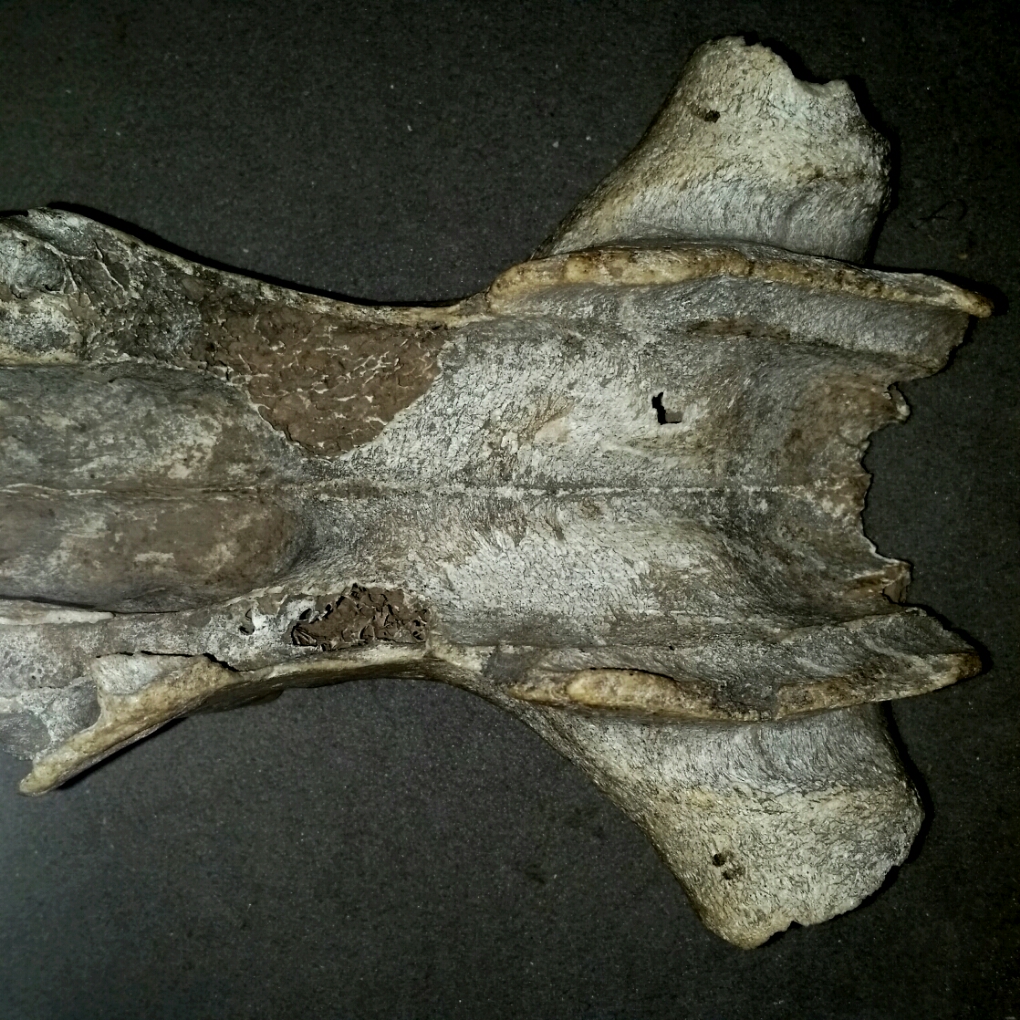
I usually offer up a mystery object on Friday, but here’ a bonus object that landed on my desk this morning.

image

Apparently it was found in a horsefield in Kent, I have narrowed down the likely species of the animal that ‘donated’ the bone to a couple of options, but thought you might like to have a go as well, before the specimen is handed over to our Anthropologists to inspect the engraved designs.

As usual can can leave your comments below. Have fun!

Friday mystery object #228 answer

Last Friday I gave you these bits of mystery forelimb (scapula and humerus) to identify:

mystery228

I thought it would be an easy one, since it’s from a very common species with a near global distribution – plus the humerus has quite a characteristic crest along the proximal end, from the shoulder articulation to the middle of the bone.

Most people who commented noticed this crest and Jake suggested that it had adaptive features (along with the scapula), maybe for a specialised way of life.

As it turns out, these bones come from an animal that is probably best described as a specialist generalist – a Brown Rat Rattus norvegicus (Berkenhout, 1769).

Rattus norvegicus, the Brown Rat. Image by National Park Service

These versatile and intelligent animals are very good climbers and brilliant swimmers, using their forelimbs to both get around and manipulate food.

This particular rat was a male pet rat purchased from Harrods in October 1960 – I get the impression it didn’t survive for that long, since the humerus head hasn’t fully fused. You can’t buy pets from Harrods any more, so this specimen not only shows us what a rat’s humerus and scapula look like, but it also represents a teeny-tiny piece of British history.

Friday mystery object #228

This week’s mystery object is a bit of a break from the cat skulls. Any idea what these two bones are and what species they’re from?

mystery228

As always, you can put your thoughts and suggestions in the comments section below, but if you think it’s easy please try to be a bit cryptic in your response, to give other people a chance. Enjoy!

Friday mystery object #227 answer

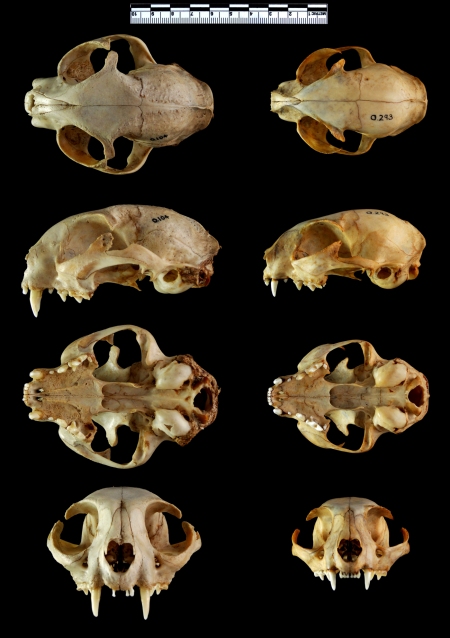
On Friday I asked you to spot the differences between these two cat skulls and I wondered whether anyone could identify them:
mystery227

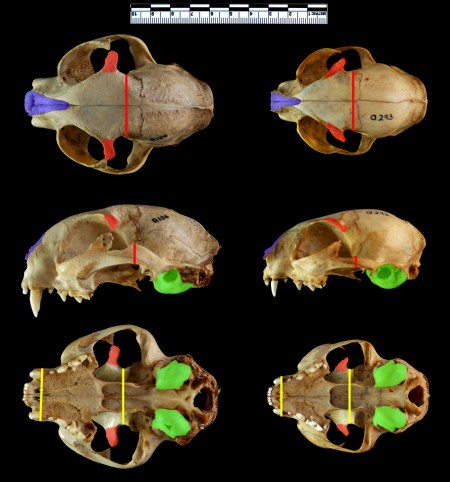
Both henstridgesj and Allen Hazen made some good observations, the first being about the difference in size, then about morphological features that I’ve marked on this image:
comparing_cats

Now henstridgesj also correctly identified one of the skulls – the one on the right of the image is from a Domestic Cat Felis catus Linnaeus, 1758.

As it turns out, this was a bit of a trick mystery object, since BOTH of the skulls belong to Domestic Cats, so this gives us a useful idea of the kind of variation we might expect within a species.

I think that the main cause of variation between these two animals is probably sex, with the male on the left and the female on the right. There may also be differences based on age (although I don’t think that’s a major factor), breed and perhaps disease (the larger specimen looks like it had an infection that affected the surface of the bone).

After taking various measurements, the most useful difference I’ve found between the two skulls is shown with the yellow line. I think that the ratio of these two measurements may provide a way to tell the difference between a male and female cat (in the male it’s around 1 or less than 1, in the female it’s greater than 1) but I’ll need to make a LOT more measurements to test this.

Two other ideas that could be tested were suggested by henstridgesj and Allen Hazen. Allen said: “My impression is that the presence and development of sagital crests, among felidae, correlates pretty strictly with size” and henstridges said: “It seems that if the species of cats are arranged in increasing size order, then the anterior half of the skull (forward of the frontal-parietal suture) seems to increase in size more than the posterior half”.

I’d better take a look to see if this has been tested before…