Friday mystery object #209 answer(ish)

It seems like an age ago that I gave you this mystery object:

mystery209

There were fantastic comments from everyone, but I’ve been bad about responding and writing an answer because I’ve been pretty swamped recently. Also, there are several things that confuse me about the specimen and I’ve not had the chance to take a really good look at comparative material.

The function of the object was correctly identified by Daniela, Paleotool and Jeanie – it is a bone whistle, in this case a fairly modern Navajo example. Our Keeper of Musical Instruments was keen to know if this was from an eagle and whether it might be covered by CITES.

At first I thought it might be the femur of one of the large American eagles, but it is far too long. If it was from any bird of prey it would be a Californian Condor based on the size but the tapering shape is wrong. I then considered the humerus – which is a better match for size, but the position of the groove for a tendon path on the underside is wrong. So it doesn’t seem to be from an eagle.

The slight curve and taper rule out a hollowed deer metapodial, which are very straight and uniform in width.

My best guess is that this may made from a section of the humerus of a species of swan – a guess partly informed by the opinion of the anatomical knowledge of Wouter van Gestel and the archaeological knowledge of Paleotool. The shape and few remaining anatomical features are about right, but there are other large birds that haven’t been ruled out.

Perhaps an unsatisfactory answer, but sometimes a good solid “I don’t know, but it’s reasonable to think it might be this” is the best answer you can get. Thanks for everyone’s input!

N.B. Here’s a side view: 20130912_125851

World Rhino Day 2013

I thought I’d do a quick update on rhinos here on Zygoma, since the theft of their horns from museum collections is something that I’ve been keeping an eye on for a while.

For the museum professionals out there it has been tough, with more thefts taking place since I published on the situation from a museum perspective at the end of 2011. On a more heartening note, there have been more arrests as well.

Of course, things have been far tougher on the rhino populations.

Poaching rates in South Africa show a steep increase since 2009, when the new wave in poaching was started after a rumour that a Vietnamese official was cured of liver cancer using powdered horn. It will be interesting to see whether the increase in poaching rate will follow the trend of the last few years, following the recent arrest of a man reputed to be one of the kingpins of the poaching and smuggling operation from South Africa.

rhino_poaching_prediction

Since the boom in poaching, rhino populations have been in decline around the world. In some cases that decline has been very rapid. In 2011 the Western Black Rhinoceros (Diceros bicornis longipes Zukowsky, 1949) was declared extinct and the Javan Rhinoceros (Rhinoceros sondaicus Desmarest, 1822) now only has one surviving subspecies, made up of maybe 40 individuals. All of this because of a single story about cancer.

As with most anecdotal claims for cancer cures (from use of vitamins to homoeopathy) there is no good evidence that rhino horn has any effect. Spontaneous remission happens and, assuming the story about the Vietnamese official contained any shred of truth there were probably numerous other treatments being used at the same time, making it impossible to identify which treatment had any effect.

If rhino horn was effective, then you might expect the countries that use it, like China, to have a lower cancer mortality rate than other parts of the world – but this is not the case. Even practitioners of Traditional Asian Medicine have explicitly stated that there is no evidence that rhino horn can cure cancer.

Moreover, if rhino horn did have any effect on a cancer, that effect should also be found by using powdered cattle hooves – a cheaper and more sustainable product. Rhino horn use is not sustainable at all. If the poaching rates continue to increase as they have been, my very quick and dirty calculations suggest that rhinos could be extinct in South Africa in as little as 10 years.

predicted_SA_rhino_decline

This is why it’s so important to raise awareness of the problems facing rhinos and communicate the fact that rhino horn is not a cure for cancer. Time is potentially very short for the populations that remain.

Friday mystery object #209

This week I thought I’d give you an object to identify that I was asked to look at by one of the other curators at the Horniman Museum:

mystery209

This object is pretty easy to identify in terms of function, but the trickier job is to work out what part of which animal has been used in its construction. Any ideas?

You can put your thoughts below and let’s see if you come to the same conclusions as me. Enjoy!

Friday mystery object #208 answer

Last Friday I gave you this mystery object to have a go at identifying:

mystery208

I wasn’t sure if it would be too easy but it turns out that no-one managed to identify it, so I guess not!

Lots of suggestions were made, from a bum (thanks Jake) or coco-de-mer to the join in a lip to the cleft between toes – but the closest suggestion came from newbie Daniela, who suggested an armpit.

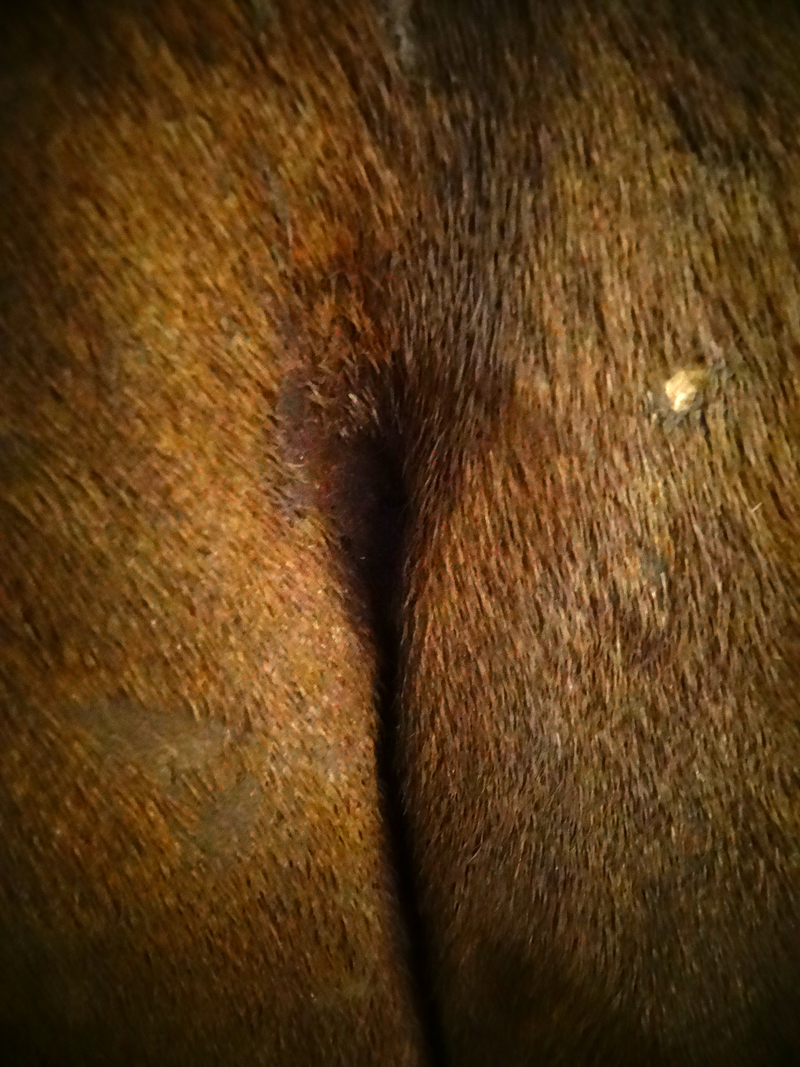
The reason I thought you might find this easy is because it’s the armpit (or perhaps flipperpit is more accurate) of the Horniman’s infamous Walrus Odobenus rosmarus (Linnaeus, 1758). This fine, if portly, specimen will be back from his hols in Margate soon.

walrus

I expect the presence of the hair may have thrown people off the scent, as we don’t tend to think of Walruses as being hairy – but as we can see, they are. A bit.

Friday mystery object #208

Things are still very busy at the moment, but I managed to find this perplexing image in my camera, that I thought might make an interesting mystery object. Any idea what it is?

mystery208

You can put your comments, questions and suggestions below – but please keep them decent!

Friday mystery object #207 answer

A very late and brief answer to the last mystery object I’m afraid – hopefully I’ll get back on track soon, once everything has calmed down a bit!

I gave you this object to identify:

mystery207


It was a bit of a mean one, since these teeth are mostly broken with several missing. but there were some great answers.

Several of you recognised these as teeth from a juvenile Old World primate, so well done to henstridgesj, Jake and Jakob Ramlau. Jakob also alluded to dogs in his answer and I wonder if he managed to spot that the  primate was a Dog-faced Baboon Papio cynocephalus (Linnaeus, 1766) or Yellow Baboon as it’s also known.

mystery207_full

I’ll take some time to talk about deciduous teeth sometime soon, once I’m able to sit down and get back to blogging properly!