Friday mystery object #57 answer

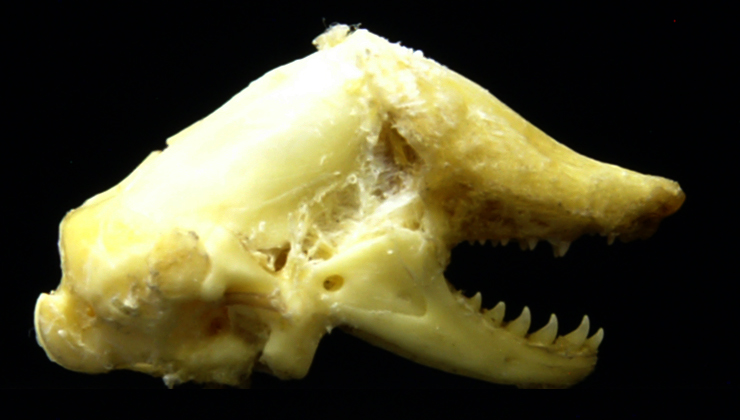
On Friday I gave you a specimen that I had to identify myself earlier in the week:

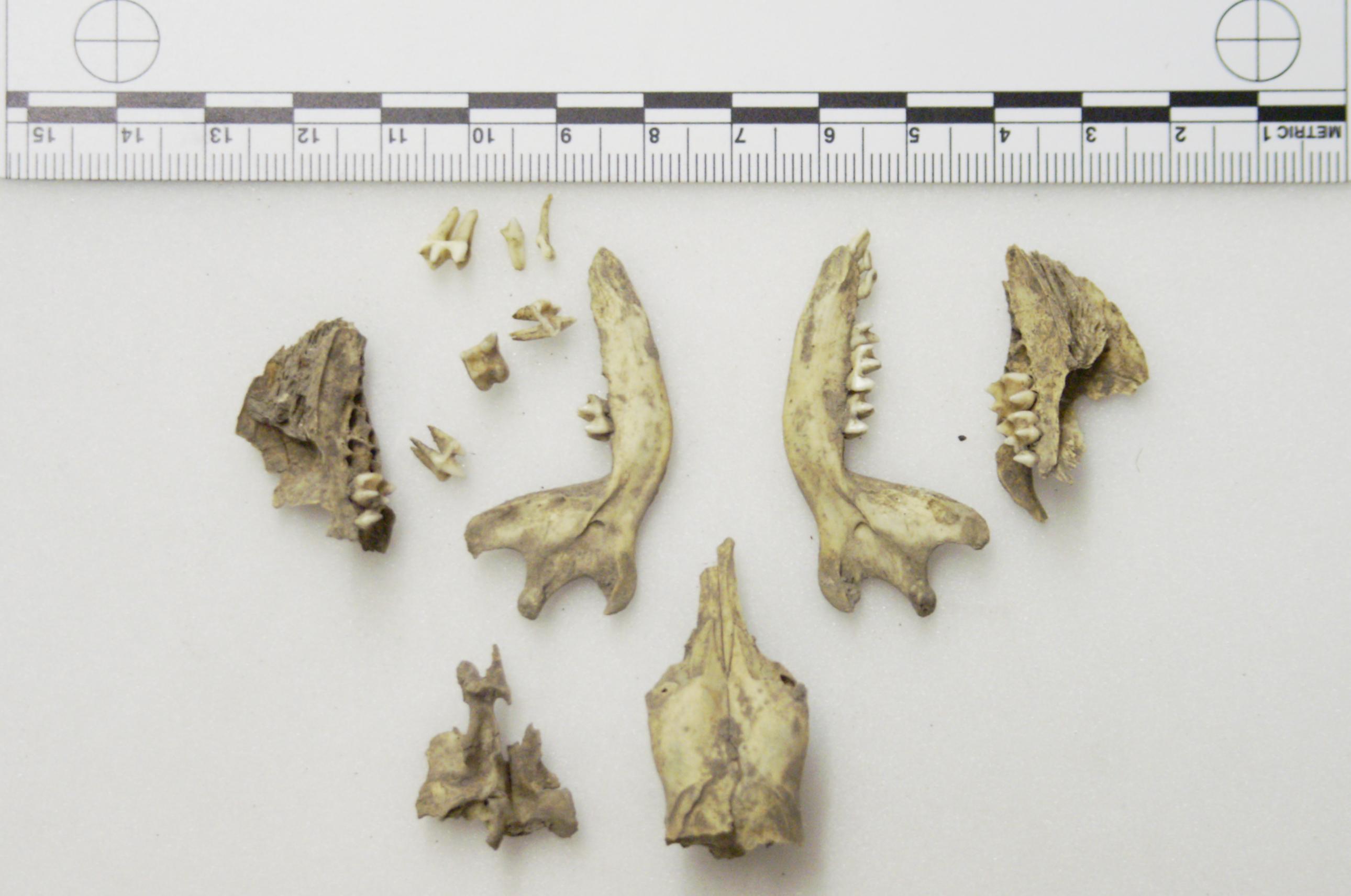
The first steps of this identification are quite straight-forward – in the words of Jake it “Looks a bit sheepy and a bit deery” which pins this firmly in the order BovidaeDave Godfrey neatly summarised what makes it look sheepy and deery – “Diastema, lack of upper incisors, and the shape of the teeth“. Rob went a step further and ruled out deer, sheep, goats and camelids – coming to the conclusion that this is an African bovid of some kind. Then David Craven blasted through the narrowing-down process and hit upon the same species as I had concluded it was, namely a  Continue reading

Friday mystery object #57

This Friday I’m taking the mystery object back to its roots, with unidentified specimens that I’ve found in the collections at the Horniman Museum where I am a curator. Yesterday myself and my trusty volunteer Cat came across two boxes labelled NH.83.1, which between them contain twenty unidentified skulls from a variety of different animals, ranging from fish to birds and mammals. This box had been in the collections since the 1930’s and there was little information to help make identifications – perfect material for mystery objects! Here’s one of the specimens I managed to identify – I’d like to see what you come up with…

As usual, put your observations, suggestions and questions in the comments section below and I’ll do my best to give you what information I can. Good luck!

Friday mystery object #56 answer

On Friday I gave you this object to identify:

I must admit that I thought it would be a tricky one, but I was surprised by the number of correct answers that came in, with the first by Prancing Papio who immediately got it to species. Neil made a subtle comment (“Looks like it could go both ways“) that almost passed me by, but which indicated that he knew which group this skull belonged to (see below for elucidation), whilst David Craven and Jamie Revell both pinned it down to species as well. That identification was  Continue reading

Friday mystery object #55 answer

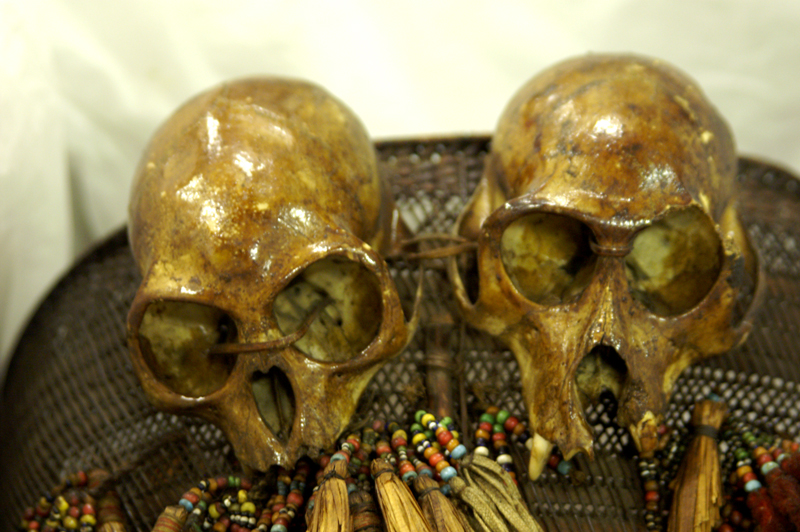
On Friday I presented you with this anthropological mystery object:
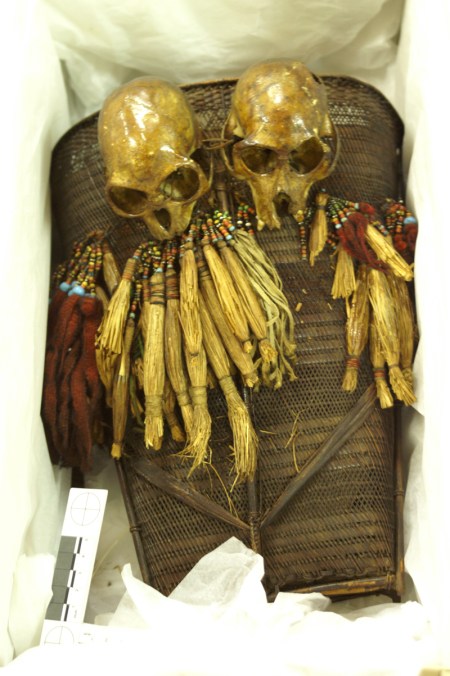
I wanted to know what it is, what it’s used for and where/what culture it’s from. Since there are skulls on it I thought it would be a good idea to ask you to identify them while you were at it. No small task then.

Alistair was first to notice that the skulls belonged to monkeys, then Smallcasserole made the comment:

It’s the Predator’s earthly trophy bag with human skulls!

Which although not entirely accurate, is correct in identifying what this object is used for – it’s for carrying trophies. Moreover it’s for carrying the same trophies that the Predator might be out collecting…

Jonquil and Dave Godfrey worked out that it’s a basket rather than a bag and then Jonquil came through with a tribe in the right culture and place. I can’t be sure of the particular tribe this is from, but the culture is that of the Naga from the Northeastern part of India (Assam in this instance), who were renowned for the practise of head-hunting (and I don’t mean in the recruitment sense) until quite recently.

As to the monkey skulls, jonpaulkaiser suggested one may be from a Macaque and Jonquil suggested Gray Langur, while Dave Godfrey suggested Macaque and Gibbon. David Craven then provided a remarkably coherent and accurate answer:

Looks like a head-hunting bag, as used by the Naga (I couldn’t give a specific tribe). Still a very fraught part of the world unfortunately.

So, what sorts of monkeys do we have in that part of India?
Loads of Macaques, but others have said Macaque without being censored. Unless that’s too general to be censored…

Okay.
I’ll say Capped Langur on the left (I also considered Hoolock Gibbon).
Macaque on the right? Hard to find good images of macaque skulls for some reason, so I have to shoot in the dark a little. Stump-tailed Macaque.

I think this is about as good an answer as I could hope for, partly because it reflects the levels of uncertainty that we are often stuck with in the museum world. The basket/bag came from Assam and it entered the collections around 1903 judging by its label. There was no tribe name associated, so that information would prove difficult (if not impossible) to track down. The primate skulls are damaged and they are attached to the bag, making them difficult to inspect in the kind of detail needed to make a certain identification.

I was personally leaning towards the skull on the left being that of a Hoolock Gibbon Hoolock hoolock (Harlan, 1834) based on the distance between the eyes, but I’m not convinced that this is reliable and the shape of the nasal opening (long and heart-shaped) doesn’t quite fit with this idea. It could indeed be a female Capped Langur Trachypithecus pileatus (Blythe, 1843) but probably not a Gray Langur Semnopithecus sp. Desmarest, 1822 because their range doesn’t quite fit. It could even be a female Macaque of some sort (although the width between the eyes looks too big for that).

The skull on the right looks like a male Macaque, probably a Rhesus Macaque Macaca mulatta (Zimmermann, 1780) or a Stump-tailed Macaque Macaca arctoides (I. Geoffroy, 1831) – with my preference being the more common and widely distributed Rhesus (compare 1 & 2). I am keen to see David Craven’s reasoning, to see what I may have missed.

Many thanks to everyone for their comments and suggestions. I particularly liked the idea by cackhandedkate that the basket was one of Lady Gaga’s costumes – something that I would not be surprised by.

Friday mystery object #55

For this week’s mystery object I am going to try something for everyone – a bit of Anthropology with some Natural History thrown in. So what is this, what’s it used for and where/what culture is it from – your bonus question is of course what species did the attached skulls belong to:

As usual questions, suggestions and observations in the comments section below, I’ll do my best to answer as the day goes on. Good luck!

Friday mystery object #54 answer

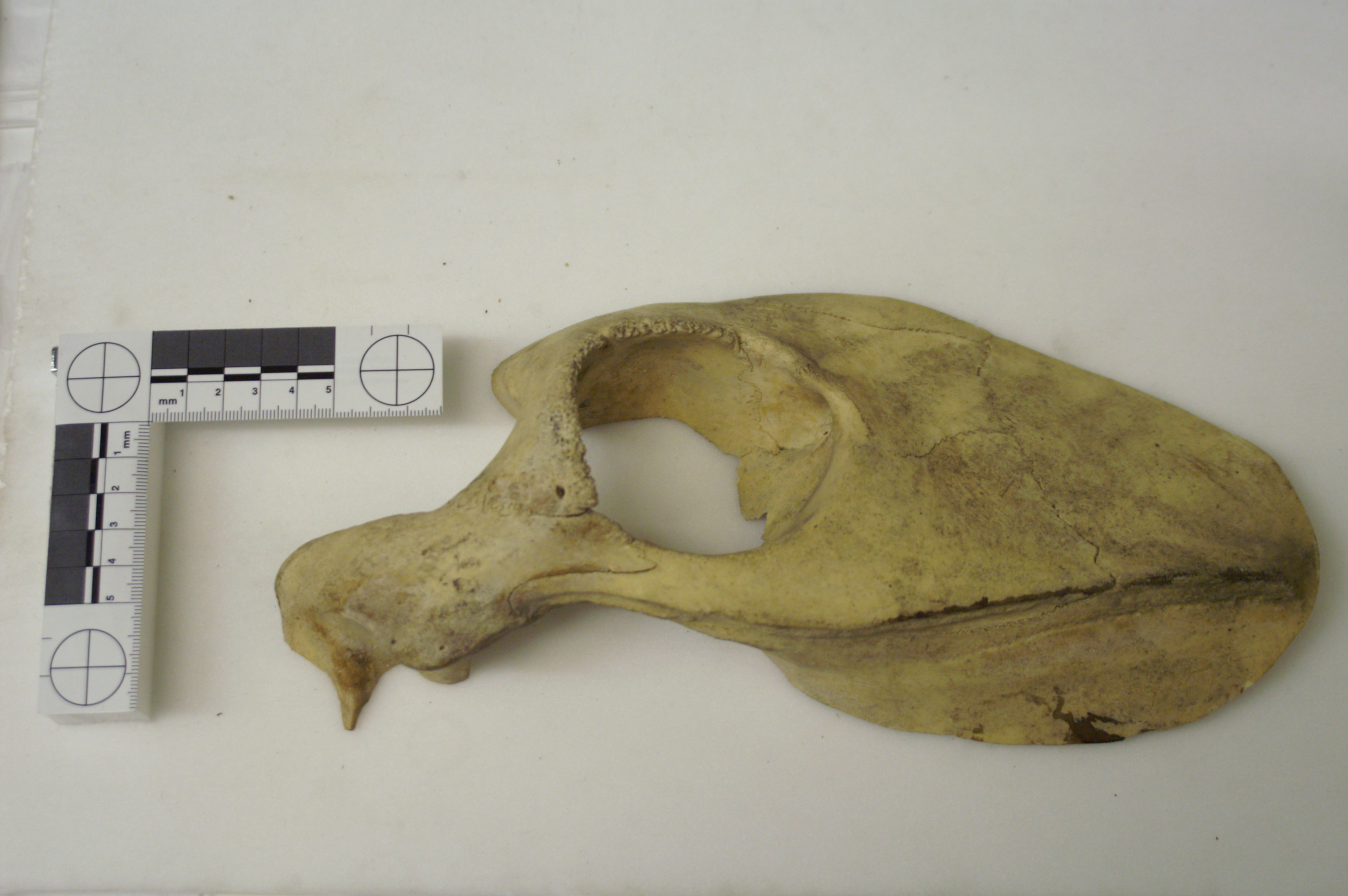
On Friday I gave you this skull to identify:

I was impressed by the efficiency with which the possibilities were whittled down and the correct species identified, since this isn’t an animal that’s very well known by most people (in the UK at least). Dave Godfrey immediately recognised this as being a member of the Carnivora and a dog-like one at that, an opinion supported by Matthew Partridge’s observations.

This line of investigation was somewhat derailed by Gimpy’s suggestion that this was a Tasmanian devil skull, an observation that was incorrect, yet very pertinent, since there are quite striking similarities between this and a Tasmanian devil skull as a result of convergent evolution. It’s strange to think that two species can look so similar and yet be separated by at least 124 million years of divergence (check out the placental-marsupial divergence node using the awesome University of Bristol Date-a-Clade webpage). That’s what similarities in environment and lifestyle will do to organisms with similar ancestral skeletal bodyplans.

Debi Linton then came to the rescue with some astute observations about the teeth of this animal and after trawling the Skulls Unlimited site (which appears to be much-used by people hunting for the answer to the FMO) she hit upon the correct answer of Continue reading

Friday mystery object #54

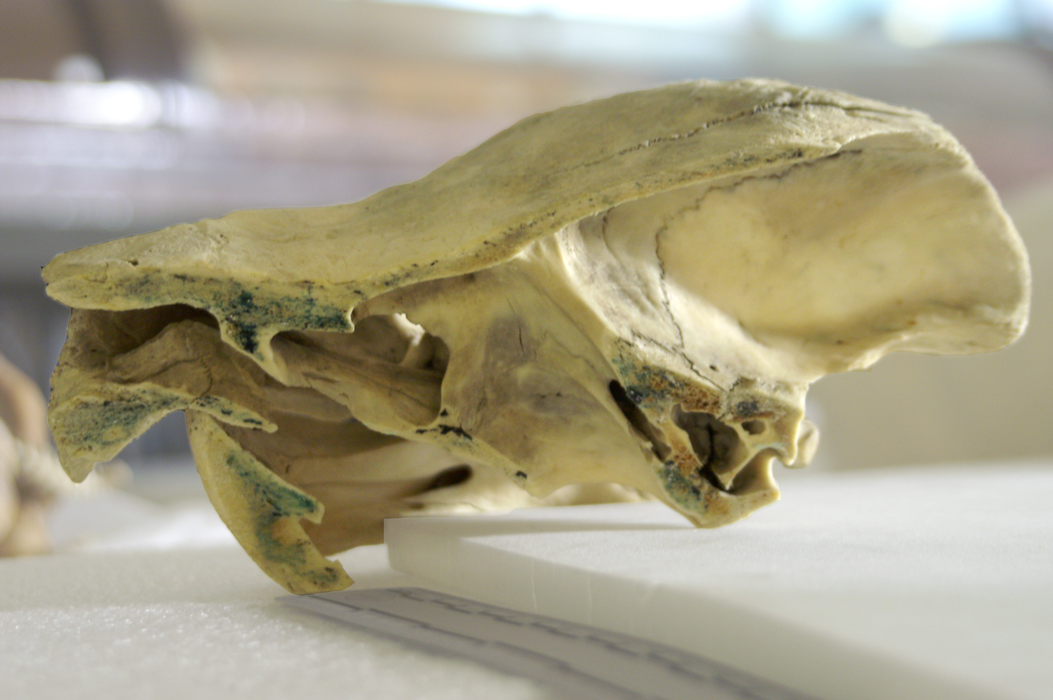
The Friday mystery object for this week is a skull specimen from the Horniman collections. Some weeks ago I suggested that I put together a guide to help with identifying skulls, which I have been doing as the opportunity arises (it should be ready soon). Since this guide will hopefully make it easier for you to identify skulls I thought I should make the most of my last opportunity to get one past you. So here it is:

As usual, you can put your suggestions, questions and general musings in the comments section below and I’ll do my best to respond. Meanwhile I will be thinking of a more anthropological object for next week (in line with suggestions made last week – see I was listening).

Good luck!

Friday mystery object #49 answer

On Friday I gave you one of the specimens on display at the Horniman Museum, photographed from an unusual angle, as the mystery object:

I thought it might prove tricky, but jonpaulkaiser managed to identify it within 16 minutes of it being posted. Impressive stuff! Matt King also managed to spot what general type of beastie this bit of bone belonged to; a Continue reading

Friday mystery object #48 answer

On Friday I gave you this lovely skull to identify:

It seems to have been a bit more tricky than I had expected. It was immediately identified as a carnivore, which is spot-on, but from there it got a bit murky. I must admit that I could have been a bit more generous with clues, particularly when David Craven asked if this was a viverrid (the family containing the civets) – I took the question at the family level, so I said ‘no’, but I should probably have asked for clarification since this skull belongs to a member of a family that falls into the infraorder Viverroidea (according to some sources).

This is in fact the skull of a Continue reading

Friday mystery object #48

This Friday I’ve taken bit more effort than usual to get a decent picture of a specimen for the mystery object. It’s amazing the difference it makes when you use a tripod and allow a good long exposure. I’m sure you’ll all identify this in no time, but hopefully you’ll enjoy the image while you’re at it – there are few things quite as beautiful as bones:

Feel free to ask questions, make suggestions or just leave your thoughts in the comments section below – I’ll do my best to answer or drop hints as the day goes on. Good luck and I hope you enjoy!

Friday mystery object #47 answer

On Friday I gave you what I consider to be a rather interesting mystery object:

I must apologise for my tardy responses to the excellent questions asked, on Friday I was at a fascinating conference about using DNA from natural history collections for research, hosted by the NHM, and I didn’t get an opportunity to address the questions until quite late.

The questions were astute from the outset, with Bob O’H asking if it was a bird – no doubt inspired by the lightweight structure of the bone. SmallCasserole suggested that it was the sectioned skull of a Cassowary, based on the presence of the bony crest (or more accurately the casque) – an opinion that was widely supported. However, Dave Godfrey raised the possibility that this skull belonged to a hornbill, a suggestion that Neil developed to arrive at the correct genus with David Craven delivered the coup de grace with the correct species identification of Continue reading

Friday mystery object #43 answer

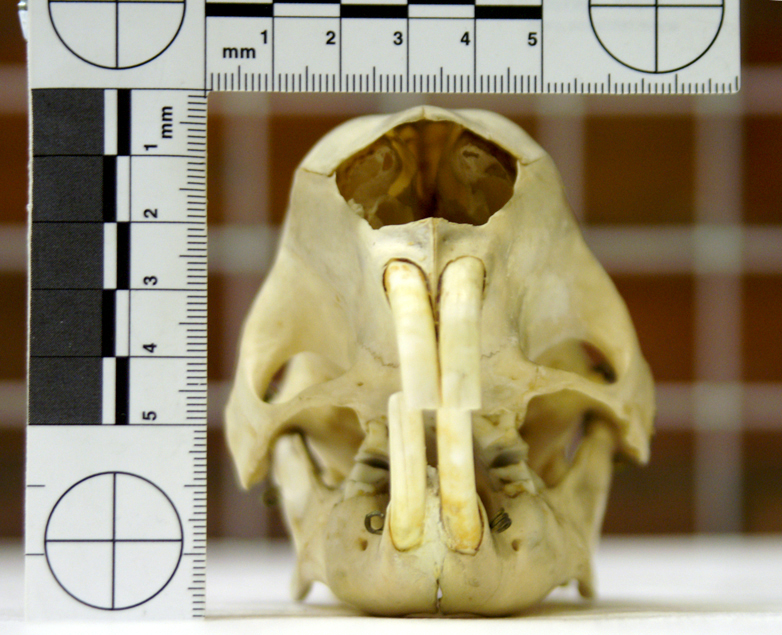
On Friday I gave you this skull to identify:

I used this skull because the shape really appealed to me when I stumbled across it in one of my office drawers – here are another couple of views of the same specimen:

Most of you quickly worked out that this skull belongs to a rodent – and a big rodent at that.  The inflated nasal region was also quickly picked up by some of you and I think that’s what led Jonpaulkaiser to the correct answer first, followed by Neil who also managed a species level identification. Well done to everyone though, there were lots of very close attempts, with several of you missing out by a quill’s breadth – if you’ll excuse the frankly awful pun. This is of course (if you didn’t guess from the bad pun) a Continue reading

Friday mystery object #43

I am back at the Horniman this week, after last week’s soujourn to Plymouth. Yesterday I was working through some of the collections that I’ve been in the process of transferring from my office space to our stores building, when I came across this specimen:

I love the shape of this skull so much that I just had to have it as a mystery object. It would be too easy if I gave you a side-view, so you’ll just have to wait for that until Monday. Make your suggestions below and I’ll do my best to respond (although my home internet has been down for the past week, so I may be limited in how much opportunity I have to reply to questions).

Best of luck!

Friday mystery object #40 answer

On Friday I gave you this skeleton to identify:

It looks a bit like a snake, but there are a couple of give-aways that mean it must be something else. First of all, snakes may look like they’re all tail, but actually they have quite short tails in relation to their body length (hint – the tail starts just after the ribs end) and second, a snake’s skull has a very open light structure (as I’ve discussed before). Both of these snaky features can be seen in this image taken by dbking:

Viperid snake skeleton (image by dbking)

Viperid snake skeleton (image by dbking)

So, if it’s not a snake, what is it? There are quite a few animals that have a long slim body with no limbs, from eels to caecilians to a variety of lizards (including, but not restricted to snakes, which are a discrete subgroup within the lizards). However, this is not an eel because their ribs don’t form a cage – they form vertical projections for their muscles to work against, it’s not a caecilian because they have even shorter tails than snakes, which leaves us with the non-snaky legless lizards (as recognised by Gimpy).

Legless lizards crop up in at least three major groups of lizard (not counting snakes) so there is a fair amount of choice out there. The Amphisbaenia are really weird and the mystery object doesn’t have the right skull shape to be one of them. The Pygopodidae are legless members of the same group as the geckos – and the mystery object could probably be one of them, except it’s not. It is in fact a member of the Anguoidea (more particularly the Anguidae) and it was identified correctly by Jim (and seconded by Neil) as being a  Continue reading

Friday mystery object #38 answer

Friday’s object was this exploded skull:
I identified it as a hedgehog, Erinaceus europaeus Linnaeus, 1758 based on comparison with the skull (particularly the lower jaw) of a specimen that I had as a mystery object last August:

My guess is that the specimen was probably a fairly young adult, since most of the fragmentation of the skull is along suture lines. However, the disarticulation is greater than would be expected simply from a poorly fused specimen, so it looks like damage has also been sustained. Since the delicate nasal turbinates are still intact and in place, I expect the damage probably happened when they were still protected by soft tissue – making me suspect that it happened before the animal was skeletonised. Given the susceptibility of hedgehogs to getting run over, I expect that this individual was killed on the road by a glancing blow to the head that loosened teeth and sutures. I’m pleased to say that Jake agreed with my identification and cause of death for this specimen, so a hearty congratulations to him!

Friday mystery object #38

This week I am going to give you a genuine mystery object – something from the collections of the museum that has no identification. I have been dealing with a few of these sorts of things recently whilst organising the osteological (that’s bone) store.

Often specimens have been acquired in a big batch, which invariably means that there will be a box left at the end which contains the jumbled and broken bits and pieces that have lost information or have been separated from the rest of a specimen during the move from their old home, or at sometime in the distant past.

Here’s one such specimen:

(click for larger image)

Do you have any idea what this exploded skull might belong to – and why it might be exploded?

As usual post your suggestions below. I might not be able to answer any questions this week, because I’m off to Norway to visit a good friend I don’t see often enough in Trondheim. Who knows, next week I may have a Norwegian mystery object for you to identify… Good luck!

Friday mystery object #33 answer

The mystery object on Friday was chosen by Taylor, a work experience student who assisted me in the collections last week. He picked a particularly tricky specimen:

However, I am pleased to say that Jake immediately spotted that it was a skull that had been sectioned and after some questions and some close guesstimates by Henry Gee (who was working through the various families within the Carnivora),  it was eventually correctly identified by Jeremy, who worked out that it was in fact from a Continue reading

Friday mystery object #28 answer

On Friday I presented you with this mystery object:

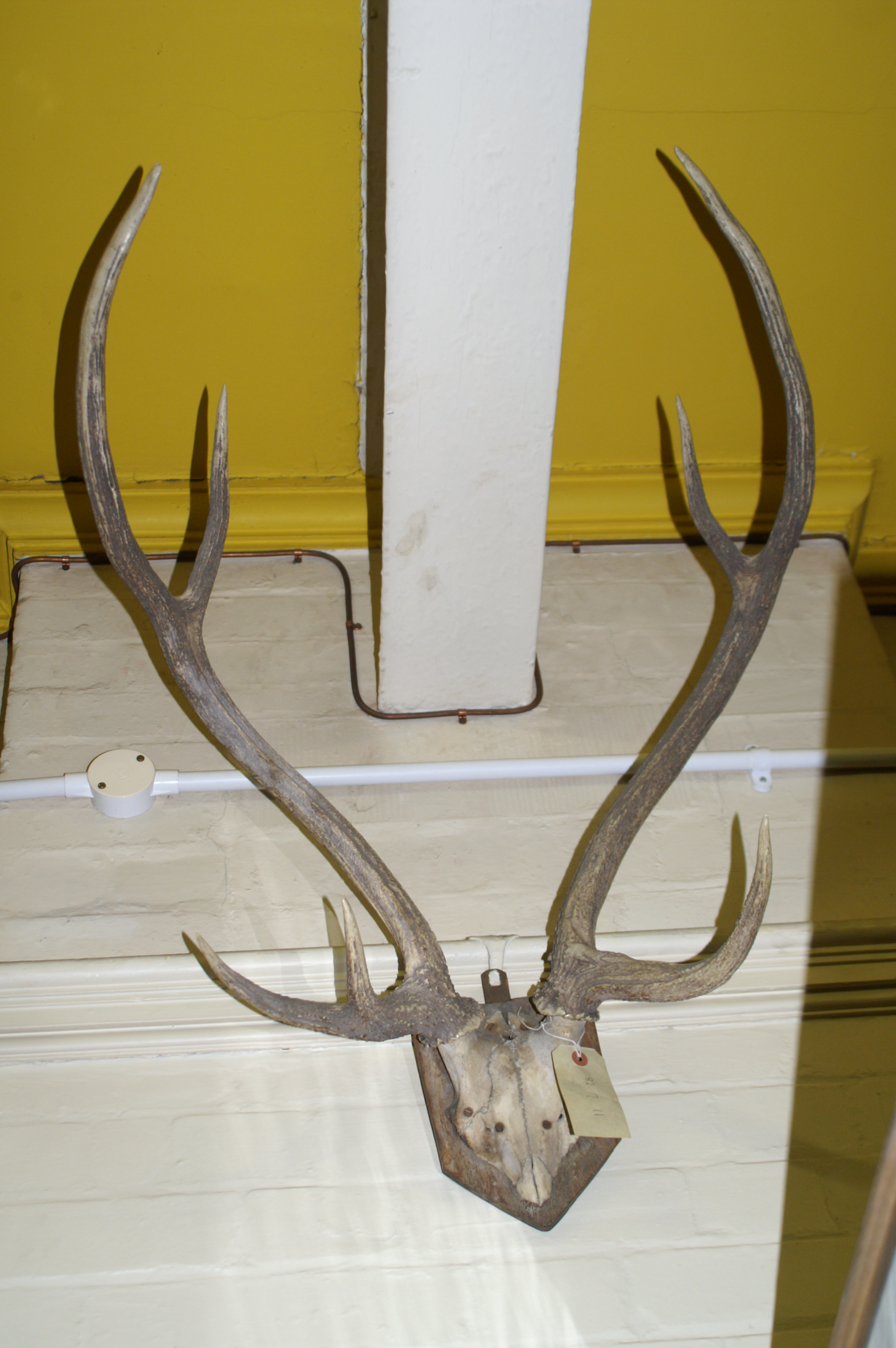
This specimen is one of 14 of the same species that we have in the Study Collections Centre at the Horniman Museum. Myself and a collegue (Steve, king of knots) recently remounted all of our trophy plates on steel mesh, using steel S-hooks, plastazote foam and archival tape restraints and supports. The outcome has been very satifactory:

Unfortunately, most of these specimens have been donated from private collections where the information has not been retained with the specimen, so I have had to identify pretty much all of these trophies. The one I showed you on Friday is most likely to be a Continue reading