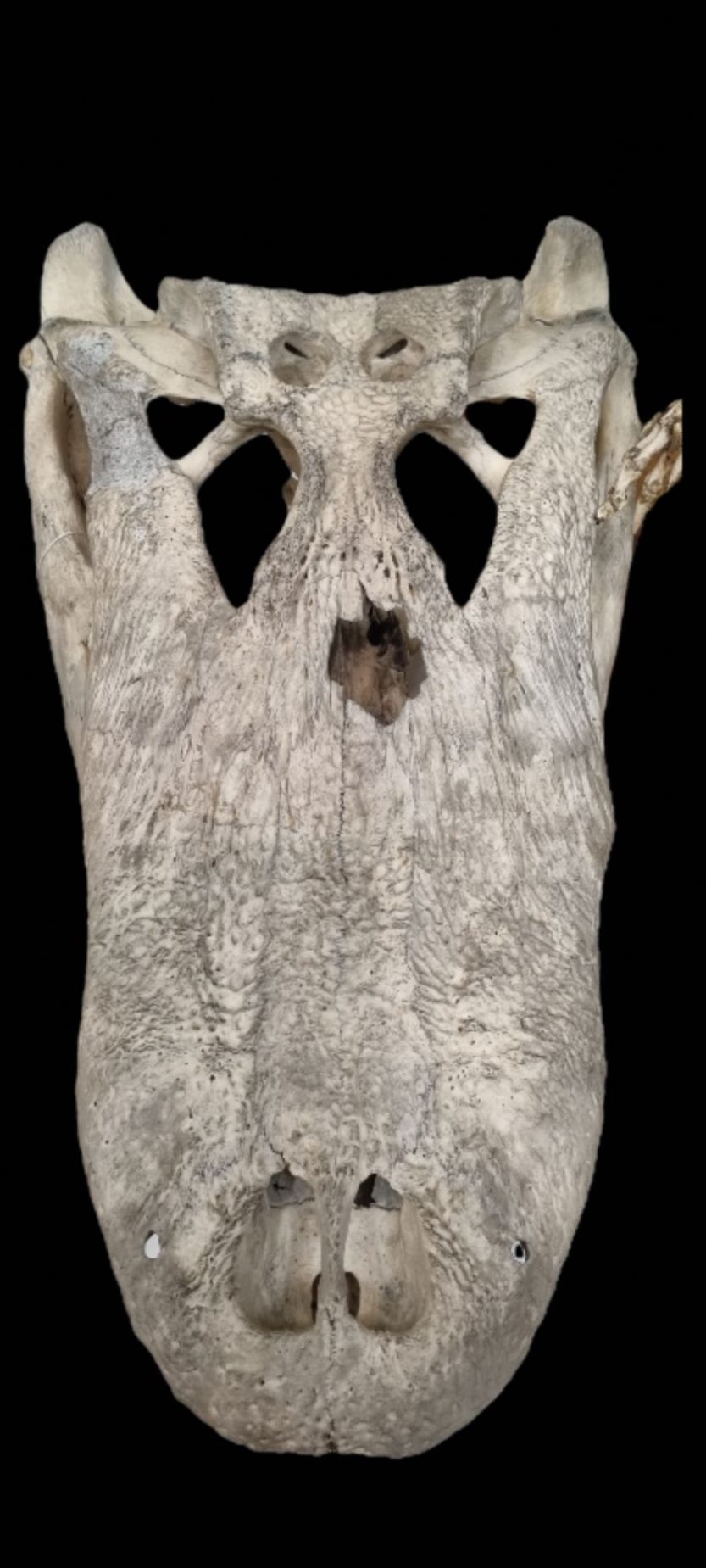
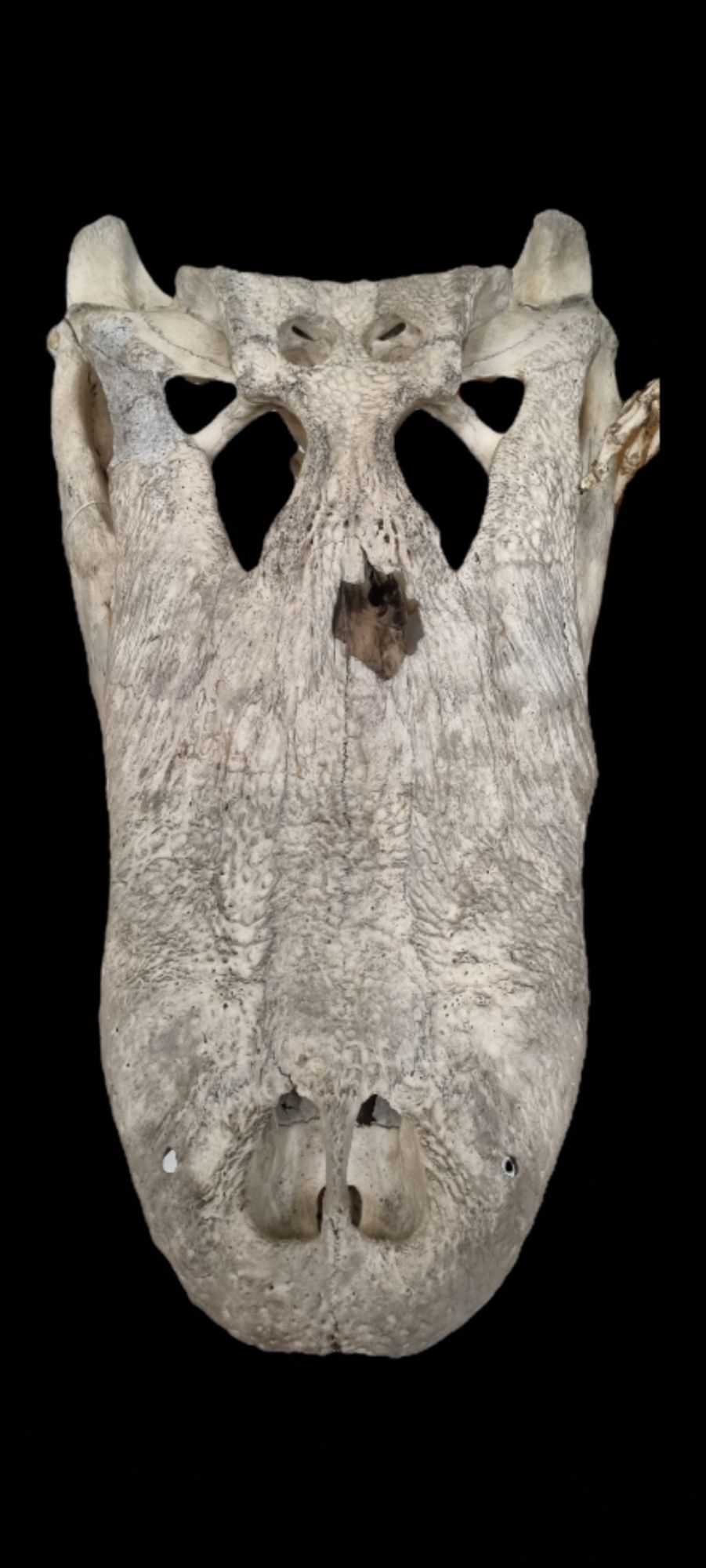
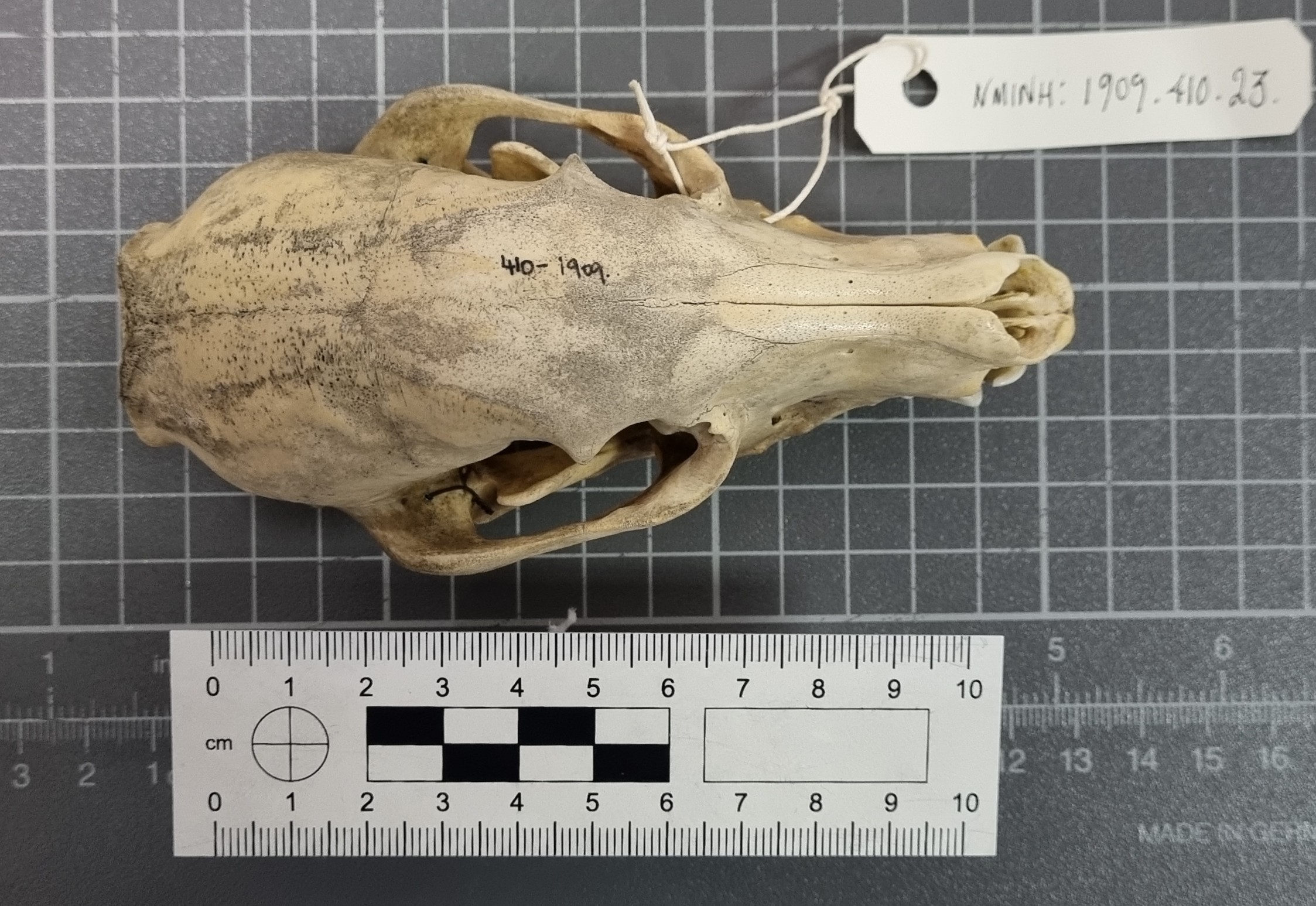
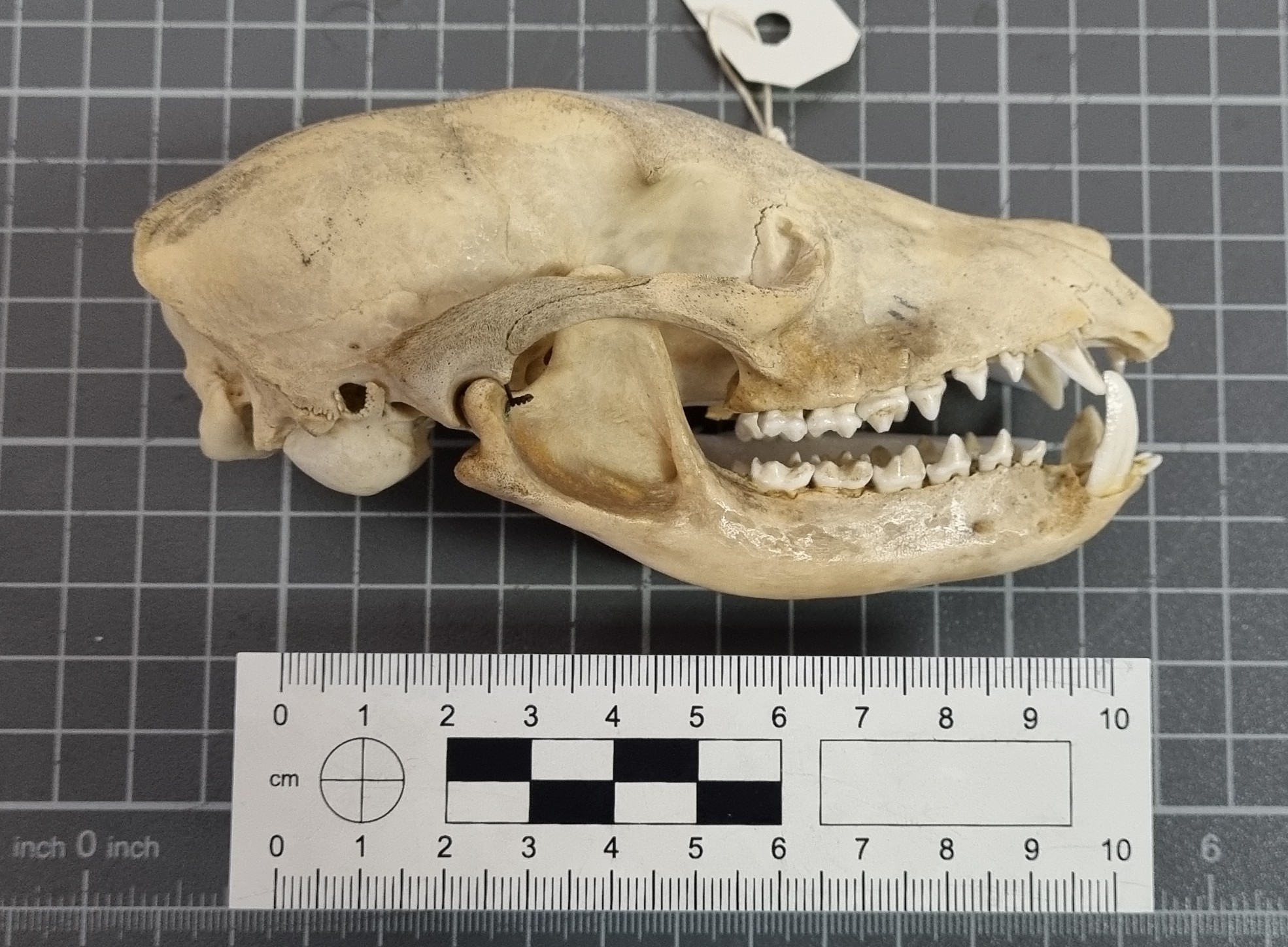
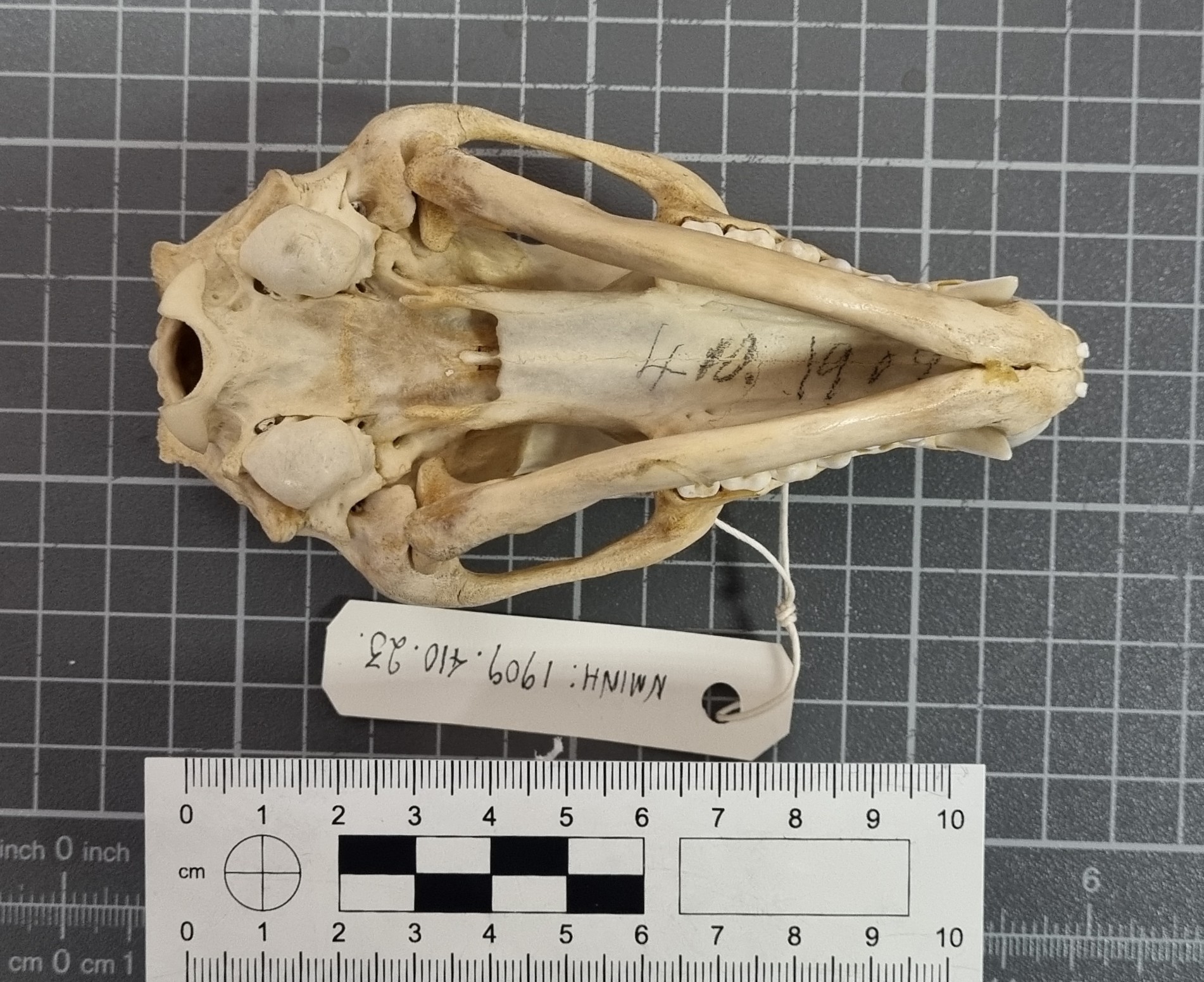
I hope you had an enjoyable Christmas! Last week I gave you this chonky skull as a mystery object to have a go at identifying:
It wasn’t anything particularly challenging or unusual, but it’s a very cool skull that we recently put on display in the Dead Zoo Lab in Dublin, and it’s nice to have a chance to share it here.
While Caimans did get a mention, pretty much everyone worked out that this is the skull of an Alligator – although which of the two living species it might be sparked some conversation.
In the words of Adam Yates:
Clues include snout shape and length, divided nostrils and lack of a lateral notch for receiving the big fangs from the lower jaw.
Excellent advice, although the simplest way I use to tell the difference is to check how much of a U-shape the maxilla forms. In this case it’s very U-shaped, which says American Alligator Alligator mississippiensis (Daudin, 1802).
I’m keeping this answer brief for this mystery object, since I’m sitting at a dinner table with family after a fantastic – and very large – meal, so I’m struggling to be creative with all my blood rushing to my stomach rather than my brain.
I hope you had a great Christmas, and I look forward to sharing more mystery objects for you in 2026!
Last week I gave you this skull from the collections of the Dead Zoo to have a go at identifying:
Bird skull identification can take a bit of work, until you get your eye in on things like the bill morphology (especially without the clues provided by the keratin sheath). Resources like the excellent Skullsite.com certainly help a lot, by providing a huge range of images of different species for comparison, and with tools to help narrow down options based on skull size and bill morphology.
As it turns out, Adam Yates certainly had his eye in, and he was first to comment with a correct identification for this specimen. It’s a Common or European Crane Grus grus (Linnaeus, 1758).
I chose this specimen as it’s one that we recently put on display in the Dead Zoo Lab as part of a community curated project called Our Irish Natural History. Eight community groups involved with iCAN (the Irish Community Archive Network) contributed to the work, which was coordinated by Adriana Ballinger – a fantastic postgraduate humanities researcher who has been working with us for the past year on a project with a focus on the wider cultural context surrounding natural history collections. The community groups involved each explored a different areas of interest, illustrating and exploring some of the connections between objects and local communities.
These sorts of projects, that connect our ostensibly scientific objects back into local communities through a cultural link are a fantastic way to broaden the relevance and interest in our collections. As a scientist it can be easy to focus on one aspect of an object – but every item we look after can be viewed from multiple perspectives – all of which add value and relevance.
I look forward to working on similar projects in the future, while hopefully taking the opportunity to share more of the collection here, for those of you with an interest in identification!
Last week I gave you a charismatic critter to have a go at identifying:
I only provided a close-up of the face of the specimen, since I didn’t want to make it too easy, and when you see the whole skeleton it’s pretty obvious which animal this is from:
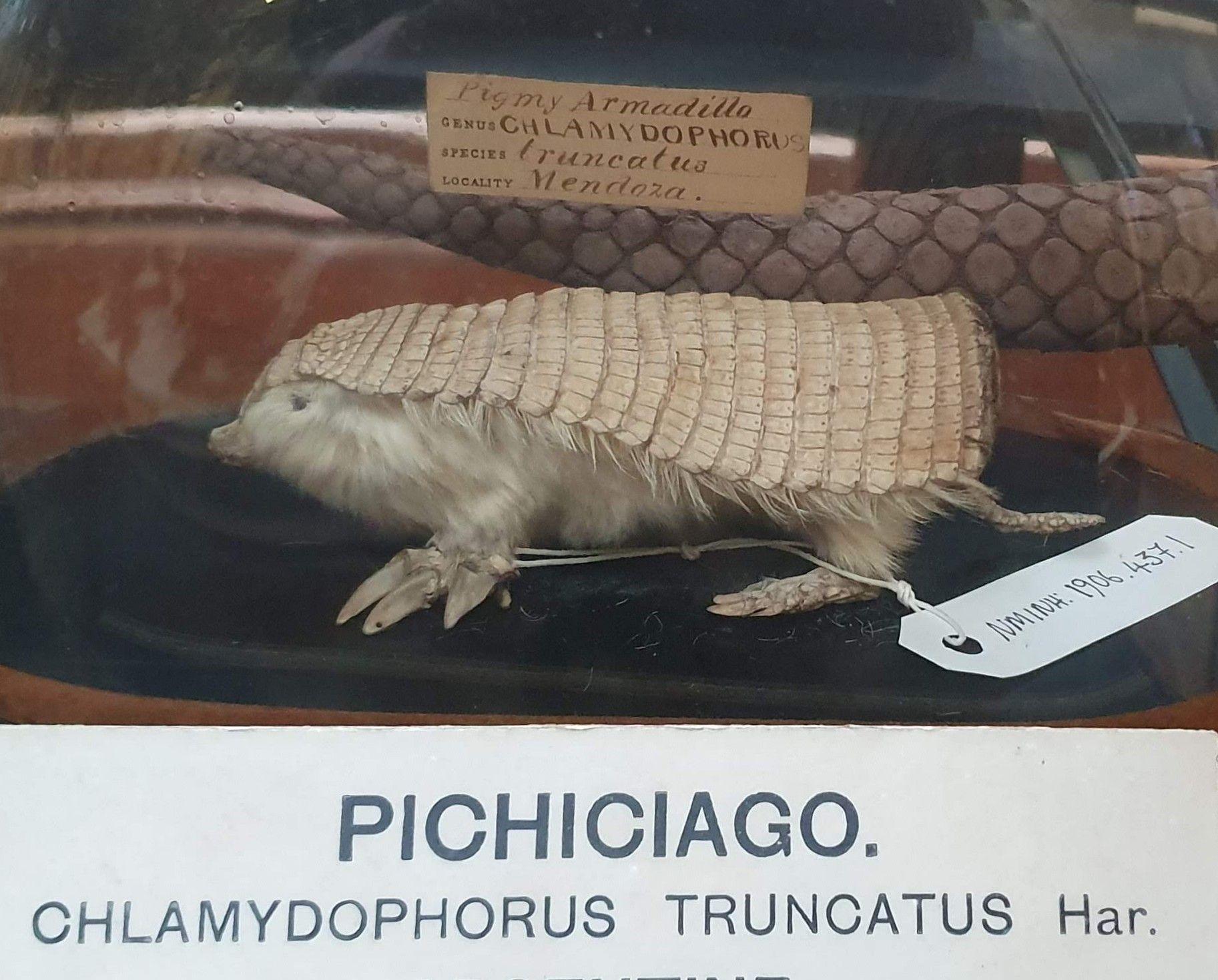
This is, of course, a Pichiciago or Pink Fairy Armadillo Chlamyphorus truncatus Harlan, 1825.
These tiny Argentinan armadillos are incredibly cute, with their silky fine hair and huge forefeet with massive claws (all the better for burrowing, my dear), although it’s a little hard to see that from the skeleton, so here’s this specimen’s skin:
Several of you worked out what this was, but Adam Yates was the first to post the answer – so well done Adam.
One of the observations from Kat Edmonson was about the protuberences from the top of the skull – for which I’ve yet to find any functional explanation. It may be as simple as providing a structure to support the armoured shield over the head area, but it’s not present in other armadillo species, so I’m not sure how this would work.
Since this species burrows and spends a lot of time in the sand hunting for ants and insect larvae, it may be that the bony protrusions help channel sound to help with prey detection and predator avoidance – but that is pure speculation. I’d love to hear your thoughts on this feature!
Well done to everyone who worked out the identity of this mystery object – while it may be distinctive, it’s an unusual wee beastie.
This week’s mystery object is one of my favourite specimens from the Dead Zoo:
I think it’s a bit too easy to identify from a photo of the full specimen, so this is just a close-up of its face, which I think is adorable – a cutie for Valentine’s Day!
Let me know your thoughts on what this might be – and have fun with it!
Last week I shared this specimen from the collections of the Dead Zoo, as it’s a good example of the type of specimen that will often turn up for identification:
If you didn’t recognise it, this is the braincase of a seal.
It’s not usual for seal skulls to be found in sections like this for a few reasons. One is that marine mammals tend to have quite open sutures in their skulls, presumably to help prevent issues with pressure during diving. Another is that young animals (with unfused skulls) will often be the ones that succumb to the rigours of nature. Finally, beaches are high energy environments, so skulls will often be rolled and broken up by wave action.
Knowing it’s a seal is useful, but there are over 30 species to choose between. However, Adam Yates spotted some useful information written on the specimen:
‘It looks like “Yellow Slrank 20/9/92” ???? I’m guessing a location and date, but Slrank? WTF is that?
Got it! Yellow Strand. It is a beach in Ireland.’
This really helps, since there are only a couple of species that are likely to be found in Ireland – the Grey Seal and the Harbour Seal.
It’s about the right size for a Harbour Seal, but the shape isn’t quite right. In particular, the frontals (that pair of bones that forms the skinny section that’s sticking out) aren’t skinny enough. There’s also a hint of muscle scars and unfused frontal-parietal sutures that suggest that the animal may be juvenile.
If that is the case (and I think it is), then I think this is most likely the skull of a young Grey Seal Halichoerus grypus (O. Fabricius, 1791). This was Adam Yate’s suggestion, supported by Kat Edmonson, so well done to them for picking up on that detail.
I hope you enjoyed that challenge – more to come next week!
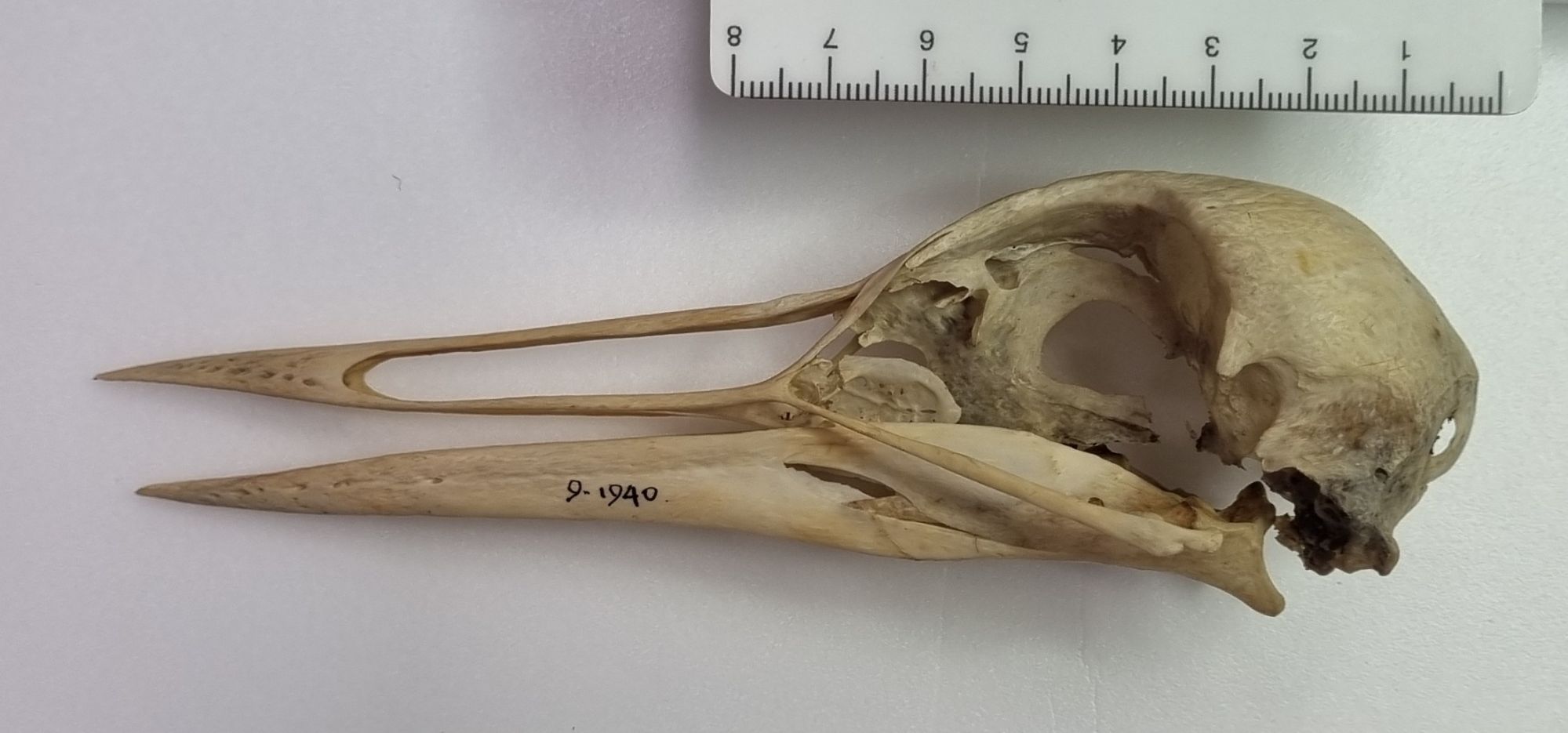
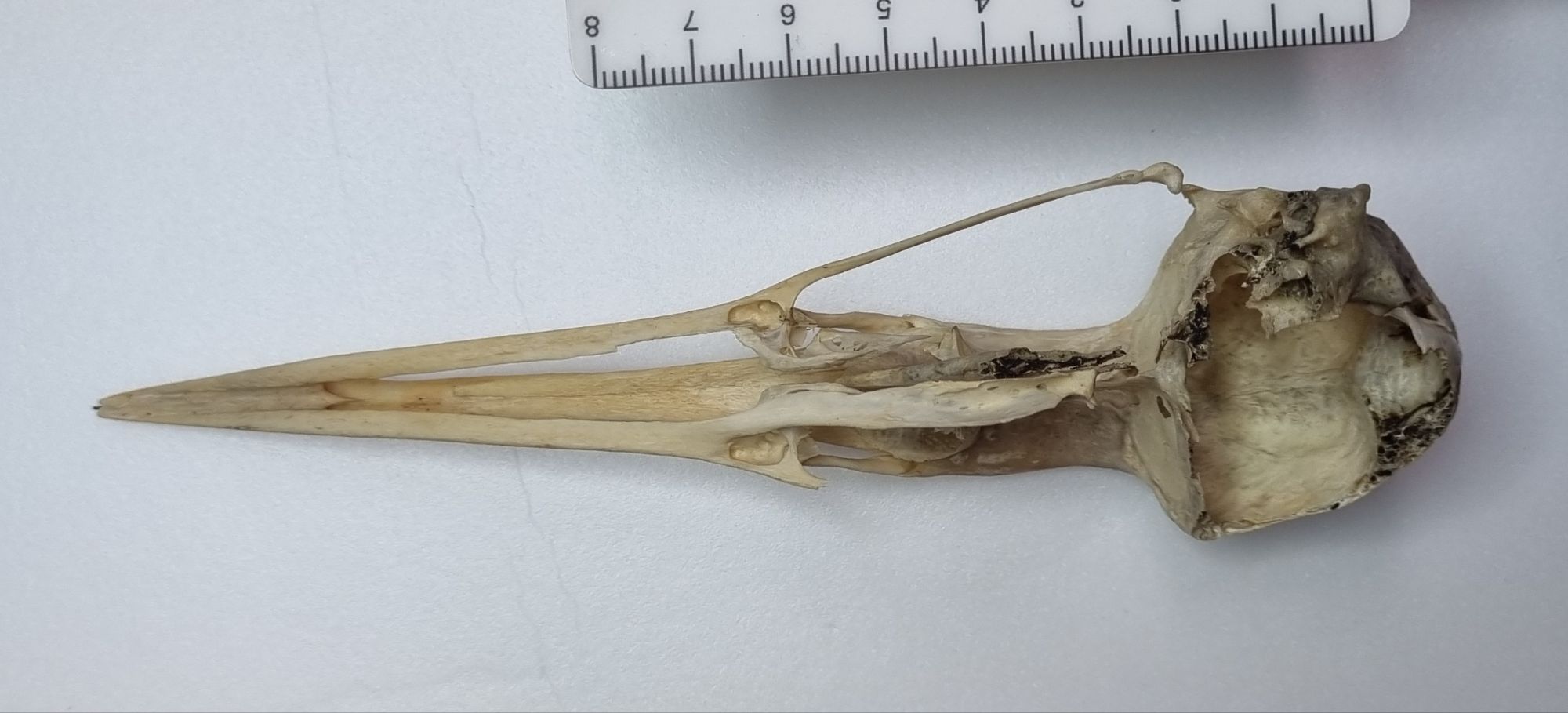
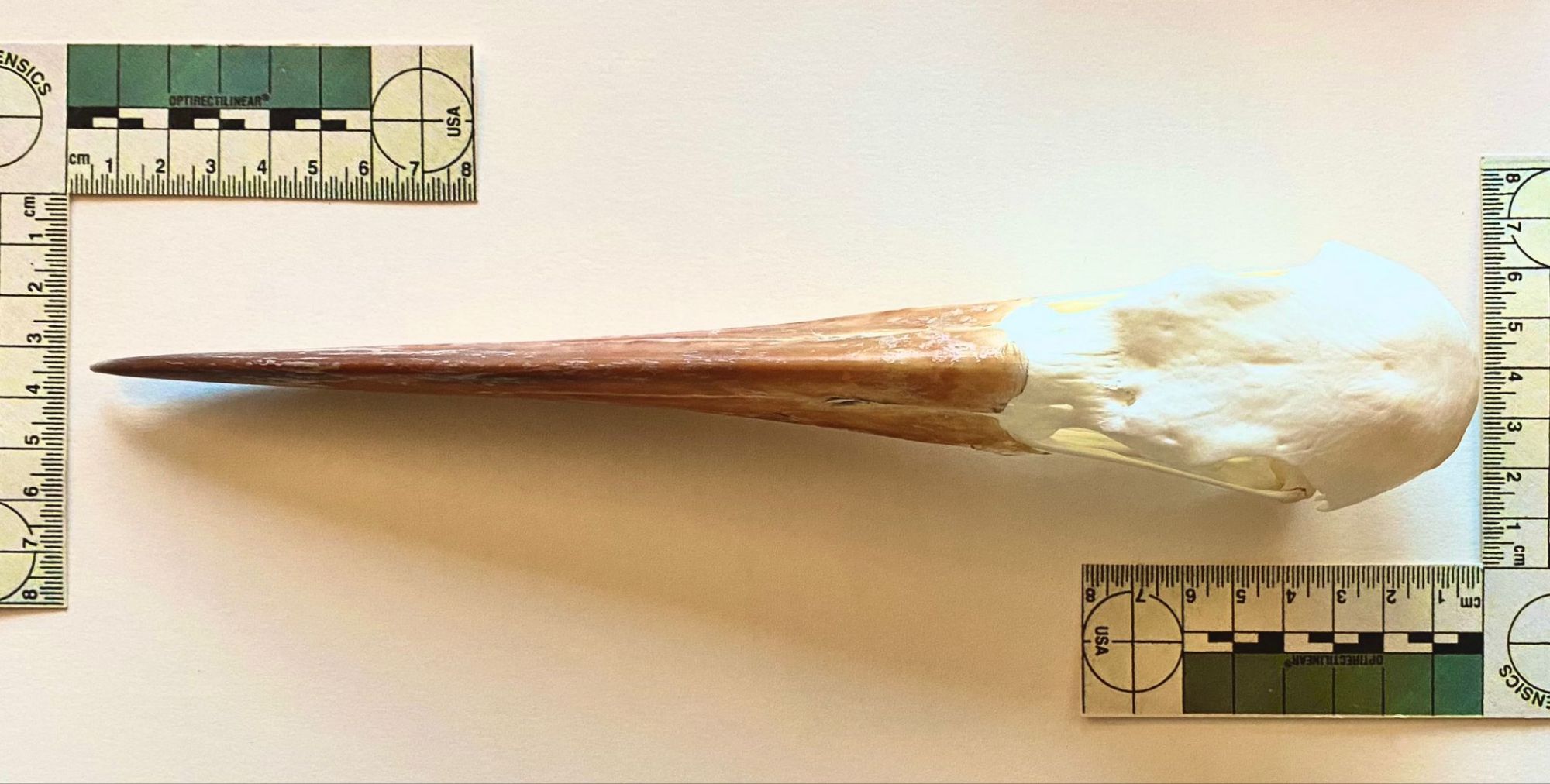
It wasn’t a particularly difficult one, since that huge bill immediately narrows down the possibilities.
The spear-like bill shape is reminiscent of a heron’s, but it’s heavier – not quite as massive as something like a Marabou Stork, Adjutant, or Jabiru, but heavy nonetheless.
As Adam Yates noted, this is the skull of a White Stork Ciconia ciconia (Linnaeus, 1758) – the second mystery object in a row with the initials C. c. (the previous one being Crocuta crocuta).
When attempting to identify bird skulls, a hugely useful resource for reference is Skullsite, which is run by regular commentor on the blog, Wouter van Gestel – who referenced the White Stork with a comment relating to their reputation for the delivery of babies.
So well done to everyone who worked out the species, here and on Mastodon, Bluesky and LinkedIn – and my thanks to Andy for sharing another gem from his collection!
This week I have a guest mystery object for you, from avid naturalist and frequent contributor, Andy Taylor, FLS:
Image by Andy Taylor FLS, 2024.
Image by Andy Taylor FLS, 2024.
Image by Andy Taylor FLS, 2024.
I suspect that some of you will get this one easily, so it’s time to break out your creativity and let me know what you think it is with a cryptic clue.
Last week I gave you this cute little skull to identify:
This is an object I selected when I was recovering from Covid, so I picked it thinking that I knew what it said on the label and so it would be an easy one to write up an answer for. Of course, the Universe being the way it is, I came to write this answer and realised that I actually took note of the wrong label.
My brain is clearly still not fully recovered from being ill, so now comes the complicated bit where I have to work out what it is, with no more information than I gave you, since I’m writing this answer at home and I don’t have access to either the specimen or our database.
Fortunately a lot of that work has already been done by the wonderful regular visitors to Zygoma (thanks folks!)
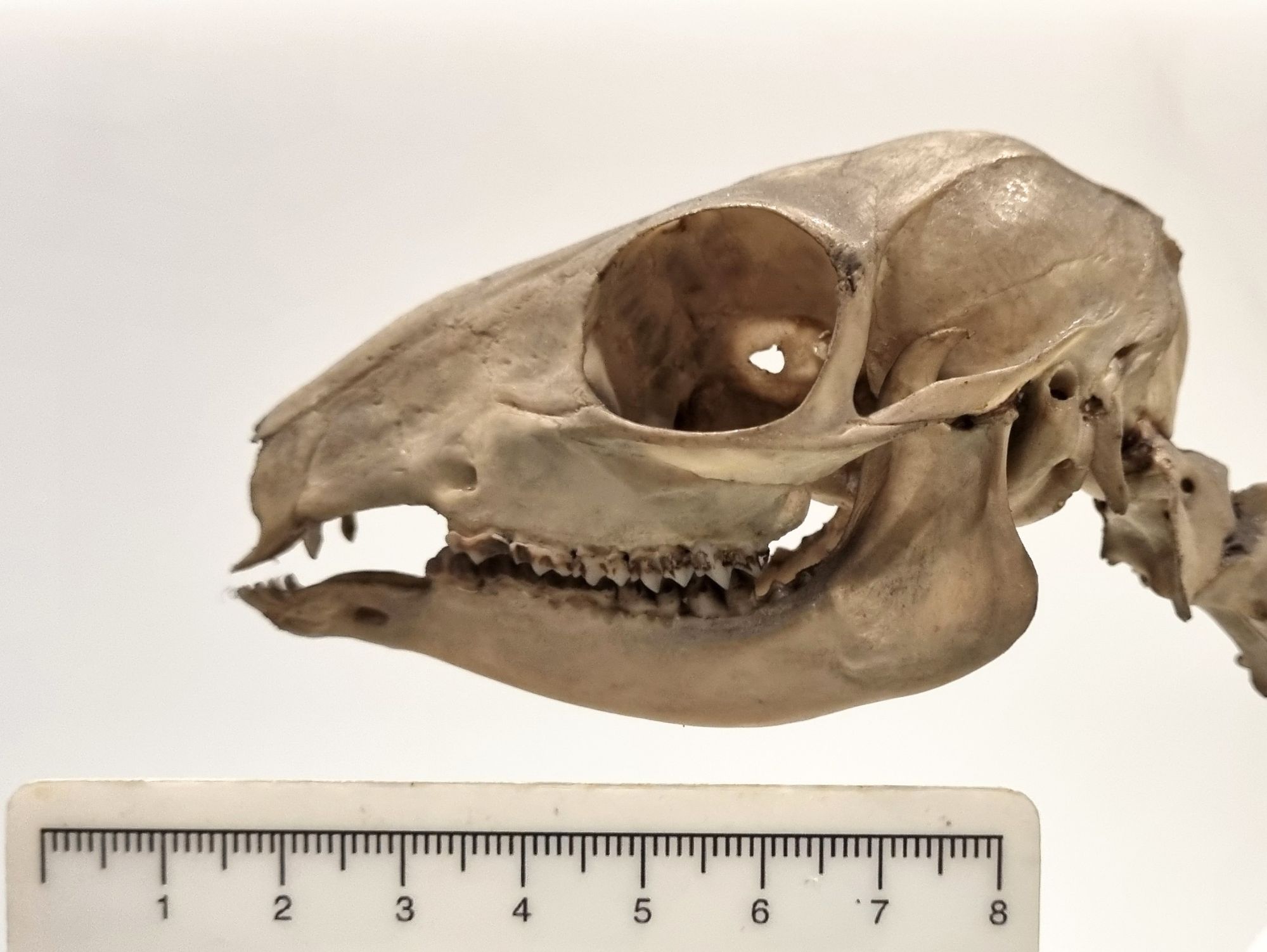
This is one of the diminutive Artiodactyls. It has neither horns nor antlers (although the specimen is female, so those might not be present even if the males of the species had them). It lacks scars from scent glands, so it’s not a Dik-dik or other tiny antelope. However, it does have small but prominent canines, which offer a clue. As Chris Jarvis suggested, this is the skull of a Mouse-deer, in the family Tragulidae.
There are three possible Genera in the family, but a quick check against specimens from the Genus Hyemoschus show some clear differences – both in general proportions of rostrum (snouty bit), the number of foramina in the front part of the mandible (Hyemoschus normally have two, but our mystery specimen has just one).
There are also differences in comparison with specimens in the Genus Moschiola – which seem to more usually have two foramina in the maxilla and a somwhat open suture at the junction between the bones of the maxilla, frontal and nasal bones.
That leaves the Genus Tragulus, which the mystery skull fits with very well.
It all gets a bit more complicated from there. In terms of size, I think we can rule out the Greater Mouse-deer since the mystery skull is about 2cm shorter that an example of the Greater Mouse-deer that I featured on the blog about 12 years ago (where doe the time go?):
This size difference is not a perfect characteristic to use, since the skull length can overlap between the species, but the mystery specimen has all the indicators of being a mature adult and it would still be at the absolute smallest end of the spectrum for the Greater Mouse-deer.
Distinguishing between the other possible species is more problematic, since there can be quite a lot of regional variation within the remaining species. From looking at examples of skulls online I’m leaning towards the Lesser Mouse-deer rather than the Java, Philippine, Vietnam or Williamson’s Mouse-deer, but that’s based on the structre of the zygomatric arch and general proportions rather than any clearly distinctive features.
In this instance I can at least check my hunch tomorrow on our museum database, to see if my hunch plays out – I’ll update this answer with the result as soon as I have a chance!
[Update: I’ve had a chance to check and my hunch was off – it’s listed as Java Mouse-deer Tragulus javanicus (Osbeck, 1765), so it goes to show that you do need those clearly distinctive features to get a good identification! This is why it’s better to rule out what it can’t be based on the data available and be happy with having a few possibile options, rather than making a misidentiifcation]
Thanks to everyone who had a stab at the identification – I hope you enjoyed the challenge!
Last week I gave you this skull to try your hand at identifying:
Adam Yates was straight in with the answer, but there were a few other suggestions that were close, but not quite on the nose.
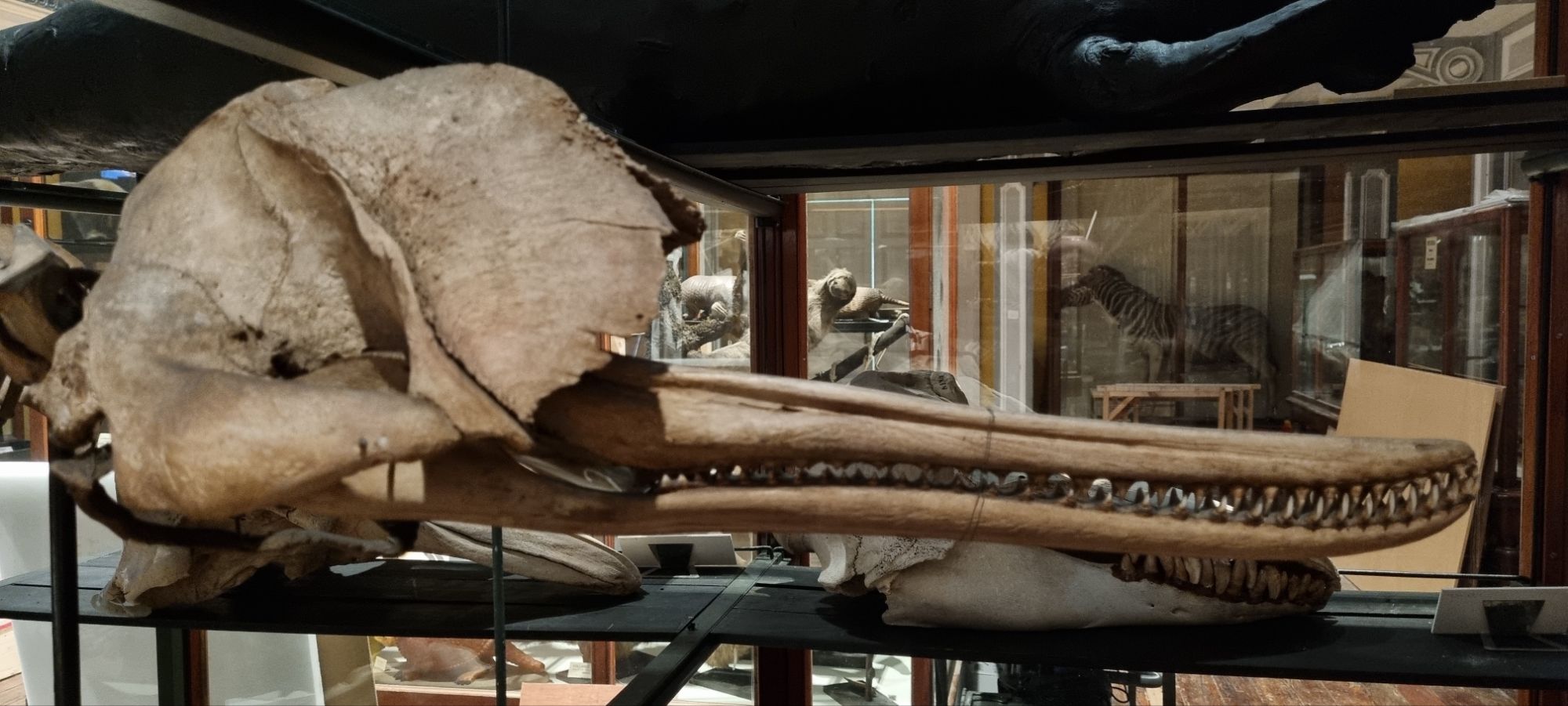
One suggestion was Tursiops, which are the bottlenose dolphins. The length of the skull is about right, but the Common Bottlenose Dolphin has a relatively longer and narrower rostrum, as you can see by comparing the with the image below:
Skull of a Common Bottlenose Dolphin
The shape of the mystery skull is perhaps a better match for Risso’s Dolphin, except the rostrum is a bit longer and the premaxilla is narrower than the maxilla in the mystery object when viewed from above, but in the Risso’s Dolphin the premaxilla is a good bit wider. Also, the mystery specimen has way too many teeth.
Another suggestion was Melon-headed Whale, which is a species that is very similar to the mystery specimen, except it has much deeper antorbital notches – those bits on the sides of the skull that stick out like the Millenium Falcon’s cockpit.
The mystery skull is in fact from a White-beaked Dolphin, Lagenorhynchus albirostris (Gray, 1846). This is a species that lives in cold North Atlantic waters, feeding on Cod and related fish. Well done to everyone who managed to work it out!
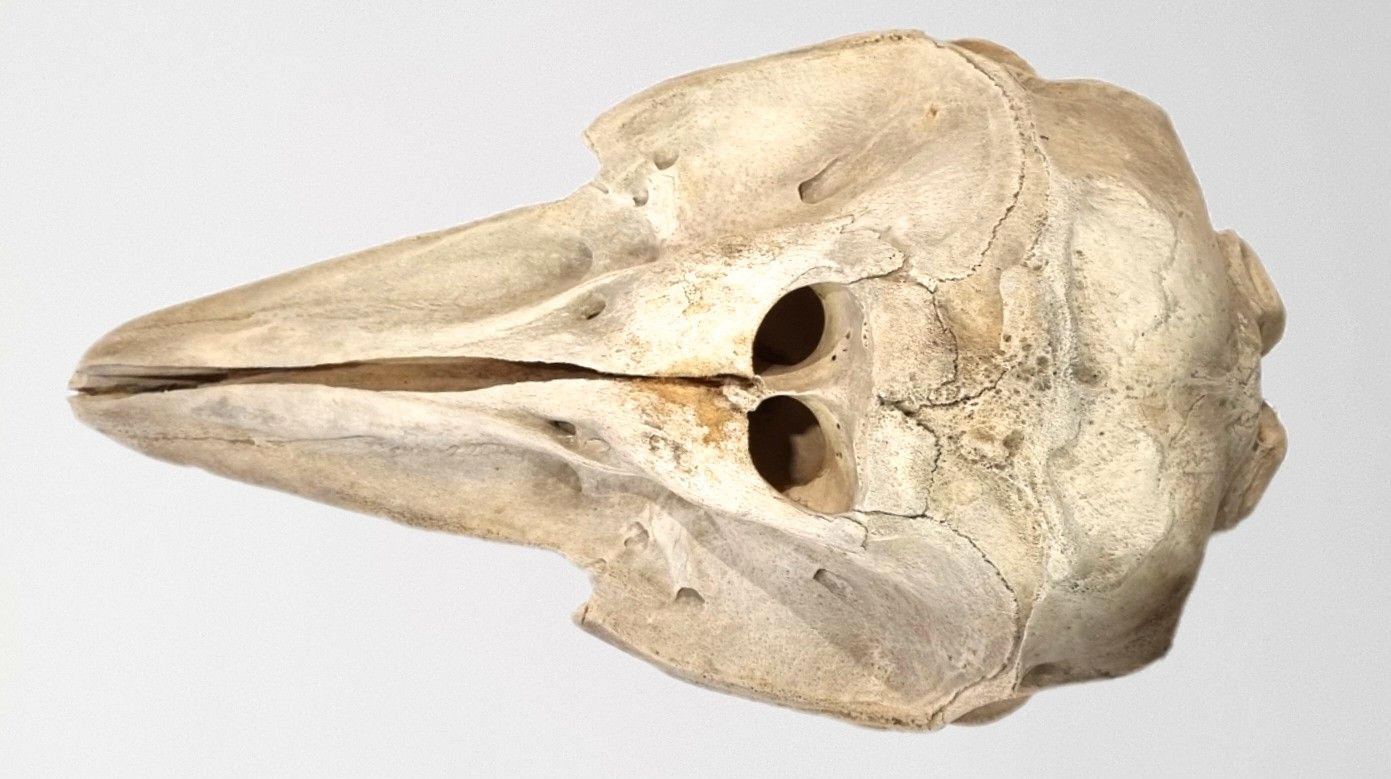
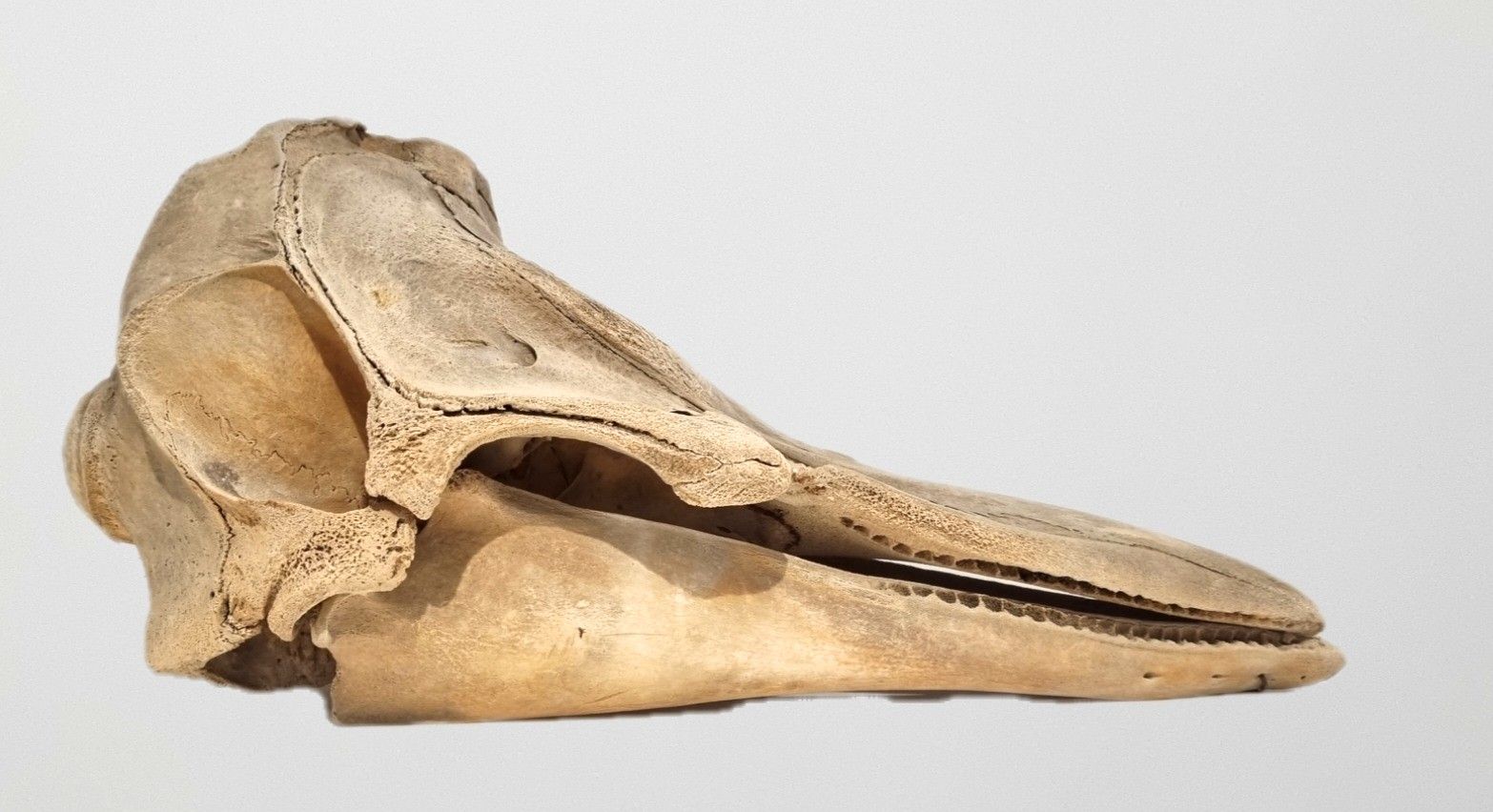
This week I have a nice skull for you to have a go at identifying:
This specimen is around 52cm long and it had an incorrect label attached, so it needed to be identified, to work out what its correct label should be. What do you think?
As always, you can leave your thoughts, questions and suggestions in the comments box below. I hope you enjoy the challenge!
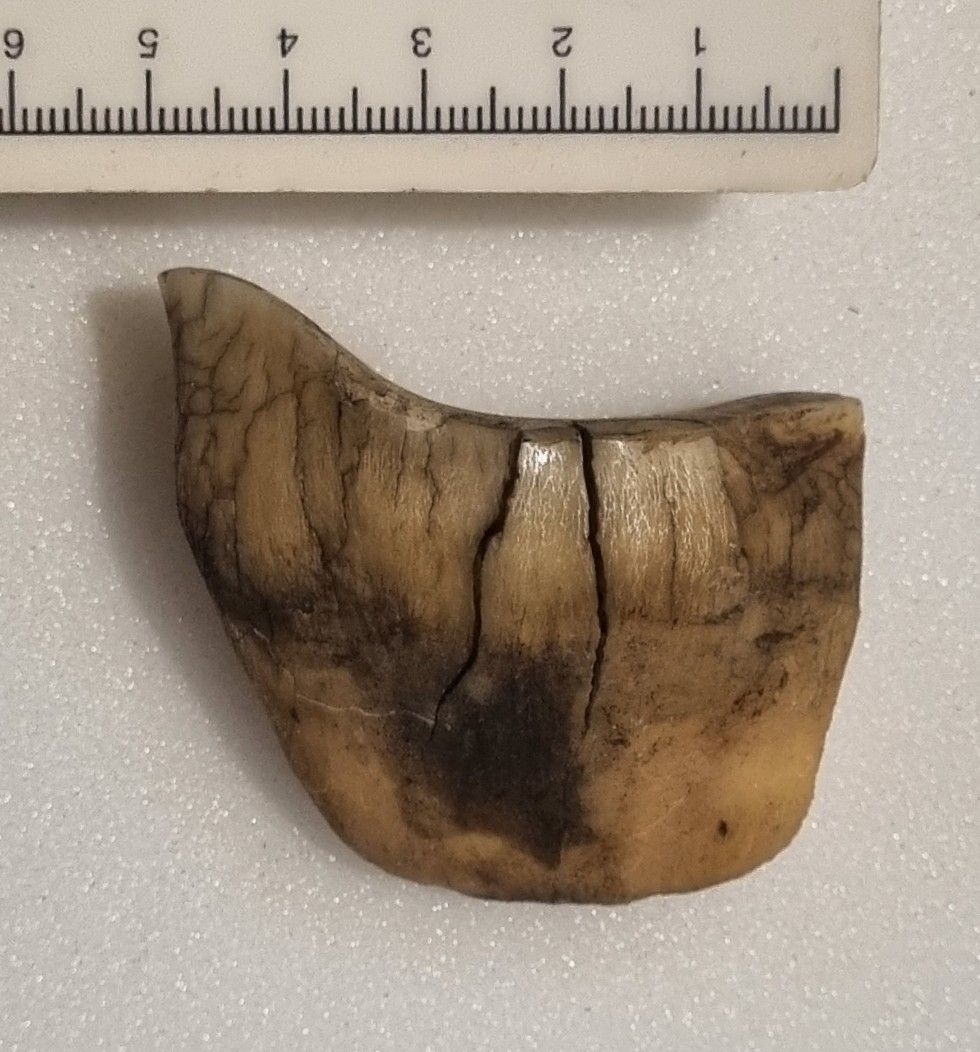
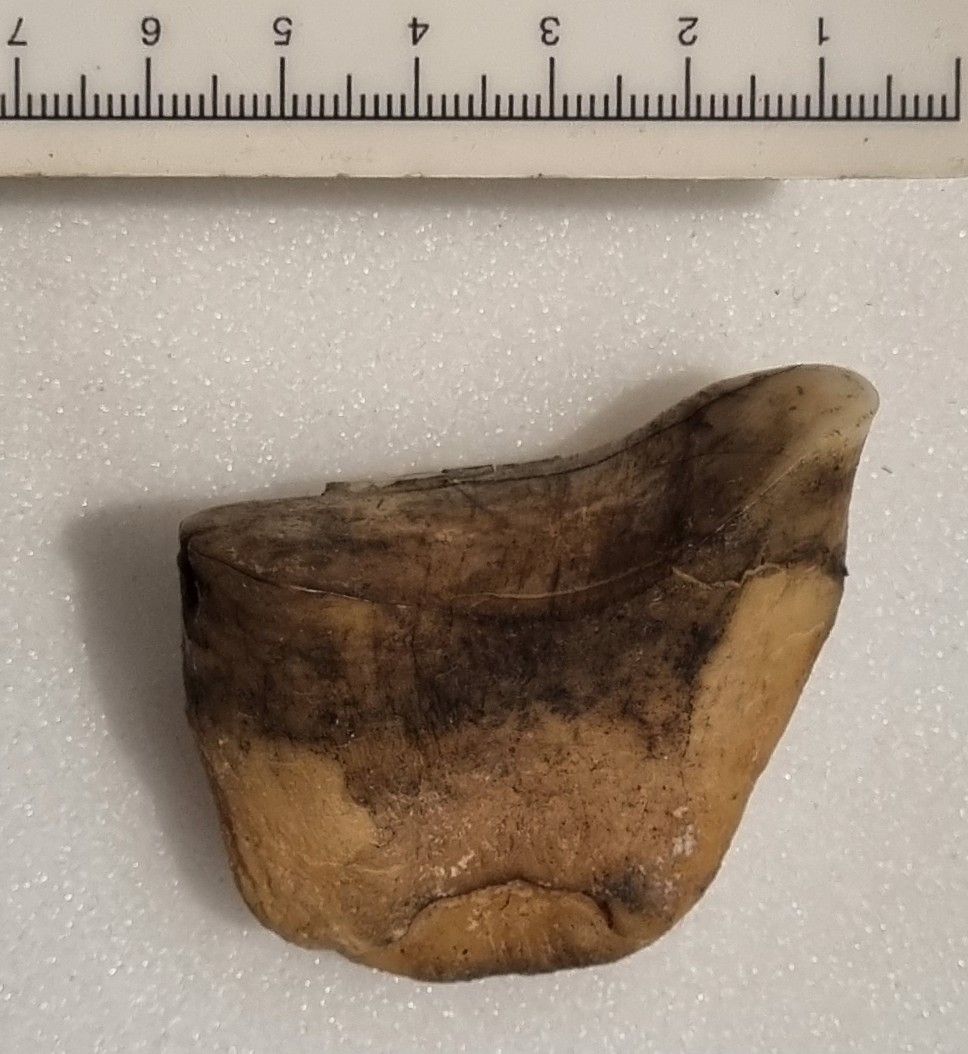
Last week I gave you this specimen to identify, from the collections of the Dead Zoo:
I thought it might prove a little challenging, and I wasn’t mistaken, although some people did manage to get very close. Chris Jervis was the first, but Adam Yates also provided a nice analysis of the specimen:
It is blade shaped without cusps, so the incisor of a large animal seems possible (I’m ruling out a Thylacoleo premolar on the basis of the broad wear facet on the occlusal surface and single root).
The root is really short so I’m guessing its a deciduous incisor.
Horses are large mammals with incisors of this sort of shape. If it were a horse it would be a third incisor because of its less square crown. As the high point (presumed mesial side) is on the left side it is probably a right incisor.
So my guess is a right deciduous incisor three of a horse.
Adam then followed up with a note about the size being too big for a horse, and leaned in to Chris Jervis’ suggestion – a good decision.
So what is it?
This is in fact the upper right incisor (or tusk) from the skull of an Indian Rhinoceros Rhinoceros unicornis Linnaeus, 1758:
African rhino species have lost their incisors, but the Indian Rhinoceros have incisors that form self-sharpening tusks with open roots, which are used in fighting.
The full specimen that this is from is a mounted skeleton that was on display in the Dead Zoo for a century or so, and the animal clearly had a very tough life, as it shows a variety of pathologies that have healed.
In the mandible there is a huge abscess at the base of the lower right tusk, possibly due to fighting or maybe a bullet wound:
The animal also has a variety of other injuries, including a bullet wound in the ribs:
and a major trauma to the lower front left leg, which has resulted in the humerus and ulna fusing together:
I have these photos of the specimen as over the last couple of weeks we have started the decant of specimens from the Dead Zoo in earnest, as we’re getting moving on a major capital developement project in the Museum, to solve a number of issues with access for the public, problems with the museum environment, and conservation of the 168 year old building.
Stay tuned for more updates on the project, as I suspect it will be keeping me busy for the next few years!
Last week I gave you this incredibly funky skull to have a go at identifying:
It’s from a very distinctive type of animal, which pretty much everyone figured out, thanks to those huge bony crests on the front of the cranium (actually originating from the maxilla). In life, these would have almost enclosed the animal’s melon (a waxy ball that helps focus sound transmitted through water), helping to improve echolocation.
This is of course the skull of a River Dolphin – which is a term given to a variety of riverine dolphins around the world – although only the Genus from South Asia (Platanista, as Chris Jarvis was the first to identify) has the characteristic bony crests. This is probably an adaptation to their reliance on echolocating in the sediment-laden and murky waters of the Indus and Ganges rivers.
As Adam Yates correctly pointed out in the comments, the tooth count suggests that of the two possible species, this is the Susu, Hihu, Shushuk, or Ganges River Dolphin Platanista gangetica (Lebeck, 1801).
These dolphins have almost lost the use of their eyes, with them being lenseless and merely used for detecting the difference between light and dark. This pushes them to rely on echolocation as their primary method of finding food.
As far as I’m aware the Giant Golden Mole has no melon, but it does have (relatively) huge ear bones, no external ear openings, and lives at ground-level rather than underwater, so it may be that the bony structure helps focus sound transmitted through the ground into the auditory region of the skull, in a way similar to that suggested for the South Asian River Dolphin’s crest, albeit in the water.
Speculation about comparative structures aside, the South Asian River Dolphins are incredibly well adapted to their habitat, which means that their populations are increasingly at risk due to changes arising from the climate crisis (such as changing annual rainfall and runoff patterns), farming practices (such as increased pesticide and fertiliser contamination of waterways), hydrological management (such as the installation of dams), plus hunting and accidental fatalities due to river traffic.
Similar pressures have almost certainly already pushed the Baiji or Yangtze River Dolphin into extinction, so let’s hope we can learn from the mistakes of the past, and ensure these strangely wonderful animals survive into the future.
This week I have a lovely specimen from the Dead Zoo for you to have a go at identifying. It’s very unusual looking, but as a result it’s very distinctive:
Any ideas what it is? If you recognise it, then please have a go at making your answer cryptic, so people who are less familiar have a chance to work it. I look forward to your responses and hope you have fun with them!
Last week I gave you this fantastic skeleton from the Dead Zoo to identify:
I suspected that it wouldn’t prove too much of a challenge for most of the regulars here, as it is fairly distinctive – although possibly not all that familiar. However, there is another species that has some very similar convergent features, which did cause some confusion.
The skull is quite elongated and there is a series of simple teeth that line the upper and lower jaw:
This skull shape – plus the powerfully built body – is reminiscent of the first animal to come to mind for anyone with an alphabetical mindset; the Aardvark:
Aardvark skull LDUCZ-Z144 at the Grant Museum of Zoology, UCL
However, as you can see, despite the similarities, there are several differences between these skulls – particularly in relation to the eye (there’s a postorbital process in the Aardvark), cheekbone and teeth (Aardvark teeth are a lot more robust – I talked about them a bit in a post from 2017 if you’re interested).
In terms of differences from the Aardvark, there’s also quite an important feature presnt in the forelimb:
Aardvarks have four front toes, all of which are fairly uniform in size and all have long and robust claws for tearing into termite mounds, but the mystery object has a very odd toe configuration, with every toe different in size and shape, with one enormous sickle-shaped third claw (also useful for demolishing termite constructions).
This is a feature unique to the Giant or Great Armadillo Priodontes maximus (Kerr, 1792):
Bones of the manus of the Great Armadillo.Frank E. Beddard, 1902
So well done to Chris Jarvis, who was the first to identify the animal – but I must say that the clue he used to share his knowledge came with a parasitic earworm from which I’m still recovering…
I have a potentially perplexing mystery object for you this week from the Dead Zoo. Any idea who this bony character might be?
If you think this is an easy one, then I would be both surprised and impressed, so let me know your thoughts through a crytic clue or two below. Enjoy the challenge!
Last week I gave you this unidentified skull from the collections of the Dead Zoo:
I say it was unidentified, but in a strange quirk of coincidence I actually did identify this skull three years ago, just a month before the start of the Covid Pandemic (which might explain why I never had a chance to update the record).
I think the specimen is most likely to be the skull of a White-nosed Coati Nasua narica (Linnaeus, 1766), for the reasons I outlined back in 2020. So well done to Leon and Chris for recognising this cousin of the Raccoon from South and Central America and the southern parts of some North American states .
Coatis have quite distinctive upper canine teeth, that look almost like short tusks. These are useful for defence from other Coatis, but they are not very well adapted for subduing larger prey. This isn’t really a problem for Coatis, since they mainly feed on invertebrates, fruit and small vertebrates that they undcover during their energetic foraging.
So I apologise to everyone for repeating a specimen – this is the first time this has happened (and hopefully the last)!
This week I’m continuing with skulls from the collections of the Dead Zoo, and this one was sitting in the “Unidentified” drawer:
Do you have any ideas what this might be? I suspect that some of you will be familiar with this, so perhaps it’s time for some cryptic suggestions in the comments. Have fun!















 Zygoma