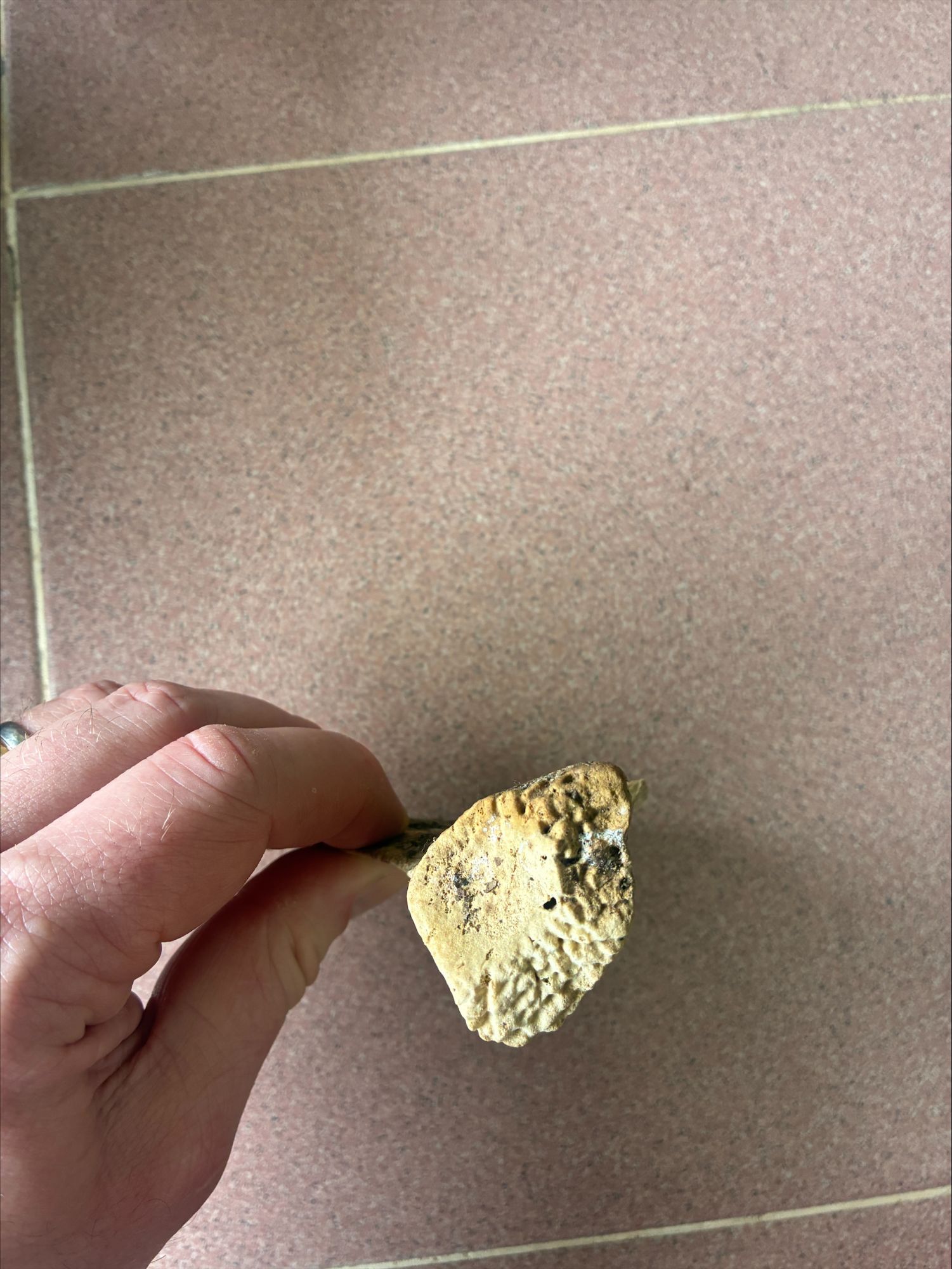
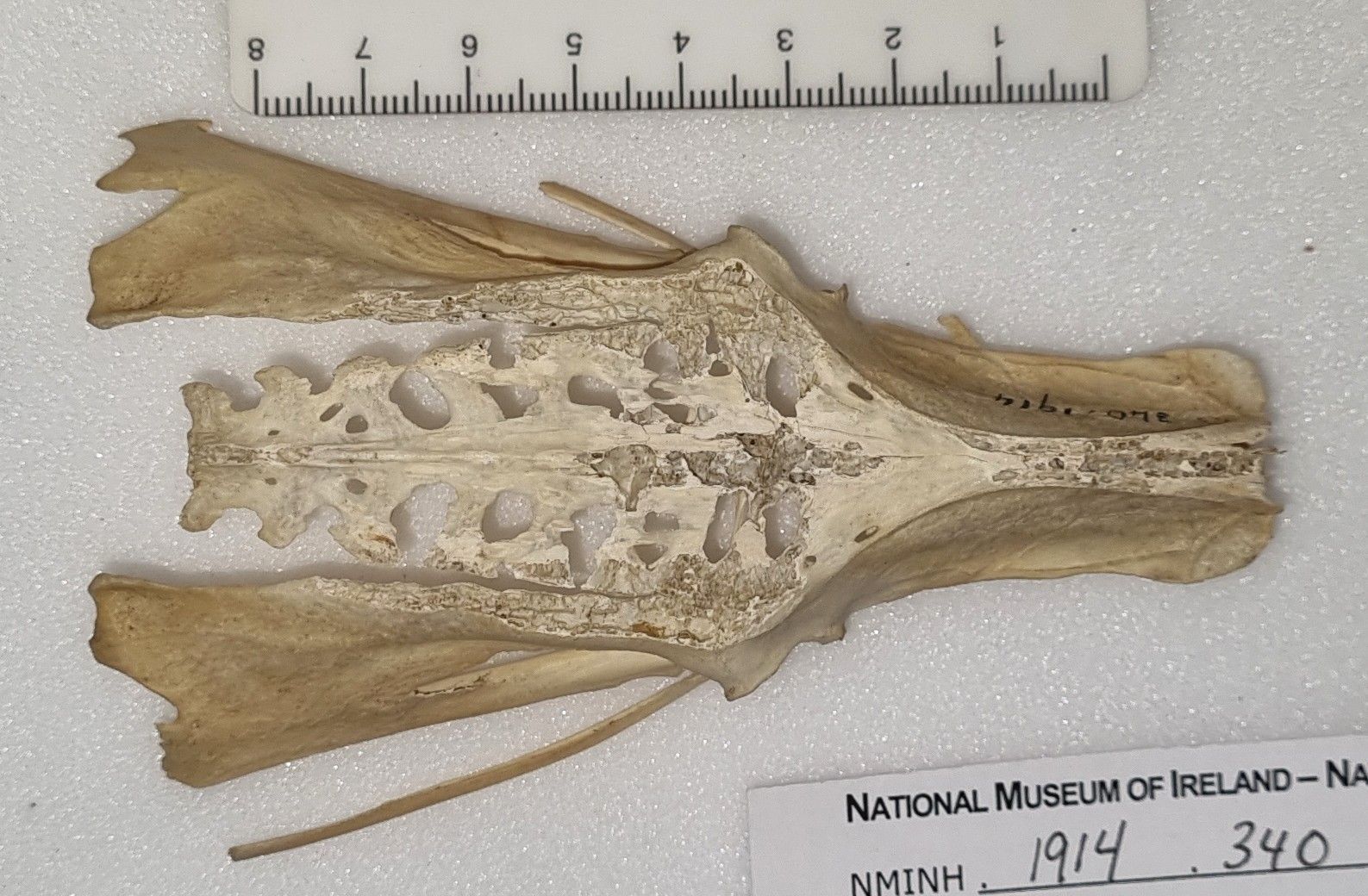
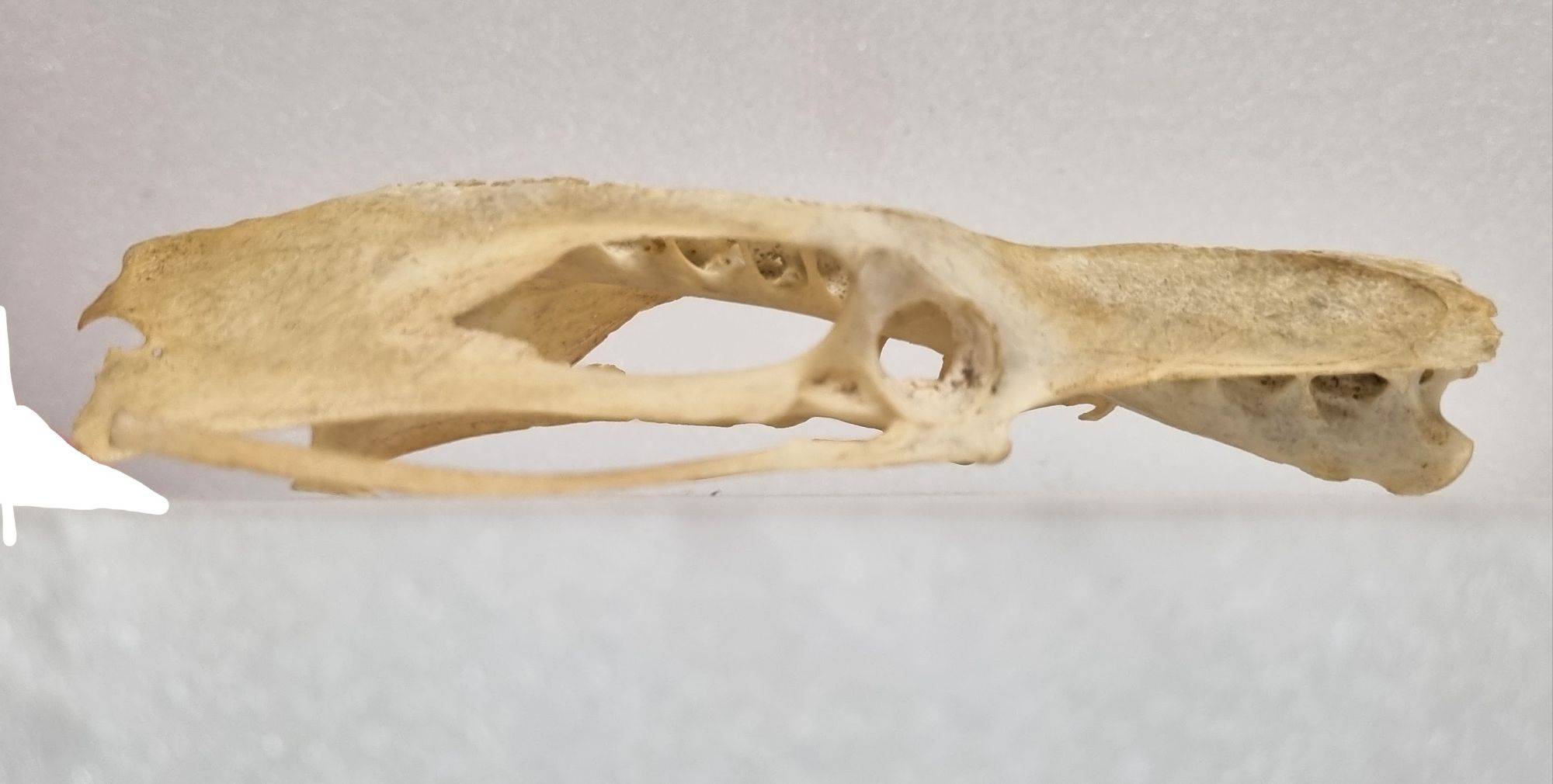
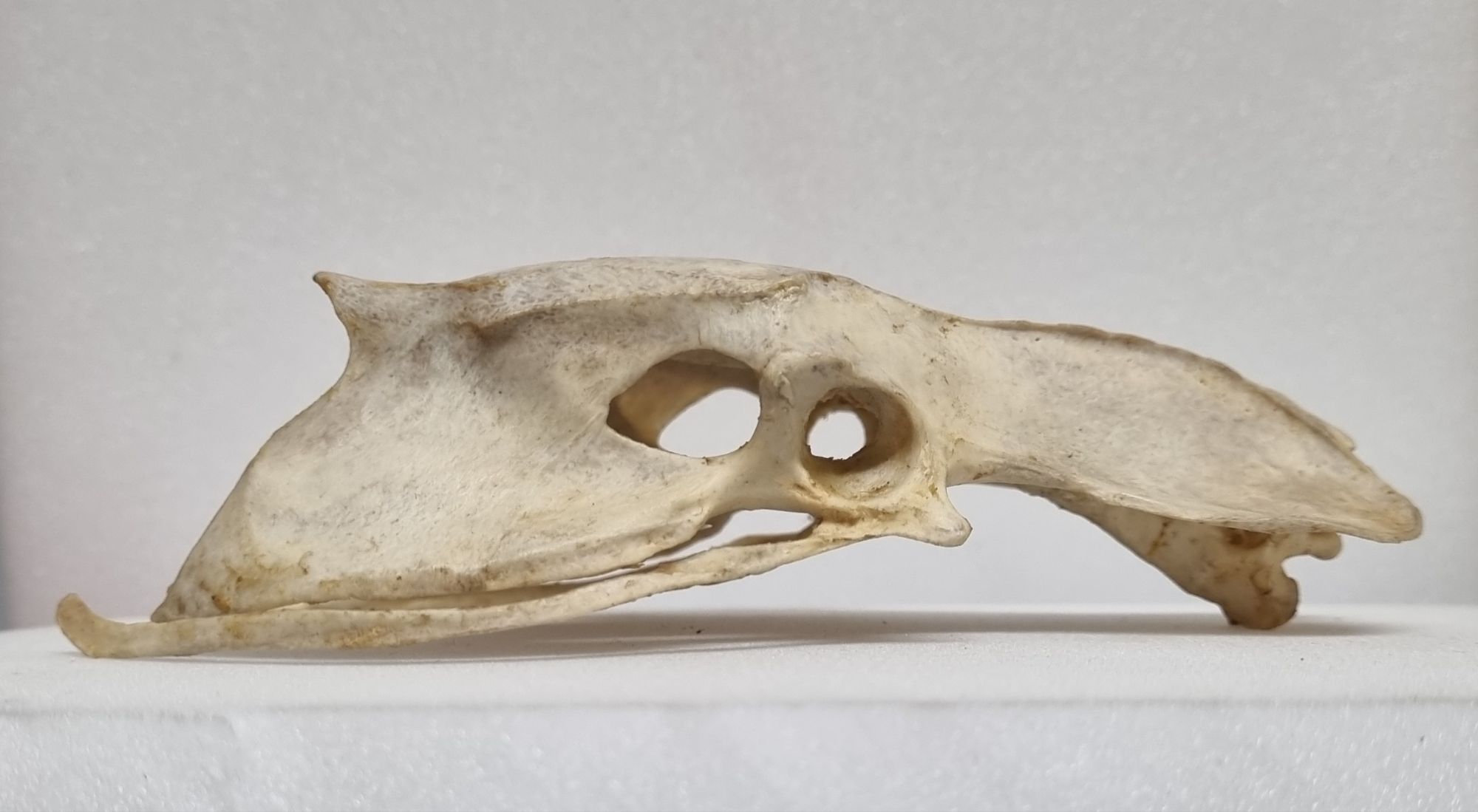
Friday mystery object #527 answer

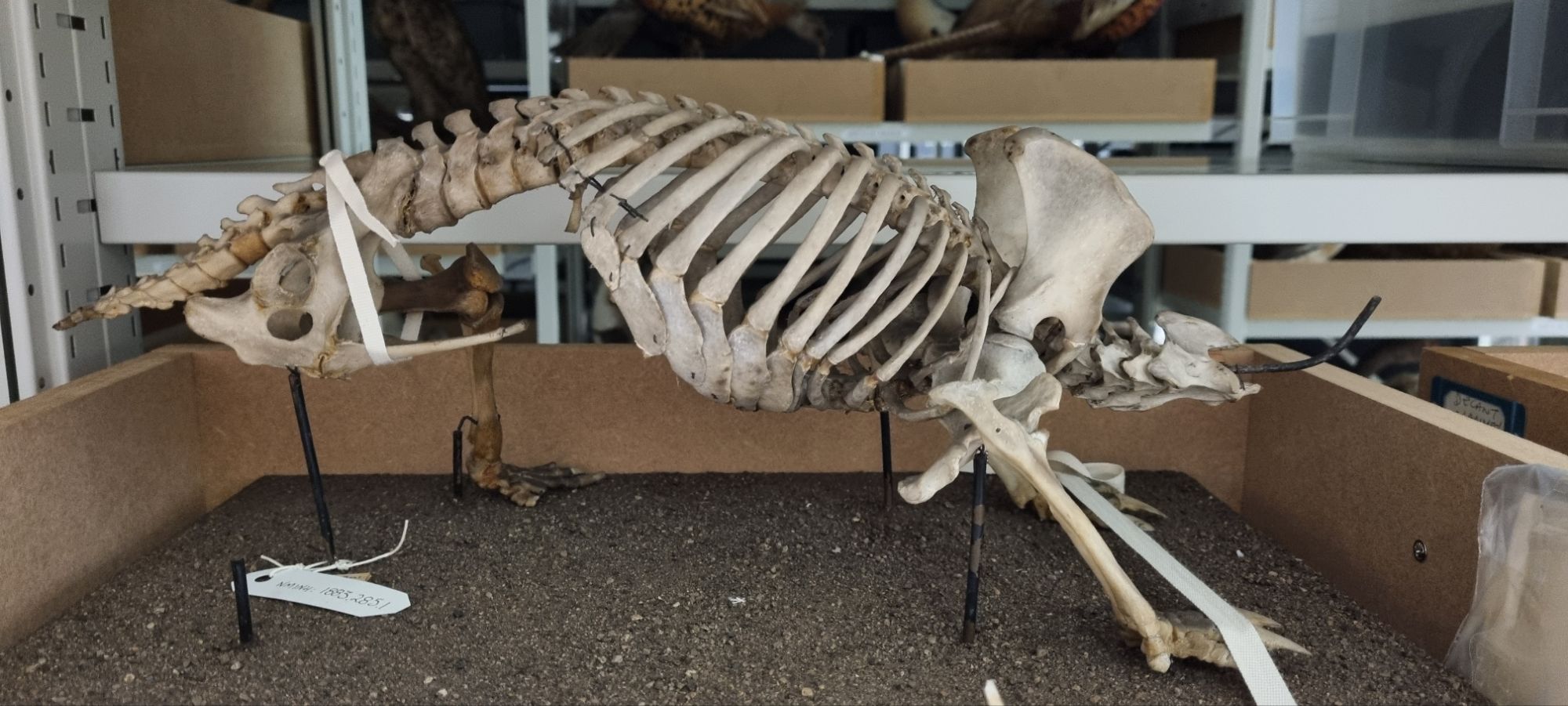
Last week I gave you this skeleton from the stores of the Dead Zoo to have a go at identifying:

The comments came flooding in, with some slightly off and some very much on target.

The robust skeleton and stocky build of this animal, combined with some interesting bony processes – especially in the pelvic region – offered up some pretty good indicators of the type of critter we’re looking at.

The forward-facing processes of the pelvis were initially mistaken for a baculum, but on a closer look their dual nature becomes more apparent:

These are epipubic bones, which aren’t found in Placental mammals – but this is definitely a mammal – so this is either a Marsupial or Monotreme.

The lack of a skull makes it a little harder to immediately figure out what this might be, but the feet are useful – very useful in fact:

These look like the feet of a digger with those big, robust, triangular claws – but not just a burrowing digger like a Wombat – more like an ant and termite specialist whocan break open their nests. That offers a key clue.

This is the skeleton of a species of spiny anteater – one of the four species of Echidna. The feet actually offer a further diagnostic clue to the species, since most species have five claws, while just one has three – the Three-toed or Western Long-beaked Echidna Zaglossus bruijnii (Peters & Doria, 1876).

This particular specimen was originally on display in the Dead Zoo under its old name Pro-echidna Bruijnii:

Photo of Three-toed Echidna skeleton NMINH:1883.285.1 at the National Museum of Ireland – Natural History taken by Illustratedjc, 2015.

The specimen has been taken off display along with everything else in the building over the last year or so, in preparation for a big refurbishment project.

When it was decanted, along with skull, the fragile right-hand-side rear limb was removed. In the photo above you can see where a claw is detaching – possibly as a result of incorrect foot positioning on the mount (Echidna feet point sideways and backwards, which seems to have confused some mounters). In other places, cotton tape was used to stabilise some of the more wobbly robust elements.

Being able to work through items like this while they’re in storage will be helpful, since it will allow us a chance to remove the worst of the dust from what may have been 140 years of display, and to make some small repairs to things like the detaching claw so it doesn’t get lost. Changing the foot position may be a bigger job, but it’s something to consider.

So while the Dead Zoo may be closed, we’re keeping busy checking the condition of the other 10,000 object we had on display, and working out what we need to do to put them back!

Friday mystery object #523 answer

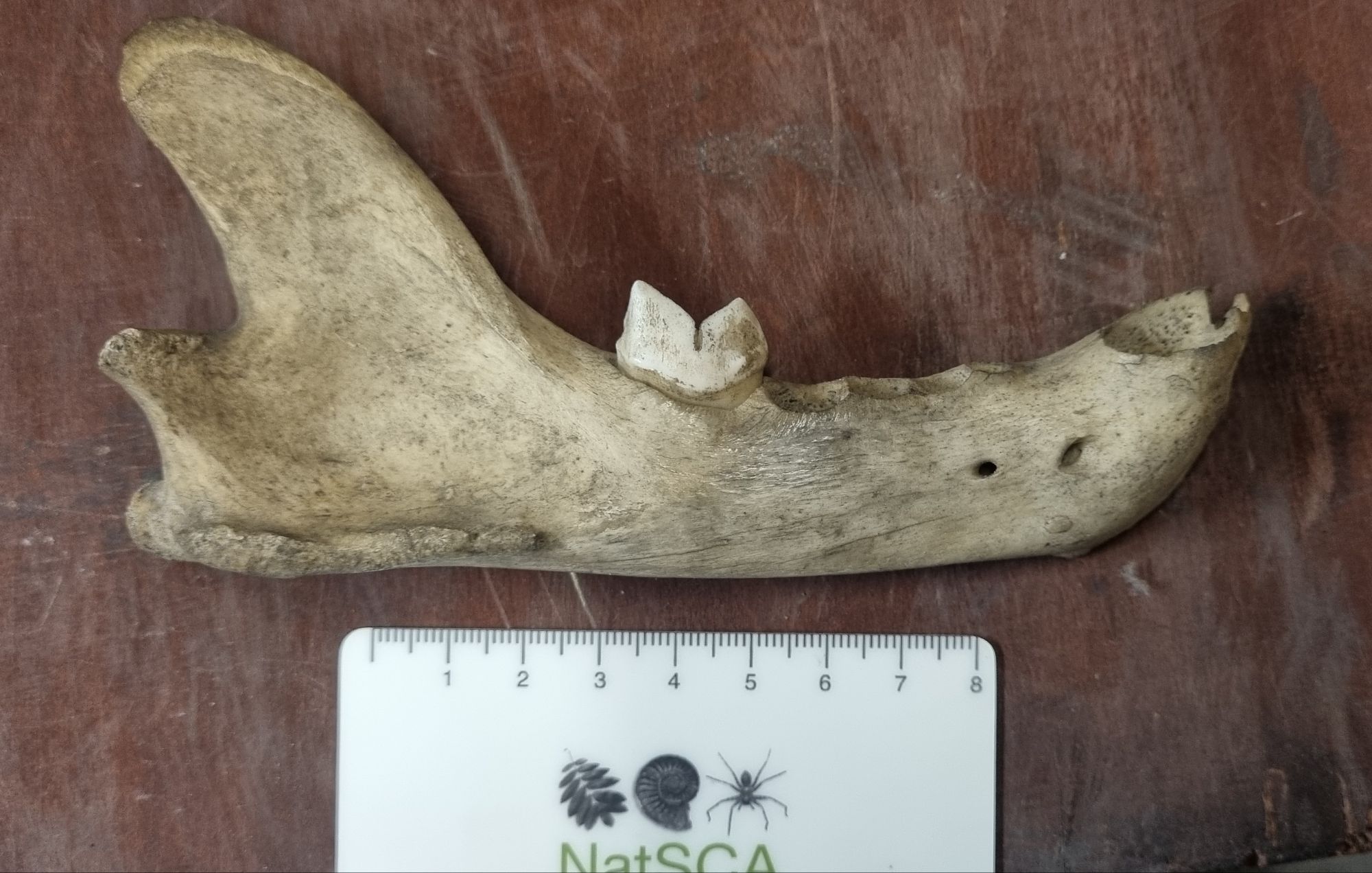
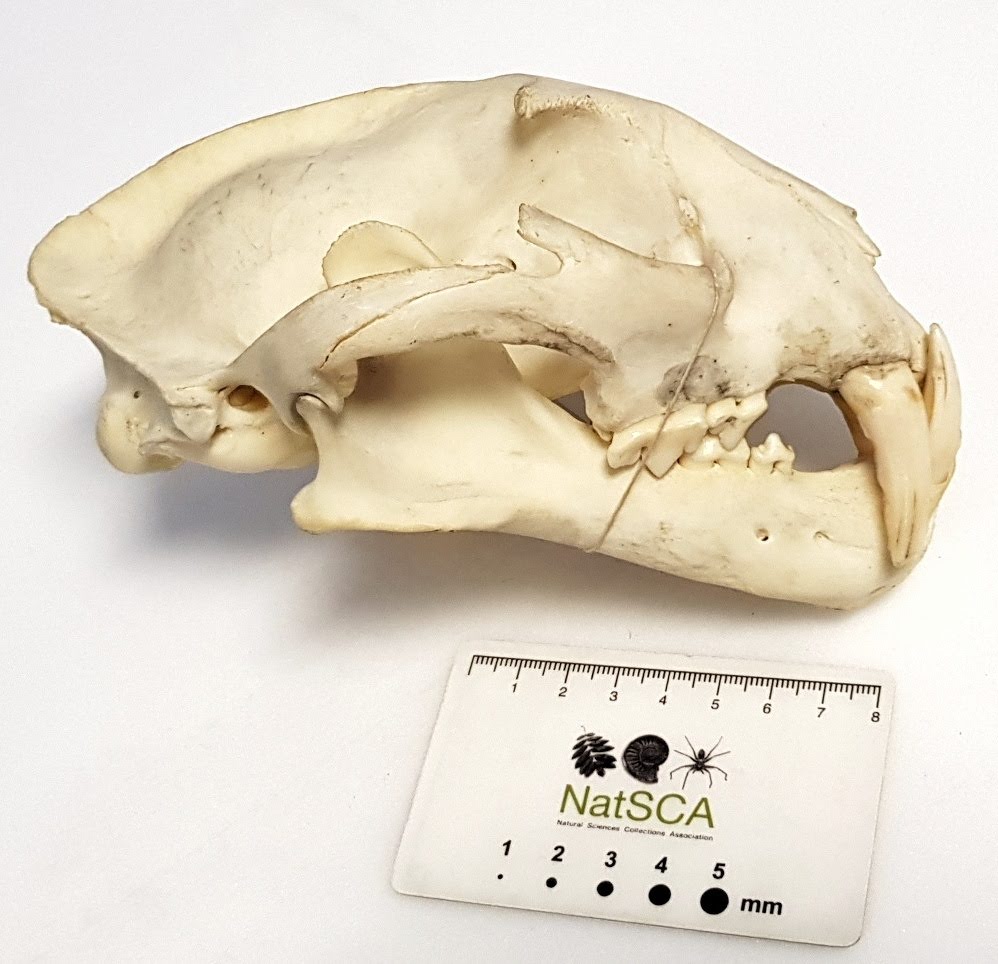
Last week I gave you this mystery mandible to help me identify:

It was found in a box of mixed shells and bony fragments, with no label, and nothing to offer a clue to its origin. This is very unusual, since these sorts of boxes of miscellany were mainly addressed years ago, but this one was well tucked away and somehow escaped being dealt with.

It’s fairly easy to recognise this as being the right mandible of some kind of cat. The Felidae have a reduced tooth count, with those hyper-carnivorous bladed premolars forming a meat-shearing carnassial row that’s very distinctive. So that’s the easy bit done.

The hard bit comes next, since the cats all share this same dental configuration, making the specific kitty in question a bit harder to narrow down. However, the size is a useful clue. This is much too big to be something like a Domestic Cat, Serval or Ocelot, but it’s also too small to be one of the big Big Cats – like the Lion or Tiger:

Tiger skulls facing off – the scale of these skulls is much greater than the mystery mandible

This leaves some of the medium-large Big Cats and perhaps a very large Small Cat (i.e. the Cheetah). Let’s start by ruling out that last one – the size is still a bit on the big side, but also the Cheetah has a more gracile coronoid process that curves, and a relatively shorter toothrow. Pumas also have a more rounded coronoid process.

The Jaguar also has a more rounded coronoid process, and has a more robust mandible, that’s just built thicker to deal with the high bite forces these cats generate:

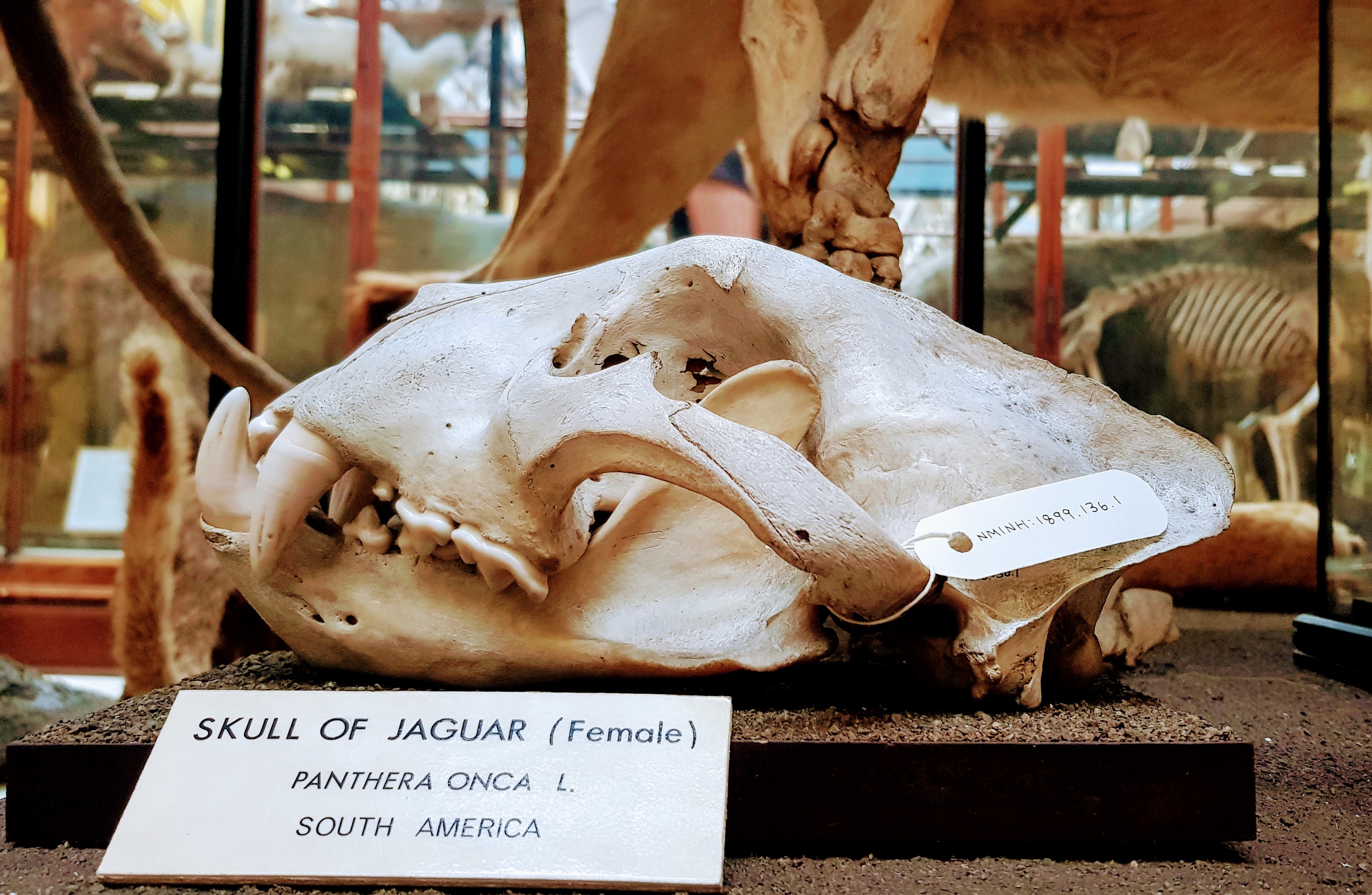
That leaves us with the Snow Leopard and the not-snow-Leopard, both of which have the more pointed coroid process that we see in the mystery object. However, the Snow Leopard has downwards inflected angular process, that’sI suspect may relate to the increased gape needed to use the excessively long canine teeth in this species:

The answer to last week's mystery mandible
Snow Leopard skull, showing the hypertrophied canines normal in this species.

So, by a process of elimination, we’re left with Leopard Pathera pardus (Linneaus, 1758). This species varies significantly in size and the morphology can be quite variable, since the species has a wide distribution, from Eastern Russia to as far West as Senegal.

This actually reminds me of a very similar mystery object from the Grant Museum of Zoology that I shared 10 years ago, so I’ hope that provided something useful for reference so I’m glad I trawled through some of my past posts to help solve this one. My thanks to everyone who offered their thoughts on this one – it’s great to see so many of you come to the same conclusion!

Friday mystery object #522 answer

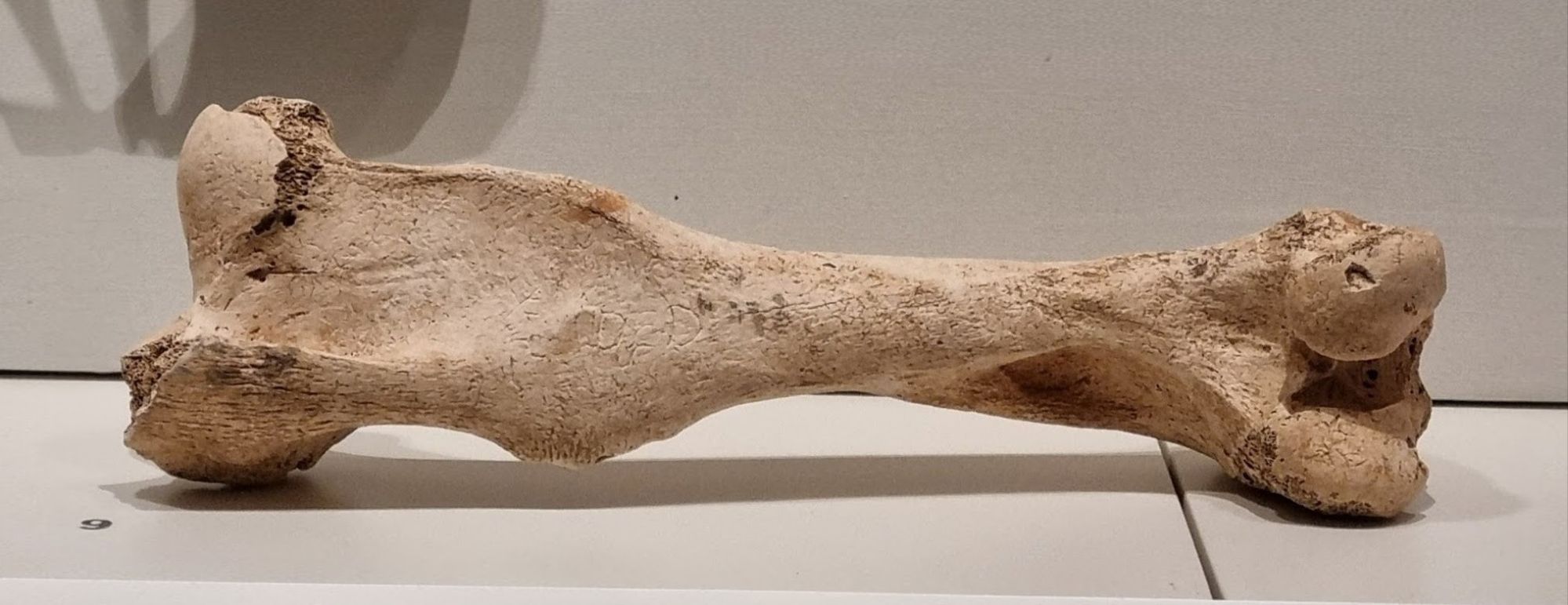
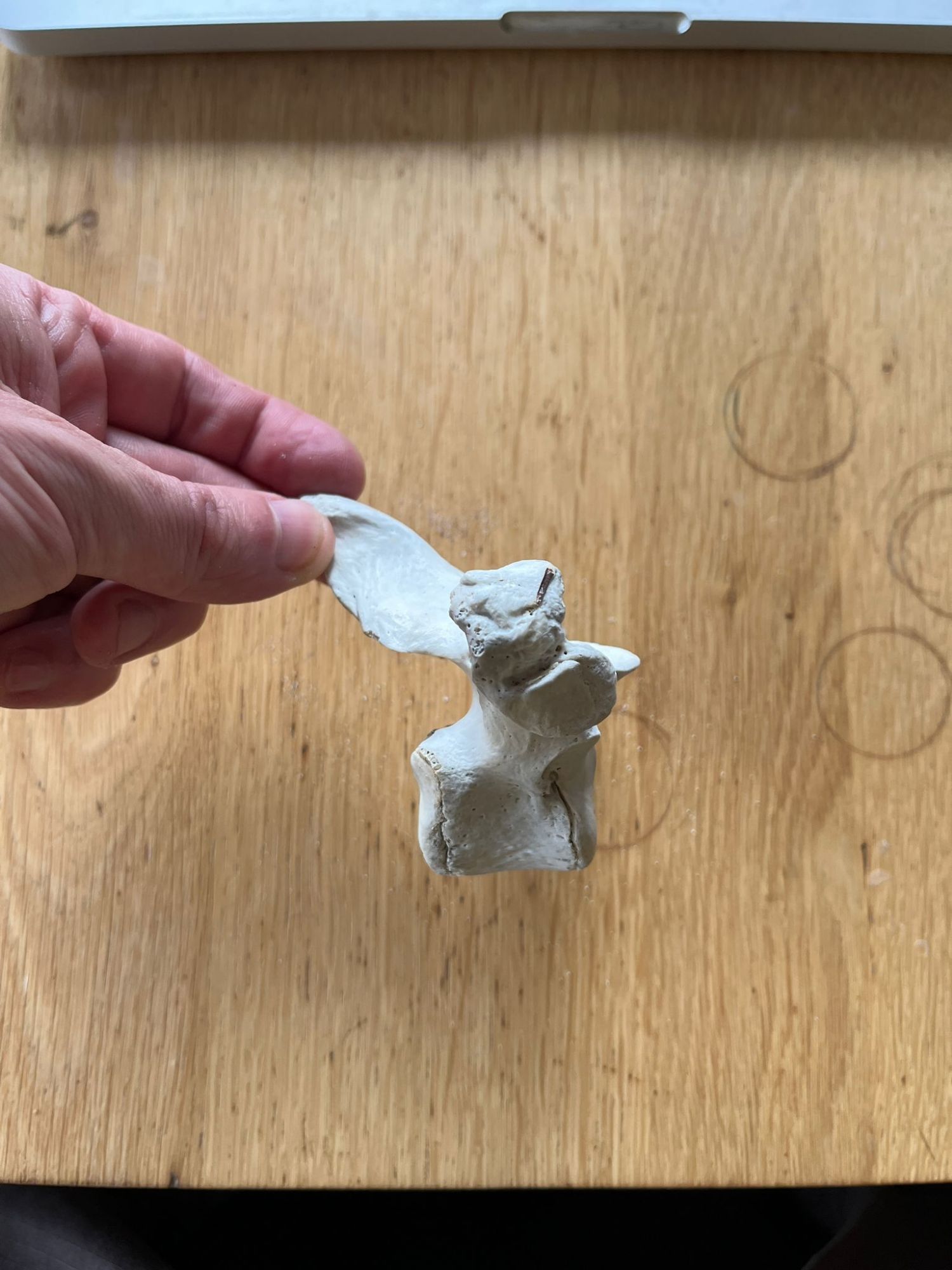
Last week I presented this mystery bone from the Words on the Wave exhibition at the National Museum of Ireland on Kildare Street:

The bone is over a thousand years old, so it’s unsurprising that a few of the processes that could be useful for identification have been worn down a little:

That said, there was plenty of information remaining to allow several of you to identify the animal, bone type and side of the animal this is from. Adam Yates was first to the comments and he also left a very helpful Toot on Mastodon, detailing the diagnostic features:

@mike @PaoloViscardi 
The prominent third trochanter and really well-developed supracondylar fossa on the lateral caudal surface at the distal end of the shaft should get you there. You won't have to look beyond  familiar farmyard beasts to find it.

For me, the supracondylar fossa on the lateral caudal surface is the instant give-away. For those who don’t speak anatomese, that’s the bit that flares out from the side of the shaft of the bone (which is actually missing a bit in this example).

This is a feature I always associate with the Perissodactyla (the tapirs, rhinos and horses), and this one is nowhere near robust enough for anything other than one of the horses. It’s also fairly small (although the lack of a scale bar doesn’t make this obvious).

This a left femur that I suspect is from a Horse Equus ferus caballus Linnaeus, 1758, but it could also be from a Donkey Equus africanus asinus Linnaeus, 1758. It can be tricky to tell these species apart, especially when the bone is a little worn down and you only have a few photos to work from – so best to err on the side of caution and leave it at an identification of Equus sp.

If you’re in Ireland and wanted to take a look at this object – and a selection of remarkable mediaeval manuscripts from the Abbey of St Gall, Switzerland, some of which are returning to Ireland for the first time in 1000 years – you have until the 24th of this month, I’d definitely recommend it!

Friday mystery object #521 answer

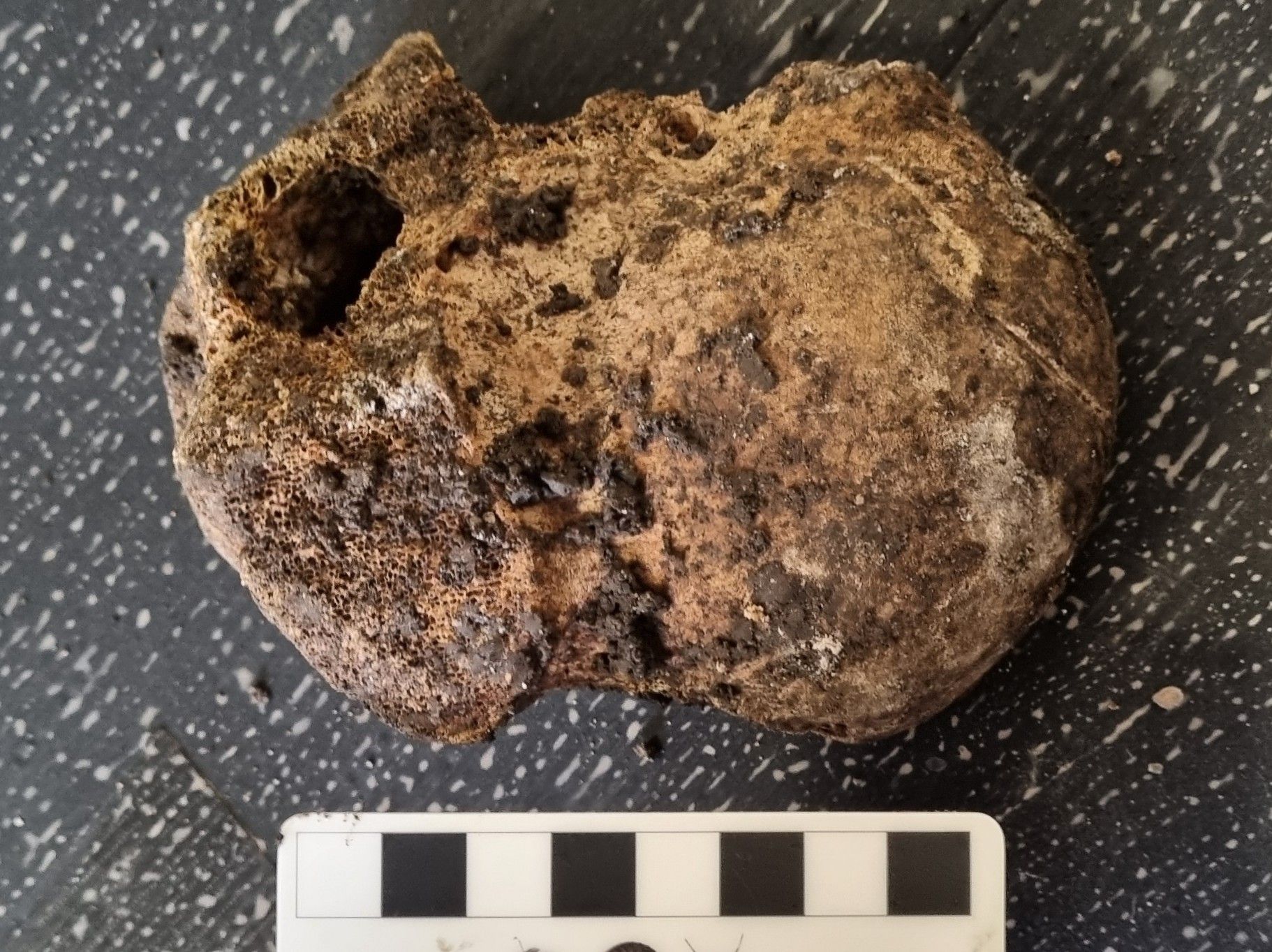
Last week I had a genuine mystery object for you to identify that was freshly dug out of the ground:

While there were a few suggestions of baked goods on social media, plenty of you spotted what it actually is – with a nod to Adam Yates who was first with the correct identification.

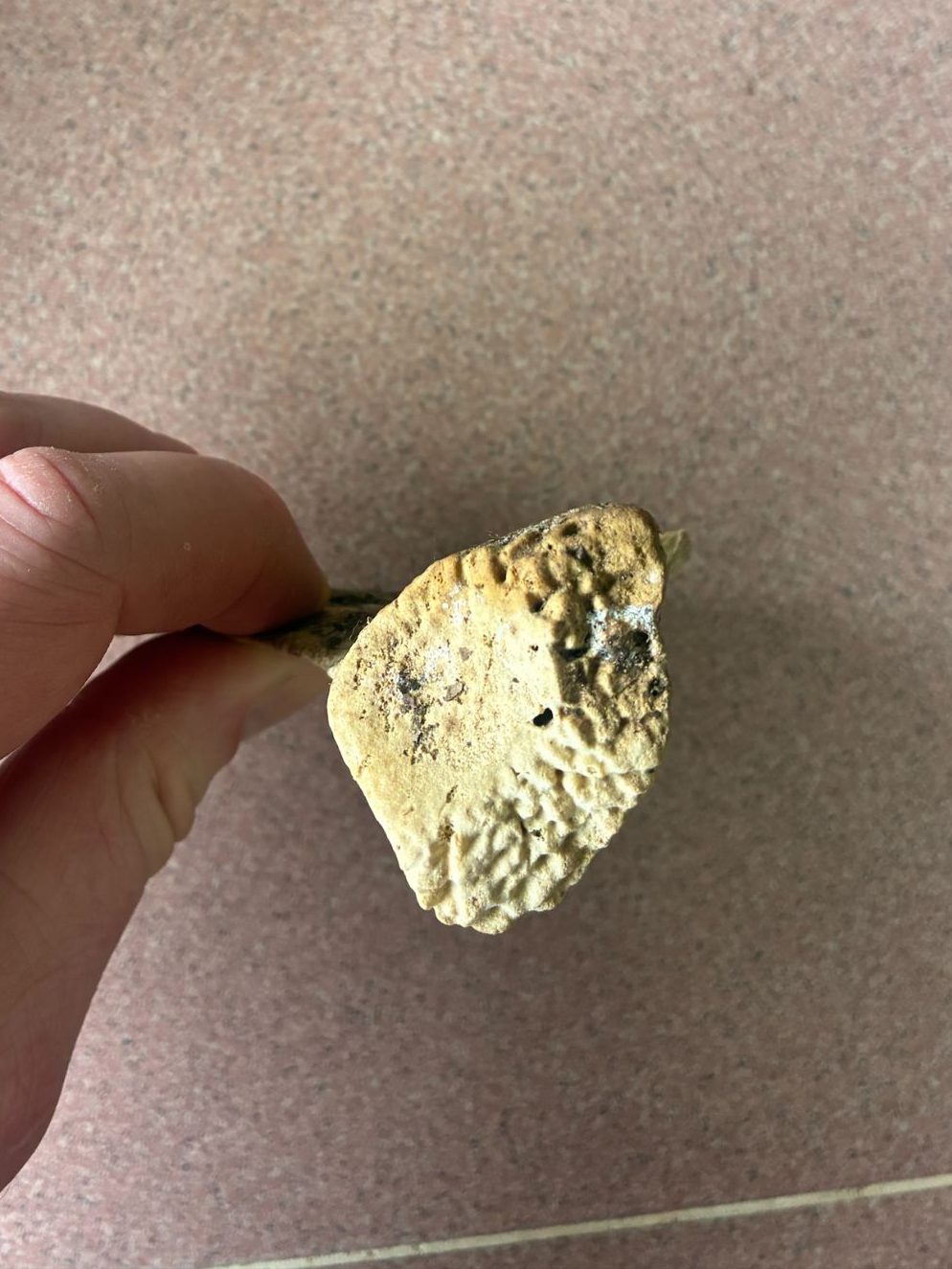
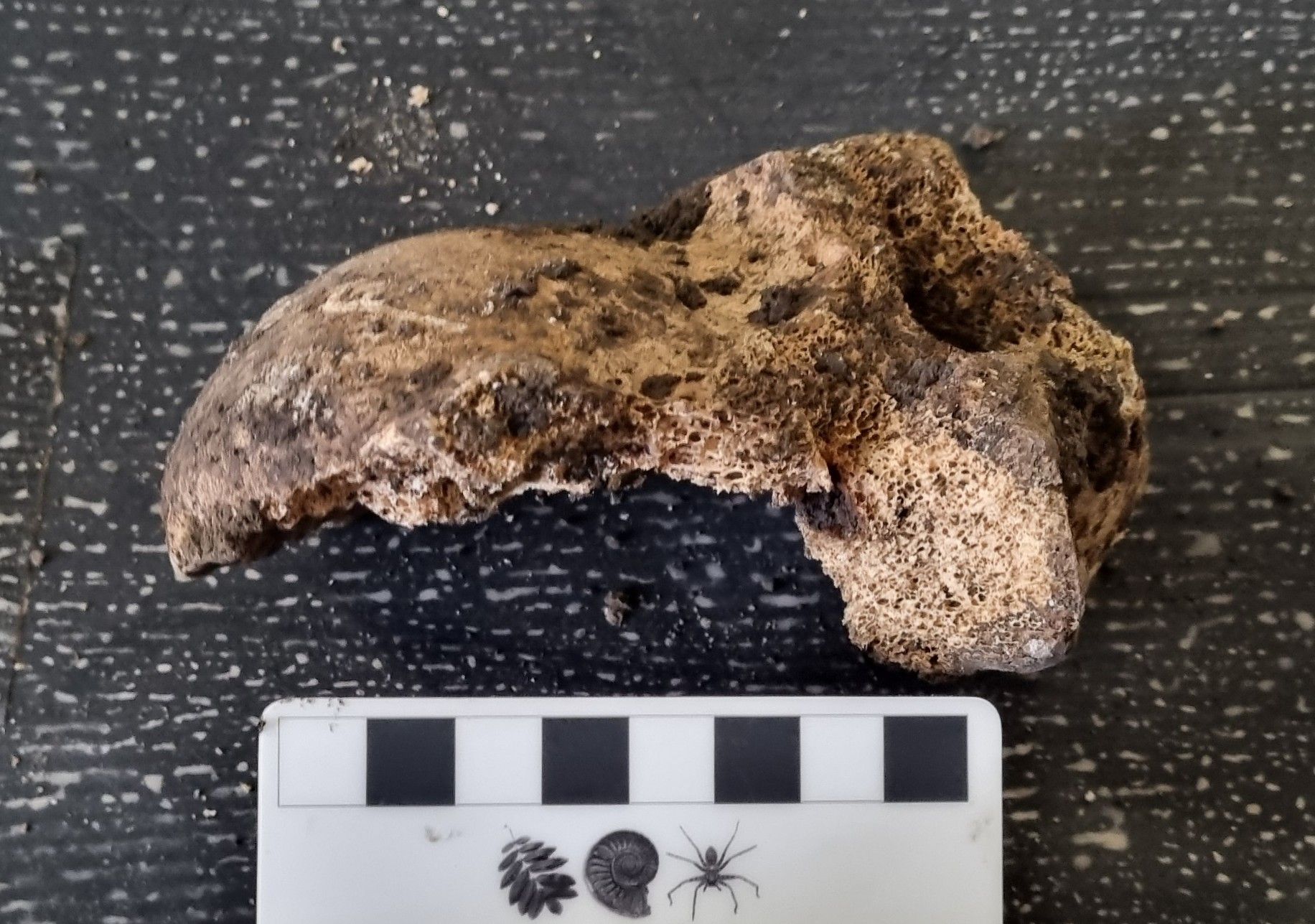
The side view is probably the most useful for setting context, as it shows the smooth curve of the head of an articular surface, with an adjacent tuberosity (or sticky-up-bit, if you prefer):

This is what you expect to see at the proximal end of a humerus (that’s bit that works with the shoulder). It’s pretty big – the scale bar is 8cm and the head of this humerus is a good bit wider across, so that also tells us something.

Another key observation comes from the underside of the humerus head:

You can just make out a rugose pattern on the underside of this piece of bone, which tells us that this is an unfused epiphysis that has become detached from the rest of the humerus. That means the animal that this piece of bone came from was young enough to still be growing, as the bones hadn’t fused.

All of that information leads us to the conclusion that the animal this piece of humerus came from was large, but still young. For me, that says that this humerus is from a Cow Bos taurus Linnaeus, 1758.

I suspect this mystery object represents the remains of a Victorian meal, based on where it was found – just under the floor of the Dead Zoo. It came to light during the investigation works on the building, which are currently underway. The building work started in 1856, so that gives us a good idea of when this beef shoulder was probably eaten.

Friday mystery object #519 answer

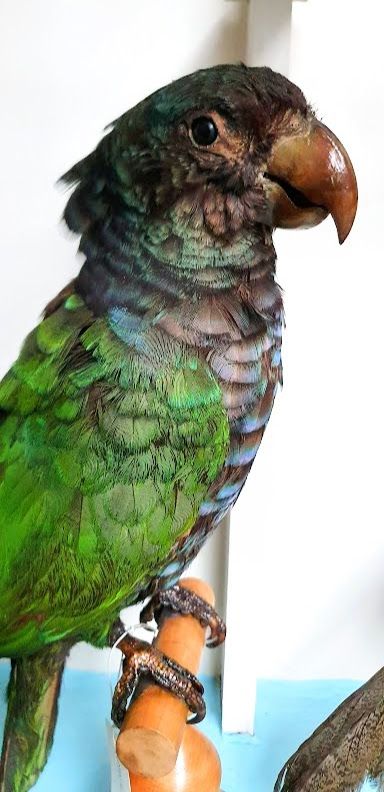
Last week I gave you a bit of tricky mystery object in the form of this colourful character:

Obviously it’s a parrot of some sort, but there are LOTS of parrots. With over 400 species to choose from, identifying one from a single image is not easy at all. Generally when it comes to parrot identification it’s very useful to know where it came from, and without that information this mystery is made even harder – but if I’d provided the locality it would have been way too easy!

I find a useful way to narrow down possible species when looking at parrots is to simply use a search engine and add descriptive terms of the colours of parts of the external anatomy. In this instance I searched for “parrot with emerald green wings, blue and purple chest” which offered up a few possible species, but it significantly narrowed down the options to work through. Of course, I did that with some awareness of colours likely being a little off.

This is a specimen that arrived in the Dead Zoo in 1902 and it’s been progressively fading due to light exposure over the last 120+ years. The purples here are muted and I suspect the blue visible on the breast is actually residual following preferential colour loss of red pigments (types of carotenoid) that would have interacted with the structural blue colour of the feather (structural colours being much more light-stable than pigments) to create a much more vivid and robust purple colour than we see today. With that in mind, it becomes much easier to work out what this species is.

This is the Dominican Amazon (or Imperial Amazon, or Sisserou) Amazona imperialis Richmond, 1899 – one of just three species of parrot from the Commonwealth of Dominica, an Island in the Carribean. Here’s an illustration of what it looks like when it’s not faded:

This species features on the flag of the Commonwealth of Dominica and sadly there are very few of these stunning birds remaining, with estimated numbers somewhere between 40 and 60 mature individuals – making it Critically Endangered.

While numbers had been declining due to habitat loss, hunting and the taking of wild birds for the pet trade, the population has been significantly impacted by severe hurricanes hitting the island – which are increasing in frequency and severity due to climate change.

Hopefully, conservation efforts and the relatively inaccessible mountaious areas of the island in which the birds live will allow them a chance to recover, but they breed slowly and the threat from hurricanes remains.

Well done to everyone who had a go at this – it really was very difficult, so props to Katenockles who came close with a suggestion of the Blue-headed Parrot. Of course, there were lots of comments that referenced the infamous Norwegian Blue, which for younger readers might be unfamiliar, so here’s the source:

Just to note, while there are no parrots known from Norway, there are some fossil examples known from Denmark – so perhaps there is a chance the Norwegian Blue actually existed – albeit 55 million years ago,

Friday mystery object #517

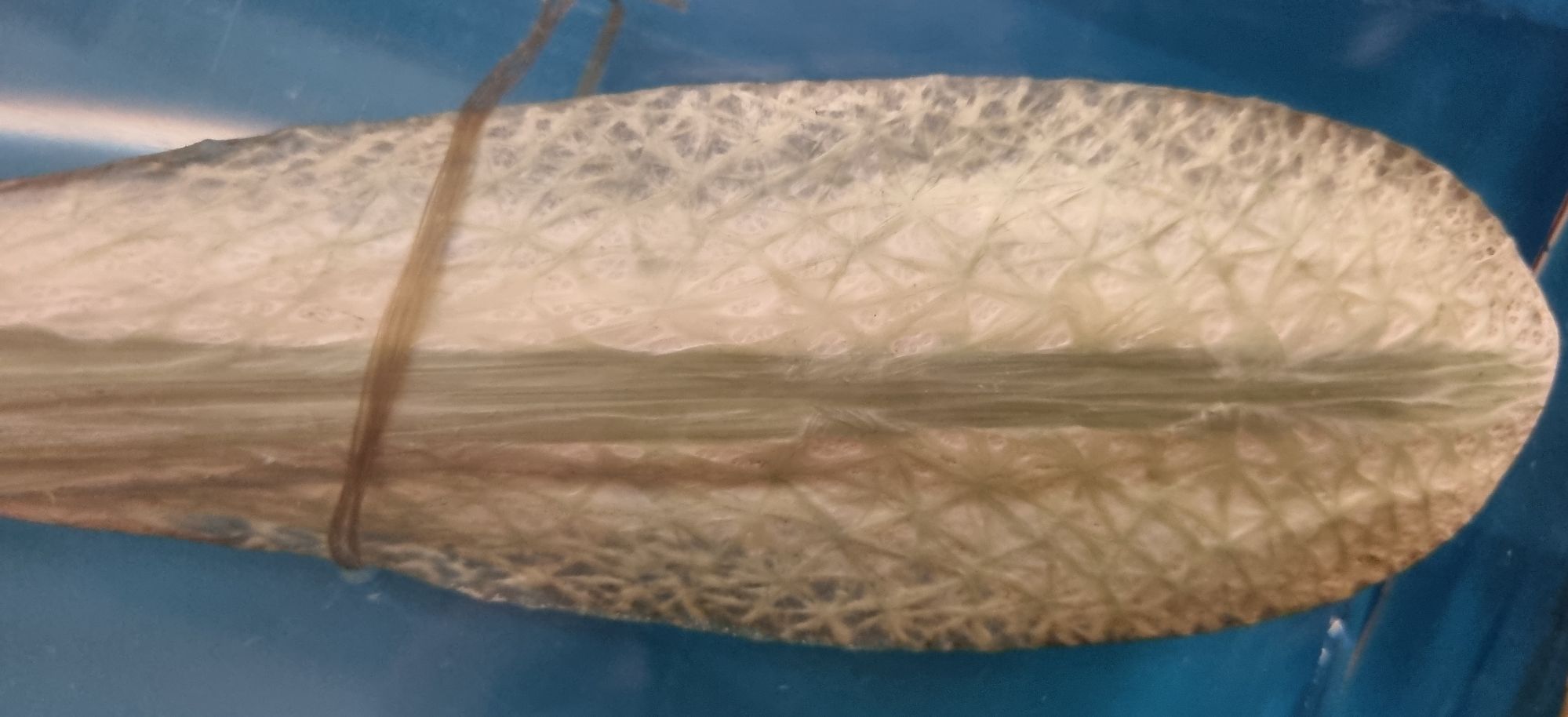
The last mystery object was a close-up detail of a specimen, and it proved tricky, but not impossible to identify. I thought I might try another close-up of a specimen, to see if it might yield a similarly balanced challenge for this week:

I feel like this has enough information to make an identification, but hopefully it’s not too easy.

Let me know what you think it could be in the comments box below – I hope it proves a fun challenge!

Friday mystery object #513

This week I have another guest mystery object for you, found on a beach by the family of one of my museum colleagues:

Image by Andrew Brady, May 2025

Let me know your thoughts about the species, where in the body this particular bone came from, and any other deductions you might have about the animal? I look forward to seeing if you agree with my thoughts!

Friday mystery object #500 answer

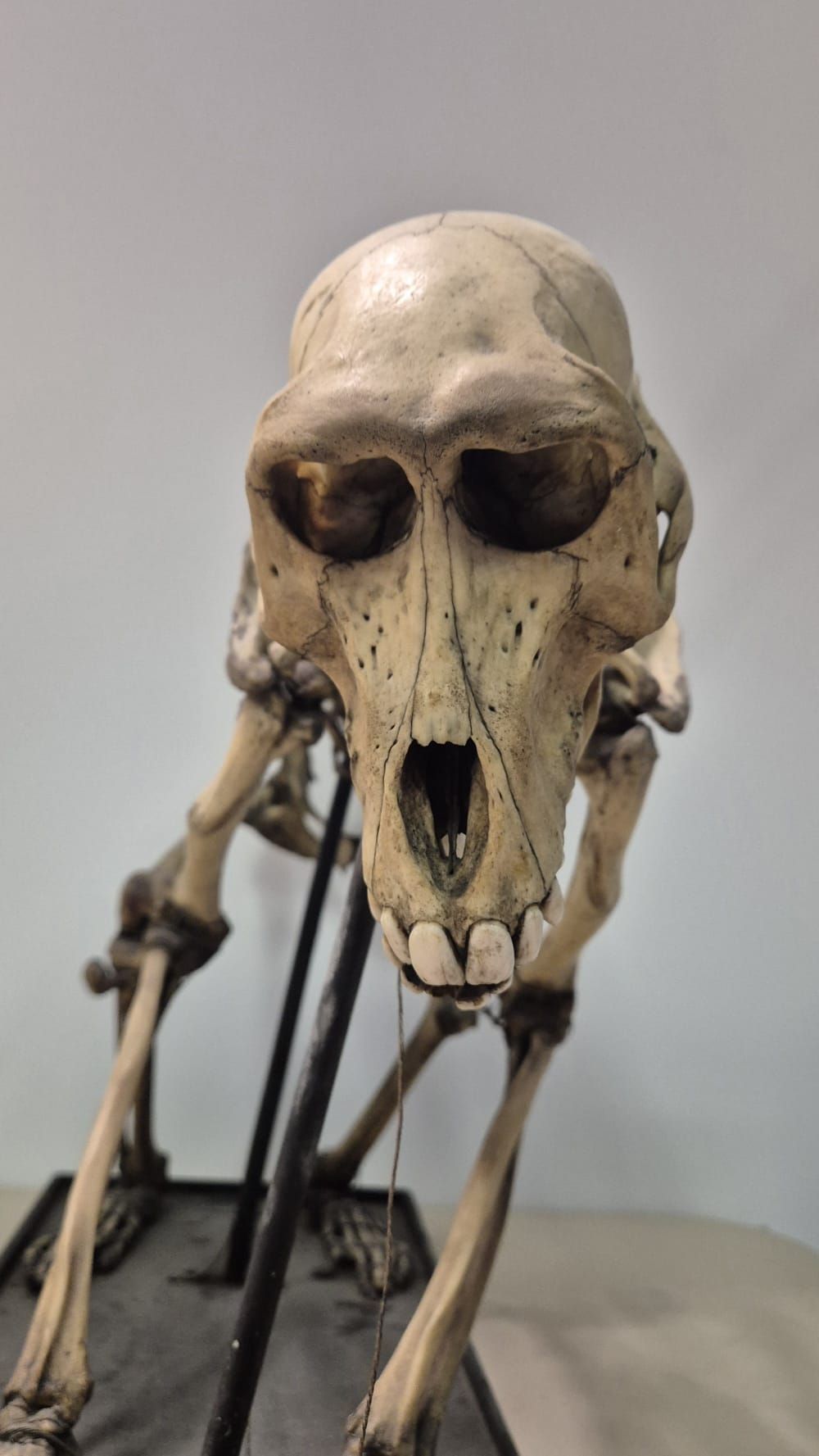
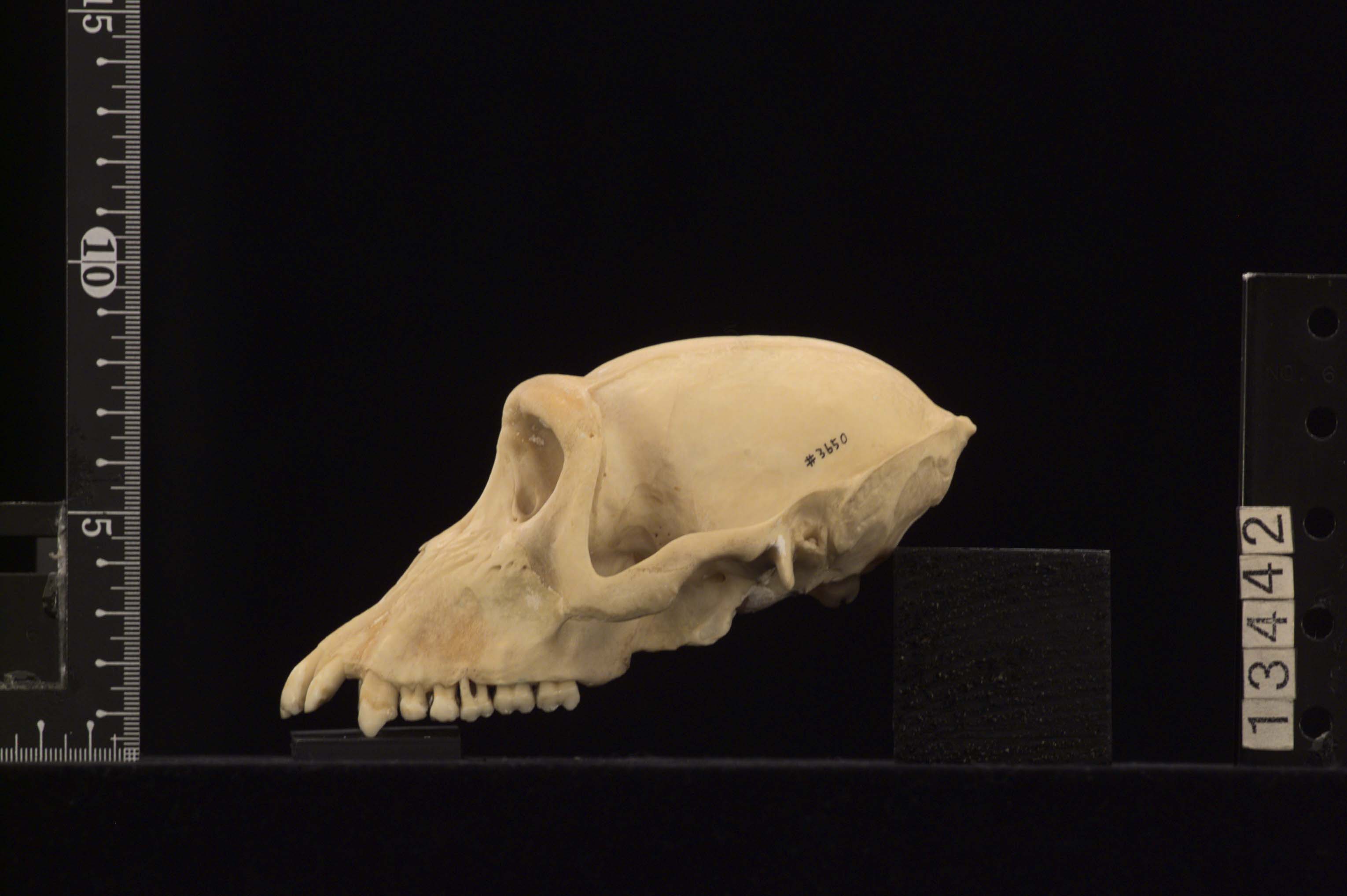
Last week I hit the 500th mystery object milestone, with this skeleton from the collections of the Dead Zoo to identify:

This specimen came to us from the Royal College of Surgeons of Ireland, and Emma Murphy, our curator responsible for the terrestrial zoology collections has been checking the identification. At the moment this is listed as being a “Baboon”, but there are 5 (maybe 6) species of baboon – so which could it be?

Just to complicate matters, Emma suspects that this may be a specimen referred to in an 1834 catalogue as a “pig-tailed baboon”, which may be where the “Baboon” listing came from. That’s not a recognised species anymore, they’re now called Southern Pig-tailed Macaques – or Northern Pig-tailed Macaques, since the Pig-tailed Macaques were split a decade or so ago.

Looking at the anatomy is always a good place to help work these issues out, but that requires comparative material – which is never as easy to find as you might like. However, there are some useful resources out there. A particularly good one is the Mammalian Crania Photographic Archive, and there are other useful sites like Skullbase and the Animal Diversity Web.

Looking through these various resources it becomes a bit easier to start picking out features to assist with identification, but it takes a bit of work and close scrutiny of a lot of different individuals within each species, to get a better idea of variation.

In profile the mystery specimen has relatively small canines and no sagittal crest, which suggests it’s a female. The face (or rostrum) is quite long, which rules out a lot of Macaque species, especially since the females tend to have shorter faces than males, and the females only develop the longer face when they are fully mature.

However, the baboons all have very long faces (even the females), so this specimen seems a little short for some of them. The Chacma Baboon is the closest I could find in proportion, but when viewed from above, the mystery specimen doesn’t seem to have the extremely well-defined cheek ridges that stand out in all baboon skulls (here’s a link to an example from the Animal Diversity Web).

Good cheekbones, but not the razor-ridges seen in baboons

After considerable comparison, the skull of the mystery specimen looks most similar to the skull of a Southern Pig-tailed Macaque featured on the Mammalian Crania Photographic Archive, although I feel that I want to look a little more closely at the confiuration of the nasal bones in relation to the frontals before making a final call, since photographs can sometimes be misleading.

My thanks to everyone for your suggestions – there were plenty that all fell in the same general area of the monkey family tree, with baboons and macaques all being suggested. Your thoughts helped me narrow down a list of likely candidates and on balance I suspect this is most likely the Southern (or possibly Northern) Pig-tailed Macaque specimen that Emma found the old entry for in the catalogue. It would probably have been much easier to figure out if the tail had survived intact!

Hopefully I’ll see you here next week for mystery object #501!

Friday mystery object #498 answer

Last week I gave you this somewhat challenging bird to have a go at identifying:

The challenging part was not simply due to this being one of the wading birds (a group within the Order Charadriiformes), which can be quite hard to identify for the uninitiated, but it’s also a species that is quite unfamiliar. This is because one hasn’t been seen since 2006 (and possibly much longer ago than that).

A similar looking relative of this bird is the Whimbrel, which is a species that several people suggested. However, as Adam Yates spotted, the Whimbrel has a strong dark bar in front of the eye running from the base of the bill, whereas this specimen has a weak stripe behind the eye, that doesn’t connect up to the bill.

This bird is a Northern, or Eskimo, Curlew Numenius borealis (Forster, 1772), as correctly spotted by Sallie Reynolds. The species is considered likely to be extinct, with the last confirmed sighting in 1963.

The species used to be numerous across their range, migrating from their breeding grounds in the Arctic, all the way down the length of America to Argentina for the summer. It seems likely that this particular specimen was blown off course, since it ended up in Ireland.

Well done to Sallie, Adam and everyone who figured out the mystery!

Friday mystery object #495 answer

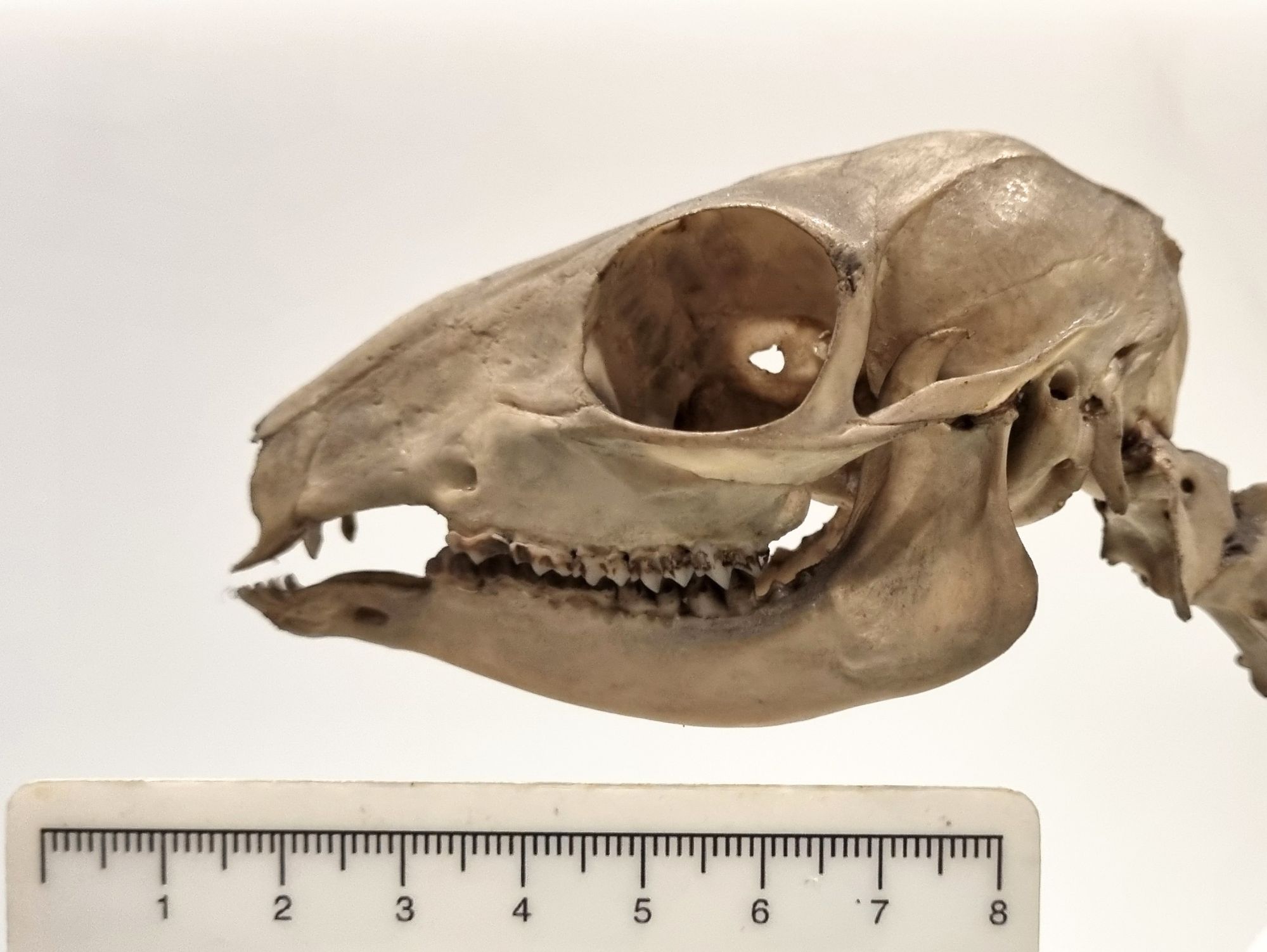
Last week I gave you this cute little skull to identify:

This is an object I selected when I was recovering from Covid, so I picked it thinking that I knew what it said on the label and so it would be an easy one to write up an answer for. Of course, the Universe being the way it is, I came to write this answer and realised that I actually took note of the wrong label.

My brain is clearly still not fully recovered from being ill, so now comes the complicated bit where I have to work out what it is, with no more information than I gave you, since I’m writing this answer at home and I don’t have access to either the specimen or our database.

Fortunately a lot of that work has already been done by the wonderful regular visitors to Zygoma (thanks folks!)

This is one of the diminutive Artiodactyls. It has neither horns nor antlers (although the specimen is female, so those might not be present even if the males of the species had them). It lacks scars from scent glands, so it’s not a Dik-dik or other tiny antelope. However, it does have small but prominent canines, which offer a clue. As Chris Jarvis suggested, this is the skull of a Mouse-deer, in the family Tragulidae.

There are three possible Genera in the family, but a quick check against specimens from the Genus Hyemoschus show some clear differences – both in general proportions of rostrum (snouty bit), the number of foramina in the front part of the mandible (Hyemoschus normally have two, but our mystery specimen has just one).

There are also differences in comparison with specimens in the Genus Moschiola – which seem to more usually have two foramina in the maxilla and a somwhat open suture at the junction between the bones of the maxilla, frontal and nasal bones.

That leaves the Genus Tragulus, which the mystery skull fits with very well.

It all gets a bit more complicated from there. In terms of size, I think we can rule out the Greater Mouse-deer since the mystery skull is about 2cm shorter that an example of the Greater Mouse-deer that I featured on the blog about 12 years ago (where doe the time go?):

This size difference is not a perfect characteristic to use, since the skull length can overlap between the species, but the mystery specimen has all the indicators of being a mature adult and it would still be at the absolute smallest end of the spectrum for the Greater Mouse-deer.

Distinguishing between the other possible species is more problematic, since there can be quite a lot of regional variation within the remaining species. From looking at examples of skulls online I’m leaning towards the Lesser Mouse-deer rather than the Java, Philippine, Vietnam or Williamson’s Mouse-deer, but that’s based on the structre of the zygomatric arch and general proportions rather than any clearly distinctive features.

In this instance I can at least check my hunch tomorrow on our museum database, to see if my hunch plays out – I’ll update this answer with the result as soon as I have a chance!

[Update: I’ve had a chance to check and my hunch was off – it’s listed as Java Mouse-deer Tragulus javanicus (Osbeck, 1765), so it goes to show that you do need those clearly distinctive features to get a good identification! This is why it’s better to rule out what it can’t be based on the data available and be happy with having a few possibile options, rather than making a misidentiifcation]

Thanks to everyone who had a stab at the identification – I hope you enjoyed the challenge!

Friday mystery object #493 answer

Last week I gave you this skull to try your hand at identifying:

Adam Yates was straight in with the answer, but there were a few other suggestions that were close, but not quite on the nose.

One suggestion was Tursiops, which are the bottlenose dolphins. The length of the skull is about right, but the Common Bottlenose Dolphin has a relatively longer and narrower rostrum, as you can see by comparing the with the image below:

Skull of a Common Bottlenose Dolphin

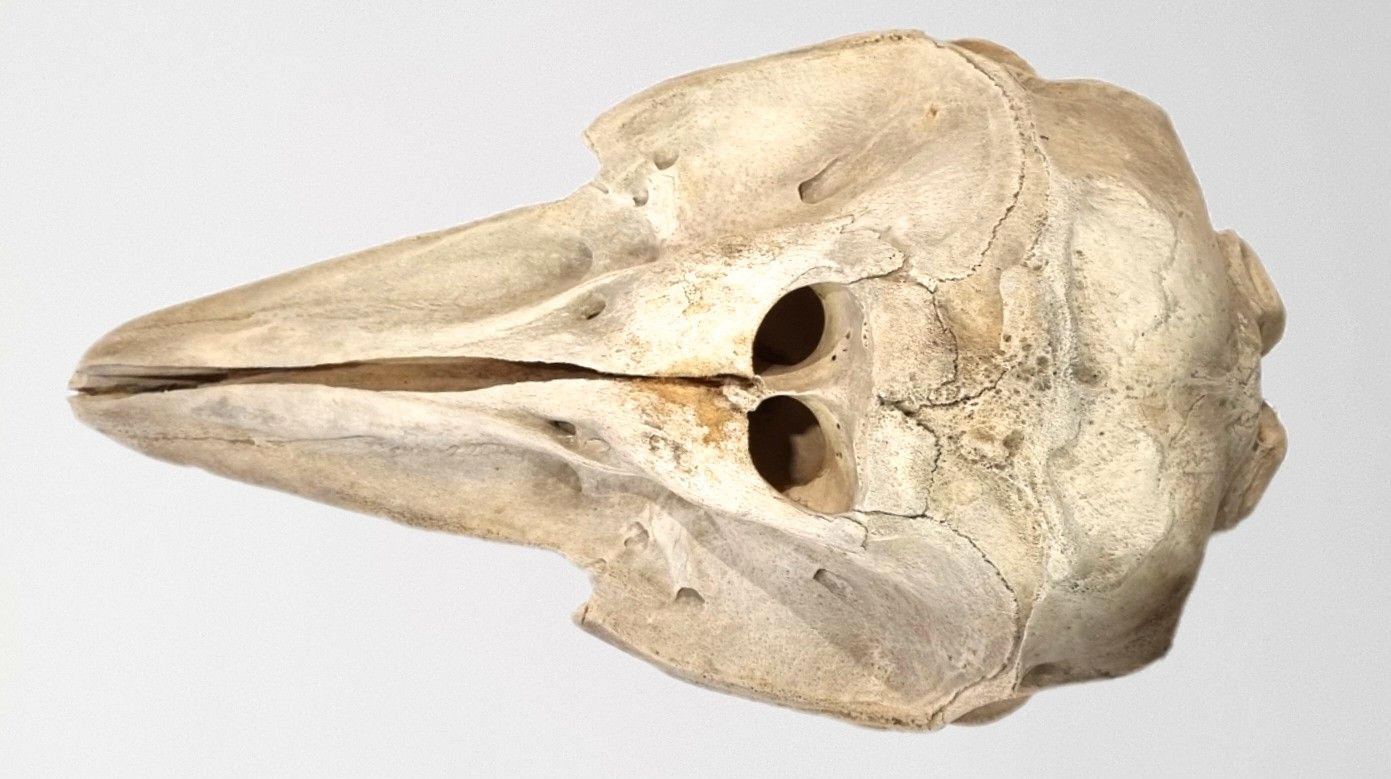
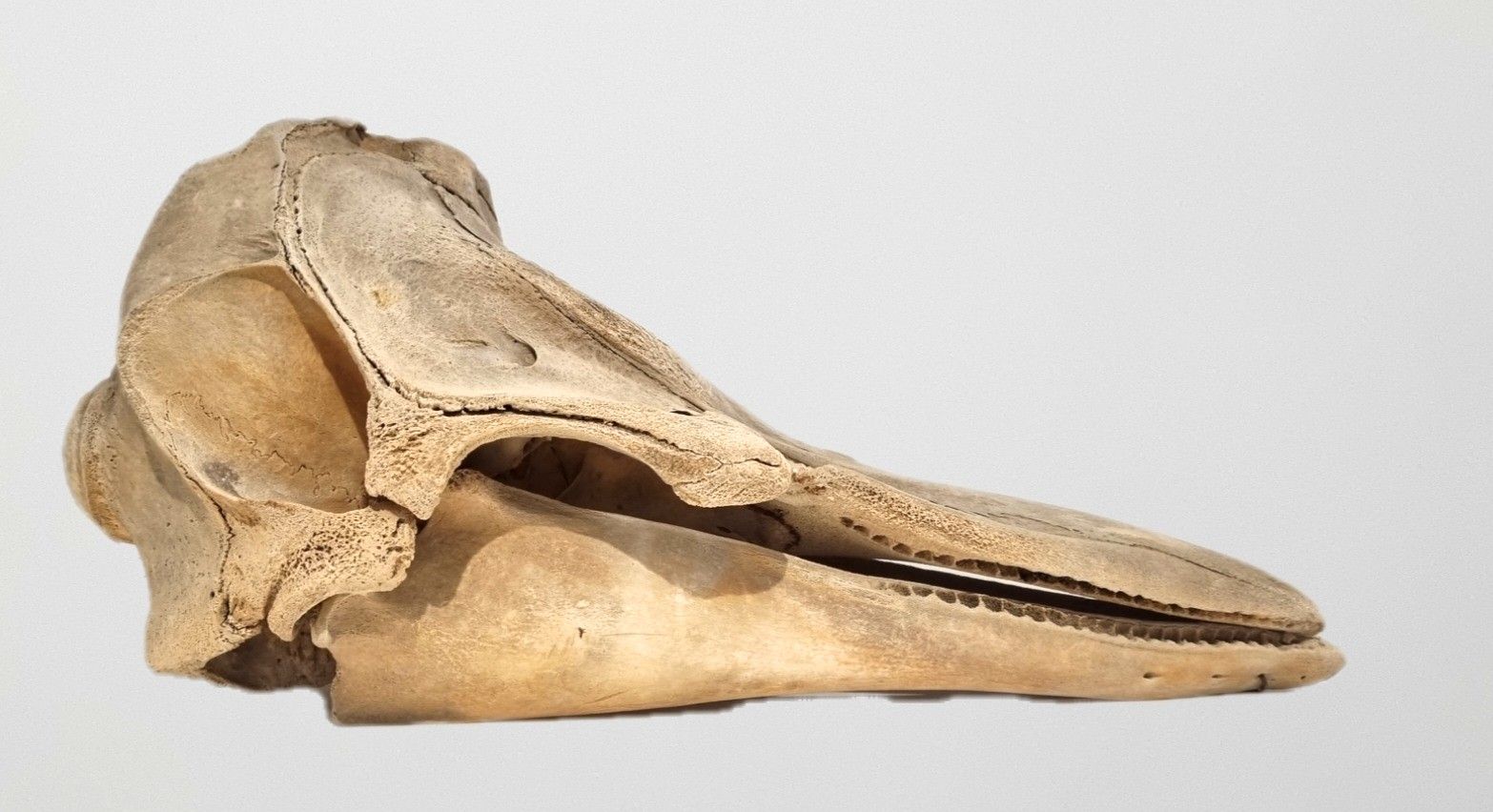
The shape of the mystery skull is perhaps a better match for Risso’s Dolphin, except the rostrum is a bit longer and the premaxilla is narrower than the maxilla in the mystery object when viewed from above, but in the Risso’s Dolphin the premaxilla is a good bit wider. Also, the mystery specimen has way too many teeth.

Another suggestion was Melon-headed Whale, which is a species that is very similar to the mystery specimen, except it has much deeper antorbital notches – those bits on the sides of the skull that stick out like the Millenium Falcon’s cockpit.

The mystery skull is in fact from a White-beaked Dolphin, Lagenorhynchus albirostris (Gray, 1846). This is a species that lives in cold North Atlantic waters, feeding on Cod and related fish. Well done to everyone who managed to work it out!

I’ve provided a few links through the blog to some online resources that might be useful for comparing images or descriptions of cetacean skulls. Here are a few more that might come in useful:
Seawatch Foundation factsheets
Museums Victoria collections database
National Museum of Nature and Science, Japan – Marine Mammal Infiormation Database

Friday mystery object #493

This week I have a nice skull for you to have a go at identifying:

This specimen is around 52cm long and it had an incorrect label attached, so it needed to be identified, to work out what its correct label should be. What do you think?

As always, you can leave your thoughts, questions and suggestions in the comments box below. I hope you enjoy the challenge!

Friday mystery object #490 answer

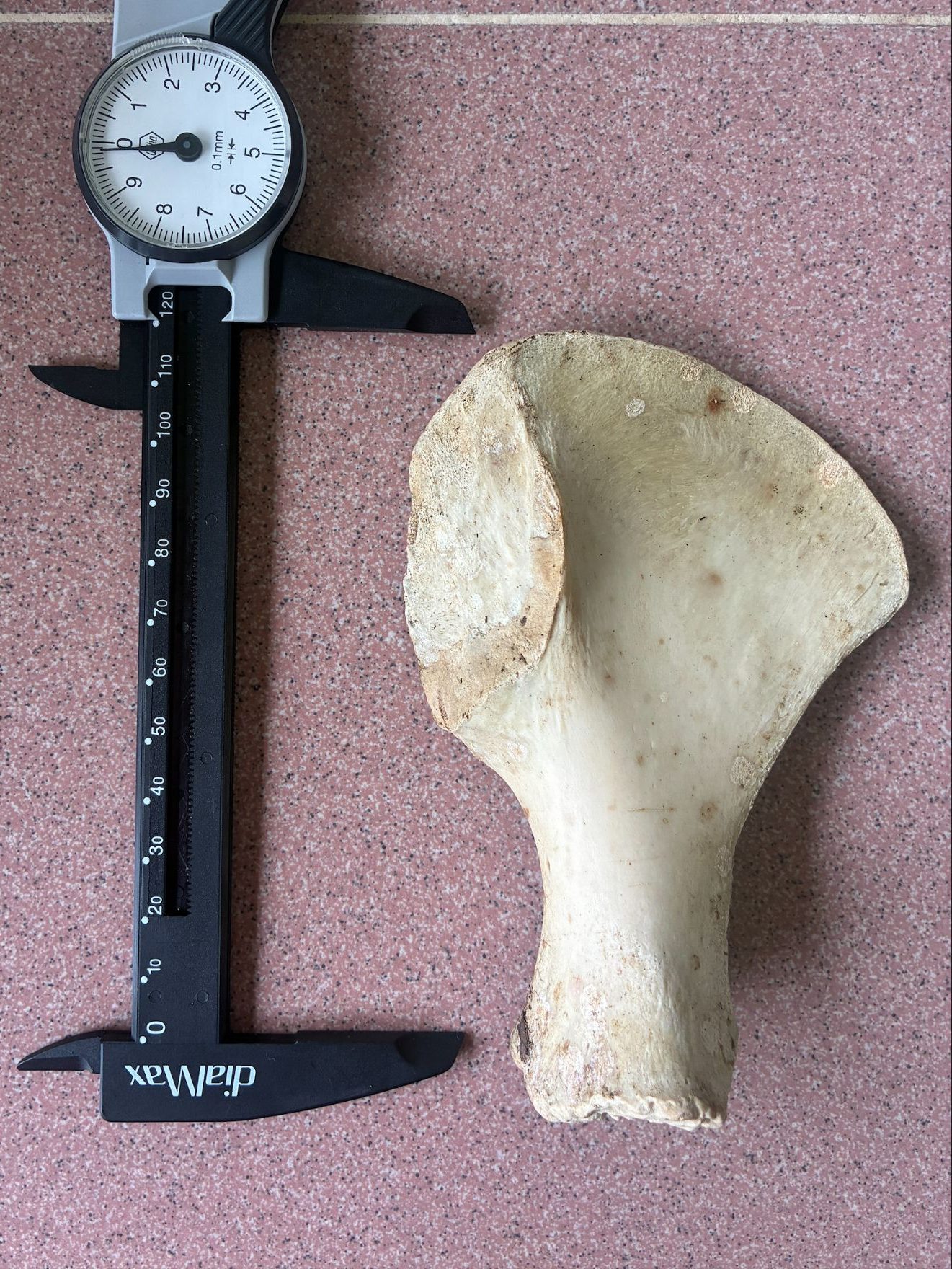
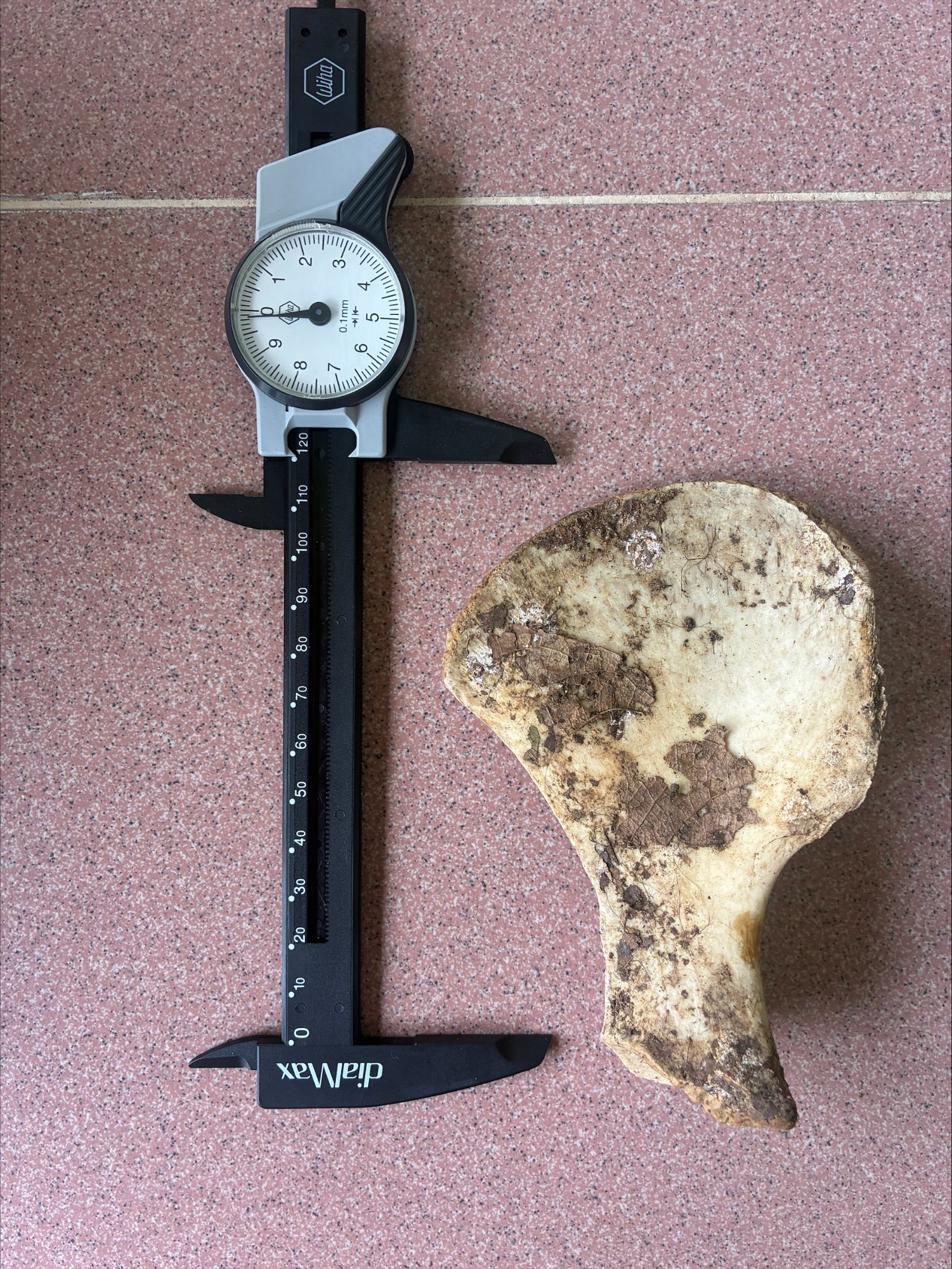
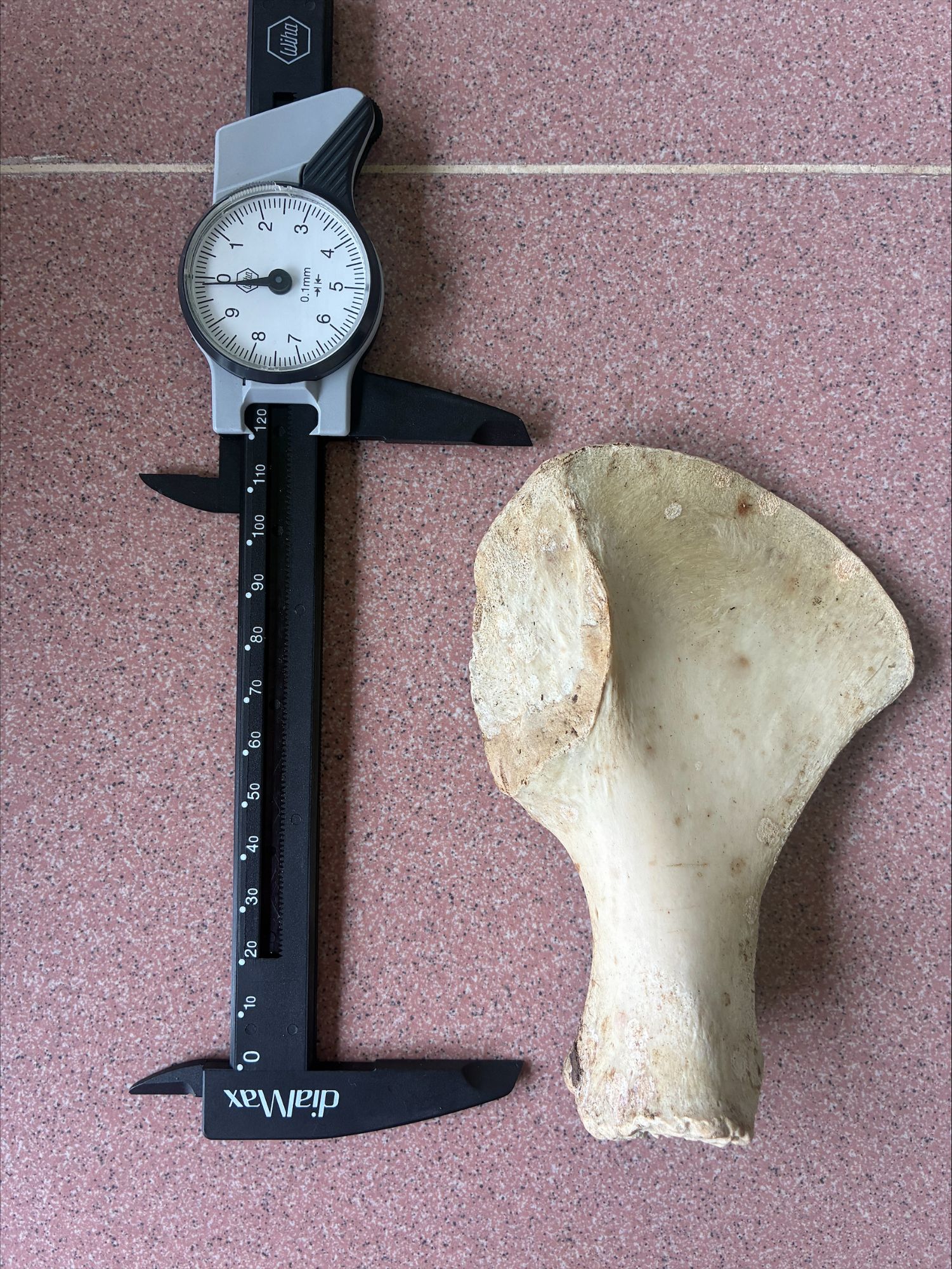
Last week I gave you this sturdy shoulder from a specimen in the Dead Zoo to try your hand at identifying:

It’s big, chunky and definitely not something you’re likely to find while digging in your garden.

The size might suggest something like a horse or cow, but it’s far too broad for either. The shape is a little more like a pig scapula, but as Sallie Reynolds pointed out, pigs have a more strongly curved scapular spine (the ridge of bone that sticks up along the middle). Plus pigs are a good bit smaller – this is a big scapula.

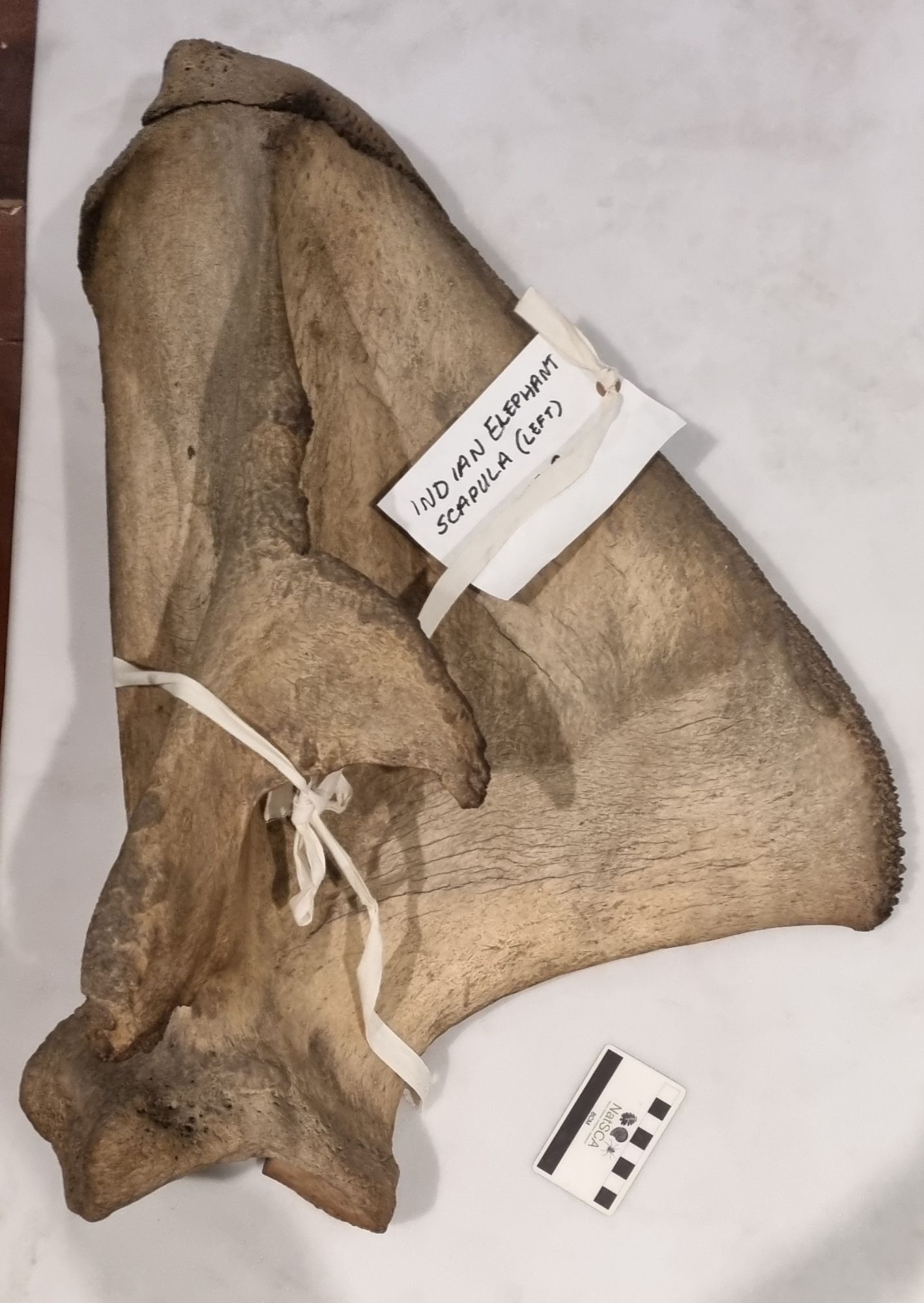
Rhinos have scapulae that are quite long and narrow – similar to a horse’s, and elephants have a very differently shaped shoulder:

Cetacean shoulders tend to be much more flattened and usually more circular, so it’s not one of them either. It is, however, from a distant cousin.

This is the scapula of a Hippo Hippopotamus amphibius Linnaeus, 1758.

Hippos used to be considered closer relatives of pigs and members of the Suborder Suina, but the discovery of the fossil whale Pakicetus in 1981 and various genetic studies over the last couple of decades have revealed that whales and hippos share a common ancestor and they have been grouped together in the Suborder Whippomorpha.

So well done to Adam Yates who dropped an equine hint about the source of this shoulderblade – since Hippopotamus does of course translate to “river horse”. I hope you enjoyed the challenge – there will be another next Friday!

Friday mystery object #488 answer

Last week I gave you this specimen to identify, from the collections of the Dead Zoo:

I thought it might prove a little challenging, and I wasn’t mistaken, although some people did manage to get very close. Chris Jervis was the first, but Adam Yates also provided a nice analysis of the specimen:

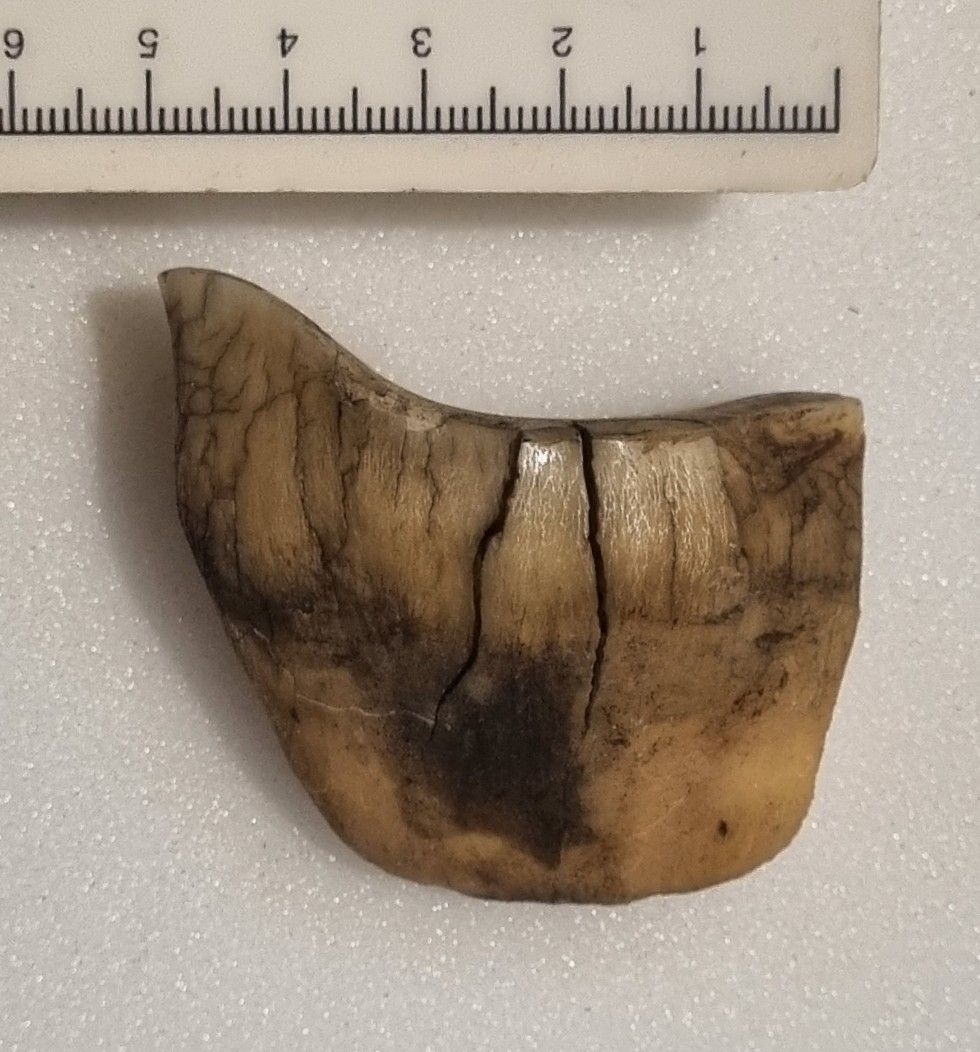
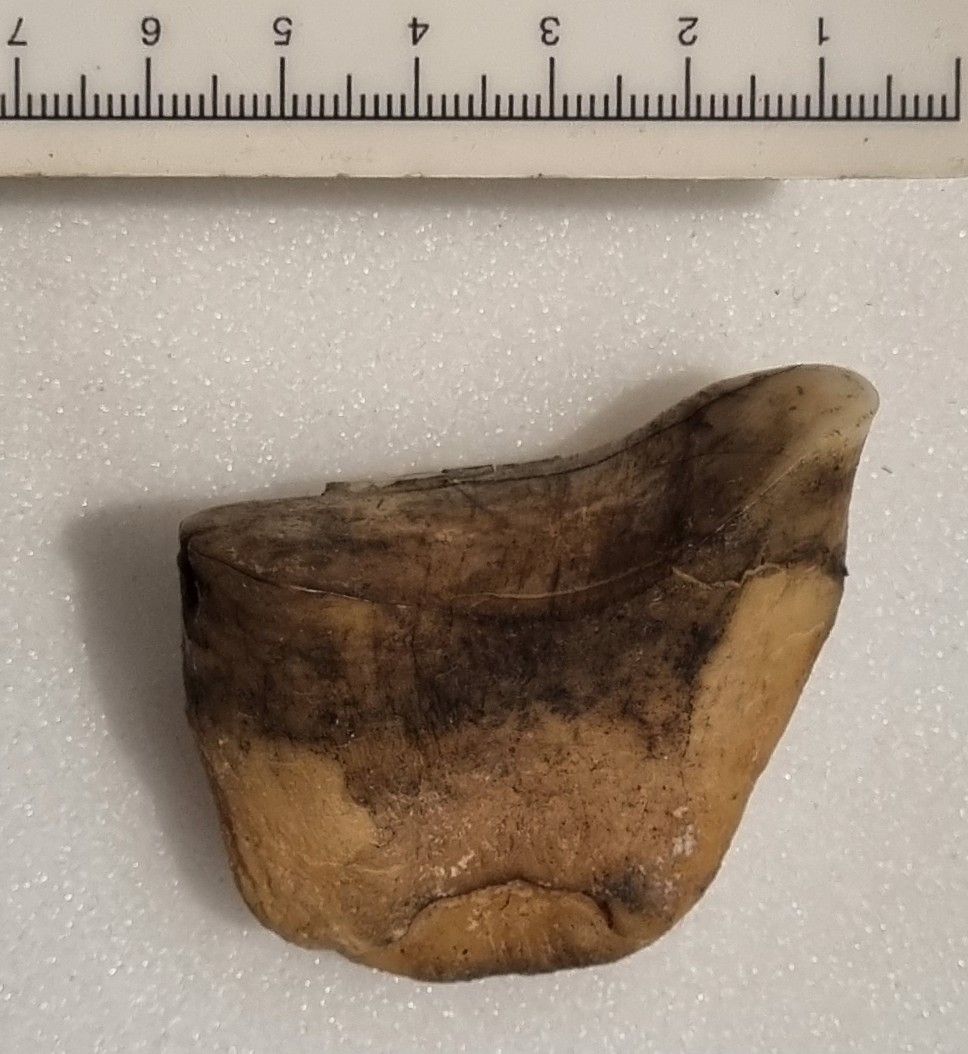
It is blade shaped without cusps, so the incisor of a large animal seems possible (I’m ruling out a Thylacoleo premolar on the basis of the broad wear facet on the occlusal surface and single root).

The root is really short so I’m guessing its a deciduous incisor.

Horses are large mammals with incisors of this sort of shape. If it were a horse it would be a third incisor because of its less square crown. As the high point (presumed mesial side) is on the left side it is probably a right incisor.

So my guess is a right deciduous incisor three of a horse.

Adam Yates June 7, 2024 at 10:20 am

Adam then followed up with a note about the size being too big for a horse, and leaned in to Chris Jervis’ suggestion – a good decision.

So what is it?

This is in fact the upper right incisor (or tusk) from the skull of an Indian Rhinoceros Rhinoceros unicornis Linnaeus, 1758:

African rhino species have lost their incisors, but the Indian Rhinoceros have incisors that form self-sharpening tusks with open roots, which are used in fighting.

The full specimen that this is from is a mounted skeleton that was on display in the Dead Zoo for a century or so, and the animal clearly had a very tough life, as it shows a variety of pathologies that have healed.

In the mandible there is a huge abscess at the base of the lower right tusk, possibly due to fighting or maybe a bullet wound:

The animal also has a variety of other injuries, including a bullet wound in the ribs:

and a major trauma to the lower front left leg, which has resulted in the humerus and ulna fusing together:

This would undoubtedly have been a very grumpy, very gnarly rhino. I’ve spoken a lot about rhinos in the past (including in a recent documentary series about the problem of rhino poaching and the wildlife trade), as they’re incredible animals that have been horribly exploited in the past, and still being horribly exploited today.

I have these photos of the specimen as over the last couple of weeks we have started the decant of specimens from the Dead Zoo in earnest, as we’re getting moving on a major capital developement project in the Museum, to solve a number of issues with access for the public, problems with the museum environment, and conservation of the 168 year old building.

Stay tuned for more updates on the project, as I suspect it will be keeping me busy for the next few years!

Friday mystery object #475 answer

Last week I gave you this unidentified skull from the collections of the Dead Zoo:

I say it was unidentified, but in a strange quirk of coincidence I actually did identify this skull three years ago, just a month before the start of the Covid Pandemic (which might explain why I never had a chance to update the record).

Not only did I identify it, the specimen also made it into the blog exactly 100 mystery objects ago.

I think the specimen is most likely to be the skull of a White-nosed Coati Nasua narica (Linnaeus, 1766), for the reasons I outlined back in 2020. So well done to Leon and Chris for recognising this cousin of the Raccoon from South and Central America and the southern parts of some North American states .

White-nosed coati (Nasua narica), Tikal, Peten, Guatemala. Image by Charles Sharp, 2023.

Coatis have quite distinctive upper canine teeth, that look almost like short tusks. These are useful for defence from other Coatis, but they are not very well adapted for subduing larger prey. This isn’t really a problem for Coatis, since they mainly feed on invertebrates, fruit and small vertebrates that they undcover during their energetic foraging.

So I apologise to everyone for repeating a specimen – this is the first time this has happened (and hopefully the last)!

Friday mystery object #474 answer

Last week I gave you this neat little skull to have a go at identifying, from research collections of the Dead Zoo in Dublin:

I wasn’t surprised that everyone in the comments worked out that this is the skull of some sort of fox, but I was equally unsurprised that nobody worked out the species. Generally speaking, most people immediately think of the near ubiquitous Red Fox or perhaps Grey Fox (or Gray Fox to our American friends), but there are plenty of others – 24 species commonly referred to as “fox” and 12 species of “true fox” in the genus Vulpes.

This particular specimen has a sagittal crest that forms a lyre-shape – normally something associated with the Grey Fox:

However, this feature can occur in other species, often in females or subadults, where the surface of the bone has not finished remodelling at the margin of the attachment of the temporalis muscles (those are the ones that connect to the lower jaw from the sides of the cranium and are responsible for the operation of the lower jaw during powerful biting).

However, in this specimen the muzzle is more tapered and the postorbital constriction is relatively broad. All of these point away from the Grey Fox.

With foxes there can be a lot of similarities between the skulls of species, with all the usual compounding issues of sexual dimorphism, age and regional variation. However, size can give some clues, and things like the relative size of the external auditory meatus (also known as the ear-hole), and the shape of the auditory bulla, are useful for differentiating between species.

With a bit of patience, a bit of pattern recognition, and a resource with good images of specimens, like the Animal Diversity Web, it is possible to work out what you’re looking at.

In this case, the mystery object is a Swift Fox Vulpes velox (Say, 1823).

Swift Fox by Abujoy, 2009 CC BY 3.0

These North American foxes are smaller than the Red or Grey Fox, but a bit bigger than their close cousin, the Kit Fox. They live in grasslands and praries, where they prey on rodents, birds, reptiles and pretty much anything they can find – including insects, fruit and grasses.

As with many species, the Swift Fox has declined due to changing land use and the systematic persecution of predators in the first half of the 20thC. In fact, it was wiped out in Canada around this time, although it was subsequently successfully reintroduced and numbers have increased.

So watch out for those foxy skulls – there are more species to consider than you might think and they can be tricky to identify without reference resources. I hope you enjoyed this little detour down the fox hole!

Friday mystery object #470 answer

Last week we had these two skulls from Andy Taylor, FLS to have a go at identifying:

Everyone recognised that these are the skulls of Tube-nosed birds in the Order Procellariiformes – very large Tube-nosed birds.

Usually, you’d think of albatrosses when considering large Procellariiformes, but they have proportionally longer bills than this and while they have the nose-tube characteristic of the group, the tube is quite small and to the sides and rear half of the bill. In the mystery specimens, the tube is large and located on the top, and in the front half of the bill.

As Wouter van Gestel recognised, these skulls are from Giant Petrels in the Genus Macronectes. They actually represent both species in the Genus – the top one is the Southern Giant Petrel Macronectes giganteus (Gmelin, 1789) and the lower one is the Northern Giant Petrel Macronectes halli Mathews, 1912.

They’re quite hard to tell apart, and the best feature I noticed for distinguishing them is the shape of the palatine, with the Southern having a very gentle curve to the rear section – as indicated below (in a very rudimentary way):

Andy has already written up some information about these birds on his Instagram account, which is well worth checking out:

Thanks for all your observations and thoughts on these rather impressive specimens!

Friday mystery object #470

This week I have a guest mystery object – or two – for you to test your skills on:

I’d love to hear your thoughts on the identification of the skulls here – keeping in mind that any differences could be due to individual variation, sexual dimorphism or they may even be different species. Looking forward to hearing your thoughts!