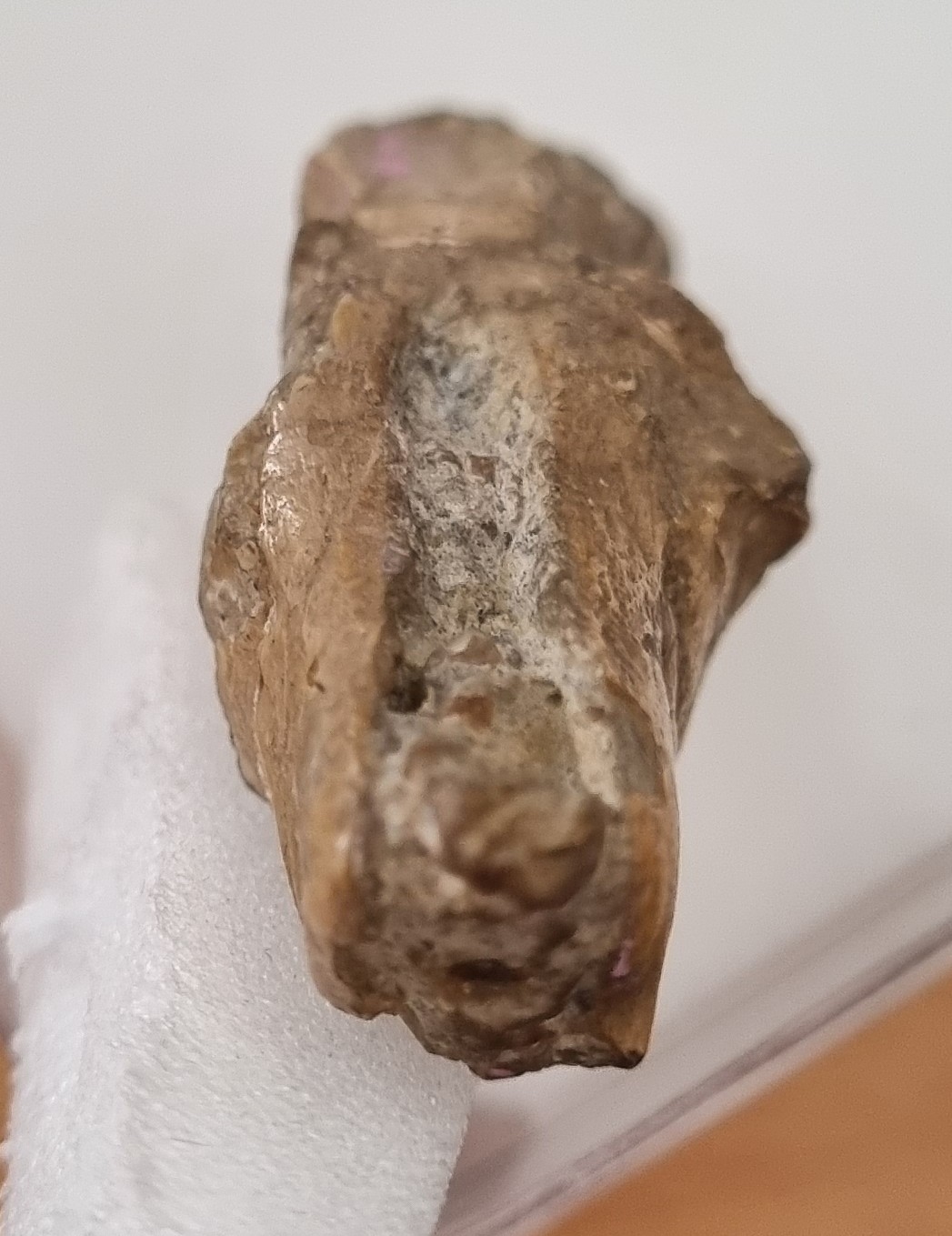
Last week I gave you this mystery object to try your hand at identifying:
I picked this specimen because it’s from Ireland, but it’s not a species you might normally associate with Ireland. Plus it’s fragmentary and missing some parts that are useful for identification.
That said, after a little initial mis-step, the correct species – and indeed subspecies – identification was reached. So well done to James Bryant, Adam Yates, and Allen Hazen.
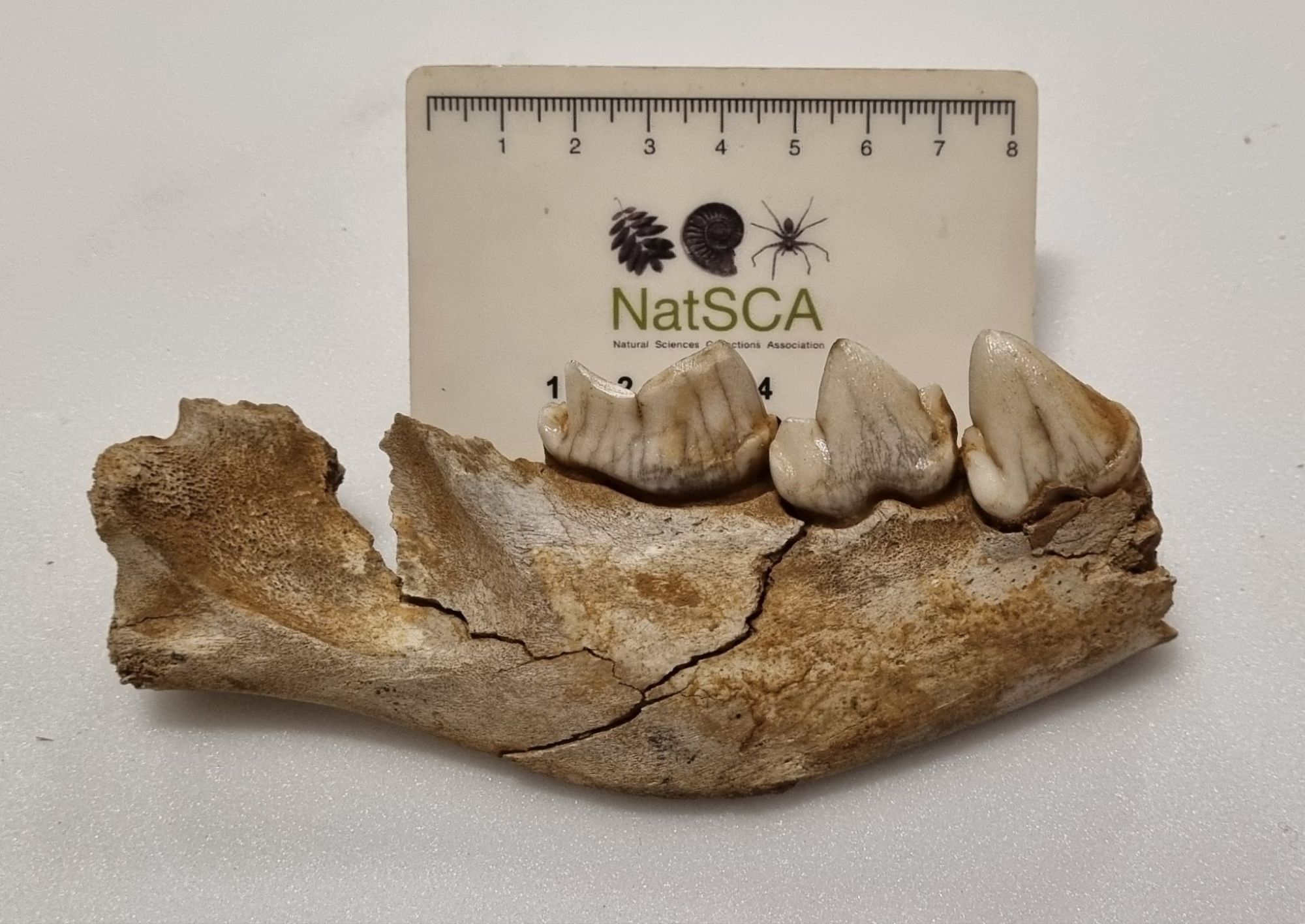
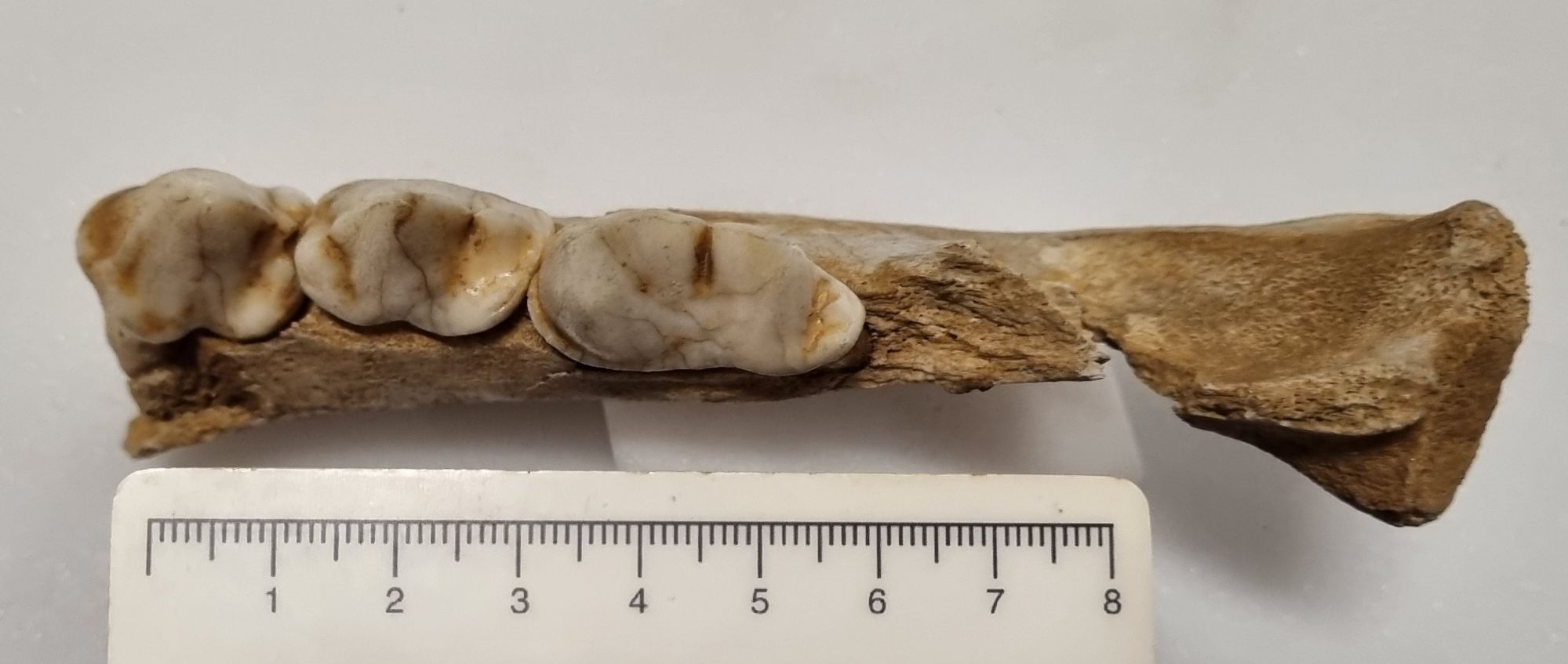
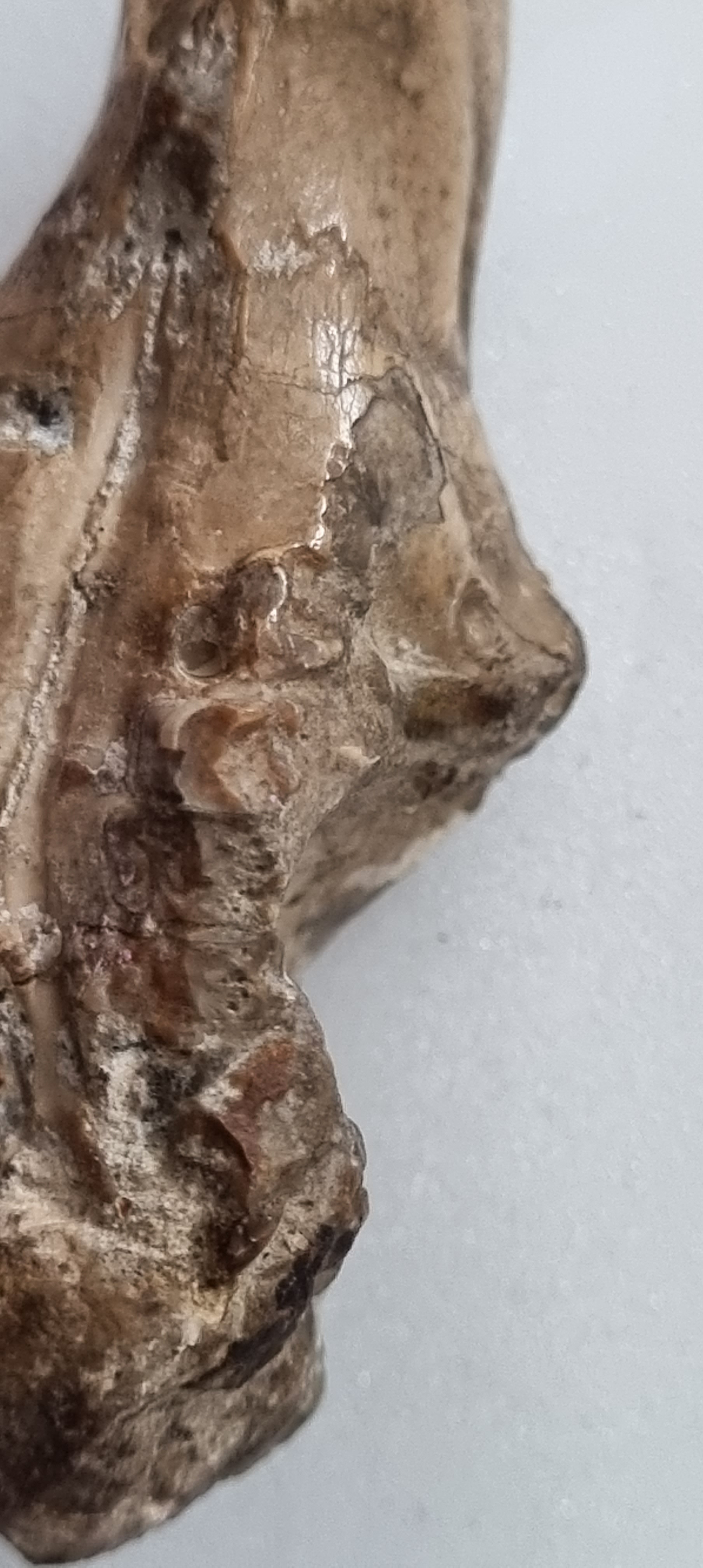
This is a section of mandible from a Cave Hyena Crocuta crocuta spelaea Goldfuss, 1823. This jaw shows just three teeth, but they are very useful teeth for identification, since they are characteristically robust, with really heavy conical premolars with well defined cingula (those ridges of enamel near the base). Perfect for smashing through bones. The curve of the jaw is also a useful clue.
The Cave Hyena was present in Ireland around 40,000 years ago we have several specimens in the Dead Zoo, mainly from Castlepook Cave in County Cork. These caves provide a rare glimpse of pre-glacial fauna, since most other sediments (and therefore fossils) from the Pleistocene period were scoured away by the glaciers of the last glacial period.
So well done to everyone who figured it out. Specimens like this provide a fantastic snapshot into the prehistory of Ireland, offering a sense of how changing climate and landscapes shape biodiversity over time.
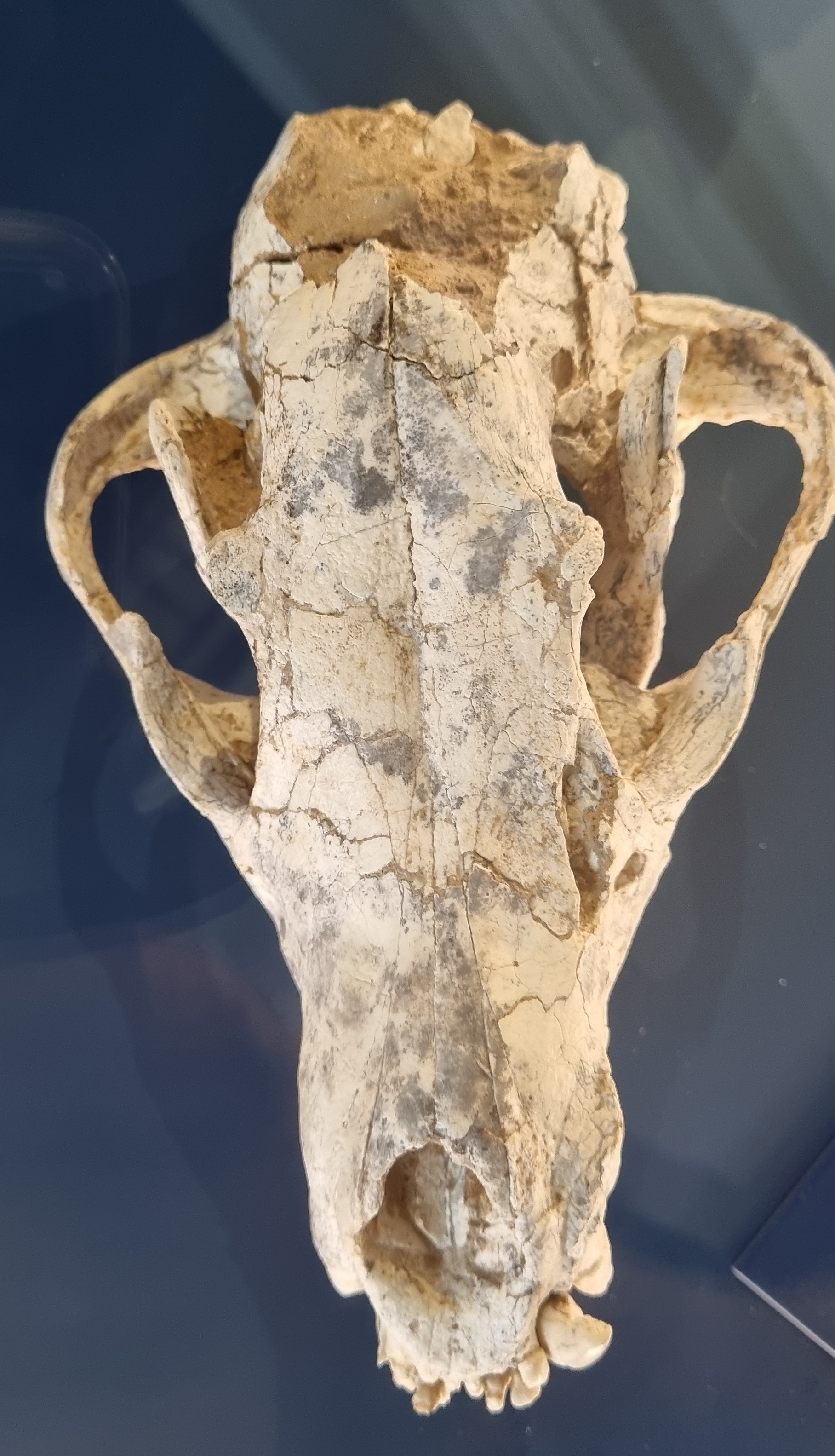
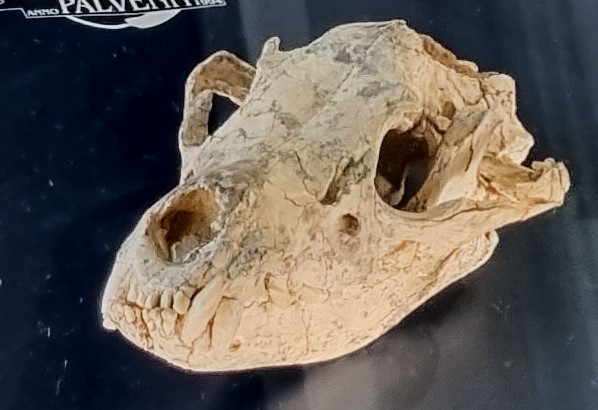
Last week I gave you this 6 million year old fossil skull to have a go at identifying:
The specimen is on display in the geology galleries of the Natural History Museum at the University of Oslo (which is well worth a vist). However, this did mean the photos provided weren’t quite as good as I’d like, particularly notable being the lack of a scale bar (sorry!)
Even without a scale, consensus shifted towards this being some kind of hyena, thanks to the curved mandible and (hint of) robust molars and shorter toothrow than you might expect to see in a canid. The broad and flat profile of the frontals between the eye sockets probably helped too:
Hyenas have an interesting evoloutionary history, branching off from the basal feliforms around 22 million years ago and adapting to fill a terrestrial carviore niche in Eurasia and becoming quite diverse. In America the canids were filling that same niche, which led to some competition when the canids made it to Eurasia (spoiler alert – the hyenas lost that competition, leaving us with just three highly specialised bone crushers and the decidedly weird Aardwolf living today).
Four live specimens of hyenas (clockwise from top left): spotted hyena (Crocuta crocuta), brown hyena (Parahyaena brunnea), aardwolf (Proteles cristata), striped hyena (Hyaena hyaena). Image by Termininja, 2020CC BY-SA 4.0
The mystery specimen was labelled as Thalassictis wongii (Zdansky, 1924), a species described from China and originally placed in the genus Icititherium, but reassessed by Kurtén (1985). A cladistic treatment of the Hyaenidae by Werdelin & Solunias (1991) later placed it in the genus Hyaenotherium, but that may not have been accepted by the curatorial team in Oslo without an accompanying formal taxonomic treatment.
These are the sorts of decisions that need to be made when considering something as simple as a label stating a species name, so you can imagine my sense of trepidation as we are about to embark on a major project at the Dead Zoo, which will allow us to reassess the information with our 10,000 or so display specimens. Fun times ahead!
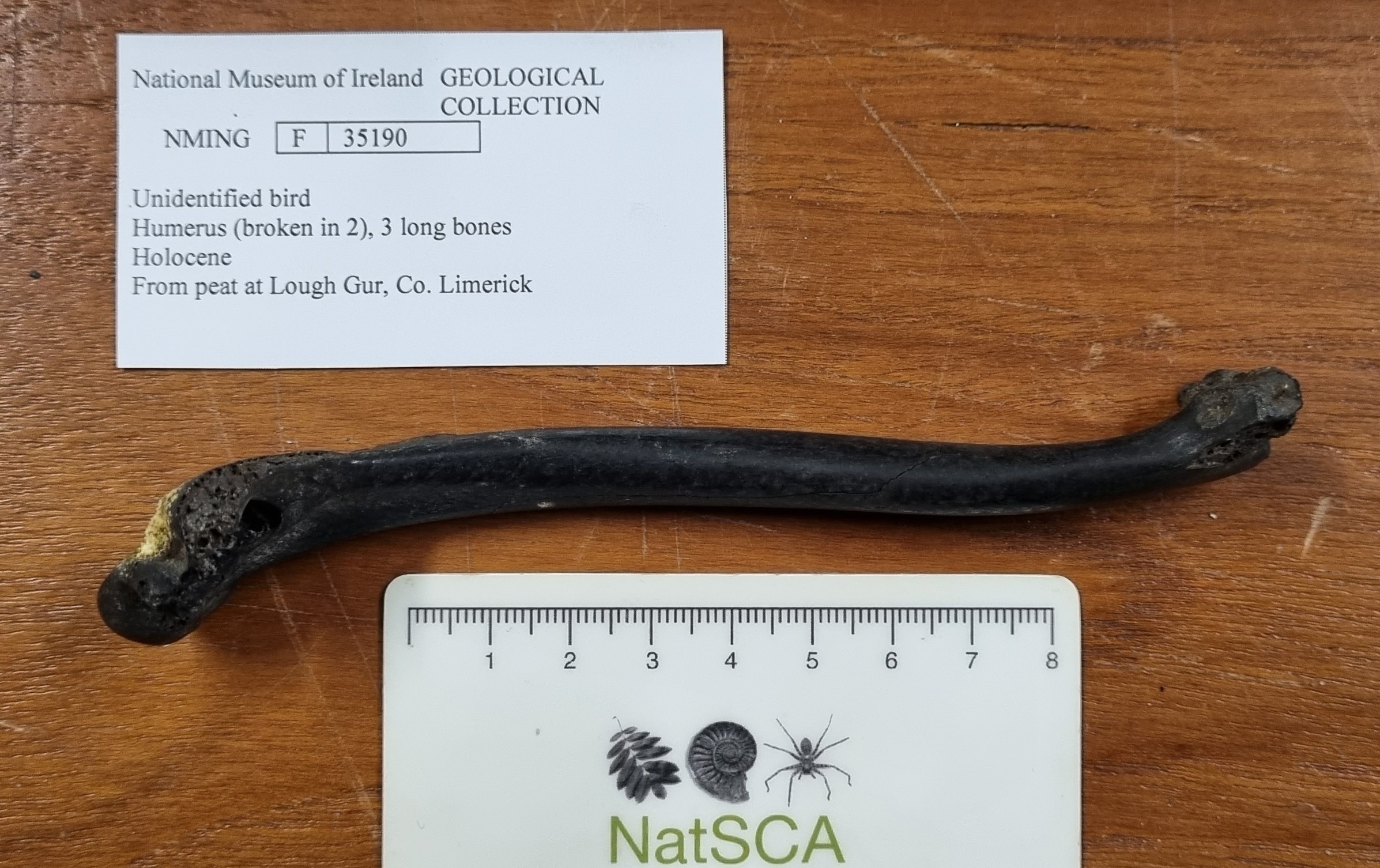
Last week I gave you this genuine mystery object to identify, from the collections of the Dead Zoo:
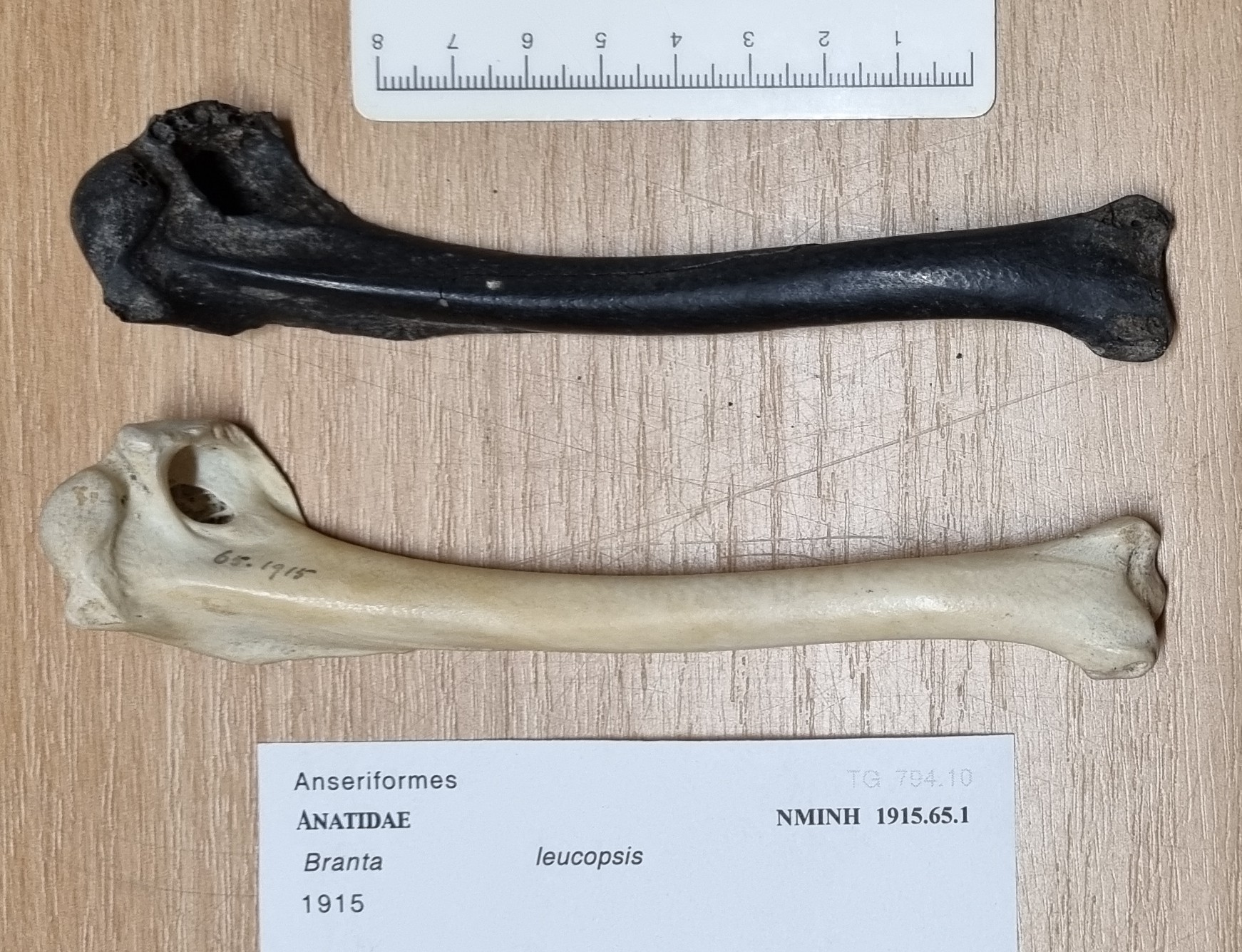
As you may have noticed, there is a preliminary identification with the specimen, that lists it as being an unidentified bird humerus from peat at Lough Gur in County Limerick. It’s dated to the Holocene, so nothing that you wouldn’t expect to find around today, at least within the wider European context.
I always maintain that identifications on labels should never be assumed to be accurate – although I’m happy to say that this one is correct.
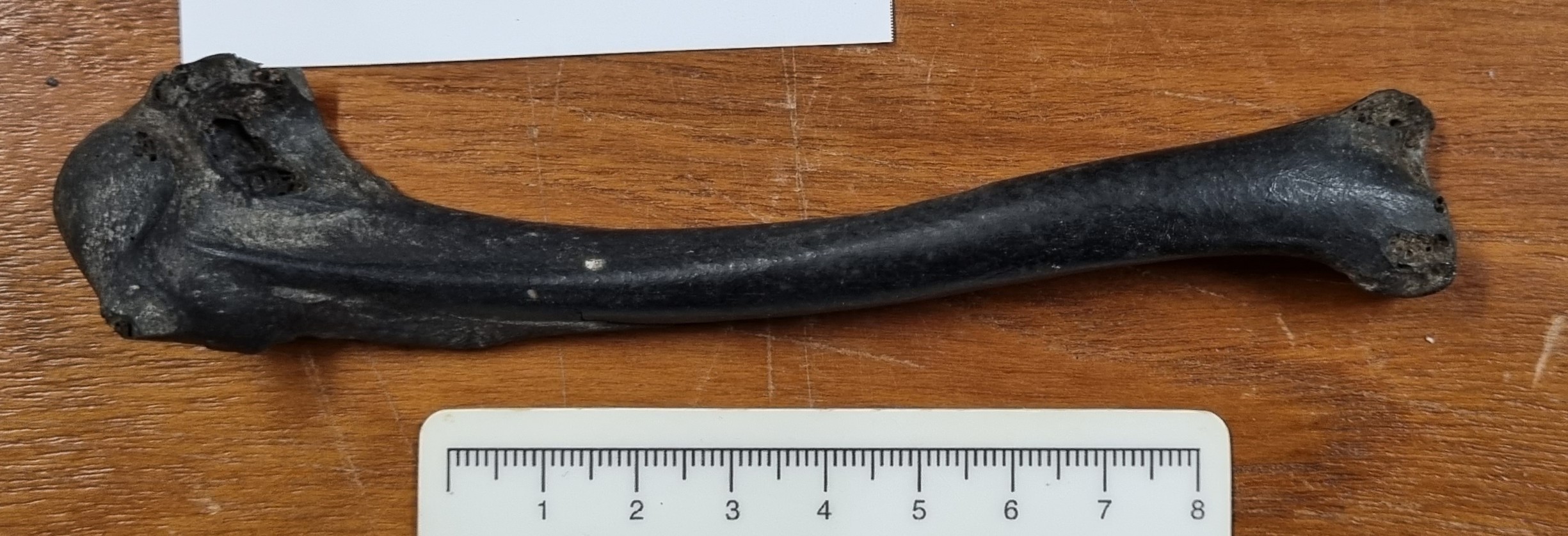
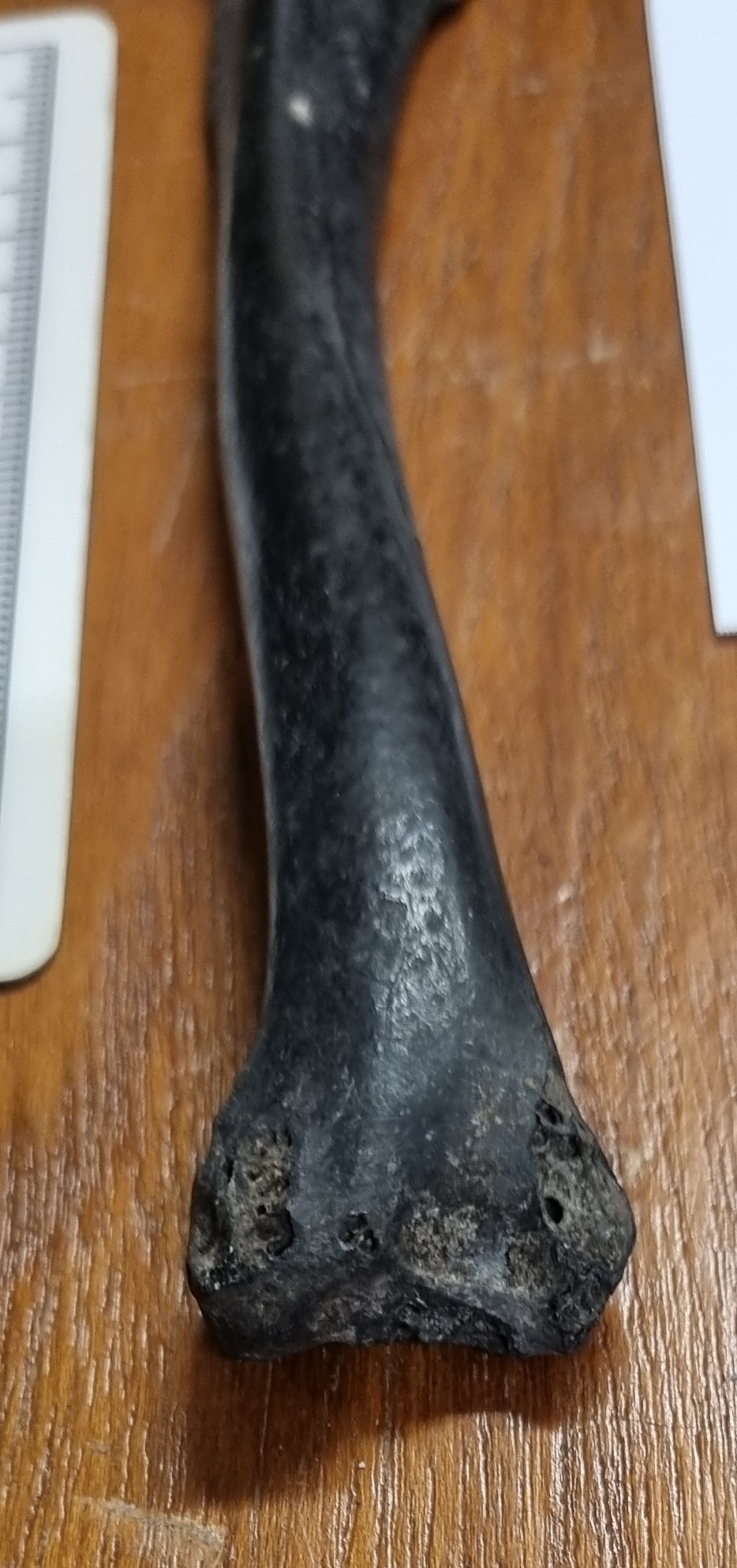
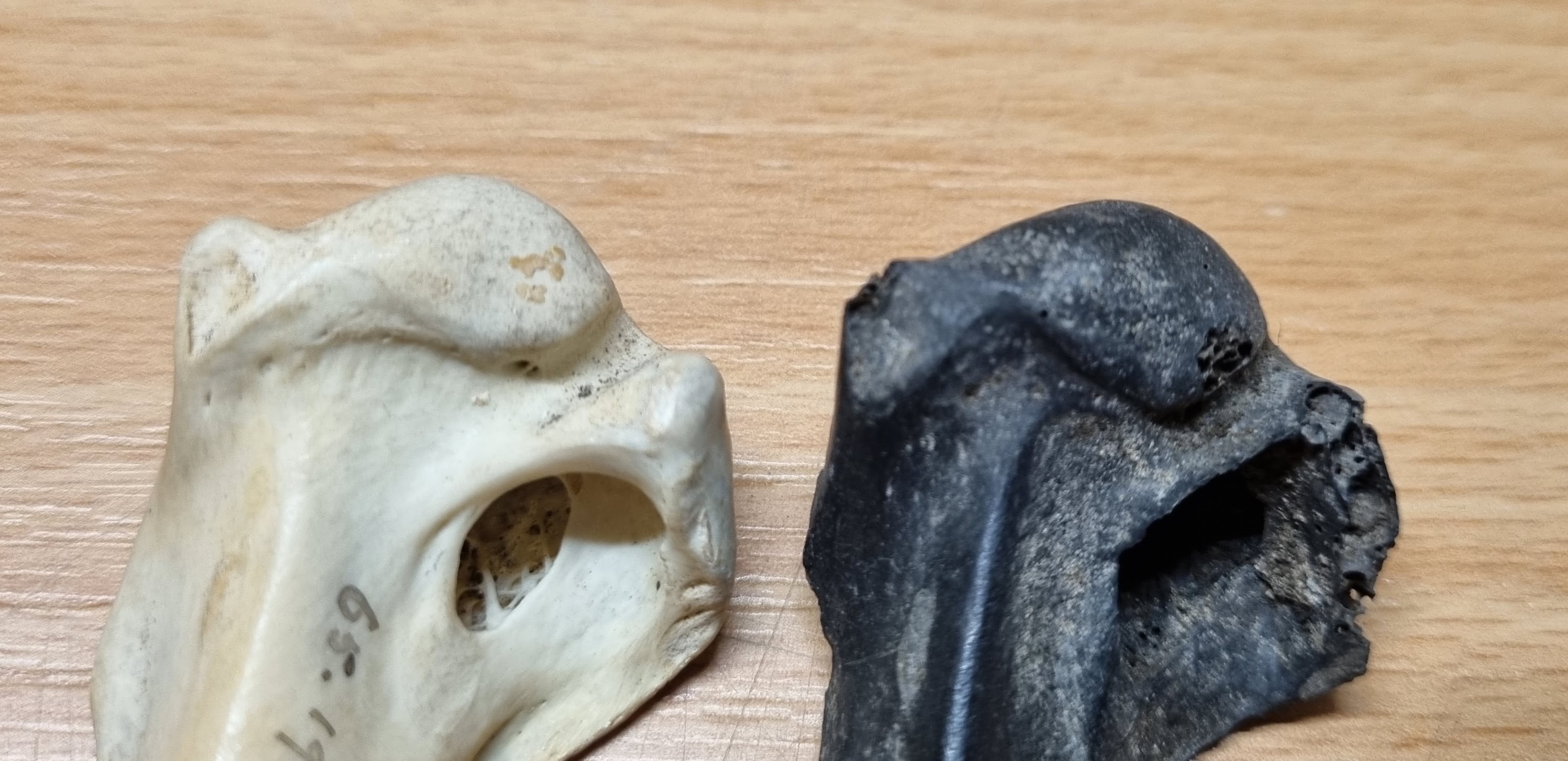
The humerus is fairly large, which helps narrow down possibilities, but there are areas of damage on the articulations, where some useful features of the bone have been worn away, revealing the honeycomb texture inside the bone:
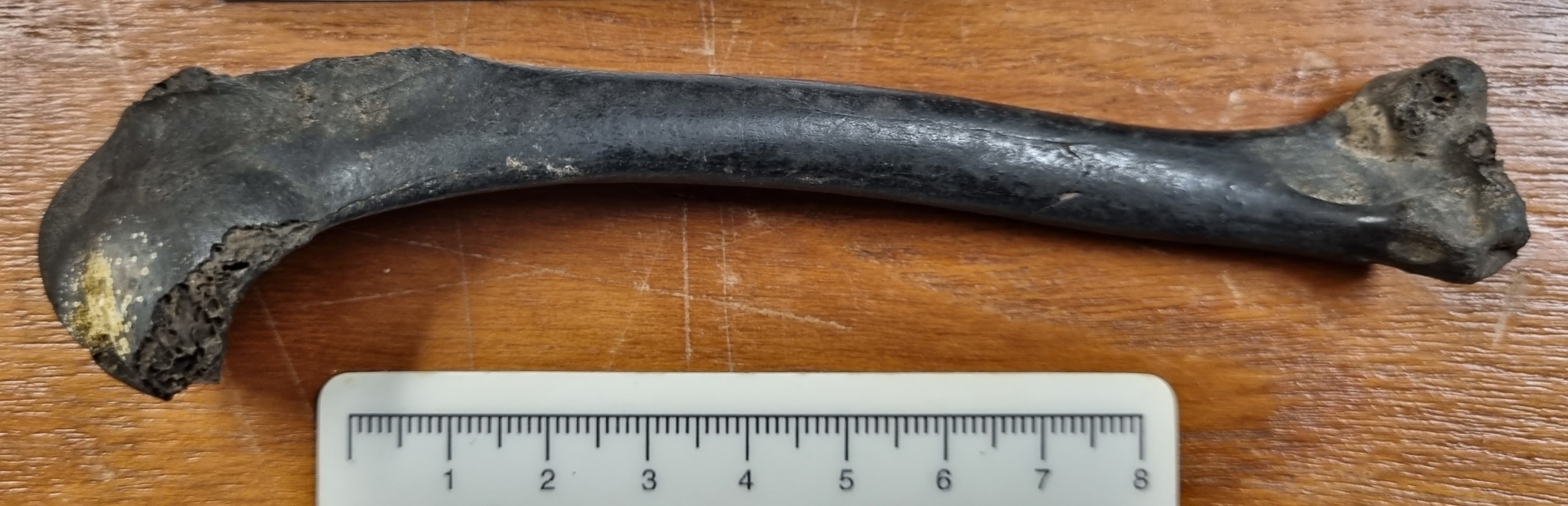
This sort of damage can often make identifications much more difficult, as it can remove diagnostic features and even change the profile of the bone, making it appear substantially different to the original form – especially where parts of elongated crests of bone have been lost:
When you attempt to identify a bone with this kind of damage, you have to keep in mind that something is missing, which can be very misleading when working from the overall shape. I think this is why many of you went down the route of a bird of prey, such as an eagle species or Osprey.
Generally in terms of an identification, the best option is to rule out the most likely species first – which means anything with a high population density or regular occurence, that frequents the habitat in which the bone was found. In this case my first thought went to waterfowl rather than raptor.
This humerus is too small for something like a swan or large species of goose, and too large for one of the ducks. However, it’s right in the range for one of the smaller goose species, so I took a look through some reference specimens from the genera Anser and Branta.
Of all comparisons, the Barnacle Goose Branta leucopsis (Bechstein, 1803) was very close in size and shape, and where the shape differed it was where there was damage visible to the bone, making it likely that some of the features that seem to be missing were actually there originally but have been abraded away:
I’m still not 100% certain the mystery object is from a Barnacle Goose, but I’m quite confident that if it’s not, it’s from a close relative. I would love to hear your thoughts!
Last week I gave you this really difficult, but incredibly cool mystery object to identify:
Definitely not a simple one for the uninitiated, but most of you got impressively close.
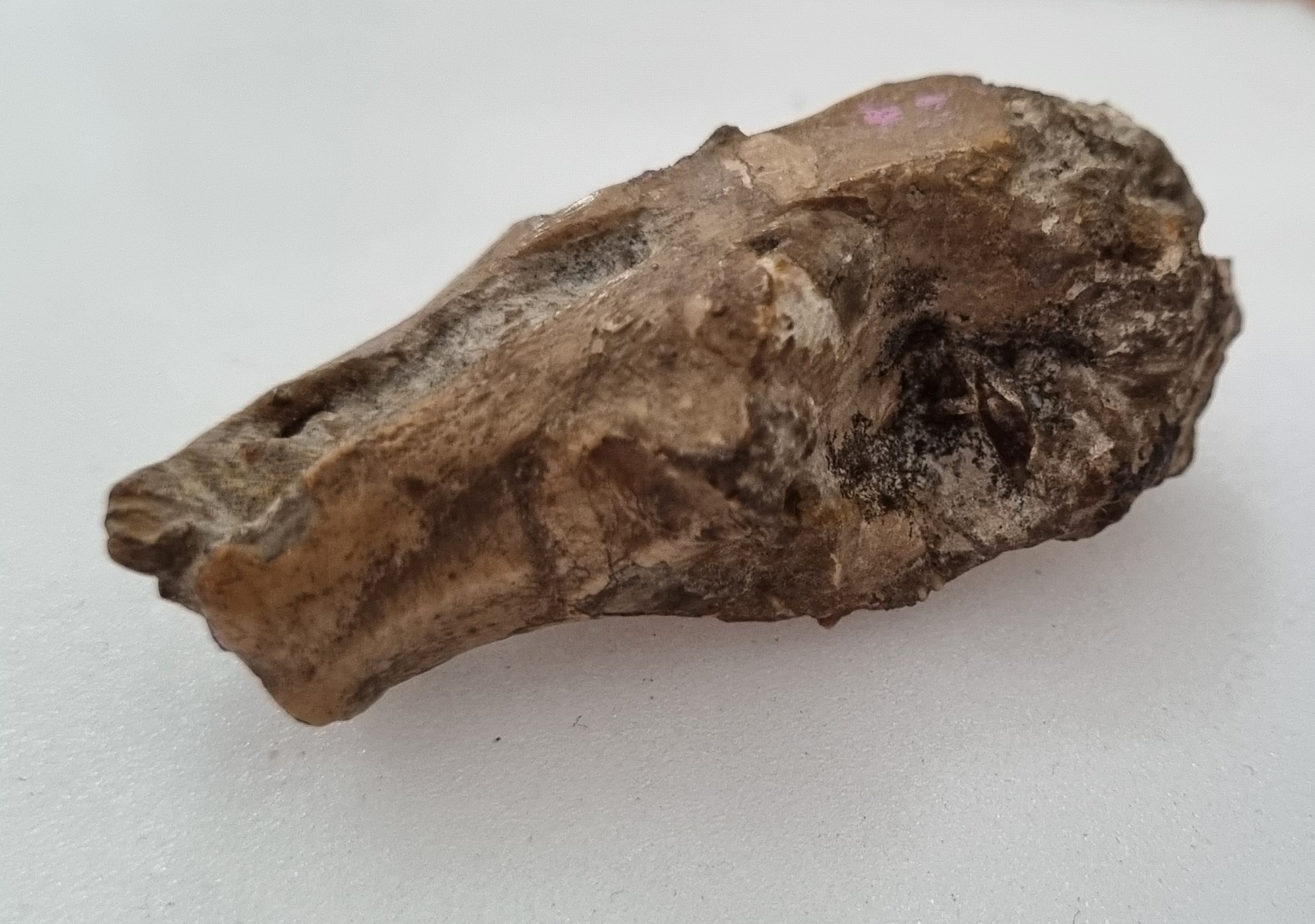
It looks a bit like ancient chewed gum at first glance (hey, it’s a thing!):
A nearly 6,000 year old piece of chewing gum, found in Scandinavia, perfectly preserved the DNA of its chewer. She was a young, hunter-gatherer girl, with dark skin, brown hair & blue eyes, who had recently eaten a meal of hazelnuts & duck. Archaeology is amazing. pic.twitter.com/kfav9PkonE
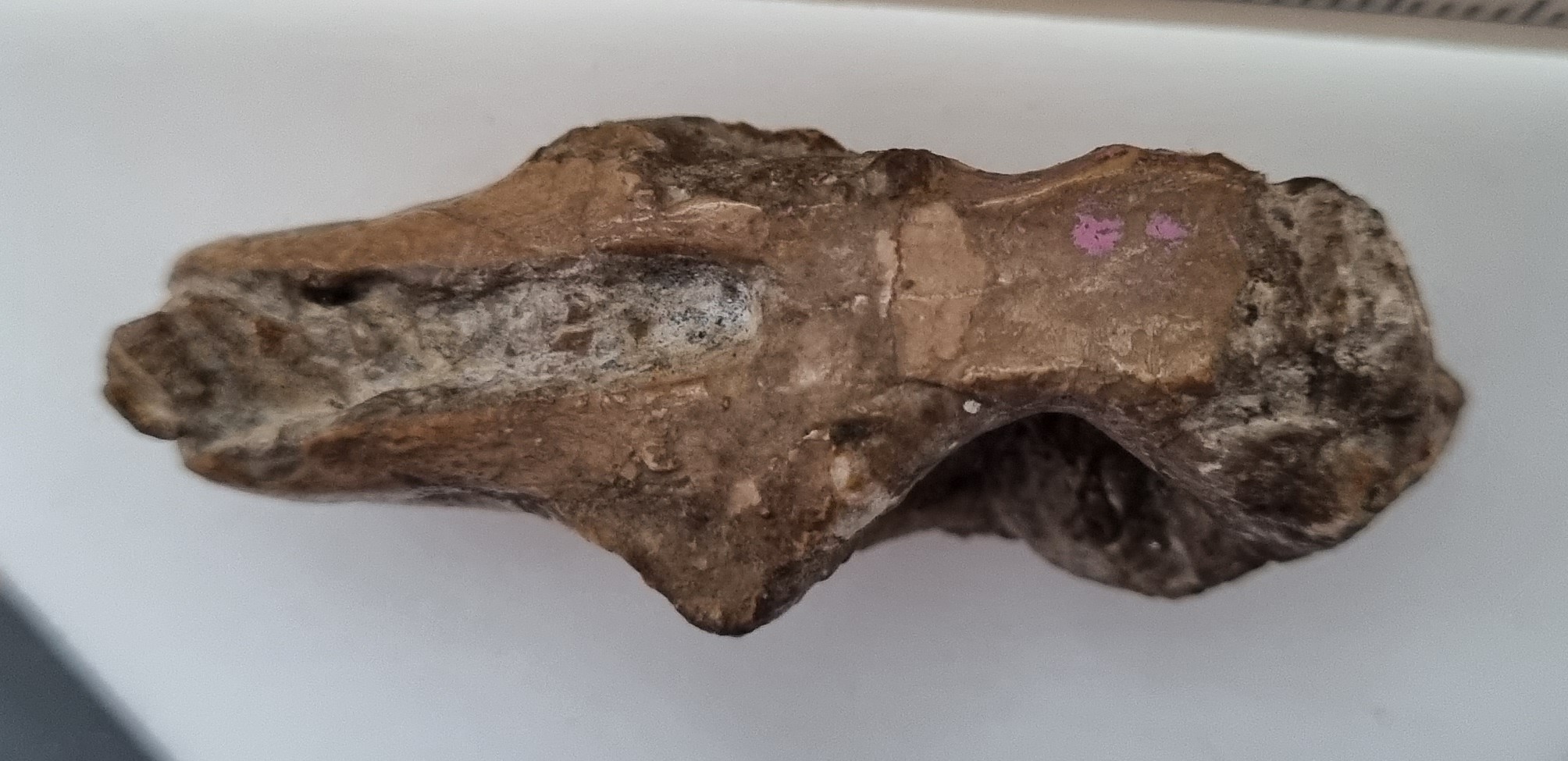
However, on closer inspection, some of the features start to emerge – including teeth:
Obviously, this is the fossilised skull or some critter, but what kind of critter is harder to determine.
The length suggests it’s something about the size of a rabbit:
And if you’re looking for a good fossil rabbit, you can’t beat Palaeolagus:
Palaeolagus skull. Image by Smithsonian Institution, 2019
NotPalaeolagus skull.
As you can see, the mystery object has a few differences, but due to the various missing parts, it’s a little hard to be confident exactly how different they are – although the shape of the orbital margin (the front of the eyesocket) gives a bit of a hint.
But, even more useful, is the curve in the maxilla (the upper jaw bone) that traces the root of the first incisor. In lagomorphs (rabbits, hares and even pikas), the incisor roots terminate with quite a big gap before the orbital margin, often with a triangular fenestrated region of cancellous bone (a sort of window of bony struts) in between.
The mystery specimen doesn’t have that – in fact the end of the incisor root is very close to the orbital margin. This is something you see in rodents.
I would have been impressed if you got that far, since the overall shape and size of this specimen definitely gives off a rabbity vibe, but believe it or not, this a dormouse. More specifically, it’s the Gigantic Dormouse Leithia miletensis (Adams, 1863) or if you want to go with the commonly used and more technically accurate, but nomenculatorily incorrect, L. melitensis, since Adams made a spelling error in his original description.
In fact, this is one of the specimens collected and figured by Adams in that original work describing the species, making this part of the type series for the species (although the holotype is more likely to be a very well preserved half mandible from the same site).
The fact that this is a fairly large and intact part of the type series means that it is of great interest to researchers. The reason I had this specimen to hand for the mystery object, is because I was preparing it for a research loan to some of my old colleagues in UCL, where it’s being MicroCT scanned.
This research will help refine an understanding of the morphology of the Gigantic Dormouse and offer some clues to what happens on islands that leads to the development of giants, building on work that they’ve been doing on this fascinating species, which is an interesting read that you can find here (you may even recognise Fig. 1B).
Virtual Cranial Reconstruction of the Endemic Gigantic Dormouse Leithia melitensis (Rodentia, Gliridae) from Poggio Schinaldo, Sicily, By Jesse J. Hennekam , Victoria L. Herridge, Loïc Costeur, Carolina Di Patti, Philip G. Cox – CC BY 4.0, https://commons.wikimedia.org/w/index.php?curid=92037373
Last week I gave you these bones to have a go at identifying:
These are of course three toe bones (AKA phalanges) from a large artiodactyly. The staining of the bone suggests that it’s a fossil and the fact that I work at the Dead Zoo in Dublin might have offered a contextual clue…
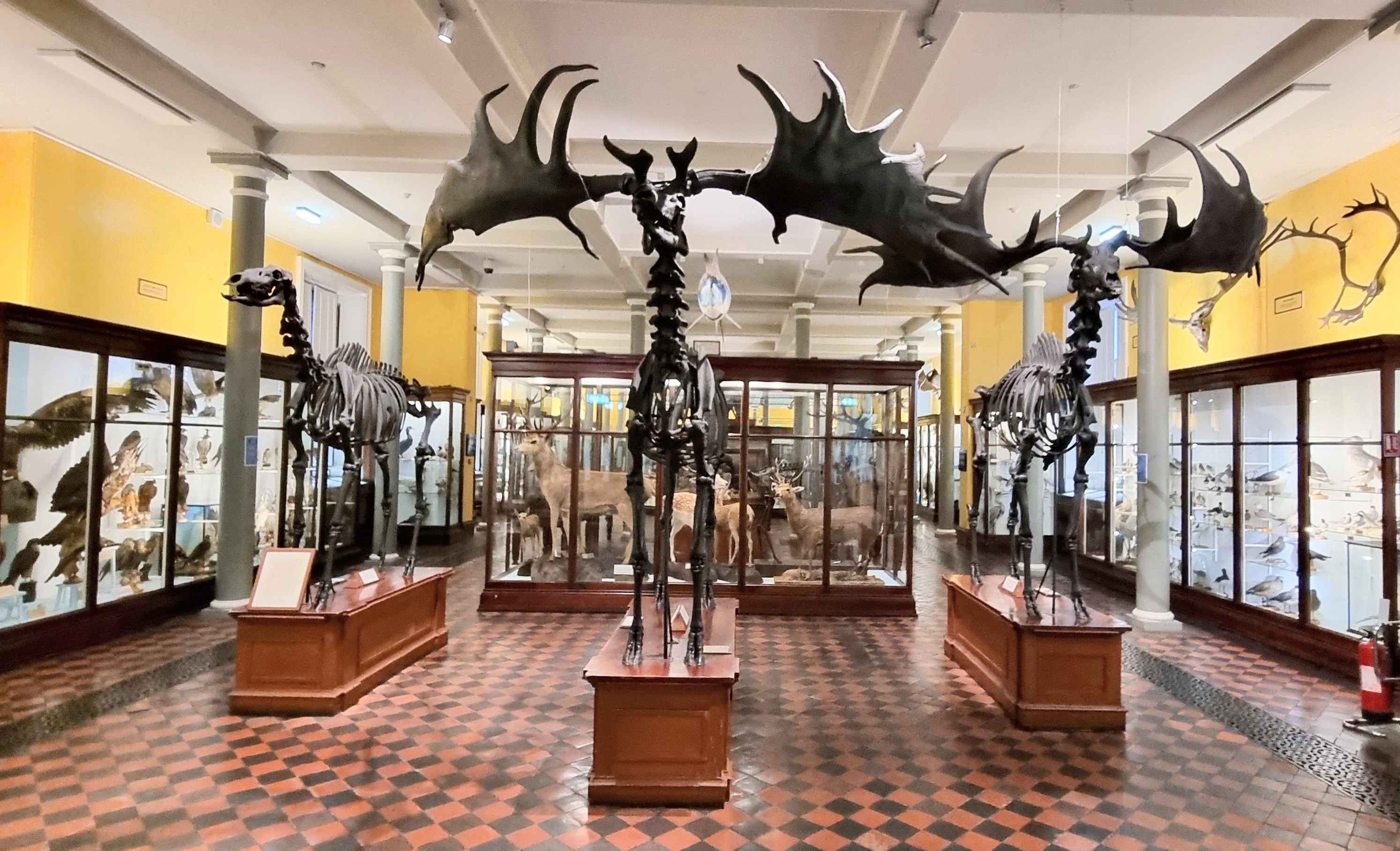
Three Giant Deer (female and two males) at the entrance to the Dead Zoo Irish Room gallery.
This is of course the proximal, medial and distal phalanx (the distal phalanx also being known as the ungual) from the outer side of the right hind leg of an Irish Giant Deer Megaloceros giganteus (Blumenbach, 1799). Well done to all of you who worked that out (to any degree of accuracy!)
We have quite a lot of Giant Deer in the collections of the Dead Zoo, with over 600 records on our database, ranging from individual bones to complete skeletons. This offers an unusually large sample for researchers and artists wanting to work on these huge, extinct cervids.
This toe came from the female skeleton on display in the Irish Room of the Museum. The wire armature running through holes drilled through the bones that held it in place failed. This is likely due to a combination of factors, since the skeletons were mounted well over a century ago, and the armature is made of iron, which will have been gradually corroding over time.
I suspect there may also have been an element of ‘messing’ by a member of the public, since the skeletons are on open display and these toes were well within reach of young children or even in the bashing zone of a backpack if some decided to sit on the specimen’s plinth. Obviously we try to discourage this sort of thing, but on a busy day it can be hard to keep track of everyone in the space.
It’s a shame this happened recently, as we undertook an overhaul of the Giant Deer on display before we reopened the Museum earlier this year. Fossil preparator and conservator Remmert Schouten worked with me to build new sections of armature to remount a skull, he cleaned the specimens, and undertook a variety of small repairs (including replacement of an ungual on one of the other specimens) to get all of the Giant Deer looking their best.
I’ll leave you with some of the photos and a couple of videos, one with Remmert talking about the work and one with me setting the context and overview of the project. It was an intense week of work onsite, but very satisfying to see the transformation of the specimens!
Specimens in stillages, waiting to be conserved.Specimen awaiting recapitation.Remmert working on building the steel armature for remounting the Giant Deer skull.Remmert rewiring the mandible to attach to the cranium.Gantry used to hoist the skull into position.Remmert removing stillages.
This week I have a close-up of something to identify, that would be a bit too obvious if I showed you the whole thing:
It’s something I have a bit of a soft spot for, so I’m interested to see if it’s as distinctive for anyone else as it is for me! I hope you have fun with it.
Everyone in the comments immediately recognised that this is the fossil of something that flies, thanks to the slender bones. The general consensus from the outset was that it was Archaeopteryx, but I wonder how much of that is because this specimen is preserved in the same Middle Jurassic lithographic limestone from Solnhofen that preserves the first bird?
The Berlin Archaeopteryx
However, Allen Hazen noticed the long slender finger that marks the mystery object as something different, when he correctly suggested that it was a pterosaur, winning over palfreyman1414 and sallie reynolds. On Twitter, @Robertgagliano1 went one better and got the correct genus when he suggested Germanodactylus.
This is indeed a fossil of Germanodactylus cristatus (Wiman, 1925). These small Jurassic pterosaurs were about the size of a raven and it is thought that they may have fed on marine crustaceans and molluscs, based on their fairly robust teeth.
This particular specimen is currently on display in our Jurassic Skies exhibition (that I talked about a fortnight ago), as it helps represent the successful group of flying reptiles that were already in the air 150 million years ago, when feathered dinosaurs first took to the skies.
This means it’s possible that the ancestors of crocodiles would have been feathered and modern crocodiles have lost this covering, possibly thanks to their specialisation for living in water. I find it quite interesting that a reticence to add feathers to representations of dinosaurs (in things like Jurassic Park) has been influenced in part by the scaly skin of modern crocodiles (the nearest living relatives to dinosaurs that are not birds), but now we find out that crocodiles may have had feathers and lost them, making prehistory a much more fuzzy place than we ever dreamed!
Last week I gave you this mystery tooth to have a go at identifying:
There were a variety of answers, but the first few took this as a worn canine tooth, presumably due to the respectable size and robustness. However, consensus shifted to this being an incisor, meaning it would have to be from a large animal – which is spot on. Moreover, it’s a large animal that was once resident in Ireland.
After that there were a variety of ideas brought up, from all manner of beasts including Sheep, Badger (or perhaps Pine Marten since a cryptic M.m. from the Irish fauna could be either Meles meles or Martes martes), Cave Bear, Coyote, Wolf and even Human. There was one just correct identification however, by Tony Morgan who recognised it as a Hyaena incisor.
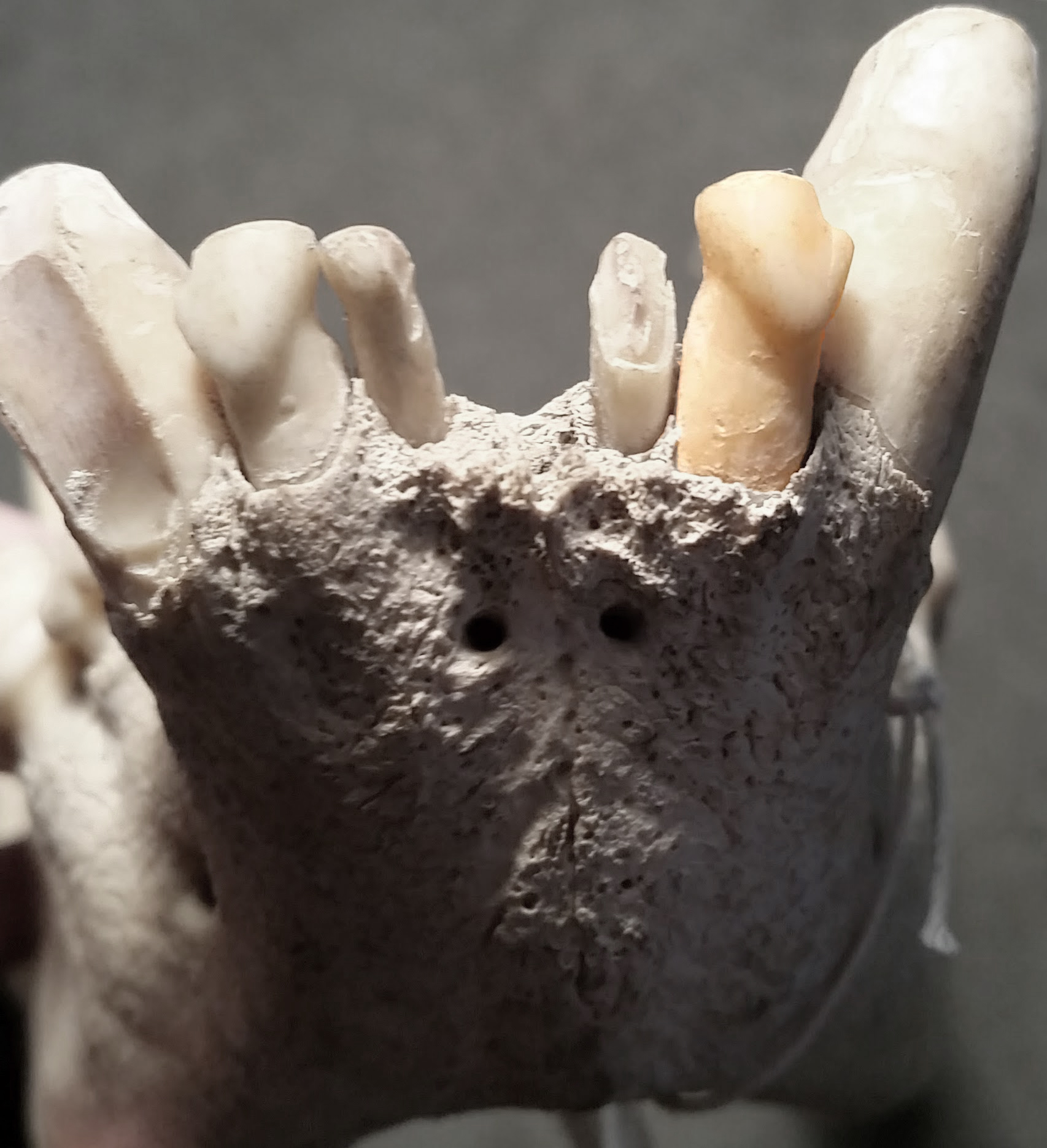
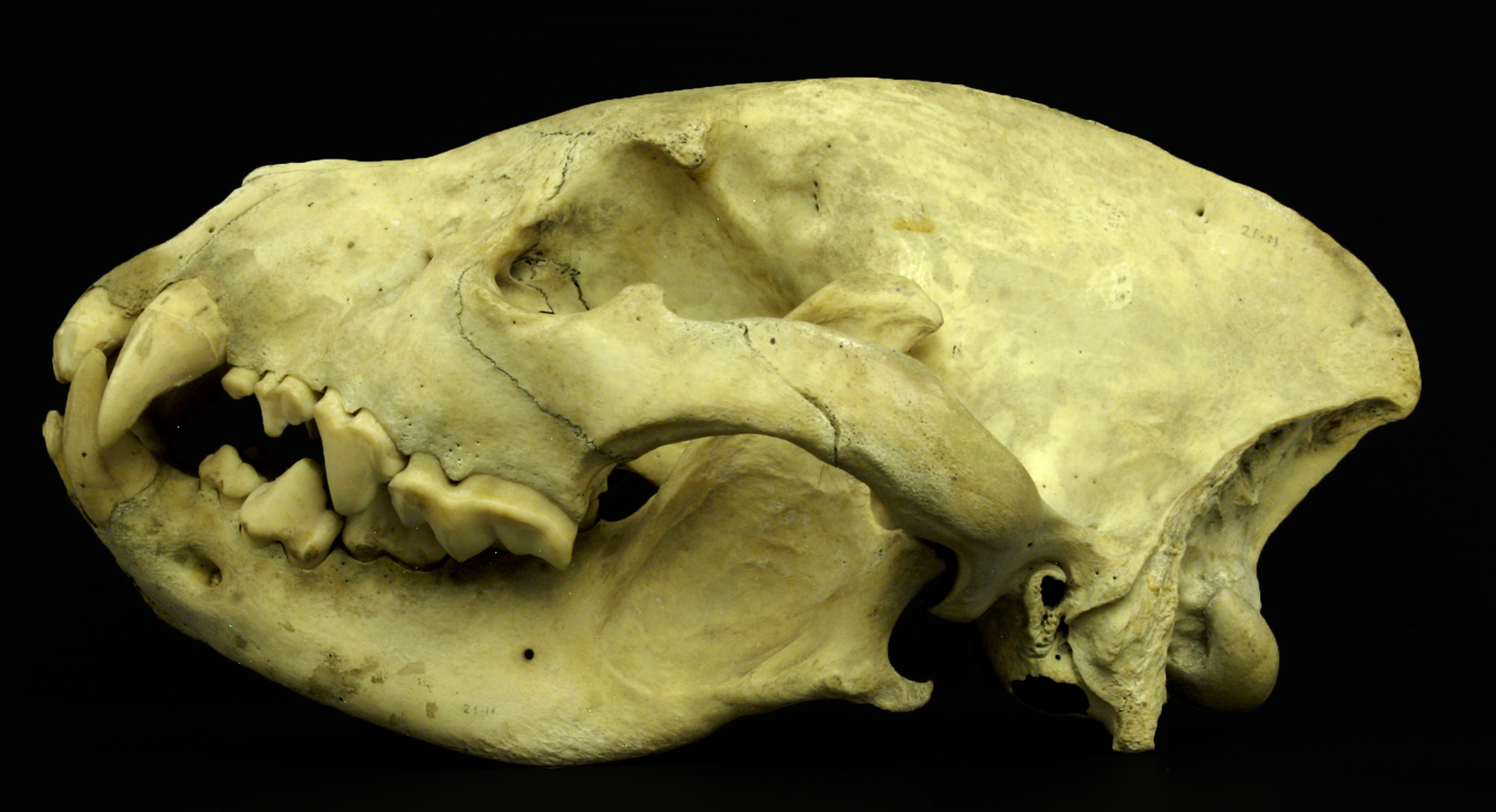
It is in fact the lower left third incisor (or i3) of Crocuta crocuta (Erxleben, 1777) – the tooth you can see in this (very gnarly) Hyaena mandible, although it’s much less worn:
Hyaenas have an incredibly thick enamel layer on their teeth which creates a distinct neck on the incisor where it stops, which is further defined by the root of the tooth bulging laterally below – presumably to help deal with the forces of prey capture and perhaps the Hyaena’s impressive bite strength.
The robust skull of a specialist bone-crusher
You probably don’t think of Hyaenas as being native to Ireland, but until 39,000 or so years ago they ranged right across Eurasia, including those parts of Europe which were to be cut off by changing sea levels to form Ireland and Britain.
It’s strange to imagine a species normally associated with the African savanna strolling around the Emerald Isle, but it’s worth remembering that the world is a constantly changing place and wildlife moves around to cope as the environment alters. Borders and boundaries are very human concepts and other species only pay attention when you have a genuine barrier, like an ocean, a mountain range or (if you’re a Dormouse) a break in the tree canopy.
That’s one of the problems with current climate change compared to past climate variations. The speed of change is so great that some species don’t have time to move into new habitats and there are fewer suitable habitats available, because humans have cleared them for farming or building. Meanwhile, some other species can find suitable habitats and are able to move – but they will then often be considered an invasive pest. Now the chances of Hyaenas returning to Ireland are pretty slim, but if they did I expect most people wouldn’t be too pleased, although you never know…
Kevin Richardson kisses hyena. Image by Kevin Richardson, 2007
Apologies for having such a belated answer to the belated mystery object from last week.
Things are really busy at the moment – I’m researching mermaids for a paper due to be submitted at the end of this month, curating an exhibition that’s due to open in September, double-checking the scientific accuracy in Jake’s book, doing talks, running PubSci, involved in recruitment for NatSCA, working on elements of the Horniman’s Bioblitz project and trying to write a grant application, on top of my more usual day-to-day work. That means I haven’t been able to spend the time on my blog that I would like. Hopefully everything will start getting back to normal in the next couple of weeks!
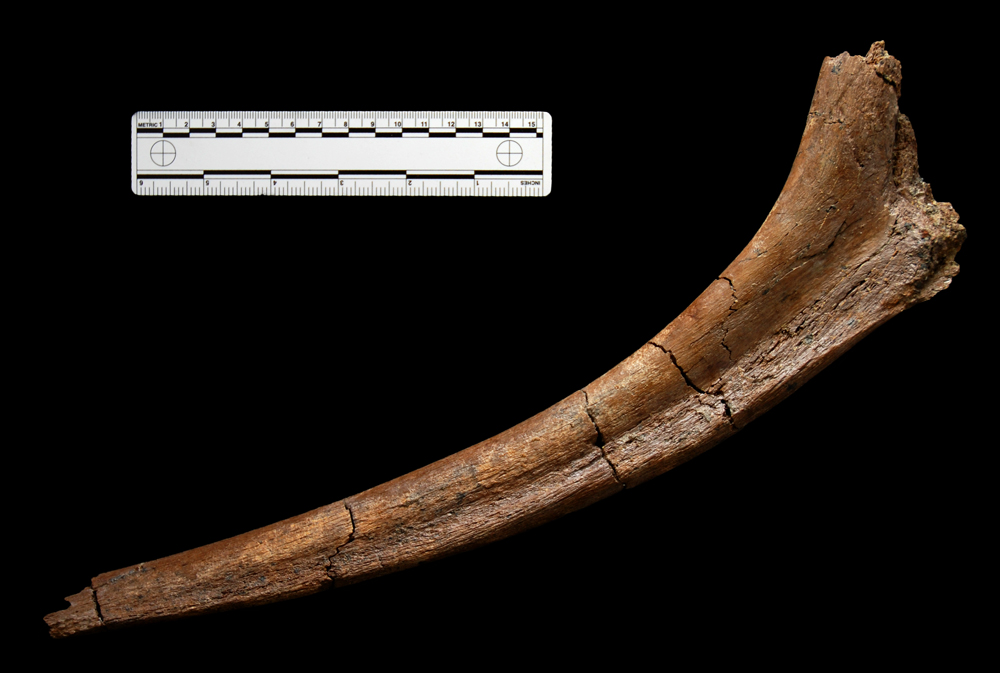
On to the answer – I’m afraid it will be brief… I asked what this bone was:
Carlos recognised this as a rib and there were a variety of suggestions about what it might be from, ranging from a cetacean to a mammoth. Some good ideas, but Lena came closest with speculation about dinosaurs.
This is in fact the rib of a Triceratops Marsh 1889.
There is a lot that could be said about Triceratops and other horned dinosaurs, but since I’m pushed for time I will just leave you with a link to an article by Darren Naish who knows more about such things than me and this brilliant stop-motion video from the 1925 film of The Lost World, which is simply iconic:
On Friday I gave you a palaeontological mystery object and asked you to choose what you thought it was from a poll:
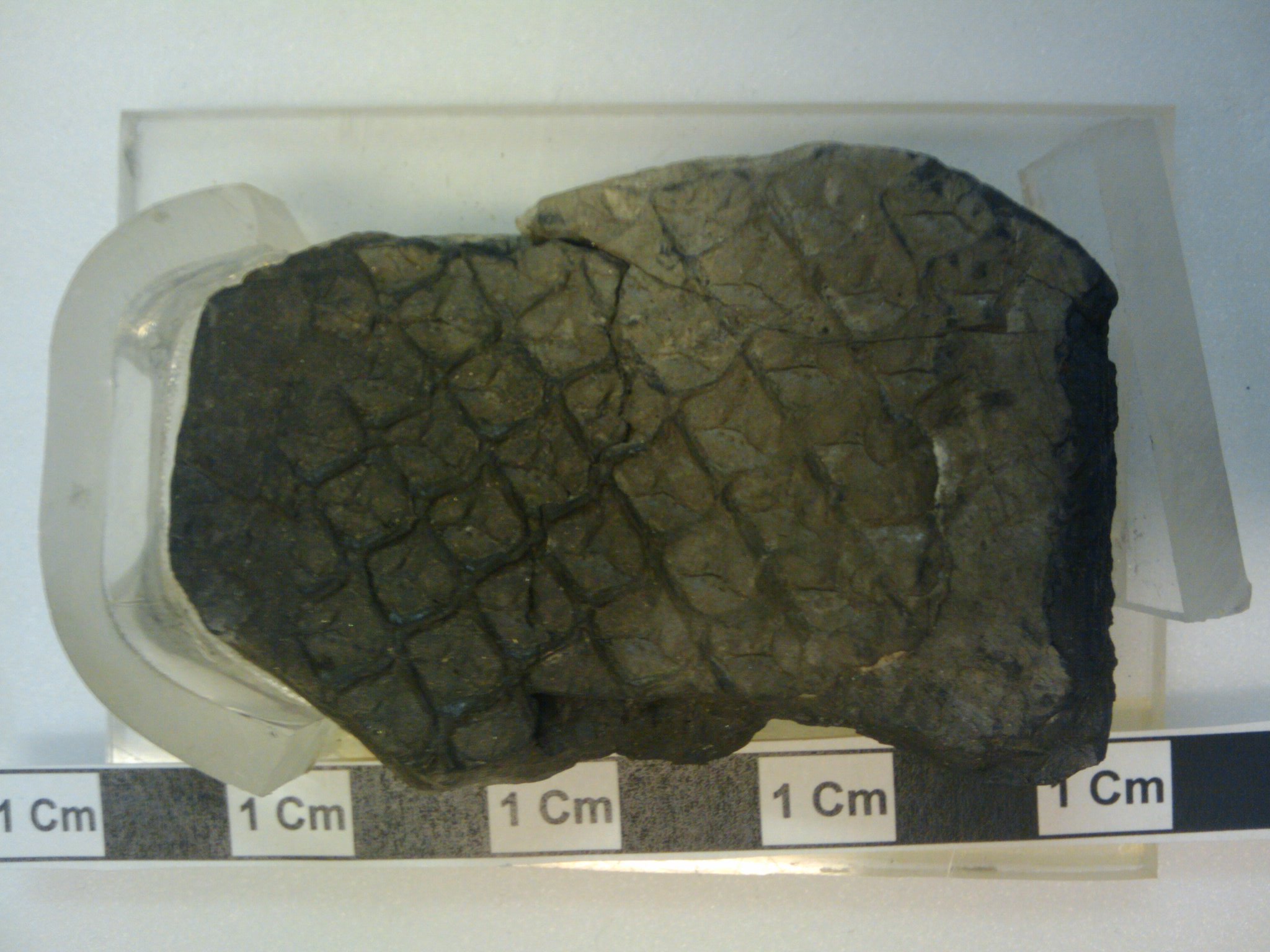
As it turns out, you did pretty well, with 60% of you selecting the correct category (with a couple of you making comments which went into greater detail). The object in indeed a piece of fossil Continue reading →










 Zygoma