Friday mystery object #206 answer

Apologies for having such a belated answer to the belated mystery object from last week.

Things are really busy at the moment – I’m researching mermaids for a paper due to be submitted at the end of this month, curating an exhibition that’s due to open in September, double-checking the scientific accuracy in Jake’s book, doing talks, running PubSci, involved in recruitment for NatSCA, working on elements of the Horniman’s Bioblitz project and trying to write a grant application, on top of my more usual day-to-day work. That means I haven’t been able to spend the time on my blog that I would like. Hopefully everything will start getting back to normal in the next couple of weeks!

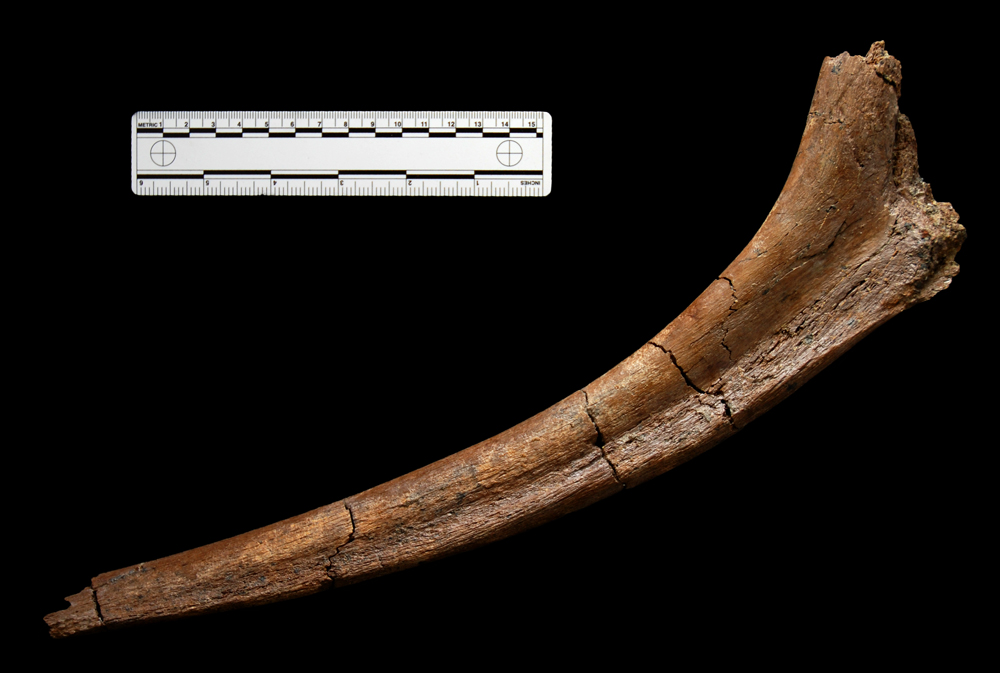
On to the answer – I’m afraid it will be brief… I asked what this bone was:

mystery206

Carlos recognised this as a rib and there were a variety of suggestions about what it might be from, ranging from a cetacean to a mammoth. Some good ideas, but Lena came closest with speculation about dinosaurs.

This is in fact the rib of a Triceratops Marsh 1889.

There is a lot that could be said about Triceratops and other horned dinosaurs, but since I’m pushed for time I will just leave you with a link to an article by Darren Naish who knows more about such things than me and this brilliant stop-motion video from the 1925 film of The Lost World, which is simply iconic:

Friday mystery object #205 answer

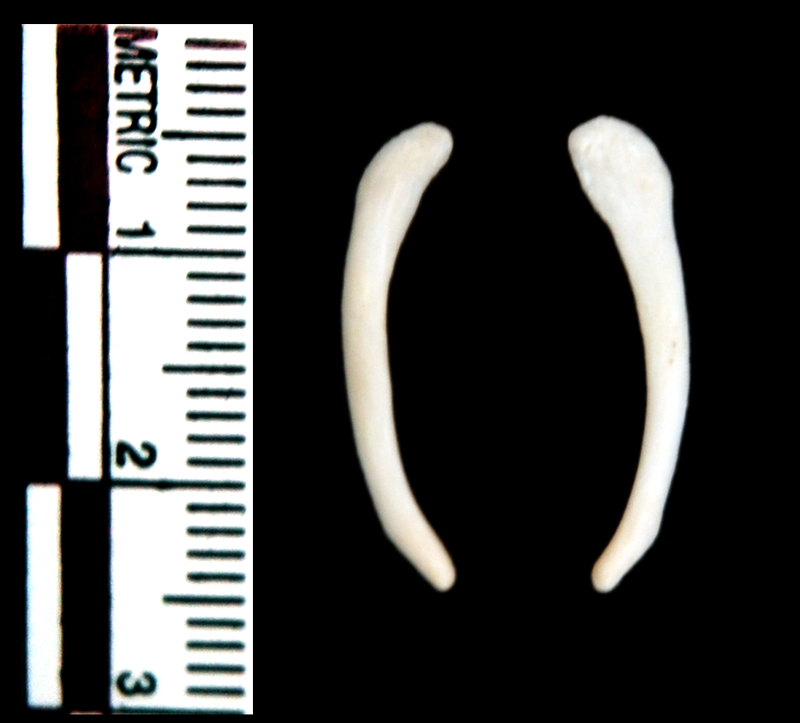
Last Friday I gave you these tiny bones to identify:

mystery205

Several suggestions were put forward with soph coming close with the suggestion of a broken furcula and Lena and henstridgesj correctly suggesting the clavicles (or collarbones) of a Cat Felis catus Linnaeus, 1758.

Cat clavicles, like the clavicles of a variety of other animals, are much reduced and are no longer connected to the scapulae (shoulder blades). This allows the scapulae to move much more freely during running, which can increase stride length and in the case of Cats it allows the animal to fit through holes big enough to get their heads through (assuming the Cat isn’t a bit too portly).

These sorts of vestigial structures are interesting from an evolutionary perspective, since they serve little or no direct function, but they still develop as a result of inheritance from ancestral forms that did use them.

In the case of Cats that form would have been around quite some time ago (probably 61.5 – 71.2 million years ago) since the closest related group to the Carnivora with a well-developed clavicle (that I can think of) would be the Chiroptera (bats), where it plays an important role in flight.

Since that divergence of the Chiroptera and the lineage giving rise to the Pangolins, Carnivora and Ungulata the clavicle has been pretty much completely lost, so it’s interesting that even a vestigial form occurs in Cats.

It’s funny to think how such small bones can raise questions that lead us through millions of years of evolution in search of answers, but that’s the nature of studying nature!

Friday mystery object #205

This Friday I have a mystery object inspired by something that might be making an appearance in Jake’s forthcoming book:

mystery205

Any idea what these little pieces of bone might be?

As usual, you can put your comments, questions and suggestions below and I’ll do my best to reply. Enjoy!

Friday mystery object #203 answer

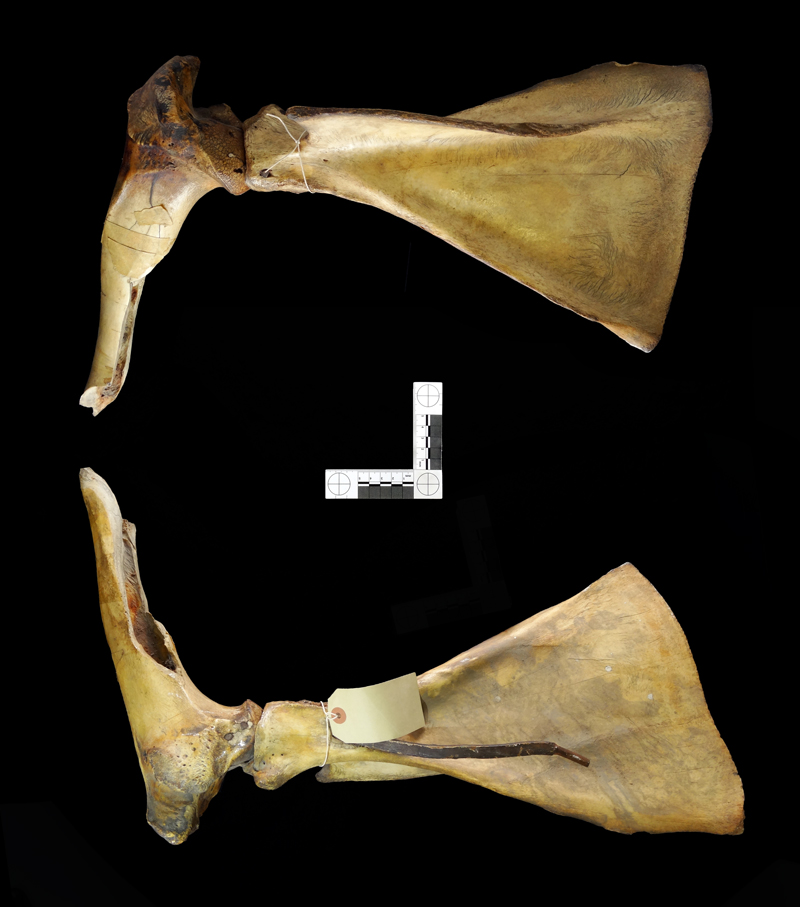
Last Friday I gave you this rather large scapula that I discovered in a crate in the Horniman’s stores to identify:

mystery203

It wasn’t an easy one, since there are relatively few distinctive features on a scapula compared to something like a skull.

Jake has talked about scapulae on his blog before and that provides a good place to see that this specimen is most likely from an ungulate – but an ungulate much bigger than a Red Deer. This led to suggestions for Cow, Horse, Aurochs and one of the larger species of deer. 

Outside the comments section on Zygoma there were also suggestions of Giraffe and Giant Irish Deer and I wondered about Camel.

All in all, there were a lot of suggestions, but none of these looked quite right when I searched for comparative material – although finding good images of scapulae online wasn’t easy. I did, however, find a useful video explaining the differences between Horse, Cow (or Ox) and Camel scapulae:

This was enough for me to rule out each of those animals, although the closest was the Cow – in particular the relative sizes of the two faces (called fossae) on either side of the raised ridge called the spine. However, the shape of the acromion (the hooked bit of the raised spine that points towards the shoulder joint) didn’t seem blunt enough for a Cow.

The size differences in the fossae turn out to be about the same in Sheep and deer as in Cow, which led me back in the direction of Jake’s deer scapulae, which seemed to most closely match the shape, if not the absolute size.

Taking the size into account I realised that this animal must stand almost twice the height of a Red Deer, which narrows it down to just one modern species – the Moose or Eurasian Elk Alces alces (Linnaeus, 1758), which can stand at over 2m at the shoulder compared to the Scottish Red Deer’s (still imposing) 1.22m.

Bull Chukotka Moose by Beloki

I still need to double-check my identification against a confirmed Moose scapula, but from looking at some images of Moose skeletons online it seems that the shape of both the fossae and the acromion fit well.

So a big thanks to everyone for their help in identifying this and special props to newcomer Jeanie who seems to have been spot-on about this being from a cervid. Thanks!

Friday mystery object #202 answer

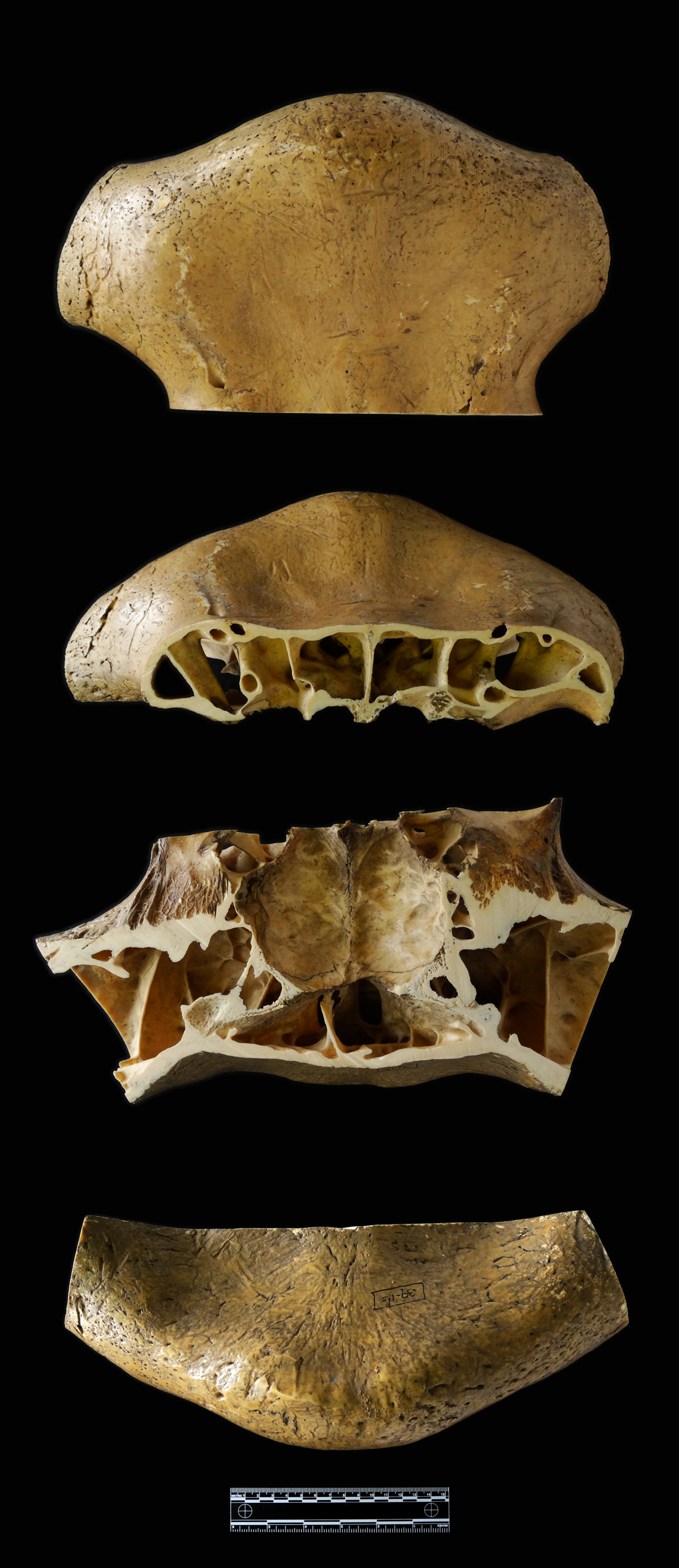
Last Friday I gave you this big chunk of bone to identify:

mystery202

I was hoping that it might be a little bit of a challenge because it doesn’t seem to have any really diagnostic characters, but your shape-matching skills were good and several of you managed to get a close identification.

Heather was straight in with the suggestion of it being the back part of the frontal bone (the bit that makes up the front and top of the skull) of an Aurochs – the very large, extinct ancestor of modern Cows. Wouter van Gestel also suggested one of the large bovids – the Asian Water Buffalo, and Ben Gruwier agreed with both Heather and Wouter in saying that it was from a large bovid.

This was as far as I had managed to get with the identification myself, however the specimen had a number (39.16), which I was able to check against the natural history registers. The first part of the number told me to check in the register for the year 1939 and it was the 16th entry for that year, so it was easy to find (unlike with some numbering systems with museum specimens).

It turns out that this specimen is in fact the frontal bone of a Gaur or Indian Bison Bos gaurus Smith,1827, and it turns out that the Gaur has a distinctive ridge between the horns, which is what this specimen is showing, so I should have been able to work it out from the morphology (I will be able to in future).

Gaur bull at Nagarhole National Park, India. By Dineshkannambadi

Bull Gaur can weigh up to 1.5 tonnes and stand 2.2m (7’2″) to the shoulder – they’re enormous. Their only natural predators are the Tigers and large Crocodiles they share their Southeast Asian forest habitat with, but even then Gaur have been known to kill Tigers by trampling and goring them.

Perhaps unsurprisingly these animals are far more risk from humans and have been hunted for meat and trophies until they have become threatened. They are protected by CITES (the Convention on International Trade in Endangered Species), but illegal trade continues and their forest habitats are constantly being lost due to human encroachment.

It’s disheartening that so many of my mystery objects end with a comment about human activities driving a species towards extinction, but unfortunately it’s a massive problem in the world we live in. I wonder if there will be any wild Gaur left in 2039, just 100 years after this specimen was collected?

Friday mystery object #197

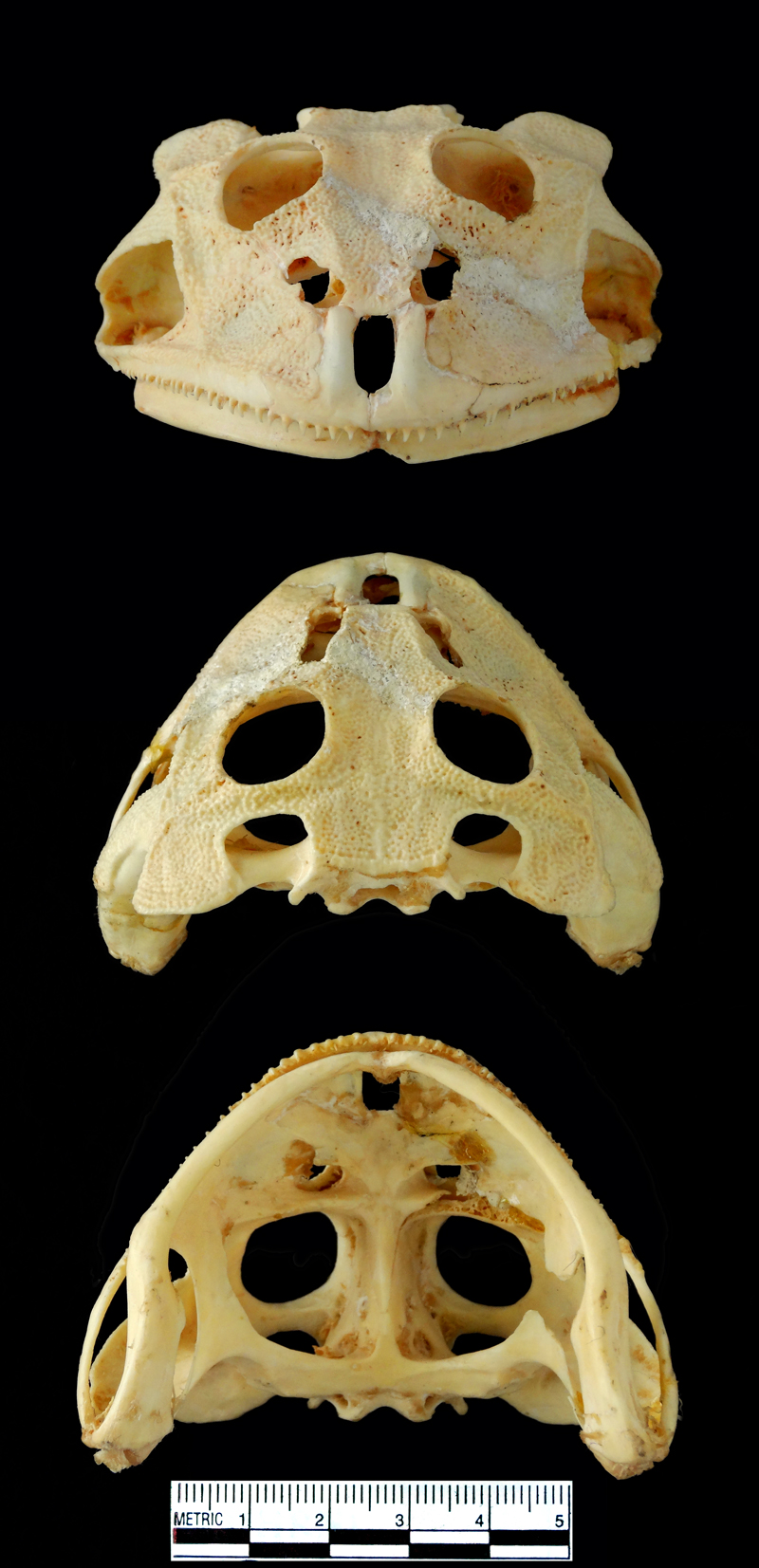
This week I have a skull for you to identify – to make a change from the more tricky specimens I’ve had recently. Any idea what this belonged to?

mystery197

As usual you can leave your comments, questions and suggestions below and I’ll do my best to respond. Enjoy!

Friday mystery object #196 answer (well, not really)

On Friday I asked you to help me identify this mystery object:

mystery196

Many thanks to everyone who made suggestions about what this sacrum and caudal vertebrae (the bones that make up the tail) could be from. There were some useful ideas that I intend to follow up on, but alas I must apologise to you all because I’ve still not managed to make a confident identification (as yet).

I always struggle with the identification of vertebrae without having good comparative material. Skulls are straightforward to identify as they tend to contain lots of diagnostic features, but with vertebrae there are fewer distinctive feature that allow a straightforward species level identification.

In this case I’m still not sure whether this tail is from a marsupial, a monkey or a mustelid, although I’m pretty certain it’s from a mammal.

I think I may have to mop up some of the loose ends of mystery objects that I’ve not been able to confidently identify at some point, by making a trip to another museum with a bigger collection of postcranial material than I have available at the Horniman.

Of course, sometimes you just have to accept that there isn’t enough information associated with a specimen to make a confident identification at all. Sometimes you also need to ask whether it’s worth the extra time and resources trying to get a good identification for a specimen with no other good data about where, when and by whom it was collected.

This kind of information can turn an interesting display or teaching specimen into an even more useful research specimen, that can be used to address questions about species distribution, population genetics and evolution – amongst other things.

With a specimen that lacks these kinds of data – and which isn’t particularly visually exciting for display – it becomes more difficult to justify going to special efforts to identify it. Nonetheless, I know this specimen will bug me until I work out what it is!

Friday mystery object #190 answer

On Friday I gave you this skull to identify:

mystery190

The animal it comes from is quite distinctive, with loads of character, so it’s no big surprise that so many of you managed to identify it.

So well done to Jake, Dave Godfrey, henstridgesjMieke Roth, Wouter van Gestel, Steven D. Garber and Crispin – this is indeed a  Continue reading

Friday mystery object #189

This week I have another interesting skull that came up during one of our recent reviews:

mystery189

Any idea what animal this belonged to? You can put your suggestions below and I’ll do my best to reply, although I will be at the NatSCA conference today, so it will depend on the quality of internet access on my phone.

Friday mystery object #188

This week I have an object that came up in one of the Bioblitz collections reviews at the Horniman recently. It’s a great specimen, but it was misidentified by the preparators when it was purchased back in 1937 and that identification had never been corrected. Any idea what it should have been labelled as?

mystery188

You can put your suggestions, questions and observations below and I’ll do my best to reply. On Monday I’ll post the identification that our incredibly helpful specialist reviewer suggested, so you can see how you did. Good luck!

Happy Year of the Snake!

Today marks the start of the Chinese Year of the Snake and tomorrow we start the Herpetology phase of our collections review at the Horniman. How very apt!

Here’s a specimen labelled ‘Boa Constrictor’  that came to light while we were preparing for the review that I thought you might like:

snakeskeleton

Have a very prosperous and healthy Year of the Snake!

Friday mystery object #184 answer (well, not really)

On Friday I asked for your help with identifying this object:

mystery184

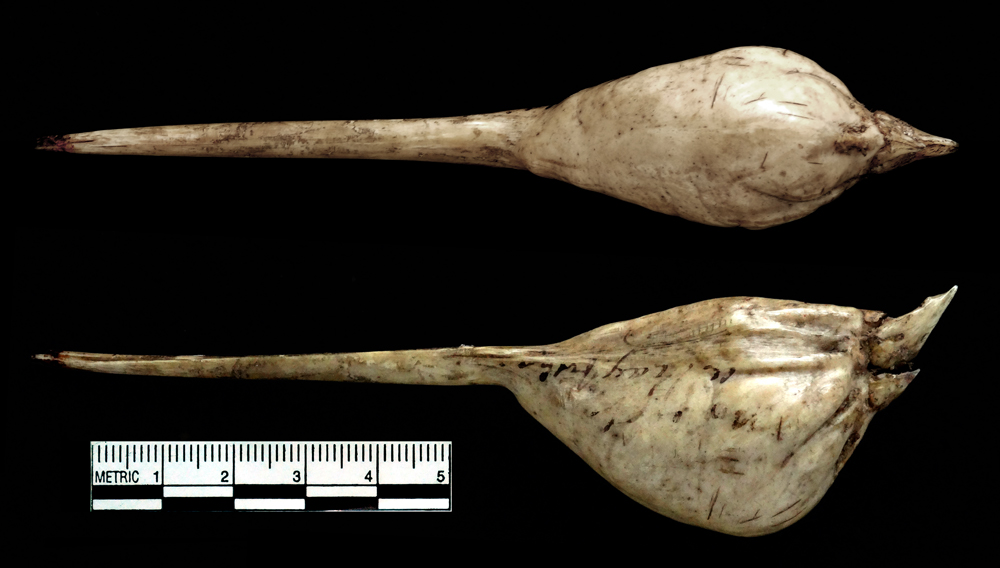
There were a few interesting suggestions from beaks to bladders, but so far nothing really corresponds with the structure of this specimen. It’s very weird.

It looks like it’s probably from something aquatic, perhaps the ossified swim bladder of a fish, but I’m by no means sure of that.

I will see if I can read the notes written on the specimen under a UV light, but for now I have to admit that I am still stumped. Please let me know if you recognise what it is!

[N.B. from the discussion and links in the comments below, it emerges that this is the hyperostotic spine from the anal fin of a fish]

Friday mystery object #183 answer

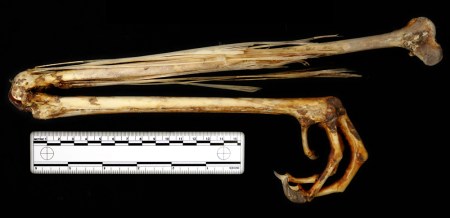
On Friday I asked for help with identifying an object that I came across while working on the Horniman’s bird collections for our forthcoming Bioblitz review:
mystery183a

I must say that I was surprised at how many people came and checked out this post and offered suggestions – largely following a retweet from the excellent QI Elves. Many thanks to everyone who offered their suggestions. In this post I’ll look at some of the suggestions and let you know what I’ve narrowed it down to.

Here’s an annotated version of the image to help make my terminology clear:

mystery183g

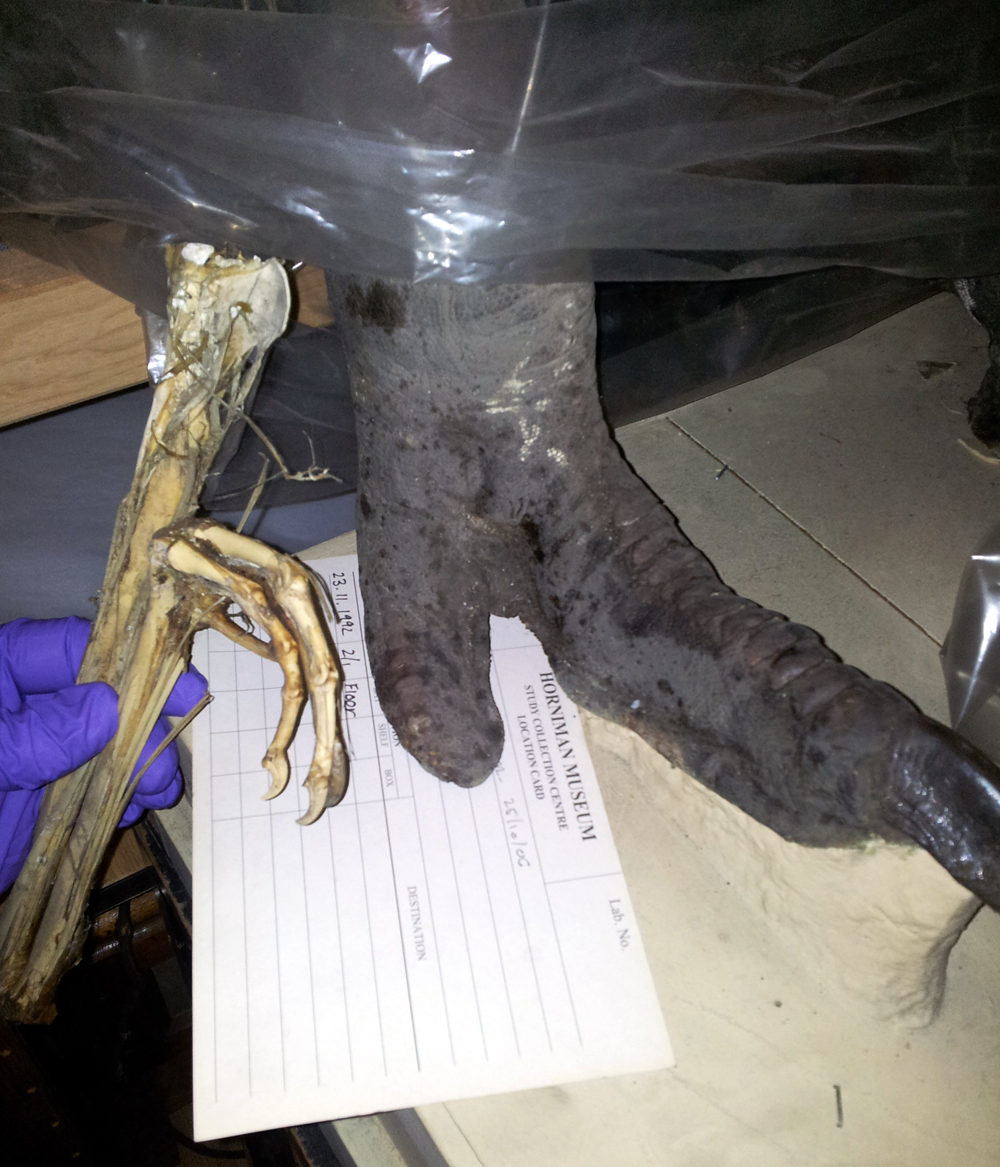
There were quite a few suggestions of Moa, Ostrich, Emu, Cassowary or Rhea (which are all Palaeognaths), but this leg is way too small and although the hallux is reduced it is definitely there, whereas in the Palaeognaths the hallux is absent. Here’s the specimen alongside an Ostrich foot:

mystery183f

A Secretarybird was another common suggestion and it was the first possibility that I thought of myself. Secretarybirds use their long legs to walk the plains of Africa in hunt of prey, which they stamp and kick to death. However, when compared to a Secretarybird in the Horniman’s collection it proved to be different in the relative proportions of the tibiotarsus and tarsometatarsus and the total length to the toes:

mystery183d

Seriemas were also suggested – these birds fill the same niche as the Secretarybirds, but in South America. They have one short digit with a sickle-like hunting claw, almost like a Velociraptor, however the mystery object has fairly equal length digits.

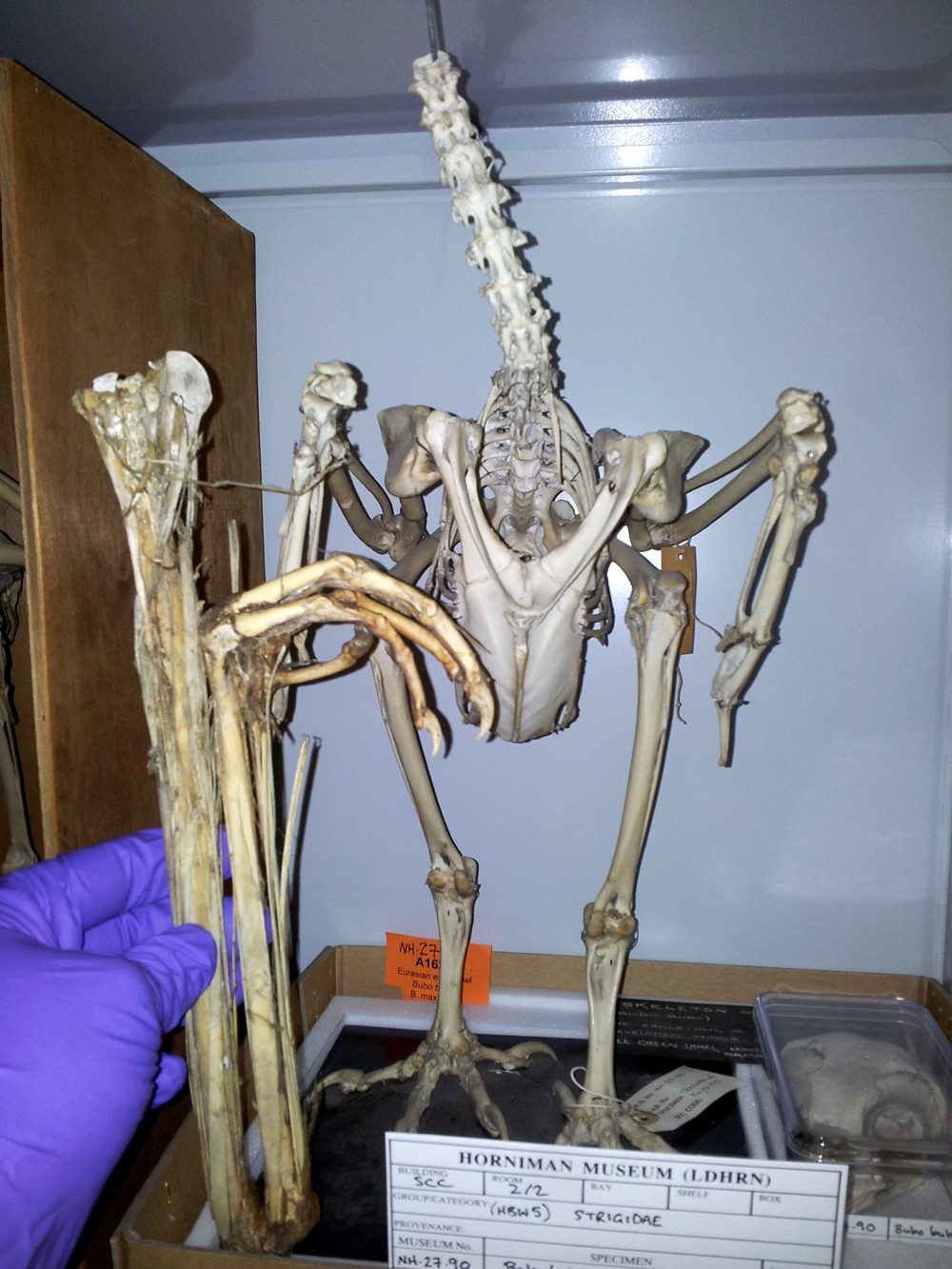
Owls were suggested, but this leg is far too long to have come from any species of Owl. Here’s the specimen compared to the biggest (or second biggest) species, the Eurasian Eagle Owl:

mystery183e

The suggestion of Owl probably arose because of the curved claw, which also looks a bit like it might belong to an Eagle or Vulture. However, the bones don’t seem to be robust enough for any of these kinds of birds. The claw confused me quite a bit, since most of the remaining possibilities are wading birds that don’t have big curved claws. This led me to reassess the claw by straightening out the digit of the mystery object in Photoshop to see if the apparent curve and size of the claw is actually a result of the postmortem clenching of the foot:

mystery183c

When viewed like this, the claw seems proportionally smaller and less likely to be from a predatory bird, especially considering that with flesh and skin on the bone the claw would seem even smaller.

This realisation made me reconsider the long-legged birds that I’d discounted at first – in particular the Herons, Storks and Cranes. I did consider Flamingo, but they have webbed feet and an even more reduced hallux than seen in the mystery object. Conversely, Herons could be excluded because they don’t have such a reduced hallux:

Heron Foot Detail by TexasEagle

Some Storks have limbs with the right sort of proportions – as helpfully summarised by henstridgesj:

The ‘FMO’: 1:0.73
Various Cranes: 1:0.7 – 1:0.8
Marabou Stork: 1:0.74
Maguari Stork: 1:0.75
Lappet-Faced Vulture: 1:0.63
Secretary Bird: 1:1
Flamingo: 1:0.84
Seriema: 1:0.87

But their claws seem too small and straight. That leaves the Cranes – as suggested by The Shonko Kid, André Rodenburghenstridgesj and Skullsite’s Wouter van Gestel. This would fit the proportions of the elements of the leg, the length of the hallux and the size and shape of the claws. It would also agree with the highly ossified tendons – a trait common to Cranes.

So, I don’t have a specific answer for you this week (that’s two weeks in a row!), but I think this leg probably belonged to one of the Cranes. Thanks for your help in getting that far!

Friday mystery object #183

This week I have another genuine mystery object for you to have a go at identifying. I found a pair of legs in the collection and although I can think of a few things that they don’t come from, I’m a bit stumped as to what they did come from. Here’s one to give you an idea of what they look like:

mystery183a


mystery183b

Any suggestions would be appreciated!

Friday mystery object #180 answer

On Friday I gave you this skull to identify:

mystery180

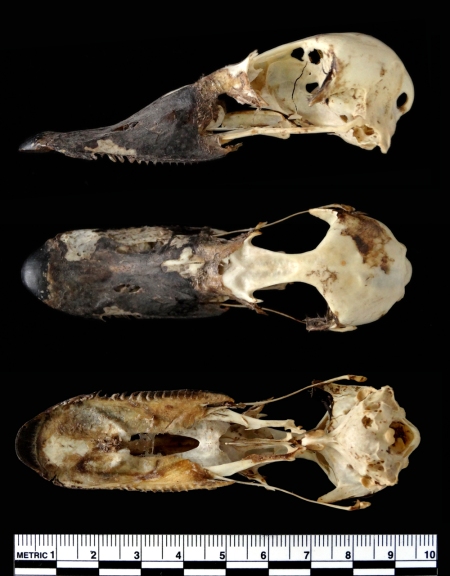
It was pretty clear that it’s from a modern animal with a duck-like bill, so either a Platypus or a member of the Anatidae (the family containing ducks, geese and swans).

There are about 140 species within the Anatidae, so narrowing it down to species was the challenge. For me the main features that help identify this duck from all the other species were the concave profile and the width to length relationship of the bill, the shape of the lacrimal bones (the bits in front of the eyes) – with the supraorbital processes bordering the salt glands, and the shape of the palate – with its mid-point deflection and flare.

It seems that some of you spotted some of these features too, since henstridgesj, miekeroth and Barbara Powell came to very similar conclusions. This skull looks like it belonged to a Common Scoter Melanitta nigra (Linnaeus, 1758) and a female Common Scoter at that, since the males have a much more inflated bill than this specimen.

Female Common Scoter photographed by Hilary Chambers

Female Common Scoter photographed by Hilary Chambers

Common Scoters are sea ducks that dive for small crustaceans, molluscs and sometimes fish. They are migratory birds and although there only a few hundred breeding the UK, there are larger flocks of visiting birds over the winter, although they’re hard to spot since they are usually a fair distance out to sea for much of the time.

Friday mystery object #179 answer

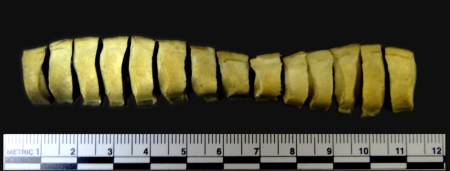
On Friday I gave you this really tricky mystery object to identify:

mystery179

Despite it being one of the hardest so far, Barbara Powell managed to not only work out what piece of morphology this specimen represents, but the species it came from. Remarkable skills Barbara!

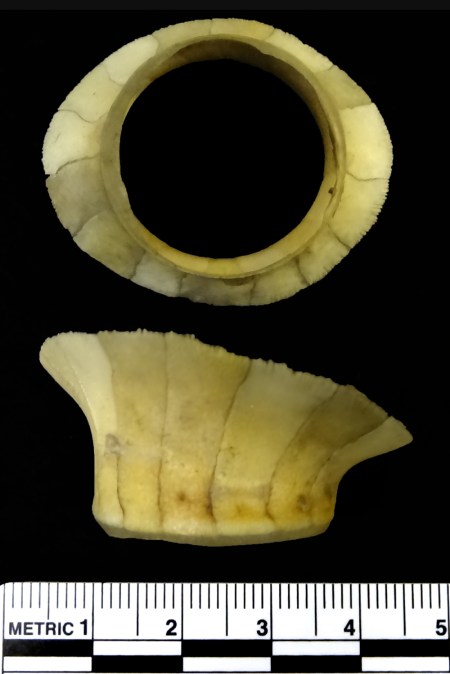
These plates of bone fit together to make a ring like this:

mystery179b

You probably have a better chance of identifying the structure when it’s assembled like this and the tubular shape is characteristic of a particular order of birds. This is the sclerotic ring of an  Continue reading

Friday mystery object #178 answer

On Friday I gave you this piece of a skeleton to identify, to help me track down the specimen it came from:

mystery178

It looks like a wing, but it’s quite oddly shaped. The humerus is strongly curved and the humeral head is small with a very limited area for muscle attachment. This suggests that it wasn’t much use for flying – it also wouldn’t have been much use for swimming underwater or any other kind of locomotion for that matter. This narrows down the possibilities quite a bit.

With these clues RH, henstridgesj and Lena all came to the same conclusion as I did – this wing is from a  Continue reading

Friday mystery object #175 answer

On Friday I gave you this anthropological mystery object to identify:

I asked you what the teeth might have belonged to and where in the world might this necklace be from.

It’s always a bit tricky to identify worked material as it will often be different from what you’d see or expect in the wild state and you lose the context of the rest of the specimen. Nonetheless, these teeth are quite distinctive to a particular group of animals.

Barbara Powell, 23thorns and Robin got the right general area with suggestions of Islands in the South Pacific, in particular New Guinea. 23thorns also nailed the animal group with his suggestion of  Continue reading