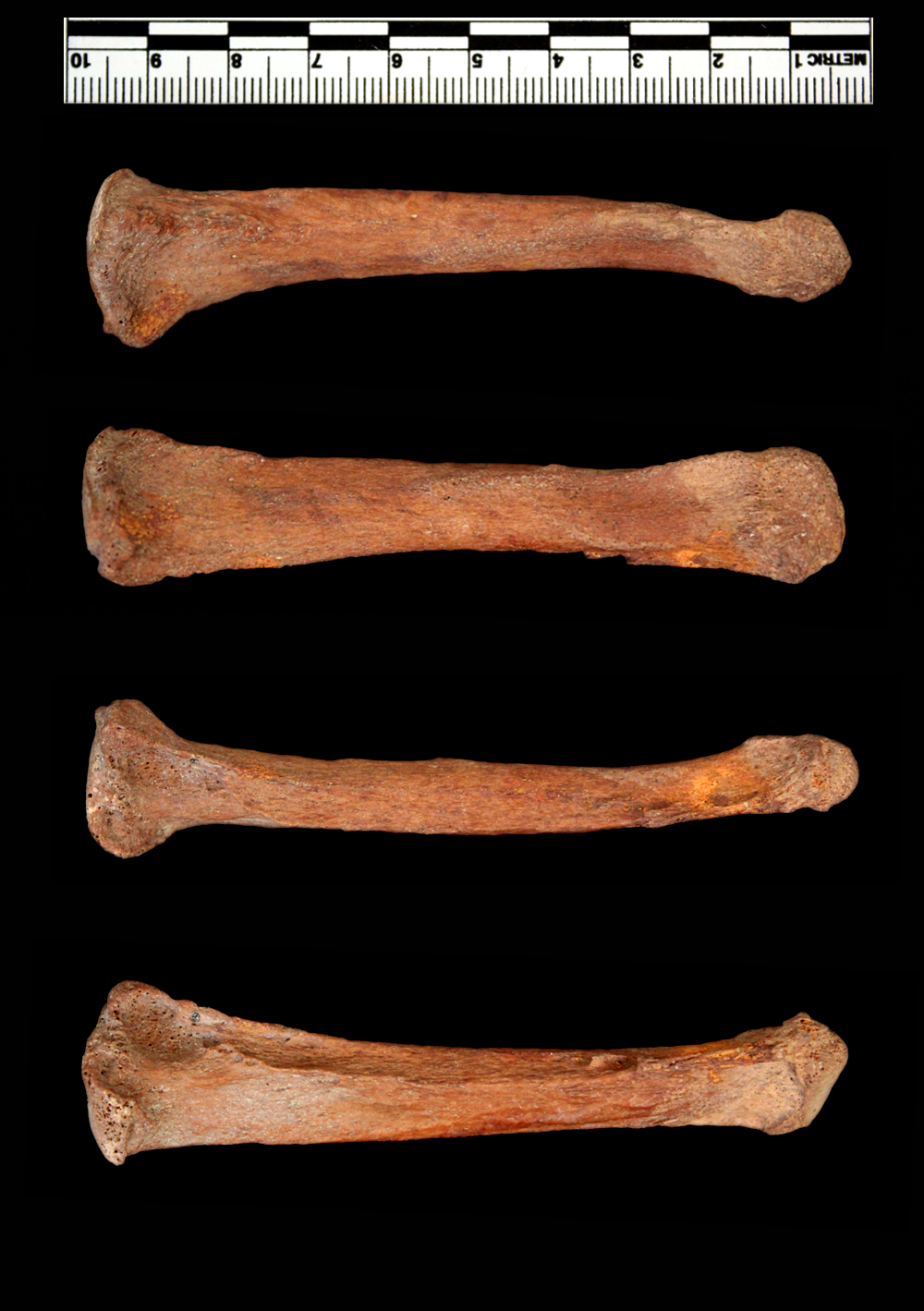
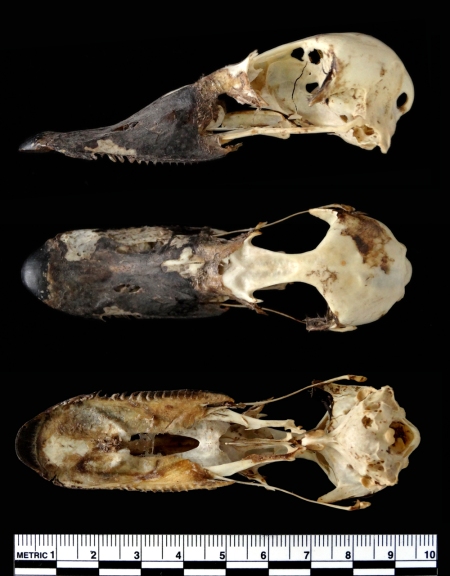
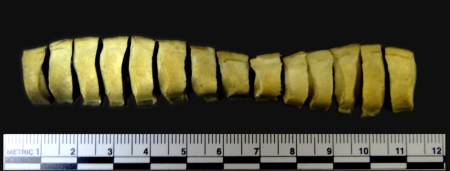
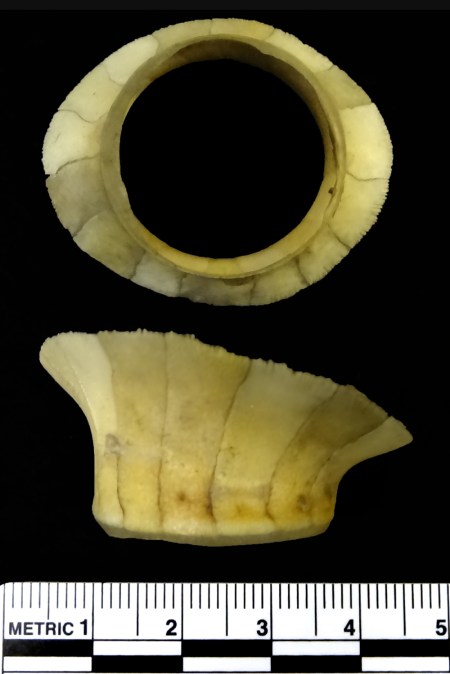
Friday mystery object #202 answer

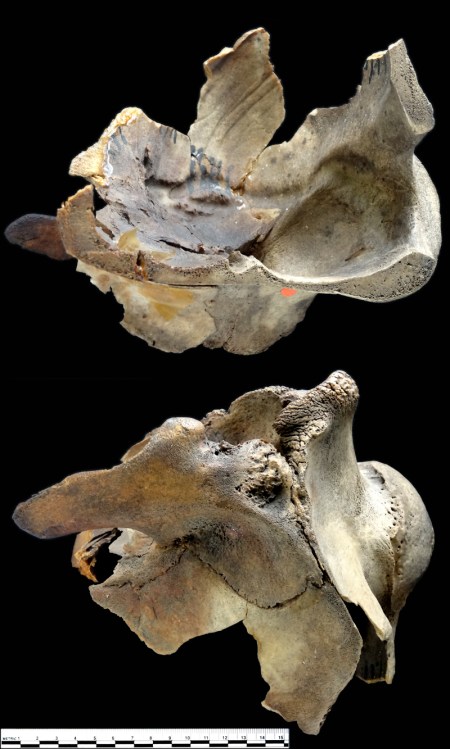
Last Friday I gave you this big chunk of bone to identify:
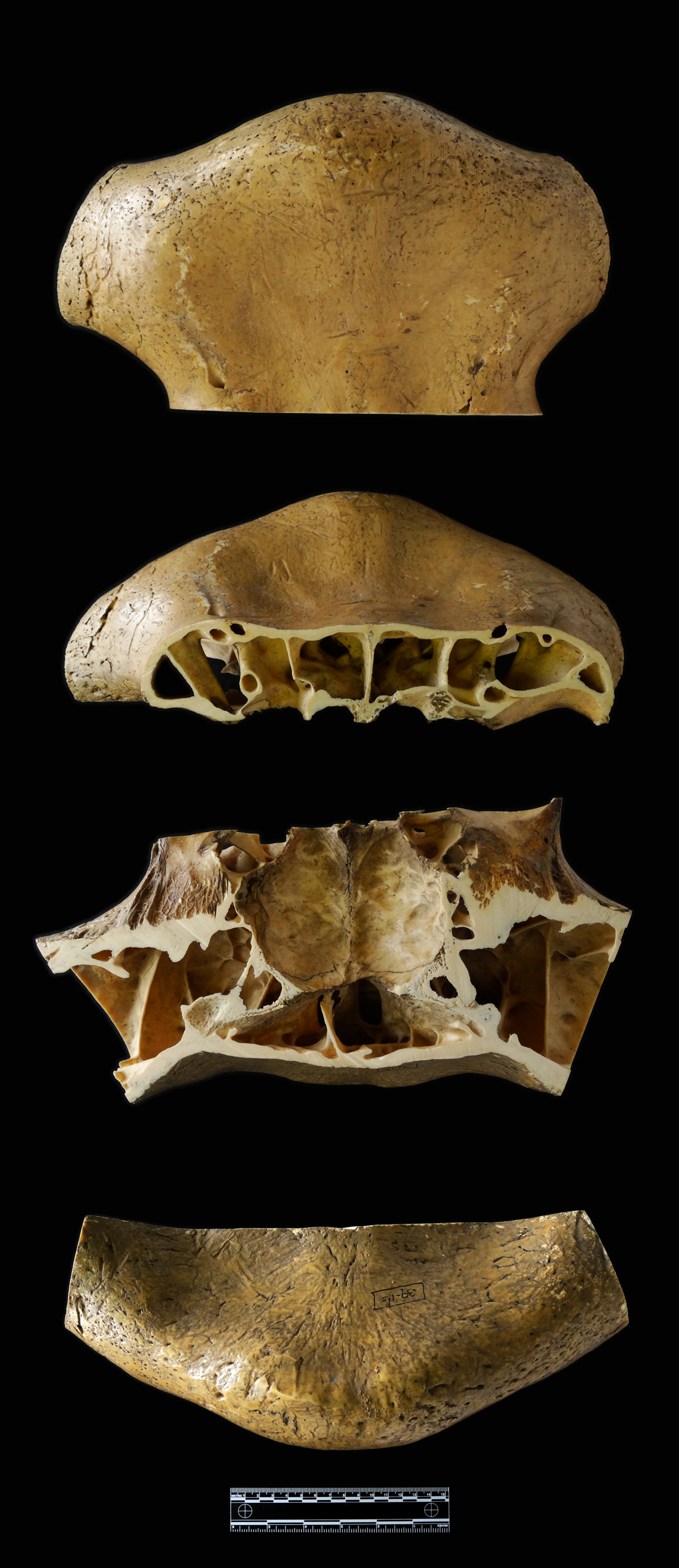
mystery202

I was hoping that it might be a little bit of a challenge because it doesn’t seem to have any really diagnostic characters, but your shape-matching skills were good and several of you managed to get a close identification.

Heather was straight in with the suggestion of it being the back part of the frontal bone (the bit that makes up the front and top of the skull) of an Aurochs – the very large, extinct ancestor of modern Cows. Wouter van Gestel also suggested one of the large bovids – the Asian Water Buffalo, and Ben Gruwier agreed with both Heather and Wouter in saying that it was from a large bovid.

This was as far as I had managed to get with the identification myself, however the specimen had a number (39.16), which I was able to check against the natural history registers. The first part of the number told me to check in the register for the year 1939 and it was the 16th entry for that year, so it was easy to find (unlike with some numbering systems with museum specimens).

It turns out that this specimen is in fact the frontal bone of a Gaur or Indian Bison Bos gaurus Smith,1827, and it turns out that the Gaur has a distinctive ridge between the horns, which is what this specimen is showing, so I should have been able to work it out from the morphology (I will be able to in future).

Gaur bull at Nagarhole National Park, India. By Dineshkannambadi

Bull Gaur can weigh up to 1.5 tonnes and stand 2.2m (7’2″) to the shoulder – they’re enormous. Their only natural predators are the Tigers and large Crocodiles they share their Southeast Asian forest habitat with, but even then Gaur have been known to kill Tigers by trampling and goring them.

Perhaps unsurprisingly these animals are far more risk from humans and have been hunted for meat and trophies until they have become threatened. They are protected by CITES (the Convention on International Trade in Endangered Species), but illegal trade continues and their forest habitats are constantly being lost due to human encroachment.

It’s disheartening that so many of my mystery objects end with a comment about human activities driving a species towards extinction, but unfortunately it’s a massive problem in the world we live in. I wonder if there will be any wild Gaur left in 2039, just 100 years after this specimen was collected?

Friday mystery object #201 answer

Last Friday I gave you this object to have a go at identifying:

mystery201

It was not an easy one and I was hoping that nobody would work out what it was, but as usual some of you managed to figure it out. So, big congratulations to cackhandedkate and Jake who suggested the surface of a tongue and henstridgesj for working out that these 2mm hooks are from the tongue of a cat – a BIG cat.

These are in fact the barbs or aculei  from the tongue of a young Tiger Panthera tigris (Linnaeus, 1758)

aculei_tiger_tongue

This small sealed box has no date associated, but the style of the label and the number suggest that it probably one of the early specimens acquired by Frederick Horniman before he built the Horniman Museum, dating to 1886 or perhaps earlier.

The aculei on cat tongues are interesting adaptations not seen in other carnivores (at least none that I can find any information for). The rows of hooks are ideal for grooming – like a stiff brush, but they are also a useful tool for removing meat from bones.

This is particularly handy when you have a relatively short face with incisors that form a broad straight row for clamping windpipes shut, unlike the narrower incisor row that you find in the dogs, which act a bit like like tweezers for removing meat on bone.

Photo of Tiger grooming by Tennessee Wanderer on Flickr

Photo of Tiger grooming by Tennessee Wanderer on Flickr

The aculei are made of keratin, the same protein that claws, hair and horns are made from. It may seem quite difficult to evolve lots of small claws on your tongue, but you might be surprised to know that the cells that secrete keratin (called keratinocytes) are the the most common cells on the surface of your skin (including your tongue) where they play an important role in fighting infection and repairing damage.

In order for these cells to secrete enough keratin to grow a small claw, they need to get a bit bigger so they can secrete more of the protein. They also need a simple mechanism that gives the resulting structure a useful shape.

Mammalian tongues are already covered in little structures called ‘papilla’, with three types containing taste buds and one type, the filiform papilla, that provide grip on the surface of the tongue, making it easier to eat ice-cream. It’s these filiform papilla that have adapted in the cats to make a structure with enough grip to lick the meat off a bone.

I’m actually a bit surprised that more mammals don’t have tongue barbs like cats, although there are other animals out there that have specialised tongues with other keratinous structures, like the horny tips of Woodpecker tongues and the tiny bristles of some Fruitbats.

Still, nothing says ‘obligate carnivore’ like a tongue covered in sharp hooks. Considering the length of the aculei I wouldn’t fancy being licked by a Tiger – their tongue looks like it could take human skin right off. However, it has given me an idea for how to quickly and easily remove wallpaper using a Tiger and a bucket or two of Bovril.

Friday mystery object #199 answer

On Friday I gave you this rather beautiful object to identify,which came to light during our mollusc Bioblitz last week:

mystery199

It turns out that it didn’t prove much of a challenge and was identified to species level in no time. So well done to Kevin, Anna Pike, @benharvey1 and Carlos Grau!

In fact, Carlos went a step further than identifying the specimen and told the very story I was planning to tell in this post. It’s great to hear stories like this about specimens or species, so I’ll share it with you in Carlos’ words:

This picture immediately brought back memories of my old seashell-collecting guide I had when I was about 12 and haven’t looked at for years and years (I will look for it next time I’m at my parent’s). The book said that this species was considered so valuable that fakes were made in rice paste by Chinese artisans, and that the counterfeits are now more rare and valuable than the actual shell! I remember finding that bit of information amazing.

It’s been so long I had to Google the book, it’s “Guide to Seashells of the World” by R. Tucker Abbott.

The animal is… Continue reading

Friday mystery object #198 answer

On Friday I gave you these two objects (with a third photo to show the end) to identify.

mystery198

The specimens had me a bit stumped. They are keratinous (keratin is the protein that makes up fingernail, hair and horn amongst other things) and perhaps unsurprisingly they had been labelled as “Artiodactyla horns” given their overall shape. Of course, if they were artiodactyl horns they would be from a bovid (antelope, sheep, cow, etc.), since the other artiodactyls don’t have unbranching horns.

There are nearly 150 bovid species, ranging from the gigantic Gaur to the miniature Royal Antelope, and so far I’ve not been able to find any with horns quite like this. Moreover, the very small size, pattern of growth and relatively shallow depth of the inside chamber of the sheath, don’t really agree with the identification.

My next thought was the spur of a galliform bird, like a Chicken. I compared these specimens to the spur of a male Chicken skeleton in the Horniman’s collection and they looked quite different and much too long, so I gave up on that idea.

Finally I started to consider claws of all sorts of animals, but this didn’t make much sense to me as claws aren’t usually round in cross-section and they have wear facets from being used to walk, climb or dig. You don’t have claws this big if you’re not going to use them and I couldn’t think of much use for a claw like this.

So that left me stumped.

Fortunately, Mieke Roth came to my rescue and made me reassess the Chicken spur identification. It turns out that the Chicken I compared the spur to much have had his spur sheaths  removed and they’d hardly grown back.

As you can see, the spur identification fits perfectly!

Many thanks to everyone for their suggestions on this mystery object. It really helps to have fresh eyes looking at a problem and suggesting something you’ve discarded in error!

Friday mystery object #197 answer

On Friday I gave you this skull to identify:

mystery197

As I suspected, it wasn’t too much of a challenge. Jake got in quick with the suggestion of a Sri Lankan Python, with Gina Allnatt, Kevin and Rhina Duque-Thues all agreeing with a generic Python sp. identification. Nicola Newton also suggested Python, but she was of the opinion that it was probably a Royal Python or Carpet Python on the basis of the size.

I agree with Nicola and think that this is most likely the skull of a Royal (or Ball) Python Python regius (Shaw, 1802), based on the size of the specimen and the shape of the supratemporal and frontal bones compared to other Pythons I was able to find images for (if you don’t know which bones I mean you can see what I mean on a handy annotated picture of a Python skull from the Digimorph website).

Pet ball python - normal phase, probably an import (rescue). By Mokele

The skull is one of several similar specimens from the old King’s College teaching collection, so it’s a pretty good bet that the skulls came from either research animals or pets. The Royal Python is a fairly small African Python that is commonly sold as a pet because it has a mild temperament – so that helps offer a bit of support for the identification, although what’s really needed is a detailed identification key for Python skulls or access to good comparative material.

The lack of good resources for identifying the skulls of snakes is a bit frustrating. After working with bird and mammal skulls, where there are some amazing resources like Skullsite and the Mammalian Crania Photographic Archive I’m still searching for something similar for reptiles. Perhaps the Deep Scaly Project will deliver the goods one day… here’s hoping!

Friday mystery object #196 answer (well, not really)

On Friday I asked you to help me identify this mystery object:

mystery196

Many thanks to everyone who made suggestions about what this sacrum and caudal vertebrae (the bones that make up the tail) could be from. There were some useful ideas that I intend to follow up on, but alas I must apologise to you all because I’ve still not managed to make a confident identification (as yet).

I always struggle with the identification of vertebrae without having good comparative material. Skulls are straightforward to identify as they tend to contain lots of diagnostic features, but with vertebrae there are fewer distinctive feature that allow a straightforward species level identification.

In this case I’m still not sure whether this tail is from a marsupial, a monkey or a mustelid, although I’m pretty certain it’s from a mammal.

I think I may have to mop up some of the loose ends of mystery objects that I’ve not been able to confidently identify at some point, by making a trip to another museum with a bigger collection of postcranial material than I have available at the Horniman.

Of course, sometimes you just have to accept that there isn’t enough information associated with a specimen to make a confident identification at all. Sometimes you also need to ask whether it’s worth the extra time and resources trying to get a good identification for a specimen with no other good data about where, when and by whom it was collected.

This kind of information can turn an interesting display or teaching specimen into an even more useful research specimen, that can be used to address questions about species distribution, population genetics and evolution – amongst other things.

With a specimen that lacks these kinds of data – and which isn’t particularly visually exciting for display – it becomes more difficult to justify going to special efforts to identify it. Nonetheless, I know this specimen will bug me until I work out what it is!

Friday mystery object #195 answer

On Friday I gave you this mystery object from the collections at the Horniman Museum to identify:

mystery195

The bone is interesting because it was badly broken when the animal was alive. As Jake pointed out, the bone has healed without the attentions of a vet, so it hasn’t healed straight and there’s a lot of excess bone growth. This makes it harder to work out what the bone originally looked like.

Minioncat recognised that this is the humerus of a juvenile animal and although there were several species suggested on the basis of size, none seemed to quite fit.

Lena made a really helpful observation about the presence of a supracondylar foramen – which is the hole that can be clearly seen on the side of the bone in the top image, near the articulation on the right hand-side of the picture.

This foramen is something seen in some of the carnivores, like cats and mustelids, but the bone itself doesn’t really match any of the cat or mustelid bones that I compared it to.

When I first found this bone I though that it belonged to a tree-climbing (or arboreal) carnivore, because the head of the humerus would allow for a considerable range of movement (plus broken bones are common in arboreal animals). The only thing I could really think of that was likely was a small species of bear, since cat humeri are quite different from this.

However, on Twitter Raymond Vagell made the inspired suggestion that it could be the humerus of a Fossa Cryptoprocta ferox Bennett, 1833 – something that I never even considered.

Fossa (Cryptoprocta ferox) image by Ran Kirlian

I don’t have any Fossa postcrania for comparison and I can’t even find a good image of a Fossa humerus online, so it’s hard to check. There is a Fossa skeleton image on the Museum Victoria website, which shows that the humerus is pretty similar, but alas it’s a clear enough image to be more sure.

Once I started thinking about less commonly occurring carnivores I broadened my search and came across a paper with a comparative drawing of the humerus of a Binturong Arctictis binturong (Raffles, 1822), which is another tree-climbing mammal, with a similar humerus shape.

Binturong (Arctictis binturong) at Overloon, NL by Tassilo Rau

The long and short of it is that I still don’t know what specimen this mystery object came from, but I now have a fresh perspective for renewing my search, thanks to the people who get involved with the Friday mystery object. I will let you know if I get any further in my search for an identification, but I owe you all a big thanks for contributing!

Friday mystery object #194 answer

On Friday I gave you this rather unusual looking skull to identify:

mystery194

In fact, it’s so unusual that it doesn’t even look entirely like a skull, so it’s not surprising that the specimen proved a bit of a challenge.

Some elements (like the lower jaw) look a bit like they’re from a turtle, but other elements of the skull shape look more like they belong to an amphibian – from something like Necturus perhaps. Despite these similarities to some of the ‘basal’ tetrapods, the skull is actually from a fish.

The reason why it looks quite similar to a tetrapod skull and less like the average fish is because it belongs to a member of the Lobe-finned fish (Sarcopterygii) which are more closely related to the tetrapods than the more common and diverse Ray-finned fish (Actinopterygii). Despite the difficult identification, microecos managed to spot that this was a Lungfish and henstridgesj managed to identify the species as being the  Continue reading

Friday mystery object #193 answer

On Friday I gave you this specimen to identify:

mystery193

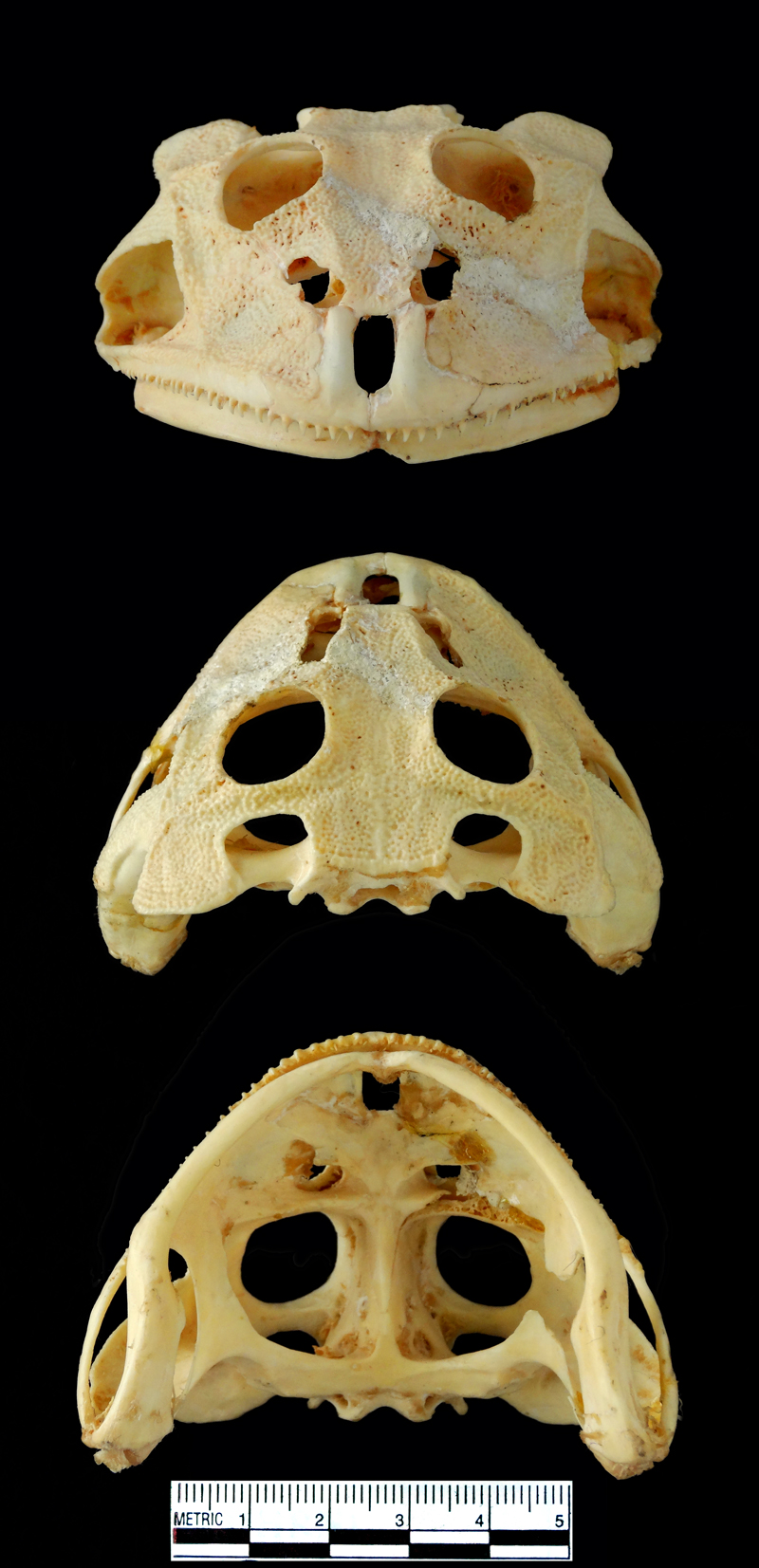
Unsurprisingly you all recognised it as a tortoise carapace. The species was a bit more difficult though as tortoises can display quite a lot of variation in their colour and shell structure within a species.

There were various good suggestions, but in the comments only Barbara Powell made reference to what Colin McCarthy and myself thought this was from, although Maggie J Watson also identified it in a tweet.

When we saw the specimen we thought that it was probably a  Continue reading

Friday mystery object #192 answer

On Friday I gave you this unidentified specimen from the Horniman’s collections to take a look at. I had already had a go at working out what it is, but it never hurts to get a second opinion.

mystery192

It’s actually a bit of a generic looking overall shape, perhaps reminiscent of a owl or a maybe a pheasant of some sort. However, the nares (nostrils) are very small and round and set in a bill that is sharp, shortish and very solidly constructed, which is something you only really see in a few passerines, some parrots and the falcons. The skull is too big for a passerine and the bill is totally the wrong overall shape for a parrot, which leaves us with a falcon – a fairly small one at that.

From there the shape of the palate and the proportions of the cranium led me to a species identification that I’m pleased to say agreed with that proposed by Tony Irwin and Wouter van Gestel (who eloquently explained the indicative characters that I mentioned above). We all think that this is the cranium of a  Continue reading

Friday mystery object #190 answer

On Friday I gave you this skull to identify:

mystery190

The animal it comes from is quite distinctive, with loads of character, so it’s no big surprise that so many of you managed to identify it.

So well done to Jake, Dave Godfrey, henstridgesjMieke Roth, Wouter van Gestel, Steven D. Garber and Crispin – this is indeed a  Continue reading

Friday mystery object #187 answer

On Friday I gave you this somewhat odd object to identify:

mystery187

My first thought when seeing it was Bowser from the Mario games:

Bowser. New Super Mario Bros. 2: © 2012 Nintendo

This probably isn’t the worst place to start the identification, since the animal with this feature was clearly big, scaly and toothy. This was obviously in the minds of Barbara Powell and Wouter van Gestel, who reached the correct conclusion that this is the structure from the tip of the snout of an adult male  Continue reading

Friday mystery object #185 answer

On Friday I gave you this object to identify:

mystery185

I thought it might have posed a bit of a challenge, since it’s part of a species of bird that you don’t find in Europe or North America. Of course, I was forgetting the skills of the Zygoma community. Everyone recognised it as the sternum of a bird with weak flight muscles and Wouter van Gestel spotted the species and was supported in his identification by Barbara Powell and Robin.

This is the sternum of a Continue reading

Friday mystery object #183 answer

On Friday I asked for help with identifying an object that I came across while working on the Horniman’s bird collections for our forthcoming Bioblitz review:

mystery183a

I must say that I was surprised at how many people came and checked out this post and offered suggestions – largely following a retweet from the excellent QI Elves. Many thanks to everyone who offered their suggestions. In this post I’ll look at some of the suggestions and let you know what I’ve narrowed it down to.

Here’s an annotated version of the image to help make my terminology clear:

mystery183g

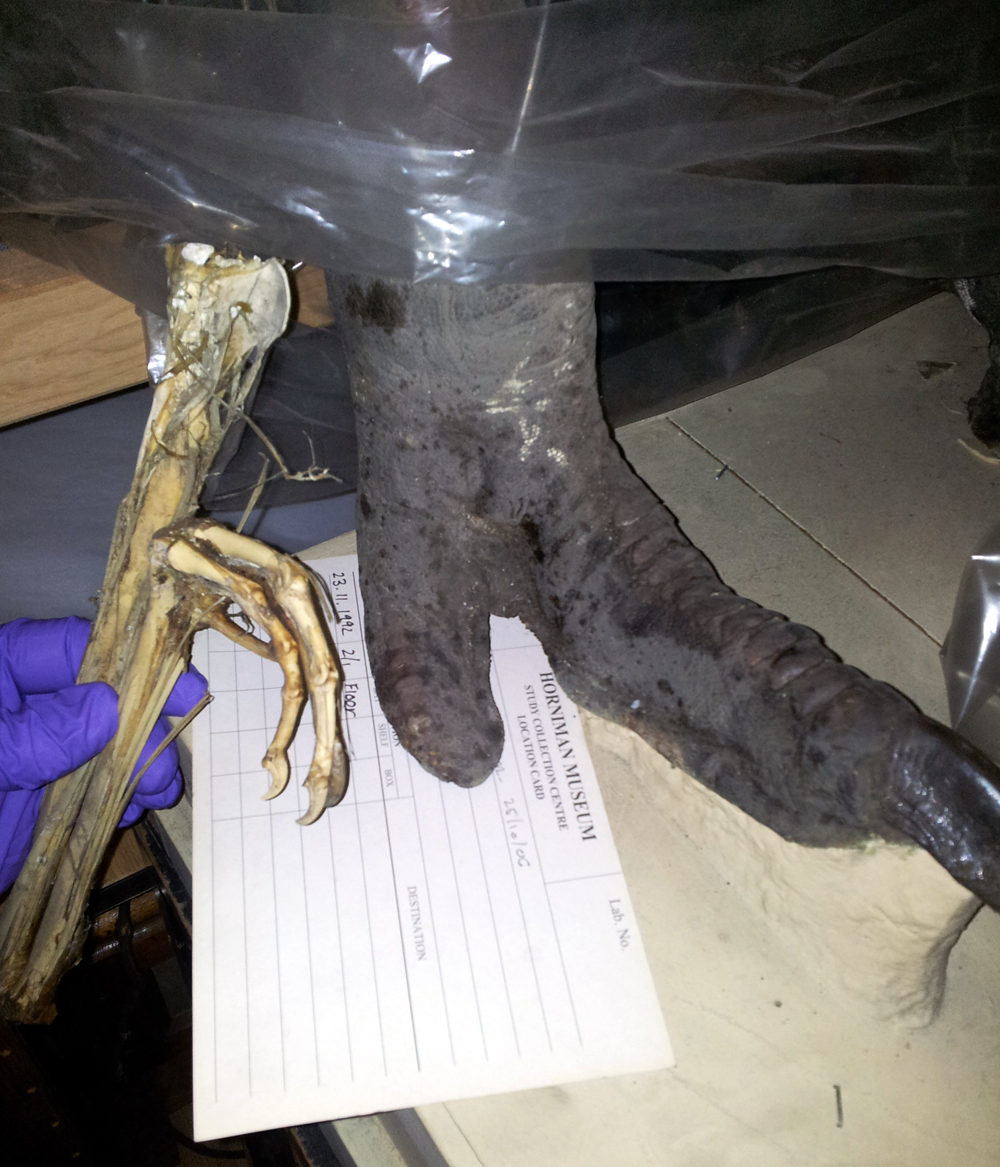
There were quite a few suggestions of Moa, Ostrich, Emu, Cassowary or Rhea (which are all Palaeognaths), but this leg is way too small and although the hallux is reduced it is definitely there, whereas in the Palaeognaths the hallux is absent. Here’s the specimen alongside an Ostrich foot:

mystery183f

A Secretarybird was another common suggestion and it was the first possibility that I thought of myself. Secretarybirds use their long legs to walk the plains of Africa in hunt of prey, which they stamp and kick to death. However, when compared to a Secretarybird in the Horniman’s collection it proved to be different in the relative proportions of the tibiotarsus and tarsometatarsus and the total length to the toes:

mystery183d

Seriemas were also suggested – these birds fill the same niche as the Secretarybirds, but in South America. They have one short digit with a sickle-like hunting claw, almost like a Velociraptor, however the mystery object has fairly equal length digits.

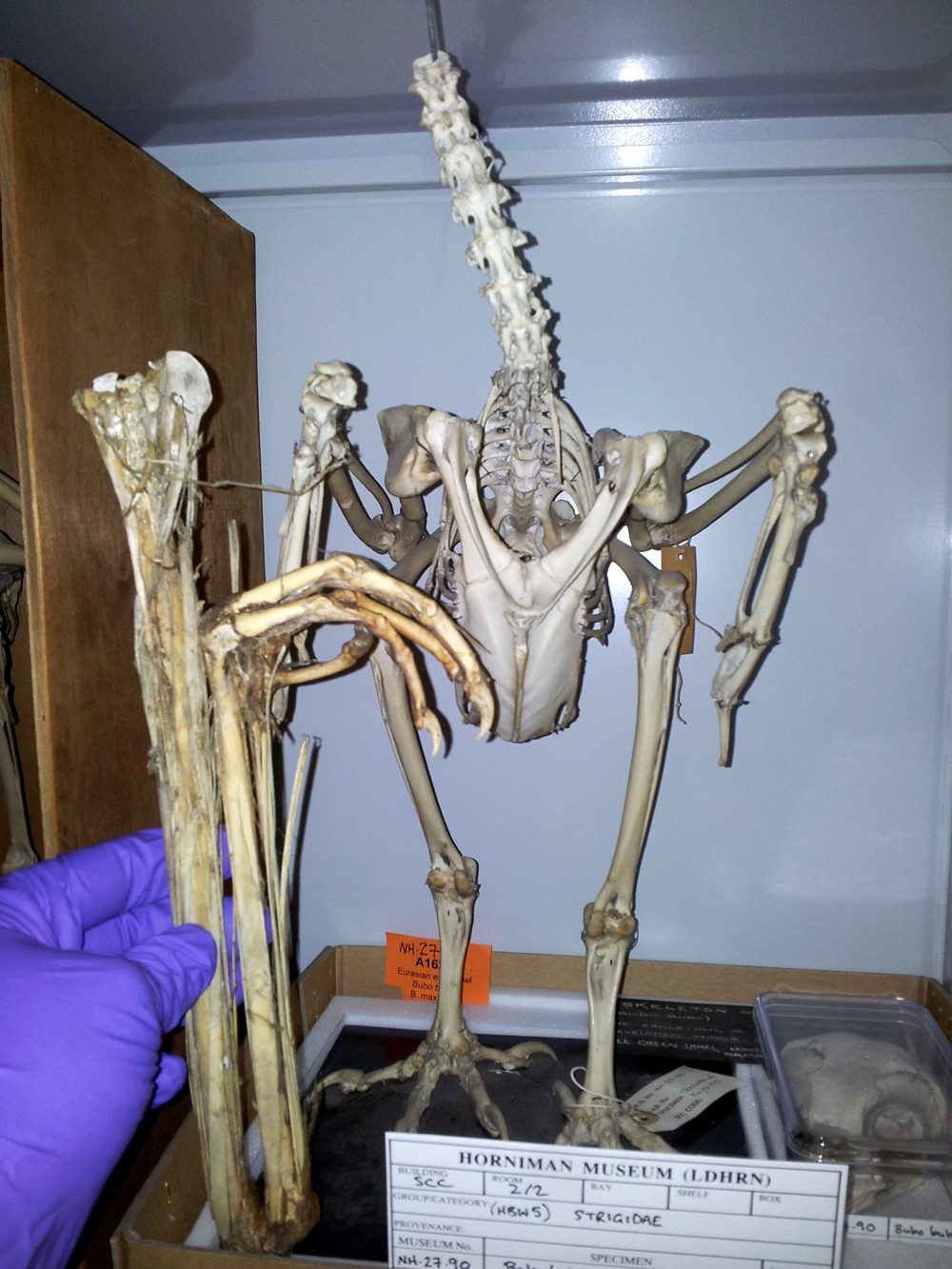
Owls were suggested, but this leg is far too long to have come from any species of Owl. Here’s the specimen compared to the biggest (or second biggest) species, the Eurasian Eagle Owl:

mystery183e

The suggestion of Owl probably arose because of the curved claw, which also looks a bit like it might belong to an Eagle or Vulture. However, the bones don’t seem to be robust enough for any of these kinds of birds. The claw confused me quite a bit, since most of the remaining possibilities are wading birds that don’t have big curved claws. This led me to reassess the claw by straightening out the digit of the mystery object in Photoshop to see if the apparent curve and size of the claw is actually a result of the postmortem clenching of the foot:

mystery183c

When viewed like this, the claw seems proportionally smaller and less likely to be from a predatory bird, especially considering that with flesh and skin on the bone the claw would seem even smaller.

This realisation made me reconsider the long-legged birds that I’d discounted at first – in particular the Herons, Storks and Cranes. I did consider Flamingo, but they have webbed feet and an even more reduced hallux than seen in the mystery object. Conversely, Herons could be excluded because they don’t have such a reduced hallux:

Heron Foot Detail by TexasEagle

Some Storks have limbs with the right sort of proportions – as helpfully summarised by henstridgesj:

The ‘FMO’: 1:0.73
Various Cranes: 1:0.7 – 1:0.8
Marabou Stork: 1:0.74
Maguari Stork: 1:0.75
Lappet-Faced Vulture: 1:0.63
Secretary Bird: 1:1
Flamingo: 1:0.84
Seriema: 1:0.87

But their claws seem too small and straight. That leaves the Cranes – as suggested by The Shonko Kid, André Rodenburghenstridgesj and Skullsite’s Wouter van Gestel. This would fit the proportions of the elements of the leg, the length of the hallux and the size and shape of the claws. It would also agree with the highly ossified tendons – a trait common to Cranes.

So, I don’t have a specific answer for you this week (that’s two weeks in a row!), but I think this leg probably belonged to one of the Cranes. Thanks for your help in getting that far!

Friday mystery object #182 answer

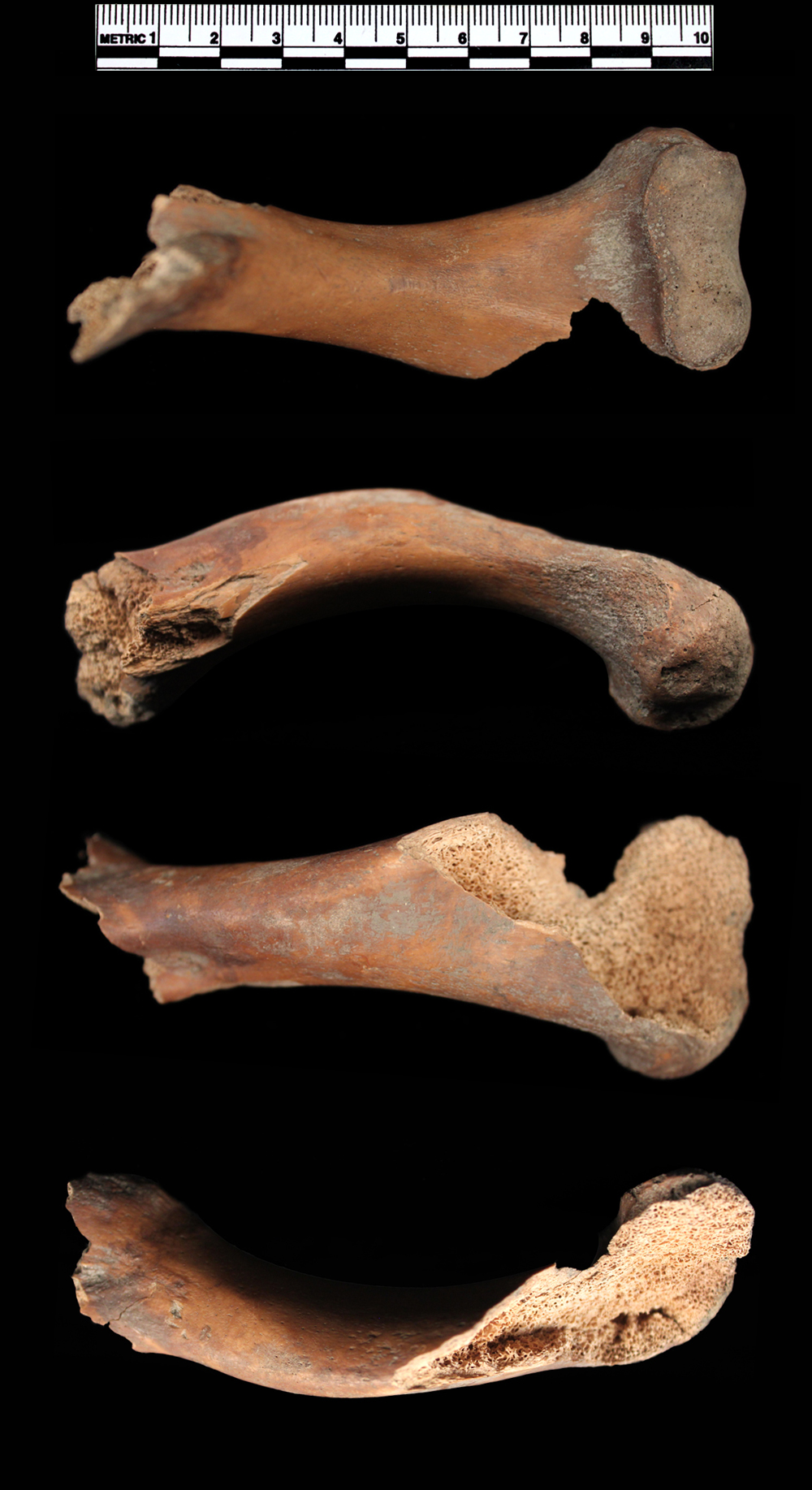
On Friday I gave you these objects to identify from Cyler Conrad, who came across them from an archaeological dig in San Francisco Bay:

mystery182a

mystery182b

I hasten to add that there is no certain answer to what these objects are, but I think there were some useful observations made by contributors and I will share my thoughts. Please feel free to continue the discussion in the comments below.

Barbara Powell and henstridgesj made some great suggestions, mainly focusing on marine mammals, particularly among the Otarids (Sea-lions and Fur-seals). Some of these large mammals certainly occur in the San Francisco Bay area (well, the Northern Fur Seal Callorhinus ursinus, Guadalupe Fur Seal Arctocephalus townsendi, Steller Sea-lion Eumetopias jubatus, California Sea-lion Zalophus californianus are all there) and they have femurs that are broadly the right size and shape as the bone in the top image – the humerus in these species is quite different, possessing a distinctive crest on the shaft.

However, I’m a bit thrown by the articular surface visible in the top image. In the Sea-lions and Fur-seals the femur has two distinct and narrow articulations with the tibia and fibula, since these animals bear weight on their hind flippers. The fact that the top specimen only shows one broad and fairly poorly defined articulation makes me think it may belong to a Phocid seal (which drag their hind flippers), which for this area would either mean a Northern Elephant Seal Mirounga angustirostris or Harbour Seal Phoca vitulina.

Given the size, I would think it would either be the femur from a large male Harbour Seal (although males are only slightly bigger than females) or a smaller female Elephant Seal, but unfortunately I can’t find comparative material to help draw a conclusion. What I have noticed is that the Harbour Seal does tend to have a relatively broader femur than we see here, but without an Elephant Seal femur for comparison I’m stumped.

The other bone looks like the first metacarpal of one of these animals and doesn’t really add much more information.

Alas, sometimes identifications are hard to make with confidence.

Friday mystery object #181 answer

On Friday I gave you this bird skull to identify:

mystery181

I thought it might prove a bit of a challenge, since it belongs to a bird that isn’t found in Europe or North America. However, the skull shape and size is quite unique and I was forgetting the impressive skills of the Zygoma readers, so it didn’t take too long for Barbara Powell, Wouter van Gestel (who I believe may be involved in SkullSite.com – one of my favourite web resources) and henstridgesj to narrow it down to the correct species.

This skull belongs to a member of the Cuculiformes, family Musophagidae (‘banana-eaters’) and to be specific it’s from a   Continue reading

Friday mystery object #180 answer

On Friday I gave you this skull to identify:

mystery180

It was pretty clear that it’s from a modern animal with a duck-like bill, so either a Platypus or a member of the Anatidae (the family containing ducks, geese and swans).

There are about 140 species within the Anatidae, so narrowing it down to species was the challenge. For me the main features that help identify this duck from all the other species were the concave profile and the width to length relationship of the bill, the shape of the lacrimal bones (the bits in front of the eyes) – with the supraorbital processes bordering the salt glands, and the shape of the palate – with its mid-point deflection and flare.

It seems that some of you spotted some of these features too, since henstridgesj, miekeroth and Barbara Powell came to very similar conclusions. This skull looks like it belonged to a Common Scoter Melanitta nigra (Linnaeus, 1758) and a female Common Scoter at that, since the males have a much more inflated bill than this specimen.

Female Common Scoter photographed by Hilary Chambers

Female Common Scoter photographed by Hilary Chambers

Common Scoters are sea ducks that dive for small crustaceans, molluscs and sometimes fish. They are migratory birds and although there only a few hundred breeding the UK, there are larger flocks of visiting birds over the winter, although they’re hard to spot since they are usually a fair distance out to sea for much of the time.

Friday mystery object #179 answer

On Friday I gave you this really tricky mystery object to identify:

mystery179

Despite it being one of the hardest so far, Barbara Powell managed to not only work out what piece of morphology this specimen represents, but the species it came from. Remarkable skills Barbara!

These plates of bone fit together to make a ring like this:

mystery179b

You probably have a better chance of identifying the structure when it’s assembled like this and the tubular shape is characteristic of a particular order of birds. This is the sclerotic ring of an  Continue reading

Friday mystery object #178 answer

On Friday I gave you this piece of a skeleton to identify, to help me track down the specimen it came from:

mystery178

It looks like a wing, but it’s quite oddly shaped. The humerus is strongly curved and the humeral head is small with a very limited area for muscle attachment. This suggests that it wasn’t much use for flying – it also wouldn’t have been much use for swimming underwater or any other kind of locomotion for that matter. This narrows down the possibilities quite a bit.

With these clues RH, henstridgesj and Lena all came to the same conclusion as I did – this wing is from a  Continue reading

Friday mystery object #177 answer

On Friday I gave you this scrappy bit of bone to identify:

mystery177

It came into the Horniman collections from King’s College in the 1980s and it was tentatively identified as a piece of ungulate bone. I’m pleased to say that you managed to do a better job of identifying the specimen than was done originally! In particular Jake managed to narrow it down to being part of the braincase of a cetacean, possibly a species of dolphin or porpoise, with henstridgesj and RH also thinking along the same lines.

When I first saw this piece of bone I also thought it belonged to one of the smaller toothed whales and so moved it from its place among the ungulates to a place in the collection with other cetaceans. This proved to be a fruitful move, since I was checking through the various bit of whale at work the other day and suddenly realised that there was a broken piece of whale rostrum also from the King’s College collection. When I put them together, this is what I got:

mystery177b

A perfect fit! This meant that the identification of toothed whale was confirmed and even better the specimen could be identified as being from a  Continue reading