This week I have a skull with character for you to identify. It will probably prove to be little challenge to some of you, but if you know what it is please try to use cryptic clues so you don’t spoil the game for others:
Put your thoughts below and I’ll be sure to make comments during the day. Enjoy!
On Friday I gave you this skull to have a go at identifying:
I didn’t do a very good job of responding to comments I’m afraid, as I was rather busy at day two of this year’s Natural Sciences Collections Association conference at the Yorkshire Museum. Nonetheless, you managed to work out what this specimen came from without any input from me.
Jake spotted that it was the skull of a big reptile, more importantly, a big reptile with heterodont dentition (meaning it’s teeth aren’t all the same shape). That narrowed down the possibilities considerably. From there henstridgesj, Wouter van Gestel and Barbara Powell came to the conclusion that this is the skull of a Continue reading →
This week I have another interesting skull that came up during one of our recent reviews:
Any idea what animal this belonged to? You can put your suggestions below and I’ll do my best to reply, although I will be at the NatSCA conference today, so it will depend on the quality of internet access on my phone.
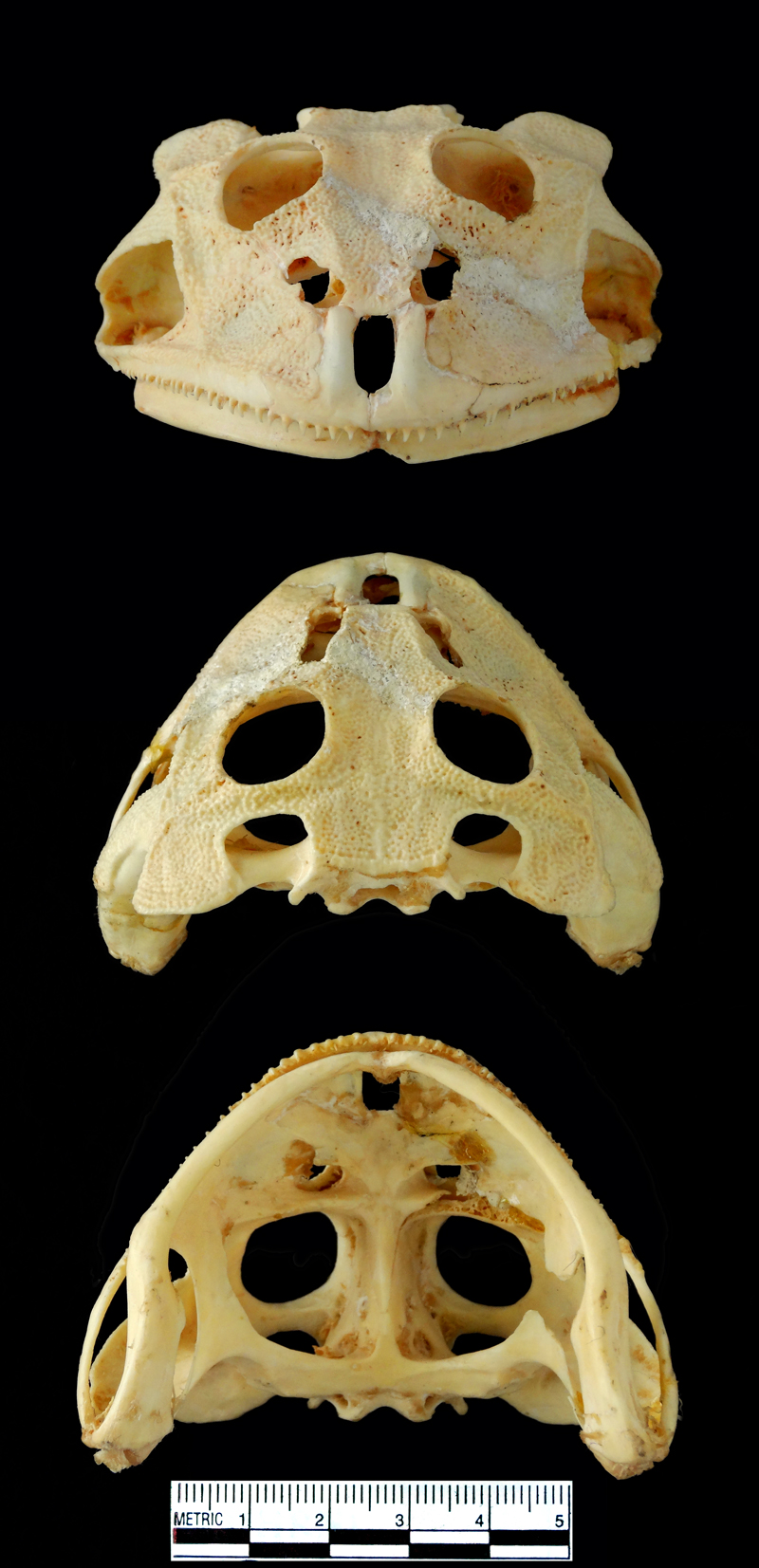
On Friday I gave you this previously misidentified specimen to have a go at identifying:
It turns out that you did a great job!
Jake and Mieke Roth immediately spotted that the skull belonged to a large turtle of some kind, henstridgesj narrowed it down to a fresh-water turtle and he and Steven D. Garber recognised that despite the large size, it wasn’t from one of the snapping turtles (which is what the original identification mistakenly had it as) and that it was more likely to be from one of the side-necked turtles. However, microecos went one better and managed to get a species identification for the specimen that agreed with the identification that our visiting reptile expert Dr Colin McCarthy who suggested Continue reading →
This week I have an object that came up in one of the Bioblitz collections reviews at the Horniman recently. It’s a great specimen, but it was misidentified by the preparators when it was purchased back in 1937 and that identification had never been corrected. Any idea what it should have been labelled as?
You can put your suggestions, questions and observations below and I’ll do my best to reply. On Monday I’ll post the identification that our incredibly helpful specialist reviewer suggested, so you can see how you did. Good luck!
On Friday I gave you this somewhat odd object to identify:
My first thought when seeing it was Bowser from the Mario games:
This probably isn’t the worst place to start the identification, since the animal with this feature was clearly big, scaly and toothy. This was obviously in the minds of Barbara Powell and Wouter van Gestel, who reached the correct conclusion that this is the structure from the tip of the snout of an adult male Continue reading →
When someone is inexplicably silent you might ask them “Has the cat got your tongue?”. I have no idea where this saying came from, since cats aren’t renowned for taking tongues. I think it would be far more appropriate to change the phrase to “Has the Cymothoa got your tongue?” since the Tongue-eating Louse Cymothoa exigua has track record of tongue stealing, at least in fish.
Here are some of the odd little critters in a jar of alcohol in my office:
These bizarre animals not only eat the tongue of their fish host, but they then replace the tongue and take over its normal duties.
Here’s a video that shows a live Cymothoa found by a fisherman, if you want to see them in their leg-wriggling entirety.
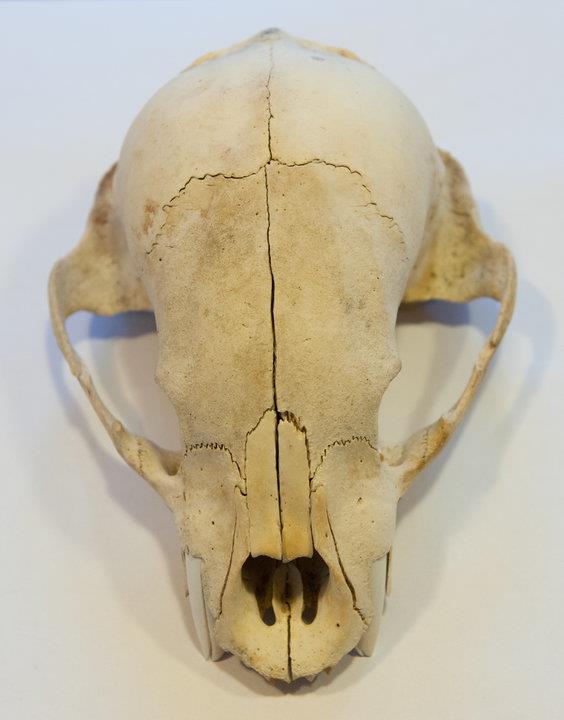
On Friday I gave you a mystery skull from the forests of south Thailand to identify, courtesy of Mark Ribbands via William Vine:
When I first saw this skull I was immediately struck by its similarity to that of a Badger:
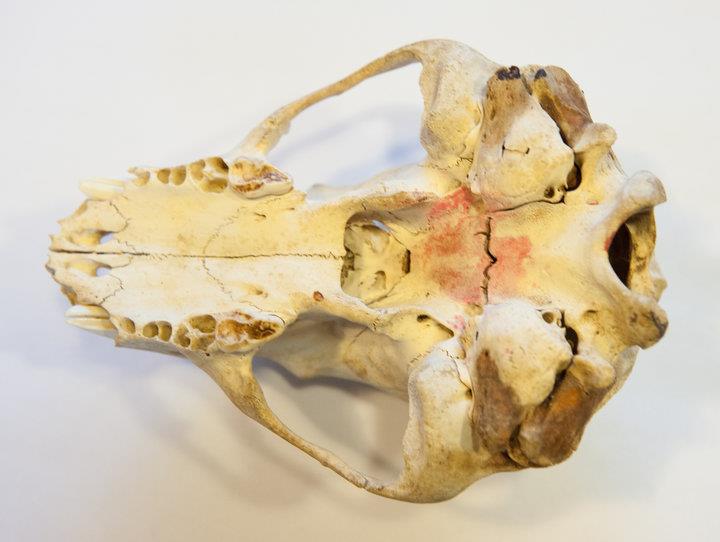
That badger-like quality (which Jake also noticed) got me thinking that it may belong to an Asian Hog Badger, but the skull length is 190mm, which is a bit too big even for a large adult Hog Badger and the unfused sutures, partially erupted canines and short muzzle make it pretty obvious that the skull comes from a very young animal (I talked about the characteristics of juvenile animals in a post a couple of years ago).
Jake recognised that the skull was from a juvenile, as did Wouter van Gestel, who went on to suggest a much larger carnivore, the Malayan Sun Bear. The other possibility would be the Asiatic Black Bear, but without comparable juvenile skulls of both it is hard to be sure which it is, but I’m pretty certain it is the skull of a bear and looking at the shape of the adult bear skulls I think the Sun Bear Helarctos malayanus Horsfield, 1825 is probably the most likely candidate.
Sun Bears are the smallest members of the bear family and are well adapted to climbing, which they do a lot of as they search for the insects, fruit and honey that make up most of their diet. Here’s a video of a Sun Bear cub putting those impressive climbing skills to the test:
Today marks the start of the Chinese Year of the Snake and tomorrow we start the Herpetology phase of our collections review at the Horniman. How very apt!
Here’s a specimen labelled ‘Boa Constrictor’ that came to light while we were preparing for the review that I thought you might like:
Have a very prosperous and healthy Year of the Snake!
This week I have an object for you that came through as an enquiry from Mark Ribbands via William Vine. It’s 190mm long and was found in the forest of South Thailand:
Any idea what it came from? As usual you can leave your suggestions below – I may not be able to respond during the day as I’m at a seminar on Natural Science Collections and the Law, but I’m sure that there will be some interesting discussion about this object from the regulars!
I find the textured surface of a Crocodile skull quite fascinating, even in a small animal like this one:
Check out the indent in the upper jaw for the large tooth in the lower jaw. That’s the easy way to spot the difference between a Crocodile and an Alligator skull.
I thought it might have posed a bit of a challenge, since it’s part of a species of bird that you don’t find in Europe or North America. Of course, I was forgetting the skills of the Zygoma community. Everyone recognised it as the sternum of a bird with weak flight muscles and Wouter van Gestel spotted the species and was supported in his identification by Barbara Powell and Robin.
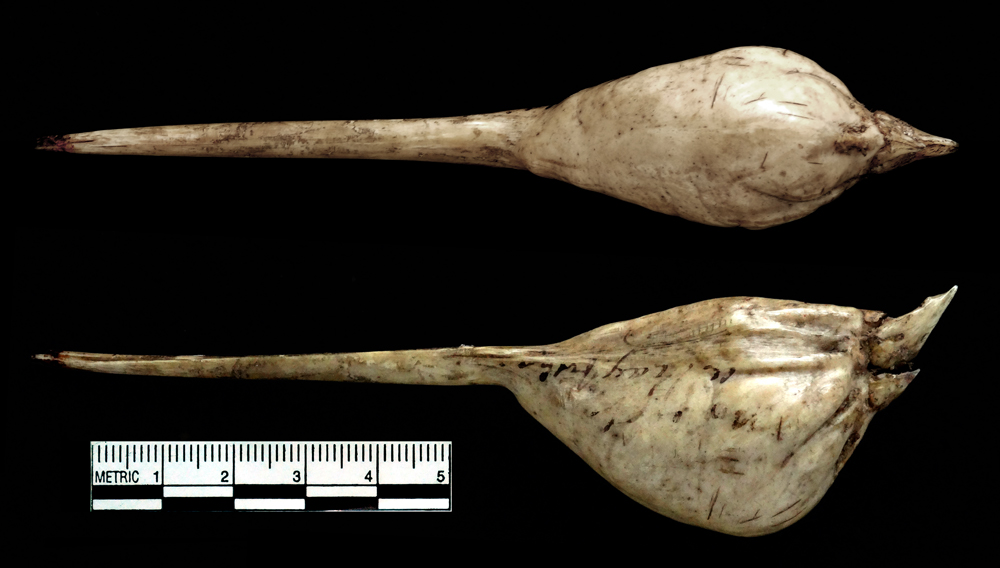
This week I have an interesting mystery object for you. It’s quite characteristic, but not necessarily very familiar, so it may prove a bit of a challenge:
Any idea what this piece of bone is and what it came from? You can put your thoughts below and I’ll do my best to get back to you. Good luck!
On Friday I asked for your help with identifying this object:
There were a few interesting suggestions from beaks to bladders, but so far nothing really corresponds with the structure of this specimen. It’s very weird.
It looks like it’s probably from something aquatic, perhaps the ossified swim bladder of a fish, but I’m by no means sure of that.
I will see if I can read the notes written on the specimen under a UV light, but for now I have to admit that I am still stumped. Please let me know if you recognise what it is!
[N.B. from the discussion and links in the comments below, it emerges that this is the hyperostotic spine from the anal fin of a fish]
Some interesting things have been coming to light in the reviews going on at the Horniman. Here’s an object that our Anthropology review team uncovered and asked me to identify.
It looks a bit like a bird of prey with a gimp mask, but it’s actually a charm from Nigeria.
Fortunately, I’d just gone through our bird skull collection and I immediately recognised this becowled bird skull as being from a Lappet-faced Vulture, so it was an easy identification – particularly since the skull is 18cm long and from Africa, which helped narrow down the possibilities considerably!
Here’s the Anthropology specimen compared directly to our Natural History specimen, so you can see what would be under the leather:
We’re also in the middle of our first collections Bioblitz at the moment, so expect to see a lot of activity on the @HornimanReviews Twitter feed!
I’ve been running my mystery object for over three years now and I’ve decided to add another kind of post in order to share some of the odd and interesting objects that I come across as I work in the collections of the Horniman Museum.
To share these specimens I’ve chosen the name ‘Oddjects’ as a portmanteau of ‘Odd’ and ‘Objects’. Here’s the first:
This happens to be a Wolffish (Anarhichas sp.) specimen that was a mystery object back in 2010, but here I just want to use the specimen to capture the imagination and spark discussion rather than provide much in-depth interpretation.
What does this make you think of?
I hope you enjoy the Oddjects I plan to share – if you do I would heartily recommend also checking out the Twitter and Tumblr feeds for the Horniman’s collections review projects as they also share some great objects.







 Zygoma